
The art of the possible: supporting progression to higher education

Posted on

Encouraging disadvantaged young people to participate in higher education has been a priority for successive governments over the last 20 years.  Often the focus for this work has been on ‘aspiration-raising’ – built on the idea that they have low aspirations for education or their future lives.  We are increasingly understanding that this approach is deeply flawed, as I have explored in two recent articles (one with Richard Waller).

Most importantly, there is no evidence that the aspirations of disadvantaged young people are low.  The evidence for several recent large-scale studies is that they are generally high and that more young people want to go to university than actually do.  There seems little purpose to raising aspirations that are already high.

A possible (selves) solution

In the two papers, I seek to shift the discourse away from aspiration and towards the theory of possible selves – first advanced by Hazel Markus and Paula Nurius in the late 1980s.  The theory has been successful in explaining behavioural change in a range of social settings by encouraging people to think about their lives in the future and develop strategies for meeting their long-term aims.

Crucially, this approach takes account of the importance of the sociocultural context in which the young person is immersed.  It starts from understanding that we all have a pool of possible selves that we can imagine, both positive and negative.  From these, we decide which are desirable and assess which are probable.

However, the selves that we can imagine, and our assessment of them, are forged in the worlds that we inhabit – our communities, the physical spaces we visit, the labour markets of which we are part, the schools in which we study and so on.  Some young people grow up thinking it is likely they will be solicitors or doctors, others hairdressers or bricklayers.  Crucially, this is not about an aspiration, but a simultaneous assessment of what is possible and what is likely in their context.

Markus and Nurius argue our possible selves give us an impetus to act: we are motivated towards becoming ‘like-to-be’ visions of ourselves that are desirable and appear probable – or to avoid those that are undesirable.  The likelihood of achieving a possible self is as important as its desirability: young people may want to be a professional sportsperson, but few expect to do so!

Evidence from the US

The work of Daphna Oyserman has explored how a possible selves approach can work, based on after-school interventions in a disadvantaged area of Detroit.  She has rigorously demonstrated how a focus on helping young people to consider their possible selves has a positive impact on their motivation for school and their educational outcomes – indeed, this impact was found to persist for several years and to act in the absence of parental engagement.

Importantly, this approach is not based on influencing young people to see particular futures valued by adults (e.g. higher education) as desirable, but rather to help them to widen the pool of possible selves they hold in mind, to understand what’s needed to achieve them and to support them in devising their own strategies for meeting (or avoiding) them.  This focus on the individual and their ‘roadmap’ sets it aside from traditional outreach work based on aspiration-raising.

A new framework

Drawing on the theory of possible selves and Oyserman’s work, I have proposed a new framework for devising and delivering outreach work designed to increase the numbers of disadvantaged young people participating in higher education.  The grey arrows denote possible intervention points – these might be spaced over a period of time or clustered within a single extended activity:

Point 1: Activities for young people to learn about adult futures, especially those not familiar within their sociocultural context, thereby adding to the palette of possible selves from which they can choose.  This might include those predicated on higher education, but this would not be emphasised.

Point 2: Focused activities, probably over a period of time, designed to (re)establish a belief in their ability to exercise control over their future and their ability to succeed at tasks that are important to them, sometimes referred to as locus of control and self-efficacy, respectively.  They would emphasise a reflective and metacognitive approach to understanding how they develop their agency, even in the face of challenges.

Point 3: Developmental work to help young people to devise strategies for achieving things that are important to them – their like-to-be selves.  Importantly, this is not about adults dictating ready-made solutions, but facilitating young people to make agentic decisions that are authentic for them and their sociocultural context.  Part of this is likely to involve giving young people the chance to ‘try on’ possible selves through mentoring and work experience programmes.

 Point 4: Experiential opportunities to be exposed to a campus environment, involvement in inspirational experiences, collaboration with current students, information about graduate careers and other opportunities to envisage oneself as a student and/or graduate.  While these activities are more similar to traditional outreach activities, here they are the culmination of earlier work.

More information

This article is intended only to give an outline of how and why the theory of possible selves is likely to be useful for widening participation in higher education – for more information, see:

Author: Neil Harrison

Creating Welcoming Learning Environments: Using Arts-Based Methods with EAL Learners

Posted on

What’s the project about?

Dr Jane Andrews and Dr Maryam Almohammad at the University of the West of England, Bristol have been working on a 12 month research project since September 2017. The project is funded by the Arts and Humanities Research Council who have “translating cultures” as one of their current research themes. The project is a collaboration between teachers, local authority and school staff who specialise in supporting children developing English as an additional language, creative artists and the researchers. Together we are aiming to develop and trial some teaching techniques which combine arts-based methods and supportive techniques for celebrating children’s languages and developing their English language skills. The project is working with school-based staff in both primary and secondary schools. Colleagues who work at Integra, South Gloucestershire (Lois Francis and Dominique Moore) are collaborators on the project.

Why this topic?

The focus for the research comes out of the arts-based methods used in a larger 3-year AHRC-funded research project entitled Researching Multilingually at Borders . In that project researchers from different academic disciplines (global mental health, anthropology, law, modern languages, intercultural communication, education) worked together with creative artists working using drama, poetry, music and textiles. The project explored the role of language in contexts where people experience pain and pressure at times of migration. The sites for the research included the Islamic University Gaza, the Lira district of Uganda, the border state of Arizona, USA, Scotland, the Netherlands, Romania, Bulgaria and Ghana. The current project was funded by the AHRC to extend the reach of the 3-year project to explore how arts-based methods can be combined with work celebrating children’s linguistic diversity and supporting their developing English.

What has the project done so far?

We have developed our way of working which has collaboration firmly at its heart. We have built on the work of Julian Edge who proposed a model of CPD named “co-operative development” which seeks to ensure that all participants are empowered to share their knowledge and expertise while learning with and from others. Using this approach we have offered a series of one day workshops in which participants have i) shared their current approaches to supporting children’s developing English and celebrating their different languages, ii) taken part in a hands-on workshop experiencing one or more creative arts techniques and iii) planned how the techniques experienced could be adapted and transferred into the specific school contexts in which they are working.

In our first workshop, the creative arts inputs have been provided by Katja Frimberger (freelance) who demonstrated drama techniques for use in class including singing in different languages and setting up a “Bristol’s got talent” friendly competition. Katja also shared a film she had made in which students and staff at Glasgow University spoke to camera in their different languages as a way of extending exposure to the institution’s shared languages.

Maryam Almohammad shared the work of the UNHCR with the use of cartoons to convey refugees’ stories:

Film making projects were planned in two schools. One school has audio recorded children and young people making announcements for the school day (for use on the tannoy system) in their own languages other than English.


In our second workshop, Lyn Ma (a lecturer at Clyde College, Glasgow) provided input into how crafting techniques such as collage and model making can be used to provide young people with opportunities to express themselves in ways that they choose to their peers and teachers. In the workshop we as participants created our own decorated suitcases and explained how and why we had chosen to decorate them as we did. Jane Andrew created a suitcase in which she included a map of Somalia and the connection with the Somali community in Bristol.  Jane has not been to Somalia but feels the connection because the Somali community forms a great part  of the British societies.


In our third workshop, Naa Densua Tordzro and Gameli Tordzro (University of Glasgow and Pan Africa Arts, Scotland) introduced participants to using musical instruments in an exploratory way to generate a sense of community. Naa Denua and Gameli also shared with us traditional Adinkra symbols from Ghana whose meanings we learned about and discussed. We then chose symbols we wanted to print using silk screen printing techniques.


Our fourth workshop was on Poetry and the Spoken Word with professor Allison Phipps and poet Tawon Sithole from the University of Glasgow. Allisson and Tawon  did activities which include the use of material object and spoken word through a process of reflection. After reflection and contemplation on objects, teachers wrote a poem about these objects. The whole team got involved in the co-writing of a multilingual poem.


Teachers transformed and contextualized the art-based activities in their school environments according to their students backgrounds, needs and practicality. Then we ran a conference for teachers and school-based staff on “Creativity and EAL” where ideas tried and tested in schools was shared on Thursday 12th July at UWE, Bristol.

How can I learn more and get involved?

There are a range of ways in which you can get involved, contribute and find out more.

  • We have a twitter  where we share our activities and events.
  • We launched a website and we will be uploading video clips from the workshops so visitors to the site can find out more. The website is new and we are planning to add resources for teachers on the use of art in language leaning and teaching.
  • We are planning a book gathering together teaching ideas about how to connect creativity, multilingualism and EAL to be published by Multilingual Matters. Please get in touch if you’d be interested in contributing to our book.

For more information contact the authors.

Authors: Jane Andrews and Maryam Almohammad

Gender, Sexuality, Bodies and Identity Research Conference

Posted on

University of the West of England (UWE) December 4th 2018

The aim of the conference is to bring together leading researchers from the South West of England and guest speakers from the United States in the field of gender, sexuality, bodies and identity. This conference will showcase some of the work of the presenters and the groups, centres and universities they represent. It will offer an opportunity for researchers and scholars to meet and discuss cutting edge theory and knowledge with the intention of promoting research and scholarly connections in the field. A series of 15 minute presentations will be followed by an open question and answer session where members of the audience can further explore research and innovations in the field of gender, sexuality, bodies and identity.  The conference aims to be inter-disciplinary in its focus and hopes to attract academics, researchers, practitioners, and post-graduate students. It will be followed by a showing of the ‘Rape of Recy Taylor’ which is a cutting edge:

‘documentary about a 24-year old black mother and sharecropper who was gang raped by six white men in 1944 Alabama. She spoke up at the time and identified her rapists. The NAACP sent Rosa Parks, their chief investigator (and civil rights activist) to look into the case. Her representation and the community’s rallied support triggered an unprecedented outcry for justice. She spoke up long before the #MeToo movement.’

The day will end with a panel discussion of this film and be followed by a drinks reception offering the potential to meet presenters from the day and other interested professionals, academics and students.

Throughout the day and in breaks, we will be running on video loop the work of Helen Bovill, Kieran McCartan, Richard Waller and UWE Student Inclusivity and the SpeakUp campaign; Finn Mackay’s TEDXtalk on feminism; CAR podcasts.

Abstracts of the presentations will be sent to delegates nearer the time.

Programme

12.00-1.00       Lunch and meet and greet.

1.00-1.15        Dr Helen Bovill Bristol Inter-Disciplinary Group for Education research (BRIDGE)

Dr Kieran McCartan and Dr Finn Mackay Social Science Research Group (SSRG)

Dr Emma Halliwell Centre for Appearance Research Centre (CAR)

5 minutes introduction from each about the relevant work of UWE research groups/centres: BRIDGE SSRG and CAR.

1.15-1.45         Key note speech:  

Dr Victoria Banyard, Professor at Rutgers School of Social

Work.

Dr Sarah McMahon, Associate Professor and Director, Centre on Violence 

Against Women and Children Rutgers School of Social Work, New Jersey.

Building better campus bystanders: Future directions for preventing

gender based violence.

1.45-2.00         Dr Katie Edwards, University of New Hampshir

Working internationally on violence prevention.

2.00-2.15         Dr Helen Bovill, UWE.

Theoretical insights into gender and sexual violence for university students in the UK.

2.15-2.30         Dr Kieran McCartan, UWE.

Perpetrators and sexual violence.

2.30-2.45         Dr Emma Halliwell, UWE.

  Strategies to reduce self-objectification in young women: Interventions in schools and universities.   

2.45-3.00         Dr Finn Mackay, UWE.

Female and Queer Masculinities in a Post-Trans Landscape.

3.00-3.15         Dr Emma Williamson, University of Bristol.

Justice, inequality and gender based violence.

3.15-3.30         Dr Jennifer Thomson, University of Bath.

The continued absence of abortion rights in Northern Ireland.

3.30-3.45         break tea and coffee.

3.45-4.15         Q and A open session with key notes and presenters.

4.15-5.45         Showing of Modern films: ‘Rape of Recy Taylor’.

5.45-6.15         Panel discussion of the film.

6.15-7.00         Drinks reception and networking.

For more information please contact Dr. Helen Bovill or Dr Maryam Almohammad

To register please click here.


Children as Engineers shortlisted for STEM Inspiration Awards

Posted on


Children as Engineers, a collaboration between the UWE Bristol Department of Education and Childhood and Department of Engineering, Design and Mathematics run by Fay Lewis, Juliet Edmonds and Laura Fogg-Rogers, has been shortlisted for an Inspirational STEM Engagement Project Award in the 2018 STEM Inspiration Awards.


Funded by HEFCE, the project paired student engineers and pre-service teachers to undertake engineering design challenges in primary schools. Research shows that children (particularly girls) develop their attitudes towards STEM as a potential career before the age of 11, yet only 5% of primary school teachers have a science related degree. Children as Engineers aimed to improve teachers’ attitudes to science and engineering, leading to a positive impact not only on children’s performance, but also on their engagement and enjoyment.

The project built on previous research  funded by the Engineering Professors’ Council, Institution of Mechanical Engineers and the Institution of Engineering and Technology and supported by Mazak. Children as Engineers also developed a UWE Bristol undergraduate degree module called ‘Engineering and Society’. This pairs engineering students with teachers to bring hands-on science programmes into primary schools, aiming to address science, technology, engineering and mathematics (STEM) skills gaps in primary schools – for teachers and children.

Winners will be announced at the STEM Inspiration Awards celebration event in the House of Lords on 1st November 2018.


Practical steps to build science capital in the classroom

Posted on

How much do you value science?

That will depend on your “science capital”, that is, how much science you’ve been exposed to. Science capital is based on the idea that all of us have differing amounts of cultural beliefs, values, qualification and experiences, which we gather from our families, education and lives, and which shape our values toward careers and social situations.

Many children will have no knowledge of adults who work or have worked in STEM (science, technology, engineering and maths) careers, which may give them less science capital. This can have a significant impact on children’s aspirations as regards STEM careers, and so increasing children’s science capital is vital to broadening their future career choices.

Capital Gains

Juilet Edmonds, Fay Lewis and Laura Fogg-Rogers, from the Science Communication Unit at the University of the West of England (UWE) are hoping to change the status quo and increase children’s science capital through initiatives in schools, but there are also many ways in which you as a teacher can boost your students’ Science Capital:

Invite a Scientist

A survey at a recent children’s conference revealed that children weren’t just interested in what scientists were discovering, but also by their personal experiences of working in science. Therefore, inviting scientists into school via the STEM ambassador network, or simply asking a parent in STEM, and getting them to share what kind of person they are and the key qualities for their job, helps children. Girls in particular need to see themselves as scientists and so inviting in female scientists or mums who are scientists is great. This helps them to identify female role models.

Activities with Real-Life Context

Doing science activities that focus on making the world a better place, have been show to raise children’s interest and improve attitudes towards science. So why not try engineering challenges? – such as the EU ‘Engineer’ project challenges or borrow the Design Process Box free from Dyson.

Or maybe explore aspects of science and scientists that benefit the quality of everyday life, e.g. the grip on training shoes for forces or the work of Professor Margaret Boden on artificial intelligence. Tthe BBC Radio 4 series The Life Scientific is useful for biographies of modern scientists.

A Culture of Science – in School and at Home

Children’s attitudes towards science are partially formed through the culture they experience at home, but some families do not have the money, time or confidence to visit science centres or museums. So it’s important to find accessible ways to get families involved.

You could set homework that involves a parent, like watching a fun but interesting television programme, such as Operation Ouch! (CBBC), related to your science topic. Or organize a weekend science centre outing with children and their families (apply to the PTA to cover the costs)

But it’s not just families, schools and teachers are also thought to influence a child’s attitude to science. Attitudes are not formed overnight, and one-off activities are unlikely to have a long-term impact on children’s attitudes. So it’s critical for schools and teachers to transmit messages about how they value science and promote it in and around the school and embed it in practice.

This can be tricky in primary schools with the dominance of literacy and numeracy in the curriculum, but there are ways to fit science into classwork. Maybe break a subject up and use a bit of English time to record science findings, or, alternatively, maths time to do data analysis.

None of these actions alone will compensate children for low science capital but a consistent programme throughout the school and in class could have a significant effect. Many scientists and engineers still recall a special teacher who got them into science – you could be that teacher!

Authors: Juliet Edmonds, Fay Lewis, and Laura Foggs Rogers.

Accessing the experiences of ‘estranged’ students

Posted on

Since January 2018, we have been exploring the experiences of ‘Estranged Students’ in Higher Education and this week we presented some of the preliminary findings of the project at the BERA conference (11th-13thSept. 2018). We follow this with our conference at the University of Strathclyde (20th Sept. 2018) titled ‘Accessing Higher Education: The Experiences of ‘Estranged Students’ Beyond Entry Point’.

Estrangement as an area of widening participation is rather under-researched, and our BERA paper certainly raised questions of definition, usefulness and ambiguity of the term, as well as the likely heterogeneity of ‘estranged students’.  In conversation with delegates, we probed at University itself as a ‘strange’ place, potentially causing rather than solving, estrangement.

Understandings of the experiences of students who are given statutory recognition for estrangement are rather scarce: can they be understood as a ‘widening participation’ group? Do they self-identify as such? In the Scottish context  only 3 universities have so far have taken the StandAlone pledge  to support people who are estranged from their family. This means that the majority of Universities have not and, as such there is clearly an urgency in bringing knowledge about the experiences of this cohort of students to the fore, informing widening participation officers, policy makers and practitioners, and instigating sector change.

The term ‘estranged students’ has been used by policy makers and support groups to refer to students whose relationships with their biological/adoptive parents and/or wider family have broken down (OFFA, 2017). Estranged students are a non-traditional group of students in Higher Education (HE) and may lead their study career without the financial and emotional support of their close family. But we ask if there is an emerging, rather awkward  individualising tendency to psychologize ‘estrangement’ from family in this context, over-emphasizing the need for therapeutic solutions as ‘working on the self’, rather than structural reform.  The rhetoric and practice of the ‘family’ has itself materialized all sorts of inequalities and violences, and understanding its nature as a social ‘buffer’ is rather complicated.

In England, the status of ‘estrangement’ was first introduced in student funding policy in 1997, alongside other financial changes –sitting alongside the marketization of Higher Education and the increased notion of what constituted a ‘student experience’ . The purpose was to enable estranged students to access financial support independently of their family’s income (Smith & Malcolm, 2008). In Scotland, however, the same status was only recognised in 2016, thus creating an almost 20 year gap between the two countries where the enactment of policy and practices aimed at supporting estranged students are concerned.  What is a ‘student experience’ in the context of ‘estrangement’?

‘Estranged students’ continue to face numerous and specific hardships not only in accessing HE, but also in completing their studies – as with other studies, we aim to complicate the story of ‘getting into’ University, exploring how interviewees’ sit with and resist ‘estrangement’. No doubt,   hardships remain, encompassing not only financial pressure, but also experiences of homelessness, discrimination and mental health problems amongst other issues, during their time at University (Bland, 2015). The scale of these challenges arguably extend beyond understanding of socio-economic struggles, though not enough is known about the intersection, for example, between ‘estrangement’ and other categories of university participation and  (e.g. race, class, gender, sexuality).

Moreover, research on estrangement is extremely limited and mostly pertains to the fields of psychology, social work or communication studies. The only data available to date come from studies commissioned by and for Stand Alone, a charity that supports and raises awareness of the challenges faced by this ‘non-standard’ entry group. In 2016, the Stand Alone Pledge was launched to help HE institutions improve the support they provide to estranged students. The pledge has now been signed by 50 institutions UK wide

Challenges identified in research (see Bland, 2017) relate to economic struggles that often impact on practical issues such as accommodation and affordability of basic goods. Research has also point out that stigmatisation and belonging are key issues estranged students face as part of their identity. The research we conducted so far confirms most of these aspects, but it also unveils a different side to estranged students regarding a very strong sense of personal resilience.

Research by Prof Yvette Taylor; Dr Cristina Costa; Sidonie Ecochard and Claire Goodfellow

If you would like to learn more about this research, why not join us on Thursday on a free event we are hosting on this thematic at the University of Strathclyde (Free registration open here) ?

You can also join the discussion online via the #StrathEstrangement

ABOUT THE AUTHOR /


Cristina is Associate Professor in Digital Education and Society in the Department of Education and Childhood, University of the West of England, Bristol, UK. After completing a degree in Modern Languages and Literatures, Cristina worked as an EFL teacher in the Portuguese Navy. During that period she developed an interest in Learning Technologies and completed an MPhil in Educational Technologies at the University of Lisbon, Portugal. In 2007 she moved to the UK to take up a post in the field of Learning and Research Technologies at the University of Salford. In February 2013 she completed her PhD study on The participatory web in the context of academic research: landscapes of change and conflicts. From March 2013 to March 2018 she worked as a Lecturer in Digital Education at the University of Strathclyde. She was named Learning Technologist of the Year 2010 by the Association for Learning Technology (ALT).

This article was firstly published in the Social Theory Applied website.


Vunja Kimya’ or breaking the silence on gender based violence for university students

Posted on

Violence prevention in a Global and Multi-cultural context: UK, US and Kenya perspectives.

Sexual violence has been in the spotlight with dramatic coverage of the abuse of young people in sports settings and institutional care. The prominence and ubiquity of sexual assault, harassment and inequality has been highlighted in global movements and campaigns such as: The Everyday Sexism Project, #MeToo,  and Time’s Up. This widespread social problem has been uncovered in all aspects of society and has caught in its spotlight prominent politicians, movie stars and celebrities, athletes, and members of religious organisations. The Sustainable Development Goals demonstrate a global agreement that gender based violence is unacceptable, however there is inconsistency and a lack of consensus on how to move forwards.

Universities are a microcosm grappling with their own responses to this widespread social problem. A 2018 UK student led survey of 4,500 students from 153 different UK universities found 62% of students had experienced sexual violence at university . In the US the National Crime Victimization Survey which interviews tens of thousands of Americans annually found that ‘sexual violence is more prevalent at college, compared to other crimes. The Royal Commonwealth Society, a champion of human rights, democracy and sustainable development identify a research gap on sexual violence in Kenyan universities with sexual violence, ‘understudied, unreported and unpunished’.

In July 2018 a group of international researchers from the UK, US and Kenya came together in a joint symposium to discuss and debate some of these issues in the International Family Violence and Child Victimization Research Conference. They talked about some of the respective problems of sexual violence in the countries in which they work and live. In essence this symposium considered the extent to which ‘time has run out on sexual assault, harassment and inequality, and what is being done about it’ part of the calling card of the Time’s Up movement.

Julia Kagunda University of New Hampshire and Catherine Bikeri Independent Consultant, Doctors Without Borders presented on sexual and partner violence (SPV) in Kenya universities. They noted that SPV is closely linked to other problematic health behaviours such as alcohol and drug use and reproductive health issues (e.g. HIV, unwanted pregnancy). Their paper discussed an outreach program implemented in 12 public and private universities in Kenya. This program identifies and trains popular opinion leaders (POLs) to promote positive health behaviours. They talked particularly about a promising aspect – Vunja Kimya Campus Project (VKCP) which explored ways in which the silence around SPV could be broken. juliakagunda@gmail.com cathybikeri83@gmail.com

Katie Edwards from University of New Hampshire has been working with Julia and Catherine on this project in a collaborative manner to work toward evaluation of its effectiveness. Katie.Edwards@unh.edu

Helen Bovill from the University of the West of England (UWE) in the UK discussed the development of bystander intervention in the university. She drew particular attention to the everyday normalisation of some aspects of sexual violence such as unwanted sexual touching. She discussed how this was being constructed as a subtle, everyday form of abusive behaviour so that it becomes an accepted micro-aggression. Her paper highlighted how some women changed their behaviours to accommodate male violence and this, alongside a climate of fear, could have consequences of limiting rather than enabling female agency. Helen2.bovill@uwe.ac.uk

Sarah McMahon from Rutgers University presented information about working with diverse ethnic and racial samples of students to understand the impact of exposure to sexual violence prevention messages. She discussed the findings from a study that explored the impact of exposure to these messages throughout middle school, high school, and college and found that the greater the exposure, the more likely students were to report a willingness to step in as helpful bystanders when witnessing situations related to sexual violence. smcmahon@ssw.rutgers.edu

Victoria Banyard from Rutgers University (formally and at time of presentation from University of New Hampshire) presented on bystander action among middle and high school populations in a community in the western plains of the U.S. with a diverse population, including 20% Native American. Findings discussed were students reported varying levels of opportunity to intervene, with opportunities to intervene in more severe instances of sexual violence less frequent than in lower level instances. This has an impact on the types of actions they were willing to take. victoria.banyard@rutgers.edu

This conference has afforded time, space and opportunities for researchers in the field of sexual violence to meet and share current work and practice.  The wider aim is that the work we are doing has a more widespread impact both within and beyond our own institutions and communities; to potentially have local, national and global effect and to break the silence regarding sexual violence. Helen Bovill, Victoria Banyard, Sarah McMahon and Katie Edwards will be continuing this conversation at a further symposium in the Uk, The Society for Research into Higher Education (SRHE) Conference 2018 taking place December 5-7 at Celtic Manor, Newport Wales.


Dr. Helen Bovill, Associate Head of the Department of Education and Childhood Research

My Viva experience: Yes, I actually enjoyed it…

Posted on


I am the mother of three small children and a research fellow based in the North West of England. My funded PhD was with UWE Bristol and explored the experiences of former apprentices in higher education. My amazing supervisory team was Professor Richard Waller and Associate Professor Neil Harrison.

Like many, my PhD journey hasn’t been easy, and there have been several literal ‘bumps’ in the road to becoming a Dr. On many occasions, I wasn’t sure I had the emotional or intellectual strength even to make it to the viva. One long-lasting memory is the guilty feelings – that I wasn’t giving my PhD enough time, that I wasn’t giving my children enough time and for my long-suffering husband.

After five and a half years (including two years of maternity) I managed to submit but I was fearful that my thesis was not good enough. For nearly two months I ignored the viva though it was looming large!! A breakthrough for me was an invaluable practice viva which gave me the chance to discuss my research in a manner like the actual viva but in more relaxed circumstances. My tip to other people approaching this stage would be to organise a practice viva with their supervisory team. Recording this practice was also really useful. I listened and re-listened to this recording, taking the time to think through the type of questions I may be asked and what my response would be. My supervisors also reminded me that examiners want to pass PhDs but must be assured of the standard and rigour.

My viva preparation consisted of re-reading my thesis and some recent papers. After not looking at it for two months I was able to bear rereading what I had written. I made notes on things like my contribution to scholarship, original aspects and the choices I had made. While I couldn’t predict what questions would come up, the practice viva discussions gave me some confidence in where the focus might lie. On the day of the viva I was extremely nervous, which I feel is only natural given its symbolic and real importance. Once I got into my stride though, the viva felt more informal than I had imagined.  My examiners were open, even friendly, and made the point that the viva should be a peer-to-peer conversation about my work. My recollection of the questions I was asked is quite hazy, but I do remember they were asked in a manner which gave me a chance to explore my thinking. I was able to talk about some of the nuances and ethical aspects of the study that supported and extended what I had written in the thesis. I really enjoyed discussing my work in this manner and revealing some of the problematic dimensions of the study. While my examiners may not always have agreed with me, I felt confident that I had defended my position with care and reflexivity. Probably the most challenging question was one regarding my theoretical framework, which did not surprise me, as I was aware I had drawn on an unusual framework and had prepared for such questions.

I was humbled to receive only minor corrections which I saw as an opportunity to enhance the thesis. I also received some positive feedback from the examiners which left me feeling elated and excited about where I may take my work.

Author: Alison Rouncefield-Swales has recently finished her Phd at the Department of Education and Childhood, the University of the West of England. She worked with Dr Richard Waller and Dr Neil Harrison.

You can read more about Ali’s research here.

Email: Alison2.Rouncefield-Swales@live.uwe.ac.uk

Twitter: @alirouncefield

Hidden Students: Former apprentices within higher education (HE) and the impact of occupational role models

Posted on

Over the past decade, apprenticeship policy has changed dramatically; with an increase in participation and an expansion in opportunities at Level 3 and above. There has also been a growing interest in whether apprenticeships offer progression to HE. Yet, despite around 35,000 former apprentices progressing to HE between 2006-07 and 2012-13, their voices are largely overlooked.

An innovative methodology? The role and influence of networks

This study explored the experiences of former apprentices who were studying in HE using narrative, longitudinal methods. The resulting case studies focused on former apprentices while drawing on multiple perspectives from their personal and work networks. The challenge was to balance a focus on the former apprentices with an interweaving of their networks to give an insight into complexities, tensions and contradictions. The networks comprised friends and family, alongside newer associates such as HE tutors or work managers. Thinking of networks in malleable forms, as people join and others exit, helps to appreciate their changing influence within someone’s life. This approach has furthered the understanding of the former apprentices’ lives through different viewpoints and broader insights.

One case study – Jamie Whitefield (all names are pseudonyms)

Diagram of Jamie’s most influential networks

 Jamie left school at 16 and bounced between unemployment and low skilled employment before he stumbled into a Bricklaying Apprenticeship which he then used to enter an Architectural Technician degree. Jamie is a first generation HE student, and his father is an electrician and his mother a teaching assistant. While there was a shared work ethic, education is viewed as a means to enter work.

One of his Apprenticeship placements was for an artisan builder whose progressive approach was highly influential. This work led to Jamie developing pride in his craftsmanship, with respect from his colleagues restoring his confidence. When the physical demands of the job took their toll Jamie began to contemplate a different future:

Some days it would be a rainy day, and you’d be in a trench, covered in mud and laying soggy concrete blocks and I would just think. When two people would walk past the site in their suit or whatever and I would just imagine myself in another life, you know.

While Jamie’s network was absent from his early decision-making his sister, along with others, were influential in his decision to progress to HE. Being at university also broadened his network, for example, he struck up a friendship with Shaun (a course technician) who was impressed by Jamie’s industry knowledge and hard work:

[Jamie] just worked, he never stopped working. He knew that this was his big shot at getting out of, you know, climbing the social strata, not being that guy anymore.


Jamie’s occupational identity underpinned his learning, and he was most engaged when his past experiences were utilised. Despite some difficult aspects he valued the opportunity to use his knowledge and was motivated by the high expectations of his tutors:

I don’t think I go unnoticed; I get like As in design projects… I think our tutors do recognise that I’ve got, that I’ve produced work that a builder could interpret and they expect that from me, knowing that I’ve got the experience that I’ve got.

Jamie’s previous fragmented learning and work experience made him acutely aware of where he may end up if he failed in his degree. This heightened sense of risk fuelled his motivation and led him to draw on the resources of those around him when he needed support. His account of HE reflects a transformation and a balance, between investing in a new improved identity and holding on to a cohesive self:

I used to be a different person; I’ve done a lot of growing up… I had some quite ignorant views… I wasn’t right, I wasn’t a positive person, but your eyes are opened as you learn more… I mean, I was that person who said I couldn’t do it, and part of me, until I did it, a lot of me wasn’t sure I could do it, whether I could come to uni.

Due to Jamie’s determination and his willingness to accept the support of his network he graduated with an Upper Second-Class Honours degree and several job offers.

What can we learn from this work?

The narratives explored here provide insight into the socially and occupationally embedded nature of educational participation which is rooted within family, friendship and peer networks. The networks draw into view the shared attitudes and dispositions about education and learning, such as the value placed on education and employment choices. For example, occupational role models encountered during the apprenticeships were powerful influencers on trajectories to HE. While some of this data can be unpicked from individual narratives, the richness of networks of data helps to set individual behaviour within a broader context. The case studies for the overall study were reflective of the diversity and complexity of apprenticeship progression to HE, both due to the variety of qualifications and the nature of provision. Furthermore, they draw attention to the pathologising of apprentices as deficient, without the ‘proper’ educational background, or lacking aspiration. The stories in this research, instead give insight into how they become effective HE students. The impact of role models was an important factor in this.

Author: Alison Rouncefield-Swales has recently finished her Phd at the Department of Education and Childhood, the University of the West of England. She worked with Dr Richard Waller and Dr Neil Harrison.

Email: Alison2.Rouncefield-Swales@live.uwe.ac.uk

Twitter: @alirouncefield


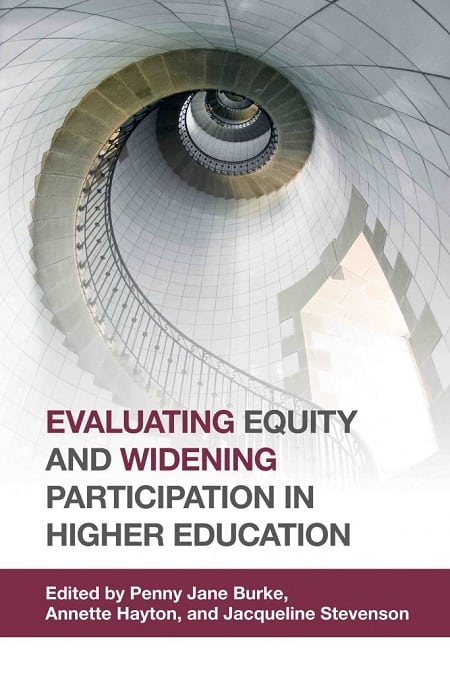
Book Launch: Evaluating Equity & Widening Participation in Higher Education

Posted on


Book Launch 

Evaluating Equity & Widening Participation in Higher Education

18 September 2018 from 4.30 – 6.00

University of Bath in London, 83 Pall Mall, London SW1Y 5ES

You are warmly invited to the launch of ‘Evaluating Equity & Widening Participation in Higher Education’ Edited by: Penny-Jane Burke, Annette Hayton and Jacqueline Stevenson. Published by: Trentham, London, 2018.

Book contributors: Matt Lumb, Catherine Dilnot, Vikki Boliver, Claire Callender, Heidi Safia Mirza,

Nicola Ingram, Jessica Abrahams, Ann-Marie Bathmaker.

‘Thank goodness! A book that moves us beyond what works to what matters in evaluating equity in higher education.

— Trevor Gale, Professor of Education Policy and Social Justice, University of Glasgow

This rich collection shows it is possible to combine rigorous evaluation with critical research and also advocacy and progressive practice.’

— Peter Scott, Professor of Higher Education Studies at the UCL Institute of Education

Speakers

Rae Tooth, Head of Strategy and Change at the UK’s Office for Students

Dr Sarah O’Shea, Associate Professor in Adult, Vocational and Higher Education University of Wollongong, Australia

Dr Richard Waller, Associate Professor of the Sociology of Education at the University of the West of England.

Registration

The launch is free to attend and open to all, and will be followed by a reception.

Our publishers,Trentham Books, IOE, will be at the book lauch and discounted copies of the book

will be available for sale or order.

To book please email: nerupi@bath.ac.uk

Speaker biographies

Dr Sarah O’Shea is an Associate Professor in Adult, Vocational and Higher Education in the School of Education, University of Wollongong, Australia. Sarah has over 20 years’ experience teaching in universities as well as the vocational and Adult Education sector, she has also published widely on issues related to educational access and equity. In 2016, Sarah was awarded an Australian Research Council Discovery project exploring the persistence and retention of university students across Australia, UK and Ireland. Sarah works within a qualitative framework and has drawn upon narrative inquiry and grounded theory in her research activities.

Rae Tooth is Head of Strategy and Change at the UK’s Office for Students, and prior to that in the same role for the Office for Fair Access (OFFA). In her role she collaborates with the sector to identify what research is needed to best enhance policy and guidance on good practice, and commissions research to support policy development and the broader understanding of widening participation and fair access. Rachael also worked on secondment for the University of Warwick in the Strategy and Change team over a five month period, and for the Higher Education Funding Council for England working directly with institutions before moving into more policy focused roles.

Dr Richard Waller is Associate Professor of the Sociology of Education at the University of the West of England. He has worked for the National Union of Students, the civil service, and, extensively, in both Further and Higher Education including undertaking widening participation work for the University of Bristol. His research focuses on WP, he was a founder member of the western WP research cluster, he is on the editorial board of four journals, and a trustee of the British Sociological Association, for whom he has previously been Education Study Group convenor and conference stream co-ordinator

Follow this blog

Get every new post delivered right to your inbox.