

Reading for pleasure, public libraries, and voices at the margins

Posted on

By Dr Anish Harrison and Professor Alpesh Maisuria

In November 2025, we submitted written evidence to the House of Commons Education Select Committee inquiry into “Reading for Pleasure”. The inquiry comes at a critical time with national data showing that children’s enjoyment of reading is now at its lowest level since records began in 2005 (NLT, 2025).

The Committee’s review sits alongside the Government’s announcement of 2026 as the National Year of Reading, led by the Department for Education and the National Literacy Trust. Framed as a chance to “kickstart a reading revolution”, the initiative recognises that reading for pleasure matters, not only for attainment, but for wellbeing, confidence and personal satisfaction. However, unless we listen to the experiences of children and families who are least engaged in reading, these ambitions risk falling short of being realised.

From thesis to Select Committee evidence

Our submission draws on doctoral research by Dr Anish Harrison, Voices at the margins: An exploration of the perceptions of ‘vulnerable’ children, their families’ and library professionals regarding reading for pleasure and public libraries. This was Anish’s EdD submission, taking a case-study approach and framed from a critical ecological perspective.  

The research explores how children and families from different demographics, including Children Looked After, children from diverse backgrounds and those in areas of high deprivation experience reading for pleasure.  It also examines the role of public libraries within this context, critically exploring its socio-historical formation and current situation that includes being a critical mechanism for reading to take place.

The study worked with children, parents and library professionals, including early years children, primary-aged readers, and young people in care. The data generated clearly highlighted that reading for pleasure is not an individualised, uniform, and silent activity. It is social, playful, emotional and deeply shaped by environment and opportunities.

One child put it simply:

“I like reading… I just want a book that I like, like comics and that …  not boring old smelly books.”

Their words challenge narrow ideas of what counts as reading, and whose preferences are valued.

Real world reading for pleasure

Across the research, children described enjoyment when they had choice and agency, but in the context of several factors: choosing and having access to a range of materials, reading with others, having inviting spaces to read and engaging with texts that reflected their interests and identities. Reading often happened alongside play, including Lego world-building, role play, and digital media.

The research found that public libraries played a crucial role in making this possible. For many families, they provided a free, welcoming “third space” beyond home and school, where reading was not assessed, timed, or in any way pressured – simply joyful. Libraries enabled shared reading, supported parents who lacked confidence, and gave children access to a wider range of books and formats than were available at home. 

An ecological model was created through the data, which reflected children’s reading for pleasure needs:

However, significant barriers were also identified. Parents spoke about time-poverty, long-working hours, and uncertainty about how to support reading. Some assumed reading was ‘something [that the] school does’ but at the same time, participants noted that school practices undermined enjoyment. For older children, reading was associated with pressure rather than pleasure.

Importantly, structural inequalities were present in what was seen as ‘legitimate reading’. These barriers prohibited the growth of children’s identity as readers, creating significant barriers to enjoying reading for pleasure.

Libraries under pressure

At the same time as reading for pleasure declining, public libraries have faced sustained budgetary cuts. Reduced opening hours, loss of professional staff, and fewer children’s activities have made access increasingly uneven. Library staff told us of high demand for story times and reading-related events, but diminishing capacity to deliver them.

Despite this, public libraries remain places of belonging. When these spaces were informal, well-designed and social, families felt welcome and reading for pleasure flourished. Conversely, where they were large, formal, or understaffed, some participants in the study felt excluded by the coldness.

Why reading for pleasure matters now

The evidence is clear: reading for pleasure supports who children grow as human beings. In the research, it created joy, connection, self-understanding, meaning-making, and confidence in lives shaped by scarcity and pressure. The opportunity to submit to the Education Select Committee was timely and ensured the thesis could have the potential for real-world impact. 

Our evidence-informed submission to the Select Committee makes five key recommendations:

  1. sustained investment in public libraries;
  2. recognising libraries as strategic partners in literacy policy;
  3. actively promoting library services during the National Year of Reading;
  4. adopting minimum service standards; and
  5. broadening definitions of reading for pleasure to reflect children’s reading realities.

If the National Year of Reading is to succeed, it must start by listening to voices at the margins. Public libraries are not a nostalgic extra, they are essential infrastructures for equity, enjoyment, and flourishing.

Did you know you can change a life? Changing a life is easy.

Posted on

Changing a life is easy.

Start by watching this short film.


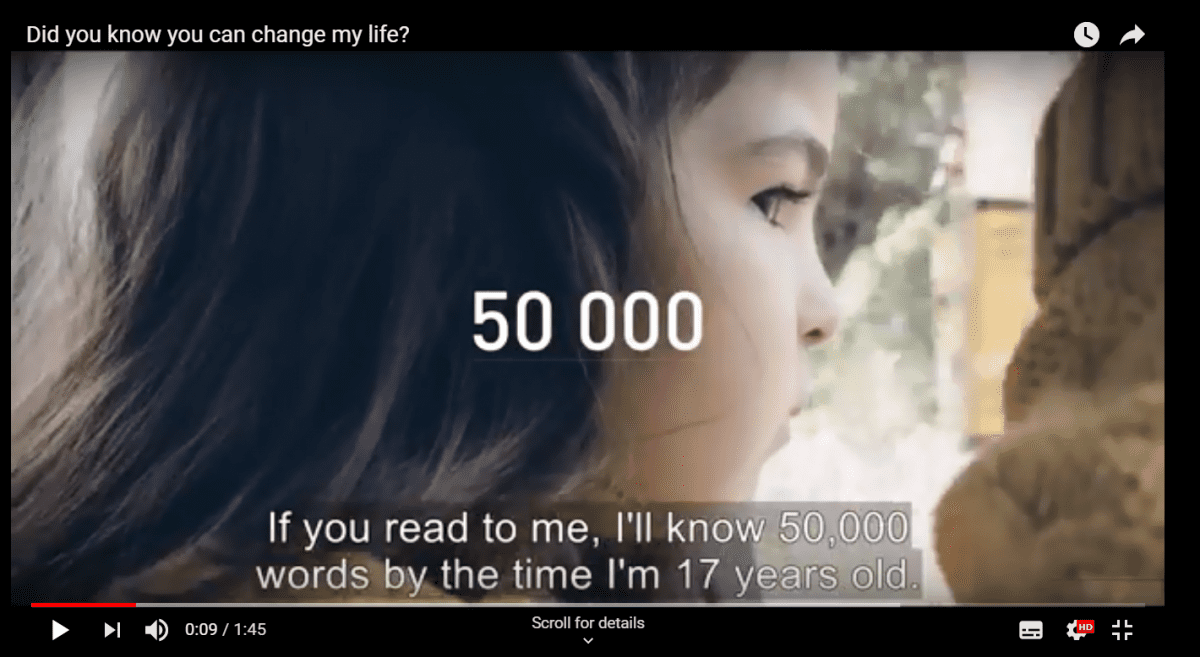
Changing a life is as simple as sharing a book with a child. This is the message that has engaged and enthused  a team of librarians, academics, family workers and local authority education specialists from across five European cities who are part of the Erasmus Plus project ‘Open the Door for Reading’

There is a growing body of research that provides the evidence about the benefits of reading aloud to a child: whether you are a parent, caregiver, teacher or from a whole host of professions working with children and families.  The research by Shahaeiana et al (2018) offers a comprehensive overview of the benefits,

Results indicated that early shared reading was associated with children’s academic achievement directly and indirectly through receptive vocabulary and early academic skills. Also, the frequency of early shared reading predicted the outcome measures, over and above other home learning activities. Associations were stronger among low and middle socioeconomic status groups compared to the high socioeconomic status group. We conclude that shared reading offers unique opportunities for adults to teach young children new words and concepts

Gothenburg, in Sweden had for some time been troubled by the apparent decline in caregivers reading to and with children, and the city embarked on an initiative to promote reading – to be “The City Where We Read for our Children”. Their research had suggested that only four in ten parents read with or to their child.

To develop the project further Gothenburg applied for Erasmus Plus funding for the ‘Open the Door for Reading’ Project launched with cities that had a similar focus: Turku in Finland; Brussels in Belgium; Milan in Italy and Bristol. Each city faces particular challenges and has similar issues with families who have traditionally been harder to engage in education or social services.  Details of the project can be found on the website. The cities have met three times now and have learnt from the practice in each country. Exciting ideas like cloakroom libraries in Gothenburg; bedtime story book shelves in early years settings in Turku and using UWE teacher training students to read with children in Bristol have ignited the imaginations of participants. Gothenburg also shared the short film linked at the start of this piece. It was produced to promote reading to caregivers. It is a powerful reminder of the impact of reading for both the child and the caregiver.

The Bristol team, Debbie Miles and Cerys Stevens (Reading Recovery Teacher Leaders), Kate Murray (Head of Libraries) and Jane Carter have been working on the projects’ output: a practitioners’ guide to supporting caregivers with reading. This guide is full of practical ideas and tips for non-education focused professionals in ways to encourage first steps in communication around a text. It is hoped that midwives, social workers, family workers and early years professionals will become ambassadors for reading in the knowledge of its life changing effects.

The team is also now trying to gather support for a Gothenburg style initiative in Bristol and has begun to plan ‘Bristol, a reading city’. The city’s councillors are interested in the project as are many stake holders who attended a first meeting a few weeks ago to plan possible first steps in the project. Representatives came from local businesses, charities, city council services (Early Years; Family Support), the museum, libraries and schools. We are currently exploring funding avenues and hope to establish the first Bristol Cloakroom libraries along with community reading ambassadors. I am planning for UWE students to be involved in this exciting initial step and with the ‘Bristol a Reading City’ when funding is secured. Watch this space!

Author: Dr Jane Carter, Senior Lecturer at the Department of Education and Childhood, the University of the West of England.


Jamie, joy and learning to read

Posted on


You may have heard the expression “never work with children or animals” and having been a primary school teacher and now a lecturer in Primary Education I have always felt that this is rather an unfair maxim. From my experience, it is often children that offer a more insightful view of the world we have created rather than the adults who created it. Children are able to reflect on the world from their unique vantage point, unburdened by big picture pressures of the big ‘p’ and small ‘p’ politics of daily life: the politics of party political education policy and its ramifications in schools and classrooms.  However, working with children does offer an element of unpredictability, surprise and unplanned for diversions – and perhaps this is what the expression is hinting at. As a researcher at UWE Bristol, these are the qualities that make researching with children so powerful and engaging.

I have just completed my Doctoral studies researching the Year 1 Phonics Screening Check and drawing on the voices of teachers and children to evaluate the Check in its widest sense. Kushner identified evaluation as a social service and the data that it generates as representing “the people – their hopes, fears, aspirations and failures.” Children, in their open and generous responses provided just this and so giving a momentary insight into the world of children aged 5 and 6, in Year 1.

One child, let’s call him Jamie, left a particular impression. The struggle to become a reader was etched on his face and clearly, reading was a real challenge. In fact when introducing the research to the children and asking if they were happy to be part of it, he immediately volunteered “I’m no good at reading, it’s really hard,” suggesting he was therefore not suitable to be part of such a research study. Jamie repeated through the session that the only way to get better was to practice – every day. His ideas of perseverance and practice seemed to be, in part, repeated tropes from teachers and parents. He offered this as the way to learn to read but without any joy or delight in the process or even a sense of any satisfaction in the final destination. Jamie knew reading was important: he made this clear – he mentioned the need to read as an adult, to get a job, to find your way “around London” as he put it. Jamie seemed to have internalised a fear of not being able to read and a keen knowledge that his friends could. Jamie expressed how he was not as good as others at reading and his face seemed to express how tired he was by this constant ‘practice’ that he seemed to suggest was his ‘lot’ for some time to come. Jamie, whilst being only six was no longer a primary school child but, as described by his teachers, ‘a student’ ripe for intervention. How is it that this term ‘student’ has come to be used with reference to all school aged children where once it was only used to identify learners at University? Have we lost the fact that Jamie is a child and that he won’t recapture these years as a child at primary school?

Jamie expressed an almost treadmill approach to developing as a reader – learning sounds; being tested on sounds; reading allocated books; moving through the book levels until one day in the future moving to that enviable position of being a free reader. Each step will be marked out by daily practice. Not only that, but Jamie expressed what seemed to be an ‘obstacle race’ view of the process – adults putting unnecessary additional hurdles in the way of the drudgery. “We have to read alien words,” he said – words that don’t make sense to children “only aliens”.  Lucy piped up at this point to correct him:

“Miss Honey said that, um they are just to help you with your sounds they are not for any other use they just help with sounds – um, a bit of a waste of time.”

These children are taught by fabulous teachers who inspire and enthuse their classes and there were many children that reflected this as part of my research. It is the voice of Jamie though that is the voice that sticks with me. In the introduction I talked about the warning that you should “never work with children or animals” and Jamie is perhaps one of those children, not because he is difficult or disruptive but because of the uncomfortable truths he expresses. Yes, we do want to teach Jamie to read and for some children, like Jamie, it won’t always be easy. However we do need to learn how best to make this a joyful process and one that doesn’t become so focused on the mechanics of practice that we lose sight of the child ‘in the student’.

Jane Carter ,Senior Lecturer in Primary Education

Back to top

Follow this blog

Get every new post delivered right to your inbox.