

By Ronnie Houselander Cook
Throughout my EdD, I have often felt that my work sits between different worlds. I have moved between different expectations, roles and ways of working, and this has sometimes made me wonder which room my work belongs in. However, through the unwavering support of my supervisors, Dr Tim Clark and Professor Jane Andrews, and the wider ECRG community, I have been able to depart from convention and embrace hybridity. This has mattered deeply because my creative practice has become a way to represent not only my research but also myself. Through zines and zineing, I have been able to remain in that in-between position, rather than feel pressured to make my work fit neatly into one space.
What is a zine?
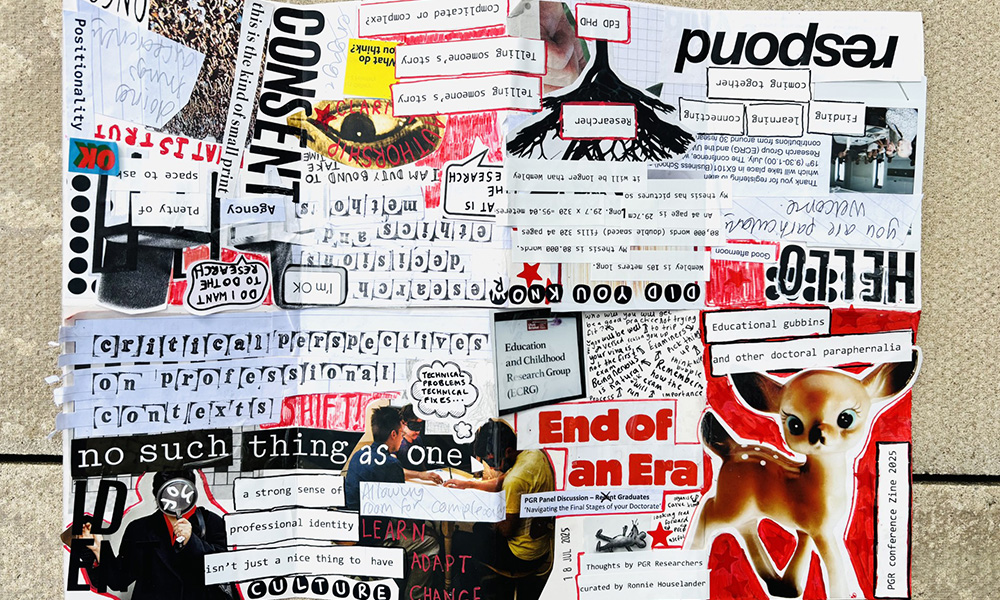
A zine can be understood as a self-published, often handmade publication, frequently characterised by a cut-and-stick aesthetic [main image – Figure 1 and Figure 2]. Zines have long histories in DIY, activist, feminist, queer and subcultural communities, where they have been used to share ideas, circulate stories and create space for voices that might sit outside more formal publishing structures (Duncombe, 1997).

Zines first existed in my life outside of research. They were things I read for pleasure, bought, traded with friends, or picked up from sellers at comic book fairs. So, when I began working with zines in my doctoral project, I did not initially approach them as a formal method. Their value seemed to come from the opposite of what I thought research was supposed to be. Zines offer a space where humour, secret-telling, oversharing, mess and contradiction are not problems to be corrected, but part of the joy.
In my research, I have used zines throughout every stage of my project. I have used them to invite participants into my project, to collect their responses to my research provocations, and perhaps more unusually, to keep my supervisors informed of my progress. I have done this by sending zines in the post, and this circle of exchange has been central to forging relationships and establishing a connection to my methods and wider practice.
On the surface, a zine and a doctoral thesis might appear as different publications, but I have come to understand them as sharing important qualities [Figure 3]. Both respond to context, hold the maker’s voice and make space for special interests. Of course, the differences matter too, and not just in terms of page numbers, but noticing their similarities has helped me understand zineing not as something outside research, but as a practice that can sit alongside and within it.

I use the term zineing to describe the practice of making a zine (Jones, 2024; Wong, Mishra, Quyoum, 2026). This distinction matters because it shifts attention away from zines as finished objects and towards what happens through the act of making.
In more conventional research writing, there can be pressure to know what we mean before we write it. But research is full of ideas that circulate before they settle: uncertain thoughts, unfinished connections, feelings, doubts and half-formed questions. I believe these moments can hold just as much value as the ideas we eventually decide to keep.
This is where zineing becomes significant. Zineing welcomes ambiguity and recognises that meaning and understanding unfold through process. Cutting, folding, arranging, layering, and obscuring can become ways of thinking. The page becomes a space where ideas can be tested, placed beside one another, interrupted or reconfigured. Zineing can offer an invitation into writing or visualising without the pressure of commitment.
Zineing can be particularly valuable for researchers working with complex, personal or practice-based material because not everything we know arrives in a linear sequence. Some forms of knowledge are felt, embodied, visual, relational or difficult to name. Because of this, zineing can offer a way of staying with those forms of knowing without forcing them too quickly into conventional academic shape.

Below are a few provocations to help you try making a zine in your own practice.
- What images, words or materials are already around you?
- What would happen if you only had eight pages for your literature review? What would you take forward?
- Include a quote, image or object that keeps returning to you.
- Write a note to your future self.
In this blog, I draw from my EdD thesis, All bugs are insects, but not all insects are bugs: Making meaning while zineing as an artist-teacher in further education, due to be completed in May 2027.
References
- Duncombe, S. (1997) Notes from Underground: Zines and the Politics of Alternative Culture. London and New York: Verso.
- Jones, D.P. (2024) ‘Anti-frontiers in zineing: Zines as process & the politics of refusal’, GeoHumanities, 10(2), pp. 407–422.
- Wong, M., Mishra, A. and Quyoum, A. (2026) ‘Zine-ing research otherwise: care, joy, and creative co-design with racially marginalised communities’, Bristol University Press, Early View, pp. 1–34.
