Project Zulu pedagogy conference and workshops – August 2026

Posted on

Photo credit: Darcey Baker

By Nick Latham, Senior Lecturer in Initial Teacher Education

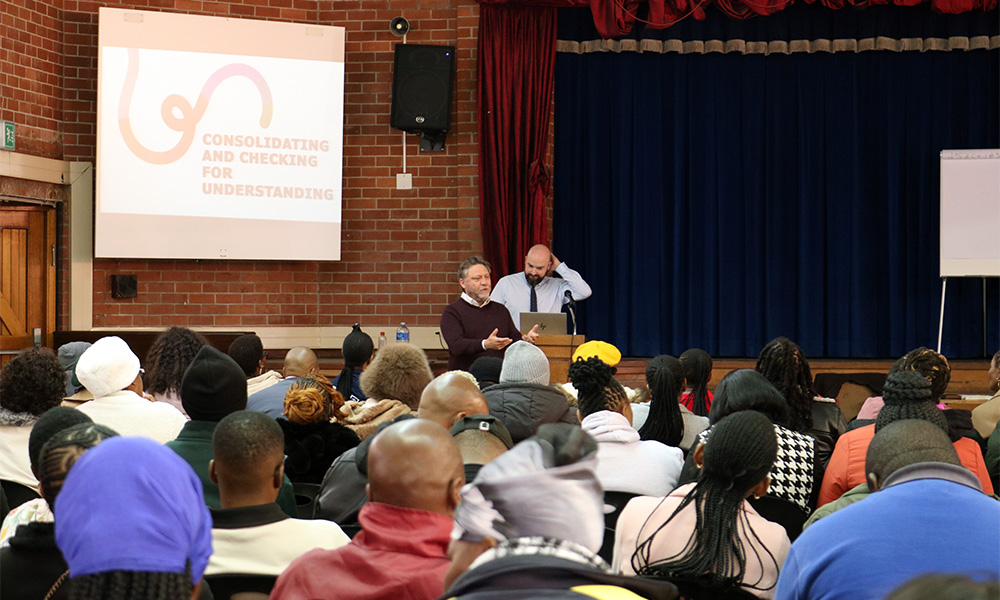
Do you ever get that feeling in an airport where you’re trying to find out which flight on the screen is yours? You’re staring at the screen and there’s an announcement about looking after your bags, the café nearby has had a large and excited group (probably on a hen do) arrive and your phone has decided that now is the time that it wants to run an update as you check the time? No? Well, I certainly did when leaving Johannesburg airport after delivering sessions to teachers in KwaZulu Natal Province, ironically about the very thing I had just experienced: cognitive overload.

I have experienced cognitive overload both as a student and a teacher (and now at OR Tambo airport) as I’m sure we all have. This meant delivering these sessions to keen (if a little chilly – it’s winter in South Africa) teachers from schools in Madadeni Township with awareness of their cognitive load and not bombarding them with too much information too quickly. Like most teaching in education, teaching such a subject can get very self-referential; you are constantly aware that you should be doing the thing you are teaching whilst teaching it. Facilitating the cognitive load of the learners in our session was at the forefront of our minds when planning this session and it went down well according to the feedback we received both informally in the session and via our reflection forms.

The main content of these sessions focused on ways to reduce the cognitive load of students during the teaching of new material. We had structured the sessions in a way that we were introducing strategies in the order that they would be in lessons. We began with recall strategies and effectively activating students’ prior knowledge to prepare them for their new learning today. In South Africa, this is referred to as ‘from the known to the unknown’ (a phrase that many of the educators joined in with when we said it – clearly a popular one). We then focused on the gradual release model that is being utilised in many schools across England: I do, we do, you do. This involved me putting on my teaching hat and modelling the process as if the educators were my students – a process that, despite the cold, they engaged with as enthusiastically as I’d have hoped. The gradual release model helps students to engage with new learning without causing cognitive overload as the thinking responsibility moves gradually from the educator to the student. We then finished with a section on effective consolidation and how to aid the process of moving new learning from working memory into long term memory (which hopefully our sessions will!).

Another element we had to consider was our environment. Ben had taught sessions in South Africa before whereas I hadn’t been south of the Equator until our arrival. When discussing what elements of learning could lead to learners experiencing cognitive overload, the teachers across all sessions put forward that the children learning in a language that wasn’t their mother-tongue (for most in Madadeni, this is isiZulu) absolutely added to their cognitive load.

Another meta experience for us as this was also the case of the majority of the educators in the room despite their proficiency in English, it could not be ignored that we were not instructing in the language many would use amongst each other or when at home. We ensured that we had added a section about strategies to introduce new vocabulary at the start of lessons to learners as even when they are taught in their first language, new technical and subject specific words can add to a learner’s cognitive load. Our South African colleagues shared with us experiences and examples of these challenges: one science teacher informed us that the English words ‘energy’ and ‘force’ both translate to ‘amandla’ in isiZulu – adding an extra layer of difficulty to teaching about kinetic energy.

Throughout the sessions, the educators were able to give us insights into how they could apply the strategies into their own practice and still keep to the demands of the curriculum in South Africa. This was a wonderful experience working with some dedicated colleagues from a place where they face some similar and yet some very different challenges to teachers in England. This was my first involvement in the wonderful work that Project Zulu does and participating in it was a truly memorable, rewarding and challenging experience that has helped me to reflect more on my own practice.

A new book for Earth Day: Taking A Close Look at Microfibres

Posted on

Earth Day (22 April 2026) saw the launch of a new children’s book, Taking a Close Look at Microfibres. Co-created by school pupils and researchers from UWE Bristol’s Science Communication Unit (SCU) and Education and Childhood Research Group (ECRG), the book supports children and teachers to explore an often invisible aspect of air quality: airborne microfibres.

The book is part of the Schools Under the Microscope project, a child-led citizen science project that invites pupils aged 9–14 to take part in real environmental research. Through hands-on investigation, creative inquiry, and collaboration with university researchers, children from England and Wales helped generate new knowledge while shaping an engaging educational resource for use in schools.

Exploring what’s in the air we breathe

While microfibres are increasingly well documented in water systems, far less is known about fibres in the air we breathe – particularly in school environments. The Schools Under the Microscope project set out to explore whether established citizen science methods, previously used in homes, could work meaningfully in classrooms.

Following an initial pilot with 90 pupils at May Park Primary School, Bristol the project expanded to include around 400 children across four schools. Together, pupils designed investigations, made predictions, prepared petri dishes, and positioned them around their schools for a two‑week sampling period. After collection, pupils used microscopes to count fibres, while researchers at UWE Bristol carried out further analysis and shared findings back with the schools.

This marked the first time data on airborne microfibres has been collected within school environments, offering valuable insights into both indoor air quality and the potential of citizen science in education settings.

Learning through participation and enquiry

The findings showed that microfibre levels in schools were similar to those found in homes, including a mix of natural and synthetic fibres – some even matching the colours of school uniforms. More importantly, pupils and teachers reported high levels of engagement and enjoyment throughout the research process.

The team found that although air pollution is often invisible, it becomes meaningful through hands-on activities.

From research to a children’s book

Children’s questions, observations, and reflections directly shaped the storyline and content of Taking a Close Look at Microfibres. The book is designed to open up discussion rather than provide simple answers, encouraging curiosity, critical thinking, and dialogue about environmental issues that affect everyday life.

Page from the book, Taking A Closer Look at Microfibres.

The illustrations were created by Luci Gorell Barnes, a socially engaged artist and arts-based researcher. Recycled plastics, fabrics, card, and paper were used to make the images – all materials known to shed microfibres. These materials were scanned and transformed into digital collages, visually reinforcing the book’s themes of materiality, pollution, and reuse.

The book is accompanied by free teacher notes and ten lesson plans, supporting cross-curricular learning in science, geography, citizenship, and sustainability education.

Launching on Earth Day – and beyond

The project also connects with wider work at UWE Bristol around sustainability and social justice. The research team is partnering with the Global Goals Centre to support the Better Uniform Campaign, which seeks to develop a more socially and environmentally just system for school uniforms across Bristol.

Access the free book and resources

Schools, teachers, and partners can access a free e‑copy of Taking a Close Look at Microfibres with resources for lessons and learning.

The team

Dr Margarida Sardo, Dr Ben Williams, Dr Verity Jones and Jacqui Warner.

Children’s literature, anti-racism, and educational impact: ‘Difference in Primary Schools’ resource

Posted on

By Dr Verity Jones, Associate Professor in Education

On 23 September 2025, Lambeth Palace hosted the launch of the Difference in Primary Schools resource—an ambitious and timely initiative that uses children’s film, songs and literature to support meaningful conversations about race, identity, and belonging in primary education.

Developed by the Difference programme, the resource is freely available to schools and educators across the UK, offering a suite of lessons that foreground empathy, critical thinking, and inclusive practice from early years through to transition into Key Stage 3.

As the team leader for the RESPECT project, I was particularly proud that the transition lesson draws directly on If Racism Vanished for a Day – a book developed through our project. Co-created with children from Bristol schools, the text and illustrations invite readers to imagine a world without racism.

The integration of our book demonstrates how academic research can shape real-world practice, particularly in the context of anti-racism education. It also highlights the power of literature as a pedagogical tool: not only to foster understanding, but to catalyse change.

As schools begin to adopt the Difference in Primary Schools resource, the reach and relevance of RESPECT’s work continues to grow – supporting educators in creating classrooms where every child feels seen, heard, and valued.

Crafting change: How craft is empowering children for a sustainable future

Posted on

By Dr Verity Jones

In the face of escalating ecological and social crises, education must evolve to equip the next generation with the tools to imagine and enact a more sustainable and just world. In our new paper published in the International Journal of Social Pedagogy, we explore how eco-craftivism – the fusion of ecological awareness and craft-based activism- can serve as a powerful pedagogical tool in primary education.

Conducted with 120 pupils aged 8 to 9 in two UK primary schools, our research investigates how creative, hands-on learning can foster eco-social pedagogy (ESP). ESP expands traditional social pedagogy by integrating ecological consciousness with social justice, emphasizing the interconnectedness of people, planet, and the material world.

We call to for a de-bordering of solidarities: to move beyond human-to-human empathy and include solidarity with the environment and non-human “things.” This form of solidarity, with human-made objects, is crucial in cultivating sustainable behaviours. Craft and craftivism are powerful tools for building creative relationships with things in ways that build solidarities with those things, but also serve as gateways to holistic solidarities with the environment and human others. By engaging with recycled materials like copper wire, cardboard, and old socks, we explore how pupils developed material literacies – an understanding of the origins, value, and lifecycle of everyday items. This awareness, in turn, sparked deeper ecological and social insights.

The project’s workshops – where children crafted bracelets, puzzles, and sock puppets – were more than just craft lessons. They were immersive experiences that connected students emotionally and intellectually to the climate crisis. Pupils expressed joy in creating, pride in reusing materials, and a newfound sense of agency. One student reflected:

It’s like doing something for the planet but also doing something that you can use.

This dual purpose – personal enjoyment and environmental impact – embodies the essence of eco-craftivism.

Teachers, too, reported a shift in perspective. Inspired by the workshops, they reconsidered their own classroom practices, opting to use more sustainable materials and integrate environmental storytelling into lessons. The study highlights how craft-making can transform both teaching and learning, making abstract issues like climate change tangible and emotionally resonant.

Importantly, the research also addresses the emotional toll of climate education. Many children initially expressed fear and helplessness. However, through creative engagement, these emotions often shifted toward hope and empowerment. Crafting became a medium for emotional expression and resilience, helping students process complex feelings in a constructive way.

This study is a vital contribution to the growing field of climate education. It demonstrates that eco-craftivism is not just about making things – it’s about making meaning. By fostering solidarity with people, nature, and objects, it cultivates a holistic understanding of sustainability that is both intellectually rigorous and emotionally grounded.

As we seek innovative ways to prepare young learners for the challenges ahead, this research offers a compelling model. Eco-craftivism shows that with the right tools – scissors, thread, and a bit of imagination – children can begin to stitch together a better future.

The full reference of this new article is:

Mulholland, J., Jones, V., Pawson, C. and Harrison, L. (2025). De-bordering solidarities: using eco-craftivism as an eco-social pedagogy in primary education. International Journal of Social Pedagogy, 14(1): 8.
DOI: https://doi.org/10.14324/111.444.ijsp.2025.v14.x.008.

Insights into the Learning to Care in the Food System article

Posted on

By Dr Verity Jones (UWE Bristol) and Dr Chris Bear (Cardiff University)

We are pleased to announce the publication of our article, Learning to Care in the Food System: Education for Sustainable Development resources, food education and the farming of animals for food, in Environmental Education Research. This sees the first review of the place of animals in food education resources for 5-11 year olds, making an important contribution to research relating to the nature and role of learning resources for education for sustainable development.

Food politics and animal welfare have recently hit the headlines as the US and UK administrations begin to explore new agreements with regard imported/exported meats. Throughout these discussions, UK representatives have been clear that any imported meat must adhere to strict food and farming standards – for example, imports of hormone-treated beef will not be permitted. This practice was banned in the UK in 1989, along with the rest of the EU, after studies suggested it could pose potential risks to human health and animal welfare. Issues of animal welfare are central to our food system and geopolitics and, we would argue, critical for inclusion within education in every phase.

In our article, we explore 117 resources aimed at ages 5–11 olds, and reflect on the implications of these and how future resources might be designed to prompt not only critical reflection on the food system but more meaningful actions and engagement amongst learners regarding care of animals farmed for food.

Key findings

We found that food education resources focussed on animals for food include very limited discussion on the welfare of farmed animals. Similarly, there are few resources that explore the link between livestock farming, climate change and sustainability – a critical lens through which food production should be framed if we are to develop agile, resilient and adaptable food systems.

Overall, we note that resources often lack depth in promoting a more-than-human ethic of care, focusing more on human-centric perspectives. We argue that there is a need for resources that extend beyond healthy food behaviours to encompass critical thinking about sustainability and ethical questions around the place of nonhuman animals in the food system. Drawing health, sustainability and animal welfare together in educational resources is a key step towards addressing the complexities of the food system and the role of animals within it.

We call for:

1. Curriculum Development

  • Inclusion of Animal Welfare: integration of animal welfare topics into the curriculum in order to foster a more holistic understanding of the food system.
  • Sustainability Education: Highlight the connections between livestock farming, climate change, and sustainability in order to support learners navigate environmental impacts of food production.

2. Resource Creation

  • Ethically Inclusive Materials: Develop resources that promote a more-than-human ethics of care to help learners appreciate the ethical dimensions of farming and food consumption.
  • Critical Thinking: Develop materials that encourage critical thinking about the ethical treatment of animals so to lead to more informed and compassionate future generations.

3. Teacher Training

  • Awareness: Train educators to address food systems topics sensitively and knowledgeably in order to enhance the effectiveness of teaching about the food system.
  • Interdisciplinary Approaches: Encouraging interdisciplinary pedagogies that combine science, ethics, and environmental issues to provide a more comprehensive educational experience.

4. Student Engagement

  • Active Participation: Engage learners in discussions and activities related to food ethics and sustainability to foster a sense of responsibility and care for the environment.

We believe that resources informed by the food system, sustainability and animal welfare have the potential to inform, develop greater empathy, and an environmentally conscious generation, better equipped to tackle the challenges of sustainable food production and ethical consumption.

To find out more, contact Verity (verity6.jones@uwe.ac.uk).

Are we listening?

Posted on

Chloe Newman shares processes, findings and next steps of her research using Photovoice to advocate for the voices of children with autism in a mainstream EYFS setting

By Chloe Newman (chloe2.newman@live.uwe.ac.uk)

This blog discusses the process, findings and next steps of Chloe Newman’s 2024 Masters project; ‘Are we listening? Photovoice research advocating for the voices of children with autism in a mainstream EYFS setting’.

I grew up being educated in both English and Welsh schools and now, having been an undergraduate and postgraduate student at UWE Bristol, I am proud to be a neurodiverse teacher in mainstream and special schools. My values in education are ever-growing but at my core I believe in continual personal reflection and creating meaningful relationships with students as individuals. In fact, countless conversations with my Masters supervisor have led me to acknowledge myself as a Freirean who does not fit within the traditional ‘banking model’ of education where teachers hold the power and students are simply taught, disciplined, and comply instead, I am driven by a Freirean sense of mutual respect, care and hope for social change from the current political framework of education.

Working with four-year-old children with autism and limited verbal communication I wanted to examine if, with the right support, they would be able to express views. I wanted to know what was important to them in school, how I could help them to share their voice and how we, as educators, could respond to Reception aged children with autism’s voices.

This research would allow me to shine a light on important, yet often minoritised, individual voices. It enabled me to challenge what is often the line of least resistance for mainstream educators due to competing educational demands. My hope was, and still is, to continue to open the conversation around more awareness of strategies that authentically invite children with special needs to the table.

My search for an appropriate methodology led me to Burris and Wang’s 1990’s Photovoice which was created to give a voice to marginalised groups of society. For me, another appealing feature was it’s underpinning in Freire’s belief in a researcher as a facilitator with the hope of having an impact on policy. Photovoice typically follows the structure of using the method of participant led photography, reflection upon photographs and sharing with the community to promote policy.

It is widely acknowledged within special schools that children with autism benefit from a total communication approach and using Alternative and Augmentative Communication (more can be read on this within the New Siblands Special School Total Communication Policy). Using self-led photography felt like an innovative tool for which could be used as a type of AAC. Do. et al.’s meta-synthesis in 2021 found that photovoice has been used with individuals with autism. However, in these studies the youngest children were eight years old and had verbal communication, this was notably different in comparison to my project. This created an interesting reflection point for me and as a Freirean based methodology, relationships had to be at the heart of the study which meant adapting and then extending the methods used.

The project used a variety of AAC strategies including the iPad for self-led photography and an additional communication board for one student. These, alongside using a relational approach and parents to support with reflections, were the flexible tools that begun a process of allowing children to share their viewpoints. When holding the iPad to explore their world, I was surprised to find both children’s imaginative play and vocabulary was increased. This has led me to consider further exploration into whether using a camera as a relational tool could support children with autism’s imaginative vocabulary.

The findings of my project and supporting literature appeared to create some generalised answers which would be worth further investigation. These included both children’s desire to communicate with trusted adults, the importance for them of accessing outdoor spaces and chosen quiet spaces and their interest in school display art. However, the children also surprised me in their own individual ways. For example, there was a held assumption prior to the project that one child did not understand emotions and yet during their self-led photography they chose to take countless photos of other children who they described as ‘friends’ who ‘were happy’.

A key aspect of my title was ‘Are We Listening?’ and when considering the educators’ responses to these children’s expression of self, it would have been too simplistic for me to say educators listened to children’s voices and actioned these to give the children agency. Within the political and social climate of mainstream education, educators held what appeared to be deep-rooted concerns around funding available for support these children and debates around whether mainstream was an appropriate setting. Educators had good intentions and were surprised by the children’s ability to express themselves, but real change is an authentic process which takes time.

The project has created what feels like a responsibility to continue a collective dialogue across educational settings around the following questions:

  • Could special schools and mainstream schools be working closer together to share their best practice? And could this in turn, help to foster a holistic approach to education where guidance can be given on how to appropriately implement AAC within mainstream schools?
  • Do we give children with SEN, parents and educators the agency to contribute to conversations around ongoing improvements for the AAC which impact them directly?
  • How are we preparing our future teachers at initial teacher training to use practical and experiential approaches to total communication for children regardless of if they are training to be in mainstream, specialist or alternative provision?

For more information around this project and future research, please contact Chloe Newman (chloe2.newman@live.uwe.ac.uk).

References

  • Do, P. L., Frawley, P., Goldingay, S., O’Shea, A. (2021) The use of Photovoice in research with people on the autism spectrum: A meta-synthesis of the literature. Research in Autism Spectrum Disorder. 87 1-14. Available from: https://www.sciencedirect.com/science/article/pii/S1750946721001033 [Accessed 24 April 2024]
  • Freire, P. (2014) Pedagogy of Hope. London: Bloomsbury.
  • Freire, P. (2013) Education for Critical Consciousness. London: Bloomsbury.
  • Freire, P. (2005) Teachers as Cultural Workers: Those who dare teach. Boulder, Routledge Second Ed.
  • Freire, P. (1972). Pedagogy of the oppressed. Penguin Books
  • New Siblands School (2025) Total Communication Procedure. Available from: https://www.newsiblands.org.uk/Policies-and-Documents/ [Accessed 9 April 2025]

Parent poverty: The missing chapter in the Government’s Child Poverty Strategy

Posted on

By Professor Alpesh Maisuria

Co-hosted by: All-Party Parliamentary Group for Schools, Learning and Assessment & All-Party Parliamentary Group for Parent

Chair: Peter Swallow MP

Date: 23 March 2025


Today I attended an APPG event that launched of the ParentKind/NEU The Missing Chapter Report in Parliament, which will soon be released. The “missing chapter” refers to parent poverty, which is overlooked when looking at child poverty. With a focus on parent poverty, this report aims to influence the government’s Child Poverty Strategy, which the ParentKind/NEU claims will have “very little impact” unless it reduces the cost of school. The report states that…

“…school is not free. The cost of school represents, on average, between a fifth and quarter of the disposable income for parents in poverty.…The cost of school can’t become a ‘missing chapter’ in the Government’s poverty strategy.”

Here is the scale of child poverty and its historical and political context.

Key headlines on child poverty:

  • The Child Poverty Act 2010 set a target to end child poverty by 2020, the Child Poverty Unit was established achieve this target.
  • In 2011, the government published A New Approach to Child Poverty: Tackling the Causes of Disadvantage and Transforming Families’ Lives.

Since 2010:

  • Child poverty has increased by 700,000.
  • There are now 4 million children living in poverty in the UK.
  • 800,000 children rely on foodbanks.
  • 23% of children in poverty are ineligible for FSM.
  • 55% of children living in families of three or more are in poverty.

These statistics are staggering. Two headlines summarise the situation:

  • Child poverty is at its highest point since records began.
  • Household income at the age of five is now the main predictor of a child’s future educational attainment.

The Child Poverty Unit, established in 2010 to deliver the original goal of ending child poverty by 2020, was shut down in 2024.

The Labour government has committed to addressing this issue by establishing a Child Poverty Taskforce to oversee the development and implementation of a cross-government strategy to reduce and alleviate child poverty. The ParentKind/NEU report aims to inform this effort by highlighting:

  • the impact of poverty on the everyday lives of parents and families.
  • the financial burden of sending children to school.
  • the unique challenges faced by parents of children with Special Educational Needs and Disabilities.
  • the effects of poverty on parents’ mental health and well-being.

The link between poverty and poorer educational outcomes is clear. In a Parliamentary Office for Science and Technology (POST) horizon scan article, I note that gaps in educational attainment are also linked to broader life outcomes, including employment, income, health, and criminality.

Recommendations for the government in this ParentKind/NEU report:

  • Commit to reducing the cost of school for parents living in poverty.
  • Set a long-term ambition and a clear target on the cost of school.
  • Set up a new independent advisory board to help reduce the cost of school.
  • Make school meals free.
  • Make every school a poverty fighting school.

This APPG meeting was well attended by MPs and Peers, and crucially officials from the new incarnation of the child poverty taskforce, so the call to action has been heard by those who have impact.

However, more research is needed to support the issue, especially with the spring budget that will announce welfare cuts.  If you have research in any of these areas and would like to disseminate it to policy makers, or you are interested in pursuing research about parent poverty, get in contact with me (alpesh.maisuria@uwe.ac.uk).

Successful launch of the ‘Tolerance’ children’s exhibition at Bristol Cathedral

Posted on

By Dr Jane Carter and Dr Sarah Whitehouse

Thursday 16 January 2025 saw the successful launch of a children’s exhibition at Bristol Cathedral, funded by a Higher Education Impact Fund (HEIF) bid and also the Early Childhood Research Group (ECRG), who funded the event’s refreshments, with a focus on the understanding of the value of tolerance and how this could be applied to a significant Bristol event, the toppling of the Colston statue.

We began the project with the European organisation, Children’s Identity and Citizenship Education (CiCe) network. CiCe had secured funding from the European Union to focus on citizenship education with a focus on the stated European values. We led the working group researching the value of tolerance from differing perspectives and applying the value to a range of sensitive and often controversial historical issues in each country of the working group. We worked with colleagues from Belgium, Romania, Greece, Estonia and Scotland to create a book for teachers to support the teaching of tolerance. The project was aligned and promoted by the Childhood, Children and Young People and Equity in Education strands of the ECRG.

Tolerance is a British Value (DfE, 2012) and also a European Value (European Commission, 2024). However, it is an underdeveloped aspect of the curriculum, in part because it is a contested, complex and so problematic area for teachers to navigate. Research by Whitehouse (2024) and Kitson and McCully (2016) has highlighted that many teachers actively avoid the teaching of controversial issues in relation to tolerance. Pettigine, Whitehouse and Carter (2024) brought together a set of distinctive perspectives on the issue – philosophical, theoretical and pedagogical. This approach enabled the development of a unique scheme of work that supports teachers to negotiate this area.

With HEIF funding, we recruited five Bristol schools to trial the lessons and to collaborate on developing the activities to match the specific contexts of each school. Whitehouse’s (2024) work on teaching controversial issues also informed the development of the project. Activities included: exploring a definition of tolerance as well as looking at definitions created by UNESCO, diamond nine discussions, drama, photo elicitation activities as well as teacher subject knowledge support to ensure children’s debates were supported by teachers planned interjections. Children were encouraged to analyse sources and consider viewpoints on the creation of the Colston statue, the work of Colston and the toppling of the statue. This work resulted in the children discussing and debating different perspectives and the impact of the Bristol Slave Trade and its legacy. Children produced writing, drawings, card sorts and discussion pieces, all of which were displayed at the cathedral.

The launch event included a talk by Jen Reid, a leading member of Bristol’s anti-racist movement, who engaged children in reflecting on their learning and on the legacy of the slave trade and current anti-racism approaches. Robert Short performed a number of spirituals that reflected the resistance of slaves.

Jen Reid, activist, with children from Ashton Gate Primary at the launch of the ‘Tolerance’ exhibition at Bristol Cathedral

Teachers and children said how inspiring the work had been and also have maturely children had managed to debate the issues, respectfully listening to the differing viewpoints expressed. The collaboration with the Cathedral has been a foundation of the launch event, with schools now coming to the Cathedral for workshops with the Cathedral Education Officer, Rebekah Guy.

Montpelier High student group, Tackling Diversity in Teaching, give PGCE Secondary students a masterclass on diversity and oracy in the classroom

Posted on

By Terra Glowach, PGCE Tutor and Co-Programme Lead for Secondary PGCE; Senior Lecturer in Education

On 14 October 2024, the Secondary PGCE Programme launched a week of university-school partnership activities focused on oracy: how to promote oracy skills among teachers and young people, and how to use pedagogy which generates rich classroom talk. This week of lectures, reading, discussions, observations and cooperative learning tasks coincides with the release of the Oracy Commission Report (PDF), which aims to centralise oracy education ‘to serve our communities and employers in helping to develop young people with the critical knowledge and skills, the sense of civic empowerment, that will prove beneficial for them and for social cohesion.’

The highlight of the week was a session led on campus by the Montpelier High student group, Tackling Diversity in Teaching (TDT), supported by teachers Amy Mayne and Jessica Bray.

Students Adama, Danitor, Sasha-Kay, Cymora, Fiza, Grace, Denecka, Ayesha, and Alexia gave a short talk on the history of TDT and the importance of promoting diversity and oracy in schools, then facilitated group discussions among trainee Secondary teachers about how they might champion diverse voices in the curriculum and the classroom.

TDT started with four members having conversations about inclusivity and how they were unrepresented in school: “It was to channel our frustrations in a positive way and somehow finding solutions for them like talking to teachers in our and other schools about our experiences as young women of colour.” Since then, they have organised and run school activities and workshops for university students training to become teachers across Bristol and the Southwest.

In terms of oracy, the members of TDT say that this experience has “been really valuable in building our teamwork and commitment. It’s of course led us to be far more confident as we have got used to speaking in public, to big audiences. Our trips to universities have been amazing in building aspiration and making us think about what we want from our education and futures. Having a group like this has emphasised how important our voices are and that we have the power to make a difference – we have now spoken in front of about 700 people – we have shaped the teaching of so many people!”

Each member of TDT took turns advising the PGCE students about how to embed diversity and oracy in their specific subjects:

English is a great subject to promote diversity and oracy. This could be through reading aloud and discussing books. However, English can bring up sensitive subjects and teachers should be mindful of this. Setting ground rules, such as never reading racial slurs, even when they’re in a text, is really important for students to feel safe.”

Maths: “Encourage students to explain their workings out. Talking it through builds confidence in their approaches, and helps others learn too.”

“Last year during Science week, we had a school wide treasure hunt. Every teacher had a scientist’s name and biography attached to their lanyard, and to complete the treasure hunt we had to speak to every teacher and ask about the scientist. This was a great way to promote oracy in conversation and social skills.”

PE: “There are so many incredible athletes, and one look at Team GB demonstrates our diverse, vibrant and multi-cultural society. Getting students to research and give presentations on their favourite sports figures, or even allocating different athletes to broaden our knowledge, is a great way to introduce oracy. Furthermore, students could be encouraged to lead warmups and training sessions, creating opportunities for public speaking in lessons. Another nice idea could be to encourage sportspeople to come in and give talks. This also models good oracy for students, as well as aspiration in sport.”

The TDT group gave a masterclass on the value of oracy and how to create a culture of oracy across the curriculum. Not only have they imparted concrete and useful suggestions to teachers which will help them act upon the recommendations in the Oracy Commission Report, but they have modelled the potential impact of acting on these suggestions: young adults with the confidence, eloquence and agency to change their world for the better.

Tackling Diversity in Teaching (TDT) encompasses the following ECRG strands of research: Equity in Education; Pedagogy; and Childhood, Children and Young People

Education in Primary Schools: climate and craft (EPICC)

Posted on

Associate Professor of Education, Verity Jones, announces new project – Education in Primary Schools: climate and craft (EPICC)

Verity Jones, Associate Professor of Education, Verity6.Jones@uwe.ac.uk.


I am excited to announce that I am to lead the EPICC team in a project funded by UWE’s Vice Chancellor Challenge fund. This work draws together a new interdisciplinary team to work with craftivists, schools and Sparks (the new sustainability department store and education hub in the centre of Bristol).

Climate change is a complex phenomenon that can make it challenging to consider across the primary curriculum, yet my previous research has shown that both teachers and pupils want more opportunities to explore this (Jones 2022). While many teachers continue to see Geography and Science as the natural homes for climate change content, the emotional, ethical, social and political issues relating to climate change found in debates and discussions can be difficult to address in the existing curriculum and more traditional pedagogies. With increasing concern regarding young people’s growing anxiety and worry around climate change (Jones and Podpadec 2023) there is an urgent need for educational practices that provide opportunities for engagement, address concerns, support emotional needs and facilitate collective response. Aitkens et al (2016) have called for pedagogy and policy that engages students in affective, tangible, and action-oriented ways. Craftivism – the use of crafting as a tool for activism –  is a vehicle for expressing human values; and as a leverage opportunity for sustainable transformation.  Craftivism can also provide an effective pedagogic medium through which to explore pupils’ culturally diverse meanings and responses to the climate crisis.


There is an urgent need for educational practices that provide opportunities for engagement, address concerns, support emotional needs and facilitate collective response – craftivism is a tool that can help


Currently, researchers at University of Bristol are exploring how craftivist activities can be used within secondary school settings from 11-14 years. UWE’s EPICC team will be extending this research into the primary sector (7-11 years) in partnership with artists from Sparks – the new sustainable department store and education hub in Bristol. This work will present a broader understanding of the challenges and benefits of such an approach.  

This project has four research questions:

  • In what ways can the creative methods of craftivism support interdisciplinary climate change education in primary schools?
  • How might the creative methods of craftivism help 8-9 year olds share, recognise and respond to climate change related emotion, understanding and behaviour?
  • How might involvement in craftivism improve 8-9 year old pupil’s voice and agency in responses to climate change?
  • How might craftivism express and facilitate diverse significations of, and responses to climate change? (diversity could include, but is not limited to gender, socioeconomic status, ethnicity, religion or other protected characteristics)

The team will be working with three schools from Bristol and three craftivists with expertise in working with textiles, e-waste and wood.  It is anticipated that the project will

  • Create resources and teacher guides that will be freely available on Global Goals Centre resource hub with workshops based on this work being develop and available to schools at Sparks
  • Conference presentations at International conference for Institute of British Geographers (Sept 2024) Climate Change Primary Education Research Network (July 2024) – BSA Sociology of Education and Climate Change Subject Group events
  • Journal articles – in Primary Science, Primary Geography (both teacher audience) to be submitted by July 2024, Environmental Education Research (education focus), Sustainability (ESD focus) to be submitted by Dec 2024

Watch out for further updates about this exciting project.

For more information please contact the EPICC team:

Verity Jones, Jon Mullholland, Chris Pawson, Lizzie Harrison


References:

Jones, V., Millett, R., & Pykett, J. (2022). Sustainable threads. Using immersive narratives to teach about the climate, wellbeing and social impacts of fast fashion. Geography Teacher, 47(2), 79-82.

Jones, V.  and Podpadec, T.  (2023). Young people, climate change and fast fashion futures. Environmental Education Research [online], DOI: 10.1080/13504622.2023.2181269. Available at: https://www.tandfonline.com/doi/pdf/10.1080/13504622.2023.2181269.

Atkins, R., Taylor, R., & Wood, B. (2016). Planning for critically informed, active citizenship: Lessons from social-studies classrooms. Journal issue, (3), 15-22.

Back to top

Follow this blog

Get every new post delivered right to your inbox.