Zineing in the in-between: Making zines in your research practice

Posted on

By Ronnie Houselander Cook

Throughout my EdD, I have often felt that my work sits between different worlds. I have moved between different expectations, roles and ways of working, and this has sometimes made me wonder which room my work belongs in. However, through the unwavering support of my supervisors, Dr Tim Clark and Professor Jane Andrews, and the wider ECRG community, I have been able to depart from convention and embrace hybridity. This has mattered deeply because my creative practice has become a way to represent not only my research but also myself. Through zines and zineing, I have been able to remain in that in-between position, rather than feel pressured to make my work fit neatly into one space. 

What is a zine?

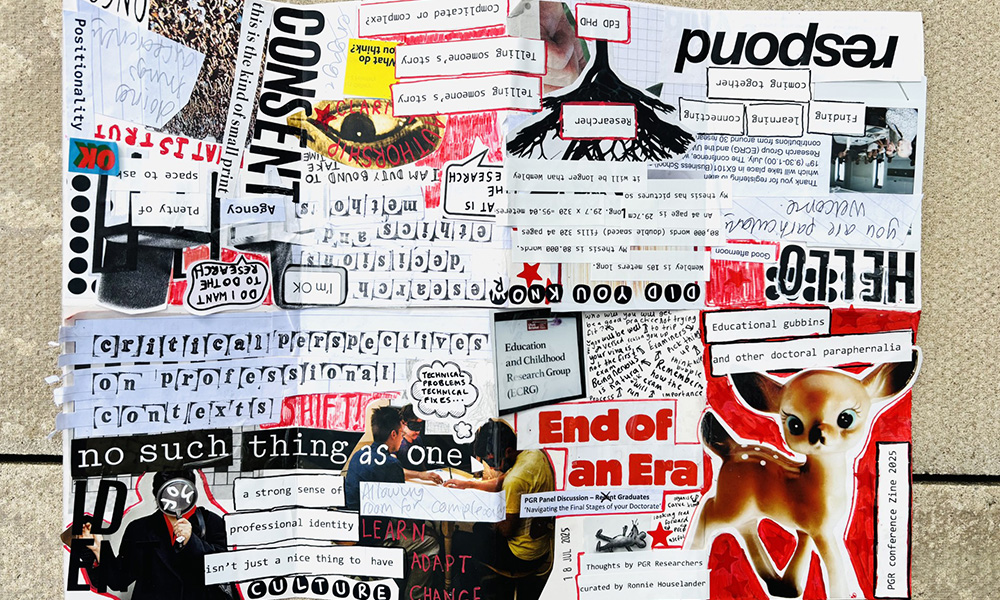
A zine can be understood as a self-published, often handmade publication, frequently characterised by a cut-and-stick aesthetic [main image – Figure 1 and Figure 2]. Zines have long histories in DIY, activist, feminist, queer and subcultural communities, where they have been used to share ideas, circulate stories and create space for voices that might sit outside more formal publishing structures (Duncombe, 1997). 

Figure 2

Zines first existed in my life outside of research. They were things I read for pleasure, bought, traded with friends, or picked up from sellers at comic book fairs. So, when I began working with zines in my doctoral project, I did not initially approach them as a formal method. Their value seemed to come from the opposite of what I thought research was supposed to be. Zines offer a space where humour, secret-telling, oversharing, mess and contradiction are not problems to be corrected, but part of the joy. 

In my research, I have used zines throughout every stage of my project. I have used them to invite participants into my project, to collect their responses to my research provocations, and perhaps more unusually, to keep my supervisors informed of my progress. I have done this by sending zines in the post, and this circle of exchange has been central to forging relationships and establishing a connection to my methods and wider practice. 

On the surface, a zine and a doctoral thesis might appear as different publications, but I have come to understand them as sharing important qualities [Figure 3]. Both respond to context, hold the maker’s voice and make space for special interests. Of course, the differences matter too, and not just in terms of page numbers, but noticing their similarities has helped me understand zineing not as something outside research, but as a practice that can sit alongside and within it. 

Figure 3

I use the term zineing to describe the practice of making a zine (Jones, 2024; Wong, Mishra, Quyoum, 2026). This distinction matters because it shifts attention away from zines as finished objects and towards what happens through the act of making. 

In more conventional research writing, there can be pressure to know what we mean before we write it. But research is full of ideas that circulate before they settle: uncertain thoughts, unfinished connections, feelings, doubts and half-formed questions. I believe these moments can hold just as much value as the ideas we eventually decide to keep. 

This is where zineing becomes significant. Zineing welcomes ambiguity and recognises that meaning and understanding unfold through process. Cutting, folding, arranging, layering, and obscuring can become ways of thinking. The page becomes a space where ideas can be tested, placed beside one another, interrupted or reconfigured. Zineing can offer an invitation into writing or visualising without the pressure of commitment. 

Zineing can be particularly valuable for researchers working with complex, personal or practice-based material because not everything we know arrives in a linear sequence. Some forms of knowledge are felt, embodied, visual, relational or difficult to name. Because of this, zineing can offer a way of staying with those forms of knowing without forcing them too quickly into conventional academic shape. 

Figure 4

Below are a few provocations to help you try making a zine in your own practice.

  1. What images, words or materials are already around you? 
  2. What would happen if you only had eight pages for your literature review? What would you take forward? 
  3. Include a quote, image or object that keeps returning to you. 
  4. Write a note to your future self.

In this blog, I draw from my EdD thesis,  All bugs are insects, but not all insects are bugs: Making meaning while zineing as an artist-teacher in further education, due to be completed in May 2027. 

References

  • Duncombe, S. (1997) Notes from Underground: Zines and the Politics of Alternative CultureLondon and New York: Verso. 
  • Jones, D.P. (2024) ‘Anti-frontiers in zineing: Zines as process & the politics of refusal’, GeoHumanities, 10(2), pp. 407–422.   
  • Wong, M., Mishra, A. and Quyoum, A. (2026) ‘Zine-ing research otherwise: care, joy, and creative co-design with racially marginalised communities’, Bristol University Press, Early View, pp. 1–34.  

A new book for Earth Day: Taking A Close Look at Microfibres

Posted on

Earth Day (22 April 2026) saw the launch of a new children’s book, Taking a Close Look at Microfibres. Co-created by school pupils and researchers from UWE Bristol’s Science Communication Unit (SCU) and Education and Childhood Research Group (ECRG), the book supports children and teachers to explore an often invisible aspect of air quality: airborne microfibres.

The book is part of the Schools Under the Microscope project, a child-led citizen science project that invites pupils aged 9–14 to take part in real environmental research. Through hands-on investigation, creative inquiry, and collaboration with university researchers, children from England and Wales helped generate new knowledge while shaping an engaging educational resource for use in schools.

Exploring what’s in the air we breathe

While microfibres are increasingly well documented in water systems, far less is known about fibres in the air we breathe – particularly in school environments. The Schools Under the Microscope project set out to explore whether established citizen science methods, previously used in homes, could work meaningfully in classrooms.

Following an initial pilot with 90 pupils at May Park Primary School, Bristol the project expanded to include around 400 children across four schools. Together, pupils designed investigations, made predictions, prepared petri dishes, and positioned them around their schools for a two‑week sampling period. After collection, pupils used microscopes to count fibres, while researchers at UWE Bristol carried out further analysis and shared findings back with the schools.

This marked the first time data on airborne microfibres has been collected within school environments, offering valuable insights into both indoor air quality and the potential of citizen science in education settings.

Learning through participation and enquiry

The findings showed that microfibre levels in schools were similar to those found in homes, including a mix of natural and synthetic fibres – some even matching the colours of school uniforms. More importantly, pupils and teachers reported high levels of engagement and enjoyment throughout the research process.

The team found that although air pollution is often invisible, it becomes meaningful through hands-on activities.

From research to a children’s book

Children’s questions, observations, and reflections directly shaped the storyline and content of Taking a Close Look at Microfibres. The book is designed to open up discussion rather than provide simple answers, encouraging curiosity, critical thinking, and dialogue about environmental issues that affect everyday life.

Page from the book, Taking A Closer Look at Microfibres.

The illustrations were created by Luci Gorell Barnes, a socially engaged artist and arts-based researcher. Recycled plastics, fabrics, card, and paper were used to make the images – all materials known to shed microfibres. These materials were scanned and transformed into digital collages, visually reinforcing the book’s themes of materiality, pollution, and reuse.

The book is accompanied by free teacher notes and ten lesson plans, supporting cross-curricular learning in science, geography, citizenship, and sustainability education.

Launching on Earth Day – and beyond

The project also connects with wider work at UWE Bristol around sustainability and social justice. The research team is partnering with the Global Goals Centre to support the Better Uniform Campaign, which seeks to develop a more socially and environmentally just system for school uniforms across Bristol.

Access the free book and resources

Schools, teachers, and partners can access a free e‑copy of Taking a Close Look at Microfibres with resources for lessons and learning.

The team

Dr Margarida Sardo, Dr Ben Williams, Dr Verity Jones and Jacqui Warner.

What have you learned from rivers?

Posted on

By Emma Thomas, Terra Glowach, Kalpa Ghelani and Dr Verity Jones

Over the coming months, we will host public workshops, school sessions, family river walks, creative encounters, and online opportunities to contribute to our river work – join us!

What have you learned from rivers?

As Channel 4’s Dirty Business casts national attention on the shocking scale of water pollution in the UK, many are asking how we arrived at a point where our rivers are now frequently unsafe to enter, fish from, or even walk beside. The documentary drama makes visible what community activists, swimmers, anglers, and ecologists have long understood: our waterways are in crisis, and the crisis is human‑made.

However, while the national conversation focuses on what we have done to rivers, we – Emma ThomasTerra Glowach, Kalpa Ghelani and Verity Jones at UWE Bristol – are asking a different kind of question:


This blog launches our forthcoming public engagement work to co‑create a plurifesto- a plural manifesto – for river‑aligned action across schools, families, and communities.

Rivers are speaking – but what are they telling us?

Rivers appear to be signalling distress. Across the UK, the health of rivers has been jeopardised by intersecting pressures: sewage pollution, agricultural runoff, climate‑change‑driven storms, and increasing flood risk. Recent data paints a consistently stark picture:

  • Raw sewage was discharged into England’s rivers and coastal waters for 3.62 million hours last year, according to Environment Agency data. [theguardian.com]
  • 4.7 million hours of sewage were dumped into UK waters in 2024. [sas.org.uk]
  • In some protected areas, pollution has been extreme. Wessex Water discharged raw sewage for 36 consecutive days at Chesil Beach, a site with multiple environmental designations. [theguardian.com]

Projects to improve the ecological health of rivers are underway. For example, in our city, the Bristol Frome Restored Project focuses on improving the ecological health of the river through farm interventions, in‑stream habitat works, and efforts to remove barriers to fish migration. The Frome Gateway Regeneration initiative treats the River Frome as a key environmental and spatial asset within a wider urban transformation aimed at providing new homes, workspaces, and improved public and green spaces shaped through community consultation.

These projects aim for compliance with frameworks, strategic coherence and alignment with planning and policy outcomes. Having watched Dirty Business, it is clear we need more than box ticking against success criteria. We need to value plural knowledge, coexisting truths and embrace ambiguity, sensory experiences and relational ethics. We need to harness opportunities for rivers to teach all of our communities about resilience and regeneration. 

A different kind of response: Learning with rivers, not just about them

While monitoring data, modelling, and policy reviewns give us vital information about rivers and contribute to neighbourhood renewal – whether related to contamination, flooding or drought –  they cannot answer some important questions on their own:

  • How do we live with rivers in ways that honour their agency?
  • How do we teach the next generation a river‑attuned ethics?
  • How do we understand what rivers themselves “say” through flow, shape, silt, flood, drought, smell, and sound?

Our project begins by placing agency with the river- not as metaphor, but as a methodological and ethical commitment.

Inspired by new materialist, ecological, and pluriversal frameworks, we recognise rivers as more than resources, landscapes, or leisure sites. They are alive with histories, stories, sediments, currents, and relationships – and these can help us re‑imagine more just environmental futures.

Introducing our plurifesto for river‑led action

Over the next year, out team will work with:

  • Families
  • Primary and secondary schools
  • Youth groups
  • Community networks
  • Anyone who has ever walked beside, paddled in, or worried about a river

Together, through creative, embodied, and relational methods, we’ll collect responses to a shared provocation:

What have you learned from rivers?

From these stories, drawings, encounters, sounds, and reflections, we will co‑create a plurifesto – a collective document that does not aim for consensus, but for multiplicity. A plurifesto that:

  • holds children’s river truths alongside adults’
  • honours scientific knowledge alongside sensory, cultural, and ancestral knowledges
  • includes what rivers tell us through flood, pollution, rest, and resurgence
  • supports actions at policy levels, school levels, and family practices

This plurifesto will be a guiding compass – not a static manifesto but a living, evolving expression of our shared commitments with rivers.

Why act now?

The release of Dirty Business has intensified national outrage about sewage and corporate misconduct. But outrage alone will not reshape relationships with rivers.

We want to help transform this moment of anger into a moment of attunement, collaboration, and community‑based river justice.

Rivers are not only victims of industrial malpractice. They are teachers in the climate crisis, showing us:

  • how environments respond to pressure
  • how ecosystems hold memory
  • how water connects communities, species, and generations
  • how resilience emerges from movement, not stasis

If we are willing to listen, rivers may guide us toward new forms of ecological responsibility.

Join us

Over the coming months, we will host public workshops, school sessions, family river walks, creative encounters, and online opportunities to contribute to our river work.

If you’d like to take part – or if your school, community group, or organisation would like to host a river‑listening session – please get in touch.

Let’s build a plurifesto that honours what rivers already know, and what they are asking of us now.

When rivers speak – through contamination, through flood, through flow – we must listen. Because the future we’re trying to secure is one in which rivers can thrive – and in thriving, teach us to thrive too.

Thinking about death for the future

Posted on

By Dr Verity Jones, Associate Professor in Education

Recently, much of my thinking, particularly in collaboration with Chris Bear (Cardiff University), has led me to think more deeply about death as an ecological, educational and ethical concept that demands a futures lens. In our work on food systems, we ask what it would mean to attend to the deaths of non-human animals and plants –  not as abstractions but as lived relations.

In February, I attended the Centre for Sociodigital Futures, Immersive Public Futures Symposium, where themes of loss, endings, disappearance and possibility threaded through discussions of how societies imagine, design and negotiate futures.

International perspectives on imagining futures

Contributions from international speakers underscored that futures – thinking is rarely a smooth trajectory of progress.

  • Fabio Rubio Scarano (Federal University of Rio de Janeiro/Museum of Tomorrow) foregrounded planetary change and regeneration through anticipating and paying attention both to memory and tomorrow.
  • Lisa Bailey (Museum of Discovery, University of South Australia) explored how museums can engage diverse publics with complex and uncertain futures.
  • Andrea Bandelli (Woven Foundation for Creative Climate Communication) challenged us to recognise immersion not as a technical medium but as a condition – a relational mode that shapes how we encounter the world and its potential futures and agencies.
  • Mandy Rose (UWE Bristol) discussed documentary and digital cultures as tools for imagining post‑carbon possibilities through planty immersion.
  • Justin McGuirk (Design Museum, London) examined design-led approaches to futures and the need to construct possible future buildings to imagine within.
  • Dan Lockton (Norwich University of the Arts) reflected on how lost futures can help people collaboratively reimagine alternative futures.
  • Johannes Stripple (Lund University) used speculative ecology and storying  to unsettle fixed narratives of crisis and change.

Across these contributions, there was an insistence that imagining futures requires attending to what is disappearing, threatened or already lost.

Connections

The symposium strongly resonated with work with my own research. Whether supporting young women in imagining near-future careers in construction and engineering, examining ecological timescales in food ethics, or analysing how children’s literature either narrows or expands temporal imagination, much of my work is centrally concerned with how learners inhabit and negotiate time.

This sits alongside collaborations with colleagues at the Global Goals Centre and SPARKS Bristol, where we co-create learning experiences that are research‑informed, inclusive, socially engaged and committed to widening imaginative possibility.

Looking ahead

The symposium has sharpened my thinking on how endings and futures coexist – and how education must hold both. Several publications drawing on this work, including research on identity making, children’s literature and sustainable education, are currently in preparation and will be shared later this year.

Building capacity, community, and climate literacy – reflections from the CCPERN January meeting

Posted on

By Dr Verity Jones, Associate Professor in Education

The Climate Change Primary Education and Research Network (CCPERN) began 2026 with an energising and thought‑provoking meeting that reaffirmed why this community matters so deeply. Bringing together teachers, researchers, practitioners, and organisations committed to sustainability education, CCPERN continues to offer a vital space for sharing practice, fostering collaboration, and exploring the urgent challenges facing climate and sustainability learning in primary education.

Our January meeting welcomed two speakers whose work, though distinct in focus, revealed powerful synergies: Kate Colechin, from UWE Bristol’s careers and widening access team, and Mark Whittaker, headteacher at a North Yorkshire primary school. Together, they helped us consider not only what children need to learn about climate change, but how education systems can better prepare young people for a rapidly changing world.

Green careers and early aspirations

Kate Colechin opened the session by offering insights from her work training careers practitioners and supporting young people in schools. Speaking from both a higher‑education and school‑engagement perspective, she highlighted how central sustainability has become to contemporary careers work.

Kate shared that, within UWE Bristol’s postgraduate careers guidance programme, sustainability and the UN Sustainable Development Goals (SDGs) are embedded across modules, shaping how future advisors support both young and old to think critically about the environmental impacts of work, and to recognise that “every job is a green job”. Her reflections on working with school pupils were particularly resonant: young people, she noted, are increasingly worried about AI, future employment, and the state of the planet – and they respond powerfully to opportunities that spark curiosity and broaden their sense of what is possible.

A key takeaway was the importance of early career‑related learning in primary school, especially as research shows that children’s assumptions about jobs often solidify between the ages of 7 and 17. Challenging stereotypes, expanding horizons, and linking learning to real‑world sustainability issues can shape dispositions that stay with children throughout their lives.

Whole‑school climate education and the power of place

From a practitioner’s standpoint, Mark Whittaker shared the work underway across Northern Star Academies Trust to embed sustainability in curriculum, culture, and community. His school’s context added important nuance to discussions about equity, engagement, and what climate education looks like in practice.

Mark described how participation in the CAPE (Climate Adaptation Pathways in Education) programme had been transformative for both him and his staff, helping them articulate the “why” of climate education and recognise the need to thread sustainability throughout the curriculum rather than bolt it on. His examples of outdoor learning, river‑themed curriculum design, and farm twinning illustrated how powerful experiential learning can be for building ecological awareness and student wellbeing.

He also emphasised the challenges: staff confidence, parental perceptions, and political sensitivities around climate issues. Yet his school’s work shows how partnerships – with RHS, the National Education Nature Park, and particularly Jamie’s Farm – can offer life‑changing experiences for children who may have limited access to green spaces.

Shared threads and looking ahead

Across both presentations, a clear message emerged: climate education is not a single subject, but a holistic endeavour. Whether helping young people imagine future green careers or enabling primary pupils to build connections with their local environments, the work must begin early, be embedded meaningfully, and involve whole communities.

CCPERN remains committed to cultivating these conversations, sharing practice, and supporting educators and researchers navigating this shifting landscape. We look forward to continuing this momentum at our next meeting on 25 March 2026, when we will explore international data on environmental education with Professor Jennie Golding from UCL and hear from Green Schools about their work across England.

Interested in joining CCPERN? Please get in touch with Verity Jones (verity6.jones@uwe.ac.uk).

A matter of Art in the Primary Curriculum

Posted on

By Dr Claire Osborne, Senior Lecturer in Education

The Labour government’s ‘Curriculum and Assessment Review’ (2025) is now out of consultation. As government ministers reflect on the implications for education policy and fulfil their quest to build a “world class curriculum for all”, I want to take a moment to reflect on the future of art learning and teaching across primary education in England.

Art is a serious matter. It involves the development of authentic knowledge and skills such as learning how to master a range of art and design techniques including drawing, painting, and sculpture to knowing about great artists, architects, and designers in history (DfE, 2013). Moreover, studying art at primary level involves having the opportunity to experiment with different kinds of materials and art tools creatively; this could include how to work with charcoal to create light and shade or mastering a range of craft tools to design and make a clay pot. Engaging in the processes and practices of art not only ignites the imagination but can also develop children’s critical thinking skills (see Tambling and Bacon, 2023, p.13); skills which are much needed by industry to support economic growth. The ability to think critically and independently is especially important today as we witness a rise in AI reliance for educational purposes which may potentially impact on people’s cognitive activity and problem-solving skills (see Kosmyna, 2025).

However, due to enduring knowledge hierarchies, as previously identified by Eisner (2002), the teaching and learning of art and visual cultural knowledge can often be sidelined or undervalued in today’s primary school curriculum (see Cooper, 2018; Tambling and Bacon, 2023; APPG, 2023). My own research also suggests that in some cases, children’s engagement with art processes and practices can sometimes be seen as a treat when the “important” schoolwork has been done (Osborne, 2025). This can reinforce an idea that the creative arts and cultural learning experiences are ‘nice to have’ rather than essential elements to the school curriculum (see CLA, 2017).  More still, when arts-based disciplines are taught in primary schools, some teachers reportedly lack sufficient time and resources to plan high quality learning experiences where the development of arts knowledge and skills are at the forefront of curriculum planning (see Cooper, 2018).

Yet despite recent government and Ofsted pronouncements around the importance of children’s access to a broad, balanced, and knowledge rich curriculum, the decline in art teaching and learning, remains an ongoing concern. In many ways the “problem” (my inverted commas) can be attributed to  a succession of central government policy making decisions over the past 30 years which have shifted the role of primary teaching and learning towards standardisation, accountability, and a focus on measuring ‘useful knowledge’ (see Ball, 2017; Nsead, 2016; Biesta, 2010) rather than offering state educated children a more holistic schooling experience (see APPG, 2023; Tambling and Bacon, 2023). However, a lack of access to art in the primary years not only limits children’s exposure to a well-rounded primary education but may restrict, what Aristotle (2018) advocated in his ninth book on Metaphysics, children’s ‘potentiality’ thus raising issues around social equity and personal fulfilment. For some children, engaging with art also serves as a cathartic experience and therefore plays a much-needed role in any school curriculum in supporting children’s general well-being (see CLA, 2018). Yet, although great things are happening in some schools where the arts are supported well by leadership teams with sufficient funding (Osborne, 2025), we still find ourselves in a position where fostering human creativity and children’s self-expression are not always high on the agenda in every state funded school in England whilst the teaching and learning of essential art knowledge and skills can be undermined as generalist teachers are increasingly deskilled or lacking in confidence (see APPG, 2023, p.10; Tambling and Bacon, 2023; Osborne 2025).

To reverse this situation, art needs to be reestablished as a serious and challenging intellectual endeavour within primary education whilst maintaining the creative freedom and enjoyment it can provide for some children. As such, all children need sufficient time in the school week to experiment freely with art materials and processes whilst critically engaging with visual cultural knowledge which can inspire and challenge children’s thinking. Such rich learning experiences can complement other types of learning and subject disciplines across the curriculum and enhance children’s critical thinking skills. Moreover, schools are active sites of learning which can cultivate new knowledge in the field. This includes knowing about a diverse range of contemporary artists, craft makers, and designers who often act as social commentators on our human condition whilst still dedicating lesson time to appreciating and critiquing some of the more familiar traditional artists and art forms widely displayed in public galleries.

However, teachers need real time, space, and investment to be and become knowledgeable others who are confident, well-trained professionals, who are constantly learning from and with children about art processes and practices which foster creativity, self-expression, criticality and original thought. Moreover, teachers need time to be and become inquisitive researchers at the forefront of curriculum reform who promote the value of both ‘powerful knowledge’ (Young, 2008) and ‘purposeful’ knowledge and skills within their localised contexts. But this can only be achieved if reinforced by top-down education policy reform. This may in turn help to reprioritise the place of art within initial teacher education (ITE) whilst influencing school leadership teams in providing ongoing support for teacher’s continuing professional development (CPD) when in role.

Time and resource will always be a challenge despite recent talk about supporting teachers’ professional autonomy over curriculum planning and design (DfE, 2025).  Hence, as we witness the implementation of the Labour government’s recent Curriculum and Assessment Review (DfE, 2025), I would argue more needs to be done, to ensure the power of arts and visual cultural knowledge and skills remains firmly on the agenda in primary education. Moreover, every child attending a state funded primary school in England should have the opportunity to engage in high-quality art learning and creative exploration facilitated by well-trained and knowledgeable teachers who can adapt learning to reflect their local contexts. This is especially pressing today as we consider the growing influence of artificial intelligence (AI) on many facets of school planning and teaching, and the potential impact this may have on learning at every level and in every subject.  As the decline in localise planning continues and there is a growing demand for time saving ready made plans, the question is, how will the tool of AI impact on creative innovation and original thought? What creative possibilities will AI bring to the primary classroom and how can AI be used well to support children’s artistic engagement and authentic learning?

In the years ahead, AI will certainly shape the future of education; and in many ways, AI and the rise in Edtech could address the marginalisation of art in some schools by freeing up teachers to focus more time on providing children with memorable learning experiences rather than being overburdened with administrative tasks. Moreover, AI may provide teachers with better access to generalised artistic knowledge and skills to inform their curriculum planning and innovation thus responding to how learners learn. Nevertheless, AI is only a tool — it cannot replace teacher’s professional knowledge or professional autonomy or address ongoing issues around subject hierarchies. Furthermore, an over reliance on AI for planning, learning or teaching may inhibit both teachers and children’s critical thinking skills and decision-making processes. These are interesting times for primary education especially in terms of the purpose and philosophy of education. As we look to the future, educationists and policy makers will need to think carefully and mindfully about how AI is used as a supportive planning aid whilst considering how teachers can provide children with greater access to authentic, meaningful, and enjoyable art lessons, where everyone can fulfil their creative potential and engage with a “world class curriculum”. Giving children more access to the creative arts during their primary education may also counteract any notions around a potential decline in human cognitive functioning due to AI reliance by enabling us to continue to think for ourselves, both critically and creatively.

References

Earth Day Heroes: Youth action, research impact, and the Bristol Uniform Challenge

Posted on

By Dr Verity Jones, Associate Professor in Education

On 30 September 2025, Sparks Bristol was filled with energy and optimism as over 100 young changemakers gathered for the Earth Day Heroes Awards Ceremony, hosted by the Global Goals Centre (GGC). From Bristol to Bangladesh, young people came together to celebrate the inspiring work they’ve been doing to make the planet better for everyone and everything.

These youth-led projects, spanning rewilding, recycling, campaigning, and creative storytelling, have involved over 7,000 participants taking active, positive steps toward sustainability, justice, and community care. It was a powerful reminder that young people are not just the future, they are part of the solution now.

Grounded in UWE Bristol research

This event and the initiatives it launched are deeply connected to research conducted at UWE Bristol. In particular, the Bristol Uniform Challenge (BUC) was launched at the ceremony. This draws directly on findings from a paper I co-authored with Dr Tessa Podpadec exploring children’s understanding of fast fashion and its impacts. The study, Young people, climate change and fast fashion futures, published in Environmental Education Research, revealed that while many young people are aware of climate issues, the links to everyday clothing choices are often overlooked.

School uniforms offer a tangible entry point for discussing sustainability, equity, and global supply chains. Through BUC, we aim to co-develop practical solutions with schools that reduce waste, support ethical production, and ease financial pressures on families  – while embedding sustainability into everyday school life.

Celebrating youth leadership

The Earth Day Heroes event featured contributions from Naomi Wilkinson (BBC Children’s wildlife presenter), a creative workshop from Aardman Animations, and award presentations by Dr Mya-Rose Craig (Birdgirl) and Cllr Henry Michallat, the Lord Mayor of Bristol. Their presence helped affirm the importance of youth-led action and the value of recognising it publicly.

As an Associate Professor at UWE Bristol, I’ve worked with the Global Goals Centre for over seven years, developing projects that centre social and environmental justice, creative engagement, and inclusive education. The Earth Day Heroes initiative is a living example of how research and practice can come together to support meaningful youth participation.

Looking ahead

Young people are now invited to begin developing their projects for the 2026 Earth Day Heroes Awards, continuing the momentum and deepening their engagement.

As educators and researchers, it’s vital that we create spaces where young people feel empowered to act, reflect, and lead. This event was more than a celebration, it was a demonstration of how research, practice, and youth voice can come together to shape a better future.

Children’s literature, anti-racism, and educational impact: ‘Difference in Primary Schools’ resource

Posted on

By Dr Verity Jones, Associate Professor in Education

On 23 September 2025, Lambeth Palace hosted the launch of the Difference in Primary Schools resource—an ambitious and timely initiative that uses children’s film, songs and literature to support meaningful conversations about race, identity, and belonging in primary education.

Developed by the Difference programme, the resource is freely available to schools and educators across the UK, offering a suite of lessons that foreground empathy, critical thinking, and inclusive practice from early years through to transition into Key Stage 3.

As the team leader for the RESPECT project, I was particularly proud that the transition lesson draws directly on If Racism Vanished for a Day – a book developed through our project. Co-created with children from Bristol schools, the text and illustrations invite readers to imagine a world without racism.

The integration of our book demonstrates how academic research can shape real-world practice, particularly in the context of anti-racism education. It also highlights the power of literature as a pedagogical tool: not only to foster understanding, but to catalyse change.

As schools begin to adopt the Difference in Primary Schools resource, the reach and relevance of RESPECT’s work continues to grow – supporting educators in creating classrooms where every child feels seen, heard, and valued.

Inclusive climate education: a call to action from additional learning needs and alternative provision settings

Posted on

By Dr Verity Jones, Associate Professor in Education

This week sees the publication of the Climate Change and Sustainability Education in Additional Learning Needs and Alternative Provision Settings report, authored by Shannon O’Connor, Dr Jennifer Rudd, Dr David Thomas, and Bryony Bromley. Drawing on research from 26 additional learning needs (ALN) settings across Wales and a micro-Delphi study, the report highlights urgent gaps in resources, training, and support for educators working with learners who are often excluded from mainstream sustainability discourse.

As co-leads of the Education and Childhood Research Group’s Sustainability Strand at UWE Bristol, myself and Dr Tessa Podpadec welcome this report’s publication. It aligns closely with our commitment to embedding climate and sustainability education across diverse educational contexts, and particularly with our work on inclusive pedagogies that centre learner agency, creativity, and justice.

The report’s findings reinforce our belief that sustainability education must be differentiated – not diluted. Learners  deserve access to meaningful, age-appropriate content that reflects their lived experiences and capacities.

These themes resonate strongly with the work that Tessa, Dr Jon Mulholland and I have been developing at Sparks, Bristol with Global Goals Centre, a sustainable education hub where we have been working with special educational needs settings. At Sparks, we’ve explored how young people engage with sustainability through sensory-rich, place-based and creative approaches – from growing food and cooking with seasonal produce, to crafting with recycled materials and engaging in community-based environmental action.

These activities not only support curriculum goals but also foster a sense of belonging, purpose, and ecological connection among learners who may not otherwise see themselves reflected in climate narratives.

The report calls for:

  • A national bank of ALN-specific CCSE resources
  • Dedicated CCSE networks for ALN educators
  • Sustainability embedded across all Areas of Learning and Experience (AoLEs)
  • Easier access to ALN-friendly school trips and experiential learning.

These recommendations align with our Strand’s goals to support practitioner-led workshops and collaborative research that foreground inclusive climate pedagogies.

As Wales moves toward its net-zero targets, and as the curriculum for Wales embeds sustainability across all AoLEs, greater emphasis needs to be made to ensure that no learner is left behind. This report offers a roadmap for doing just that in Wales and beyond -and we encourage colleagues across education, policy, and research to engage with its findings. 

Where has all the creativity gone?

Posted on

By Ros Steward, Senior Lecturer in Education, UWE Bristol

Art has been acknowledged (Hewlett & Unsworth in Driscoll, Lambirth & Roden, 2012; Herne et al, 2009) as becoming marginalised in the primary national curriculum even prior to the current iteration (DfE, 2013), due in part to the timetabling of Foundation subjects being increasingly reduced as the focus on the core subjects, particularly Maths and English as a result of the Government’s focus on standardised testing in these subjects, has increased.

This has been seen to impact upon the integrity of many of the foundation subjects, but in particular the arts. The reduction of art and design at KS4 (no longer being a statutory subject) has also had an impact upon the teaching and learning in Primary teaching and learning, with the debate ensuing around the importance of the arts in general and the necessity for them in the 21st Century.

Added to this, there is an issue where future teachers are being trained to teach Foundation subjects, (the allocation of time with training programmes mirroring that of school based curricula), including art, for which they have little affinity due to a variety of reasons including their personal perception of ability and subject knowledge. Indeed, many have the perception that art has little value as a subject other than being an minor adjunct to other areas of learning in education, suggesting that art as a force for creative and innovative thinking, the opportunity for imagination to flourish and the understanding of how artists over time have expressed their view of the world, may well be increasingly diminishing within our classrooms. Robinson (2006) expressed:  “We are educating people out of their creativity” and there might well be some truth in his assertions with the current political climate and assessment driven agenda.

The National Society for Education in Art and Design (NSEAD) stated only this year that ‘Art and design is popular, but it is complacent to say it is thriving – children are getting less art and design’ in their written response to the Curriculum and Assessment Review (DfE, 2025), followed by a further report by Thomson et al (2025), both reflecting what our Primary trainees are reporting to us- they see little or no art being taught in schools during their placements. So is it an issue with the pedagogical focus currently seen in ITE generally or specifically here at UWE Bristol? And can it be addressed?

Since teaching on an Initial Teacher Education programme at UWE, I have reflected on how art is taught in Primary education. I realised that, although I believed I was fostering creativity by teaching discrete skills and art knowledge, the structured and directive approach may have limited children’s creative expression and confidence. Conversations with trainees about their own experiences highlighted that this method might have contributed to the negative perceptions of art that many held, particularly during Key Stage 2.

This is not a new concern; previous research (Gatt & Karpinnen, 2014; Gibson, 2003; Russell-Bowie, 2004; 2012) has similarly found that student teachers’ perceptions of art are shaped by their own schooling experiences. These perceptions are often left unchallenged during initial teacher education, largely due to the prioritisation of core subjects. My own small-scale research supports these findings: qualitative data from an online questionnaire revealed that many students held preconceived views about the value of art and design in Primary education, often linked to low confidence stemming from limited personal skills or subject knowledge. Rokeach (1970) cited in Smith (1971) defines attitude as:

An attitude is a relatively enduring organisation of beliefs around an object or situation, predisposing one to respond in some preferential manner. An attitude is relatively enduring because it can be learned, it can be unlearned. Because it is learned, it can be taught.’

                                                                                                (Smith, 1971:82)

A key factor in developing a new approach was the allocation of sufficient timetabled sessions within the Foundation modules at UWE Bristol. Year 1 undergraduates received five 3-hour sessions focused on art and design, allowing for both skill development across various media (including photography) and the nurturing of creativity. The PGCE programme offered a comparable amount of time. In Year 2, undergraduates engaged with a module on integrating art into cross-curricular themes and could choose an art specialism that further explored how art and design could be embedded meaningfully across the Primary curriculum.

As a result of my research and reflection, I adapted my planning to allow for more open-ended outcomes from an initial stimulus, aiming to encourage students to develop original ideas collaboratively or individually, based on their existing skills. This approach did not eliminate the discrete teaching of skills, which remains essential—particularly since many teacher trainees, especially in EYFS and Primary education, have had little formal art education beyond GCSE or A level. Many trainees recalled enjoying art in early childhood, when exploration was encouraged, but later lost interest due to comparisons with peers. This aligns with Lowenfeld’s (1947) stages of artistic development: during the ‘Dawning Realism’ stage (7–9 years), children become more self-critical, and by the ‘Pseudo-Naturalistic’ stage (10–13 years), they evaluate their success based on realism, often resulting in frustration. In many Primary settings, children are still directed toward uniform outcomes, increasing the potential for comparison. Conversations with trainees revealed that teacher attitudes and feedback often contributed to diminished confidence—for example, work not being displayed or comments suggesting they weren’t good enough. As previously noted this issue is longstanding, but I believed it could be positively addressed through thoughtful preparation for practice. Shifting trainees’ negative perceptions toward enthusiasm became my central aim.

To begin adapting my approach, I reviewed a Year 6 unit I had previously taught for several years based on the QCA scheme of work ‘People in Action’ (DfEE/QCA, 2000). At the time, I believed the children had made progress—developing subject knowledge of artists like Duchamp and Chagall, and improving skills such as drawing and proportion. However, further reflection and research highlighted significant limitations in the way the unit was delivered. Although initial activities encouraged open dialogue and imaginative thinking through unprompted discussion of artworks, the creative potential was ultimately constrained. Children were shown examples of prior outcomes, told what medium to use (chalk pastel), and guided through a set sequence to produce work ‘in the style of’ a specific artist. This predetermined outcome left little room for genuine creativity, resulting in near-identical pieces. As Hickman (2010) noted, such an approach prioritises product over process. To reverse this, greater flexibility in media, scale, and open-ended outcomes, aligned with models of creative thinking like Bloom’s Taxonomy and the SOLO taxonomy, might foster deeper engagement and original thinking.

Teaching itself is a ‘creative act’…and relies continuously on chance meetings of idea and materials, curiosity, flexibility and adventurous thinking”

(Barnes : 2007:137)

To further develop this new pedagogical approach, I revisited the QCA unit ‘Take a Seat’, but this time handed over the entire creative process to the trainees to help build their confidence and reduce self-criticism. After sharing my previous experience and the limitations I had identified, I invited the trainees to interpret the unit title independently, without further guidance. This encouraged a broad range of ideas to emerge. Working in groups, trainees planned their own direction, documented their thinking and adaptations, and experimented with different materials and techniques. While some discrete skill teaching was necessary—for example, when using unfamiliar materials like modroc or working with clay—the main emphasis was on exploration, discovery, and peer-supported learning, consistent with Bruner’s (1960, 1968) constructivist approach and findings by Dismore et al. (2008). The open-ended nature of the task allowed for an unexpectedly wide range of outcomes, including both 2D and 3D works. Trainees utilised diverse media—ICT (posters, videos, presentations), clay, wire, modroc, found materials, drawings, and paintings—demonstrating increased creativity, autonomy, and collaborative learning.

The reflections from the trainees were extremely encouraging and confirmed that by enabling them to explore different ideas and build upon their strengths and learn new skills, the majority had become far more confident in their own abilities as artists. It was clear that this approach had stimulated their creativity in unexpected ways, and in turn their attitude had become far more enthused for a subject previously viewed negatively. This in turn prompted many of them to try out this approach of teaching art in their own practice with positive results.

In recent years, the focus within Initial Teacher Education (ITE) has shifted once again toward the core subjects, with all year groups receiving dedicated input in English, maths, and science, while coverage of Foundation subjects, such as art and design, has notably declined. This narrowing of focus reflects the concerns raised by Susan Ogier (2022) who critiques the dominance of accountability measures that limit children’s access to a truly broad and enriching education, essential for preparing them for a creative and technological future. This is mirrored at UWE; Year 1 students now receive just one lecture and three 2-hour sessions in art and design, focused only on basic skills, with little to no opportunity for extended or applied creative learning. The Year 2 art specialism has been removed, and art is now taught within a cross-curricular module in a hierarchical format (Barnes, 2015), limiting deeper engagement with the subject. As Eisner (1972) argued, the arts uniquely enrich human experience and perception, particularly through aesthetic understanding—a contribution no other field can replicate. Without meaningful opportunities for participation in art and design, we risk depriving future generations of these vital humanising experiences.

So, where do we go from here? To offset the limited opportunities within current ITE training, some colleagues and I are planning to deliver regular twilight continuing professional development meetings, incorporating practical workshops, for our Partnership colleagues and also Year 2 and 3 trainees, where we can discuss how we can better deliver creative teaching and encourage teaching of creativity across the Arts for all Primary children, encouraging them to reflect on the theoretical aspects of discrete and cross curricular models, developing their own practical subject knowledge to enhance their confidence and suggesting how the shift from product driven teaching to process, enabling children to investigate and explore possibilities, will enable a vibrant community where successes can be celebrated and shared. It will be interesting to monitor how this is received by our Primary teaching colleagues, and our trainees, and study whether any appreciable impact can be identified on how the Arts are delivered in our Partnership schools in the future.

References

Barnes, J. (2007, 2nd ed). Cross-Curricular Learning 3-14. London: Sage

Barnes, J. (2015) Cross-Curricular Learning 3-14. London: Sage

Bloom, B. S.; Engelhart, M. D.; Furst, E. J.; Hill, W. H.; Krathwohl, D. R. (1956). Taxonomy of educational objectives: The classification of educational goals. New York: David McKay Company.

Bruner, J. (1960) The Process of Education. Cambridge, MA: Harvard University Press

Bruner, J. (1968) Towards a Theory of Instruction. New York: Norton

DfE (2025) Curriculum and Assessment Review: interim report https://www.gov.uk/government/news/curriculum-and-assessment-review-publishes-interim-findings

DfEE/QCA, (2000) Art and design scheme of work  https://www.qca.org.uk/232.html

Dismore, P., Barnes, J. and Scoffham, S. (2008) Space to Reflect. London: Creative Partnerships

Driscoll, P., Lambirth, A. and Roden, J. (eds) (2012) The Primary Curriculum- a creative approach. London: Sage

Eisner, E. (1972). Educating Artistic Vision. New York: MacMillan

Gatt, I & Karppinen, S (2014) An Enquiry into Primary Student Teachers’ Confidence, Feelings and Attitudes towards Teaching Arts and Crafts in Finland and Malta during Initial Teacher Training. International Journal of Art & Design Education 33.1

Gibson, R. (2003) Learning to be an art educator: student teachers’ attitudes to art and art education, International Journal of Art & Design Education, Vol. 22, No.1, pp. 111–20

Herne, S., Cox, S., Watts, R. (eds) (2009) Readings in Primary Art Education, Intellect Books

Hickman, R. (2010, 2nd ed.). Why We Make Art – and why it is taught. Bristol: Intellect

Lowenfeld, V. (1947) Creative and Mental Growth. New York: Macmillan Co.

NSEAD (2025) Curriculum and Assessment Review – NSEAD response and analysis  https://www.nsead.org/files/79b22a9c45f173a4ef2d2a8941248165.pdf

Ogier, S. (2022) A Broad and Balanced Curriculum in Primary Schools London: Sage

Robinson (2006) Do Schools kill Creativity? TED talk https://www.youtube.com/watch?v=NRnToFZQQP4

Russell-Bowie, D. (2004). Arts education: Are the problems the same across five countries?

Preservice teachers’ perceptions of the problems to teaching arts education in primary schools in five countries. Paper presented at the Australian Association for Research in Education, Melbourne

Russell-Bowie, D. (2012) Developing preservice primary teachers’ confidence and competence in arts education using principles of authentic learning, Australian Journal of Teacher Education, Vol. 37, No. 1 Article 4

Smith, A. N. (1971) The importance of attitude in foreign language learning. Modern language journal. 55 (2), pp. 83-88.

Thomson, P., Hall, C., Maloy, L. (2025) The RAPS Project: Researching the Arts in Primary Schools  The University of Nottingham https://artsprimary.com/wp-content/uploads/2025/02/raps-final-feb-2025–4.pdf

Back to top

Follow this blog

Get every new post delivered right to your inbox.