

Zineing in the in-between: Making zines in your research practice

Posted on

By Ronnie Houselander Cook

Throughout my EdD, I have often felt that my work sits between different worlds. I have moved between different expectations, roles and ways of working, and this has sometimes made me wonder which room my work belongs in. However, through the unwavering support of my supervisors, Dr Tim Clark and Professor Jane Andrews, and the wider ECRG community, I have been able to depart from convention and embrace hybridity. This has mattered deeply because my creative practice has become a way to represent not only my research but also myself. Through zines and zineing, I have been able to remain in that in-between position, rather than feel pressured to make my work fit neatly into one space. 

What is a zine?

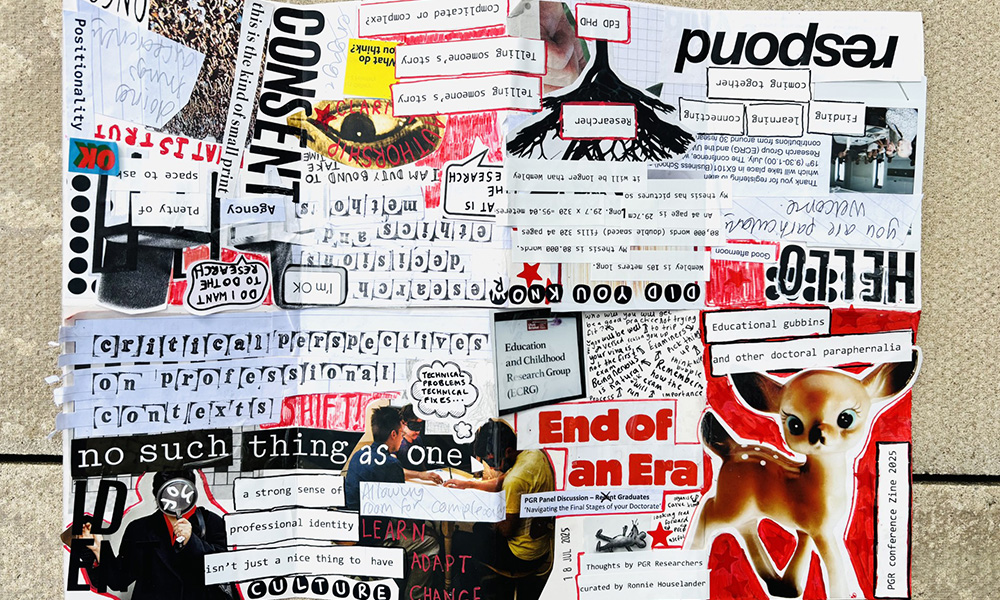
A zine can be understood as a self-published, often handmade publication, frequently characterised by a cut-and-stick aesthetic [main image – Figure 1 and Figure 2]. Zines have long histories in DIY, activist, feminist, queer and subcultural communities, where they have been used to share ideas, circulate stories and create space for voices that might sit outside more formal publishing structures (Duncombe, 1997). 

Figure 2

Zines first existed in my life outside of research. They were things I read for pleasure, bought, traded with friends, or picked up from sellers at comic book fairs. So, when I began working with zines in my doctoral project, I did not initially approach them as a formal method. Their value seemed to come from the opposite of what I thought research was supposed to be. Zines offer a space where humour, secret-telling, oversharing, mess and contradiction are not problems to be corrected, but part of the joy. 

In my research, I have used zines throughout every stage of my project. I have used them to invite participants into my project, to collect their responses to my research provocations, and perhaps more unusually, to keep my supervisors informed of my progress. I have done this by sending zines in the post, and this circle of exchange has been central to forging relationships and establishing a connection to my methods and wider practice. 

On the surface, a zine and a doctoral thesis might appear as different publications, but I have come to understand them as sharing important qualities [Figure 3]. Both respond to context, hold the maker’s voice and make space for special interests. Of course, the differences matter too, and not just in terms of page numbers, but noticing their similarities has helped me understand zineing not as something outside research, but as a practice that can sit alongside and within it. 

Figure 3

I use the term zineing to describe the practice of making a zine (Jones, 2024; Wong, Mishra, Quyoum, 2026). This distinction matters because it shifts attention away from zines as finished objects and towards what happens through the act of making. 

In more conventional research writing, there can be pressure to know what we mean before we write it. But research is full of ideas that circulate before they settle: uncertain thoughts, unfinished connections, feelings, doubts and half-formed questions. I believe these moments can hold just as much value as the ideas we eventually decide to keep. 

This is where zineing becomes significant. Zineing welcomes ambiguity and recognises that meaning and understanding unfold through process. Cutting, folding, arranging, layering, and obscuring can become ways of thinking. The page becomes a space where ideas can be tested, placed beside one another, interrupted or reconfigured. Zineing can offer an invitation into writing or visualising without the pressure of commitment. 

Zineing can be particularly valuable for researchers working with complex, personal or practice-based material because not everything we know arrives in a linear sequence. Some forms of knowledge are felt, embodied, visual, relational or difficult to name. Because of this, zineing can offer a way of staying with those forms of knowing without forcing them too quickly into conventional academic shape. 

Figure 4

Below are a few provocations to help you try making a zine in your own practice.

  1. What images, words or materials are already around you? 
  2. What would happen if you only had eight pages for your literature review? What would you take forward? 
  3. Include a quote, image or object that keeps returning to you. 
  4. Write a note to your future self.

In this blog, I draw from my EdD thesis,  All bugs are insects, but not all insects are bugs: Making meaning while zineing as an artist-teacher in further education, due to be completed in May 2027. 

References

  • Duncombe, S. (1997) Notes from Underground: Zines and the Politics of Alternative CultureLondon and New York: Verso. 
  • Jones, D.P. (2024) ‘Anti-frontiers in zineing: Zines as process & the politics of refusal’, GeoHumanities, 10(2), pp. 407–422.   
  • Wong, M., Mishra, A. and Quyoum, A. (2026) ‘Zine-ing research otherwise: care, joy, and creative co-design with racially marginalised communities’, Bristol University Press, Early View, pp. 1–34.  

Reading for pleasure, public libraries, and voices at the margins

Posted on

By Dr Anish Harrison and Professor Alpesh Maisuria

In November 2025, we submitted written evidence to the House of Commons Education Select Committee inquiry into “Reading for Pleasure”. The inquiry comes at a critical time with national data showing that children’s enjoyment of reading is now at its lowest level since records began in 2005 (NLT, 2025).

The Committee’s review sits alongside the Government’s announcement of 2026 as the National Year of Reading, led by the Department for Education and the National Literacy Trust. Framed as a chance to “kickstart a reading revolution”, the initiative recognises that reading for pleasure matters, not only for attainment, but for wellbeing, confidence and personal satisfaction. However, unless we listen to the experiences of children and families who are least engaged in reading, these ambitions risk falling short of being realised.

From thesis to Select Committee evidence

Our submission draws on doctoral research by Dr Anish Harrison, Voices at the margins: An exploration of the perceptions of ‘vulnerable’ children, their families’ and library professionals regarding reading for pleasure and public libraries. This was Anish’s EdD submission, taking a case-study approach and framed from a critical ecological perspective.  

The research explores how children and families from different demographics, including Children Looked After, children from diverse backgrounds and those in areas of high deprivation experience reading for pleasure.  It also examines the role of public libraries within this context, critically exploring its socio-historical formation and current situation that includes being a critical mechanism for reading to take place.

The study worked with children, parents and library professionals, including early years children, primary-aged readers, and young people in care. The data generated clearly highlighted that reading for pleasure is not an individualised, uniform, and silent activity. It is social, playful, emotional and deeply shaped by environment and opportunities.

One child put it simply:

“I like reading… I just want a book that I like, like comics and that …  not boring old smelly books.”

Their words challenge narrow ideas of what counts as reading, and whose preferences are valued.

Real world reading for pleasure

Across the research, children described enjoyment when they had choice and agency, but in the context of several factors: choosing and having access to a range of materials, reading with others, having inviting spaces to read and engaging with texts that reflected their interests and identities. Reading often happened alongside play, including Lego world-building, role play, and digital media.

The research found that public libraries played a crucial role in making this possible. For many families, they provided a free, welcoming “third space” beyond home and school, where reading was not assessed, timed, or in any way pressured – simply joyful. Libraries enabled shared reading, supported parents who lacked confidence, and gave children access to a wider range of books and formats than were available at home. 

An ecological model was created through the data, which reflected children’s reading for pleasure needs:

However, significant barriers were also identified. Parents spoke about time-poverty, long-working hours, and uncertainty about how to support reading. Some assumed reading was ‘something [that the] school does’ but at the same time, participants noted that school practices undermined enjoyment. For older children, reading was associated with pressure rather than pleasure.

Importantly, structural inequalities were present in what was seen as ‘legitimate reading’. These barriers prohibited the growth of children’s identity as readers, creating significant barriers to enjoying reading for pleasure.

Libraries under pressure

At the same time as reading for pleasure declining, public libraries have faced sustained budgetary cuts. Reduced opening hours, loss of professional staff, and fewer children’s activities have made access increasingly uneven. Library staff told us of high demand for story times and reading-related events, but diminishing capacity to deliver them.

Despite this, public libraries remain places of belonging. When these spaces were informal, well-designed and social, families felt welcome and reading for pleasure flourished. Conversely, where they were large, formal, or understaffed, some participants in the study felt excluded by the coldness.

Why reading for pleasure matters now

The evidence is clear: reading for pleasure supports who children grow as human beings. In the research, it created joy, connection, self-understanding, meaning-making, and confidence in lives shaped by scarcity and pressure. The opportunity to submit to the Education Select Committee was timely and ensured the thesis could have the potential for real-world impact. 

Our evidence-informed submission to the Select Committee makes five key recommendations:

  1. sustained investment in public libraries;
  2. recognising libraries as strategic partners in literacy policy;
  3. actively promoting library services during the National Year of Reading;
  4. adopting minimum service standards; and
  5. broadening definitions of reading for pleasure to reflect children’s reading realities.

If the National Year of Reading is to succeed, it must start by listening to voices at the margins. Public libraries are not a nostalgic extra, they are essential infrastructures for equity, enjoyment, and flourishing.

Going against the grain? Arts-based research and the EdD: resistance, activism and identity

Posted on

By Dr Tim Clark (UWE Bristol/ECRG Strand Lead) and Professor Tom Dobson (York St John University) originally featured on the Society for Research into Higher Education blog.

Arts-based research (ABR) encompasses work which draws on aspects of visual, literary or performative arts as ‘methodological tools… during any or all phases of research’ (Leavy, 2018). There has been growing interest in the potential of ABR methods to enrich educational inquiry (Everley, 2021), however, minimal attention has been given to how accessible or relevant ABR is for practice-based researchers (including lecturers and teachers), who undertake the professional doctorate in education (EdD) pathway. We believe that this lack of attention is significant, partly because institutional frameworks for doctoral programmes are often informed by traditional models of PhD research, which may constrain the creative possibilities of practice-based study (Vaughan, 2021), and partly due to the nature and ‘uniqueness’ of the EdD as a research degree (Dennis, Chandler & Punthil, 2023). We also think this topic may be of interest to ECRG members, many of whom have experience of teaching, supervising or studying on UWE’s successful EdD programme.

We have previously argued that ABR potentially holds particular promise for EdD research due to its alignment with the programme’s highly relational and contextual nature and its engagement with diverse audiences. In our 2024 paper, which was part of a special issue of Teaching in Higher Education, we mapped the theoretical similarities in understandings of ABR and the EdD, exploring this alignment across aspects including practice, audience and reflexivity (Dobson & Clark, 2024). Our paper called for colleagues to ‘embrace hybridity’ and provide permission for creativity in EdD research and we attempted to illustrate this within the paper itself, entangling examples of creative nonfiction writing with a traditional scoping review to embody our theorisation. However, we also concluded with a realisation that maximising the potential of ABR requires careful attention to how design, practice and regulations support students’ identity development and agency (Savva & Nygaard, 2021).

To build on this, throughout 2024, we have been working with a group of nine EdD students studying at our respective institutions, who are all exploring the potential of ABR for their work. These students span professional roles from early childhood through to higher education, and disciplines including the arts, business and science. Following initial narrative interviews with each student, we developed an online cross-institution action learning set (Revans, 1982) to facilitate dialogue and learning relating to some of the key problems and opportunities students were experiencing in relation to their engagement with ABR. As a group we met 6 times, each time agreeing an area of focus, and providing opportunities for individuals to present and group members to ask clarifying and open-ended coaching style questions. This process culminated in creative analysis, where we collaboratively analysed and reflected on the learning that had taken place, and each student presented a creative interpretation of their learning to the group. We are currently working with a group of these EdD students to co-author a paper which captures and illustrates this learning and shares these creative outputs.

Alongside this, the second paper from our project (Clark & Dobson, forthcoming) explores some of the key learning arising from the initial interview phase – in particular the idea of ABR as a form of ‘resistance’ involving potentially either a deliberate, or more hesitant, decision to ‘go against the grain’. Using Glăveanu’s 5A’s theory (actors, actions, artifacts, audiences and affordances) to understand creativity as embedded in social relations, we developed the interview transcripts into vignettes for each student and identified three key strands of the students’ perceptions of their experiences – many of which continued to be key areas of focus as we worked through the action learning set process. The process highlighted the students’ understanding of how methodological expectations were reflected through key audiences and structures, how methodological choices aligned with their sense of self and identity and the role of ABR in promoting action and agency. The vignettes offered a nuanced illustration of the tensions in these areas, which we feel offers wider value due to the fact that, unlike any previous work we had identified in this area, the understandings related to students both with and without previous artist identities, backgrounds or experiences.

The focus on audience and structures highlighted the numerous audiences which exist for students’ EdD research, often spanning academic, professional and community spaces and how these can create tensions in terms of expectations of what research ‘should’ look like. Some students talked of an ongoing battle to justify and ensure their ABR projects were taken seriously, whilst others positioned their decision to use ABR as an active decision to resist academic or managerial structures they perceived had been unhelpfully imposed on them. This also highlighted that whilst valuing creativity in research within the micro context of an EdD programme itself (through teaching and supervision) was significant and built confidence, students also needed support to consider how to frame their work in wider contexts, including through institutional processes (such as those for ethics approval) and professional and academic communities. One student, for example, highlighted feeling ‘junior’ and ‘a bit insecure’ about engaging in wider university processes designed for what they felt was understood as more ‘serious research’.

In relation to identities and self, we explored a complex and nuanced understanding of students’ perceptions of the need for ongoing negotiation of the entanglement between professional, researcher, and in some cases, artist identities. Where students identified pre-existing artist identities, for some this created an obvious alignment with their research, but for others they identified tensions, including feeling ‘nervous’ about bringing this identity into their research and apprehensive of their relevance to an academic audience. Where students had no prior expertise or experience in the arts, they often expressed hesitance regarding using ABR, but strong feelings about its potential to align with aspects of their professional identity and values. For example, they appreciated ABR’s affordances in ensuring research was accessible to wider communities and supporting children’s voices to be heard.

This also connected with the final strand, action and agency, where ABR was positioned by the students as having the potential to facilitate an emancipatory process in education, promote agency and in some cases play a role in research as a form of activism. This was often associated with ideas of social justice, with one student, for example, talking of ABR as providing agency for him to ‘push back against’ an education system that marginalises certain groups. Alongside this, another highlighted ABR as having stronger potential to be participatory and action based, maximising the benefits of the research process itself on her participants who were also her students.   

As we continue our work on this project, the learning it has generated allows us to begin to reflect on its implications: implications that are both within individual EdD programs, where teaching and supervision have strong potential to offer spaces to explore, and reflect on, the potential value of ABR within EdD research, and at an institutional level, where regulations need to continue to respond to growing focus on the social and professional relevance of doctoral research and the range of models, and methodologies, they encompass. A key part of the action learning sets has also been their role in highlighting the value of facilitating methodological dialogue and creating a community of doctoral researchers exploring ABR. As one of the students reflected, this has helped with their sense of ‘validation’ for their work and provided a space to navigate some of the key tensions.

Authors:

Back to top

Follow this blog

Get every new post delivered right to your inbox.