

Project Zulu pedagogy conference and workshops – August 2026

Posted on

Photo credit: Darcey Baker

By Nick Latham, Senior Lecturer in Initial Teacher Education

Do you ever get that feeling in an airport where you’re trying to find out which flight on the screen is yours? You’re staring at the screen and there’s an announcement about looking after your bags, the café nearby has had a large and excited group (probably on a hen do) arrive and your phone has decided that now is the time that it wants to run an update as you check the time? No? Well, I certainly did when leaving Johannesburg airport after delivering sessions to teachers in KwaZulu Natal Province, ironically about the very thing I had just experienced: cognitive overload.

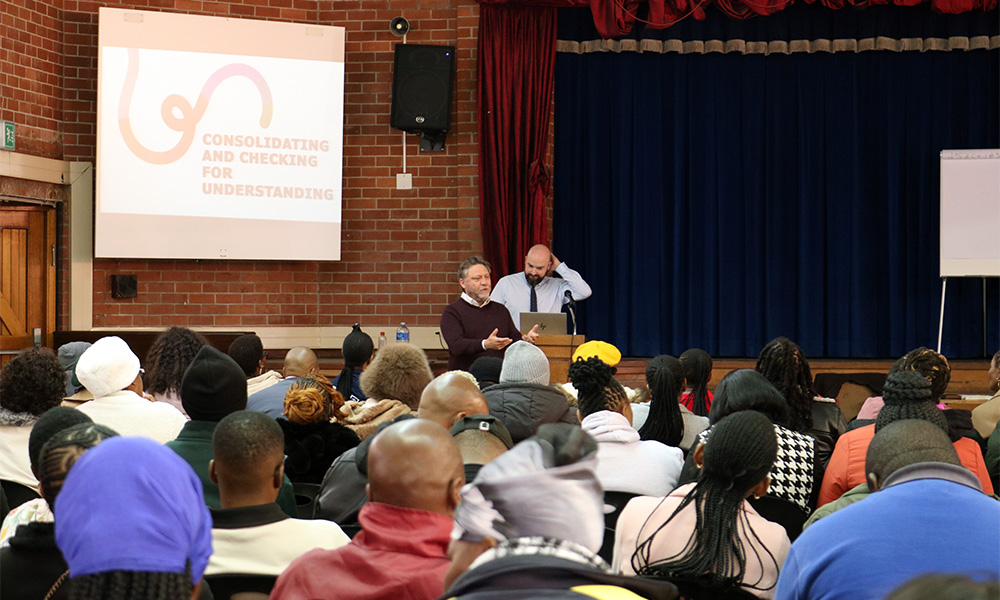
I have experienced cognitive overload both as a student and a teacher (and now at OR Tambo airport) as I’m sure we all have. This meant delivering these sessions to keen (if a little chilly – it’s winter in South Africa) teachers from schools in Madadeni Township with awareness of their cognitive load and not bombarding them with too much information too quickly. Like most teaching in education, teaching such a subject can get very self-referential; you are constantly aware that you should be doing the thing you are teaching whilst teaching it. Facilitating the cognitive load of the learners in our session was at the forefront of our minds when planning this session and it went down well according to the feedback we received both informally in the session and via our reflection forms.

The main content of these sessions focused on ways to reduce the cognitive load of students during the teaching of new material. We had structured the sessions in a way that we were introducing strategies in the order that they would be in lessons. We began with recall strategies and effectively activating students’ prior knowledge to prepare them for their new learning today. In South Africa, this is referred to as ‘from the known to the unknown’ (a phrase that many of the educators joined in with when we said it – clearly a popular one). We then focused on the gradual release model that is being utilised in many schools across England: I do, we do, you do. This involved me putting on my teaching hat and modelling the process as if the educators were my students – a process that, despite the cold, they engaged with as enthusiastically as I’d have hoped. The gradual release model helps students to engage with new learning without causing cognitive overload as the thinking responsibility moves gradually from the educator to the student. We then finished with a section on effective consolidation and how to aid the process of moving new learning from working memory into long term memory (which hopefully our sessions will!).

Another element we had to consider was our environment. Ben had taught sessions in South Africa before whereas I hadn’t been south of the Equator until our arrival. When discussing what elements of learning could lead to learners experiencing cognitive overload, the teachers across all sessions put forward that the children learning in a language that wasn’t their mother-tongue (for most in Madadeni, this is isiZulu) absolutely added to their cognitive load.

Another meta experience for us as this was also the case of the majority of the educators in the room despite their proficiency in English, it could not be ignored that we were not instructing in the language many would use amongst each other or when at home. We ensured that we had added a section about strategies to introduce new vocabulary at the start of lessons to learners as even when they are taught in their first language, new technical and subject specific words can add to a learner’s cognitive load. Our South African colleagues shared with us experiences and examples of these challenges: one science teacher informed us that the English words ‘energy’ and ‘force’ both translate to ‘amandla’ in isiZulu – adding an extra layer of difficulty to teaching about kinetic energy.

Throughout the sessions, the educators were able to give us insights into how they could apply the strategies into their own practice and still keep to the demands of the curriculum in South Africa. This was a wonderful experience working with some dedicated colleagues from a place where they face some similar and yet some very different challenges to teachers in England. This was my first involvement in the wonderful work that Project Zulu does and participating in it was a truly memorable, rewarding and challenging experience that has helped me to reflect more on my own practice.

ECRG Pedagogy Strand: Showcase ‘In conversation with Professor Gert Biesta’, 13 November 2024

Posted on

Once in a while, an opportunity presents itself to spend a few hours in the company of someone inspiring. For many in education and academia, Gert Biesta is one such individual. I’m pretty sure he would fit Malcolm Gladwell’s criteria for an ‘Outlier’, having definitely clocked up more than ‘ten thousand hours’ of practice in his specialist area, having authored and contributed to more than twenty books, edited multiple international journals, advised governments on education policy and held professorships at multiple universities around the world. But it isn’t just these achievements which set him apart. For me and many others, it’s the poignancy, challenge, clarity and hint of mischief in his ideas which make him a thought-leader in education, and someone worth listening to.

So, it was a great pleasure for the ECRG Pedagogy Strand to host Gert for an ‘in conversation with…’ event last Wednesday evening, to invite him to share his thoughts about the nature of teaching and to delve into these in conversation. Around one hundred teachers, school leaders and academics were treated to Gert’s headline ideas and emergent thinking in a short presentation titled ‘What teaching is, what it is for, how it works and why it requires artistry’. This talk was based on a paper of the same title which he wrote in 2023.

The key takeaways from this were that, whether we like it or not, teaching operates in uncertainty. It is complex, subtle and nuanced. It requires judgement and intuition and its qualities (or it’s quality – whatever that is?) cannot be easily captured or measured using the logic of technical rationalism. This of course resonates closely with my own work and calls to mind that line from Hargreaves and Fullan (2012, p.107) that ‘uncertainty is the parent of professionalism […]’. Uncertainty is inescapably baked-into teaching.

An idea hovering conspicuously throughout Gert’s address, and our conversation, was that, despite its ubiquity in influencing policy, the explanatory and inquiry-based logic of the medical profession (which leads organisations to rank order interventions in terms of cost effectiveness), is not well suited to education. Gert took aim at this approach to judging teaching ‘quality’ because of its tendency to frame pupils similarly to patients, and ‘teaching’ somewhat like a cure. He talked a lot about the artistry of teaching and it is clear that art and artistry are important topics for Gert.

In our conversation, I invited him to put himself in the shoes of a headteacher whose pupils are soon to take exams, the outcomes of which will determine their next steps and for which he will be judged. I asked, “Do you want artistry from your teachers, or outcomes?’ and his response was short and unequivocal: Teaching requires artistry whatever the headteacher wants. That is the nature of teaching.

Read more about Gert’s work and works on his website, gertbiesta.com, and you may like to follow him on social media:

Nurturing Professional Judgement: A Critical Guide for Teacher Educators

Posted on

Dr Ben Knight, Benjamin3.Knight@uwe.ac.uk


Dr Ben Knight, Senior Lecturer in the School of Education & Childhood has a new book coming out in January 2024.

The book guides teacher educators and early carer teacher mentors in ways to nurture professional judgement in the complex, dynamic and unpredictable environments of classrooms.

In-the-moment dilemmas and situational awareness are central to teachers’ work, but these concepts may not always find their way into teaching about teaching – as they often get pushed aside in favour of curriculum coverage and box ticking. This book challenges a technicist and mechanistic view of teaching and learning to examine how teacher educators might best prepare soon-to-be teachers to adapt to the multiple and ever-changing dilemmas of classroom practice. It discusses evidence in the literature that teaching does not simply ‘produce’ learning and that nurturing learning is a complex business which relies on both ‘art and science’. Current policies and compliancy agendas influencing the content of ITE programmes are analysed, and the text provides practical suggestions for how to nurture professional judgement in trainee and novice teachers, through HE provision and school-based mentoring.

The book describes the dynamism of those who teach in classrooms and reminds teacher educators of the value and necessity of managing structure and improvisation, protocol and intuition which are at the heart of what it means to be a professional.

The book is available for pre-order from Critical Publishing and Amazon.

Author Biography

Dr Ben Knight is a former primary teacher and current academic, teacher educator and educational researcher. After 11 years in the classroom Ben now teaches future teachers and educational researchers on a variety of undergraduate, postgraduate, masters and doctoral programmes at UWE. His own research and writing interests include teacher professional learning, interactive group work and applications of complexity theory to education.

Back to top

Follow this blog

Get every new post delivered right to your inbox.