
Project Zulu pedagogy conference and workshops – August 2026

Posted on

Photo credit: Darcey Baker

By Nick Latham, Senior Lecturer in Initial Teacher Education

Do you ever get that feeling in an airport where you’re trying to find out which flight on the screen is yours? You’re staring at the screen and there’s an announcement about looking after your bags, the café nearby has had a large and excited group (probably on a hen do) arrive and your phone has decided that now is the time that it wants to run an update as you check the time? No? Well, I certainly did when leaving Johannesburg airport after delivering sessions to teachers in KwaZulu Natal Province, ironically about the very thing I had just experienced: cognitive overload.

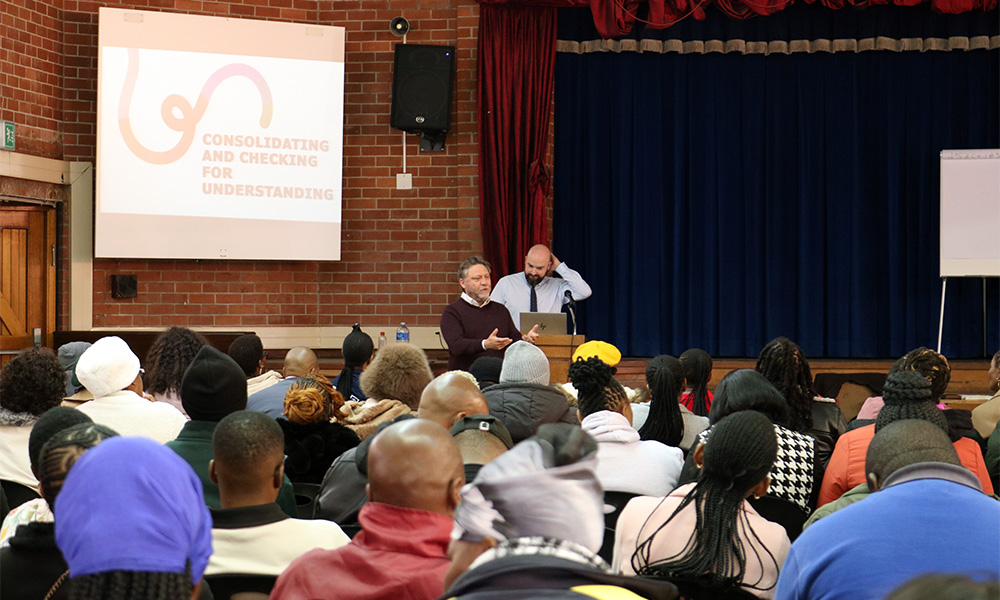
I have experienced cognitive overload both as a student and a teacher (and now at OR Tambo airport) as I’m sure we all have. This meant delivering these sessions to keen (if a little chilly – it’s winter in South Africa) teachers from schools in Madadeni Township with awareness of their cognitive load and not bombarding them with too much information too quickly. Like most teaching in education, teaching such a subject can get very self-referential; you are constantly aware that you should be doing the thing you are teaching whilst teaching it. Facilitating the cognitive load of the learners in our session was at the forefront of our minds when planning this session and it went down well according to the feedback we received both informally in the session and via our reflection forms.

The main content of these sessions focused on ways to reduce the cognitive load of students during the teaching of new material. We had structured the sessions in a way that we were introducing strategies in the order that they would be in lessons. We began with recall strategies and effectively activating students’ prior knowledge to prepare them for their new learning today. In South Africa, this is referred to as ‘from the known to the unknown’ (a phrase that many of the educators joined in with when we said it – clearly a popular one). We then focused on the gradual release model that is being utilised in many schools across England: I do, we do, you do. This involved me putting on my teaching hat and modelling the process as if the educators were my students – a process that, despite the cold, they engaged with as enthusiastically as I’d have hoped. The gradual release model helps students to engage with new learning without causing cognitive overload as the thinking responsibility moves gradually from the educator to the student. We then finished with a section on effective consolidation and how to aid the process of moving new learning from working memory into long term memory (which hopefully our sessions will!).

Another element we had to consider was our environment. Ben had taught sessions in South Africa before whereas I hadn’t been south of the Equator until our arrival. When discussing what elements of learning could lead to learners experiencing cognitive overload, the teachers across all sessions put forward that the children learning in a language that wasn’t their mother-tongue (for most in Madadeni, this is isiZulu) absolutely added to their cognitive load.

Another meta experience for us as this was also the case of the majority of the educators in the room despite their proficiency in English, it could not be ignored that we were not instructing in the language many would use amongst each other or when at home. We ensured that we had added a section about strategies to introduce new vocabulary at the start of lessons to learners as even when they are taught in their first language, new technical and subject specific words can add to a learner’s cognitive load. Our South African colleagues shared with us experiences and examples of these challenges: one science teacher informed us that the English words ‘energy’ and ‘force’ both translate to ‘amandla’ in isiZulu – adding an extra layer of difficulty to teaching about kinetic energy.

Throughout the sessions, the educators were able to give us insights into how they could apply the strategies into their own practice and still keep to the demands of the curriculum in South Africa. This was a wonderful experience working with some dedicated colleagues from a place where they face some similar and yet some very different challenges to teachers in England. This was my first involvement in the wonderful work that Project Zulu does and participating in it was a truly memorable, rewarding and challenging experience that has helped me to reflect more on my own practice.

A new book for Earth Day: Taking A Close Look at Microfibres

Posted on

Earth Day (22 April 2026) saw the launch of a new children’s book, Taking a Close Look at Microfibres. Co-created by school pupils and researchers from UWE Bristol’s Science Communication Unit (SCU) and Education and Childhood Research Group (ECRG), the book supports children and teachers to explore an often invisible aspect of air quality: airborne microfibres.

The book is part of the Schools Under the Microscope project, a child-led citizen science project that invites pupils aged 9–14 to take part in real environmental research. Through hands-on investigation, creative inquiry, and collaboration with university researchers, children from England and Wales helped generate new knowledge while shaping an engaging educational resource for use in schools.

Exploring what’s in the air we breathe

While microfibres are increasingly well documented in water systems, far less is known about fibres in the air we breathe – particularly in school environments. The Schools Under the Microscope project set out to explore whether established citizen science methods, previously used in homes, could work meaningfully in classrooms.

Following an initial pilot with 90 pupils at May Park Primary School, Bristol the project expanded to include around 400 children across four schools. Together, pupils designed investigations, made predictions, prepared petri dishes, and positioned them around their schools for a two‑week sampling period. After collection, pupils used microscopes to count fibres, while researchers at UWE Bristol carried out further analysis and shared findings back with the schools.

This marked the first time data on airborne microfibres has been collected within school environments, offering valuable insights into both indoor air quality and the potential of citizen science in education settings.

Learning through participation and enquiry

The findings showed that microfibre levels in schools were similar to those found in homes, including a mix of natural and synthetic fibres – some even matching the colours of school uniforms. More importantly, pupils and teachers reported high levels of engagement and enjoyment throughout the research process.

The team found that although air pollution is often invisible, it becomes meaningful through hands-on activities.

From research to a children’s book

Children’s questions, observations, and reflections directly shaped the storyline and content of Taking a Close Look at Microfibres. The book is designed to open up discussion rather than provide simple answers, encouraging curiosity, critical thinking, and dialogue about environmental issues that affect everyday life.

Page from the book, Taking A Closer Look at Microfibres.

The illustrations were created by Luci Gorell Barnes, a socially engaged artist and arts-based researcher. Recycled plastics, fabrics, card, and paper were used to make the images – all materials known to shed microfibres. These materials were scanned and transformed into digital collages, visually reinforcing the book’s themes of materiality, pollution, and reuse.

The book is accompanied by free teacher notes and ten lesson plans, supporting cross-curricular learning in science, geography, citizenship, and sustainability education.

Launching on Earth Day – and beyond

The project also connects with wider work at UWE Bristol around sustainability and social justice. The research team is partnering with the Global Goals Centre to support the Better Uniform Campaign, which seeks to develop a more socially and environmentally just system for school uniforms across Bristol.

Access the free book and resources

Schools, teachers, and partners can access a free e‑copy of Taking a Close Look at Microfibres with resources for lessons and learning.

The team

Dr Margarida Sardo, Dr Ben Williams, Dr Verity Jones and Jacqui Warner.

Thinking about death for the future

Posted on

By Dr Verity Jones, Associate Professor in Education

Recently, much of my thinking, particularly in collaboration with Chris Bear (Cardiff University), has led me to think more deeply about death as an ecological, educational and ethical concept that demands a futures lens. In our work on food systems, we ask what it would mean to attend to the deaths of non-human animals and plants –  not as abstractions but as lived relations.

In February, I attended the Centre for Sociodigital Futures, Immersive Public Futures Symposium, where themes of loss, endings, disappearance and possibility threaded through discussions of how societies imagine, design and negotiate futures.

International perspectives on imagining futures

Contributions from international speakers underscored that futures – thinking is rarely a smooth trajectory of progress.

  • Fabio Rubio Scarano (Federal University of Rio de Janeiro/Museum of Tomorrow) foregrounded planetary change and regeneration through anticipating and paying attention both to memory and tomorrow.
  • Lisa Bailey (Museum of Discovery, University of South Australia) explored how museums can engage diverse publics with complex and uncertain futures.
  • Andrea Bandelli (Woven Foundation for Creative Climate Communication) challenged us to recognise immersion not as a technical medium but as a condition – a relational mode that shapes how we encounter the world and its potential futures and agencies.
  • Mandy Rose (UWE Bristol) discussed documentary and digital cultures as tools for imagining post‑carbon possibilities through planty immersion.
  • Justin McGuirk (Design Museum, London) examined design-led approaches to futures and the need to construct possible future buildings to imagine within.
  • Dan Lockton (Norwich University of the Arts) reflected on how lost futures can help people collaboratively reimagine alternative futures.
  • Johannes Stripple (Lund University) used speculative ecology and storying  to unsettle fixed narratives of crisis and change.

Across these contributions, there was an insistence that imagining futures requires attending to what is disappearing, threatened or already lost.

Connections

The symposium strongly resonated with work with my own research. Whether supporting young women in imagining near-future careers in construction and engineering, examining ecological timescales in food ethics, or analysing how children’s literature either narrows or expands temporal imagination, much of my work is centrally concerned with how learners inhabit and negotiate time.

This sits alongside collaborations with colleagues at the Global Goals Centre and SPARKS Bristol, where we co-create learning experiences that are research‑informed, inclusive, socially engaged and committed to widening imaginative possibility.

Looking ahead

The symposium has sharpened my thinking on how endings and futures coexist – and how education must hold both. Several publications drawing on this work, including research on identity making, children’s literature and sustainable education, are currently in preparation and will be shared later this year.

Building capacity, community, and climate literacy – reflections from the CCPERN January meeting

Posted on

By Dr Verity Jones, Associate Professor in Education

The Climate Change Primary Education and Research Network (CCPERN) began 2026 with an energising and thought‑provoking meeting that reaffirmed why this community matters so deeply. Bringing together teachers, researchers, practitioners, and organisations committed to sustainability education, CCPERN continues to offer a vital space for sharing practice, fostering collaboration, and exploring the urgent challenges facing climate and sustainability learning in primary education.

Our January meeting welcomed two speakers whose work, though distinct in focus, revealed powerful synergies: Kate Colechin, from UWE Bristol’s careers and widening access team, and Mark Whittaker, headteacher at a North Yorkshire primary school. Together, they helped us consider not only what children need to learn about climate change, but how education systems can better prepare young people for a rapidly changing world.

Green careers and early aspirations

Kate Colechin opened the session by offering insights from her work training careers practitioners and supporting young people in schools. Speaking from both a higher‑education and school‑engagement perspective, she highlighted how central sustainability has become to contemporary careers work.

Kate shared that, within UWE Bristol’s postgraduate careers guidance programme, sustainability and the UN Sustainable Development Goals (SDGs) are embedded across modules, shaping how future advisors support both young and old to think critically about the environmental impacts of work, and to recognise that “every job is a green job”. Her reflections on working with school pupils were particularly resonant: young people, she noted, are increasingly worried about AI, future employment, and the state of the planet – and they respond powerfully to opportunities that spark curiosity and broaden their sense of what is possible.

A key takeaway was the importance of early career‑related learning in primary school, especially as research shows that children’s assumptions about jobs often solidify between the ages of 7 and 17. Challenging stereotypes, expanding horizons, and linking learning to real‑world sustainability issues can shape dispositions that stay with children throughout their lives.

Whole‑school climate education and the power of place

From a practitioner’s standpoint, Mark Whittaker shared the work underway across Northern Star Academies Trust to embed sustainability in curriculum, culture, and community. His school’s context added important nuance to discussions about equity, engagement, and what climate education looks like in practice.

Mark described how participation in the CAPE (Climate Adaptation Pathways in Education) programme had been transformative for both him and his staff, helping them articulate the “why” of climate education and recognise the need to thread sustainability throughout the curriculum rather than bolt it on. His examples of outdoor learning, river‑themed curriculum design, and farm twinning illustrated how powerful experiential learning can be for building ecological awareness and student wellbeing.

He also emphasised the challenges: staff confidence, parental perceptions, and political sensitivities around climate issues. Yet his school’s work shows how partnerships – with RHS, the National Education Nature Park, and particularly Jamie’s Farm – can offer life‑changing experiences for children who may have limited access to green spaces.

Shared threads and looking ahead

Across both presentations, a clear message emerged: climate education is not a single subject, but a holistic endeavour. Whether helping young people imagine future green careers or enabling primary pupils to build connections with their local environments, the work must begin early, be embedded meaningfully, and involve whole communities.

CCPERN remains committed to cultivating these conversations, sharing practice, and supporting educators and researchers navigating this shifting landscape. We look forward to continuing this momentum at our next meeting on 25 March 2026, when we will explore international data on environmental education with Professor Jennie Golding from UCL and hear from Green Schools about their work across England.

Interested in joining CCPERN? Please get in touch with Verity Jones (verity6.jones@uwe.ac.uk).

Why geography teacher educator conferences matter: Reflections from Manchester

Posted on

By Dr Verity Jones, Associate Professor in Education

The annual Geography Teacher Educator Conference took place in Manchester this year. At a time when teachers, teacher educators and researchers are navigating curriculum change, intensifying accountability pressures and the urgent challenges of climate and environmental crisis, conferences like this feel more important than ever. They offer not only a space for sharing research, but also a vital community of practice where ideas, uncertainties and hopes can be held collectively.

Conferences as spaces of knowledge exchange and care

The Geography Teacher Educator conference was awash with the generosity of exchange. Geography teacher education sits at a productive intersection between academic research, classroom practice and policy, and this was reflected in the diversity of sessions and conversations. Delegates moved fluidly between theory and practice: discussing curriculum futures, teacher identity, disciplinary knowledge, and pedagogical approaches to sustainability and environmental justice.

Equally important was the sense of support. Informal conversations over coffee were as valuable as formal presentations, offering space to share challenges, test ideas and reconnect with a community that understands the particular pressures of working in and with schools. In a sector where workloads are high and opportunities for reflective dialogue can be limited, these conferences act as moments of pause, renewal and collective thinking.

Schools under the microscope: Interdisciplinary inquiry with children

I was fortunate to present two interdisciplinary projects during the conference. The first was Schools under the microscope, a collaborative project (with Dr Ben Williams and Dr Margarida Sardo, UWE Bristol) that brings together geography, science, creative methods and children’s literature to explore how young people understand and experience their school environments.

Central to this project is our new children’s book, developed as both a research output and a pedagogical resource (with a launch coming soon!). The book invites children to look closely at microfibres. Sharing this work with geography teacher educators prompted rich discussion about the role of narrative, creativity and interdisciplinary approaches in supporting meaningful environmental learning.

The Hear Soil Project

My second input to the conference was a co-presentation with Amanda Bailey (Bath Spa University) focused on the Hear Soil Project. Hear Soil uses sound, sensory engagement and creative inquiry to foreground soil as a living, relational and often invisible element of geographical education.

Presenting this work within a geography teacher education context generated thoughtful conversations about how we might move beyond extractive or purely scientific framings of soil, towards pedagogies that emphasise care, reciprocity and more-than-human relationships. These discussions reinforced the value of collaborative, cross-institutional projects in opening up new ways of thinking about disciplinary knowledge.

Looking ahead

Leaving Manchester, I was reminded that conferences like this are not simply about dissemination. They are about connection, care and collective imagination. For those of us working in education and childhood research, they provide the conditions for interdisciplinary ideas to take root, for early-stage projects to be nurtured, and for shared commitments to social and environmental justice to be renewed.

As we look ahead to upcoming project launches and continued collaborations, the conversations begun at this conference will continue to shape both research and practice – a reminder of why these spaces matter.

Earth Day Heroes: Youth action, research impact, and the Bristol Uniform Challenge

Posted on

By Dr Verity Jones, Associate Professor in Education

On 30 September 2025, Sparks Bristol was filled with energy and optimism as over 100 young changemakers gathered for the Earth Day Heroes Awards Ceremony, hosted by the Global Goals Centre (GGC). From Bristol to Bangladesh, young people came together to celebrate the inspiring work they’ve been doing to make the planet better for everyone and everything.

These youth-led projects, spanning rewilding, recycling, campaigning, and creative storytelling, have involved over 7,000 participants taking active, positive steps toward sustainability, justice, and community care. It was a powerful reminder that young people are not just the future, they are part of the solution now.

Grounded in UWE Bristol research

This event and the initiatives it launched are deeply connected to research conducted at UWE Bristol. In particular, the Bristol Uniform Challenge (BUC) was launched at the ceremony. This draws directly on findings from a paper I co-authored with Dr Tessa Podpadec exploring children’s understanding of fast fashion and its impacts. The study, Young people, climate change and fast fashion futures, published in Environmental Education Research, revealed that while many young people are aware of climate issues, the links to everyday clothing choices are often overlooked.

School uniforms offer a tangible entry point for discussing sustainability, equity, and global supply chains. Through BUC, we aim to co-develop practical solutions with schools that reduce waste, support ethical production, and ease financial pressures on families  – while embedding sustainability into everyday school life.

Celebrating youth leadership

The Earth Day Heroes event featured contributions from Naomi Wilkinson (BBC Children’s wildlife presenter), a creative workshop from Aardman Animations, and award presentations by Dr Mya-Rose Craig (Birdgirl) and Cllr Henry Michallat, the Lord Mayor of Bristol. Their presence helped affirm the importance of youth-led action and the value of recognising it publicly.

As an Associate Professor at UWE Bristol, I’ve worked with the Global Goals Centre for over seven years, developing projects that centre social and environmental justice, creative engagement, and inclusive education. The Earth Day Heroes initiative is a living example of how research and practice can come together to support meaningful youth participation.

Looking ahead

Young people are now invited to begin developing their projects for the 2026 Earth Day Heroes Awards, continuing the momentum and deepening their engagement.

As educators and researchers, it’s vital that we create spaces where young people feel empowered to act, reflect, and lead. This event was more than a celebration, it was a demonstration of how research, practice, and youth voice can come together to shape a better future.

Children’s literature, anti-racism, and educational impact: ‘Difference in Primary Schools’ resource

Posted on

By Dr Verity Jones, Associate Professor in Education

On 23 September 2025, Lambeth Palace hosted the launch of the Difference in Primary Schools resource—an ambitious and timely initiative that uses children’s film, songs and literature to support meaningful conversations about race, identity, and belonging in primary education.

Developed by the Difference programme, the resource is freely available to schools and educators across the UK, offering a suite of lessons that foreground empathy, critical thinking, and inclusive practice from early years through to transition into Key Stage 3.

As the team leader for the RESPECT project, I was particularly proud that the transition lesson draws directly on If Racism Vanished for a Day – a book developed through our project. Co-created with children from Bristol schools, the text and illustrations invite readers to imagine a world without racism.

The integration of our book demonstrates how academic research can shape real-world practice, particularly in the context of anti-racism education. It also highlights the power of literature as a pedagogical tool: not only to foster understanding, but to catalyse change.

As schools begin to adopt the Difference in Primary Schools resource, the reach and relevance of RESPECT’s work continues to grow – supporting educators in creating classrooms where every child feels seen, heard, and valued.

Crafting change: How craft is empowering children for a sustainable future

Posted on

By Dr Verity Jones

In the face of escalating ecological and social crises, education must evolve to equip the next generation with the tools to imagine and enact a more sustainable and just world. In our new paper published in the International Journal of Social Pedagogy, we explore how eco-craftivism – the fusion of ecological awareness and craft-based activism- can serve as a powerful pedagogical tool in primary education.

Conducted with 120 pupils aged 8 to 9 in two UK primary schools, our research investigates how creative, hands-on learning can foster eco-social pedagogy (ESP). ESP expands traditional social pedagogy by integrating ecological consciousness with social justice, emphasizing the interconnectedness of people, planet, and the material world.

We call to for a de-bordering of solidarities: to move beyond human-to-human empathy and include solidarity with the environment and non-human “things.” This form of solidarity, with human-made objects, is crucial in cultivating sustainable behaviours. Craft and craftivism are powerful tools for building creative relationships with things in ways that build solidarities with those things, but also serve as gateways to holistic solidarities with the environment and human others. By engaging with recycled materials like copper wire, cardboard, and old socks, we explore how pupils developed material literacies – an understanding of the origins, value, and lifecycle of everyday items. This awareness, in turn, sparked deeper ecological and social insights.

The project’s workshops – where children crafted bracelets, puzzles, and sock puppets – were more than just craft lessons. They were immersive experiences that connected students emotionally and intellectually to the climate crisis. Pupils expressed joy in creating, pride in reusing materials, and a newfound sense of agency. One student reflected:

“It’s like doing something for the planet but also doing something that you can use.”

This dual purpose – personal enjoyment and environmental impact – embodies the essence of eco-craftivism.

Teachers, too, reported a shift in perspective. Inspired by the workshops, they reconsidered their own classroom practices, opting to use more sustainable materials and integrate environmental storytelling into lessons. The study highlights how craft-making can transform both teaching and learning, making abstract issues like climate change tangible and emotionally resonant.

Importantly, the research also addresses the emotional toll of climate education. Many children initially expressed fear and helplessness. However, through creative engagement, these emotions often shifted toward hope and empowerment. Crafting became a medium for emotional expression and resilience, helping students process complex feelings in a constructive way.

This study is a vital contribution to the growing field of climate education. It demonstrates that eco-craftivism is not just about making things – it’s about making meaning. By fostering solidarity with people, nature, and objects, it cultivates a holistic understanding of sustainability that is both intellectually rigorous and emotionally grounded.

As we seek innovative ways to prepare young learners for the challenges ahead, this research offers a compelling model. Eco-craftivism shows that with the right tools – scissors, thread, and a bit of imagination – children can begin to stitch together a better future.

The full reference of this new article is:

Mulholland, J., Jones, V., Pawson, C. and Harrison, L. (2025). De-bordering solidarities: using eco-craftivism as an eco-social pedagogy in primary education. International Journal of Social Pedagogy, 14(1): 8.
DOI: https://doi.org/10.14324/111.444.ijsp.2025.v14.x.008.

Insights into the Learning to Care in the Food System article

Posted on

By Dr Verity Jones (UWE Bristol) and Dr Chris Bear (Cardiff University)

We are pleased to announce the publication of our article, Learning to Care in the Food System: Education for Sustainable Development resources, food education and the farming of animals for food, in Environmental Education Research. This sees the first review of the place of animals in food education resources for 5-11 year olds, making an important contribution to research relating to the nature and role of learning resources for education for sustainable development.

Food politics and animal welfare have recently hit the headlines as the US and UK administrations begin to explore new agreements with regard imported/exported meats. Throughout these discussions, UK representatives have been clear that any imported meat must adhere to strict food and farming standards – for example, imports of hormone-treated beef will not be permitted. This practice was banned in the UK in 1989, along with the rest of the EU, after studies suggested it could pose potential risks to human health and animal welfare. Issues of animal welfare are central to our food system and geopolitics and, we would argue, critical for inclusion within education in every phase.

In our article, we explore 117 resources aimed at ages 5–11 olds, and reflect on the implications of these and how future resources might be designed to prompt not only critical reflection on the food system but more meaningful actions and engagement amongst learners regarding care of animals farmed for food.

Key findings

We found that food education resources focussed on animals for food include very limited discussion on the welfare of farmed animals. Similarly, there are few resources that explore the link between livestock farming, climate change and sustainability – a critical lens through which food production should be framed if we are to develop agile, resilient and adaptable food systems.

Overall, we note that resources often lack depth in promoting a more-than-human ethic of care, focusing more on human-centric perspectives. We argue that there is a need for resources that extend beyond healthy food behaviours to encompass critical thinking about sustainability and ethical questions around the place of nonhuman animals in the food system. Drawing health, sustainability and animal welfare together in educational resources is a key step towards addressing the complexities of the food system and the role of animals within it.

We call for:

1. Curriculum Development

  • Inclusion of Animal Welfare: integration of animal welfare topics into the curriculum in order to foster a more holistic understanding of the food system.
  • Sustainability Education: Highlight the connections between livestock farming, climate change, and sustainability in order to support learners navigate environmental impacts of food production.

2. Resource Creation

  • Ethically Inclusive Materials: Develop resources that promote a more-than-human ethics of care to help learners appreciate the ethical dimensions of farming and food consumption.
  • Critical Thinking: Develop materials that encourage critical thinking about the ethical treatment of animals so to lead to more informed and compassionate future generations.

3. Teacher Training

  • Awareness: Train educators to address food systems topics sensitively and knowledgeably in order to enhance the effectiveness of teaching about the food system.
  • Interdisciplinary Approaches: Encouraging interdisciplinary pedagogies that combine science, ethics, and environmental issues to provide a more comprehensive educational experience.

4. Student Engagement

  • Active Participation: Engage learners in discussions and activities related to food ethics and sustainability to foster a sense of responsibility and care for the environment.

We believe that resources informed by the food system, sustainability and animal welfare have the potential to inform, develop greater empathy, and an environmentally conscious generation, better equipped to tackle the challenges of sustainable food production and ethical consumption.

To find out more, contact Verity (verity6.jones@uwe.ac.uk).

Are we listening?

Posted on

Chloe Newman shares processes, findings and next steps of her research using Photovoice to advocate for the voices of children with autism in a mainstream EYFS setting

By Chloe Newman (chloe2.newman@live.uwe.ac.uk)

This blog discusses the process, findings and next steps of Chloe Newman’s 2024 Masters project; ‘Are we listening? Photovoice research advocating for the voices of children with autism in a mainstream EYFS setting’.

I grew up being educated in both English and Welsh schools and now, having been an undergraduate and postgraduate student at UWE Bristol, I am proud to be a neurodiverse teacher in mainstream and special schools. My values in education are ever-growing but at my core I believe in continual personal reflection and creating meaningful relationships with students as individuals. In fact, countless conversations with my Masters supervisor have led me to acknowledge myself as a Freirean who does not fit within the traditional ‘banking model’ of education where teachers hold the power and students are simply taught, disciplined, and comply instead, I am driven by a Freirean sense of mutual respect, care and hope for social change from the current political framework of education.

Working with four-year-old children with autism and limited verbal communication I wanted to examine if, with the right support, they would be able to express views. I wanted to know what was important to them in school, how I could help them to share their voice and how we, as educators, could respond to Reception aged children with autism’s voices.

This research would allow me to shine a light on important, yet often minoritised, individual voices. It enabled me to challenge what is often the line of least resistance for mainstream educators due to competing educational demands. My hope was, and still is, to continue to open the conversation around more awareness of strategies that authentically invite children with special needs to the table.

My search for an appropriate methodology led me to Burris and Wang’s 1990’s Photovoice which was created to give a voice to marginalised groups of society. For me, another appealing feature was it’s underpinning in Freire’s belief in a researcher as a facilitator with the hope of having an impact on policy. Photovoice typically follows the structure of using the method of participant led photography, reflection upon photographs and sharing with the community to promote policy.

It is widely acknowledged within special schools that children with autism benefit from a total communication approach and using Alternative and Augmentative Communication (more can be read on this within the New Siblands Special School Total Communication Policy). Using self-led photography felt like an innovative tool for which could be used as a type of AAC. Do. et al.’s meta-synthesis in 2021 found that photovoice has been used with individuals with autism. However, in these studies the youngest children were eight years old and had verbal communication, this was notably different in comparison to my project. This created an interesting reflection point for me and as a Freirean based methodology, relationships had to be at the heart of the study which meant adapting and then extending the methods used.

The project used a variety of AAC strategies including the iPad for self-led photography and an additional communication board for one student. These, alongside using a relational approach and parents to support with reflections, were the flexible tools that begun a process of allowing children to share their viewpoints. When holding the iPad to explore their world, I was surprised to find both children’s imaginative play and vocabulary was increased. This has led me to consider further exploration into whether using a camera as a relational tool could support children with autism’s imaginative vocabulary.

The findings of my project and supporting literature appeared to create some generalised answers which would be worth further investigation. These included both children’s desire to communicate with trusted adults, the importance for them of accessing outdoor spaces and chosen quiet spaces and their interest in school display art. However, the children also surprised me in their own individual ways. For example, there was a held assumption prior to the project that one child did not understand emotions and yet during their self-led photography they chose to take countless photos of other children who they described as ‘friends’ who ‘were happy’.

A key aspect of my title was ‘Are We Listening?’ and when considering the educators’ responses to these children’s expression of self, it would have been too simplistic for me to say educators listened to children’s voices and actioned these to give the children agency. Within the political and social climate of mainstream education, educators held what appeared to be deep-rooted concerns around funding available for support these children and debates around whether mainstream was an appropriate setting. Educators had good intentions and were surprised by the children’s ability to express themselves, but real change is an authentic process which takes time.

The project has created what feels like a responsibility to continue a collective dialogue across educational settings around the following questions:

  • Could special schools and mainstream schools be working closer together to share their best practice? And could this in turn, help to foster a holistic approach to education where guidance can be given on how to appropriately implement AAC within mainstream schools?
  • Do we give children with SEN, parents and educators the agency to contribute to conversations around ongoing improvements for the AAC which impact them directly?
  • How are we preparing our future teachers at initial teacher training to use practical and experiential approaches to total communication for children regardless of if they are training to be in mainstream, specialist or alternative provision?

For more information around this project and future research, please contact Chloe Newman (chloe2.newman@live.uwe.ac.uk).

References

  • Do, P. L., Frawley, P., Goldingay, S., O’Shea, A. (2021) The use of Photovoice in research with people on the autism spectrum: A meta-synthesis of the literature. Research in Autism Spectrum Disorder. 87 1-14. Available from: https://www.sciencedirect.com/science/article/pii/S1750946721001033 [Accessed 24 April 2024]
  • Freire, P. (2014) Pedagogy of Hope. London: Bloomsbury.
  • Freire, P. (2013) Education for Critical Consciousness. London: Bloomsbury.
  • Freire, P. (2005) Teachers as Cultural Workers: Those who dare teach. Boulder, Routledge Second Ed.
  • Freire, P. (1972). Pedagogy of the oppressed. Penguin Books
  • New Siblands School (2025) Total Communication Procedure. Available from: https://www.newsiblands.org.uk/Policies-and-Documents/ [Accessed 9 April 2025]

Back to top

Follow this blog

Get every new post delivered right to your inbox.