


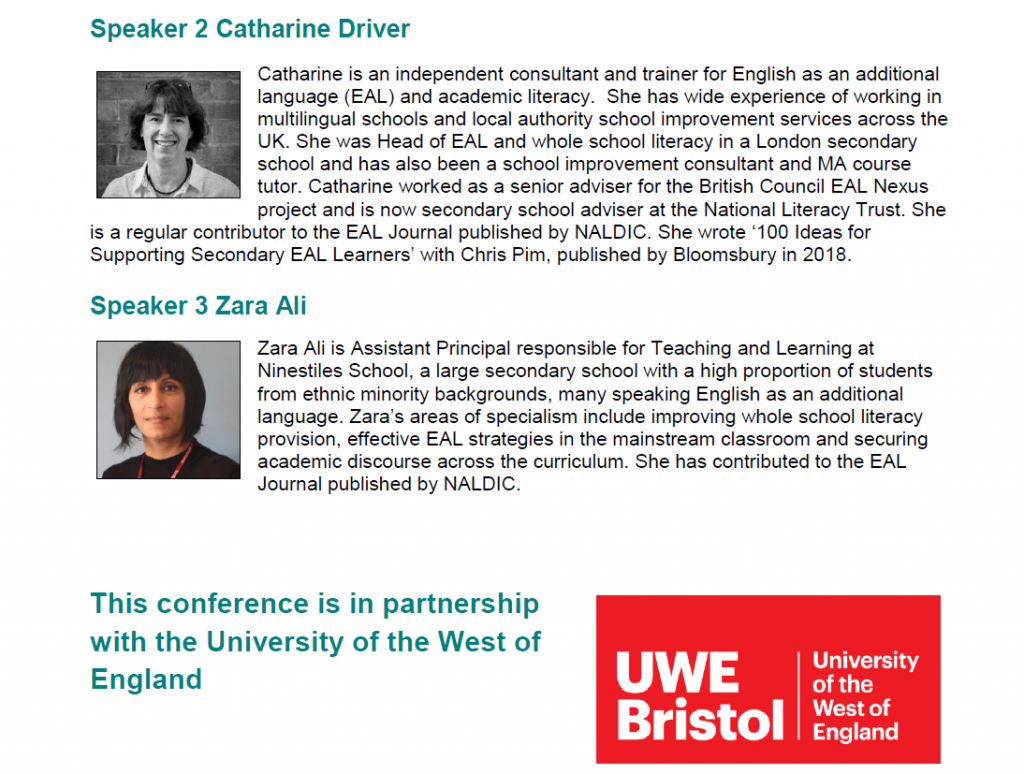
Cost – £30 To make a booking visit our CPD online booking system at http://cpd.sgsts.org.uk and quote conference ref number CONF/19/155
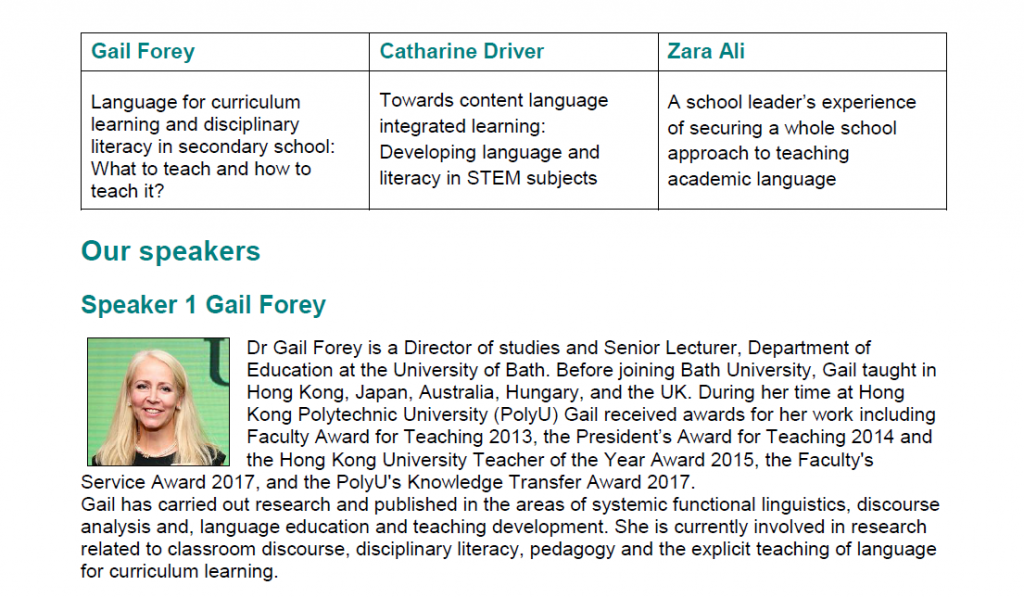
Cost – £30 To make a booking visit our CPD online booking system at http://cpd.sgsts.org.uk and quote conference ref number CONF/19/155
UWE Bristol is taking a pro-active action and working collaboratively with students, UWE Student Union, staff and the city of Bristol to tackle Gender Based Violence.
I (Helen Bovill) recently spoke at two events in Bristol, at City Hall; exploring the research and provision at UWE aimed at interrupting and preventing gender based violence (GBV). I was really pleased to be invited to be part of the panel closing the day in the Bristol Zero Tolerance room (BZT) at the Bristol Women’s Voice (BWV) International Women’s Day celebration on March 2nd 2019. I joined in conversation with an expert panel of speakers from Safegigs4women, Somerset and Avon Rape and Sexual Abuse support (SARSAS), Stand Against Racism (SARI) and feminist performers Deborah Antoinette and China Fish. At this event I discussed the research I am involved in regarding GBV and UWE’s proactive approach to GBV as part of SpeakUp – this is a UWE collaboration between: UWE students, UWE Student Union, UWE staff, and external Stakeholders; (BZT), (SARSAS) and (SARI). The SpeakUp campaign asks students and staff at UWE to speak up when a situation does not feel right. The campaign emphasises safety first and foremost, and aims to work with students and staff to develop the knowledge and skills to be pro-active bystanders. It has developed films (see below) which have a tag line of ‘inappropriate behaviour, appropriate action’. The campaign is focused on enabling and sustaining ‘an inclusive campus where diversity is celebrated, antisocial attitudes and behaviours are challenged and any type of harassment, assault and discrimination aren’t acceptable. We want you to SpeakUp if you see or hear something that’s not right, and be an active bystander.’
Students, staff and the Students’ Union at UWE are committed to developing and cultivating an inclusive campus for all our students to thrive within. We are proud to work in close partnership to continually review our approach to sexual violence and harassment on campus and ensure we have effective proactive campaigns in place, as well as vigorous support mechanisms. Rachel Colley (Community Manager at The Students’ Union at UWE), Dr Helen Bovill (Associate Head of Department Research and Scholarship), Ana Miguel Lazaro (Student Inclusivity Project Officer, UWE) and Charlotte Gage (Bristol Zero Tolerance) recently spoke at a second event in the City. This time at the Bristol Forum ‘Creating positive action through research and collaboration’ event on Friday March 29th 2019 at City Hall.
They spoke about ‘Collaborative problem solving to address the challenges students face in relation to sexual and domestic violence’. Helen discussed bystander intervention as part of the SpeakUp campaign, Ana and Rachel spoke about the wider work of the campaign within UWE and the involvement of the Student Union at UWE within this. For example, discussing that more than 5000 UWE Fresher’s students received messages from the SpeakUp campaign during induction. The five short films, developed by UWE as part of the Office For Students (OFS) funded social norms campaign, formed part of this induction. These films explore issues of: ‘unwanted touching and groping’, ‘consent’, ‘inappropriate use of social media’, ‘domestic abuse’, and ‘initiation and humiliation ceremonies’, they can be found here. Helen, Ana and Rachel talked about student involvement in the research that underpinned the social norms campaign, with UWE students identifying these five social norms as problematic in student life. They also discussed how UWE works with students and the city of Bristol, with an understanding that UWE students are ambassadors for the University in the city of Bristol and beyond. Charlotte Gage from BZT discussed working with UWE on this campaign and the collaborative approaches used. She also considered the wider work regarding GBV and BZT within Bristol such as the Stop Street Harassment Campaign. Both talks demonstrated that UWE sees itself at the forefront of measures to counteract GBV, and is working in a pro-active and collaborative manner with both students and the city of Bristol.
If you are passionate to support this work, why not join the new Speak Up Society!
For more information, please click the following links:
Author: Helen Bovill, Associate Head of Department Research and Scholarship, the Department of Education and Childhood, the University of the West of England.
Let’s get to know some of the people in the Department of Education and Childhood, ACE Faculty a little better. Dan Northover, Senior Lecturer in Primary Education, tells us more!
Dan works within the Education Department at Frenchay, lighting up S Block for staff and students alike. His students quote Dan as being enthusiastic, dedicated and very generous with chocolate! Last week, Dan won the Outstanding Teaching Award at the Student Experience Awards.
Dan is completing his PhD in Education at the University of Exeter. His current research interest is in the area of children’s writing and how metacognition and metalinguistic awareness develop across the primary years. Let’s find out more about Dan – outside of the classroom!
Favourite thing about working at UWE?
Working alongside such fantastic colleagues and students, and that part of my role is to read and talk about brilliant children’s books!
Three things you’d take with you to a desert island?
· My wife and kids
· A library card for the Desert Island Library
· A coffee machine
If you could host a dinner party and invite anyone (historical/fictional/real), who would you invite?
I’d invite Yotam Ottelenghi, Nadiya Hussain, The XX, Royal Blood, Dave, Maya Angelou, Cormac McCarthy, Zadie Smith, Kazuo Ishiguro, Philip Pullman, Nicola Davies and Tom Percival, then I’d have the food, music and bookish conversation sorted!
One thing that may surprise you?
My current favourite TV show is ‘The Marvelous Mrs Maisel’ – doesn’t sound great from the title but is actually really good!
A quote that inspires you this month?
“Stories matter.Many stories matter. Stories have been used to dispossess and to malign, but stories can also be used to empower and to humanize. Stories can break the dignity of a people, but stories can also repair that broken dignity.” Chimamanda Ngozi Adichie
Thank you Dan, congratulations again on such a well-deserved win!
The Department of Education and Childhood, Bristol Inter-disciplinary Group for Education Research (BRIDGE), is pleased to have Dr Jessica Gagnon speak about the HEFCE funded research project Changing Minds, 7 May, 4:30-6:30, Room 2S604, Frenchay Campus.
The challenge to change unequal student outcomes: Initial findings from the Changing Mindsets project
This presentation will explore initial findings from the two-year Office for Students (OfS) funded attainment gap project titled “Changing Mindsets: Reducing stereotype threat and implicit bias as barriers to student success”. The project is focused on addressing unequal student outcomes for two student groups: Black and Minority Ethnic (BME) students and socio-economically disadvantaged students. Findings from the project are intended to inform higher education policies and practices to address inequalities in students’ experiences and outcomes. For more about the project, please visit the website or follow the project on Twitter.
To register and book your place, please click here.
Dr Jessica Gagnon is a Senior Research Fellow in the School of Education and Sociology at the University of Portsmouth. She is an educational sociologist with a PhD in Education from the University of Sussex. She was raised in a working-class, American, single-mother family and she was first in her family to attend university. Her research is focused on inequalities in higher education.
Tuesday 27th November 2018 was the culmination of over four years of work – the awarding of my Education Doctorate at Bristol Cathedral alongside fellow students. The Cathedral echoed with the voices of many students, parents, friends and supporters all celebrating a mixture of academic success, resilience, personal struggle and the joy of learning. The floppy hat and gown worn at the ceremony added to the sense of occasion, tradition and the special nature of the event: it isn’t often you are able to don such a hat and it isn’t everyone who can!
The smiles and congratulations were a product of this unique award that recognises the professional knowledge, skills and practice of the student and this is foregrounded in the way the doctoral programme runs and how the student’s research is guided and located.
My research was titled ‘An Illuminative Evaluation of the Year 1 Phonics Screening Check: Listening to the Voices of Children and their Teachers’ and it was situated in my long history as first, a primary school teacher then deputy head, Teaching School Manager and Initial Teacher Educator. I knew that the Phonics Screening Check was the area I wanted to research: it was impossible to ignore the anecdote of a friend, a Head Teacher of a diverse inner city primary school who related the story of a number of children in her school in the year the check was introduced. The Phonics Screening consists of 40 words: 20 real and 20 pseudo words that children sound and blend to read. One of the real words in the check was the word ‘nigh’. A number of children didn’t recognise the trigraph ‘igh’ (three letters that make one sound) and sounded the word as ‘n-i-g-hur’. Rather than blend the sounds to make the word the children were confused and upset: if they blended this word they would say a word that was considered offensive, a word that their teachers and fellow classmates knew as rude and inappropriate. The same story was recounted by a number of teachers across schools in the city. Prompted by the initial stages of the EdD programme, I was able to begin to frame this as an unintended consequence of the Check and so an area that needed to be explored further.
The Education Doctorate has an initial taught phase which guides, prompts and challenges the wide range of professionals that embark on the doctoral journey. The first part of the EdD encourages reflection and critical positioning and so enabled me to identify my doctoral thesis focus. What is distinctive is the variety of educational professionals on the programme: in my cohort this included a prison educator; an Early Years Centre Manager; secondary, F.E and H.E teachers and lecturers; an air traffic controller trainer and a teaching assistant and learning mentor in a local primary school. It is this diverse group that enables each person to think beyond the usual professional considerations, to view issues in new ways to “make the familiar strange” (Jackson and Mazzei, 2012).
The programme challenged my approaches to thinking about ethical considerations in research and led to my thesis that foregrounded the voices of those “normally silenced” (Greene, 1994) in educational evaluation – in my case, the children who took the Phonics Screening Check. The EdD programme also pushed me to reflect on theory and in my research, the myriad of theories that impact on the practice of the teaching of early reading. A study unit on policy shone a light on the different ways that policy can be analysed which drew me to the work of Gemma Moss and the evolution of Literacy policy. All of this was in Part One of the EdD programme and this provided the springboard to progress to Part Two– the research itself. Guided by challenging supervisors who questioned, recommended and pushed me to explain and explore beyond my usual comfort zone, the thesis took shape. This was a period of delight in the wisdom of the five year olds I talked to in my focus groups; despair in the multiple writes and re-writes of different sections and moments of the type of ‘flow’ that Csikszentmihalyi describes, the total absorption in the task at hand.
I would recommend the UWE Education Doctorate to any educational professional who wants to lay bare an aspect of practice, to approach it from different viewpoints, to dissect it with forensic care and to challenge their thinking beyond the everyday. And of course – there is the lure of the floppy hat to keep you going!
Dr. Jane Carter is a senior lecturer in education and childhood.
BRIDGE is pleased to invite you to the Paired Peers Twilight event. This event is on 14 Feb, 16:30-18:30, Room 2S704, Frenchay Campus, the University of the West of England.
Critical perspectives on transitions into, through and beyond university: Learning from the Paired Peers project
Dr Richard Waller, Associate Professor of the Sociology of Education, Dept of Education and Childhood.
The phenomenon of people’s access to and experience of higher education being informed by their social class position is by no means new. Yet despite numerous policy initiatives and interventions in the last few decades, significant inequalities remain between working and middle class young people regarding their chances of progressing to higher education, the type of university attended, their student experiences and their graduate outcomes. The Paired Peers project was a two part longitudinal study (2010-2103 and 2014-2017) funded by the Leverhulme Trust which followed an initial cohort of 90 undergraduates studying at either of the two universities in one English city. The University of Bristol is an ‘elite’, research intensive institution and a founding member of the Russell Group. The University of the West of England is an ex-polytechnic, a post-1992 institution generally lying around the middle of HE league tables and which prides itself on the quality of its teaching as evidenced by the recent Gold TEF award. The project matched pairs of students by social class, gender and subject discipline both within and between the two institutions, and followed them from induction to graduation and for several years beyond into their post-university lives and careers. The project explored not just what class based inequalities existed in terms of access to university, the experience of going through higher education and the transition into the workplace, but also the processes by which these significant inequalities were established and maintained.
The presentation will be followed by a discussion of the implications of the project’s findings for the practice of academics and university professional services staff alike.
This event is free. However, registration is required. To register click here. Refreshments will be served.
Please share widely.
The Department of Education and Childhood, Bristol Inter-disciplinary Group for Education Research (BRIDGE) invites you to this seminar on 21st Jan 2019 — 12noon-1pm — Room 2S602. This event is open to everybody.
Ms Dimitra Magkafa, Doctoral Researcher, Department of Arts and Cultural Industries, UWE
In recent years, there has been much research into the potential of technology programs to support and facilitate a variety of skills for children with ASD and, in some cases, access to services. From a museum perspective, digital services are a means of extending the network of visitors and of enhancing visitor experiences with object rich collections. Having these perspectives as a starting point, the aim of the talk is to present briefly the overall process for the design and evaluation of a museum-based app for children with ASD. The purpose of the study was to develop a digital platform that would promote the inclusion and foster the engagement of children with ASD in a museum environment. This study aimed to understand the impact of a digital museum experience, through collecting and analysing qualitative data. The results obtained from different perspectives revealed the positive influence of the museum-based app by presenting emotions of enjoyment, engagement, and satisfaction among the children. This study provided some important insights into the importance of the use of digital services, in this case, a touchscreen-based app, as a mediating tool to offer opportunities for interactive experiences and create an inclusive environment for diverse user communities in the museum community.
Dr Nigel Newbutt, Senior Lecturer / Researcher Department of Education, UWE
In this talk I will provide some context to using head-mounted display (HMD) technology with autistic groups; the potential benefits and why this technology has/is being applied. In addition, this session will provide insights from research and practice in using technologies in classrooms for autistic children. I will look at virtual reality and examples of how this has been applied with autistic children in their education (and specific support needs more generally) for positive gains and outcomes. This talk will showcase some examples and responses to using virtual reality in schools while also covering some of the key challenges and barriers that have been reported in taking VR into classrooms. With the benefits of VR-HMD technology clear (from a research perspective), I will discuss the ways to best overcome some challenges that lie ahead and how practitioners and researchers can work collaboratively to help ensure technology can be applied in real-world settings.
This post was originally published on The British Educational Research Association on 18 December, 2018.
‘Aspirations’ are a wonderfully simple concept. The problem is that it’s becoming increasingly clear they are of little worth in terms of understanding pathways towards higher education, as we argue in our new article in the British Educational Research Journal (Harrison and Waller, 2018).
In it we explore how higher education outreach activities are conceived and delivered through the eyes of two generations of practitioner-managers: those leading the national Aimhigher programme (2004–2011), and those now working in English universities. The first group, comprising 10 former directors of the programme, participated in extended telephone interviews, while data from the second group was collected through an online survey.
One notable theme within our data is the ubiquity of the discourse of ‘aspiration-raising’. While the Aimhigher generation were generally critical of it, contemporary practitioner-managers are much more committed to the idea. It’s where they feel their work is successful, and it underpins many of the activities that they manage.
‘Aspiration-raising is touted as the silver bullet for social mobility. The problem is that it simply doesn’t stack up, as the evidence demonstrates.’
Indeed, this discourse of aspiration-raising has long pedigree. The argument runs that many disadvantaged young people don’t participate in higher education because they lack ambition: they seek careers that don’t match their academic potential, and they are satisfied with less. Aspiration-raising becomes the silver bullet for providing social mobility – a commonsense ‘quick win’.
The problem is that it just doesn’t stack up, as has been demonstrated by several recent large-scale studies that explored the aspirations of young people. Firstly, disadvantaged young people do not have notably lower aspirations that others (Baker et al, 2014). Secondly, if anything, some young people’s aspirations are unrealistically high (St Clair, Kintrea & Houston, 2013). Thirdly, there is no strong evidence that aspirations drive motivation or attainment (Gorard, See & Davies, 2012).
So, where does this leave us? We argue that we need to refocus our attention on young people’s expectations. Contrary to aspirations, there is good evidence for a link between expectations and disadvantage (Archer, DeWitt & Wong, 2014).
This is not just a semantic turn. Expectations are substantively different to aspirations. They embody not just what a young person wants to be, but also a subjective assessment of challenges and constraints. Many young people aspire to be professional sportspeople or entertainers, but few expecttheir lives to turn out that way.
Young people’s expectations are forged through the people who surround them – the everyday messages about what they can or should do, or what they cannot or should not. Teachers and parents exert a strong influence on how young people see the world, yet outreach programmes rarely engage extensively with these influencers.
Higher education outreach needs a rethink. It needs to abandon the vapid discourse of aspiration-raising and consider expectations instead. We make three broad suggestions.
This blog post is based on the article, ‘Challenging discourses of aspiration: The role of expectations and attainment in access to higher education’, Challenging discourses of aspiration: The role of expectations and attainment in access to higher education’, by Neil Harrison and Richard Waller, published in the British Educational Research Journal. It is free-to-view for a time-limited period, courtesy of the journal’s publisher, Wiley.
References
Archer, L., DeWitt, J. & Wong, B. (2014). Spheres of influence: What shapes young people’s aspirations at age 12/13 and what are the implications for education policy?. Journal of Education Policy, 29(1), 58–85. https://www.tandfonline.com/doi/abs/10.1080/02680939.2013.790079
Baker, W., Sammons, P., Siraj‐Blatchford, I., Sylva, K., Melhuish, E. C. & Taggart, B. (2014). Aspirations, education and inequality in England: Insights from the effective provision of pre‐school, primary and secondary education project. Oxford Review of Education, 40(5), 525–542. https://www.tandfonline.com/doi/abs/10.1080/03054985.2014.953921
Gorard, S., See, B. H. & Davies, P. (2012). The impact of attitudes and aspirations on educational attainment and participation. York: Joseph Rowntree Foundation. Retrieved from: https://www.jrf.org.uk/report/impact-attitudes-and-aspirations-educational-attainment-and-participation
Harrison, N. & Waller, R. (2018). Challenging discourses of aspiration: the role of expectations and attainment in access to higher education. British Educational Research Journal, 44(5), 914–938. https://onlinelibrary.wiley.com/doi/10.1002/berj.3475
St Clair, R., Kintrea, K. & Houston, M. (2013). Silver bullet or red herring? New evidence on the place of aspirations in education. Oxford Review of Education, 39(6), 719–738. https://www.tandfonline.com/doi/abs/10.1080/03054985.2013.854201
Neil Harrison (@DrNeilHarrison) is deputy director of the Rees Centre at the University of Oxford. His research interests are focussed on social justice issues in secondary and higher education, especially for marginalised groups such as care-experienced students. He is the co-editor of Access to Higher Education: Theoretical Perspectives and Contemporary Challenges, published by Routledge in 2017.
Richard Waller has worked in further and higher education for over 20 years, and is currently associate professor of the sociology of education at the University of the West of England. His research interests focus on the intersection of education, identity and social justice, and he has published widely in the area.
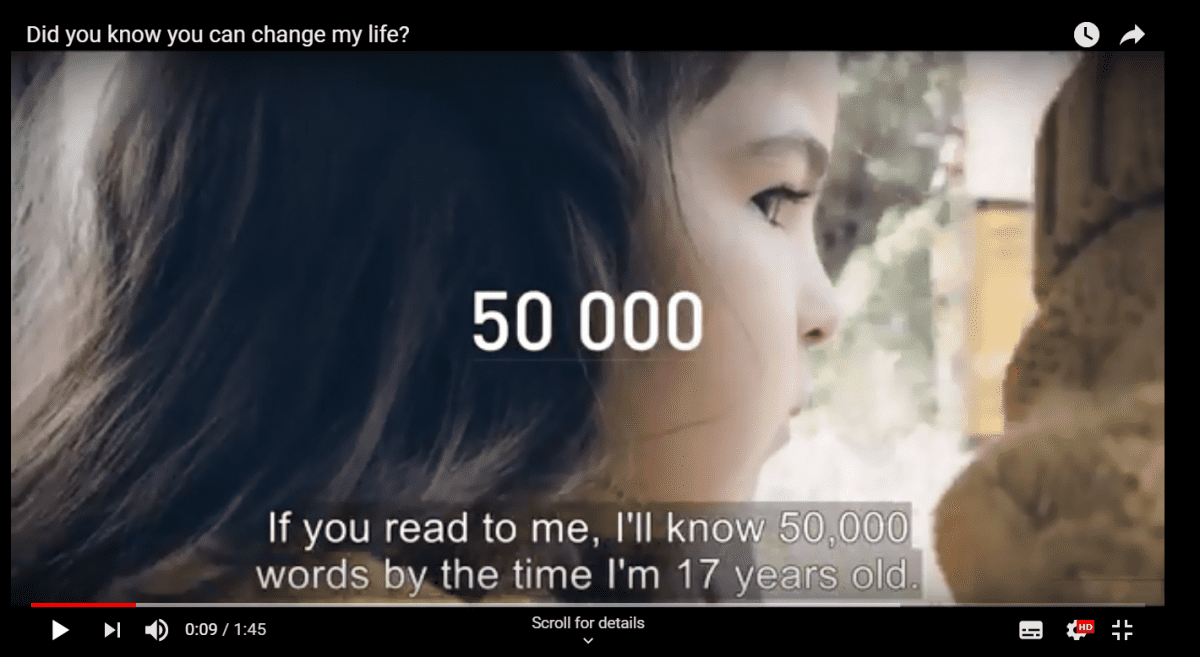
Changing a life is easy.
Start by watching this short film.
Changing a life is as simple as sharing a book with a child. This is the message that has engaged and enthused a team of librarians, academics, family workers and local authority education specialists from across five European cities who are part of the Erasmus Plus project ‘Open the Door for Reading’
There is a growing body of research that provides the evidence about the benefits of reading aloud to a child: whether you are a parent, caregiver, teacher or from a whole host of professions working with children and families. The research by Shahaeiana et al (2018) offers a comprehensive overview of the benefits,
Results indicated that early shared reading was associated with children’s academic achievement directly and indirectly through receptive vocabulary and early academic skills. Also, the frequency of early shared reading predicted the outcome measures, over and above other home learning activities. Associations were stronger among low and middle socioeconomic status groups compared to the high socioeconomic status group. We conclude that shared reading offers unique opportunities for adults to teach young children new words and concepts
Gothenburg, in Sweden had for some time been troubled by the apparent decline in caregivers reading to and with children, and the city embarked on an initiative to promote reading – to be “The City Where We Read for our Children”. Their research had suggested that only four in ten parents read with or to their child.
To develop the project further Gothenburg applied for Erasmus Plus funding for the ‘Open the Door for Reading’ Project launched with cities that had a similar focus: Turku in Finland; Brussels in Belgium; Milan in Italy and Bristol. Each city faces particular challenges and has similar issues with families who have traditionally been harder to engage in education or social services. Details of the project can be found on the website. The cities have met three times now and have learnt from the practice in each country. Exciting ideas like cloakroom libraries in Gothenburg; bedtime story book shelves in early years settings in Turku and using UWE teacher training students to read with children in Bristol have ignited the imaginations of participants. Gothenburg also shared the short film linked at the start of this piece. It was produced to promote reading to caregivers. It is a powerful reminder of the impact of reading for both the child and the caregiver.
The Bristol team, Debbie Miles and Cerys Stevens (Reading Recovery Teacher Leaders), Kate Murray (Head of Libraries) and Jane Carter have been working on the projects’ output: a practitioners’ guide to supporting caregivers with reading. This guide is full of practical ideas and tips for non-education focused professionals in ways to encourage first steps in communication around a text. It is hoped that midwives, social workers, family workers and early years professionals will become ambassadors for reading in the knowledge of its life changing effects.
The team is also now trying to gather support for a Gothenburg style initiative in Bristol and has begun to plan ‘Bristol, a reading city’. The city’s councillors are interested in the project as are many stake holders who attended a first meeting a few weeks ago to plan possible first steps in the project. Representatives came from local businesses, charities, city council services (Early Years; Family Support), the museum, libraries and schools. We are currently exploring funding avenues and hope to establish the first Bristol Cloakroom libraries along with community reading ambassadors. I am planning for UWE students to be involved in this exciting initial step and with the ‘Bristol a Reading City’ when funding is secured. Watch this space!
Author: Dr Jane Carter, Senior Lecturer at the Department of Education and Childhood, the University of the West of England.
Bristol Inter-disciplinary Group for Education Research (BRIDGE) invites you to a lunchtime seminar on 13 December, 12-1pm, Room 2S601. Our speakers are Laura Manison Shore, PGCE Primary and EY Programme Leader and Partnership Manager, Department of Education and Childhood; and Dr. Maryam Almohammad, a Research Associate at the Department of Education and Childhood.
Laura Manison Shore: EdD student (part 2) Title of EdD thesis:
Is teaching a classed and gendered profession? Exploring the narratives of female primary school teachers

This research explores the experience of female trainee primary school teachers during their first year at this university. It is set against a backdrop of perceived class identity, developing professional identity, and choices made that led them to train to be a teacher. My overarching interest is in the notion of class and how this impacts self-perception and emerging professional identity and asks, is primary school teaching a classed – and gendered occupation? Through narrative enquiry as a methodological approach, I listen to trainees’ ‘stories’, and unpick and develop the themes that I have foregrounded in my research questions and engage with my participants to co-construct themes and meaning from the narratives they share. I am particularly interested in the experiences and subsequent impact on habitus of women who are first generation university attenders. My theoretical position is framed by Bourdieu’s notions of capital; I am interested in how these capitals might be both explicitly and implicitly demonstrated by my participants. My particular focus is around the area of cultural capital and the assumed nature of certain forms of knowledge and practices. My interest in both the substantive research focus and the choice of methodology is embedded in my own ‘life history’, and self-consciously reflecting on my own experiences is a way of reflexively understanding my research where I have recognised that how, in the context of my background, becoming a teacher imbued with me a level of perceived ‘respectability’ which impacted my own personal and professional identity and subsequently shaped and informed my research interests.
Performing Identities and Negotiating Positions in the Syrian Workplace: Access, Learning and Evaluation

Literacy practices are always enacted in specific social arenas where language and the field dynamics reshape the social experiences of actors. This paper explores how three Syrian graduates navigate their internship landscape within the context of TESOL in Syria. The internships are part of a training programme in a Higher Education Training Institute. The three trainees negotiate their positions and access of the internship workplaces using social, educational and linguistic resources. In both internships, access and positioning are a source of identity struggle. Language and other forms of capital play a role in reproducing the interns’ professional identities within the internship multilingual arenas. This research adopts an ethnographic approach and analyses data from interviews, internship reports, documents and self-narrative. Drawing upon Bernstein’s theory of pedagogical codes and pedagogical device, the paper discusses the complex process of knowledge production, reproduction and distribution, as a result of the dynamic interplay of structure and agency. The paper traces the processes of accessing workplaces, learning (about positions and discourses) and finally evaluation of the internship. The findings reveal that evaluation takes place when the consciousness of the three trainees develops towards assessing the possibility of knowledge transfer and mobilization of literacy practices.
For more details contact: Maryam.almohammad@uwe.ac.uk