Wandering about Bristol

Posted on

Throughout 2015 – 2017, Senior Lecturer Pam Seanor has been working on the Wandering about Bristol project.

Wandering about Bristol is a Small Research Grant for the project ‘Thinking urban spaces differently: Articulating and contesting “green” imageries of Bristol as an enterprising city’ and is supported by the British Academy and Leverhulme Trust.

The project involved three collective walks and culminated in a workshop at the Arnolfini.

The workshop was attended by those who had participated in the 3 wanders including initiative, local government, consultants, architects, landscape architects and artists to name a few.

The workshop was opened by David Relph, Director of Bristol Health Partners who set the scene for the importance of people feeling they have power to act and how Health is about a connection with place.

A short film of the wanders was shown during the workshop.

The findings from the workshop will be shared in the few months.

2nd Gelism-UWE International Conference on Economics, Finance and Management: “Challenges of the 21st Century in Economics, Finance and Management” – Call for papers

Posted on

University of the West of England and Gelisim University, Turkey are going to jointly host the 2nd Gelisim-UWE International Conference on Economics, Finance and Management, in May (3rd -4th), 2018. The conference will take place in the new business school building. The theme of the conference is “Challenges of the 21st Century in Economics, Finance and Management”.

In a highly competitive and uncertain global environment many businesses are struggling to successfully compete and grow across the globe while governments search for effective policies to catch up or stay ahead of their competitors. The rising global economies, volatile financial markets and evolving management practices pose new challenges that demand imaginative and innovative solutions from the academic and practitioner community.

This international conference on economics, finance and management aims to bring together scholars, researchers and practitioners on a common platform to address the challenges of the 21st century. This conference will provide opportunities for global participants to exchange views and research on current trends and problems in global economic developments, the financial world and management practices, and it will foster collaboration and networking opportunities to advance theory and practice.

Areas of interest:

The challenges of the 21st Century in economics, finance and management are broad and wide ranging. The conference scientific committee invites papers that reveal, solve or respond to these important challenges. Papers will be shortlisted for presentation in an economics, finance or management stream.

We are also inviting proposals to run special track sessions in economics, finance and management areas. Please get in touch if you are keen to put forward a special track with a one page proposal.

Submission Process

Deadline for submission: 15th February 2018. You can either submit an extended abstract or a full manuscript.

If you are submitting a full manuscript:

  • Full manuscripts that have not been published elsewhere in Word/Pdf format will be considered for evaluation. Papers should be submitted via electronic mail. Other forms of submission are not accepted. The paper should include at least one contact address.
  • There should be an abstract of no more than 300 words and up to 10 key words.
  • Manuscripts should be typed 1.5 spaced in 11 point Arial or 12 point Calibri font and should not exceed 8 pages. All tables should be placed properly.

If you are submitting an extended abstract:

  • Extended abstracts should be between 500-1000 words clearly highlighting the purpose, design/methodology, findings, originality/value, practical/theoretical contributions and limitations.

 Selected papers will be published in Euro Proceedings on Advances in Management and Business Administration” (EUROPAMBA).

Selected papers will be also considered for publication in the Journal of Social Sciences of Istanbul Gelisim University and International Journal of Operations and Supply Chain Resilience (IJSCOR). Some more journals will be added in the coming months, so please keep an eye on the conference website.  If you would like your paper to be considered for publication in our journal, please make note in your submission.

Papers will be blind refereed by the Scientific Committee and the results of the evaluation will be sent to the authors by 15 March 2018.

Submission address

Please mail your full papers to following email address:

gelisimuwe@gelisim.edu.tr

For any further information regarding the conference, including early submission of conference abstracts and papers and the conference fee, please see our website at the following address:

http://guicefm.gelisim.edu.tr/

Or contact:

Prof Vikas Kumar: Vikas.Kumar@uwe.ac.uk

Prof Don Webber: Don.Webber@uwe.ac.uk

Bristol Business School 2017 round up

Posted on

As 2017 comes to a close we want to share with you some of our highlights from the past year:

Back in January we launched our new Research Centres and groups.

In February, we helped alumnus Jeremiah Daliel’s launch his first book, inspired by his real life experiences 

tom_sparey_uwe_talent_2017-153
Bristol Business School and Bristol Law School students at the UWE Talent awards

At the UWE Talent awards in March, students from the Bristol Business School and Bristol Law School won 5 categories and were runners up in 5 categories.

In April, we opened the doors to our £55 million new building which is now home to the Bristol Business School and Bristol Law School.

nb3
Bristol Business School

We invited our alumni to be some of the first to visit the building at a networking event in May.

In June, we announced our 5 year partnership with Glastonbury Festival.

Glasto pic
Steve West and Fiona Jordan at Glastonbury Festival

July saw us celebrate our student success at our Graduation ceremonies. The ceremonies in July included the first cohort of students from our partnership University, Villa College in the Maldives.

Villa College students graduation
Our Villa College students at Graduation 

Bristol Business School academic Svetlana Cicmil was awarded the Lifetime Achievement Award for Research in August.

Research Achievement Award
Svetlana Cicmil

In September, the Times Higher Education awards shortlisted the Bristol Business School as Business School of the Year.

FBL_Building_2_TS-01
Bristol Business School nominated for Business School of the Year

October saw our first cohort from the Hire Association Europe and Event Hire Association finish their ILM Level 5 in Leadership and Management. Read about how the Bristol Business School helped them develop a qualification for the industry in this case study.

In November, we announced our partnership with the Aldridge Foundation with a guest blog from Sir Rod Aldridge.

Sir Rod Aldridge-17
Sir Rod Aldridge

Finally, in December one of our students was named CIPD West of England Branch Student of the Year.

Kelly pic
CIPD Student of the Year 

To see more of our highlights from 2017 visit our blog. Roll on 2018!

Organisation and Leadership Development for Malaria Elimination in Zimbabwe

Posted on


Professor Peter Case returned recently from Zimbabwe where he and Professor Jonathan Gosling have been progressing a project to assist the National Malaria Control Programme (NMCP) in that country. Peter and Jonathan were both working in Bulawayo when the Zimbabwean military took control on 14th November and, for a few days, had to contend with a high degree of uncertainty as political events unfolded around them and they were advised to remain in their hotel.

Despite the difficult circumstances, they worked alongside two other FBL Associate Lecturers, Dr Greyling Viljoen and Professor Peliwe Mnguni, to deliver the first of a series of workshops to a cohort of medics and senior administrators from Matabeleland South – members of a provincial team that has been involved with the wider project since August 2016 and who have embarked on a training programme entitled Organisation Development for Malaria Elimination (ODME).

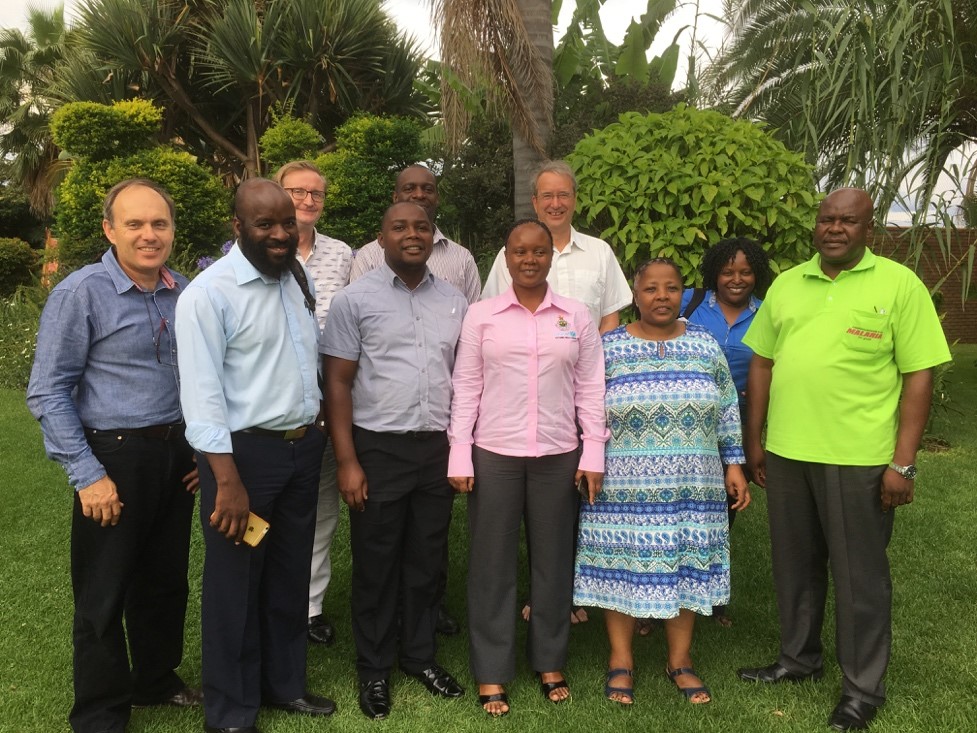
The plan is to build OD training capacity in the Zimbabwean health system with a longer-term aim of expanding the process-improvement work to other nations in the region. The training is accredited through FBL’s Postgraduate Certificate in Professional Practice and the students (pictured below with the FBL project team) have all expressed an interest in pursuing a UWE-based masters degree. Dr Carol Jarvis, Felicity Cargill and Sue Brown have assisted greatly with setting up the PG Cert and enrolling the first cohort.

The two-day induction event (13-14 November) was judged to be a success by all concerned and several of the trainees made themselves available to assist Professors Mnguni, Case and Gosling with a large-scale workshop designed to address malaria-specific challenges in Matabeleland North province. For delivery of the workshop, the team expanded to include Professor Daniel Chandramohan – a world leading expert on malaria from the London School of Hygiene and Tropical Medicine – and Precious Chitapi an OD facilitator based in Harare. Now in its second year, the project will be active in over half of Zimbabwe (geographically) by the end of the 2017-18 malaria season. The work has been contracted by the Malaria Elimination Initiative – based at the University of California, San Francisco – and is funded by the Bill & Melinda Gates Foundation.

The project has been approved by the Zimbabwean Ministry of Health and in-country administrative support is provided by the Clinton Health Access Initiative.

Bristol Business School student named CIPD West of England Branch Student of the Year

Posted on

On Thursday 23 November, Kelly Smallcombe, a PG International Human Resource Management student, was awarded the CIPD West of England Branch Student of the Year Award.

Kelly, who also studied her undergraduate degree at UWE Bristol, was chosen for the award due to her outstanding results and journey whilst undertaking her studies.

Kelly was also commended for overcoming the struggles of working and studying at the same time.

Kelly was nominated by Human Resource Management Lecturer Hilary Drew, who felt Kelly deserved her the recognition after being so committed to the course.

Kelly commented

“I think it is important to recognise the lecturers who got me to where I am today. I am very grateful for all their support and the lecturers past and present have been a major part in why I have done so well.”

Congratulations to Kelly on this great achievement.

“The chancellor is out of ideas. Today’s budget is one to forget” Associate Professor Dr Jo Michell comments on the budget

Posted on

Associate Professor in Economics Dr Jo Michell provides comment on today’s budget: 

It is unlikely that UK Chancellor Phillip Hammond was looking forward to his budget speech. He would have seen the latest economic forecasts from the independent Office for Budget Responsibility. There is no way to spin them as good news.

The newspaper front pages will not make for comfortable reading.

The OBR is tasked with producing detailed forecasts of the UK economy. These forecasts form the basis for evaluation of the Government’s performance against the rules it sets itself on public debt.

In reality, the rules change so often they have little meaning. Today was no exception. By reclassifying housing associations as “private” institutions and fiddling the accounting rules for the upcoming privatisation of RBS, the chancellor conjured up extra £5bn a year of spending – a trivially small amount.

The OBR forecasts of the outlook for the UK economy are of more interest: they are the nearest thing we have to official projections of our future prospects for income, employment and prosperity.

Since its inception in 2010, the OBR has been wrong about one of the most important economic indicators: labour productivity. This is a measure of the goods and services produced on average by each worker. Without productivity growth, living standards can’t rise.

The OBR has consistently over-estimated productivity, as the chart below shows. Twice a year for the last seven years, the OBR has predicted a return to pre-crisis trend growth of two per cent per annum. It was wrong every time: productivity growth has averaged near enough zero over the period.

chart1

In its latest forecasts, the OBR admitted defeat and downgraded productivity forecasts to 1.5%, in line with recent projections by the Bank of England. While these look optimistic given the recent performance, the implications for growth, incomes and public services are dramatic. Government revenues are predicted to be £20bn per year lower than previously forecast. By 2022, wages will still be more than £500 per year lower than in 2007. And this is without taking the possible effects of a ‘hard Brexit’ into account.

Against such a dismal backdrop, the chancellor’s announcement of new productivity-boosting measures, such as an R&D tax credit, inevitably rang hollow.

To try and sugar the pill, the chancellor announced a few short-term giveaways. The most headline-grabbing was the abolition of stamp duty for first-time house-buyers. This might sound like a welcome boost for young people looking to get a foot on the housing ladder. But the OBR were quick to debunk this: they predict that the resulting increase in house prices will exceed  savings on stamp duty: “prices paid by first-time buyers would actually be higher with the relief than without it. Thus the main gainers from the policy are people who already own property, not the first time buyers themselves.” (p. 128).

Instead of given a leg-up to young people struggling to own a home, the chancellor has poured petrol on the fire and given another hand-out to the already-wealthy.

This will only increase the severity of the debt problem that the chancellor didn’t mention in today’s speech: the debt of UK households. Research at UWE Bristol has found that, while austerity has so far failed to reduce public debt, it has been accompanied by ever-faster growth of household debt. As the chart below shows, for every £2bn the chancellor has cut from the deficit, the rate at which households take on new debt has increased by £1bn.

hh2

Nothing in today’s budget will reverse this trend. With incomes set to stagnate for years, and households already struggling, more will be forced to take on debt to make ends meet.

The chancellor had the opportunity to recognise the scale of the challenges faced by the country – flat productivity, unaffordable housing, stagnant incomes and government services pushed to the limit – and to announce a real change in direction. He should have announced a significant programme of public investment – in infrastructure, in R&D and in housing.

Instead, he did nothing of substance: a couple of new tax cuts and another nudge for house prices.

The chancellor is out of ideas. Today’s budget is one to forget.


David Hong Tsung Lan to receive honorary degree for government role

Posted on

Professor Dr David Hong Tsung Lan is to be awarded the Honorary Degree of Doctor of Business Administration by the University of the West of England (UWE Bristol)in recognition of his long and prestigious career in government in Hong Kong and his contribution to international trade and education.

Born in Shanghai, David completed his early education in Hong Kong, joining the Hong Kong Civil Service in 1961 before studying to become a Chartered Secretary in addition to earning an external BA degree from London University.

During his time with the Hong Kong Civil Service, David worked in a variety of departments, including the Transport and Housing Authority. In 1979 David was appointed Official Justice of the Peace in Hong Kong.

In 1988, he was appointed Regional Secretary for Hong Kong and Kowloon before being appointed to Hong Kong’s Principal Economic and Trade Representative based in Japan. In 1997, after the handover of Hong Kong, David became the first Secretary for Home Affairs of the Hong Kong Special Administrative Region (SAR) Government.

David currently holds a variety of Board positions in the banking, commercial, infrastructure development and trust sectors including non-executive directorship to Nanyang Commercial Bank (Hong Kong) and Cheung Kong Infrastructure Holdings Ltd, Hong Kong.

David has been conferred with many awards including Doctor of Humanities and two Visiting Professorships from overseas institutions. In 1991, David was awarded the Imperial Service Order for his services to the Civil Service and in 2000 the Gold Bauhinia Star Medal in recognition of his contribution to public service.

The honorary degree will be conferred at the awards ceremony of the Faculty of Business and Law at Bristol Cathedral on Tuesday 28 November at 5pm.

Journalist to receive honorary degree for contribution to business engagement

Posted on

Andrew Lynch is to be awarded the Honorary Degree of Doctor of Business Administration by the University of the West of England (UWE Bristol) in recognition of his contribution to business and academic-business engagement.

Andrew, 58, has served as assistant business editor of The Sunday Times since 2009.

He graduated from Bristol Polytechnic, where he read humanities, in 1984 and joined the Bristol Evening Post as a reporter. After spells at the Financial Times, the Guardian and Sunday Telegraph, Andrew spent 10 years in Hong Kong as deputy night editor at the South China Morning Post and then editor of the rival Hong Kong Standard. He returned to the UK in 2002, working at the Daily Mail, the Evening Standard and the Irish Daily Mail in Dublin. He spent a year organising research and events for the Paris-based World Association of Newspapers.

At The Sunday Times, Andrew oversees production of the business section as well as writing about small businesses or editing the diary column. He also arranges events focused on the business agenda and has produced magazines and supplements such as 50 Years of Business, The Start-up List and The MBA List. He also curates the annual Maserati 100 list of entrepreneurs.

The honorary degree will be conferred at the awards ceremony of the Faculty of Business and Law at Bristol Cathedral on Tuesday 28 November at 2pm.

Bristol Business School at the Personal Finance Society Festival of Finance

Posted on

In early November, as part of the developing relationship between the Bristol Business School and the Chartered Institute of Insurers, eight students from Accounting Economics and Finance UG and PG programmes accompanied Debbie Sturge, Departmental Academic Director Accounting, Economics and Finance, to the  Personal Finance Society Festival of Finance at the NEC.

The Bristol Business School stand, which was supported by the students, was in the Future Generations area of the Festival. Our students spoke to other delegates and secondary school students to promote the degree programs in the Bristol Business School, as well as networking with financial service firms.

In addition to manning the stand, the students also got the opportunity to attend a variety of talks on subjects as diverse as inheritance tax, demographics and the digital revolution, including the intriguingly titled ‘Sex , chocolate and bucket list planning’.

Speakers included ex pensions minsters Ros Altmann and Steve Webb,  Sir Clive Woodward on ‘Data and  the power of knowledge’ and Sir Vince Cable on ‘The EU, Finance and the City’ .

The event proved beneficial for the students as they managed to find guest speakers for the Accounting Society, explore placement and employment opportunities and investigate new career path options in finance and financial services.


Guest blog post for Global Entrepreneurship Week: Sir Rod Aldridge, Founder and Chair of the Aldridge Foundation

Posted on

The Aldridge Foundation and Bristol Business School are delighted to announce their partnership to create the Aldridge Institute for Enterprise and Entrepreneurship at the Bristol Business School. 

Guest author: Sir Rod Aldridge

As an entrepreneur I had the opportunity to found my own business – the Capita Group. Over a 22-year period I led the company’s development from a start-up with one employee, me, to the FTSE 100.

Today Capita employs 74,000 people, with annual revenues approaching £5 billion.

What is unusual about my story is that my opportunity didn’t come until I was 38. Having failed my 11-plus, my education didn’t equip me to succeed, and I left school at 16 to be a post boy in the local Council offices. Fortunately, my family gave me determination and self-belief. I built a successful career in the public sector and, at 38, was in a position to take my chance.

I don’t mind admitting that I feel angry about my education. How it didn’t develop my enterprising skills from a younger age. I wonder what I could have achieved in those 20+ years if it had been different.

Increasingly young people want to start their own businesses. To work in sectors where self-employment is more the norm. The pace of technological and economic change means that many of tomorrow’s careers are only being imagined today. More than ever young people need not only good qualifications but the skills to adapt and flourish in an ever-changing society.

I established the Aldridge Foundation because I’m passionate about transforming the life-chances of young people. I believe this can be achieved through education equipping them to develop an enterprising mind-set alongside gaining their academic qualifications. Through the schools in the Aldridge Education multi-academy trust we have ten years’ experience of doing just that.

Aldridge_Spencer-House-171-web-1024x683

Aldridge and the Bristol Business School at UWE share very similar vison and values. We have a collective focus on employability and tackling the issues around social exclusion. On developing innovative, evidence-based approaches to embedding enterprising skills in teaching and learning.

And so I am delighted that we have agreed a partnership to create the Aldridge Institute for Enterprise and Entrepreneurship at BBS.

Led by a Professor of Enterprise & Entrepreneurship the Aldridge Institute will change thinking about how people learn and train teachers to teach in a different way. It will transform the skills young people develop in UK schools, colleges and universities, changing their futures and creating a more successful economy.

Coming at the end of Global Entrepreneurship Week I believe this is a really exciting development for UK students, educators and UK PLC.