

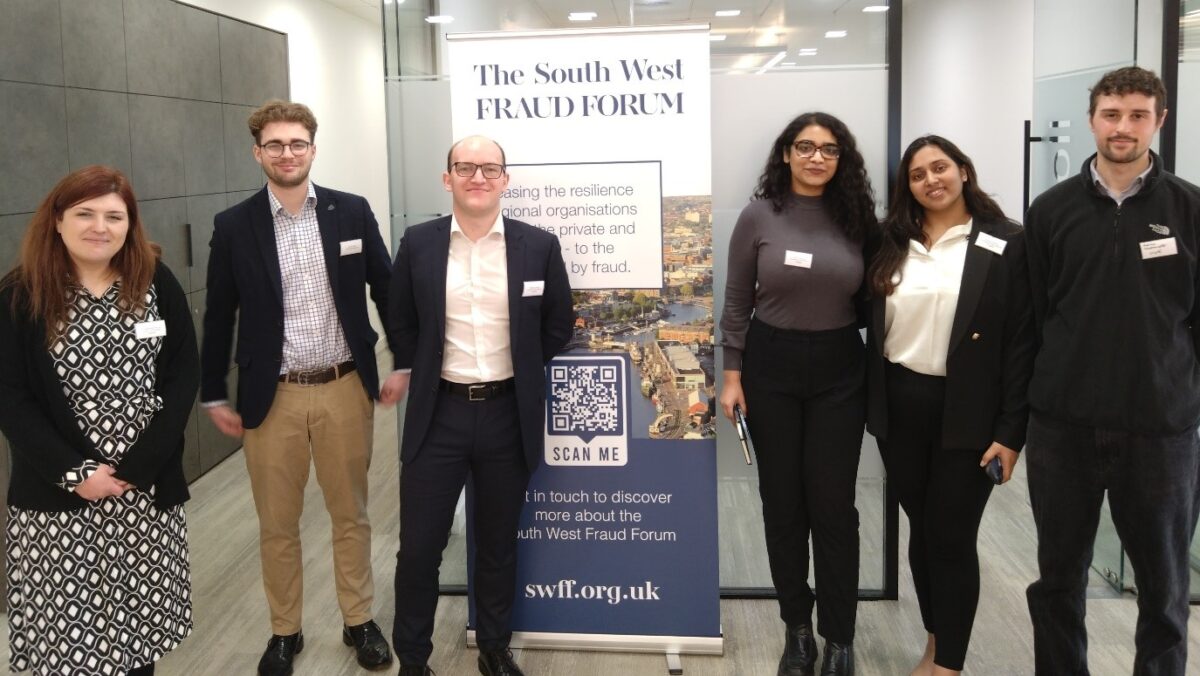
By James Barker, Rishna Bhadain, and Syeda Rahman
On 10/03/2023, the South West Fraud Forum hosted its first annual conference at Foot Anstey LLP in Bristol. In this post, three Law of Financial Crime students at the University of the West of England reflect on their experience of attending the conference.
The Speakers
The conference was introduced by Steven Richards and James Gliddon (both Co-Chairs of the South West Fraud Forum). The speakers were the Right Hon. the Baroness Morgan of Cotes (Chair of the Fraud Act 2006 and Digital Fraud Committee), Andy Baguley (Lead for Force Engagement and Performance, City of London Police) and Dr Henry Hillman (Lecturer in Law, University of Reading).
The Right Hon. the Baroness Morgan of Cotes
The conference began with a keynote speech from Baroness Nicky Morgan, the Chair of the Inquiry into the Fraud Act 2006 and Digital Fraud Committee. This inquiry resulted in a report called ‘Fighting Fraud: Breaking the Chain’. Amongst other aims, the Inquiry assessed how the Fraud Act is applied in practice and explored reform ideas.
Baroness Morgan’s illustrious political career proved to give a refreshing insight into the state of current fraud policy. She noted that the Government are taking serious steps in introducing a new fraud strategy. This long-awaited strategy could prove of great impact to the landscape of economic crime and its policy.
Building on the introduction of a Failure to Prevent Offences for bribery and tax evasion, Baroness Morgan informed us that the Economic Crime and Corporate Transparency Bill introduces a new clause, i.e., an ‘offence of failure to prevent fraud’, which has been the subject of great debate.
Baroness Morgan also explained that the Online Safety Bill contains important measures for prevention of fraudulent content and scam advertisements. The Bill imposes a duty upon large online platforms and search engines to prevent paid-for scam advertisements from appearing on their platforms.
Overall, the Baroness’s keynote address was impressive, to say the least. She was calm, composed, and well-spoken, which was unsurprising considering her credentials.
Andy Baguley
Andy began his presentation by exhibiting statistics in relation to fraud. For example, it accounts for 41% of all crime in England and Wales.
Andy identified the role carried out by the City of London Police, including investigatory work and the promotion of workplace due diligence. Their main goals are pursuing fraudsters, empowering the public, and stopping and blocking fraud.
Andy emphasised that the City of London Police tends to prioritise victim care. This can be seen through the creation of the National Economic Crime Victim Care Unit, which focuses on leadership and coordination of victim care. A significant amount of funding has also been invested in the Economic and Cyber Crime Academy, which is focused on development and training within the police.
He explained that whilst there has been a positive introduction of Action Fraud, they still do not have the capacity to investigate all cases. The new Fraud and Cyber Crime Reporting and Analysis System is due to go live in April 2024 and will be considered as the new Action Fraud.
Andy also explained that the Fraud Strategy will establish Key Performance Indicators for policing within the Strategic Policing Requirement, placing additional pressure on the police to investigate fraud.
Overall, Andy Baguley’s professional talk reassured the audience that the City of London Police’s objectives seem promising and endeavour to make important strides in combating fraud.
Dr Henry Hillman
Henry explained that cryptocurrency is prominent within the UK and refers to an alternative form of digitally buying and selling assets. There is no central authority or central bank regulating cryptocurrency.
Henry explained that the liquidity and open access of cryptocurrency creates a strong sense of appeal. However, the very nature of cryptocurrencies means there is little to no protection for the consumer. Additionally, consumers investing in cryptocurrency tend to be more elusive; they are often unwilling to disclose information, making it difficult to detect fraud and harder to help victims.
Henry identified several types of cryptocurrency fraud:
- Initial coin offerings (ICO) – Companies launch ICOs in the form of a new coin for investors. These are barely regulated and often used to scam unsuspecting consumers.
- Rug pulls – Crypto scams whereby creators lie to the public for financial gain, such as ‘OneCoin’.
- Limited sell orders – Coins bought by consumers that are deemed useless as they are coded to allow only the developer to sell the coin, such as ‘Squid Tokens.’
- Pump and Dumps – Creators force a price rise on a token while holding large amounts and then sell overinflated stocks.
Initial steps have been taken by the UK Government to register virtual assets. However, by April 2022, only 34 firms had registered.
Overall, Henry Hillman managed to take a complex matter and explain it very simply. His presentation was factual and elucidative.
Conclusion
The South West Fraud Forum’s first annual conference was a great initiative whereby various professionals received information and feedback on ongoing efforts. The day proved insightful and proactive to the issue of fraud and the forum itself is providing detailed and useful information to businesses, banks, and legislators. This event pushed the need for further awareness on fraud and was useful to anyone that attended.