Have you heard of Learning Lab placements? They are placements are offered to students studying a MSc Science Communication with UWE Bristol’s Science Communication Unit. They are a great way to gain industry experience and network with some fantastic organizations.
My name is Laura Thomas, and I am a recent postgraduate student who studied Science Communication at UWE Bristol. I have recently finished two placements as part of the Learning Lab scheme, and I fully recommend seizing this opportunity.
I did my first placement with ecancer, a charity which communicates advances in cancer treatment and patient care to professionals, such as doctors, academics and patients.
I was an editorial assistant for a week, where I wrote tweets for ecancer’s Twitter feed to promote ecancer’s content, posted videos and news stories on ecancer’s website, produced a reference pack for a scientific article and wrote a news article to communicate an advance in oncology research to doctors, nurses and oncologists.
My interests lie in conservation, but I decided to communicate a new topic to challenge myself, test my boundaries and see if I enjoyed communicating cancer research.
Writing the news article was a really useful exercise as it allowed me to develop my portfolio and improved my ability to translate a scientific research paper into a news release for professionals. I learnt a lot about writing for this kind of target audience. Additionally, I was able to receive valuable feedback from my line manager, who was very experienced in the field, which will be useful for future projects.
My second placement was with Films@59. Films@59 is a Bristol based TV production company that mainly focus on post-production. They cover a variety of genres – their most famous being reality and natural history (for example, The Great British Bake Off and Planet Earth).
I was a runner for a week where I ran errands for clients, such as making tea and coffee, and sat in on three sessions with clients. I attended sessions on offline editing, dubbing, and grading. During the sessions I was able to watch people at work and ask them questions. It was interesting to learn how all these different elements contributed to the story and how one small tweak can massively influence the piece.
During my placement I was able to network with people and learn about the variety of career journeys employees had been on to get where they are. There really were a whole range of pathways – both planned and unplanned. Overall, it was a really valuable experience, and I learnt a lot about the industry.
I found the Learning Lab placements extremely rewarding. They are a fantastic way to evaluate your career choices, develop your skills, network, and explore the career paths you could take. I would definitely recommend applying for a Learning Lab placement – you never know what you might gain from it!
Students on the Science on Air and on Screen module in the 21/22 academic year made a 7 minute film to fit in a magazine programme like The One Show or Countryfile. Students were given free reign to choose, research, storyboard and film their sequence before heading to the post-production house Films@59 in Bristol to work with industry editors to complete their films.
Secrets of the Avon gorge
Delving into the stories and science of Bristol’s Avon Gorge, Holly Stevenson, Aimee Milne, Cerys Baker, Laura Thomas, Yi-Hsuan Lee and Jayasuriva Perera made this film.
Reconnecting with nature
Inspired by humanity’s reconnection with nature which, for some, was an unexpected side effect of the Covid-19 pandemic, Dorothy Giles, Elizandra Cripps, Martin Lewis, Lisa Frew, Derek Troutman and Annie Wilson’s film explored our relationship with the natural world around us.
I never knew what I wanted to be – except that any career for me had to have three conditions: it must involve an above-average dose of the outdoors, I would like to be in charge of the agenda, and some sort of animal (any will do!) needs to be in close proximity at all times. No doubt the aspirations of most people, right?
I had a linear route into science communication, albeit with several detours in-between. Studying Zoology at the University of Bristol straight after school, I appreciated the programmes breadth in not funnelling me in a niche direction. Like anyone in their late teens/early twenties, my mind was a meandering muddle. In a bid to find some sort of path to address the dreaded ‘what’s next?!’ question from parents and family, I dipped my toes into many pools – applying for work experience and short internships in physiotherapy, veterinary medicine, law, magazine publishing, copy editing, countryside management, the military and teaching. Although quite relentless, it became a helpful ‘tick-box exercise’ allowing me to cross off those areas which I didn’t enjoy (vital), and keep close those I found interesting.
Eventually, I found focus in the middle of all of these careers and interests. That is – in science communication – a dynamic and exciting vocation where you act as the mediator between scientific research, and the public. A crucial role, amid such a noisy, turbulent world. Despite this being only six years ago, science communication was something I had never heard of at the time. Safe to say, after seeing the MSc in Science Communication offered at UWE Bristol, and how varied it was, I was officially intrigued. And that was before I’d even had a chance to explore the careers that alumni had pursued after graduating.
During my masters at UWE in 2016-17, the world felt like it was changing. Social media reared its head and became the giant it is today. We saw the power of how we can use those platforms to communicate environmental truths, and rally public support for positive change; namely with the release of Blue Planet 2 and the battle to eliminate single use plastics. The realities of climate change and biodiversity loss rushed into conversation, creating urgent pressure to find solutions. Personally, all of these events over the past six or so years have shifted my own communication priorities. I’m not only trying to engage the public with the joy of nature on a fundamental level, but also trying to spur real, lasting action for its future. It’s more of a ‘the faster we act, the less we lose,’ sort of situation.
After I graduated in 2018, I tried my hand at going freelance. The notion appealed to me (if we just revisit my eclectic career conditions above…) and I was grateful to be in a position where I could still live at home in Devon, earn money with two retail jobs, and experiment with science communication on the side. It was an immense balancing act, and at times very stressful and disheartening. Repeated rejection for jobs, ideas and offers of work sure makes you resilient! But the hope of finding a seat at the table really did keep me going.
I fostered and maintained links with wildlife charities and NGOs, offering volunteer hours with The Wildlife Trusts, fundraising for them and others and being a bit of a prolific networker whist trying to find my voice. Later, I got the brilliant opportunity to be part of the RSPB steering group for the 2019 State of Nature Report, and contribute to the forward. A spin-off article I was asked to write reflecting on the report’s implications was picked up by a major publisher, who asked me if I had ever thought about writing a book. Of course I hadn’t. I was convinced they thought I was somebody else (imposter syndrome, hello!). After all, isn’t writing a book something you do when you’ve accomplished something? Something you might strive to do in your wildest dreams of your later years?
But it’s only looking back that I’ve realised I’ve been writing my whole life. Without realising, I have always sought comfort in words, stories and narratives. Many of us do. Not a voracious reader by any means, but I have kept extensive diaries, written letters, postcards, poems and short stories. Whilst all my friends at school talked about the bands and music they were into, I kept quiet, for all I ever listened to were story tapes, and later, audiobooks.
I loved English at school and didn’t realise how much being able to write, and enjoy it, helped me through both my BSc and MSc, where many of the exams and coursework were written. Writing this blog has made me reflect on how much the variety of modules, teaching and assessments offered by the Science Communication Unit at UWE was invaluable preparation for my current work, not least in battling with imposter syndrome in writing my book. Despite what social media might portray, I’m shy, and introverted. Painfully so, when I was younger. But the MSc was a game changer for me. Smaller cohorts allowed better integration and interaction between staff and students, which boosted my confidence to contribute in class. The staff encouraged us to explore our individual creative and research interests, to push boundaries and take risks.
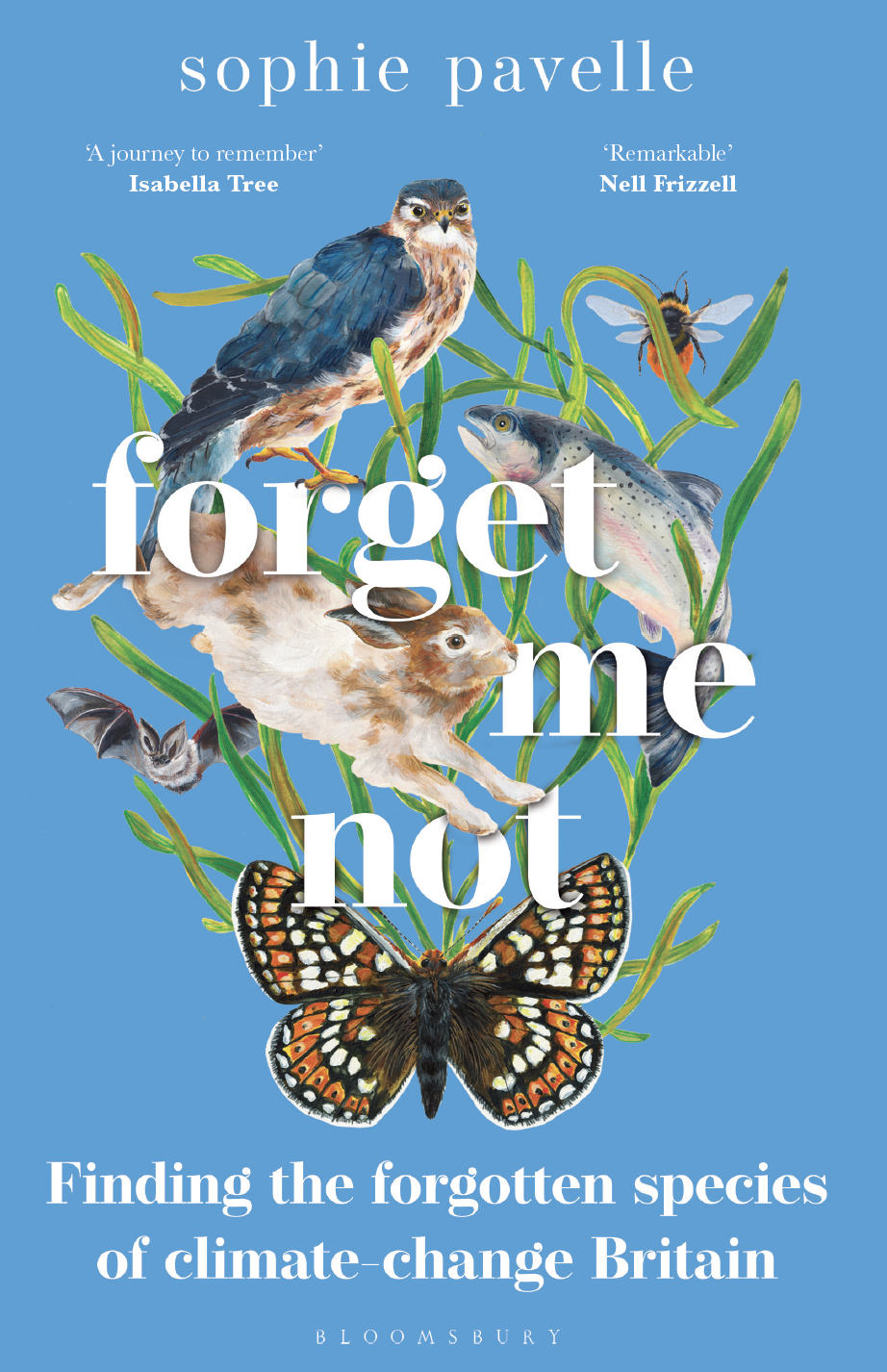
Bloomsbury commissioned me to write a non-fiction narrative about endangered native species and climate change in spring 2020 – on the same day that I got offered a communications job with Beaver Trust, and just as the UK went into lockdown. A rather overwhelming time to say the least…! The pandemic brought many books and creative content to fruition, but for me, that was never the plan for Forget Me Not. Covid-19 became a natural part of the narrative, and made elements of the low-carbon travel immensely challenging and stressful. Over the course of the 18 months of travelling and writing, I was prepared to have writers block and want to give up. Many people told me to expect this. But weirdly, that never happened. As I write this we are finalising the text, before I escape to a studio and record the audiobook. It’s a bizarre experience in a way. I often dream about certain paragraphs, and can place words and sentences exactly in the text, remembering where I was when I wrote it, what music I may have been listening to. Even what I was wearing!
Writing a book has by far been the hardest and most exhausting marathon of my life, but I adored every second. With just one month to go until publication day (9th June!) I’m still pinching myself at this surreal opportunity. I had no idea ‘science communication’ could look like this.
Sophie Pavelle is a writer and science communicator. Sharing stories about Britishwide audiences, she puts a contemporary twist on the natural history genre.Sophie works for Beaver Trust and presented their award-winning documentary BeaversWithout Borders. She is also an Ambassador for The Wildlife Trusts and sits on theRSPB England Advisory Committee. Her writing has appeared in The Metro, BBCCountryfile, BBC Wildlife and Coast magazines. Her first book ‘Forget Me Not: finding the forgotten species of climate-change Britain’ is published on June 9th by Bloomsbury.You can pre-order it here: https://linktr.ee/forgetmenotbook
Finishing our MSc in Science Communication and graduating during a pandemic and national lockdowns was not how any of us expected it to go. But despite that I managed to get a job a few months after submitting my thesis. Not only that, but what I learnt, the work I did and the experiences I had on the MSc helped me to get the role along with my previous experience working in NHS roles.
I am working as content coordinator for NHS Blood and Transplant, the organisation which is responsible for the supply of blood, organs, tissues and stem cells. Most of my role is about developing and producing content for The Donor, a newsletter which is sent to everyone who is registered as a blood donor four times per year. We share donor stories, recipient stories, updates about the donation process, information about different blood types and types of donations, how important blood and organ donations are etc. Whilst not every article is super sciency, the aim is to engage the readers and keep the donors donating to meet the constant demand for blood products.
My writing improved so much during the masters and I think that has definitely helped me get the role as I had to write an article as part of the interview process. It has also helped in my day-to-day work. I go back to the news structure we learnt in the Writing Science module again and again when writing articles at work. It’s currently on a sticky note stuck on the wall above my desk.
Starting a new job whilst working from home in lockdown wasn’t without its challenges but in the past year and a bit I have:
Contributed to five editions of The Donor
Learnt the editorial process and house style of writing; spoken to/interviewed donors, recipients and internal/external stakeholders
Built confidence and developed my personal style
Learnt about blood donation, blood components and treatments
Chosen supporting images, designed articles and uploaded them onto the content management system
Researched and written a new regular scientific feature called functions of blood. Each article focuses on a different key role of our blood: transport, immunity and clotting. Did you know that the body has 60,000 miles of blood vessels? This is long enough to circle the globe more than twice.
I’ve also donated blood three times so far and counting!
By Morwenna Bugg
Morwenna was a student on the MSc in Science Communication at UWE Bristol in the 2019-2020 academic year.
Students on the Writing Science module in the 20/21 academic year came up with some impressive online science magazines. Their brief was to develop a science magazine from scratch and they were left to develop the concept and choose who the audience would be themselves.
Claudia Stocker, Morwenna Bugg, Jessica Howard and Alex Johanson-Brown decided to turn their mutual interest in coffee into a fully caffeinated science magazine. Grounds for Thought is aimed at readers who work in the coffee industry and keeps them up to date with the science related to coffee, the coffee industry and coffee shops:
Ben Holder, Anna Shah, Ed Carter and Chloe Raikes developed Go Low, an online magazine student travel magazine that aims to promote sustainable travel by giving useful information about how to reduce the environmental impacts of travelling:
Students on the Science on Air and on Screen module in the 20/21 academic year had to contend with social distancing and restrictions on travel as they developed their science TV programme – one of the assessments for the module. They were tasked with making a film which was roughly seven minutes long in a news feature style about a scientific subject of their choice. The rest was down to the filmmaking training they received – and their creativity. And this year, because of the limitations on what they could do due to the pandemic, they had to get particularly creative about where and how they filmed. But they put together some fantastic videos. Here’s a small sample of what they produced.
Gemma Kerr produced a video about Bristol Museum’s archive and its ‘living fossil’. Her film includes an interview with Rhian Rowson, a Curator at Bristol Museum.
Lucy Perrott put together a Focus on Fungi Q&A that features an interview with Dr Andy Bailey from the University of Bristol.
Kassie at NASA Ames in front of the Stratospheric Observatory for Infrared Astronomy (SOFIA)
My name is Kassie. I’m a storyteller, science facilitator, and science advocate. I work as a federal contractor for the Bay Area Environmental Research Institute at NASA Ames in Silicon Valley. A decade ago, I would have never expected my career to head in this direction. I’ve always enjoyed science – especially robotics and space science – but early on I was drawn to the humanities. Reading literature taught me about the human condition and prepared me to think critically and communicate clearly. Effective science communication follows a similar thread: communicate clearly and connect with your audiences through good storytelling. We’re not data processors, after all.
I discovered science communication after a bit of soul-searching. In my early 30s, I worked as a research communicator at Saïd Business School, University of Oxford and I wanted to level up my practical experience with training courses. Well, I didn’t find research communication training, however, ‘science communication’ popped up. Huh, interesting. I was curious and signed up to the week-long Science Communication Masterclass taking place in Bristol and organised by the SCU. At the end of the week I was hooked. That was it for me. I didn’t know in what shape or form, but science communication needed to be in my future!
At NASA, I’m the go-between for our scientists (the science community) and members of the public. The best way I can explain it is finding that sweet spot connection between exploring the science and humanity in our work. I do a lot of interviewing. I ask scientists about their science journey and challenge them to explain their science like they were presenting at a science museum and to eager science enthusiasts. Explain the acronyms!
I learned to practice upstream engagement at UWE Bristol. Now I understand how to better incorporate inclusive learning experiences and fostering two-way dialogues. Just as it sounds, it implies creating space for members of ‘publics’ early on in science conversations and working together – as opposed to disseminating and hoping for the best. It challenges perceptions in our current model of science discourse. At NASA this can be a tricky, however, things are getting better! Citizen science is where it can really take off.
Kassie in front of the new Hidden Figure Way, at NASA HQ in Washington DC.
It took a few years, but we’ve recently developed a citizen science proposal around this concept. We – a small group of astronomers and science communicators – are developing engaging science communication content via videos, inviting people along the science journey with astronomers as they look through data – augmenting a current citizen science project called ‘Planet Hunters’. We are not shying away from technical aspects and delving into the nitty-gritty astronomers experience during the process. Citizen scientists will lend their expertise, lead video content, and can influence the direction of the tutorials. Instead of pushing out content WE think people are interested in seeing, we will be working alongside citizen scientists and listening to their anxieties, concerns, and building our project together with them. Scientists, citizen scientists, and science communicators. Our little project is only just starting – wish us luck!
None of this would have been possible without my training at UWE, which I continued after the Masterclass by completing an MSc in Science Communication. The teaching staff nurtured my budding interest in robotics and electric vehicles. I decided to focus my MSc project dissertation on public perceptions of autonomous vehicles. I felt a personal sense of accomplishment with my deep dive dissertation. Shortly thereafter, I interviewed with NASA leadership and moved back to California for this job. Like any new role, it has evolved over time. I still get to write about cool science topics, but now I’m more involved in day-to-day management as a managing editor and my brand new citizen science project!
My advice: if you’re thinking about science communication, give it a go. Attend a taster, attend the Masterclass. It will be rigorous and challenging, but you’ll walk away with skills and confidence to go after anything. I know I did. Then come join me at NASA!
Walking around the Frenchay campus at UWE Bristol is an intriguing experience. Wander down one corridor and you find yourself in the Centre for Appearance Research, down another and you’ll find yourself flanked by science labs. Just what is that researcher doing, hunched over their experiment? What about the one peering at their computer screen? Step outside and, tucked away behind the student union, is the Bristol Robotics Lab. Just what is going on behind those doors?
The Science Chatters podcast is a collaboration between students and staff from the SCU and seeks to answer such questions.
Priya Payment, studying on the Level 3 Wildlife Film and Media module, interviewed Annie Moir whose film, A Voice Above Nature, recently won a prestigious award at the Jackson Hole Wildlife Film Festival. Annie is a recent graduate from the MA in Wildlife Filmmaking.
From that sublime beginning, we had to turn to something more ridiculous and the second episode of Science Chatters is now live, with the enticing theme of Poo and Wee. Chloe Russell, studying the MSc in Science Communication speaks to Dr. Iwona Gadja about the Urine-tricity project, gaining electricity from urine.
The Urine-tricity project is one way in which researchers in the Bristol Robotics Lab are seeking to find ways to apply their knowledge of how to use “Pee Power” to provide electricity in areas including displacement and refugee camps.
Fellow MSc student, Jessica Howard interviews Angeliki Savvantoglou about her PhD research into the bears of Greece…through the flies that interact with that thing that bears do in the woods.
Angeliki Savvantoglou examining bear scat.
There’s an argument that we should have called it Bears and Electricity but either way, you can listen here now.
Science Communication comes in many forms and Angeliki is an illustrator alongside her work on her PhD. If she is allowed to use the illustrations in her thesis, the reviewers will have a treat…as well as reading a lot of detail about poo.
Brown bear illustration by Angeliki Savvantoglou.
Jessica Howard, who interviewed Angeliki, is also an illustrator and designed the Science Chatters logo.
I’ve been something of a podcast fan for many years, both as a listener and as a creator. There’s something about the medium which lends itself to conversations which are filled with insight and honesty. In a world seemingly dominated by opinion and spin (to put it mildly), podcasts can provide a much needed escape. The relaxed format allows for conversations which are not afforded by other media and being able to hear directly to researchers involved in the science is really revealing.
UWE Bristol is a hotbed of research and Science Chatters allows listeners to listen in behind the scenes.
Andrew Glester, Lecturer in Science Communication at UWE Bristol.
To apply for the bursary, you must have applied for the MSc Science Communication by Friday 5th June 2020 and be wishing to start the course in September 2020. Only those who have been or who are in the process of being offered a conditional or unconditional full time place will be considered eligible. The bursary may only be used on the Science Communication courses offered at UWE Bristol.
The
MSc in Science Communication is taught at UWE Bristol’s Frenchay campus. If
however restrictions due to coronavirus are in place during part of the
programme, full teaching will be provided online so that your learning is not
effected.
To apply for the
bursary, please complete one of the following;
Write a short popular article that is no more than 300 words long on an area of science, health or the environment. The article should include a headline. Also provide brief details of the publication where the article would appear, outlining its audience, the types of article it publishes and why your article is a good fit with the publication – this should be no more than 200 words. The chosen publication should be a newspaper, magazine or website that covers science-related topics for non-experts.
OR
Write an outline for a science communication activity (maximum 500 words) on an area of science, health or the environment. The outline should describe the planned activity, give an indication of content and details of the target audience.
Your work should be emailed to Andy Ridgway (details below) to be received by 5pm on Monday 15th June 2020. You will be informed if you have been successful in your application for a bursary by Friday 3rd July 2020. The successful applicant should inform us if they are subsequently successful in receiving funding from a different source or sponsor i.e. employers, local schemes, so that the bursary may be allocated to a different student.
Further information on UWE Bristol fees, studentship and bursary advice is also available here:
Andy Ridgway, Programme Leader MSc Science Communication
If you are not interested in applying
for a bursary, the deadline for applications to the programmes remains the 31st
July 2020. Please note – we are currently receiving a high number of
applications and would encourage you to apply as soon as your application is
ready.
During my undergraduate degree in biochemistry I spent a year studying abroad in Grenoble in the French Alps. I studied in the university for some of the time, and also did a 5 month placement in a research lab. Although interesting, it was enough to show me that a career in research was perhaps not for me, so I spent much of time gazing dreamily at the mountains wondering what else I could do.
I liked working in the laboratory, but I realised I really
wanted to be on the outside, telling people about all of the exciting things
that were going on inside. So when I came back for my final year I persuaded my
supervisors to let me do a science communication project for my final project,
rather than a bench research project, and I was hooked!
The UWE Bristol MSc Science Communication programme gave me an opportunity to work part time at Science Oxford – a small but influential charity that works to encourage the pursuit of science and enterprise. I was delivering workshops and shows to schools and the public, and also ran the regional STEM Ambassador programme, finding and training scientists and engineers across the region to work with schools too.
I always wanted to work in a museum or a science centre, so when
I took the MSc I was keen to focus on the modules relating to delivering
science communication face to face. I remember being inspired by people from
the Gulbenkian Foundation, the Royal Society, at-Bristol (as it was then known)
who we met during the course, and they all motivated me to use my wide range of
interests – art, music, family learning as well as science – to tell stories
and create conversations.
Jo Lewis at CERN
I also loved the Science on Air and Screen module, some of
which took place at the BBC. At the time I would listen to a lot of radio
(before the days of podcasts which now feature heavily in my down time!) and I
loved working in a small team to produce both a short radio show about
‘progress’, including a poet as a live guest, and a short TV piece about
Healthy Living Day. Although I haven’t gone on to work in broadcast media the
lessons on how to sum up coherently yet colloquially have come in handy when I’ve
been interviewed for radio or TV, including for BBC Stargazing Live and local
radio.
My Masters project was an evaluation of a set of touchable exhibits at the Oxford University Museum of Natural History. Finally a chance to do some work in a museum setting! I devised and piloted a series of protocols to help the museum evaluate how families were using their new exhibition. I now use these skills every day in my job as Public Engagement Development Manager for the Science and Technologies Facilities Council (STFC), one of the UK research councils. A key component of my job has involved producing an evaluation framework for a complex programme of work. As STFC is a funder as well as a delivery body, we aim to measure and evaluate events and activities run by around 40 partners a year reaching in excess of 500,000 people face to face, and a further 2.5 million via online and broadcast media to better report, improve and celebrate what we do.
Jo Lewis at Boulby Mine
My
favourite part of the job has got to be working with scientists and engineers
who love what they do and who are really keen to share their enthusiasm with
others. I work with them to help them to do so in a way that is engaging, will
genuinely appeal to the audience they are wishing to engage – ensuring they
have thought about who that is! – and then hear all their brilliant creative
ideas for how to communicate their area of research to others!
I’ll also be using all of these skills in a new large project coming up called Wonder. The launch of Wonder marks a long-term commitment by STFC public engagement to move our focus towards audience-driven public engagement with under-served communities in the most socioeconomically-deprived areas of the UK. We want more working with people, and less delivering to people. The project is still in early days, but it means that I’ve been able to feed in ideas right from the start and use many of the skills I learned on the MSc – from reading lots of publications and reports that others have written to be sure we are using current good practice, to writing a brief for an external evaluation consultant.
Jo Lewis, MSc Science Communication student at UWE Bristol.