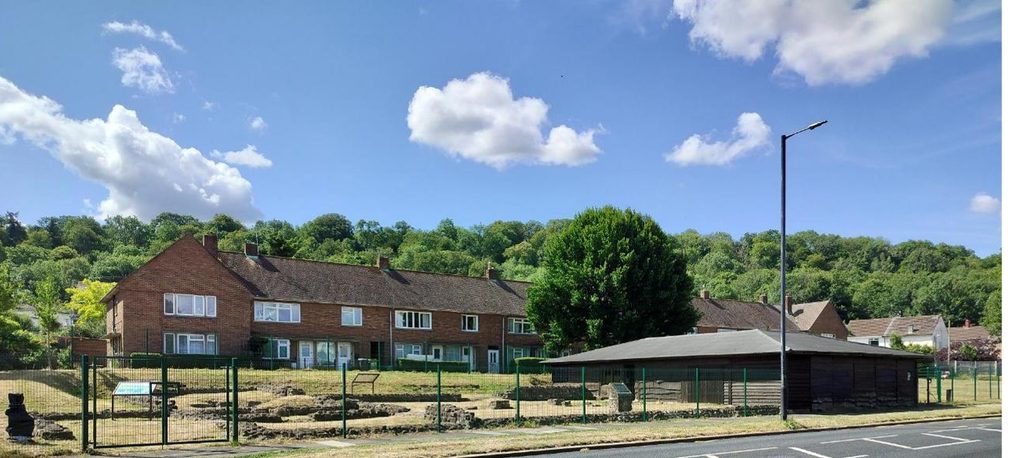
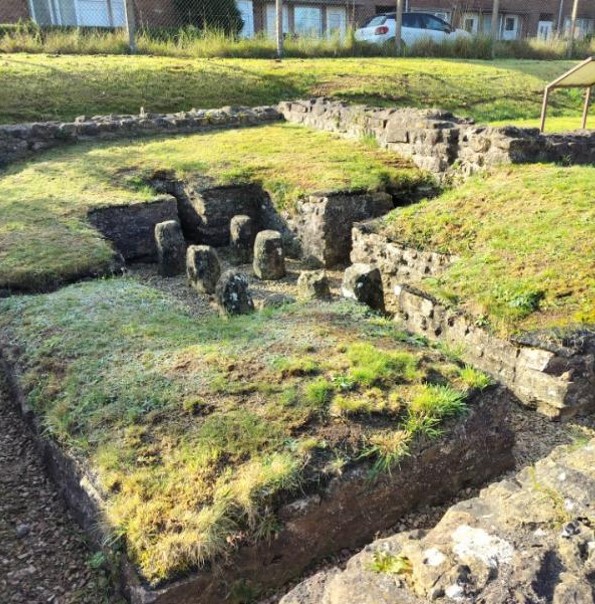
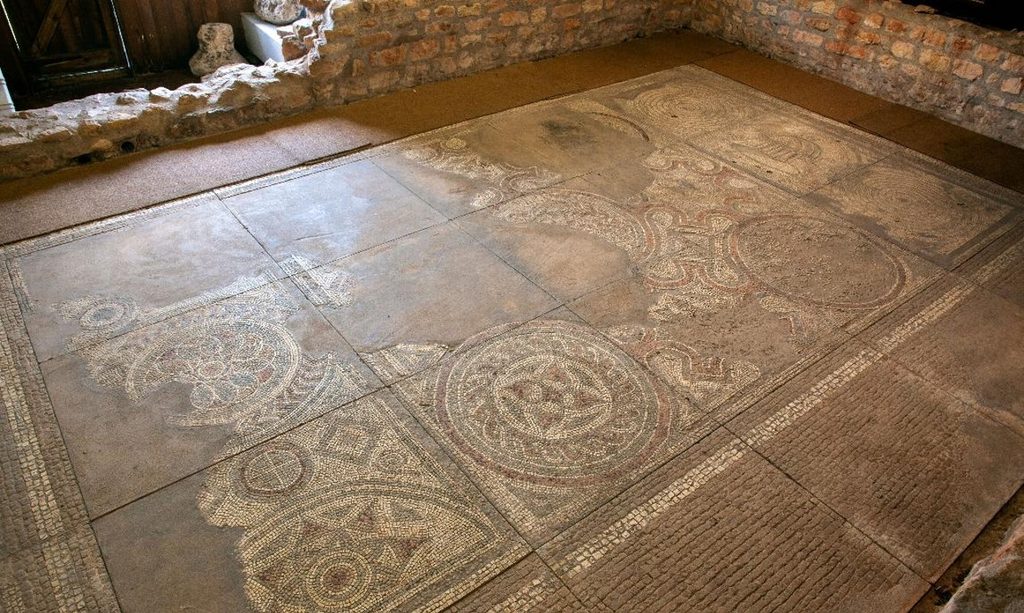
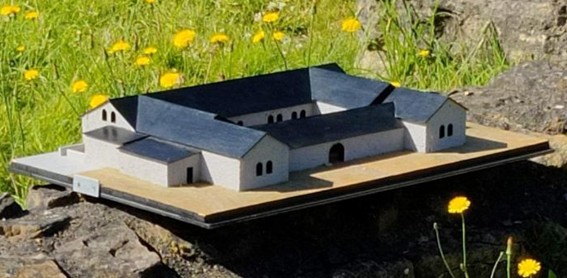
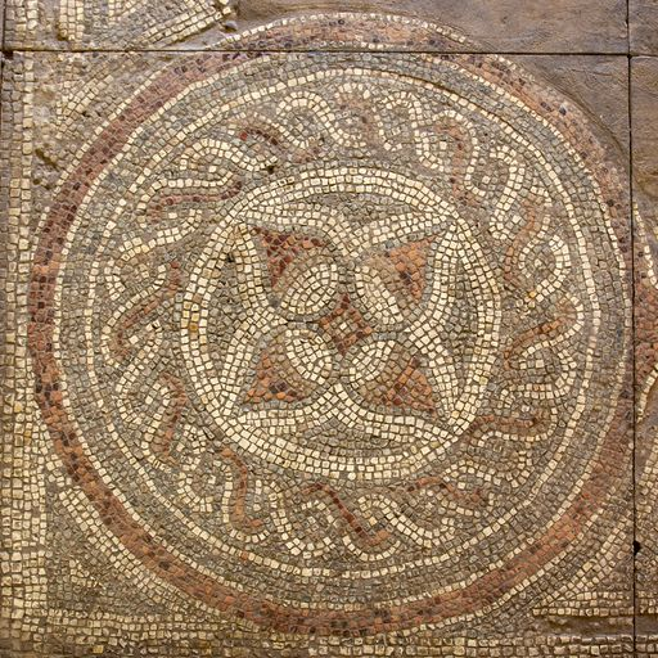
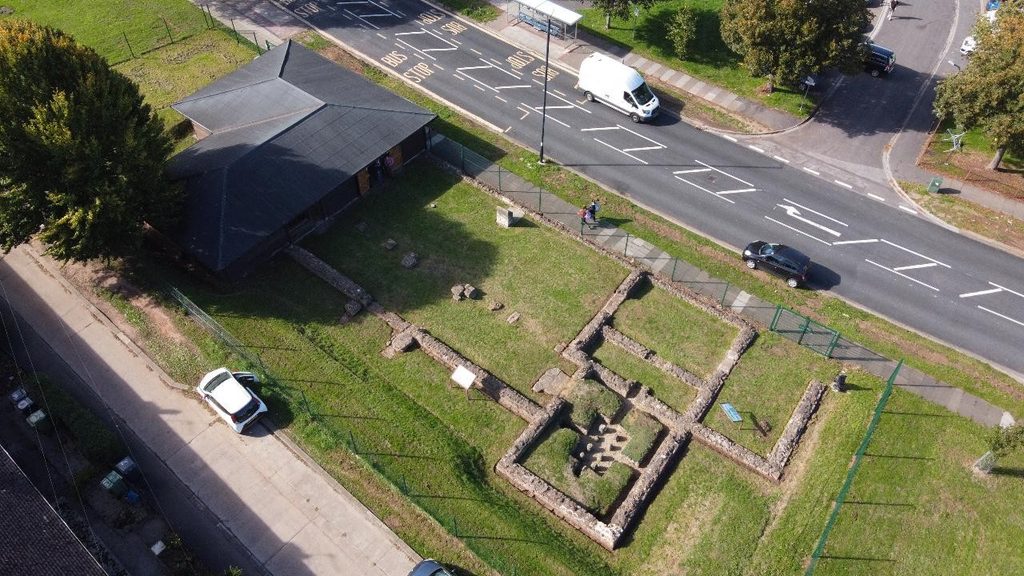
Discovered in 1947 during the construction of the Long Cross road and the housing estate now built around it, 1700-yer-old Kings Weston Roman Villa in Lawrence Weston is the only place to see a Roman bath suite in Bristol, and one of the only places in Britain with an in-situ Roman mosaic floor. The villa site has been on display ever since its excavation between 1948 and 1950 – the remains of a Roman central heating system are visible from the roadside and visitors can also explore the remains of the villa walls. Situated at the centre of a farming estate, the villa eventually collapsed and was buried under topsoil, but is now Bristol’s only surviving Roman villa.
Kings Weston roman villa site, Lawrence WestonUnderground heating systemMosaic floorModel of Kings Weston villaMosaic floor
Photo credit: Bristol Museums
A new collaboration between Bristol Museums and UWE is led by the Science Communication Unit’s Dr Laura Hobbs and Kate Iles, Senior Curator for Archaeology for Bristol Museums. It uses the well-established Science Hunters approach to engage children with Kings Weston Roman Villa using Minecraft. A co-designed Minecraft building challenge related to the real-world site, contextualised through a learner-centred approach and supported with practical anchors such as object handling, will support children to explore themes, build upon their existing knowledge, and develop their understanding of archaeological science and local heritage.
Aerial view of Kings Weston roman villa. Photo credit: Bristol University.
The project is off to an exciting start. During the summer, the UWE team visited the site, worked with the museum team to gather information and are now working on an example build of the villa in Minecraft. The project will then provide opportunities for local schools and community groups in the areas surrounding the villa. UWE researchers and the museum team will run trial sessions in schools and community settings and use the game to explore how the villa may have looked. Participants will be able to build a version of the Roman villa for themselves, engage with real and replica Roman objects and find out more about the Roman villa on their doorstep. The project will be evaluated via mixed-methods analysis to explore science communication through play-based engagement linked to the site, its heritage and its artefacts.
For further information or to get involved, please email sciencehunters@uwe.ac.uk.
Supported by Bristol City Council, Bristol Museum Development Trust and UWE Bristol.
By Dr Laura Hobbs, Science Communication Unit, UWE Bristol and Kate Iles, Bristol Museums.
In 2020, the long-running Science Hunters programme launched Building to Break Barriers, an engagement project to support children from under-represented groups to explore engineering through Minecraft.
Science Hunters has a well-established history of communicating environmental sciences through the popular computer game, and this was its first large project focusing specifically on engineering aspects, supported by a Royal Academy of Engineering Ingenious Award. Despite facing significant challenges due to the COVID-19 pandemic, which affected environmental engagement projects across the UK, the project rapidly adapted, moved the majority of delivery to online activities and met or exceeded all targets by January 2022.
In September 2020, Science Hunters partnered with the DETI Inspire Programme to design a new session – the West in Minecraft – through the Building to Break Barriers project. Minecraft Clubs for children with Special Educational Needs in collaboration with Lancaster University, and another for Looked After Children were supported to continue during the pandemic. Schools were engaged virtually and children were able to participate in a Summer Challenge. Additional funding via a Biochemical Society Diversity in Science grant saw the project further extended into 2022, to deliver an event for children Special Educational Needs in collaboration with Loughborough University.
Legacy resources resulting from the project include two practitioner guides, on engaging children with STEM using Minecraft and available editions of Minecraft, and 15 topic-based resources, one of which was developed in collaboration with the Institution of Mechanical Engineers. Engineers participating in the project contributed to selection of topics and design of content, as well as delivery of sessions and analysis at the end of the project indicated that topics naturally aligned with the United Nations Sustainable Development Goals. Results were presented at the International Conference for Sustainable Ecological Engineering Design for Society, winning a Chair’s Award.
Example of a solar crop dryer designed in Minecraft. The Building to Break Barriers Solar Crop Dryer session was developed with UWE engineer Ceri Morris (image: Daisy Bristow, UWE graduate engineer).
Expanding on these outcomes, Science Hunters: Engineering for Sustainable Societies launched in 2023 with further support from the Royal Academy of Engineering’s Ingenious Award scheme. In this project, the focus was explicitly on exploring the Sustainable Development Goals, again supporting children from under-represented groups and using Minecraft. Sessions were delivered in schools and communities, including setting up several new Minecraft Clubs in disadvantaged areas of Bristol, and at science festivals. Views of teachers on incorporating the Sustainable Development Goals into engineering and environmental engagement activities using Minecraft were gathered and analysed to support the project’s delivery (results can be found in Education Sciences) and we are currently exploring the perspectives of community group leaders.
The project produced a further 12 topic resources, and a supporting resource pack and resource guide produced as outcomes of the project. The topic resources can be used as standalone activities, or together as outlined in the resource pack and guide, to support children to design and develop their own sustainable future communities.
So far, these Science Hunters engineering projects have produced more than 30 resources, freely available on their SCU webpages. Feedback from both projects has been overwhelmingly positive. Engineers have gained training and experience, while children reported that they enjoyed the sessions, learnt about engineering and engineers and wanted to learn more about engineering. Minecraft Clubs reached multiple groups of children, with feedback reflecting how valuable this was to them and their parents/carers. Teachers responded enthusiastically to the projects, citing the efficacy of Minecraft in engaging children, the benefits of seeing women in STEM roles and accessibility for children with Special Educational Needs. In Engineering for Sustainable Societies in particular, they highlighted the need to engage them with the Sustainable Development Goals and positive impacts, both now and in their futures, on their understanding of engineers and engineering and the role they play in society.
On June 14th, Joshua Warren from the Science Communication Unit (SCU) Inspire Sustainability team at UWE Engineering, inspired a class of Year 3 students from Cabot Primary with a STEM workshop based upon the children’s book, ‘Izzy Gizmo’ by Pip Jones.
The workshop was a collaboration between the Inspire Sustainability team and the Bristol Old Vic Theatre, as part of the development of a stage-show based upon the book.
‘Izzy Gizmo’ is a young global majority girl with a passion for inventing all sorts of wacky machines. In the book, she discovers that engineering is all about finding success by trying again and again, as her inventions don’t always work first time. One day, she finds an injured crow on her way home, and sets about trying to invent something to allow her new friend to fly again.
The children in the workshop, were delighted to be joined by the author, Pip Jones. Pip introduced the children to the character of Izzy, and also talked to them about how inventions have changed their own worlds over time. The children then were challenged to think like Izzy and design and build a flying machine for the crow, named ‘Fixer’.
All students were awarded the ‘Izzy and Fixer’s Award of Invention!’ by Pip for attending the workshop and had a really inspiring day building and inventing!
The Science Communication Unit (SCU) Inspire Sustainability team welcomed over 900 people from across the city into UWE Engineering on Saturday 6th July 2024 to explore a range of different science and engineering activities. It was a wonderful day and the team received loads of great feedback. Watch the video to get an insight into the day.
Activities included:
Planetarium show called ‘We Make our Future‘ about how we can use human ingenuity and engineering skills to make a brighter future for our planet (the Inspire Sustainability team commissioned this show which Explorer Dome created and took to COP26 as well as into loads of local schools)
Flight and Driving Simulators – two very popular activities provided by UWE’s Digital Gallery
Robot building experience – was constantly surrounded by kids and adults alike building and coding Lego robots
Immersion in Bristol Minecraft worlds – everyone headed up the stairs to design changes to their city in the digital worlds
Physics in the Freezer – David Williams provided an awesome show with liquid nitrogen and magnets
Wind Turbine activity – some examples of wind turbine blade designs can be seen below – who could generate the most electricity?
Anibotics – families flocked to the animations and free giveaways David Smee and his team had on offer
Eco-House – Deborah Adkins had her wonderfully interactive Eco-houses on display
The Tinker Table – children loved getting hands on using tools to tear apart all the broken down electrical items donated as part of the UWE’s MAKERS repair cafe
Each year the Science Communication Unit (SCU) Inspire Sustainability team in UWE Engineering, supports the regional delivery of the Leaders Award competition – challenging children to think like an engineer and design a solution to a problem.
This year, at the regional celebration event for the competition on 5th June, UWE Engineers revealed early plans to turn a young person’s winning design into reality.
The Leaders Award is a nationwide engineering competition (run by Primary Engineer) for young people to design inventions to solve a problem. UWE Engineering is one of the Leaders Awards partners in the South West of England and hosted this year’s exhibition of distinction shortlisted, highly commended & winning designs.
During the Awards ceremony, Hollie Lewis, Lecturer in Sustainable Project Management, presented plans for a UWE team to build last year’s winner Elliot James’ design, the “Smart shower”. Hollie is heading up the “Proto team” which includes Electronics Mechatronics Technical Team Leader, Steve Regester and Engineering Students: Erika Aiwekhoe, Ruth Cockroft and Naing Tun.
120 people attended the celebration event to congratulate the winners and take part in the activities UWE Engineering’s Inspire Sustainability team had to offer. The exhibition remained up the following day for the Family Fun day, where over 900 people visited and took part in a whole range of hands-on activities.
Hollie Lewis, Proto-team lead, alongside Elliot James, inventorHollie presents at the awards ceremonyElliot James and his proud familyAward winners & their families viewed the competition exhibitionElliot James Leaders Award design won the Year 12 category in 2023
“Smart Shower”
Last year, Elliot James, pupil at St Katherine’s sixth form, won the prize for best Year 12 design – you can see his original “SMARTH” – SMART Bath – design below. The UWE proto-team have adapted this design and are starting to build the Smart shower.
More prototypes!
Engineers from GKN, headed up by Ian Gent, Research Engineer in Composites, also revealed a prototype machine that purifies water.
Dean of Engineering, Ramin Amali expressed at the Awards Ceremony how wonderful it is to have so many local young people participating in this Engineering competition and having their designs turned into a reality!
During the global pandemic, children’s lives were changed by both the presence of the virus and measures put in place to control it e.g., closure of schools and play spaces, move to online learning, and social distancing. The Voices in a Pandemic project (VIP-CLEAR) highlighted the importance of capturing children’s voices, which are often missed, about the impacts of these mitigations on their lives.
The interdisciplinary research team from UWE Bristol (which included 3 members of the Science Communication Unit) used arts-based methods to capture the experiences of children in six schools in socially disadvantaged areas of Bristol. The first of these activities asked them to ‘map their world’ as the country emerged from the third national lockdown. This process gave children the time and space to reflect on this period of their lives. Their drawings showed how diverse their experiences were; some children enjoyed spending time with their family, but others found it difficult being separated from key support networks, and friends and family members. It was particularly hard for those who were dealing with existing challenges around space, food, money and resources. It is likely that children will experience further social shocks (e.g., pandemics, climate change) and the mapping policy brief outlines ways in which schools, community services, local government and public health teams can support children to cope with these intangible threats. A primary book and teacher’s notes have also been co-created by the project artist in collaboration with the academic researcher team. ‘Learning to Live with Fog Monsters’ is available digitally and in hardcopy, and aims to engage children with these complex topics.
The Future Brief COVID-19 and the environment: links, impacts and lessons learned, meanwhile, brings together research that highlights how the risk of zoonotic disease and pandemics is increased through human activities such as industrialised agriculture and land-use change. The policy brief, produced by Science for Environment Policy (based in the Science Communication Unit) for the EU Directorate-General of the Environment, also highlights how climate change and the wildlife trade are increasing the risk of emerging infectious diseases that may jump from animals to humans.
The brief emphasises the importance of the One Health Approach, which recognises that environment, wildlife and human health are interdependent. Since the risk of zoonotic disease increases where humans encroach on wildlife habitat, global hotspots of high risk have been identified by researchers working in this field. Minimising the risk is another task; this will rely on actions that improve the sustainability of farming, land use and our interactions with wildlife.
The brief also offers an overview of findings on the environmental impacts of the pandemic – from changing air quality as the world locked down, to increased volumes of single-use plastic and PPE littering beaches. Mass action can change behaviour to be kinder to the environment – can we harness the shock wave of COVID to inspire a green recovery? The brief was produced before the war in Ukraine, which has of course had huge effects on the energy landscape in the EU, but the message stands that addressing climate change and environmental degradation should not be overshadowed by economics but be integral to a sustainable future.
Although national and world events in 2022 have turned our attention away from the pandemic and its effects, the VIP-CLEAR project and the Future Brief show that it is crucial we reflect on the events of the last three years, to learn lessons, to understand and support those affected, and look to a resilient future.
Homes Under the Microscope (HOMEs) is a multidisciplinary project that brings scientists, participants and the textile industry together to develop a new way to measure microplastics in the home. It is a collaboration between the University of West England, the University of Leeds and the University of Edinburgh. The researchers involved have a wide range of backgrounds including environmental research, laboratory analysis of microplastics and social science researchers who work to evaluate research projects. Led by Dr Ben Williams (Air Quality Management Resource Centre, UWE Bristol), HOMEs has the involvement of two Science Communication Unit members, Dr Margarida Sardo and Sophie Laggan.
About two thirds of the clothes we wear contain plastic, most commonly polyester, nylon or acrylic. These materials are cheap and extremely versatile. Plastics can help make fabrics stretchy and more breathable as well as making them long-lasting and durable. Other textiles also contain plastics – sofas, curtains and carpets often have plastics added to make them more hard wearing. When we use the textiles in our home, friction causes tiny fibres to break off and be released into the air. These small fragments are called microplastics. There have been very few studies about the amount of microplastics in the home, but what research has been done shows that every home sampled so far contains some airborne microplastics.
In this study researchers want to count how many airborne microplastic particles there are in a wide range of different houses. They also want to examine what they are made of, which will help us understand where they come from.
Citizen scientists will place passive samplers in their homes, using low-cost microscopes to see and take pictures of their samples. They will then use machine vision approaches to characterise their own samples by size/shape/colour etc., at home.
The research team will also undertake confirmatory analyses so citizens can see what types of plastic (if any) are present in their samples, allowing the team to build an understanding of airborne microplastic generation at home.
A Youth Climate Café that took place in St Marks Church in Easton in April 2022 invited young people across Bristol to come and share in climate discussions and activities. It was organised by UWE Bristol researchers, community members and charitable groups in Easton.
Audience engagement activities on the day included an immersive climate dome, seed pot making, presentations, conversations, an air pollution workshop and walk, and a fast fashion dance. The creative input was supported by Baggator Nexus, St Mark’s Baptist Church, Peace of Art, Easton Community Members, CCC-Catapult Youth Action partner group, Quartet Community Foundation, the UWE Community fund as well as the UWE Bristol Enterprise, Knowledge Exchange and Public Engagement fund.
Apart from providing a much-needed opportunity for young people to hear, see and talk about climate change and what to do about it, three key insights emerged from the event that seem to indicate when community climate engagement works at its best – when it sees the local connection, listens to people disproportionally affected by climate change and builds a resilient community ready for action.
St Marks Road, Easton, Bristol. photograph by Josh Hart
See the local connection
The first plus of the climate café event was that it brought the focus back to local issues – the impact that can be directly felt. Air quality is an important issue for the Easton community. A talk and guided walk pointed out the problems in this area and how a community has come together to learn and influence change. Through a citizen science project, Easton residents are getting involved in air quality sensing, gathering data and interpreting what it means. They are making connections between the presence of particulate matter in the air with health issues experienced by friends and family.
To help bridge the digital gap between residents in Easton – one of the most deprived areas in Bristol- and air quality scientists, STEM ambassadors and UWE Bristol have been collaborating with BMCS and Baggator to use data on Air Pollution and Traffic data from Saaf Hava (‘clean air’). Stuart Phelps (Baggator) presented how this all connected at the Climate Café:
Saaf Hava is a Citizen Sensing project. Twenty sites across Easton will measure Air Pollution, Temperature, Humidity; with room for expansion. These twenty sites will make up over 1.6 square kilometres and may perhaps be the most comprehensive Citizen Sensing network in the UK. Telraam traffic counters have been added to this via UWE Bristol’s WE COUNT programme and introduced via STEM Ambassadors at Baggator.
Telraam site showing St Marks Road traffic data
According to Maryan Abdirahman, Baggator’s Data Analyst & User Researcher, gathering air quality data in Easton’s streets and communicating results to the people who live there is proving to be useful climate action. It has already led to greater awareness, change of habits and a better-informed lobbying of political decision-makers in Bristol.
Maryan Abdirahman
Communicate with everyone
A second insight that makes Easton community climate actions impactful is involving people not currently featuring prominently in public climate debates. Saaf Hava, the Citizen Sensing project mentioned before, is a joint initiative between RADE and the Council of Bristol Mosques and as such gives a voice to unheard BAME and working-class people in environmental debates.
Page 3 of the Muslim’s Guide the Climate Change, by Easton Jamia Masjid
The Easton climate café (hosted in St Marks Baptist church!) invited different audiences to contribute their views to an event and take note of each other, young Muslim women, families, older citizens, small business owners. Workshops held in preparation to the event connected young people living in Easton with university students and university researchers were facilitated by ‘Peace of Art’, a group of Muslim women creating Street Art.
Andalusia Academy creative work
Get ready to take climate action
Climate change is rooted in actions taken by the more affluent inhabitants of this planet, and the most disadvantaged groups are often far more affected by its negative impacts. Paradoxically, climate engagement tends to increase with education and income. To arrive at a more balanced debate and move things forward, a greater representation of disadvantaged and lower-income voices in climate debates seems crucial. We need to understand how race, ethnicity, class and gender issues can interact to influence/prevent climate change engagement. Perhaps the engagement formats we tend to use prevent access for many, and so we hear far less from people far earlier or far more affected by climate change.
Media coverage often ignores what takes place quietly in our communities. Under-represented groups may already have explored and implemented working solutions, quietly. ‘Green’ practices, passed on from generation to generation, may have originated in necessity, not idealism: living through hard times, periods of shortages, mending and making do, using as little resources as possible. Perhaps we can still learn a lot from each other.
Regarding climate change, most of us understand the urgency to act. The pressures of rising living costs in the UK are getting more real every day. But how we go about taking action seems as important as the fact that we do take action. This means to address social and political exclusion. Climate activism needs to be inclusive and from this perspective, Easton is a perfect place to start.
Dr Mic Palmer is Senior Lecturer in Digital Media at UWE Bristol
Today marks the launch of a new year-long programme that aims to inspire and motivate young people in the West of England to pursue green career pathways. Known as Inspire Sustainability, it is one of three West of England Combined Authority (WECA)-funded initiatives as part of the Green Futures Fund, that, if successful, could be replicated and scaled to meet the region’s Climate Emergency Plan and Net Zero ambition.
This announcement builds on recent WECA support of other green skills initiatives in local schools, with West of England Mayor Dan Norris awarding the first green jobs grant for three schools to develop a special environmental careers programme -read more here.
All-school engagement: tailored lessons, talks and careers events with diverse role models, culminating in a whole-school Sustainability Summit.
Eco Council engagement: Eco Action Plan co-development to support the schools achieve Eco School status
Teacher engagement: training so that teachers have the confidence to engage young people on these topics and support them to imagine a future where they can see themselves playing an active role in shaping development.
Once piloted, the outcomes will be shared widely to primary and secondary schools as well as to educational professionals and academics through the consortium’s networks.
West of England Mayor Dan Norris with Year 10 pupils from Orchard School at the Youth Engineering for Environmental Sustainability Summit in October 2021
Building on what works
The Inspire Sustainability approach builds on tried and tested methods explored in DETI Inspire, which has engaged over 7,000 children and young people in the West of England on engineering for sustainability.
Consortium member UWE-Bristol’s Science Communication Unit has a track record of working with and training diverse stakeholders to reach sustainability goals. In 2021, the Unit launched its Climate Action Hub to highlight the existing work of students and academics in this space, as well as to offer support and training to further amplify climate action. Currently it is delivering climate communications training to young people and supporting them to act on things that matter to them. The Youth Climate Communications toolkit will be used to develop the teacher engagement portion of Inspire Sustainability.
Meanwhile, the STEM Ambassador programme will be key to recruiting diverse green role models while Avon Schools Eco Network will use their expertise to support the schools to develop their action plans.
If you are interested to know more about any of this work, please contact project manager Sophie Laggan.
A toolkit and training for effective youth climate comms and social action
UWE Bristol’s Science Communication Unit (SCU) is launching a new Youth Climate Action Toolkit to empower young people to act on things that matter to them. The toolkit is suitable for 16-24-year-olds, and we encourage you to please download and share the kit with any (young) person you think may benefit from these tools!
The newly developed toolkit has been produced in partnership with young people from the Avon Schools Eco Network, following pilot training held with the DETI Inspire team in the School of Engineering.
The pilot involved 12 young climate activists who learnt how to be more effective with their own campaigning, whilst forming the foundations of this new toolkit to support other young people. As well as empowering young people to act, the toolkit aims to speak with and engage diverse audiences that may not otherwise take part (e.g., through filmmaking, persuasive writing and interactive stalls, etc).
What is inside the toolkit?
To allow any young person to use the materials independently of the training, the toolkit has been designed to stand-alone or complement the training. It consists of four sections:
Section one: lays the foundations for effective team working, with a skills audit for young people to assess their baseline entrepreneurial skills for sustainability, and time set aside to define their action project based on need
Section two: encourages readers to understand different worldviews – including those from different sides of the political spectrum, and people in positions of power and influence
Section three: drills down into the communication methods, allowing readers to select the right method for their audience and to prototype and test their communications
Section four: encourages readers to reflect on their learnings, re-assess their skills and evaluate the impact of their communications
Training in the community
The SCU team have also been delivering the Youth Climate Communications to local colleges and youth groups. The training is modular, which allows it to be adapted to suit the needs and interests of the organisations involved.
The training is already being modified to suit the needs of one college, where they have aims to support a more sustainable educational environment by delivering to their students over a two-week period at the end of term. Students will vote on a priority for action within their college and then work in teams, with the support of a coach, developing a communications and behaviour change campaign which could then be delivered in the following term.
The young people’s experience of the programme is being evaluated to better understand whether their attitudes, skills and behaviours relating to sustainability, change as a result of the training. Findings will be shared on this blog later this year.
For empowerment programmes
Meanwhile, aspects of the training are also being delivered to participants of more established empowerment programmes, such as this year’s Catalyse Change programme, Bristol Education Partnership’s Climate Challenge and The Global Goals Centre’s Groundbreakers awards, with the toolkit also featuring in the Groundbreakers’ action pack.
A future aim of the project is to deliver the training online to youth groups and educational establishments across the country, and beyond, with training provided to educators to deliver the programme themselves. For a taster of what this training could look like, head to our YouTube where you can access the social media component of the training.
Where it all began
The training emerged from conversations among the SCU and colleagues about the desire to share our knowledge on climate communications and active citizenship more broadly, so when a funding opportunity arose the Unit was quick to pull together a team to make their dream a reality. The all-female team consists of academics and researchers in disciplines ranging from human geography, engineering, and environmental anthropology – to building physics and entrepreneurship. What unites them is a common interest in supporting young people to develop the skills and confidence they need to take action about things that matter to them.
This training is the first offering from UWE’s Climate Action Hub, also established by the SCU. The Hub is a place for researchers and students to connect with communities for climate action. There is already some work on campus doing just this, such as the children’s workshops delivered by DETI Inspire and Inspire Sustainability, but this is the first time training has been put in place to support the University and communities to do more.
To find out more about the in-person and online toolkit or to connect to the Climate Action Hub, email project manager Sophie Laggan.