The long and winding road to science journalism

Posted on

How do you get your first job in science communication? That’s not a straightforward question to answer – when it comes to science journalism at least. My experience of working in the industry showed me that having some kind of experience – either in the form of a placement or a few articles published – can be invaluable. Just as important as any qualification, in fact. And if you’ve won some form of recognition for your writing – perhaps through a competition – that can have a big impact on your job prospects too. It’s probably not too much of an exaggeration to say that there are as many routes into science writing as there are science writers.

It’s out of this experience that the UWE SCU Science Writing Competition was born. Targeted specifically at those who haven’t had popular science writing published before, it is now in its second year.

Given its target audience of new writers, this year we (the SCU that is) decided to provide writing advice in the form of blogs from the judges and other respected science writers, including one of last year’s winners – Emily Coyte .

There were another couple of important additions too, including a partnership with the Royal Institution – an organisation with a track record for nurturing new talent – and a survey of the competition participants aimed at gaining a fuller picture of the opportunities and barriers they face in breaking in to the science writing industry. The survey makes for interesting reading.

For starters, all of the 49 people who took part in the survey (out of roughly 90 competition entries) said they were interested in a career in science writing in some form – some as full time writers or editors and others envisaged writing as a sideline to a career in research science. Many participants were students and most (almost 90%) had not had any form of science writing training. Of those who hadn’t had training, a fairly high proportion (45%) said they were not aware of any training courses.

However, it’s where the responses to this survey – from those who want to be science writers – are compared with the responses from another survey we conducted – from those who are already science writers – that things get really interesting. But this isn’t the place to go into any detail on that – there will be more on that later. So watch this space…

As for this year’s science writing competition, the shortlist has now been drawn up and the judges will meet in August to decide the winners, who will be announced on 1 September 2016.

Andy Ridgway

Science Writing Competition now open

Posted on

It’s been a busy few weeks in the office getting ready for the UWE Bristol SCU Science Writing Competition 2016. We are looking for 700 words on “the next big thing in science”.

Entrants can be residents anywhere in the world, but must be non-professionals (professional journalists and anyone else who writes for money). All others, including scientists and bloggers, are welcome to apply. There are no residency restrictions, and we have separate categories for under 18s and over 18s. Closing date for applications is 24th June 2016. For full details, please see the SCU website.

We’re excited to have an impressive judging panel on board, who’ve prepared some excellent tips for new science writers. Fascinating stuff for newbies and old-timers alike.

The competition is run by UWE Bristol’s Science Communication Unit (SCU) in partnership with BBC Focus magazine and the Royal Institution.

Behind the scenes at Bristol Museum

Posted on

Text by Andy Ridgway, Senior Lecturer in Science Communication, images by Marta Palau Franco, euRathlon project manager.

“Artists love this kind of thing,” says Bonnie Griffin, Natural History Curator at Bristol Museum & Art Gallery. The thing in question is a scrawny-looking taxidermy pigeon that’s a victim of moth strike. The moths have stripped away the ‘feathery bits’ of its feathers, the barb, to reveal the rachis – the pointy bits in the middle.

He – or she – was introduced to students on our Masters and Postgraduate Certificate in Science Communication during our tour of the Museum’s natural history store, somewhere that’s normally off limits to members of the public. The tour was part of a day spent at the Museum to get an insight into the inner workings of a museum with a vast natural history collection.

OLYMPUS DIGITAL CAMERA
Natural History Curator Bonnie Griffin shows our MSc students some of the extraordinary taxidermy in the natural history store

The pigeon may be one of the less exotic residents of the store but it illustrates the two principle challenges of having such a huge resource; how to make use of a valuable resource when display space is at such a premium and how to stop the objects themselves being eaten or decaying in some other way.

The store has 650,000 residents – all of them dead – and this represents 90-95 per cent of Bristol Museum’s natural history collection. This means there’s only space for 5-10 per cent of the collection to be on display at any one time. It’s not an uncommon problem (and has prompted some at other institutions to consider drastic action).

But ways are being found for the store’s residents to earn their keep. So while the scrawny pigeon is making its living as an artist’s muse (the shiny tropical beetles are popular too), other residents are the object of scientific study. A humming bird, for instance, is giving us a clearer picture of what dinosaur plumage was like – apparently the way the colour and shine are created is the same as would have been the case in dinosaur feathers.

OLYMPUS DIGITAL CAMERA
Mysterious samples make up some of the 650,000 items in the collection

It is Bristol’s history that has led to such a vast collection – its wealthy merchants of past years would pay for specimens from exotic lands to be brought to our shores. And the museum’s proximity to Bristol Zoo is another factor – several of the zoo’s inhabitants have taken up residence in the museum once they have died. Among them is Henry the orangutan, who once shared a cage with his orangutan sweetheart, Ann, at the zoo. Today, the store is taking in fewer new residents and rather than coming from far flung corners of the globe, most of it is roadkill.

OLYMPUS DIGITAL CAMERA
Henry the orangutan, formerly a resident of Bristol Zoo.


While moth strike is one of the threats to the natural history collection, pyrite decay (where the sulphite component of the mineral oxidises) is one of the – if not the – biggest threats to the collection in the museum’s geology store. So temperature and humidity down here are continually monitored. In the geology store we were given a guided tour by Senior Natural History Curator Dr Victoria Purewal.

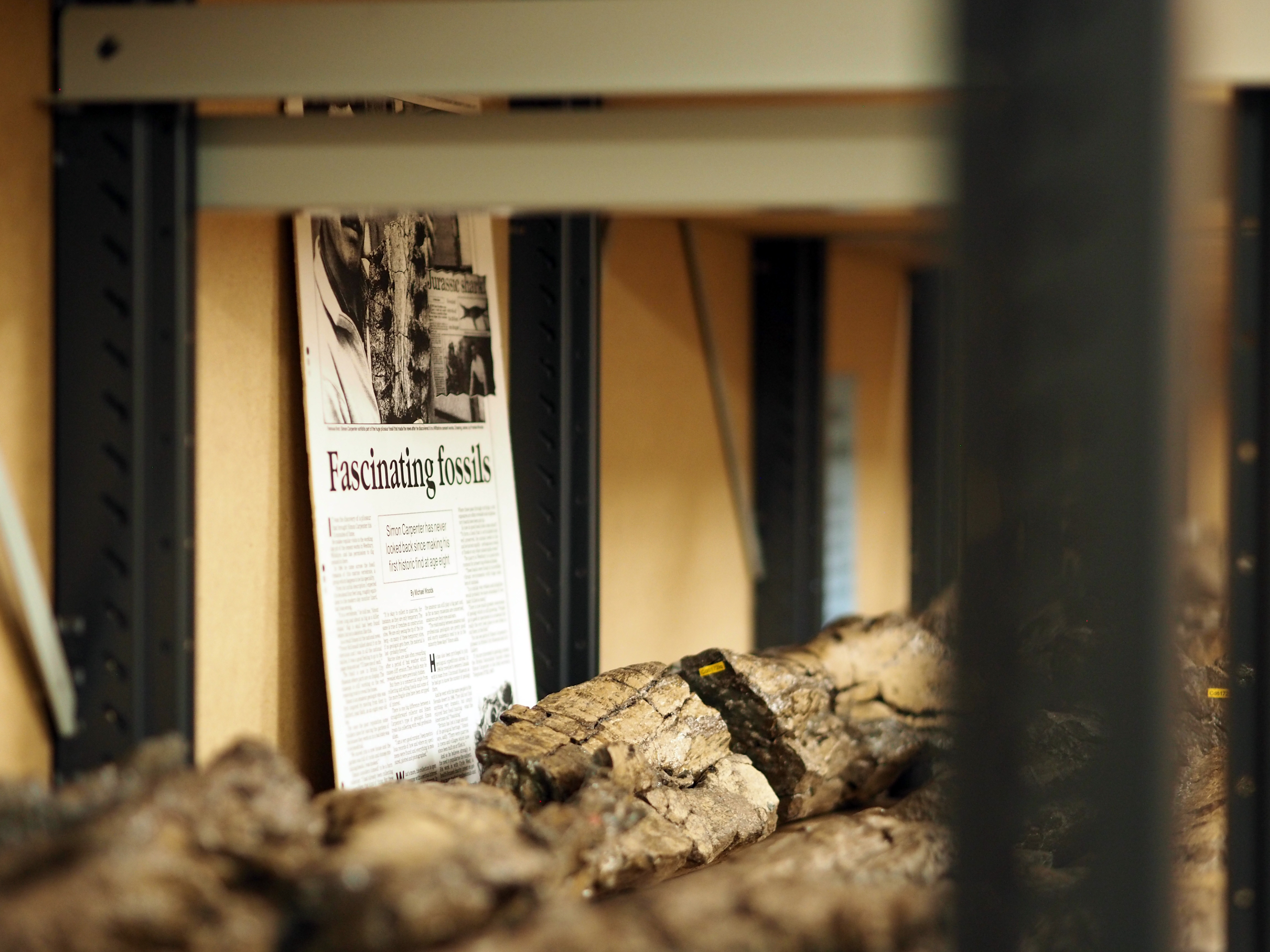
Again it’s the detail known about some of the objects that helps bring them back to life. Take fossil of Pliosaurus carpenteri, that sits on one of the shelves and is the only known example of this species (it’s named after Simon Carpenter, who discovered it at Westbury clay pit in Wiltshire). Thought to be a female, it would have suffered from excruciating toothache in the final years of its life – its fossilised remains revealing signs of a tooth abscess.

OLYMPUS DIGITAL CAMERA
Shelves of fossils, some of them unique finds, in the Bristol Museum store.

Thanks to the staff at the museum for such a fascinating insight into their work – it was a valuable day out for our students.


Back to top

Follow this blog

Get every new post delivered right to your inbox.