Top row L – R: Mahmoda Ali, Enterprise Team Manger; Mark Corderoy, Enterprise and Incubation Manager; Leanne Newton, Enterprise and Incubation Mangager; Nick Powell, Enterprise Programmes Manager.
Bottom row L – R: Daniel Nyambutora, Student Enterprise Co-ordinator; Nhi Ho, Student Enterprise Co-ordinator; Jo Portis, Enterprise and Incubation Co-ordinator
Guest blog post: Mahmoda Ali, Enterprise Team Manager
Over the past year, I’ve spent a lot of time talking to founders, students, academics, colleagues and partners about entrepreneurship at UWE Bristol and across the West of England.
One thing has come through strongly: there is no shortage of ideas or ambition here.
What often makes the difference is what surrounds those ideas- the people you meet, the expertise you can access, the confidence to take the next step and, sometimes, simply knowing where to start.
That thinking has shaped something we’re really excited to launch this September: the UWE Bristol Enterprise Engine.
The Enterprise Engine brings together our support for students, graduates, staff, researchers and regional founders. However, it’s more than putting existing activity under one roof. Instead of a single programme with a fixed starting point, we’re creating different ways into enterprise depending on where you are and what you need. Whether you’re exploring entrepreneurship for the first time, developing an idea, commercialising research or already building a venture, the aim is to help you find the right support, connections and next step, and stay connected to the wider ecosystem as you progress.
But for me, the most exciting part isn’t simply bringing our support together.
It’s what we can build around it.
The West of England is full of entrepreneurial talent, research, creativity and innovation. UWE is part of that ecosystem, and we want to play an even bigger role in connecting its different parts.
That means opening up more opportunities for people inside and outside the University to meet, share expertise, test ideas and build relationships. It means helping promising ideas find their next connection. And it means creating an enterprise community that people want to stay part of as they progress.
Because the best ecosystems keep giving back.
Students become founders. Researchers turn ideas into ventures. Founders become mentors, advisers and investors. Experience and connections flow back to the people just starting out.
That’s the kind of community we want the Enterprise Engine to help grow.
And this is just the beginning.
Over the coming months, we’ll be opening up new ways to get involved through our events, programmes and growing community.
Whether you have an idea, experience to share, connections to make or are simply curious about what’s happening, we’d love you to be part of it.
We will share more details in time, but get in touch to find out more: Enterprise@uwe.ac.uk
Manufacturers are under increasing pressure to improve productivity, address skills shortages and remain competitive. While robotics, automation and AI offer significant opportunities, many organisations lack the capability to adopt these technologies effectively.
To help address this, UWE Bristol is launching the AI-Ready Robotics Workforce Programme, delivered through the world-renowned Bristol Robotics Laboratory (BRL) in partnership with the United Strategic Planning Centre (USPC). Designed specifically for organisations operating within manufacturing and production, this fully funded programme will help participants build practical robotics skills and understand how AI can enhance industrial applications.
What participants will learn
Participants will gain practical, hands-on experience in:
Operating and programming industrial and collaborative robots
Working with sensors, communication interfaces and machine vision systems
Integrating robotics within manufacturing environments
Using AI tools to support programming, diagnostics and process monitoring
Applying robotics and automation skills to workplace challenges
Understanding responsible AI use and human oversight in industrial settings
The programme will run over 10 weeks, with participants attending one full day per week at Bristol Robotics Laboratory.
Day 1: Industrial robotics fundamentals and safety
Start with the foundations of industrial robotics. You’ll explore the different types of industrial and collaborative robots used in modern manufacturing, learn essential safety practices, tour BRL’s advanced robotics facilities, and gain your first hands-on experience operating a UR5e collaborative robot.
Day 2: Collaborative robot operation and programming
Build confidence in programming a collaborative robot. Using a teach pendant and introductory URScript commands, you’ll create movement sequences and complete practical tasks such as pick-and-place operations using a robotic gripper.
Day 3: Robot communication and control
Discover how robots interact with external systems. You’ll configure robot networks, access and interpret live robot data, send movement commands through the UR5e’s RTDE interface, and explore how ROS2 enables communication across robotic platforms.
Day 4: Sensors and machine vision
Learn how robots sense and respond to the world around them. Working with force-torque sensors, cameras and environmental sensors, you’ll capture and analyse data, carry out inspection tasks, and integrate information using industrial communication standards such as OPC-UA.
Day 5: Multi-robot and cross-platform working
Gain experience with multiple robotics platforms by working with both the UR5e and KUKA iiwa collaborative robots. You’ll compare programming approaches, evaluate their suitability for different manufacturing applications, and establish communication between robot systems.
Day 6: Manufacturing cell design and integration
Put your skills into practice by designing and building a complete manufacturing cell. Working in teams, you’ll integrate robots, sensors, machine vision and communications technologies, while addressing practical challenges around safety, performance and troubleshooting.
Day 7: Agentic AI and the Model Context Protocol
Begin exploring how AI can support robotics engineering. You’ll learn the principles of agentic AI, set up Claude Code, connect AI tools to technical documentation using the Model Context Protocol (MCP), and develop strategies for validating AI-generated outputs.
Day 8: AI-assisted robot programming
Harness AI to accelerate robot programming. Using natural-language instructions, you’ll generate code for both UR5e and KUKA robots, review and verify outputs against technical requirements and safety constraints, and test solutions on physical hardware.
Day 9: AI-driven diagnostics and process monitoring
Discover how AI can improve maintenance and operational performance. You’ll connect AI agents to live sensor data, investigate simulated production issues, evaluate AI-generated recommendations, and produce reports to support decision-making.
Day 10: Integrated AI and robotics deployment
Bring everything together in a final team project. You’ll design, build and demonstrate an AI-enhanced robotics workflow that uses AI to programme, monitor and diagnose robotic operations, while exploring responsible deployment and identifying opportunities for real-world application within your organisation.
Cohort dates
Tuesday 3 November, 09:30-16:30
Tuesday 10 November, 09:30-16:30
Tuesday 17 November, 09:30-16:30
Tuesday 24 November, 09:30-16:30
Tuesday 1 December, 09:30-16:30
Tuesday 15 December, 09:30-16:30
Tuesday 12 January, 09:30-16:30
Tuesday 19 January, 09:30-16:30
Tuesday 26 January, 09:30-16:30
Wednesday 27 January, 09:30-16:30
Benefits for employers
By investing in workforce development, employers can:
Build confidence in robotics and automation projects
Develop in-house capability rather than relying solely on external expertise
Improve productivity and operational resilience
Strengthen understanding of both robotics hardware and software workflows
Support future investment decisions around automation and advanced manufacturing technologies
Who can apply?
The programme is open to organisations that have been operating for at least one year and work within manufacturing, engineering, production, automation or related industrial sectors. Participating organisations must be able to attend training at Bristol Robotics Laboratory on UWE Bristol’s Frenchay Campus.
Have you ever wondered about the future of the healthcare industry? Who is taking us with them? Let’s Talk Health and Care Podcast (LTH&C), a part of the Integrated Care Academy (ICA) at UWE Bristol, aims to unveil the answers to these key questions and introduce you to the academics, researchers, founders and community leaders driving this change. Meet the people working to tackle real-world challenges with compassion and determination from the bottom up.
Professors Marc Griffiths and Peter Brindle sit down with academics, founders and community leaders who have identified real opportunities for change and who are working incredibly hard to implement that change. In the wake of the NHS England 10-Year Health Plan, the healthcare industry is actively searching for innovative solutions to complex problems.
“the NHS now stands at an existential brink” where “the choice for the NHS is… reform or die”.
Department for Health and Social Care, 2025
How can one conversation change the trajectory of your career?
In episode 8, Dr Appolinaire Etoundi explained how one conversation at a swimming pool changed his career. He discusses how, by blending engineering with healthcare he is now able to improve accessibility and independence for amputees and people with disabilities. Now, his work has helped to reduce the cost of prosthetics by up to 80%, with devices costing less than £500. This is the meaningful impact and innovation the podcast continues to spotlight. Listen now to hear Dr Etoundi explain how this happened.
One theme which comes up repeatedly is that healthcare is a complex industry inextricably linked with other industries, ranging from engineering to technological development, to community centres, to educational institutions. The ICA bridges all these industries and more, promoting a collaborative healthcare environment, fit for the future.
Intervention through community
In episode 10, we explore how we can prevent acute health issues requiring hospital treatment further down the line. Both our guests, Mark Graham and Jo Poole, emphasise the importance of neighbourhood-based health for building trust and a boundary-less workforce, bridging the gap between community and healthcare. Find out more about how this community centre acts as a one-stop community hub, and the impact it is having.
This boundary-less mindset can be applied when tackling cultural change, like systemic racism. In episode 2, Noor Nixon and Professor Anthony Hill discuss the Inclusive Training Within Practice Project, highlighting the challenges Black, Asian and Minority Ethnic students and staff face, and what a multi-system initiative can achieve. This is echoed with Caafi Health in episode 4, who exemplify a community-logic model, where healthcare is powered by the community, for the community. Listen to episodes 2 and 4 to find out how systemic discrimination is holding health and care back.
“We learned that the idea that health challenges are deeply social rather than just medical.”
Huda Hajinur, Co-founder and Director of Caafi Health, episode 4.
Listen to the podcast and find out how the latest research and collaborative problem solving is changing the way we interact with healthcare. Episodes are available on SoundCloud, Spotify and Apple Podcasts.
This is a guest blog by Jane Exon, Apprenticeship Employer Development Manager at UWE Bristol.
July is always one of the most exciting and proud highlights of the year for all of us involved in apprenticeships at UWE Bristol. It is a moment to celebrate achievement, perseverance and business partnerships. We proudly applauded our 2026 Degree Apprentice graduates recognising not only the incredible learners who crossed the graduation stage, but also the businesses who invested in their potential and supported them throughout their journey.
A degree apprenticeship is never achieved alone.
Behind every apprentice graduating is a business that has committed time, investment, mentoring and encouragement – managers who have created opportunities, colleagues who have shared their own experiences, and businesses that decided to build the skills of their future workforce through apprenticeships.
Our graduates are a powerful reminder of what can be achieved when providers, employers and apprentices work together with a shared goal – the truest meaning of a triparty!
Amongst the many inspiring stories from this year’s graduation ceremonies was that of John Adesoye from Bristol NHS Foundation Trust.
At the age of 64, John graduated with a BSc (Hons) Nurse Degree Apprenticeship, demonstrating that age should never be considered a barrier to learning, development or career progression. Having previously worked as an electronics technician, John changed careers, pursued opportunities through apprenticeships and has now qualified as a registered nurse. His story sends a powerful message to employers and potential apprentices alike: it is never too late to invest in your future. His journey highlights the transformative impact that apprenticeship opportunities can have on individuals, while showcasing Bristol NHS Foundation Trust’s commitment to workforce development and lifelong learning.
Supporting the engineers and architects of the future
Across the School of Engineering and School of Architecture, our apprentice graduates are already making a positive impact across the region and beyond, helping to design infrastructure, deliver engineering solutions, shape sustainable buildings and contribute to the UK’s future skills base, proving that apprentices develop the technical capability to be future innovators and leaders in industry.
Standout examples include Prithvi Ramesh at Rolls-Royce, who was recognised as Engineering & Manufacturing Apprentice of the Year at the Multicultural Apprenticeship Awards. The awards highlighted Prithvi’s technical excellence advocating for apprenticeships and inspiring future engineers, demonstrating that true engineering success lies not only in innovation but in inspiring future generations.
Hannah Hart from Atkins Realis successfully wonthe South West Princess Royal Award for Emerging Engineers 2026, impressing judges with her paper and presentation about the public response to flood alerts in Newport, South Wales. Hannah’s research found that many people were receiving and reading flood warnings but often didn’t understand them or know how to respond. “It highlighted that improving resilience is not only about predicting risk but communicating them effectively.’
Leonce Pereira with Safran Landing Systems who was a finalist in the EnginuitySkills Awards 2026. Leonce was shortlisted for combining technical excellence and design improvements with leadership and innovation, delivering impact through efficiency and improvement projects, while mentoring peers and promoting engineering careers through STEM outreach.
Thank you to our employer partners
At UWE Bristol we are proud to work alongside employers who are committed to future talent development through apprenticeships.
Smith Consult, whose support for apprentices continues to transform careers and strengthen the profession perfectly capturing what degree apprenticeships are all about in their reflections on this years’ graduations:
“For five years, they’ve juggled full-time roles, university study, independent learning and busy personal lives. Everything they have achieved is a testament to their hard work and dedication, and it has been an absolute privilege to watch them grow into the accomplished engineers they are today. The support from UWE is so appreciated. The teaching team there have been fabulous, thank you.”
As we celebrate our apprentice graduates, we also celebrate the employers who have made these achievements possible. From businesses helping individuals redefine and retrain later in life, to supporting award-winning early career engineering talent, these partnerships continue to demonstrate the transformational power of degree apprenticeships.
To all our July 2026 graduates: congratulations.
You have balanced work, study and life commitments with resilience, determination and professionalism. Your achievements deserve to be celebrated.
And to every employer that has supported a UWE Bristol apprentice along the way: thank you for investing in people, skills and the future workforce.
Together, we are not simply awarding degrees. We are building futures.
Lynne Fernandes Optometrists is a highly skilled, national award-winning Optometrists founded by Lynne and Gerard Fernandes. It is one of the most respected and trusted UK independent opticians, with highly qualified optometrists and industry-leading technology. Their innovative eye care and exemplary customer service is continuously improved by investment in equipment and products to provide personalised eye care and vision correction of the highest standard.
The Knowledge Base team was made up of Mario Vafeas, Michelle Jackson, and Mary-Ann Sherratt. Professor of Marketing, Mario Vafeas teaches undergraduate and masters; he is involved in Knowledge Exchange Projects with SMEs, and research in the field of buyer-seller relationships and value co-creation. Michelle Jackson is a Senior Lecturer in the Business School, teaching at undergraduate and master’s level and is an experienced marketer and marketing manager. Mary-Ann Sherratt was the Workforce Development Portfolio lead, and Clinical Lead for Optometry and is now Head of Optometry and Consultant Optometrist at Bristol Eye Hospital.
About the KTP Associate:
David Todd worked as a Marketing and Business Change Manager with Lynne Fernandes Optometrists and UWE Bristol. He holds a Master’s degree in Strategy, Change and Leadership, as well as Business Administration. During his time on the KTP programme, David benefitted from extensive training, including a course at Ashorne Hill on Strategy and Innovation, and studied for a Diploma in Digital Marketing.
When asked if he would recommend the KTP Associate role, David shared:
“I would thoroughly recommend the programme to other graduates. You quickly gain knowledge and experience that can make a positive difference to the organisation you work with. You will always have problems, and I have found on several occasions talking to the right people makes a tremendous difference – people want to help. I feel that it is a springboard to a successful and interesting career. The programme gives you the tools and knowledge to progress and enables you to be an asset to your organisation. It is just a pity that more people do not know about it!“
Photo: David Todd, KTP Associate
About Innovate UK:
Innovate UK is part of UK Research and Innovation, is the UK’s innovation agency. Their mission is to help companies to grow through their development and commercialisation of new products, processes and services, supported by an outstanding innovation ecosystem that is agile, inclusive and easy to navigate.
The Challenge the KTP Addressed:
The KTP project set out to address the follow aims:
Repositioning and relaunching the EyeSense subscription
A key challenge for LFO was to fundamentally reposition and successfully relaunch its EyeSense subscription, clearly articulating its value proposition and differentiating it from traditional eye care offerings in a market dominated by large competitors.
Introducing performance standards and monitoring
LFO faced the challenge of introducing consistent performance standards and robust performance monitoring across the business, in order to enhance patient experience while simultaneously improving eyecare outcomes.
Scaling the business and workforce
Another significant challenge was increasing the number of LFO practices on the high street and expanding the workforce within a year of project completion, requiring scalable systems, leadership capacity, and sustainable growth processes.
For Lynne Fernandes Optometrists (LFO), continued growth, competitiveness, and resilience in the face of the ‘big three’ presented a clear challenge. Competing on price was neither viable nor desirable; to prosper, LFO had to differentiate itself by delivering demonstrable added value to customers.
This made the expansion of its EyeSense subscription service not just an opportunity, but an imperative. However, scaling this service posed a significant challenge: it demanded management capability, alongside robust clinical and business systems and processes that the company did not yet have in place.
Photo: Newly refurbished practice on Wells Road (Bristol)
The Solution:
To address Lynne Fernandes Optometrists strategic growth ambitions, they undertook a programme of organisational development, focusing on embedding new management practices, cultural change and leadership capability.
These changes were essential to enable the scalable relaunch and growth of its innovative EyeSense subscription service, which offers predictive and preventative eye care and differentiates the business from more reactive competitors. LFO had previously engaged marketing expertise where the understanding of the importance of care quality had been misunderstood. Similarly, it was difficult to find people with clinical expertise who understood business and marketing.
Facing challenges in aligning clinical expertise with business and marketing capability, LFO partnered with experts from Bristol Business School and Optometry to manage this growth period rigorously. This led to the embedment of these changes within LFO, ensuring long-term impact beyond the project’s lifetime.
Photo: Inside the Nailsea Practice
The Impacts/Benefits of the KTP
The KTP delivered clear benefits for all partners. For Lynne Fernandes Optometrists, it resulted in a defined positioning statement for EyeSense, and a marketing plan for EyeSense, providing a strategic framework for future communications. The project also introduced standardised operating procedures, a new patient record coding system, and an electronic questionnaire, supporting improved efficiency and consistency. In 2025, the LFO group achieved 10% growth – EyeSense revenue had increased due to a fee uplift. Retail performance had been particularly strong, which was an impressive result given the broader UK retail landscape and the challenges which faced optical retail.
For UWE Bristol, the KTP project generated both academic and practitioner-focused outputs, including data collection for two research papers, one of which examines how tensions affect resource integration and outcomes in a private healthcare setting, and, jointly with the Associate, the development of a teaching case study based on brand positioning and branding hierarchy in an SME. These outputs contribute to academic dissemination and strengthen the potential for a future REF impact case study.
The KTP Associate gained a professional marketing qualification and completed the Strategy Innovation course, supported the advancement of their research and strategic skills through interviews, customer research via customer survey and operational development. This fed into the development of a positioning statement for EyeSense, which will guide all future marketing communications, and also led staff training and the implementation of new procedures, contributing to capability building within the business. They also developed standardised operating procedures – supporting staff development, new ways of working and ran staff training sessions.
What the partners have to say…
“The KTP has been a challenging but supported way of increasing and learning from cross discipline collaboration to the benefit of Lynne Fernandes Optometrists. In turn this will benefit patients in our geographical area and potentially influence national eyecare.“
Gerard Fernandes, Company Chair, Lynne Fernandes Optometrists
Photo: Gerard Fernandes, Optometrist and Director, Lynne Fernandes Optometrists
What the Knowledge Base partners have to say…
Academic Lead
“From an academic perspective the KTP was an opportunity to apply research-based knowledge to real-world commercial problems. The two-year project generated teaching material and provided the academic team with data for a new research paper. Working on a multi-disciplinary project, which had full commitment from the firm’s leadership team, was a very positive and rewarding experience.“
Mario Vafeas, Professor of Marketing, UWE Bristol.
Photo: Mario Vafeas, Professor of Marketing, Bristol Business School, UWE Bristol
Academic Supervisor
““Being involved with a KTP reminds me of the importance for business tutors, like myself, of the benefit of practical, live, real-time exposure to actual businesses. Gaining knowledge and experience is incredibly valuable for students, as it enriches their understanding and provides a practical context to theoretical learning. When students can relate their studies to real-world experiences, it not only enhances their learning but also prepares them for future professional challenges.”
Michelle Jackson, Senior Lecturer in Marketing, UWE Bristol
Photo: Michelle Jackson, Senior Lecturer in Marketing, Bristol Business School, UWE Bristol
International Women in Engineering Day (INWED) is celebrated annually on 23 June, and is a global celebration of the achievements, influence, and impact of women in the engineering profession. What began as a UK initiative by the Women’s Engineering Society has grown into an international movement with UNESCO patronage, bringing together communities, organisations, and individuals who are committed to shaping a more inclusive future for engineering.
The day shines a light on three core ambitions:
Inspiring future engineers – encouraging girls and young women to explore engineering pathways and helping address global skills shortages.
Showcasing women’s contributions – celebrating the innovation, leadership, and problem-solving women bring to the sector.
Championing equality – supporting women to thrive and promoting diverse, inclusive engineering workplaces.
A conversation about belonging, opportunity and change
At UWE Bristol, we’re marking International Women in Engineering Day with a special podcast featuring women at different stages of their engineering journeys. The discussion explores what representation means, how opportunities are created, and why engineering is a place where more women should feel like they belong.
Huge thanks go to our five brilliant panel members for talking so candidly and thoughtfully, and for sharing their experiences and insights:
Amelia Davies, Business Partnerships Manager for Advanced Engineering and Defence at UWE Bristol.
Emily Boys, Faculty Leader for Science at Cotham School.
Madeleine Starling, fourth-year Degree Apprentice at GKN Aerospace.
Alexia Williams, Chartered Engineer and Technical Lead at Rolls Royce. Alexia was recently named in the King’s Birthday Honours List 2026. She was awarded an MBE in recognition of her outstanding services to skills and education, her leadership in encouraging more women into STEM, and her commitment to closing the UK skills gap.
The conversation delves into the lived experiences and diverse pathways that brought each guest into engineering, highlighting the moments – both big turning points and quiet realisations – when they thought “yes, this is for me.”
The panel unpacks the persistent misconceptions that discourage girls from choosing subjects such as maths, DT and physics at school, reflects on early widening participation efforts in schools that can shift those patterns, and considers which mentoring approaches genuinely support women to thrive in engineering.
Throughout the conversation, several themes resonated strongly:
Representation matters – seeing women in engineering roles helps others to imagine themselves in those spaces and believe they belong.
Curiosity counts – problem solving, resilience, and a willingness to explore are often just as important (if not more important) than grades.
Engineering shapes the future – from healthcare to sustainability, engineers are tackling the world’s biggest challenges.
The overarching message was clear: engineering has space for everyone.
Building skills that empower women to thrive
At UWE Bristol, we are committed to creating pathways that support women entering and progressing through engineering careers. Our degree apprenticeships combine academic learning with hands-on industry experience, helping apprentices build confidence, capability, and a strong professional identity from day one.
We also work to create environments where women feel supported and connected. Mentoring opportunities link learners with role models across the sector, while award-winning initiatives such as Women Like Me amplify real stories and lived experiences that challenge stereotypes and open doors for the next generation.
By investing in inclusive routes into engineering and supporting talent at every stage, we’re helping to build a more diverse, skilled, and innovative engineering workforce for the future. And as our podcast guests reminded us, representation, curiosity, and community all play a vital role in shaping that future. When women see themselves reflected in engineering – and are given the space to thrive – the whole sector becomes stronger.
UWE Bristol’s Master of Architecture (MArch) students and local primary school St Michael’s CofE in Stoke Gifford have recently collaborated on an ‘Exploratory Design Studio’ community project to develop concept designs for a school building’s expansion.
Supported by Ann de Graft-Johnson, students Elliot Burningham, Craig Harding, Shahd Jabr, Huw Lansdowne, Charlotte Ongley and Daniel Pinto Rodrigues produced a series of designs for a new building to replace the school’s ageing ‘H-block’ and further expansion plans to include an onsite nursery and dedicated SEND facility.
What makes this project stand out is the depth of collaboration. Through consultation with staff and parents, and an engaging workshop with the school’s student council, they gathered insights from the people who know the site best. Pupils shared what excites them about learning spaces, while staff highlighted the practical needs of a growing school community. These voices became the backbone of the design process.
The resulting concepts place inclusion, sustainability and community at the forefront. Students explored ways to strengthen the school’s SEND provision, from acoustically considerate learning areas to dedicated spaces for extra provision sessions. Outdoor learning also played a central role, with ideas inspired by the forest school approach and a focus on creating more opportunities for children to learn and play outside. Several proposals also considered how the school could host community events more effectively, ensuring that new spaces feel welcoming and adaptable.
Pete Barnard, Headteacher of St Michael’s CofE School, described the students’ work with real enthusiasm:
“We were blown away by their professionalism and dedication to getting the designs right for all members of our school community. Their attention to detail and engagement of all stakeholders was exceptional, and our children have loved looking through the designs and choosing their favourites!”
Kay Confait, Pre-Award Coordinator at UWE Bristol, said:
“As a parent with children at St Michael’s Primary School, I have spent the last few years facilitating community outreach opportunities between the school and UWE. For this project our goal was to incorporate UWE architecture design expertise to develop concepts for new learning spaces, with a special emphasis on making the environments inclusive and adaptable for pupils with Special Educational Needs and Disabilities (SEND).
It was an incredible opportunity to bring MArch students on board. Over the last six months, it has been a true privilege to guide the collaboration from the initial briefing sessions and pupil engagement workshops to the final presentation of their outstanding concept designs.”
With the concept designs now complete, the school plans to present them to a local MP as part of its wider expansion ambitions.
The work will also be showcased during UWE Bristol’s annual Degree Show, ‘Showcase’. The Master of Architecture (M-Arch) cohort’s exhibition will be available for the public to view between Friday 7 June to Wednesday 10 June on Frenchay Campus (with the exception of Monday 8 June).
This partnership demonstrates the power of connecting academic learning with real‑world challenges. For the MArch students, it offered hands‑on experience in community‑engaged design. For St Michael’s, it provided a fresh, imaginative vision of what its growing school could become.
What does long-term business growth actually look like for SME leaders? For more than 330 participants on a high-impact leadership and management course at UWE Bristol, it has meant building stronger strategies, more resilient teams, and lasting peer networks that continue well beyond the classroom.
The Help to Grow: Management Courseis a 12‑week, 90% funded programme that gives SME leaders the skills, confidence, and support to take their business to the next level. Delivered across the UK by Small Business Charter-accredited business schools, to date it has helped over 10,000 leaders strengthen their strategy, sharpen operations, and accelerate growth. With a mix of online and in‑person sessions, dedicated 1:1 mentoring, and practical, ready‑to‑use tools, the course is built to deliver real impact from day one.
At UWE Bristol Business School, the course is delivered by academics and industry experts, with a focus on strategy, innovation, digital adoption, financial management, and leading people.
This year marks a milestone for the course. Now entering its sixth year of delivery at UWE Bristol, the programme has so far supported 330 business leaders to complete the course – each bringing their own challenges, ambitions, and ideas for the future of their organisations.
Since 2020, we’ve welcomed SME leaders from across the region and from a huge variety of sectors. Some arrived from organisations of five people, others from organisations of more than 200. That mix has always been one of the strengths of the programme: leaders learn as much from each other as they do from the curriculum itself.
A network that doesn’t disappear after 12 weeks
One of the clearest signs of the programme’s impact is the strength of the community that has formed around it. With an established national and local Alumni Programme, participants are offered learning and networking opportunities through varied content and events once the 12 week course ends.
Individual cohort communities also continue to support each other – members of Cohort 8, who completed the course in March 2021, still meet every month for peer support sessions. They’ve spoken at alumni events, and two members of the group are now launching a joint venture together.
Members of Cohort 8 speaking at a Help to Grow: Management Alumni Event in March 2025
This particular group shows that what starts as a structured programme can become an invaluable ongoing source of support, accountability, and collaboration.
Real change inside real businesses
Over the years, participants have used the course to tackle some major turning points in their organisations. Some have been preparing for succession, others exploring employee‑ownership models. One business has since transitioned to full employee ownership, using the course as a springboard for that journey.
Many alumni have also stayed connected with UWE Bristol through other opportunities. One has taken part in a Knowledge Transfer Partnership, others have worked with our student consultancy teams, and many have joined additional funded skills programmes such as Skills Bootcamps, Made Smarter, and the Leadership Fundamentals Programme. A number have even returned as guest speakers, panellists, or case study contributors – helping shape the experience for future cohorts.
“From the first session, I felt less overwhelmed with my workload, and gained clarity on how I needed to structure my business, and remove myself from the day-to-day in order to focus on the bigger picture.
The course has more value than you could imagine – the advice, experience, insights, resources and the mentorship hours you get access to is so worth it. The peer group you graduate with is also an incredible resource. The company I started the course with looks quite different to the company I completed the course with.”
Lou Fitzpatrick, Director at PrePitched
Mentoring that makes a difference
Mentoring is a core part of Help to Grow, with each participant having the opportunity to access 10 hours of 1:1 mentoring during their time on the course – and it’s been a real success story. Our mentors bring a wealth of experience, and the relationships they build with participants often continue long after the course ends. One of our Help to Grow alumni was recently named as a finalist at the National Mentoring Matters Awards, and one of our mentors recently won a national award, crediting his success to the work he did with his mentee through the programme:
“For me, the mentoring element of Help to Grow is where the learning becomes real leadership – it’s the bridge between knowing what to do and actually putting it into action. I joined Help to Grow to give back, but mentoring has turned into an unexpected long term partnership that has added value to both of our businesses.”
Olly Reid, Co-Founder of HUM4NS and Mentor on the Help to Grow: Management Course
Looking ahead
Reaching 330 alumni is something we’re very proud of – not just because of the number itself, but because of what it represents. It reflects hundreds of hours of learning, collaboration, and problem‑solving. It reflects businesses that are more resilient, more confident, and better connected. And it reflects a community of leaders who continue to support one another long after the course has finished.
As we enter our sixth year of delivery, the programme continues to grow and evolve. What hasn’t changed is our commitment to supporting SMEs across the region and helping leaders build the skills, networks, and confidence they need to take their organisations forward.
We’re excited to see what the next year of Help to Grow brings, and to continue working with the businesses and people who make Help to Grow what it is.
We’re thrilled to be delivering a new Help to Grow: Management Course cohort, starting in July 2026.
Metrea is a global defence company specialising in intelligence, surveillance, reconnaissance and advanced technology solutions for national security partners worldwide. Through a Knowledge Transfer Partnership (KTP) with UWE Bristol’s Centre for Machine Vision, the company worked to develop AI-powered software capable of detecting, tracking and classifying objects in orbit using airborne imagery.
About the Knowledge Base:
Researchers from UWE Bristol’s Centre for Machine Vision brought expertise in computer vision, machine learning and object modelling. Working alongside Metrea, the team helped develop and test innovative AI approaches capable of analysing complex orbital imagery, transforming early-stage research into a commercially viable solution.
Mark Hansen (UWE), Izaak Stanton (UWE Research Associate), Lyndon Smith (UWE), Chris Dunn (Metrea), Louis Aberdeen (KTP Associate), Ryan Gery (Previous Company Supervisor), and Ria Eyers (UWE) during a tour of the Engineering School.
About the KTP Associate:
KTP Associate Louis Aberdeen joined the project after graduating with a degree in Mathematics from the University of Bath. During the two-year partnership, Louis led much of the technical development, applying expertise in machine learning, optimisation and computer vision to help create a new AI-driven platform for space-domain analysis.
The experience enabled Louis to develop specialist skills in deep learning, image analysis and research translation, ultimately leading to a role as a Machine Learning Engineer.
Louis Aberdeen (KTP Associate) at the Louis Aberdeen (KTP Associate) at Farnborough Bristol Robotics Laboratory
About Innovate UK:
Innovate UK is part of UK Research and Innovation, is the UK’s innovation agency. Their mission is to help companies to grow through their development and commercialisation of new products, processes and services, supported by an outstanding innovation ecosystem that is agile, inclusive and easy to navigate.
The Challenge the KTP addressed
Tracking and identifying objects in orbit is becoming increasingly important as space becomes more congested. Existing methods can be expensive, technically complex and difficult to deploy at scale. Metrea wanted to explore whether AI and machine vision techniques could be used to improve the detection and classification of orbital objects using airborne imagery.
Ryan Gerry (previous Company Supervisor) and Louis Aberdeen (KTP Associate) at the International Space Show – Farnborough
The solution
Researchers from UWE Bristol’s Centre for Machine Vision worked alongside Metrea to develop new machine-learning approaches capable of detecting and classifying objects from airborne imagery.
The project combined expertise in computer vision, artificial intelligence and image analysis to create an analytical pipeline that could process complex imagery and identify objects of interest with greater speed and accuracy.
Throughout the partnership, the team iteratively tested, refined and validated the technology, including operational trials in real-world environments.
An example reconstructed output image of the international space station
The Benefits of the KTP:
The partnership delivered significant benefits for both Metrea and UWE Bristol.
For Metrea, the project accelerated the development of innovative AI capabilities, helping the company move a promising concept towards commercial readiness. The work strengthened Metrea’s ability to analyse and interpret orbital imagery, creating opportunities for future applications in defence, security and space operations.
For UWE Bristol, the partnership provided an opportunity to apply cutting-edge machine vision research to a real-world challenge. The project generated new knowledge, strengthened industry collaboration and created opportunities for future research in artificial intelligence, image analysis and space technologies.
The KTP also delivered a substantial professional development opportunity for KTP Associate Louis Aberdeen. During the project, Louis developed specialist expertise in machine learning, computer vision and software development, gaining experience of translating research into practical solutions for industry.
The success of the partnership demonstrates how Knowledge Transfer Partnerships can bridge the gap between academic research and commercial innovation, helping businesses access specialist expertise while creating lasting impact for researchers, graduates and industry partners alike.
Metrea – Chris Dunn (Company Lead) talk at the Centre for Machine Vision, Bristol Robotics Laboratory.
Impact:
The partnership delivered significant benefits for Metrea, UWE Bristol and KTP Associate Louis Aberdeen.
For Metrea, the project transformed LASSO from a data collection tool into a sophisticated analytics platform capable of generating operationally valuable insights. This work directly supported Ministry of Defence feasibility studies worth more than £1 million and opened opportunities for future software licensing, data sales and commercial applications.
The project also increased Metrea’s visibility across the defence and space sectors, with the technology showcased to organisations including NATO and the UK Ministry of Defence. Beyond its original focus on Space Domain Awareness, the research created opportunities for wider applications in Maritime Domain Awareness and signals intelligence.
For UWE Bristol’s Centre for Machine Vision, the partnership generated new research outputs, including peer-reviewed publications and a new area of applied research at the intersection of computer vision and space technologies. The project strengthened relationships with industry partners and created opportunities for future collaboration and research funding.
KTP Associate Louis Aberdeen played a central role in the project’s success, leading the technical development from image simulation through to advanced analytical techniques. The experience included operational data-collection flights in Florida, academic publishing opportunities and engagement with senior stakeholders across the business. Following the completion of the KTP, Louis secured a role as a Machine Learning Engineer, demonstrating the programme’s impact on graduate development and career progression.
Collectively, the project demonstrated how academic expertise and industry collaboration can accelerate innovation, transforming research into practical solutions with commercial, societal and strategic value.
ERS-2 (ESA) during re-entry period
What the partners have to say… “This was our first time working with a KTP and it has proved to be a very worthwhile venture. UWE Bristol was able to provide Metrea with an exceptional Associate who was able to adapt rapidly to the continued changing business demands throughout his period of work with us. His knowledge and adaptability provided rapid analytical outputs and support products to our customers and was most welcome as we used them across the globe tackling some of the most complex and wicked security problems faced today”. – Chris Dunn: Solution Architect at Metrea.
Returning Aircraft at Tampa test facility
What the Knowledge Base partner has to say… “This was a highly ambitious KTP that has delivered excellently against its plan, in no small part down to the exceptional adaptability of the associate, Louis. It has been a pleasure for the academic team at the CMV to work with Metrea and especially with Louis and see him develop so much over the course of the KTP. The projects that Louis worked on while at Metrea have the potential to have a real impact on international defence as well as giving the CMV its first foray into space. We wish Louis the very best for his future and look forward to working with Metrea again.” Prof Mark Hansen.
KTP Associate… “The KTP has been a fantastic opportunity to develop both my technical and professional skills. Working to foster collaboration between the industry partner and knowledge base results in an outcome greater than the sum of its parts. A personal highlight was getting into the hangar with my KTP supervisor Ryan to troubleshoot the integration of LASSO into Metrea’s aircraft, crawling around on the floor checking we had all the correct port connections” Louis Aberdeen (KTP Space Data Analyst Associate).
Louis Aberdeen (KTP Associate) using a flight simulator at UWE Engineering School.
From the Knowledge Transfer Adviser: “This innovation project has been very successful in enabling new revenue streams now and in the future for the Company as well as achieving significant societal benefits in early detection of fire, people smuggling and defence/space problems enabling early detection and real time actions to be taken
Louis has led the project with drive and determination and has successfully covered the technical and commercial challenges through excellent communication skills and innovative thinking.
The development of the deep learning-based image recovery system by the team is based on wide ranging technology integration into a working and practical system with a strong commercial focus and is a great example of how the KTP methodology works to achieve breakthrough solutions at pace”. Paul Spenley (Knowledge Transfer Adviser – IUK)
This blog is written by Ben Tilley, Employer Engagement Officer in the Student and Graduate Talent team at UWE Bristol.
With all careers events now delivered for 2025/26, we thought it would be a good time to reflect on another dynamic year in the Student and Graduate Talent team.
In this academic year we welcomed 315 organisations onto campus. Our events spanned a range of activities, from straight up careers fairs, through to ask the expert sessions, panels and employer career talks. Here is a sample of the great feedback we have received from employers about our events:
Ralph, Aviva (Computer Science Panel): I thought it was a really good event, and I enjoyed getting to talk to your students. I’ve made several new LinkedIn connections and it’s really great to hear that some are already enrolled in the Aviva Graduate Assessment Centres.
Ben, Science Creates Outreach (Science Futures Fair): The students were confident, professional and open to asking questions. It was a pleasure to talk to them.
Despite being an employer focused team, students are the centre of everything we do, and we welcomed over 4,300 to the 35+ events we delivered over the course of the academic year. We had record breaking student turnout at the Engineering Fair, the Law Fair and Professional Practice Week (PPW). At PPW 2026 the student attendance was double the attendance of the previous year! With an increased focus on the benefit of experiential learning, careers events have taken on even greater significance when it comes to preparing students for what happens when they complete their studies. Here is a sample of some of the great student feedback we’ve received about our events:
Alizeh, LLB Hons Law, 3rd year (Law Fair): Attending the fairs has helped me understand what a career in law looks like beyond university. They gave me insight into the wide range of roles and employers available, which grew my inspiration. Thanks to UWE Careers Fairs, I am more confident in my pursuit of a career in law after graduation.
Dami, Computer Science with AI, 3rd year (Business School Careers Fair): Attending the fair gave me the chance to connect with employers and learn more about internship opportunities in tech. I was impressed by the variety of companies there, and it helped me feel more confident speaking to recruiters about my skills and career goals.
Special thanks to our wonderful staff who continue to support our events and offer their expert guidance to students, while pulling together the various elements required to make our events a success. Also, to the Events team for offering their expertise, guidance and support this year.
With our continued desire to deliver greater experiences for our students and employers alike, we are revamping our careers fairs for academic year 2026/27. All fairs will be consolidated into 3 events over the course of a fortnight in October (7 -21 October 2026), combining several complementary disciplines into each event as follows:
Applied and Social Sciences, Environmental and Public Sector – 7 October 2026
Architecture, Construction, Engineering and Property – 14 October 2026
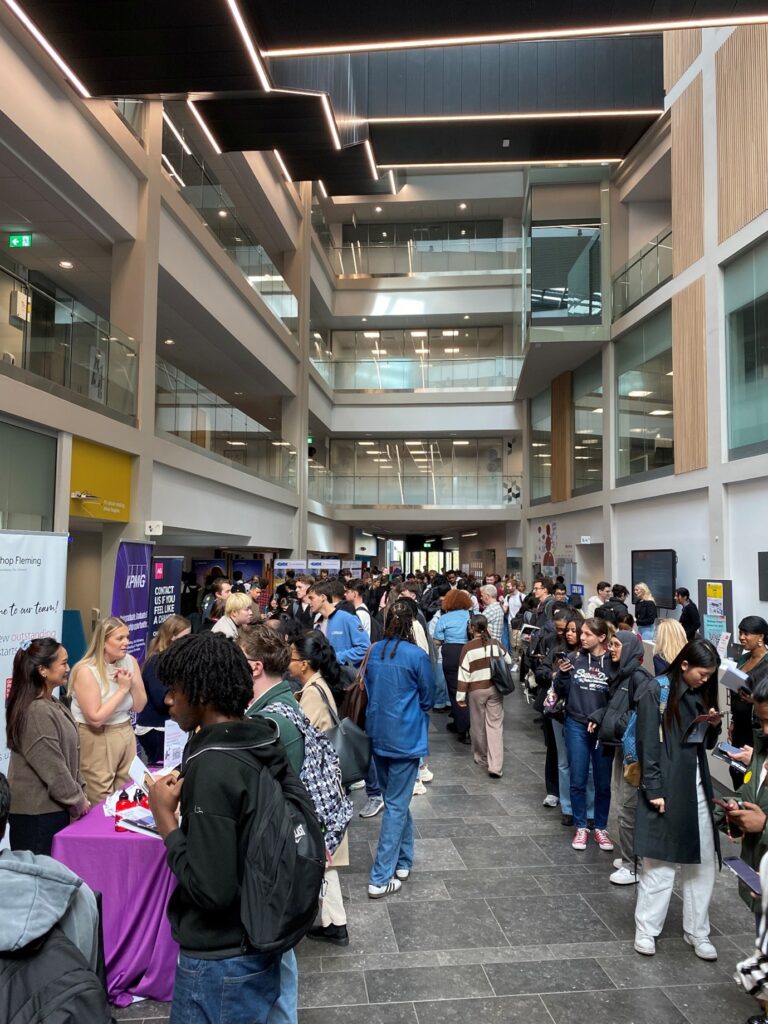
Business School Careers Fair, October 2025Property and Construction Bootcamp, October 2025Professional Practice Week, Creative and Tech Mixer at Strange Brew, January 2026Ask the Experts (Accounting and Finance), February 2026