Reflections on the June 2026 One City Gathering: Inclusive, Equitable and Sustainable Economy

Posted on

This blog has been co-authored by Alicia Hallatt and Allan Macleod from the Civic and Inclusivity team.


At a time when universities are coming under scrutiny to be more than just places of academic teaching and research, UWE Bristol is continuing to actively embed its civic ambition across the institution. Our role in Bristol One City reflects this commitment. Given our role within the region, the latest One City Gathering, which focused on building an inclusive, equitable and sustainable economy, was especially relevant. Some of the team that attended have reflected on the discussions they had and what it means for UWE Bristol and our work within the city.

Across the day, a consistent theme emerged: ask communities what they want and need to thrive, then take action that both includes and enables them. The desire for collective, collaborative action was powerful, running through every session and conversation. The One City Gathering’s keynote speaker, Andy Haldane CBE, summarised it as a need to move beyond co-creation to something more equitable, ensuring all affected parties have a place at the table and everyone leaves equipped with the skills and knowledge to continue growing.

discussions around tables
Credit: Bristol City Office

The four workshops covered Bristol’s response to helping those Not in Employment Education or Training (NEETs), how we can tackle the gender, race and disability pay gaps, delivering a circular economy that provides economic opportunity and discussion about meaningful community development in light of the upcoming Pride in Place and Pride of Place programmes in Hartcliffe.

One contributor  to the NEET workshop noted how quickly young people calibrate their aspirations to what they perceive as attainable, what opportunities are visible, and what fits-in with their peers; this was identified as a leading factor in why some Bristol wards sadly continue to experience persistently low social mobility.   Addressing this is a key aim for Bristol One City’s partners, highlighted by the goal that no-one’s future prospects should be defined by where they have come from. Colleagues reflected on the recent Milburn report and discussed the challenge locally. What is clear is that Bristol has a substantial number of impactful initiatives, but these need better coordination to make them attainable to employers, trainers, and those at risk of becoming NEET. The result will be not only improved individual outcomes but also stronger societal outcomes, increased capacity for local organisations, and a stronger regional economy as more people are able to contribute, regardless of their background.

people sharing thier thoughts with post its on bpard
Credit: Bristol City Office

The Civic and Inclusivity team are actively trying to tackle many of the issues raised in the pay gap discussion. UWE Bristol is working towards becoming an anti-racist university , acknowledging this will require continued effort and listening. Further, our team has been building understanding around how our disabled and global majority students can be better supported in placements, mentorship programmes and bespoke extra-curricular opportunities to ensure that those who have been left behind in the past have more equitable opportunities to succeed in the future and reward gaps are reduced.

The key takeaway from the One City Gathering was clear: trust is built through listening, and impact is sustained through collaboration. Our connections and our communities are our biggest strengths. Our huge thanks goes to Bristol One City for arranging such a packed morning that enabled connections between such a diverse audience.  At UWE Bristol, we are keen to build on this momentum, collaborating with partners to connect talent, share knowledge and create opportunities. If you are interested in collaborating with us, please contact us at uwebusiness@uwe.ac.uk or volunteering@uwe.ac.uk.


Innovation with impact: Supporting the World Federation on Incontinence and Pelvic Problems World Continence Week.

Posted on

This week is World Continence Week (15th to 21st June 2026) and researchers from UWE Bristol’s School of Health and Social Wellbeing are working to promote better bladder and bowel health at UWE Bristol and across the region. Bladder and Bowel leakage affects about 1 in 5 adults, which is about as common as hay fever, but is an issue that people are often reluctant to discuss.

Led by Prof. Nikki Cotterill, we are working with the Bristol Active City Network to raise awareness of how bladder and bowel leakage can affect people’s ability to get out and about and engage in exercise and other activities. For World Continence Week Nikki will be leading a webinar for the network, building upon previous engagement work with them on a pathway redesign project, aiming to help people to talk about bladder and bowel leakage and to access available self-help. In particular, bladder and bowel leakage can be the difference between taking part in exercise or being too embarrassed or worried about an accident. Addressing this, provides an opportunity to keep people in the activities they enjoy and socialising with friends and family.

A key resource to raise awareness and promote self-help is the CONfidence app, a self-help app developed by UWE Bristol researchers in conjunction with the Bladder and Bowel Confidence Health Integration Team (BABCON HIT) and Expert Self Care. The app has been downloaded by almost 20,000 people and has reached 20 countries. This App has been Co-created with people who have experienced leakage symptoms and national experts specialising in bladder and bowel care. Anyone experiencing bladder and bowel leakage can download the app for free. This gives access to practical advice and information on how to improve their bladder and bowel health.

Further tackling taboos, UWE Bristol has spearheaded the Boys Need Bins campaign, aiming to raise awareness about incontinence in men and the need for bins in men’s toilets. UWE Bristol is taking part in a pilot placing sanitary waste bins in men’s toilets across the Frenchay campus. This allows for the disposal of incontinence products including incontinence pads, stoma care items or other medical and sanitary products. Researchers are working with system partners to roll this out in other organisations across Bristol aiming for a ‘Boys need Bins Bristol’.

We need to talk more about bladder and bowel health to break down the stigma preventing symptom improvement. We are always keen to hear from anybody with an interest in this area, so please do contact Prof Nikki Cotterill with any thoughts or suggestions this World Continence Week: nikki.cotterill@uwe.ac.uk.

UWE Bristol Returns to the UK’s Biggest Celebration of Nature.

Posted on

UWE Bristol is delighted to once again take part in the Festival of Nature, the UK’s largest celebration of the natural world. UWE staff, families, and friends are warmly invited to join us at Millennium Square, Bristol City Centre, on Saturday 13 and Sunday 14 June, where our researchers will be showcasing an inspiring range of activities in the UWE tent.

What UWE Researchers Are Bringing to the Festival

This year’s programme features a rich mix of hands‑on workshops and interactive demonstrations.

Clair Schwarz (CATE) will introduce visitors to the ecological and cultural significance of the wren, offering the chance to create clay wrens and paper masks while exploring themes of storytelling, identity, and tradition.

A bio screen print of a wren

Dr Laura Morgan (CATE) and Laura Clarke (CATE) will run a bio screen‑printing workshop using colour derived from native UK trees, helping visitors understand where textile colour comes from, why it matters, and how material choices can support more sustainable futures.

Nature‑inspired innovation will also be on display as Lidia Badarnah (CATE) and Dr Sigita Zigure (CATE) demonstrate how biomimicry, bio‑design, and nature‑based solutions can help create greener, cooler, and more resilient places. Their activity invites visitors to take part in creative challenges that show how nature can guide imaginative problem‑solving.

Verity Jones (CHSS) will share Taking a Close Look at Microfibres, an activity linking UWE research on air quality with the Schools Under the Microscope project, offering a creative way to explore microfibres, clothing, and indoor air quality.

Kishwar Ali (CHSS) will showcase research on how plants respond to climate change, how biodiversity supports resilient ecosystems, and how we can design greener, climate‑smart cities and landscapes.

Families can also meet the Oak Tree Doctors, presented by Carrie Brady (CHSS) and her research group. This hands‑on activity introduces the importance of healthy trees and the challenges posed by Acute Oak Decline (AOD), a disease affecting native UK oak species involving bacteria, the Agrilus biguttatus beetle, and environmental stressors.

A woman on one knee extracting a sample from an oak tree with a long drill like apparatus

Freya Radford (CHSS) will help visitors understand what makes a healthy river system, the organisms that live there, the stressors they face, and how biodiversity and ecosystem structure influence a river’s ability to withstand pollution.

Exploring greener streets, Yarden Woolf (CHSS) will present GP4Streets, an interdisciplinary project showing how everyday streets can become healthier and more climate‑resilient through simple, community‑led action. The project brings together expertise from urban planning, landscape architecture, public health, environmental science, and air quality research.

Oluwadamilola Okeyoyin (CHSS) will offer Plants and You, an interactive activity inviting visitors to touch, smell, and investigate herbs and plant materials while discovering how plants, microbes, and everyday health are interconnected.

Emma Thomas (CHSS) will present The Rights of Rivers an activity grounded in interdisciplinary research that treats rivers as teachers, collaborators, and agents within environmental futures. This work challenges narratives that position rivers as passive victims of pollution, instead highlighting river agency and diverse forms of knowledge—scientific, sensory, cultural, ancestral, and experiential.

A parent and child looking intently at a mock up of a biome resembling a river. The parent is crouched in the reeds, his eyes following the child's finger that points off to the distance
Credit: Ania Shrimpton

Beyond the UWE tent, Kat Corbett (CATE) will contribute to the ‘How‑To’ Talks Tent with an activity focused on the circular economy. Using materials from the Scrapstore, participants will experiment with creating multiple objects from the same set of resources—such as playdough, buttons, and milk bottle lids—highlighting the value of reuse, imagination, and resourcefulness.

About the Festival

The Festival of Nature is directed by the Natural History Consortium, a partnership of 14 regional and national organisations, including UWE Bristol, the BBC, and the National Trust, working together to engage people with the natural world through collaborative action.

The Wild Weekend at Bristol’s Millennium Square is the largest event in the Festival of Nature programme, attracting 10,000–15,000 visitors over the weekend.

Find the full programme of events at Festival of Nature Website and follow updates on social media at @festofnature. 

Event Details

Saturday 13 June 2026: 10:00–18:00

Sunday 14 June 2026: 10:00–17:00

Location: Millennium Square, Bristol City Centre, BS1 5SZ

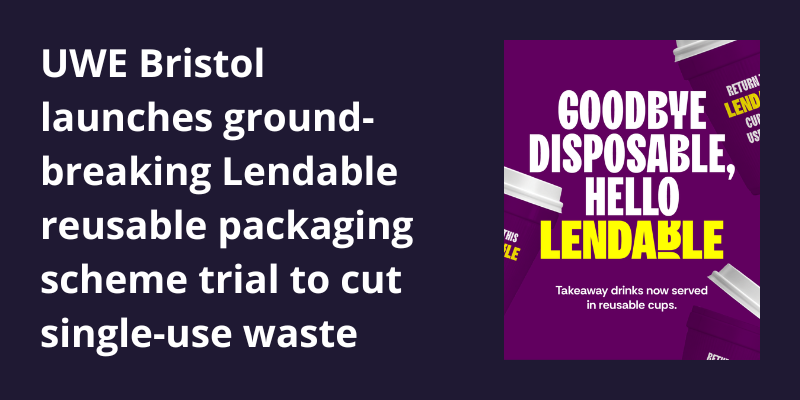
UWE Bristol launches ground-breaking Lendable reusable packaging scheme trial to cut single-use waste

Posted on

UWE Bristol is proud to host a pioneering trial of the Lendable reusable cup scheme on our Frenchay campus, taking a practical step to reduce single-use cup waste and advance circular economy principles. As a first-of-its-kind initiative, this trial positions UWE Bristol at the forefront of sustainable campus innovation.

How the Lendable scheme works

From May 11th, takeaway drinks will be served in purple reusable cups at three Frenchay campus locations: the Wild Kitchen Vegan Café, Atrium Café in X Block (Bristol Business School), and the Student Union Bar. The scheme is designed to be frictionless: while the usual take away cup levy still applies, there are no deposits, no sign-ups, and no apps required.

After use, cups should be returned to purple bins located across campus. To make the job as easy as possible for the cleaning and waste teams, we would kindly like to ask to dispose of the liquid of any unfinished drinks before putting the cups in the purple waste bins. A map of bin locations is available here to help find the nearest drop-off point. Cups are then collected, professionally cleaned by Re_Uz, experts in the hygienic deployment of reusable packaging at large events, and then returned for reuse.

This closed-loop system can reduce carbon emissions by up to 20 – 30% after just two uses, compared to single-use paper cups, which are typically non-recyclable due to mixed materials. The April trial will provide important feedback and enable a wider roll out of Lendable across all cafes from September.

A collaborative partnership driving circular change

The scheme is a great UWE Bristol partnership including Sustainability, Hospitality, Cleaning and Waste working closely with the Students’ Union and our external partners:

  • Ecosurety: a Bristol based B Corp-certified company that helps businesses comply with packaging and recycling rules while promoting sustainability and innovation in waste management.
  • SUEZ Recycling and Recovery UK: a leading environmental services and waste management company, and UWE Bristol’s current waste contractor, responsible for waste collection, recycling, and supporting the transition to a circular, low-carbon economy

UWE Bristol’s Frenchay campus will be acting as a living lab, providing a real-world testing ground to trial and refine the scheme, while aligning it with our sustainability commitments and research goals. The university was chosen for this trial because of its strong reputation for hands-on, action-led sustainability and circular economy innovation.

As Jade Shih, Head of Circular Economy at UWE Bristol, explains, “This trial not only reduces waste but also creates valuable opportunities for research, innovation and skills development, thereby embedding sustainability into campus life and supporting UWE Bristol’s RISE beacons.”

The scheme supports UWE Bristol’s sustainability commitments through collaborative research and innovation, offering students and staff opportunities to engage with circular economy practices. It also aims to strengthen green skills development by integrating real-world projects into teaching and placements. Dr. Sarah Hills, Senior Lecturer in Geography & Environmental Management, highlights the educational impact:“Reusable systems like Lendable are essential for moving beyond recycling towards true circularity. By integrating this scheme with our teaching and research, we prepare students to lead sustainable change in their future careers.”

Reflecting on the practical design of the scheme, Richard Marriott, Head of Reuse at Ecosurety, adds, “We focused on making the system as simple and accessible as possible, so that choosing reuse becomes effortless. This trial is a vital step in demonstrating that large-scale reuse can work effectively in real-world settings.”

Operationally, the trial demonstrates a system-led approach to sustainable campus management, contributing to improved Sustainable Development Goals performance and helping meet UWE Bristol’s ambitious sustainability targets.

Your voice matters: help shape the future of reuse

As the trial unfolds, we invite staff, students, and visitors to share their experiences. Feedback on ease of use, cup design, and bin accessibility will be crucial to refining the scheme and planning a wider rollout across campus. A simple feedback form is available to capture your insights and suggestions. a simple feedback form can be accessed via a QR code on the cups

The Renters’ Rights Act: why this moment matters for universities, communities and business.

Posted on

Written by Allan Mcleod. Allan is the the Head of Civic and Inclusivity, leading the University’s partnership work with communities, public sector organisations, and local and regional government, as well as the VCSE sector. Allan has prior experience leading on partnership work at Bristol City Council in the City Office and holds strong links across Bristol and the West of England, particularly within the VCSE and sustainability sectors.


The Renters’ Rights Act comes into force beginning May 2026. Reshaping the private rented sector in England, and marking the most significant change to renting in a generation. For a city like Bristol, where housing affordability is amongst the worst in the country and private renting is a central part of the housing system this moment really matters.

At UWE Bristol, beyond our students housing alone, our research, civic engagement and external partnerships show us first hand how housing stability impacts people and business.

So, what is the Renters’ Rights Act and why does it matter?

The Renters’ Rights Act new national government legislation designed to strengthen protections for people renting privately and to rebalance relationships between renters and landlords. The Act abolishes Section 21 “no‑fault” evictions, so tenants are no longer required to leave their homes without a specific, lawful reason. It also rolls out open‑ended tenancies, limits rent increases to once per year at market rate, and includes stronger protections against discrimination, including for families and people in receipt of benefits. The Act also provides tenants with clearer rights to request pets and increases accountability through improved enforcement mechanisms.

For those wanting to understand the detail of the legislation, the government has published an official Renters’ Rights Act information sheet explaining the changes in plain language. UWE has been working with a local organisation Housing Matters who have also set up a user friendly campaign called We Rent that offers advice for renters and landlords navigating the new system.

Community and economic impact

Housing is a foundational need and a lack of housing security can have huge knock on consequences around mental health, family stability, children’s education and people’s ability to participate fully in their communities. In Bristol, where demand far outstrips supply and rents continue to rise, even small changes in tenancy conditions can have major consequences for people’s lives.

As mentioned above, UWE Bristol has partnered with Housing Matters, a Bristol‑based charity supporting people facing housing insecurity. We have seen how confusion around housing rights can exacerbate vulnerability and how many renters leave homes earlier than they legally need to and accepting unlawful rent increases, or not challenging unsafe conditions because they are unsure where to turn and are scared of negative consequences of doing so.

While the Renters’ Rights Act has the potential to reduce these pressures, lasting change will depend on strong local understanding and collaboration. Understanding this need, UWE Bristol is actively supporting this work creating partnerships, aligned research and community engagement, to help translate this national bill into practical benefit across our region.

The Renters’ Rights Act also carries important implications for business. Employers across the West of England increasingly recognise that housing insecurity affects their workforce. Employees who rent are facing frequent moves, sudden eviction notices or escalating rents are more likely to experience external stressors that lead to disruption to work, those who are landlords need to understand their rights and requirements too. The WE Rent campaign is helping to support both renters and landlords in providing this information.

Greater stability in the private rented sector ensures a more resilient workforce, enabling business to find, and keep the right talent.

Opportunities for collaboration and research

As the Renters’ Rights Act beds in, there is a strong need to evidence its impact. How renters and landlords experience the new system as well as the effect local housing markets respond will all vary by region.

Universities can support this work by developing strong, trusted partnerships with organisations on the ground. At UWE Bristol, we have been building relationships with local housing charities such as Housing Matters, demonstrating the importance of working alongside practitioners to understand emerging challenges and contribute constructively to local responses. Our Centre for Sustainable Planning and Environments (SPE) undertake research that contributes to planning theory, policy and practice and has expertise in planning, housing and homelessness.

Looking ahead, there are opportunities for further collaboration around data analysis, service design, training, public engagement and policy learning. The Renters’ Rights Act creates new space for doing things differently, and universities can help ensure those changes are informed by evidence rather than assumption.

For UWE Bristol, this moment reinforces the importance of our civic role. By working alongside partners to understand change as it unfolds, and by using our resources in service of the region, we can help ensure reforms translate into meaningful improvements in people’s lives.


We’re always interested in building new partnerships with charities and social enterprises working at the heart of our communities. If you’re interested in working with UWE Bristol to make an impact, find out more about the Civic and Inclusivity team.

Enterprise that fuels progress: How Women Like Me Is Redefining What’s Possible for Women in Male Dominated Industries 

Posted on

A programme that boosts confidence, transforms workplaces, and strengthens the region’s talent pipeline. 

A Turning Point for Women in Male Dominated Industries 

When Dr. Laura Fogg ‑Rogers first developed Women Like Me, she wanted to address a long standing, systemic issue that has been historically difficult to approach. Brilliant women were entering professions with enthusiasm, ability, and ambition but getting worn down and burned out quickly, because of the culture surrounding the work. Women consistently felt “like they were constantly proving they deserved to be in the room.’’  

Dr. Fogg –Rogers wanted to change this by creating networks of women within male-dominated industries who feel seen and supported. “Women Like Me is about making sure talented women aren’t lost in the background. When women feel supported and empowered, they contribute more confidently to their teams and the whole sector benefits.” 

That belief has helped shape a research‑informed, award‑winning, initiative that is transforming how the region nurtures and retains engineering talent. 

Why Talent Was Slipping Through the Cracks 

Despite major progress, women remain under-represented in Engineering and, more widely, STEM education and careers worldwide. Recent studies show women make up only 28% of the STEM workforce depending on region, and their participation in STEM training pathways remains significantly lower than men. With gender stereotypes and lack of visible role models less women are training into STEM and Engineering careers. 

Further issues arise for women within the workplace. Many women report navigating professional isolation, a lack of relatable mentors, and limited opportunities to build confidence in leadership and communication. These challenges affect organisations greatly, through reduced retention, stalled progression, and a narrowing of perspectives within teams. 

One engineer reflected, “I was doing good work, but I didn’t feel visible. I didn’t feel like a leader even though others told me I was capable of more.” 

This gap is deeply problematic because it limits diversity, reduces inclusion, and ultimately weakens the innovation potential of the sector. At a time when the world is confronting complex economic, environmental, geopolitical, societal, and technological challenges, addressing underrepresentation is crucial. Closing the gender gap is essential to drive sustainable, tech‑enabled innovation, and to meet the economic demands of a rapidly evolving global landscape.  

This is the gap Women Like Me set out to close. 

Inside a Programme Built to Change the System

Women Like Me combines mentoring, skills development, outreach, and community. These are all backed by research led from UWE Bristol’s Science Communication Unit. The programme was set up in 2019 with Dr Laura Hobbs, and has received funding from the Royal Academy of Engineering, the Digital Engineering Technology and Innovation initiative, Office for Students, Rider Levett Bucknall, and Suez. In 2023, the programme expanded to the construction and property sector, and in 2025 worked with UWE Degree Apprenticeships to reach women in digital and nuclear fields.  

Early‑career and mid‑career women are paired with senior mentors who understand the realities of male-dominated workplaces and can offer guidance with empathy and experience.  

Participants also take part in communication training and outreach activities, organised by research associates Sarah Behenna and Louisa Cockbill, to support them becoming visible role models, and developing a support structure for the next generation. This approach builds not only individual confidence but a wider culture where women’s voice is heard and their expertise is acknowledged and amplified. Since 2024, Professor Sue Durbin, Dr Vanda Papafilippou, Dr Samantha Organ, and Dr Amina Hamoud have lent their expertise to strengthening work on inclusive HR practices and intersectionality within the programme.  

As one industry partner put it, “The engineers we supported through Women Like Me returned with a sense of renewed purpose. Their confidence grew; this had a direct impact on our organisation.” 

The transformation participants describe is both personal and professional. Many speak about finally feeling like they belong, gaining the confidence to put themselves forward, and seeing their skills recognised within their teams. “Being part of Women Like Me helped me step into my own voice. I’m now leading projects I would never have felt bold enough to take on before.” 

For enterprises, this translates into more engaged staff, stronger leadership potential, and a workplace culture that attracts and retains diverse talent. The region benefits too, through expanded outreach networks, strengthened industry–university collaboration, and a more resilient engineering and construction ecosystem built on inclusion rather than exclusion. 

What’s Next for Women Like Me 

The next phase of Women Like Me aims to deepen its reach, engaging more women, working with more employers, and creating broader visibility for women within the sector. The programme will continue building on the Science Communication Unit’s research to evolve mentoring, leadership training, and outreach activity. 

Dr. Fogg‑Rogers says, “We’re not just supporting individual careers; we’re helping reshape the culture of engineering so that women’s talent is valued, recognised, and retained.” 

Discover more about the Women Like Me project. 
 
If you liked this blog read: The impact of hybrid working on Black women academics: navigating visibility, care and change 

Back to top