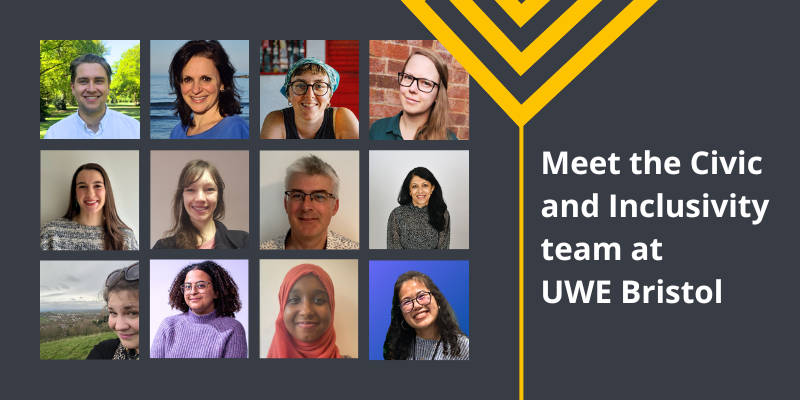
Meet the Civic and Inclusivity team within UWE Bristol.

Posted on

We are the Civic and Inclusivity team at UWE Bristol. Our work is shaped by a sector wide understanding that universities play a vital role in contributing to the social, economic, and environmental wellbeing of the places they serve. Our team looks to develop new opportunities for charities, communities and public sector partners. Sat within Research and External Engagement (REE) we enable these organisations to navigate UWE Bristol and all it has to offer, helping them seek out opportunities and find partnerships within the university. We work to ensure that UWE Bristol’s civic activity is purposeful, measurable, and rooted in authentic, proactive relationships with its surrounding communities.

At UWE Bristol, meaningful civic engagement is inseparable from our commitment to equity, antiracism and inclusion. The University has an Anti-Racism Strategy that acknowledges the deep-rooted inequities faced by Global Majority students and staff, outlining a clear need for accountable, institution wide action to dismantle systemic racism. Alongside this, UWE Bristol’s broader equality, diversity and inclusion (EDI) commitments prioritise creating inclusive cultures, amplifying staff and student voice, and ensuring that discrimination, bullying, and harassment are actively challenged across the institution. These commitments shape how the Civic and Inclusivity team partners with communities, supports students and works to change practice across the institution.

Bringing these elements together, the Civic and Inclusivity team works across the University. We support colleagues, students, and external partners in co‑creating initiatives that strengthen community connection, widen participation, and ensure that UWE Bristol’s civic mission contributes to positive local change. Our goal is to ensure that UWE Bristol’s role as an anchor institution is lived out in ways that benefit local people, empower marginalised voices, and enrich the University’s relationship with the communities it serves.

Meet the Team:

I’m Allan, I lead the Civic and Inclusivity team at UWE Bristol. Having worked in strategic and community-based partnerships for a number of years I lead the work to coordinate the University’s engagement with local partners across the region. I support academics to incorporate local partners into their research, meet community and charity partners to understand their needs and try to find ways to support them within the University, and work strategically across the institution to shift the ways we operate to become more inclusive and impactful for communities across the region.


I’m the Civic Development Manager at UWE Bristol, where I lead the Civic and Community Engagement Team enhancing students’ experience through in curriculum and extra-curricular activities. I work closely with academic colleagues to embed meaningful, community engaged learning in the curriculum.

I’m passionate about building purposeful, long-term partnerships with Voluntary, Community, or Social Enterprise (VCSE) organisations across Bristol and the wider region. My role focuses on connecting these partners with the university’s research, expertise, talent, and facilities, creating opportunities that enrich student learning, support community priorities, and strengthen UWE Bristol’s civic mission. Connect with me if you’re looking to develop collaborative projects, community‑engaged learning opportunities, or research partnerships that create tangible benefits for students, staff and local communities.


I’m Georgia, Civic and Community Engagement Coordinator at UWE Bristol. I focus on building mutually beneficial collaborations between charities, civic organisations, and our students. I coordinate initiatives that respond to the ambitions of our partners while giving students opportunities to share their skills, support local communities, and drive positive change. 


I’m Kate, the Project Zulu Coordinator at UWE Bristol. I work closely with our partner schools in South Africa and colleagues across the university to support educational and community projects shaped by local priorities. My role includes coordinating overseas opportunities for UWE Bristol students and academics, supporting international partnerships and leading on the biennial Project Zulu Choir tours. I’m committed to building relationships that strengthen education and benefit communities in both the UK and South Africa.


Samantha Ciardi, Data Analyst

I’m Samantha, a Data Analyst within the Civic and Inclusivity Team, focusing on evaluating the impact of UWE Bristol’s civic work across the City of Bristol. As part of my role, I work part of the time in the City Office at Bristol City Council, analysing the impact of the One City Plan and its approach. Alongside my skills in data analysis and insights, I bring extensive experience in public engagement and co design, ensuring that research and data collection are grounded in genuine collaboration and deliver meaningful, actionable insights


I’m Alicia, the Civic and Community Engagement Officer at UWE Bristol. I work alongside Francesca and Georgia to design, promote, and deliver a diverse range of volunteering opportunities that enhance UWE Bristol students’ employability, enrich their university experience, and support local charities and community organisations in achieving their objectives. 


I lead the EDI projects team which aims to improve the experience and outcomes for students who may experience greater barriers to success, supporting UWE Bristol’s Access and Participation Plan and Anti-Racism Strategy. Many of these projects are delivered with partners within or outside of UWE Bristol, providing practice-based opportunities which help to ensure that all our students are able to succeed and thrive.


I’m Jaya the EDI Projects Co-ordinator delivering positive action programmes UWE Equity and UWE Futures supporting Global Majority students to thrive and succeed through activities such as coaching sessions, a mentoring programme and work experience opportunities.


I’m Steffie, EDI Projects Coordinator. I have led cross-university student positive action projects here at UWE Bristol for years, driving institutional change, inclusion, accessibility, and improvements in student outcomes for diverse student groups as aligned with our regulatory commitments to the Office for Students (OfS.) I’m passionate about social justice and demonstrating impact through robust evaluation. Connect with me if you’re looking for specialist knowledge and ideas about designing targeted interventions and projects that remove barriers to success.


I’m Touka Mostafa an EDI Projects Coordinator. I deliver positive action programmes such as The Equity Programme which supports Global Majority Students in thriving and achieving positive graduate outcomes through bespoke coaching sessions, skills workshops and mentoring. I also deliver and implement our Anti-Racism Strategy across REE by developing and running Anti Racist in Practice workshops. 


Ilwad Abdi, Graduate Assistant

I’m Ilwad, and I work as a Graduate Assistant on the UWE Futures Programme at UWE Bristol, assisting administration, recruitment, data and marketing. I help improve processes in these areas to increase student engagement, expand partnerships, help Global Majority students access more opportunities during their university life.


Hi, I’m Equity’s Social Media Intern, I build digital visibility for student talent and industry partnerships. Through strategic UWE Equity LinkedIn growth and storytelling, I help amplify access to opportunity and showcase programme impact.

Yan Kay, Social Media Intern

CASE STUDY One: UWE Futures Programme Providing Students with Transformative Professional Experience 

UWE Bristol has ran the UWE Futures programme for three years. 23 final-year students from the College of Business and Law and School of Computing and Creative Technologies took part in the most recent week-long work experience placement across leading law firms  and UWE Bristol within their professional services teams in the region. 

Hosted by Bevan Brittan, Burges Salmon, Clarke Willmott, Foot Anstey, Osborne Clarke, RPC, and UWE Finance, the programme offered students the opportunity to gain invaluable industry insight, engage directly with professionals, and develop a deeper understanding of workplace culture and expectations. Students were also matched with a Mentor to provide advice and guidance until the end of the academic year.  

For many of the students, this was their first experience in a professional working environment. While initially daunting, many found that the opportunity provided real-world exposure that helped them to clarify their career aspirations and next steps following graduation. 

For more information about UWE Futures or to explore partnership opportunities, please contact: equity@uwe.ac.uk  


CASE STUDY 2 – UWE Bristol Community Fund, supporting students and staff to support our region’s communities


In partnership with The Quartet foundation, the Civic and Inclusivity team coordinate and distribute the UWE Bristol Community Fund which awards grants of up to £3,000 for community partnership projects.


This initiative aims to support projects which help to build relationships between staff, students and local communities. We are always looking to: develop opportunities for students to volunteer in the local community; enhance teamwork, communication and project management skills; enhance student learning through practical, community-based projects; deliver significant impact for the West of England region.


Applications must be led by a current UWE Bristol student or staff member and identify a lead community partner. If you have a good idea and are seeking a suitable community partner, the UWE Bristol Fund and civic engagement team can help with this. The project must benefit communities in the region’s four local authorities – Bristol, Bath and Northeast Somerset, North Somerset and South Gloucestershire. The fund give priority to projects that focus on schools and education, sustainability, stronger communities or health and wellbeing.


To learn more about the fund, to submit an expression of interest form or to get in touch with the team, please visit the UWE Bristol Community Fund webpages.


If you’d like to learn more about any of the work highlighted above, explore potential partnerships, or discuss how we can support your organisation or community, we’d love to hear from you. The Civic and Inclusivity team is here to help you navigate opportunities at UWE Bristol, connect with the right people, and co‑create initiatives that make a meaningful difference across our region.

Please get in touch with one of us or visit our webpages to start a conversation. We look forward to working with you.

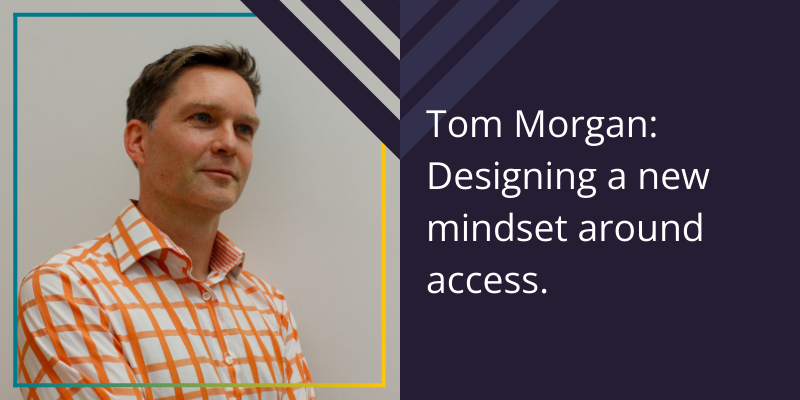
Enterprise that fuels progress: Engineering a new mindset around access with Tom Morgan and Supersmith.

Posted on

For this RISE Blog Tom Morgan, one of the founders and CEO of Supersmith to talks about the company, and the journey so far. Supersmith has been supported by UWE Bristol’s Bristol Robotics Lab (BRL) and Future Space, from concept to being moments away from launch


How we are changing the way the world thinks about mobility scooters

Tom Morgan, Founder & CEO, Supersmith

When most people picture a mobility scooter, they don’t think about innovation. They think about something medical. Functional. Bulky, maroon. Something you need, not something you want.

And that perception is exactly the problem.

At Supersmith, we believe mobility scooters shouldn’t just help people move. They should expand what’s possible. They should feel safe. They should feel empowering. And they should be designed with the same ambition and pride as any other consumer product. For many people, a traditional mobility scooter just doesn’t make them feel good. With the help of our community, that’s what we are hoping to change

Because if we’re honest this category hasn’t changed meaningfully in decades.

The Safety Gap that society has normalised

a Supersmith 3scooter navigating a tight space, one wheel is off the curb while the other two remain on the pavement

In the UK, 6.3 million people experience walking impairment. Yet traditional mobility scooters have five times more fatalities per distance travelled than motorbikes.

That statistic stopped us in our tracks.

Even more striking, over one third of mobility scooter users have tipped over at least once.

Somehow, instability has been accepted as part of the experience. Users are expected to adapt to cambers, uneven pavements and dropped kerbs. The burden of safety has been placed on the rider, not the design. Mobility scooters have long been treated as medical aids not high tech mobility systems. And when you categorise something as a “medical device,” expectations lower, design stagnates, and innovation slows. We believe that needs to change.

A Personal Mission

Supersmith was founded by myself, my wife Emily, and her cousin Dr Fred Russell-Pavier.

For us, this is personal, I’ve seen my sister live with multiple sclerosis and struggle with traditional scooters, not only because of safety concerns, but because of the social stigma attached to them. Mobility shouldn’t mean feeling exposed or diminished. It shouldn’t mean sitting far below eye level, being literally and metaphorically looked over. We all deserve better.

Her lived experience has shaped everything about how we approached design.

Engineering Confidence

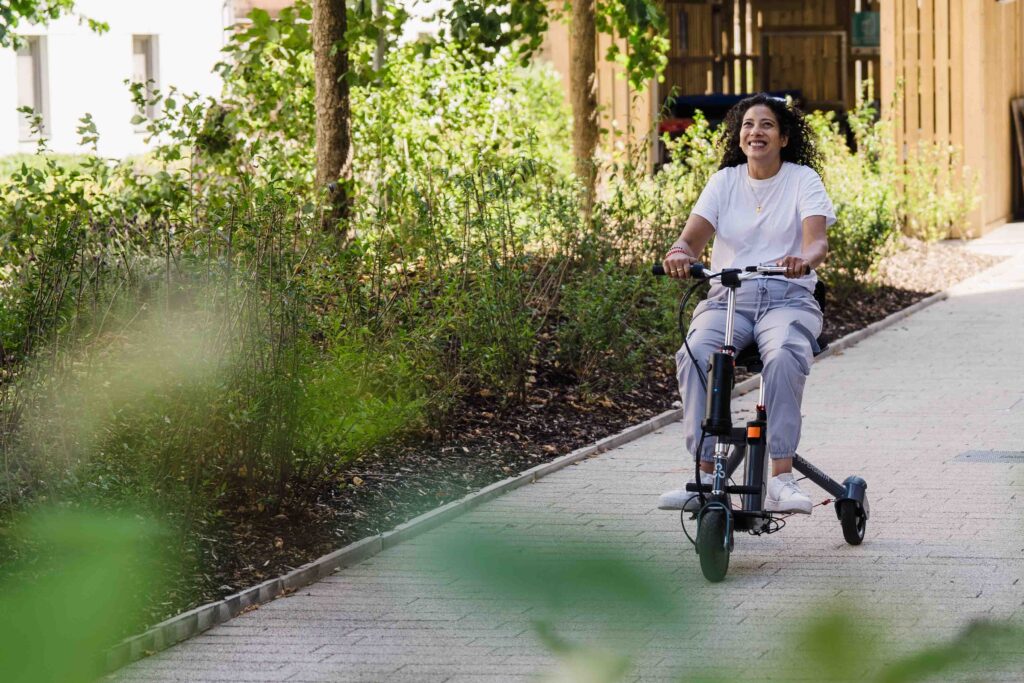
A person joyful as they move quickly along using her Supersmith 3scooter

Our first product, the 3Scooter, was created to tackle both stability and stigma head-on.

Inside every model is a patented active stabilisation system called EverLevel™ . It continuously adjusts to terrain and turns, actively adapting to maintain balance. It means you can do things that simply wouldn’t be possible on  traditional 3 and 4 wheel mobility scooters without tipping.

Users can sit up to 90% of their standing height, changing not just visibility, but presence. The aesthetic blends contemporary e-scooter styling with practical functionality. It folds in around 10 seconds, can be partially used as a walker, and is lightweight enough to lift into a car boot .

“Nothing For Us, Without Us”

One of the most important principles guiding Supersmith is a mantra well known in the disability community: Nothing for us, without us .

From concept to production, our community has been involved at every stage. Not as test subjects, but as collaborators. Because if we want to change how the world thinks about mobility scooters, we have to start by listening to the people who rely on them.

Changing perception isn’t just about engineering. It’s about language, brand, distribution, and storytelling. Our ambition at Supersmith isn’t simply to launch a new scooter in 2026. It’s to shift a mindset that has been stuck for too long.

Because when you change how people think about a product, you change how they feel about using it. And when you change how someone feels about moving through the world, you start to slowly change that world, one scooter at a time. That’s the mission Emily, Fred and I are committed to alongside our incredible community team and support network.

How the UWE Bristol Ecosystem Accelerated Our Journey

Based at UWE Bristol, within the BRL Hardware Incubator, has been instrumental in turning our ambition into something tangible. The Hardware Incubator, together with Future Space, are vital components of an ecosystem which includes active investment communities, and a wide range of support, diverse skills and talent.

Building a hardware startup is complex, and access to specialist facilities, technical expertise and a collaborative innovation community has allowed us to iterate faster and achieve more. Which, when you’re trying to rethink an entire category from the ground up is vital.

Tom Morgan
Founder & CEO
Supersmith


More information on Supersmith and their journey

Find out more about how we can support your business journey.

From tree planting to first aid: How UWE Bristol students made their mark during Student Volunteering Week

Posted on

Written by Georgia Bate and Alicia Hallatt from the Civic and Inclusivity team

Student Volunteering Week at UWE Bristol saw 100s of students getting involved and discovering just how varied and meaningful volunteering can be.

Held every February across the UK and led by the Student Volunteering Network, the week celebrates student volunteering and inspires students to use their skills and time to support local communities and drive positive change.

Why we do it

Students don’t just come to Bristol to study, they are a huge part of the fabric of the city, they live and work in our neighbourhoods. Many will build their lives and careers here. They bring a rich mix of lived experiences and skills and we want to help students make the most of their time in the city by becoming active, confident citizens who understand the power they already hold.

Student Volunteering Week is a chance to open doors: to social action, to community development, to ways of working that centre co‑production and awareness of power dynamics. It’s about helping students see that they don’t have to wait until they leave university to make a difference, that they can start helping to create positive change now, alongside their studies.

The UK government’s Tackling Loneliness strategy review reported that loneliness is higher for people who are 16-24 years old. Volunteering helps students step beyond the university bubble, meet people they wouldn’t normally encounter, and feel a stronger sense of belonging to Bristol’s communities. When students volunteer, they grow in confidence, in empathy and in understanding.

What we did this year

We kicked off with an inspiring Alumni Fireside Chat, where previous Student Volunteering Award winners shared how volunteering shaped their confidence, careers and sense of purpose. They busted the myth that volunteering is only bucket fundraising or in a shop (although those are great too), talking about a broad range of things they had taken part in, and continue to do, including food redistribution, being a Trustee, and volunteering with a radio station!

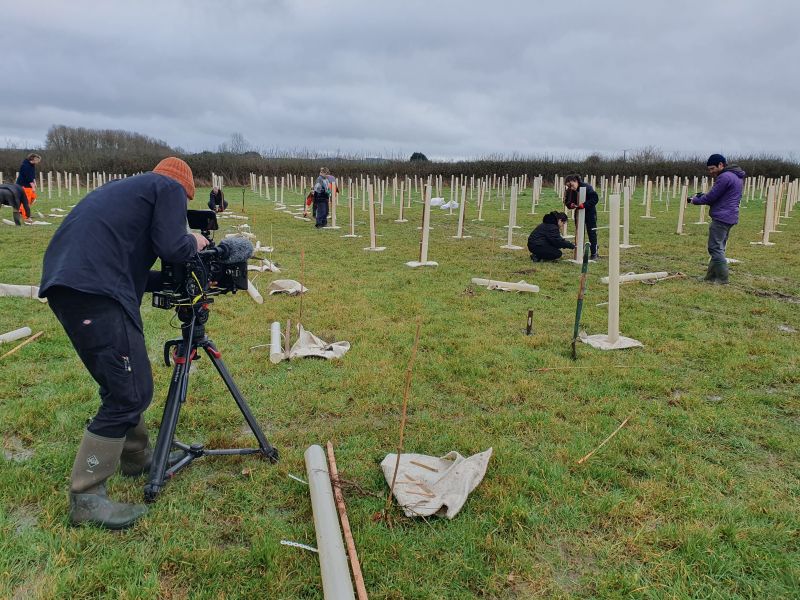
Determined students braved the rain to plant 500 trees with the Great Western Forest team in Pucklechurch and others Joined Stoke Park Rangers to remove invasive laurel and support the local woodland.

At our volunteering fair students spoke to charities about a wide range of opportunities from supporting community soap operas to fixing up second hand bikes and supporting young people to develop green skills to being a ‘Librarian of Things’ at Share Bristol. The week also included online and in person sessions where students could learn about different volunteering opportunities and take time out to support their wellbeing.

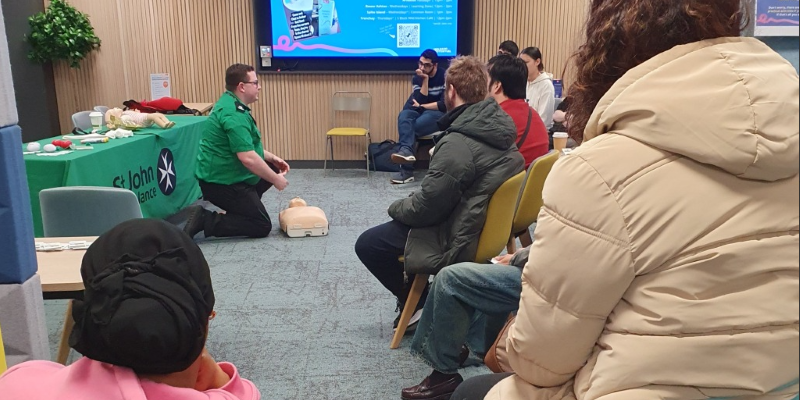
We ended with a St John’s Ambulance first aid session led by volunteer Callum, giving students practical, life‑saving skills to support their communities. We all left after a lot of laughter feeling more confident in our ability to offer support than to know how to care for friends, family and neighbours in an emergency.


Why you should care

Student Volunteering Week puts the incredible work of the West of England’s VCSE sector front and centre for students. Charities and community groups don’t always have the resources or capacity to shout about the impact of their work, and how it underpins how the city and wider region works to support marginalised peoples, create thriving communities and drive positive change. Part of student volunteering week is about making this visible to students and for them to imagine their role.

Student Volunteering Week at UWE was made possible through collaborations with:

Action Tutoring, NSPCC, Natural History Consortium , Western Forest UK, South Gloucestershire Council , Bristol Bike Project, Fairshare South West, Local Learning CIC, Share Bristol, Full Circle Project, St Johns Ambulance, Bristol City Council Parks Volunteer Programme, UWE Wellbeing team, UWE Sustainability Team, UWE Centre for Sport, UWE Student Action for Refugees Society and UWE Alumni Celina Tomas, Constance Hui, Miriam Betts

Students are future employees, trustees, thinkers, campaigners, changemakers. They are the next generation of people who will shape the sector. When they volunteer with you, they gain insight into how social action really works and why it’s important. They discover where their passions fit. They bring fresh ideas and skills that can strengthen your mission and the energy to get things done. Volunteering at university is often the first small step that leads to a lifetime of involvement, support or leadership in driving positive change.

A huge thank you to everyone who was involved.


There is in incredible VCSE sector in Bristol and the Southwest and volunteers are an essential piece of this puzzle. In Civic and Community engagement at UWE Bristol we create connections between students and non-profits to create mutually beneficial opportunities for everyone.

If you want to be part of student volunteering week next year – or connect with student volunteers for the work you do, get in touch! Email volunteering@uwe.ac.uk

Introducing the 2025 Entrepreneurial Futures Award Winners

Posted on

Guest Writer Lily Majid Student Ventures

Thanks to the incredible generosity of UWE Bristol alumnus Peter Fane, who donated £250,000 to support our entrepreneurial ecosystem over five years, we’re proud to announce the 2025 recipients of the Entrepreneurial Futures Award. Each winner receives up to £20,000 in funding, plus tailored support from our Student Ventures team. These are resources that can make all the difference at the start of someone’s entrepreneurial journey.

This year’s cohort represents the remarkable breadth of innovation emerging from UWE Bristol. From marine conservation technology to regenerative agriculture, accessibility enhancing performance systems to AI powered recruitment solutions, these ventures are working across the board with creativity, technical expertise, and great social impact.

What unites these diverse entrepreneurs is their commitment to building sustainable businesses that matter. Each has demonstrated their entrepreneurial ability through UWE Bristol’s support programmes and shown a clear vision for growth beyond graduation.

Find out more about each of the Entrepreneurial Futures Award fund recipients below.

Entrepreneurial Futures Award winners 2025 

Benjamin Mallinson – Signal Bridge 

Signal Bridge is changing the way we collect underwater sound data. Traditional methods depend on surface buoys and frequent trips to retrieve recordings, which are expensive, risky, and often create noise that affects data quality. Signal Bridge solves these problems with a smart module that stays deep and quiet, only coming to the surface when it needs to send data or recharge using solar power. This simple approach cuts costs, reduces environmental impact, and delivers cleaner, more reliable acoustic data for marine research. 

The system works seamlessly with existing Passive Acoustic Monitoring setups, allowing scientists to track ocean ecosystems for longer periods without interruption. By bridging the gap between sensors and researchers, Signal Bridge makes high-quality data collection easier and more scalable – helping us better understand and protect marine environments worldwide. With this innovative technology, ocean intelligence is becoming more accessible, affordable, and impactful than ever before. 


Katie Hounsham – Barraquito 

Barraquito is redefining Southampton’s coffee culture. Launched in July 2025, this independent specialty coffee and bar concept was created to tackle the city’s “Third Place Deficit” – the lack of welcoming spaces beyond home and work. In just three and a half months, Barraquito has become a local favourite, serving over 8,000 coffees and earning a 98.5% five-star review rate. By focussing on exceptional service, quality products, and genuine community engagement, they offer more than great coffee; it’s a vibrant social hub where people can connect, relax, and feel at home. 

The mission behind Barraquito is bold: to lead a transformation in hospitality by creating a space where people feel welcome and connected. The team believes great coffee and brilliant service should go hand in hand with a strong sense of community. As they grow, their vision is to bring this experience to more cities across the UK, proving that hospitality can be warm, authentic, and consistent no matter the scale. 


Billy Barker – Arquip 

Arquip is reinventing the welding mask for a safer, smarter future. For decades, welding masks have barely changed – it’s bulky, limits visibility, and makes training harder. These outdated designs contribute to thousands of eye injuries every year. Arquip was born from real-world experience to solve these problems. Its next-generation mask uses dual cameras and a high-resolution digital display to give welders a clear, unobstructed view of their work. Trainees can see more, instructors can teach more effectively, and businesses benefit from reduced risk and downtime. 

Since launching in early 2025, Arquip has moved quickly from concept to prototype. Now, with a fully sourced dual-camera stereoscopic design in development, the team is preparing for field testing with welding training centres already expressing interest. Arquip’s mission is simple: make welding safer, easier, and more efficient – starting with the mask that every welder depends on. 


Christopher Russell Middleton – Mycobiome 

Farming starts with healthy soil – and MycoBiome makes that possible through science. This biotechnology company is developing advanced biofertilisers that boost soil health, improve nutrient uptake, and reduce reliance on chemical inputs. Their approach combines microbial inoculants with expert advisory services, delivering measurable benefits like better yield stability, increased soil carbon, and long-term land resilience. 

Behind MycoBiome is a multidisciplinary team blending engineering, mycology, and agricultural expertise. Since its launch, the company has initiated field trials with early adopter farms, designed a business model that integrates carbon credit schemes, and built partnerships with research institutions. Their mission is clear: make science-driven soil solutions accessible to every farmer, and lead the UK’s transition toward regenerative agriculture. By turning cutting-edge microbiology into practical tools, MycoBiome is paving the way for a future where farming works in harmony with nature. 


Faizan Mir – Scootrr 

Scootrr is making e-scooter riding safer and smarter. Micromobility is booming in cities, but with that comes challenges – high accident rates, risky rider behaviour, and compliance issues. Scootrr tackles these problems with an innovative on-vehicle camera system powered by Edge-AI. It spots hazards in real time, moderates speed, and encourages safer riding – all without relying on slow cloud systems. The hardware is designed to fit easily into existing scooters, making it simple for operators to upgrade their fleets. 

In just a short time, Scootrr has shipped its first prototype to Voi, secured interest from major operators, and is preparing for pilot programs in Bristol. By combining cutting-edge technology with practical design, Scootrr is helping cities and operators reduce accidents, improve rider safety, and build trust in micromobility. It’s a big step toward making urban transport not just convenient, but truly safe. 


Michael Fergie – Haptek 

Haptek brings a new sensory layer to concerts, theatre, and immersive arts: sound you can feel. This tech venture is developing next-generation haptic floor systems that turn audio into precise vibrations and synchronised lighting. Their modular platform, Haptagon, creates environments where audiences don’t just hear music or performance – they experience it physically. Designed to be scalable and event-ready, Haptek’s system enhances engagement while making events more inclusive for d/Deaf, Disabled, and Neurodiverse audiences. 

Haptek is led by Michael Fergie, who brings over a decade of experience in sound and haptic technology, including five years creating haptic floor systems for major UK venues like the Southbank Centre and Roundhouse Theatre. With strong feedback from accessibility advocates and immersive experience designers, Haptek is setting the stage for a future where performance is multi-sensory and shared by everyone. By combining cutting-edge engineering with inclusive design, Haptek is redefining what it means to feel the music. 


Oliver Tyler – Shroot and Kabloom 

From wildflower seed bombs to microgreen kits, Shroot creates eco-friendly, growable gifts that are as practical as they are beautiful. Designing and manufactures growable gifts across a small house of brands: Seedbom/Kabloom, Greens & Greetings, Bottle Farm, and Wildflower Wishes. Every product is assembled in-house to maintain quality and speed, using responsibly sourced materials like coir, a coconut by-product that supports fair trade in Sri Lanka and India. Their wildflower mixes are 100% wildflower and tailored for UK conditions, making each product a simple way to create habitats and support biodiversity. 

Since acquiring the business in 2022, founder Oliver Tyler has grown Shroot into a trusted name with over 1,100 stockists and 850 brand partners, including Harrods, Liberty London, Kew Gardens – while scaling corporate campaigns with Vodafone and TK Maxx to tens of thousands of units. With 20% of profits funding Wild Britain, Shroot isn’t just creating gifts, it’s buying and protecting UK land for rewilding. Their vision is to become the UK’s leading eco gift house and a top 100 landowner for reviving nature.  


Pedro Do Rosario – Rosent 

Rosent is transforming recruitment by giving recruiters their time back. Instead of spending hours on repetitive admin tasks, recruiters can now focus on building relationships and closing deals. Rosent’s AI voice platform automates the most time-consuming parts of the job, freeing up nearly half a day and unlocking the potential to double billable revenue. This isn’t just efficiency; it’s a shift that can refine productivity and profitability in recruitment. 

In just four weeks, Rosent attracted over 1,000 sign-ups to its waitlist and earned recognition as one of EU-Startups’ “Top 50 Promising Early-Stage Startups in Europe.” They are gaining traction in a market eager for smarter, faster solutions with their simple mission: make recruitment more efficient, more human, and more impactful by letting AI handle the heavy lifting. 


Samuel Hodgson – Enviro IT 

Enviro IT gives technology a second life whilst reducing e-waste. Based at UWE Bristol, the company refurbishes redundant IT equipment from local SMEs – primarily laptops – making high-quality, durable devices accessible to students, families, charities, and professionals at prices starting from £150. Unlike low-cost, short-lived alternatives, these refurbished devices are built to last, promoting reuse over replacement and cutting environmental impact. Every collection includes secure data destruction using industry-standard tools, with GDPR-compliant certificates for peace of mind. 

Founded by Sam Hodgson, a Team Entrepreneurship graduate passionate about reducing IT waste, Enviro IT has already generated over £16,000 in revenue and sold more than 1,200 items through platforms like eBay. Their vision is to become Bristol’s leading IT recycling and refurbishing company – partnering with sustainability initiatives, creating training opportunities, and donating devices to those in need. By combining affordability, security, and sustainability, Enviro IT is proving that technology can be both accessible and responsible. 


William Crewe-Turrell – Bio Drive/Bio-Agri Ltd 

Bio-Agri Ltd is addressing one of the UK’s biggest agricultural challenges: over 100 million tonnes of organic waste produced annually by farms and anaerobic digestion (AD) plants. Conventional treatment systems are costly and inaccessible for smaller operators, leading to nutrient loss, water pollution, and rising compliance pressures. Their solution, the Bio-Recover System, is a compact, modular unit that transforms waste into clean water, liquid fertiliser, and dry compost-like solids. Designed for affordability and scalability, Bio-Recover helps farms and AD plants cut costs, meet environmental regulations, and embrace a circular economy. 

Their vision is to make nutrient and water recovery as common on farms as tractors—an everyday tool that supports sustainable agriculture and energy. Over the next five years, they aim to roll out Bio-Recover units across the UK, proving that advanced waste treatment doesn’t require high cost or complexity. Looking ahead, Bio-Agri sees global potential, turning organic waste into a resource for clean water, affordable fertiliser, and renewable energy – reducing emissions, restoring water quality, and strengthening food and energy security worldwide. 


To all our 2025 winners: congratulations, and here’s to your continued success. The future looks bright.

Want to follow in their footsteps? Keep an eye on the Student Ventures webpage for information about future Entrepreneurial Futures Award opportunities and other support programmes available to UWE Bristol entrepreneur

Enterprise that fuels progress: Bristol Sanctuary Theatre, Supporting Refugees Through Creative Expression.

Posted on

Renata Mendes is the founder of Bristol Sanctuary Theatre, a community-led company that supports refugees and migrants by creating a platform for joint artistic expression and co-creation. Bristol Sanctuary Theatre helps its community with integration and healing through the creation of original theatre works.

About the project

Bristol Sanctuary Theatre began when Renata, a UWE Bristol Drama and Acting student with a background in psychology and anthropology, connected her own experiences as an immigrant with the challenges faced by refugees and migrants in Bristol. Working with Dr Fahrudin Salihbegovic, who had been supporting refugees and migrants through drama, Renata witnessed people flourish through the art.

“I met a bunch of lovely people who are refugees and migrants, so for them it’s even harder… I say, what can we do here? What can we create?”

From there, Bristol Sanctuary Theatre was born, a Community Interest Company (CIC) with support from UWE Bristol’s Student Ventures programme.

Partnership in action

As Bristol proudly holds Sanctuary City status and UWE Bristol is a University of Sanctuary, Bristol Sanctuary Theatre builds on this foundation of welcome and support. The project brings together UWE Bristol, which provides academic support and student involvement through the Drama and Acting programme, alongside City of Bristol College, which engages refugee and migrant students in creative work. Bristol Beacon hosts performances and provides a platform for voices to be heard, while Bristol Refugee Festival helps connect the work with wider community initiatives.

In June, the company delivered a powerful performance at Bristol Beacon featuring refugee students from City of Bristol College alongside UWE students.

“We performed a play at Bristol Beacon about refugees with refugees, they are students at Bristol College … (it was a) really beautiful achievement for us, with very, very positive feedback… the audience cried and laughed so it was really yeah fulfilling our heart I would say.”

Aims and impact

Bristol Sanctuary Theatre creates a safe, inclusive space where cultural differences are celebrated rather than sidelined. Through storytelling and creative expression, the project challenges harmful narratives about refugees and migrants whilst providing opportunities for skill development and artistic growth. At its core, the work builds connections between diverse communities across Bristol, fostering understanding and respect. “The most important value we want to create,” Renata emphasises, “is a community that can accept the difference.”

Building confidence and capability

UWE’s Student Ventures programme has been instrumental in developing the enterprise. “Of course, there’s the budget,” Renata notes. “But also, and I think it’s the most important, were the mentors.”

The support helped Renata develop a clear mission, vision, values, and business plan. “They never told me, do that. You should do that. They said, there’s all those ways and you can choose. So it was really a freedom of choices but educated choices.”

For Renata personally, studying Drama and Acting at UWE was “really a revelation.” She found her voice and creativity while being embraced by staff and students. “I was thinking, am I going to a university in England? It must be so hard. It was the opposite. It was super lovely. It’s an explosion of creativity.”

Next steps

Bristol Sanctuary Theatre is now expanding to work with adults who have creative arts backgrounds, creating what Renata calls “a point of trust for them to come.”

“Bristol Sanctuary Theatre that’s not theatre, it’s arts,” she says with excitement. “And I’m very excited, I think it’s going to be brilliant.”

Bristol Sanctuary Theatre’s vision is a UK cultural landscape where the voices of refugees and migrants are essential, not sidelined—reclaiming narratives and celebrating new voices through collaborative art.

Innovation with impact: Matthew Freeman, Bridging Universities and Start-ups

Posted on

In this blog, Professor Matt Freeman, Centre Director of Future Space, UWE Bristol’s innovation centre for high-tech businesses, shares his journey from academic to start-up founder to university-business innovation leader, reflecting on what it truly takes to bridge these worlds and make collaboration thrive.


If you had met me a few years ago, I might have introduced myself as Professor Matt Freeman, a digital media academic who published books and led research at a university. I spent over a decade in academia, from completing a PhD and lecturing, all the way to running a research centre, leading REF and becoming a professor. Yet, despite the publications and promotions, I realised that being an academic was never really about the research for me, it was always about the role of innovation.

Along the way, I’ve learned a few lessons about what it takes to make university-business partnerships thrive. In this blog, I want to share those insights with both my university colleagues and our industry partners. My hope is that these reflections can spark ideas on how we innovate together across the academia-industry divide.

My journey from academia to entrepreneurship

My personal turning point came during a secondment to a £6.8m university-business R&D partnership (Bristol+Bath Creative R+D, itself led by UWE Bristol). There, I fell in love with bringing together commercial businesses, academic research, knowledge exchange and fresh student minds under one collaborative effort. I saw first hand how powerful it is when ideas developed in universities get tested and applied by industry and vice versa. In fact, I loved it so much that I took the leap into entrepreneurship myself. In 2021 I founded Immersive Promotion Design, an R&D-led marketing consultancy to help virtual and augmented reality creatives put cutting-edge ideas into practice. That experience, applying research insights to real business challenges; taught me more about bridging academia and industry than any journal paper ever could.

Fast-forward to today: I now run Future Space, an innovation centre on UWE Bristol’s Frenchay campus, where we support 70+ high-tech start-ups. It’s a role that lets me combine both identities: the academic and the entrepreneur, to drive university-partnered innovation. If I’ve learned anything, it’s that innovation is never a ‘bolt-on’ to business, it’s an all-encompassing reimagining of what can be done and how.

What makes innovation partnerships succeed

Working at the intersection of academia and industry, I’ve seen some partnerships soar and others stall. Success isn’t automatic; university-business collaboration doesn’t happen by accident. There are two ingredients that I believe make all the difference:

Physical proximity and shared goals: Firstly, both sides need to be committed to a common purpose. The most successful collaborations I’ve led weren’t transactions, they were true partnerships built on trust and aligned vision. A recent national evaluation of University Enterprise Zones reinforced this: Place-based innovation infrastructure can work. A chat by the campus coffee shop can spark a R&D project or a hire, but only when paired with clear sector focus and active engagement. In short, everyone needs to row in the same direction.

Bridge-builders and brokers: Secondly, successful innovation partnerships need people who can speak both ‘languages’ and broker the relationship. In many ways, that’s become my job description. Universities and companies often have different cultures and timelines, so you need dedicated translators to connect the dots. It takes skilled facilitation to turn an introduction into a funded R&D project. Having a team with the skills and capacity to broker relationships and deliver tailored business support is critical.

Bridging cultural gaps between universities and industry

Even when the will to collaborate is there, cultural and structural barriers can get in the way. I’ve lived in both worlds, so I know the misconceptions that academics and business folks sometimes hold about each other. Universities can see industry as too fast paced and profit driven; businesses can see academia as an ivory tower too slow to adapt. The reality is, both worlds do things differently, and together they can offer different insights and value. Recognising this is the first step to bridging the gap.

One major difference is how each measures success. Academia rewards rigour, depth and publication. Industry rewards speed, customer satisfaction and revenue. Neither approach is ‘better’ outright – they are just different. The key is finding ways to reconcile these approaches. For example, at Future Space we pair 121 business support (an industry-style, bespoke approach) with one-to-many support like workshops and student projects (a university-style approach). Rather than argue over which is superior, there’s plenty of room for both models to co-exist, delivering richer support together.

Communication is another common barrier. Academics speak in terms of theories and long term impact; entrepreneurs speak in MVPs and quarters. We’ve learned to build a common language, often around solving concrete problems. Framing a collaboration around a shared challenge (say, prototyping a new medical device or testing a software algorithm) helps both sides see the value. I always remind my academic peers that innovation needs research but research should not be done in isolation. We need to get research ideas out of the classroom or even the journals and into real use. Likewise, I reassure start-ups that tapping into university expertise isn’t about getting bogged down; it’s about supercharging and validating their product with insight and evidence.

What universities and start-ups can learn from each other

Having one foot in a university and the other in the start-up world has convinced me that universities and start-ups actually have a lot more in common than people think… and a lot to teach each other. In fact, as pressures mount on higher education, universities may increasingly need to think like start-ups to survive and fulfil their mission.

What does that mean in practice?

For universities learning from start-ups: It means embracing agility, customer-focus and a willingness to adapt. Start-ups thrive by being lean and pivoting quickly when something isn’t working. Universities, by contrast, often carry heavy legacy structures that resist change. But universities can adopt a more market oriented mindset, tuning in closely to what students (the customers) and employers (the market) need. That could mean updating curricula faster, focusing on practical skills, or even launching entirely new bite size boot camp style programmes in response to emerging fields. In short, academia can borrow the start-up ethos of ‘adapt or perish’, staying mission driven, but being willing to reinvent how we deliver on that mission.

For start-ups learning from universities: I’d argue there’s an equally valuable lesson in the other direction. Start-ups can benefit from the depth of research and the long term thinking that universities are built on. In the rush to ship product, start-ups sometimes skip the step of truly understanding why something works or doesn’t. University expertise can provide that rigour, whether it’s a data science start-up tapping into a professor’s algorithm knowledge, or a biotech venture using university lab facilities to validate their tech. Moreover, universities train people to question assumptions and think critically, a useful check against the exuberance of start-up culture. In our innovation centre, I’ve seen start-ups gain huge advantages by engaging with faculty and students: they access state-of-the-art facilities and research labs, collaborate with experts on R&D, and plug into a pipeline of talent by recruiting graduates and interns.

As I often say, when a start-up partners with a university, it’s like getting a ‘sage’ on board. Someone who values knowledge and education as the path to breakthroughs. Conversely, the university benefits by partnering with a ‘hero’ within innovation, nurturing new companies that make the world better. Both sides win by combining the Sage’s wisdom and the Hero’s drive. By learning from each other, agility from start-ups, and research depth from universities we can each become more effective in our missions.

My offer to you

I want to close on a personal note. Having navigated this path from academia to entrepreneurship and back into the fold of university-business collaboration, I’m making an offer to you. Whether you’re an academic, a business leader, or both:

  • I commit to being a bridge-builder. If you’re an academic with an idea that could have commercial impact, or a business seeking academic insight, my door is open. I will use my position to help connect you with the right people, be it researchers or partners. Bridging the gap between our two worlds is my passion, and I’ll gladly play the translator to get a partnership off the ground.
  • I commit to sharing lessons (including the hard ones). Innovation isn’t all success stories. There will be setbacks and failures. I promise to be candid about what doesn’t work and to foster a culture where we learn from mistakes. Whether it’s through my own Innovate Together think-piece (published monthly on LinkedIn) or a casual coffee chat, I’ll share the insights I’ve gained (and the scars I’ve earned) so that we can all innovate smarter together.
  • I commit to championing change. Within my university and in my interactions with others, I’ll continue to challenge the status quo that hinders collaboration. That means advocating for more flexible policies, celebrating engaged academic and industry-savvy students, and pushing for initiatives that make partnership the norm, not the exception. Institutions only change when people inside them drive the change – consider me fully on board for that mission.

Ultimately, my offer is partnership. Let’s break down the barriers and unleash more innovation. The challenges our society faces are too complex for one sector to solve alone. But I truly believe that by combining the curious minds in universities with the daring doers in business, we can create solutions neither could achieve independently.

Find out about the amazing work at future space and how you can get involved.

UWE Philosophy and HSBC Deepen Collaboration with Critical Thinking Workshops for Legal Teams

Posted on

The ongoing collaboration between Dr Francesco Tava, Associate Professor of Philosophy at UWE, and HSBC has reached a new phase in October 2025. Francesco has been invited to design and co-lead a series of high-impact workshops on Critical Thinking for HSBC’s legal teams in London, Birmingham, and Leeds. For this initiative, he partnered with professionals from the London-based law firm Addleshaw Goddard, combining philosophical insights with practical legal expertise to explore both the conceptual foundations and applications of critical thinking.

Todays sessions objectives/outcomes

Support core Expectations like identifying and questioning risk, forming good judgement and challenging appropriately, 
enhance senior leadership behaviours such as collaboration through leadership and effective partnering Build in existing content including podcase series with Francesco Tava

This series builds on Francesco’s 2024 podcast on Critical Thinking, commissioned by HSBC and distributed to their global legal teams. In the new workshops, compliance and legal professionals engaged in discussions on the key characteristics and potential of Critical Thinking, applying their newly acquired skills to real-world challenges—from the ethical and practical implications of AI to risks associated with financial instability and crisis management. Participants examined core themes such as early risk identification, informed and ethical decision-making, and cross-functional collaboration, with the goal of equipping them with immediately applicable skills for their day-to-day work.

A modern HSBC bank lobby, people bustling and a well lit sealing stretches across the screen

“I think this initiative represents an amazing opportunity to showcase the inherently applied nature of philosophy,” says Francesco. “Discussing Socratic questioning and ethical reasoning with highly engaged professionals in a global industry is a unique experience for both teachers and learners. It bridges gaps that might otherwise seem insurmountable and demonstrates the creative power of Critical Thinking in both professional and personal life”.

Dr Kuldip Kaur, Senior Legal Counsel at HSBC and one of London workshop attendees, added: “The workshop on critical thinking was highly valuable and relevant to collaborative work. I appreciated the focus on identifying biases, evaluating evidence, and making more reasoned group decisions. The interactive discussions made the concepts practical and engaging, and I found Francesco’s facilitation encouraging and thought-provoking. I now feel more confident questioning assumptions and contributing constructively during team decision-making”.

The HSBC podcast and workshops are the first steps in a broader teaching and learning project led by Francesco and the UWE Philosophy team. Future collaborations are already being planned, with the aim of extending these workshops beyond the UK to HSBC’s global network, which spans more than 50 countries.


Closer to home, Francesco has also designed a new CPD (Continuous Professional Development) course at UWE: CT Lab: Critical Thinking from Theory to Practice, set to begin in February 2026. Subscriptions are now open. To learn more about the course, visit its webpage and watch Francesco’s introductory video.

Enterprise that fuels progress: Nikki Dodd’s creative journey at UWE Bristol

Posted on

After nearly a decade working on documentary productions in New York City, Nikki Dodd brought her passions for filmmaking and environmental advocacy together through the MA Wildlife Filmmaking programme at UWE Bristol, delivered in partnership with the BBC Natural History Unit.

Holding strong working experience and a deep commitment to environmental storytelling, Nikki’s time at UWE Bristol reshaped not only her final project, but also her understanding of filmmaking as a tool for community engagement and meaningful change. Supported by UWE Enterprise, she developed a venture to take her film One Last Farm into local communities. This earned her the The Pryde of Women in Business Award and helped turn her thesis into a platform for public dialogue and impact within the local communities she worked with.

Finding Stories That Matter

As a filmmaker, Nikki is drawn to stories that explore our relationship with the planet. A passion that started while growing up in “one of the most city-est cities that there is” New York City. That urban upbringing left her feeling a deep disconnection from nature that she struggled to articulate for years.

"It wasn't until I was maybe in my early 20s and was reading eco-feminist literature that I understood I wasn't alone in feeling that," she shares. "A lot of the built society has created this disconnection that we feel from the planet and from the resources that we rely on and our own inherent connection with the natural world."

This experience shaped her approach to storytelling, leading her to character-driven stories that express our connection to nature. When she read about Yew Tree Farm facing development pressure, it immediately sparked her interest. It was a small farm within a city that addressed interconnected challenges of local food security, healthy food production, and creating vital green space for both wildlife and people. Catherine Withers, the farm’s guardian and the film’s subject, embodies the kind of passionate storytelling Nikki gravitates toward.” I was able to find a little bit of expression for my own desire to really highlight our connection as people with the planet.”

From Thesis Film to Community Impact

Winning the UWE Enterprise Pride of Women in Business award enabled Nikki to transform her project into something with community legacy. The enterprise team provided crucial funding, coaching, and mentoring that helped her develop a venture for community driven screenings across the city. The enterprise support also fundamentally shifted how Nikki thought about her work as a filmmaker.

"It's one thing to make a film, but it's quite another to get it out into the world and have it really connect with audiences," she reflects. "It made me consider what's the life for the film after the cameras shut off when the film is done. What impact did I want the film to have in the world?"

With the enterprise team behind her, she worked to connect with community organisations to produce five screening events across the city. The highlight was a sold out audience of over 300 people at the Bristol IMAX theatre, featuring panel discussions and a Q&A on wildlife-friendly farming and the importance of community focused green space.

Now based in New York City, Nikki remains deeply engaged with the wildlife filmmaking community she first connected with at UWE Bristol. Her film One Last Farm has earned recognition both as a finalist at the Jackson Wild Summit, and winning the BAFTA Student Award for Best Documentary, underscoring how the right support can elevate student work into meaningful, real world impact. Through screenings, partnerships, and discussions, Nikki’s project has sparked vital conversations around food security, conservation, and the role of urban farms in reconnecting people with nature. It is an inspiring testament to what’s possible when passion, education, and entrepreneurial support align.

Advice for Future Student Entrepreneurs

Nikki encourages people to embrace the all the opportunities at UWE Bristol, even when self doubt creeps in. She knows first-hand how easy it is to question your own capabilities, wondering if your idea is good enough or whether you belong in an entrepreneurial space. But her experience with UWE Enterprise helped shift that mindset, offering a supportive and non-judgmental environment where she could incubate and develop ideas.

For Nikki, that environment made all the difference, turning uncertainty into confidence and creativity.

Her advice? Don’t wait for the perfect idea… you just need to take the first step.


Interested in developing your own enterprise venture? Visit the UWE Innovation and Enterprise team to learn about funding opportunities, mentoring support, and awards available to current students and recent graduates.

From Student Ventures to Social Impact: UWE Bristol Graduates Tackle Homelessness Through Art

Posted on

How university funding helped launch a creative enterprise that’s now making a real difference in Bristol

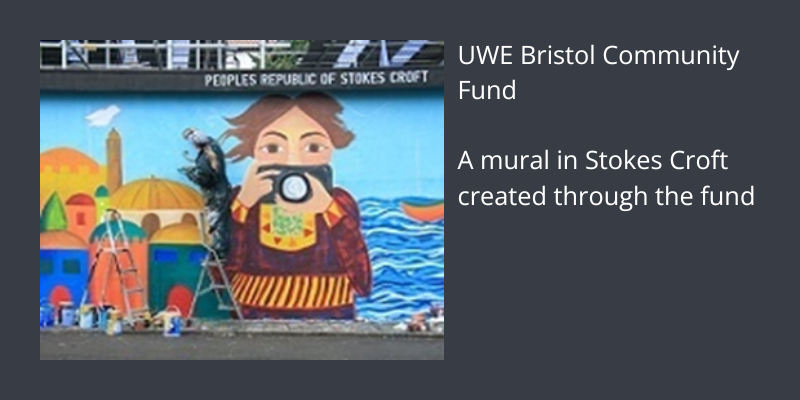
When Art Sync’s co-founders pitched their idea during UWE’s Venture Ready funding programme, they had a vision: to support BillyChip in creating a powerful marketing mural that would raise awareness of Bristol’s homelessness crisis. This month, that vision becomes reality with a striking 19-metre artwork in the heart of Stokes Croft.

The journey from university pitch to community impact demonstrates the tangible difference that Student Ventures funding can make. The Art Sync team couldn’t have funded this charity mural project without that crucial support, and now it’s set to have a significant impact on efforts to address homelessness in Bristol.

“This charity mural will have a big impact on the homeless crisis, and Student Ventures funding has made this happen,” explains the Art Sync founder Azul Amos. “We proposed this idea during the Venture Ready funding, to support BillyChip to install their own marketing mural. So it’s exciting to actually be able to pull it off.”

The success of Art Sync extends well beyond this single project. The graduate-led agency is now UWE’s current mural supplier, with five murals scheduled for installation across campus over the next six months. It’s a testament to how university support can nurture enterprises that give back to the institution while serving the wider community.

Art Meets Action in Stokes Croft

The 19-metre mural, being unveiled at the People’s Republic of Stokes Croft outdoor gallery next to Turbo Island, brings together four Bristol artists: Jody, Melo, Conrico, and AimesWasHere[RW1] . Each contributing their distinctive style to tell a compelling story.

The artwork celebrates collaboration between BillyChip, Big Issue, and the creative community to raise awareness ahead of a major fundraiser on 22 November. Hosted by BillyChip and DJ James Hype, the event will support Help Bristol’s Homeless in building micro homes that provide lasting, practical solutions to homelessness.

Values-Led Business in Action

What sets this project apart is its collaborative, values-driven approach. Art Sync contributed £1,000 and waived their agency fee to maximise impact. The participating artists reduced their rates, PRSC offered discounted space, and BillyChip covered the remaining costs. Organisations working together to amplify a clear message.

Azul Amos reflected: “It means a lot to be able to use our platform to spotlight causes that make a real difference. We’ve always believed art should inspire and connect people, this is our way of putting that belief into action.”

Jack Gascoigne, Communications Director at BillyChip, added: “Over the past year, we’ve been working hard to build meaningful connections with people and organisations who share our vision for real change. Seeing these partnerships come together, from Big Issue to Art Sync and DJ James Hype, shows how collaboration can make a real difference for those who need it most.”

The Ripple Effect of University Support

Art Sync’s trajectory shows the multiplier effect of supporting student entrepreneurs. Student Ventures funding didn’t just help launch a business—it enabled an enterprise that now creates opportunities for artists, enhances the university’s campus environment, and contributes to addressing one of Bristol’s most pressing social challenges.

As the graduates continue to grow their agency and take on more ambitious projects, they’re proving that creative businesses can be commercially successful while staying true to their social purpose. It’s exactly the kind of impact that university enterprise support programmes aim to achieve.


The Stokes Croft mural will be unveiled on 20 October 2025. The fundraiser for Help Bristol’s Homeless takes place on 22 November.

For more information about Art Sync, visit www.artsync.uk

Yu can find out more about student ventures here, or you can visit them on campus. – Pop in and say ‘Hi’


Back to top