HVN Labs is a Bristol-based technology company specialising in drone swarm and light-show UAV design, manufacture and choreography. The business develops both the hardware and software technology stack with respect to drone swarm technology. HVN’s markets span commercial drone light shows, bespoke swarm choreography for events, and drone hardware/software design services, serving clients across the UK.
About the Knowledge Base:
The academic team based within the School of Engineering at The University of the West of England (UWE Bristol) brings cross-disciplinary research, combining both academic and industry perspectives. The KTP was supported by UWE Bristol academics Dr Jun Yao and Dr Amina Hamoud. Dr Jun Yao is an Associate Professor in Aerospace Engineering at UWE Bristol whose teaching subjects relate to fundamental aerodynamics, aero propulsion, fluid dynamics and thermodynamics with expertise in Computational Fluid Dynamics (CFD). Dr Amina Hamoud is a Senior Lecturer in Systems Engineering, her research and industry work are within areas of digital twin, systems and control, robotics and autonomous vehicles.
About the KTP Associate:
The KTP Associate, Ritvik Swaminathan holds a 1st class MEng degree from the University of Southampton, bringing his expertise in aircraft design and simulation into this project. He has a deep passion for developing efficient computational solutions in the aircraft design processes ultimately reducing the R&D costs.
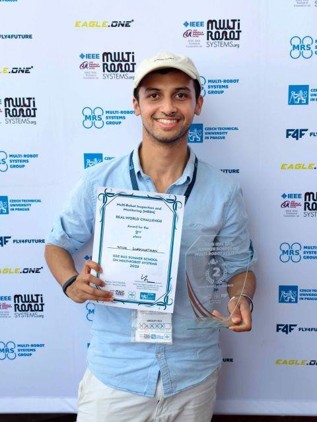
KTP Associate – Ritvik Swaminathan holding his award after achieving 2nd place in the real-world challenge (and 4th in the virtual challenge) at the IEEE RAS Summer School on Multi-Robot Systems, hosted by MRS Group at FEE-CTU Prague.
About Innovate UK:
Innovate UK is part of UK Research and Innovation, the UK’s innovation agency. Their mission is to help companies to grow through their development and commercialisation of new products, processes and services, supported by an outstanding innovation ecosystem that is agile, inclusive and easy to navigate.
The Challenge the KTP Addressed:
The original aim of the Knowledge Transfer Partnership (KTP) was to develop a digital twin system capable of simulating drone flights prior to real-world operations. This capability was intended to support research and development activities, pilot training, and the development of swarm flight behaviours. A further objective was to create a simulation environment that could validate the flight performance of different drone configurations before physical testing, enabling faster design iteration and reducing development risk whist lowering drone development costs.
UWE Bristol provided academic expertise and strategic guidance to support the KTP Associate during the development of the software platform. Additionally, the company worked closely with the university throughout the KTP, to guide the development of the project, which helped ensure the resulting system addressed practical and operational needs to fulfil HVN’s expectations.
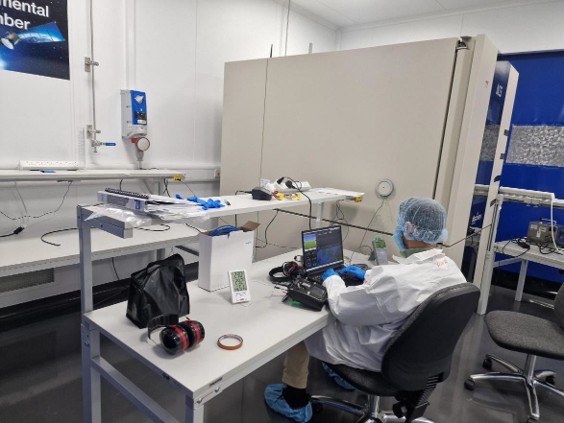
Photo: KTP Associate – Ritvik Swaminathan during lab experiments to collect crucial data to characterise the performance of HVN’s show fleet under extreme temperature and humidity conditions.
The Solution:
The KTP delivered significant value to HVN across commercial, operational and academic dimensions. By establishing a robust digital twin and simulation capability, the project transformed how the company designs, tests and validates its drone systems. The resulting tools and processes have reduced development costs and testing requirements, strengthened safety assurance, and generated new research outputs that contribute to the wider field of Unmanned Aerial Vehicle (UAV) simulation and validation.
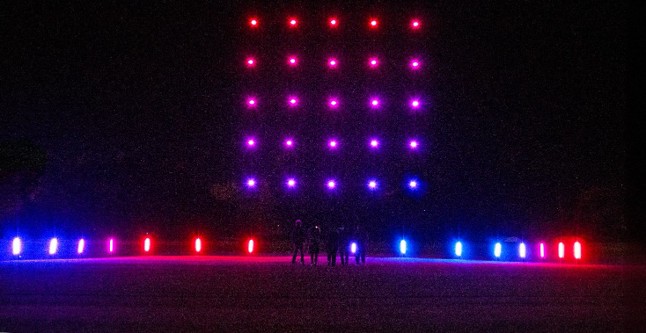
Photo: Internal drone light show #1 demonstration showcased at HVN.
Financial benefits:
Replacing large blocks of physical flight testing with a validated simulation stack cut performance-testing time by 93%, freeing flight-tests resources for revenue-generating shows and new client projects, which led to reducing the cost of qualifying each new drone variant. The new in-house design-configuration tool allows HVN to test and compare novel drone designs within a visual environment using software before committing to physical prototypes, reducing research and development costs on new design exploration.
Non-financial benefits:
The KTP fundamentally changed how HVN designs, tests and validates its technology. What was previously a predominantly ad hoc, test-first design culture has evolved into a company-wide structured simulation-first workflow embedded in the company, enabling engineers to assess performance, safety and system behaviour before flight. The business now holds an in-house flight simulation capability that did not exist before. This gives HVN a genuine internal design and safety-validation capability it previously had to work around rather than own.
Academic input:
The project generated a peer-reviewed research publication and new knowledge in drone simulation and digital twin technology. This provides UWE Bristol with a valuable industry-informed
research output and demonstrates the impact that collaboration between universities and businesses can achieve.
Key milestones:
Full digital twin build and Software-in-the-Loop (SITL) simulation capability; four-tier fidelity validation study; 93% reduction in physical testing time.
Photo: Internal demonstration drone light show #2 developed showcased at HVN.
Key Facts and Impact:
93% reduction in performance-testing time, cutting testing from around 30 days to just 2 days through the introduction of a simulation-first design and validation approach.
Reduction in R&D costs associated with exploring and evaluating new drone designs by enabling virtual testing before physical prototypes are built.
Developed and embedded HVN’s first in-house drone simulation and digital twin capability, transforming the business from a physical test-first approach to a simulation-first workflow.
Developed and validated swarm simulation capability, supporting expansion into larger-scale drone swarm operations.
Developed and validated swarm simulation capability, supporting expansion into larger-scale drone swarm operations.
Significantly reduced operational risk by validating drone performance.
Reduced reliance on external suppliers by creating an in-house propulsion modelling capability for selecting and optimising motors, propellers and batteries.
Enabled HVN to develop new drone designs more quickly and efficiently, improving stability, performance, safety and energy efficiency.
Workforce approximately tripled during the KTP period, with dedicated hardware, software and flight-testing teams established as the business scaled.
Delivered a peer-reviewed research output and a transferable digital twin software package, creating long-term value for both HVN and UWE Bristol.
The Results of the KTP:
The KTP delivered lasting benefits for both HVN Labs and UWE Bristol. The partnership enabled HVN to transform how it designs, tests and validates drone technology, supporting business growth and new commercial opportunities. For UWE Bristol, the project generated valuable research outputs, strengthened expertise in digital twin and autonomous systems technologies, and created new opportunities for knowledge exchange and future collaboration.
Photo: Internal demonstration drone light show #3 developed and showcased at HVN
What the partners have to say…
“We could always fly UAVs. What we didn’t have was a way of modelling them properly, and that’s what the KTP changed. The academic team at UWE were involved throughout, not just at review meetings. They brought the modelling expertise and stayed close enough to the work to understand how weactually operate. We now run flight dynamics through the digital twin before anything leaves the ground, which means far fewer test flights to answer the same questions.
Ritvik is the reason it came together. He sat between the academic side and the operational side and got genuinely good at both, with support from his supervisors at UWE behind him. He’s an engineer we rely on now, and we’re lucky to have him.”
Dr. Laura Alvarez-Hidalgo: Controls Engineer|Lead Drone Engineer
What the Knowledge Base partner has to say…
“The academic team at UWE has enjoyed working with both the KTP associate and HVN supervisionteam. The KTP project has been an invaluable experience, enabling academic expertise to be translated into real-world innovation while effectively addressing the business partner’s technological challenges. Regular collaboration ensured that the project remained on track, while the KTP Associate gained substantial hands-on experience, developing advanced technical skills, confidence, and emerging leadership. The partnership delivered a market ready solution and further strengthened industry–university links, generating long–term benefits for both parties.”
Dr Jun Yao, Associate Professor in Aerospace Engineering at UWE Bristol
KTP Associate…
“The KTP project has been a great opportunity for me as the Associate to take complete ownership and manage quite a large project from day one. On top of gaining the experience of managing a project with many key stakeholders, I’ve also developed many core technical skills which is a great stepping stone to now pursue the next phase of my career”
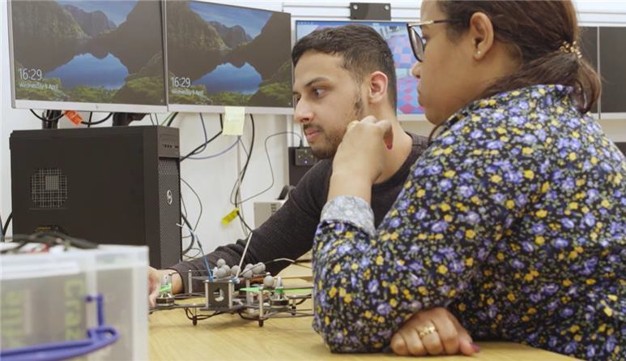
Photo: Ritvik Swaminathan (KTP Associate) and Dr Amina Hamoud (Academic supervisor) inspecting the first version of the digital-twin-system and debugging issues.
Lynne Fernandes Optometrists is a highly skilled, national award-winning Optometrists founded by Lynne and Gerard Fernandes. It is one of the most respected and trusted UK independent opticians, with highly qualified optometrists and industry-leading technology. Their innovative eye care and exemplary customer service is continuously improved by investment in equipment and products to provide personalised eye care and vision correction of the highest standard.
The Knowledge Base team was made up of Mario Vafeas, Michelle Jackson, and Mary-Ann Sherratt. Professor of Marketing, Mario Vafeas teaches undergraduate and masters; he is involved in Knowledge Exchange Projects with SMEs, and research in the field of buyer-seller relationships and value co-creation. Michelle Jackson is a Senior Lecturer in the Business School, teaching at undergraduate and master’s level and is an experienced marketer and marketing manager. Mary-Ann Sherratt was the Workforce Development Portfolio lead, and Clinical Lead for Optometry and is now Head of Optometry and Consultant Optometrist at Bristol Eye Hospital.
About the KTP Associate:
David Todd worked as a Marketing and Business Change Manager with Lynne Fernandes Optometrists and UWE Bristol. He holds a Master’s degree in Strategy, Change and Leadership, as well as Business Administration. During his time on the KTP programme, David benefitted from extensive training, including a course at Ashorne Hill on Strategy and Innovation, and studied for a Diploma in Digital Marketing.
When asked if he would recommend the KTP Associate role, David shared:
“I would thoroughly recommend the programme to other graduates. You quickly gain knowledge and experience that can make a positive difference to the organisation you work with. You will always have problems, and I have found on several occasions talking to the right people makes a tremendous difference – people want to help. I feel that it is a springboard to a successful and interesting career. The programme gives you the tools and knowledge to progress and enables you to be an asset to your organisation. It is just a pity that more people do not know about it!“
Photo: David Todd, KTP Associate
About Innovate UK:
Innovate UK is part of UK Research and Innovation, is the UK’s innovation agency. Their mission is to help companies to grow through their development and commercialisation of new products, processes and services, supported by an outstanding innovation ecosystem that is agile, inclusive and easy to navigate.
The Challenge the KTP Addressed:
The KTP project set out to address the follow aims:
Repositioning and relaunching the EyeSense subscription
A key challenge for LFO was to fundamentally reposition and successfully relaunch its EyeSense subscription, clearly articulating its value proposition and differentiating it from traditional eye care offerings in a market dominated by large competitors.
Introducing performance standards and monitoring
LFO faced the challenge of introducing consistent performance standards and robust performance monitoring across the business, in order to enhance patient experience while simultaneously improving eyecare outcomes.
Scaling the business and workforce
Another significant challenge was increasing the number of LFO practices on the high street and expanding the workforce within a year of project completion, requiring scalable systems, leadership capacity, and sustainable growth processes.
For Lynne Fernandes Optometrists (LFO), continued growth, competitiveness, and resilience in the face of the ‘big three’ presented a clear challenge. Competing on price was neither viable nor desirable; to prosper, LFO had to differentiate itself by delivering demonstrable added value to customers.
This made the expansion of its EyeSense subscription service not just an opportunity, but an imperative. However, scaling this service posed a significant challenge: it demanded management capability, alongside robust clinical and business systems and processes that the company did not yet have in place.
Photo: Newly refurbished practice on Wells Road (Bristol)
The Solution:
To address Lynne Fernandes Optometrists strategic growth ambitions, they undertook a programme of organisational development, focusing on embedding new management practices, cultural change and leadership capability.
These changes were essential to enable the scalable relaunch and growth of its innovative EyeSense subscription service, which offers predictive and preventative eye care and differentiates the business from more reactive competitors. LFO had previously engaged marketing expertise where the understanding of the importance of care quality had been misunderstood. Similarly, it was difficult to find people with clinical expertise who understood business and marketing.
Facing challenges in aligning clinical expertise with business and marketing capability, LFO partnered with experts from Bristol Business School and Optometry to manage this growth period rigorously. This led to the embedment of these changes within LFO, ensuring long-term impact beyond the project’s lifetime.
Photo: Inside the Nailsea Practice
The Impacts/Benefits of the KTP
The KTP delivered clear benefits for all partners. For Lynne Fernandes Optometrists, it resulted in a defined positioning statement for EyeSense, and a marketing plan for EyeSense, providing a strategic framework for future communications. The project also introduced standardised operating procedures, a new patient record coding system, and an electronic questionnaire, supporting improved efficiency and consistency. In 2025, the LFO group achieved 10% growth – EyeSense revenue had increased due to a fee uplift. Retail performance had been particularly strong, which was an impressive result given the broader UK retail landscape and the challenges which faced optical retail.
For UWE Bristol, the KTP project generated both academic and practitioner-focused outputs, including data collection for two research papers, one of which examines how tensions affect resource integration and outcomes in a private healthcare setting, and, jointly with the Associate, the development of a teaching case study based on brand positioning and branding hierarchy in an SME. These outputs contribute to academic dissemination and strengthen the potential for a future REF impact case study.
The KTP Associate gained a professional marketing qualification and completed the Strategy Innovation course, supported the advancement of their research and strategic skills through interviews, customer research via customer survey and operational development. This fed into the development of a positioning statement for EyeSense, which will guide all future marketing communications, and also led staff training and the implementation of new procedures, contributing to capability building within the business. They also developed standardised operating procedures – supporting staff development, new ways of working and ran staff training sessions.
What the partners have to say…
“The KTP has been a challenging but supported way of increasing and learning from cross discipline collaboration to the benefit of Lynne Fernandes Optometrists. In turn this will benefit patients in our geographical area and potentially influence national eyecare.“
Gerard Fernandes, Company Chair, Lynne Fernandes Optometrists
Photo: Gerard Fernandes, Optometrist and Director, Lynne Fernandes Optometrists
What the Knowledge Base partners have to say…
Academic Lead
“From an academic perspective the KTP was an opportunity to apply research-based knowledge to real-world commercial problems. The two-year project generated teaching material and provided the academic team with data for a new research paper. Working on a multi-disciplinary project, which had full commitment from the firm’s leadership team, was a very positive and rewarding experience.“
Mario Vafeas, Professor of Marketing, UWE Bristol.
Photo: Mario Vafeas, Professor of Marketing, Bristol Business School, UWE Bristol
Academic Supervisor
““Being involved with a KTP reminds me of the importance for business tutors, like myself, of the benefit of practical, live, real-time exposure to actual businesses. Gaining knowledge and experience is incredibly valuable for students, as it enriches their understanding and provides a practical context to theoretical learning. When students can relate their studies to real-world experiences, it not only enhances their learning but also prepares them for future professional challenges.”
Michelle Jackson, Senior Lecturer in Marketing, UWE Bristol
Photo: Michelle Jackson, Senior Lecturer in Marketing, Bristol Business School, UWE Bristol
Duku Product Design is a UK-based engineering design consultancy with over a decade of experience in transforming client ideas into market-ready products. The company specialises in end-to-end product development, from concept through to design for manufacture and production delivery. In recent years, Duku has expanded beyond consultancy into the development of its own proprietary technologies, with a strategic focus on innovative and accessible EV charging systems, transitioning from a service-led consultancy model to a product-led scalable business.
About the Knowledge Base:
The academic team based within the Bristol Business School at UWE Bristol brings a strong research foundation, combining both academic and industry perspectives. The KTP was supported by Dr Mel Hudson Smith and Eamonn Condon. As Associate Professor in Operations Management, Mel has over 20yrs of experience working with small businesses to enable them to achieve their strategic objectives by ensuring their operational capabilities and processes are high quality, efficient and strategically aligned. Eamonn is the Programme Lead for the Marketing Degree and a Senior Lecturer in marketing. With international experience, Eamonn has valuable expertise in launching services, leading product teams and embedding processes and launch strategies to new markets.
Photo from the Final LMC – Eamonn Condon (Academic Supervisor), Ria Eyers (KTP Officer), Ellen Parkes (KTP Development and Growth Manager), Taabish Khan (KTP Associate), Andrew Aylesbury (Duku – Company Chair), and Paul Spenley (IUK Adviser). Excluding Alex Lee (Duku – Company Supervisor), Mel Smith (Academic Lead) and Helen Lewis (KTP Project Manager).
About the KTP Associate:
The KTP Associate, Taabish Khan, holds an MBA in Strategy and BSc in Business Management, brings over six years of experience across sales, project management, and corporate communications. His professional background spans both industry and agency roles, delivering commercially focused projects and working across cross-functional teams.
About Innovate UK:
Innovate UK is part of UK Research and Innovation, is the UK’s innovation agency. Their mission is to help companies to grow through their development and commercialisation of new products, processes and services, supported by an outstanding innovation ecosystem that is agile, inclusive and easy to navigate.
The Challenge the KTP Addressed:
The partnership aimed to embed a full commercialisation capability within Duku EV, enabling the transition from a design‑led consultancy to a scalable EV technology business. This capability supports the direct marketing of Duku’s own in-house designed products and enables a full idea‑to‑market service for new and existing design consultancy clients across home, fleet, and public charging markets.
Business Challenge:
At the outset of the KTP, Duku operated primarily as a product design consultancy but had begun developing proprietary EV charging technologies and patents. However, it lacked the commercial capability required to take these products to market. While the business had strong expertise in engineering design and product development, it did not have the internal frameworks needed to support market entry, revenue generation, or scale.
More broadly, the business faced structural challenges such as:
No formal market sizing or prioritisation framework
Lack of defined routes to market or commercial models
Absence of investor-ready financial planning and valuation logic
No established supply chain to support hardware delivery
Reliance on ad hoc project-based revenue rather than scalable growth
In addition, entering the EV charging market required navigating a complex and capital-intensive landscape, including manufacturing readiness, certification requirements, and long procurement cycles.
As a result, the core challenge was not only to commercialise a product, but to determine what should be commercialised, how it should be brought to market, and how the business could do so in a scalable and financially sustainable way.
The Solution:
To address the lack of commercial capability, the KTP focused on embedding structured, evidence-led decision-making within the business, while simultaneously validating real market opportunities for Duku’s EV charging technologies.
The project did not follow a linear path. Early in the partnership, initial commercial assumptions around launching a single public EV charger were tested through detailed market research and industry engagement. This revealed that the chosen segment was highly competitive, low margin, and capital intensive, prompting a fundamental shift in strategy.
In response, the focus moved from commercialising a single product to developing a scalable product portfolio built around Duku’s core cable management technology and family of 11+ patents. This shift enabled the business to target multiple higher-value markets, including fleet, domestic, and commercial charging applications, significantly improving long-term growth potential.
Alongside this strategic pivot, structured commercialisation frameworks were introduced across the organisation. Market sizing methodologies (TAM–SAM–SOM), competitor analysis tools, and value proposition frameworks replaced ad-hoc decision-making, allowing the business to prioritise opportunities based on evidence rather than assumption.
As industry engagement increased, further insights shaped the commercial approach. Engagement with OEMs, charge point operators, and international manufacturers highlighted differing preferences between licensing and hardware supply models. This led to the development of flexible routes to market, including both hardware delivery and IP-led licensing strategies.
(Charlie Meadows. Product Designer at Duku assembling the Duku EV ARC system)
In parallel, significant progress was made in building the foundations required for commercial execution. This included the development of investor ready financial models, structured outreach pipelines, early-stage supply chain relationships, and active participation in industry events to validate demand and position the business within the EV ecosystem.
These activities collectively transformed the business from a consultancy-led organisation with a single product concept into a commercially structured EV charging solutions provider, with a defined product portfolio, validated market opportunities, and a clear pathway to scale.
Key activities delivered through the KTP included:
Development of market sizing and total opportunity assessment frameworks
Expansion from a single product to a multi-sector EV charging portfolio
Creation of repeatable commercialisation tools and processes
Strategic input into Innovate UK grant funding applications
Preparation of investor ready financial and strategic documentation
Industry engagement through exhibitions, panels, and stakeholder outreach
The Results of the KTP:
By the end of the KTP, the business had undergone a fundamental shift – from a consultancy with an early-stage EV concept to a commercially structured EV charging solutions provider with validated demand, secured funding, and a clear pathway to scale.
This transformation was reflected not only in strategy, but in tangible commercial outcomes. During the project, the business secured over £276,000 in pre-production sales across multiple product lines, alongside contributing to £461,967 in Innovate UK funding. Combined, this represents a total financial impact exceeding £730,000, which is more than four times the grant value for the KTP.
Crucially, this activity was not isolated. EV-related grants and commercial traction accounted for approximately 30% of company revenue during the period, demonstrating a meaningful shift away from reliance on consultancy-led income and towards a scalable product-led model. In parallel, the business expanded from a single unfinished product to a portfolio of five production-ready EV charging solutions, significantly reducing market concentration risk and opening multiple routes to market.
The organisational impact extended beyond revenue. Headcount increased by 10% during the KTP, with the commercial groundwork laid through the project expected to support further job creation, including an estimated 7-12 roles within manufacturing through contract partners, and 4–6 roles within the emerging UK marine EV charging sector.
Beyond commercial performance, the project delivered meaningful societal and industry impact. Duku’s focus on accessibility contributed to a measurable improvement in usability, with the proportion of disabled users able to confidently use EV charging increasing from 25% to 61%. This represents a significant step toward inclusive infrastructure, addressing one of the key barriers to wider EV adoption.
(Emily Yates (www.emilyroseyates.co.uk) – Journalist + BBC presenter at a study conducted by Duku EV and RiDC around accessibility on EVC charging)
Depot and charging network safety was another critical area of impact. With 31% of workplace injuries attributed to trips and falls (HSE), the development of automated cable management systems directly addresses a major risk factor within EV charging environments, particularly in fleet and public settings.
The project also contributed to sustainability objectives. Through collaboration with sustainability specialists, the products developed are targeting up to99% recyclability, supporting longer-term environmental goals alongside electrification.
Just as importantly, the KTP elevated Duku EV’s external reputation and industry visibility. During the partnership, the business won the Industry Advocacy Award at the London EV Show 2024 and received Innovation of the Year from the IET for accessible vehicle technology.
(Alex accepting the Industry Advocacy Award at the London EV Show)
Duku EV also strengthened its position as a thought leader in the sector through a talk on accessible EV charging at Cenex Expo 2025, alongside panel participation at Cenex Expo in Millbrook and the EV Charging UK Conference in London in 2026. These milestones signalled growing recognition not only of the technology itself, but of the company’s role in shaping conversations around accessible and user-centred EV infrastructure.
(The Associate delivering a talk at the CENEX Expo ’25)
At an industry level, the KTP enabled Duku to contribute to early-stage policy and infrastructure development. Through involvement in the Clean Maritime Demonstration Competition (CMDC6) under UK SHORE, the business worked alongside organisations such as Cenex and the IET to help shape design guidance and best practices for marine EV charging, an emerging and strategically important sector.
The Knowledge Transfer Partnership (KTP) delivered significant benefits to the knowledge base partner, UWE Bristol, by providing a live commercial environment in which academic frameworks could be applied and tested. For the core project team of Mel Smith and Eamonn Condon, participating in Duku’s strategic transformation created a rich source of real-world material for both teaching and research.
Crucially, the collaboration provided valuable teaching examples of how a new intellectual property (IP) innovation is successfully brought to market (GTM). These practical insights are now being utilised in postgraduate courses, such as the MBA and the MSc in Marketing programmes. These outputs feed into student project work and support the development of future research and impact case studies.
Furthermore, the project’s complex requirements facilitated broader university collaboration, as thought leaders from across UWE outside of the core project team were brought in to assist wherever their specific expertise was needed.
Perhaps most significantly, the KTP has created capability that extends far beyond the lifecycle of the project. The commercialisation frameworks developed, covering market sizing, financial modelling, and go-to-market strategy, are now embedded within the business and are being actively deployed not only within Duku EV, but also as a formal service offering to external clients.
As a result, the KTP has not only delivered immediate financial return, but has established a repeatable and revenue-generating commercial capability that will continue to drive growth long after the project’s completion, while positioning the business for international expansion and external investment.
Key Facts and Impact:
Commercial Impact
Three Innovate UK bids won, valued at £71k, £184k, and £81k
Two confirmed sales orders across different product lines, valued at £88k + VAT and £186k + VAT
Total direct monetary impact of £610k during the project period
3.2x return on the original KTP grant value within the lifetime of the project
Estimated cost savings of £2.73 million over five years through improved strategic decision-making and reduced reliance on external consultancy
Strategic and Organisational Impact
Expansion from 1 to 5 product lines, covering domestic, fleet, and public EV charging markets
Establishment of a scalable supply chain to support hardware and licensing models
Transition from a design consultancy to an EV technology business with defined commercial pathways
Full redesign and launch of the Duku EV website, strengthening market presence and credibility
Reputation and Thought Leadership
Winner of the Industry Advocacy Award at the London EV Show 2024
Winner of Innovation of the Year for Accessible Vehicle Technology, awarded by the Institution of Engineering and Technology (IET)
Delivery of a talk on accessible EV charging at the Cenex Expo ‘25
Participation in panel discussions at:
Cenex Expo, Millbrook (2025)
EV Charging UK Conference, Crowne Plaza London (2026)
(Andrew, Alex, and Taabish with the award at the London EV Show ‘24)
Future and Legacy:
The KTP has established a foundation that extends well beyond the lifecycle of the project, embedding both capability and opportunity that will continue to drive growth across the business.
A key legacy is the formalisation of commercialisation as a structured function within Duku. The frameworks developed during the partnership, including market sizing, financial modelling, and route-to-market strategy, are now embedded at management level and actively used across both EV and non-EV projects. This capability has also been translated into a client-facing service, already generating revenue and strengthening the company’s wider offering.
The project is positioning Duku EV as a clean, investable, and scalable business, separate from the legacy product design consultancy. Commercial and financial readiness has been achieved, with Duku EV now progressing toward a £1.35 million seed raise, supported by early investor interest and ongoing governance development.
New market opportunities have also been unlocked. Active partnerships are now developed with UK and European charge point manufacturers, particularly in the fleet sector, where Duku’s ARC technology is gaining recognition as a differentiated solution. In parallel, the business is exploring marine EV charging, building on its involvement in the Clean Maritime Demonstration Competition (CMDC6), where it contributed to the development of design guidance and best practices alongside organisations such as the IET and Cenex.
While the focus is now on scaling the existing product portfolio, additional opportunities, particularly within marine AC and DC charging, are being explored as part of the longer-term roadmap.
The academic outputs extend beyond UWE. This included an industry project with the MBA cohort of Aston University, which explored IP valuation, organisational transition to hardware supply, and strategic recommendations for scaling, delivering both academic and commercial value.
Looking ahead, the impact of the KTP is expected to extend beyond the business itself. As Duku EV scales, there is clear potential for job creation across manufacturing and emerging sectors such as marine electrification. More broadly, by improving accessibility and usability in EV charging, the business is helping to reduce barriers to adoption and support the wider transition to electric mobility.
With commercial capability embedded, market pathways defined, and early traction established, the KTP has reshaped the trajectory of the business, positioning Duku EV for sustained growth, international expansion, and long-term impact within the EV infrastructure sector.
(Taabish visiting S.Charge’s facility in India – which is Duku’s manufacturer and partner on an international Innovate UK – India Department of Science and Technology (DST) grant)
What the partners have to say…
“This KTP has been genuinely transformative for our business. The project started at a pivotal point for us where we could see an opportunity and had a strong technical concept, but understanding where to focus our resources and building the strategy to exploit it was very difficult. We had a strong technical capability from our background in design and engineering, but this project gave us the structure and support to spend time on the commercial aspects which were not well defined at that point. Working with Taabish and the team at UWE has allowed us to challenge our thinking, refine our approach and ultimately build a plan with real long-term potential. We have ended the KTP with real clarity about our next steps, the next 12 months are going to be very exciting and we’re very grateful for the advice and support we’ve received from UWE and to have Taabish on board to expand and develop this opportunity.” Andrew Aylesbury – Director.
What the Knowledge Base partners have to say…
“From my role as a support academic on this project, I am very satisfied with how the transfer of knowledge from UWE has contributed to the pool of expertise to both Taabish and DUKU in their quest to lift their EV capability to the next stage. The partnership has worked very well and to me is a model of how they should be run” Eamonn Condon – Academic Supervisor.
“It has been a joy to be involved in this innovative and exciting KTP. The partnership between the company, academics and the Associate was exceptional and was key to unlocking the transformation from engineering consultancy to EV charging solution provider. As an academic, the impact of being part of both the planning and execution of a such a significant strategic change project, has created a rich source of material for both teaching and research” Mel Smith – Academic Lead.
KTP Associate…
“This KTP has been an ideal first long-term project following my MBA. While the course prepares you to act as a change agent bridging strategy with operational reality, this experience allowed me to apply that in a live business environment.
Building and translating a strategy into execution is rarely straightforward, particularly in a business balancing technical development with commercial ambition. The project exposed me to real constraints around resources, alignment, and timing – all of which shape outcomes.
It has been a steep and an extremely rewarding learning curve, requiring me to work across product strategy, market analysis, business development, and brand building within a highly competitive EV charging sector. I am grateful to have had this opportunity and the experience gained – and we aren’t finished yet!” Taabish Khan – KTP Associate.
From the Knowledge Transfer Adviser…
“The KTP is a great example of product development and commercialisation led with determination and skill by Taabish. It was a pleasure to work with the whole team and to be a part of the journey towards the implementation of a new sustainable revenue stream which adds to the business model. The KTP makes the company more competitive and with new strategic capabilities most notably the marketing and sales methodology which will serve as an embedded process suitable for any new product or service” Paul Spenkley – IUK Adviser.
Metrea is a global defence company specialising in intelligence, surveillance, reconnaissance and advanced technology solutions for national security partners worldwide. Through a Knowledge Transfer Partnership (KTP) with UWE Bristol’s Centre for Machine Vision, the company worked to develop AI-powered software capable of detecting, tracking and classifying objects in orbit using airborne imagery.
About the Knowledge Base:
Researchers from UWE Bristol’s Centre for Machine Vision brought expertise in computer vision, machine learning and object modelling. Working alongside Metrea, the team helped develop and test innovative AI approaches capable of analysing complex orbital imagery, transforming early-stage research into a commercially viable solution.
Mark Hansen (UWE), Izaak Stanton (UWE Research Associate), Lyndon Smith (UWE), Chris Dunn (Metrea), Louis Aberdeen (KTP Associate), Ryan Gery (Previous Company Supervisor), and Ria Eyers (UWE) during a tour of the Engineering School.
About the KTP Associate:
KTP Associate Louis Aberdeen joined the project after graduating with a degree in Mathematics from the University of Bath. During the two-year partnership, Louis led much of the technical development, applying expertise in machine learning, optimisation and computer vision to help create a new AI-driven platform for space-domain analysis.
The experience enabled Louis to develop specialist skills in deep learning, image analysis and research translation, ultimately leading to a role as a Machine Learning Engineer.
Louis Aberdeen (KTP Associate) at the Louis Aberdeen (KTP Associate) at Farnborough Bristol Robotics Laboratory
About Innovate UK:
Innovate UK is part of UK Research and Innovation, is the UK’s innovation agency. Their mission is to help companies to grow through their development and commercialisation of new products, processes and services, supported by an outstanding innovation ecosystem that is agile, inclusive and easy to navigate.
The Challenge the KTP addressed
Tracking and identifying objects in orbit is becoming increasingly important as space becomes more congested. Existing methods can be expensive, technically complex and difficult to deploy at scale. Metrea wanted to explore whether AI and machine vision techniques could be used to improve the detection and classification of orbital objects using airborne imagery.
Ryan Gerry (previous Company Supervisor) and Louis Aberdeen (KTP Associate) at the International Space Show – Farnborough
The solution
Researchers from UWE Bristol’s Centre for Machine Vision worked alongside Metrea to develop new machine-learning approaches capable of detecting and classifying objects from airborne imagery.
The project combined expertise in computer vision, artificial intelligence and image analysis to create an analytical pipeline that could process complex imagery and identify objects of interest with greater speed and accuracy.
Throughout the partnership, the team iteratively tested, refined and validated the technology, including operational trials in real-world environments.
An example reconstructed output image of the international space station
The Benefits of the KTP:
The partnership delivered significant benefits for both Metrea and UWE Bristol.
For Metrea, the project accelerated the development of innovative AI capabilities, helping the company move a promising concept towards commercial readiness. The work strengthened Metrea’s ability to analyse and interpret orbital imagery, creating opportunities for future applications in defence, security and space operations.
For UWE Bristol, the partnership provided an opportunity to apply cutting-edge machine vision research to a real-world challenge. The project generated new knowledge, strengthened industry collaboration and created opportunities for future research in artificial intelligence, image analysis and space technologies.
The KTP also delivered a substantial professional development opportunity for KTP Associate Louis Aberdeen. During the project, Louis developed specialist expertise in machine learning, computer vision and software development, gaining experience of translating research into practical solutions for industry.
The success of the partnership demonstrates how Knowledge Transfer Partnerships can bridge the gap between academic research and commercial innovation, helping businesses access specialist expertise while creating lasting impact for researchers, graduates and industry partners alike.
Metrea – Chris Dunn (Company Lead) talk at the Centre for Machine Vision, Bristol Robotics Laboratory.
Impact:
The partnership delivered significant benefits for Metrea, UWE Bristol and KTP Associate Louis Aberdeen.
For Metrea, the project transformed LASSO from a data collection tool into a sophisticated analytics platform capable of generating operationally valuable insights. This work directly supported Ministry of Defence feasibility studies worth more than £1 million and opened opportunities for future software licensing, data sales and commercial applications.
The project also increased Metrea’s visibility across the defence and space sectors, with the technology showcased to organisations including NATO and the UK Ministry of Defence. Beyond its original focus on Space Domain Awareness, the research created opportunities for wider applications in Maritime Domain Awareness and signals intelligence.
For UWE Bristol’s Centre for Machine Vision, the partnership generated new research outputs, including peer-reviewed publications and a new area of applied research at the intersection of computer vision and space technologies. The project strengthened relationships with industry partners and created opportunities for future collaboration and research funding.
KTP Associate Louis Aberdeen played a central role in the project’s success, leading the technical development from image simulation through to advanced analytical techniques. The experience included operational data-collection flights in Florida, academic publishing opportunities and engagement with senior stakeholders across the business. Following the completion of the KTP, Louis secured a role as a Machine Learning Engineer, demonstrating the programme’s impact on graduate development and career progression.
Collectively, the project demonstrated how academic expertise and industry collaboration can accelerate innovation, transforming research into practical solutions with commercial, societal and strategic value.
ERS-2 (ESA) during re-entry period
What the partners have to say… “This was our first time working with a KTP and it has proved to be a very worthwhile venture. UWE Bristol was able to provide Metrea with an exceptional Associate who was able to adapt rapidly to the continued changing business demands throughout his period of work with us. His knowledge and adaptability provided rapid analytical outputs and support products to our customers and was most welcome as we used them across the globe tackling some of the most complex and wicked security problems faced today”. – Chris Dunn: Solution Architect at Metrea.
Returning Aircraft at Tampa test facility
What the Knowledge Base partner has to say… “This was a highly ambitious KTP that has delivered excellently against its plan, in no small part down to the exceptional adaptability of the associate, Louis. It has been a pleasure for the academic team at the CMV to work with Metrea and especially with Louis and see him develop so much over the course of the KTP. The projects that Louis worked on while at Metrea have the potential to have a real impact on international defence as well as giving the CMV its first foray into space. We wish Louis the very best for his future and look forward to working with Metrea again.” Prof Mark Hansen.
KTP Associate… “The KTP has been a fantastic opportunity to develop both my technical and professional skills. Working to foster collaboration between the industry partner and knowledge base results in an outcome greater than the sum of its parts. A personal highlight was getting into the hangar with my KTP supervisor Ryan to troubleshoot the integration of LASSO into Metrea’s aircraft, crawling around on the floor checking we had all the correct port connections” Louis Aberdeen (KTP Space Data Analyst Associate).
Louis Aberdeen (KTP Associate) using a flight simulator at UWE Engineering School.
From the Knowledge Transfer Adviser: “This innovation project has been very successful in enabling new revenue streams now and in the future for the Company as well as achieving significant societal benefits in early detection of fire, people smuggling and defence/space problems enabling early detection and real time actions to be taken
Louis has led the project with drive and determination and has successfully covered the technical and commercial challenges through excellent communication skills and innovative thinking.
The development of the deep learning-based image recovery system by the team is based on wide ranging technology integration into a working and practical system with a strong commercial focus and is a great example of how the KTP methodology works to achieve breakthrough solutions at pace”. Paul Spenley (Knowledge Transfer Adviser – IUK)
Knowledge Transfer Partnerships (KTPs) are one of the UK’s best-kept secrets in innovation, quietly transforming businesses for decades.
For over 50 years, they’ve helped companies turn ideas into practical solutions with real-world impact, creating more than 14,000 projects and boosting the economy by £2.3 billion.
KTPs continue to deliver not only because they provide access to funding, but because they embed expertise, build capability, and deliver measurable change. In an environment where companies are under constant pressure to keep evolving, KTP is the initiative that consistently delivers the tools to do exactly that.
Why KTPs work
Unlike traditional funding schemes, KTPs also prioritise delivering a partnership and provide ongoing support. With an 87% success rate, this easily makes them one of the UK’s most effective innovation programmes.
At the centre of every KTP is a unique three-way collaboration between:
A business looking to innovate and grow.
An academic institution with cutting-edge expertise.
A graduate associate who brings fresh skills and energy.
This isn’t just a theory. Associates work full-time in the company, supported by academic experts and an Innovate UK Knowledge Transfer Adviser. It’s a system designed to deliver projects and build lasting capabilities.
Why do UWE Bristol do them so well?
UWE Bristol’s dedicated KTP Team has supported over 100 successful projects in the last 20 years. Our academics bring strengths across disciplines from robotics to marketing delivering projects that advance innovation, sustainability goals, community impact, and regionaldevelopment.
This expertise is supported by state-of-the-art facilities across our three campuses, with £300 million invested in the last five years to create spaces that inspire collaboration and creativity.
UWE Bristol’s infrastructure and dedicated KTP Team support the full project journey delivering better outcomes, stronger partnerships, and long-term impact.
Proof is in the results
A recent example is UWE Bristol’s award-winning African Agriculture KTP with Taro Agric and Obafemi Awolowo University. The project developed Internet of Things (IoT) enabled devices and smart dashboards to support the digital transformation of poultry farms, improving operational efficiency and animal welfare. Early outcomes showed potential for improved business performance and enhanced digital agriculture skills among more than 100 farming participants from various local communities. The KTP highlights how innovation can drive more sustainable agricultural practices.
Or look at Viper Innovations. Recognising the potential beyond subsea oil and gas for their cable‑monitoring technology, CableGuardian®, the company used a KTP to identify new opportunities in rail. The partnership embedded new innovation practices and aligned CableGuardian® with an emerging rail safety standard, resulting in successful trials, strong stakeholder buy-in and growing international interest.
In just 18 months, Viper reshaped its market strategy, strengthened product development, and laid the foundation for global expansion. Building on the success of this initial KTP, Viper later undertook a second KTP focused on generating greater insight from live data and enhancing the CableGuardian® service offering, which contributed to strengthening the company’s commercial proposition.
The impact of the initial KTP is already clear through UK installations, new strategic partnerships in the rail sector, and embedded capabilities that enhance product design and strategic planning, delivering real benefits for customers, including fewer delays, reduced penalties, and lower maintenance costs.
The secret to success
Let’s be clear, not every partnership is right for a KTP. KTPs are most successful when all of the partners are truly aligned. If a business brings a clear strategic need, academics offer relevant expertise, and the associate drives delivery, innovation will follow. With open communication and commitment from all partners, the outcome is long-term, transformational impact.
Why businesses should get involved
With Innovate UK covering up to 67% of project costs, the financial risk is significantly reduced, giving the business freedom to reap the other rewards of the programme. Those rewards are substantial. Remember: You’re not only unlocking funding for a project; you’re embedding expertise, creating intellectual property, and opening doors to new markets. In a world where innovation drives competitiveness, KTPs offer a practical route to staying ahead.
KTPs aren’t just another government programme. They’re the UK’s best-kept secret for driving innovation, building resilience, and future-proofing businesses. The evidence and outcomes are clear. If you have a project in mind, contact UWE Bristol’s KTP Team:
Leila Powell is a Community Engagement Researcher working on an Accelerated Knowledge Transfer(AKT) project with Via, tackling one of society’s most complex challenges: drug and alcohol dependency and its wider impacts.
Inspired by the Knowledge Transfer Partnership(KTP) model, AKT creates short-term collaborations between businesses and UK knowledge bases to accelerate innovation over two to four months. Co-funded by Innovate UK, this initiative aims to deliver rapid, high-impact solutions.
Via’sInnovation & Research Unit (IRU) ensures the charity delivers high-quality, evidence-based support by partnering with organisations like UWE Bristol to design and evaluate interventions that meet real needs.
Leila’s AKT project takes a distinctive approach by examining how individuals affected by drugs and alcohol engage with community resources and identifying what helps or hinders that connection. Supported by the Centre for Public Health and Wellbeing at UWE Bristol, the team aims to uncover key factors influencing engagement and develop a practical tool that empowers service users, strengthens pathways to holistic support, and overcomes potential barriers.
The KTP team at UWE Bristol recently caught up with Leila to hear about her AKT experience so far:
About Leila
My academic background includes a BSc (Hons) in Biomedical Sciences and an MSc in Public Health, which have shaped my enthusiasm for improving health outcomes through evidence-based approaches. Outside of work and academics, I enjoy playing volleyball and have previously been involved in volunteer work at the university, which strengthened my commitment to community-focused initiatives.
What attracted you to the position?
I was writing my MSc dissertation and working as a part-time multidisciplinary intern between Bristol Business School and the Centre for Public Health and Wellbeing (CPHWB) when I found out about this opportunity. Dr Amy Beardmore – the project lead, and my MSc programme lead – encouraged me to apply, which was incredibly validating as a soon-to-be graduate. Being able to implement my newfound skillset in a meaningful way before my graduation ceremony has felt like such a timely opportunity.
The goals of the project have resonated with me. Helping people is a reason I pursued my BSc in Biomedical Sciences in the first place, after seeing what occurred during the pandemic and how people were disproportionately affected. Looking ahead, I aspire to pursue a mixed-methods, multidisciplinary PhD with the CPHWB, and this role is the perfect stepping stone. These desires, along with my value of problem-solving, align with this AKT project.
What are you most looking forward to?
I’m excited about:
Contributing to a collaboration between UWE and Via.
Helping to build a (hopefully) long-term relationship between Via and UWE, where future students can continue this research and develop the project further.
Achieving milestones that will make a tangible difference for service users.
Gaining personal and professional development opportunities that will shape my future career.
How is the partnership between UWE Bristol and the company working?
The collaboration between UWE and Via has been positive and productive. We’ve had one planning meeting in London, and recently held our first workshop, which was co-designed by both teams. This session was incredibly insightful, as it allowed us to hear first-hand experiences from individuals, giving us a deeper understanding of the challenges and opportunities in accessing community assets.
Having both academic and community support ensures that our research is practical, innovative, and grounded in real-world needs.
What are the major benefits/support available from UWE Bristol?
Working with UWE offers:
Mentorship and guidance from academic supervisors: being able to work at a hot-desk office space in the CPHWB means I’m physically embedded within the team, and able to chat to staff for support or advice. This also provides frequent opportunities to discuss future career or PhD aspects.
Support from the KTP office: they are amazing with my (many) questions!
Access to expertise and resources, including staff facilities (yes, even the coffee machines!)
What do you enjoy most about your job?
I love the learning opportunities and the collaborative workplace culture. Not being able to go a day without having a conversation with at least one member of staff is very lovely. My past lecturers and supervisors are so keen to see me succeed, so it’s equitable to having positive affirmations thrown my way every day. Little things, like the team Christmas dinner that I was invited to before even starting my position, make the experience more special. Most importantly, I feel a sense of purpose, knowing that my work contributes to broader public health goals.
Conclusion and reflections
I’m enthusiastic and committed to making the most of this opportunity. The AKT partnership represents innovation, sustainability and early career development, all of which are crucial for shaping the future of public health research. Looking ahead, I’m excited about the potential impact of this project and the personal growth it will bring, not just for me, but for future students who may continue this work.
UWE Bristol is delighted to announce a new Accelerated Knowledge Transfer (AKT) partnership with Bristol Drugs Project, co-funded by Innovate UK. This collaboration aims to develop and trial a digital communications campaign to facilitate engagement with early intervention in ketamine dependency. The development of the campaign will involve:
Researching barriers to users’ engagement with the night/festival programmes.
Developing effective messaging.
Identifying media and influencers through which the campaign may be delivered
Ketamine use has risen dramatically among young people across the UK in the past few years. There is very little research around the methods and messages we use to engage people around their drug use. This campaign will bring together the expert support that BDP offer people who use drugs in Bristol with the expert researchers at UWE Bristol to develop a body of evidence around what messages connect with people who use ketamine with the aim of engaging them in treatment earlier to prevent long term physical health issues.
About Bristol Drugs Project Limited
Bristol Drugs Project (BDP) is a charity providing harm reduction and treatment for people who are experiencing a negative relationship with drugs and/or alcohol. With 39 years of experience, their goal is to support people towards the changes they want to see in their lives no matter what they may be.
BDP strives to support all members of Bristol in an open and inclusive service and are passionate about challenging the stigma faced by people who use drugs and alcohol wherever BDP see it.
The Project
With specialist support from the academic team based in the Bristol Business School at UWE Bristol, the project aims to increase engagement with the Bristol Drugs Project’s ketamine harm reduction interventions, via the application of social marketing (behaviour change) principles and digital marketing techniques.
“BDP are proud to deliver evidence-based interventions for people in Bristol around their drug and alcohol use. This project offers us an amazing opportunity to develop a body of evidence that will improve people’s engagement and experiences in treatment around their ketamine use. We are very proud to partner with researchers from UWE Bristol on this project.”
Lydia Plant – CEO of Bristol Drugs Project
Co-Funded by Innovate UK, the UK’s innovation agency. Innovate UK drives productivity and economic growth by supporting businesses to develop and realise the potential of new ideas. Innovate UK is part of UK Research and Innovation. For more information visit www.innovateuk.ukri.org
UWE Bristol has been recognised at the 2025 Innovate UK Knowledge Transfer Partnership (KTP) Awards, marking the 50th anniversary of the UK’s longest-running innovation programme.
The partnership between UWE Bristol, Obafemi Awolowo University (OAU) in Nigeria, and Taro Agric Farm (TAF) was named winner of the African Agriculture KTP Award for its work applying data-enabled innovation to transform poultry farming in Nigeria.
Led by Professor Kamran Munir, Professor of Data Science at UWE Bristol, and Professor Saidu Oseni, Professor of Animal Sciences at OAU, the collaboration has transformed poultry production through the use of Internet of Things (IoT) sensors, dashboards, and predictive analytics.
About Taro Agric Farm
Taro Agric Farm (TAF) is a broiler-chicken production company based in southwest Nigeria with more than a decade of experience in commercial poultry farming. Operating concurrent batches of 2,000 birds per cycle, TAF runs multiple production centres across Osun and Oyo States.
Beyond production, the company provides consulting services, training, and capacity building for poultry farmers, supporting every stage of the broiler-chicken value chain-from input supply and production to processing, distribution, and marketing.
Through the African Agriculture KTP (AAKTP), TAF integrated smart technologies such as IoT-enabled sensors, real-time data storage systems, and predictive analytics, positioning itself as one of the leaders in digital and sustainable poultry farming in Nigeria.
Tackling sector-wide challenges through innovation
The Knowledge Transfer Partnership (KTP) between TAF, OAU, and UWE Bristol set out to apply data-enabled innovations (DEI) to commercial chicken production and to optimise business operations.
Nigeria’s poultry industry faces long-standing challenges such as high mortality rates, inefficient management practices, limited data use, and poor environmental conditions affecting bird welfare and productivity. Previously, farms relied on manual data collection and intuition rather than real-time monitoring, which often led to delayed interventions and losses.
To address these issues, the project introduced IoT technology, smart sensors, and a cloud-based dashboard for continuous monitoring of key welfare and environmental parameters, including temperature, humidity, air quality, and toxic gases.
Project activities included setting up and testing the IoT platform, configuring sensor nodes, creating a real-time database, developing dashboards to track key performance indicators (KPIs), and holding a stakeholder engagement workshop with around 100 participants to promote adoption across the sector.
Transformative results
The KTP has delivered measurable improvements in productivity, efficiency, and profitability at Taro Agric Farm.
Staff gained hands-on expertise in deploying sensor nodes to monitor broiler health and welfare.
A smart-farm infrastructure was installed, combining Wi-Fi, inverters, smart cameras, and sensor clusters for remote monitoring and improved decision-making.
A MySQL database now tracks and analyses data on performance, costs, and returns, supporting evidence-based planning.
A real-time decision-support dashboard enables proactive management of poultry welfare and performance.
Staff training in KPI tracking has enhanced consistency and forecasting accuracy.
As a result, sales turnover is expected to grow by 30 – 40% within three years, and profit before tax by 20%, driven by improved efficiency and scalability.
The collaboration also led to the creation of a Data-Enabled Innovation (DEI) Lab within OAU’s Department of Animal Sciences, and integration of digital agriculture into the university’s curriculum – embedding long-term change in teaching and research.
Wider industry impact
The project’s influence extends across Nigeria’s poultry sector:
100+ poultry farmers and industry professionals trained in data-driven farming.
19 undergraduate and 2 MSc research projects launched on digital poultry innovation.
Findings presented at the Nigerian Poultry Show 2024, positioning TAF as a leader in smart farming.
Increased demand for TAF’s consultancy services from farms keen to adopt similar digital systems.
Continuous, solar-powered IoT system operation achieved through inverter installation.
Voices from the partnership
“The KTP experience was truly transformative for me. It provided a unique opportunity to bridge the gap between academic research and real-world business applications. Through hands-on engagement with IoT sensors and data analytics, I have gained invaluable expertise in optimising broiler production through data-driven decision-making. The mentorship and collaboration have strengthened my skills in AI, machine learning, and predictive modelling—all crucial for the future of precision livestock farming.”
– Rasheed Lawal, KTP Associate
“This KTP was a game-changer for our business. Before the partnership, we relied on manual processes with limited real-time insight. Now, IoT-driven smart farming technologies allow us to monitor flock health, predict performance trends, and optimise efficiency. Productivity has increased, mortality reduced, and costs cut. We’re now recognised as one of Nigeria’s leading smart poultry farms and plan to expand AI-driven automation for disease detection, weight prediction, and feed optimisation.”
“The KTP was an excellent opportunity to blend academic research with industry application. At OAU, we’ve long been committed to advancing precision livestock farming, and this project allowed us to demonstrate the power of digital transformation in practice. The training delivered to students is already inspiring new courses in AI, computer vision, and smart farming.”
– Professor Saidu Oseni, Professor of Animal Sciences, Obafemi Awolowo University, Nigeria
“This has been a transformative collaboration between TAF, OAU, and UWE Bristol. By applying data-enabled innovations, we’ve tackled challenges such as high mortality and inefficient farm management. TAF staff have gained advanced digital-farming skills, and OAU has enhanced its curriculum and research capacity. This partnership exemplifies how innovation and collaboration can drive sustainable agricultural development.”
– Professor Kamran Munir, Professor of Data Science, University of the West of England, Bristol
A model for global collaboration
As Innovate UK marks 50 years of KTP, this award highlights how international partnerships can combine academic expertise, business insight, and innovation to create lasting social and economic impact.
From real-time environmental monitoring to AI-driven productivity gains, the Taro Agric Farm partnership demonstrates how research can be turned into practical solutions – improving livelihoods, strengthening industry resilience, and setting a new benchmark for digital agriculture across Africa.
The Knowledge Transfer Partnership (KTP) between University of the West of England (UWE Bristol) and True to Nature was established to develop a high-performance underwater drone (ROV) called Mako for capturing cinematic footage of fast-moving marine animals like sharks and dolphins. The project aimed to enhance True to Nature’s innovation capabilities and establish in-house R&D capacity while addressing technical challenges in underwater filming through advanced engineering and manufacturing expertise. Professor Carinna Parraman led the multidisciplinary academic team from UWE Bristol’s Centre for Print Research, with Matt Dumbrill serving as the KTP Associate who developed expertise in prototyping, design, and systems integration.
The Company
True to Nature is a Bristol-based independent production company founded by Dr Wendy Darke, former Head of the BBC Natural History Unit. True To Nature specialises in creating innovative natural history content that connects people with the natural world. With nature at its core, the company invests in advanced filming technologies to deliver immersive visuals and serve as a voice for the planet. True To Nature has produced content for major broadcasters and streaming platforms including BBC, Sky and Netflix and is currently expanding its reach through YouTube.
The Challenge
The KTP project addressed two core challenges: designing a high-performance underwater drone from scratch and embedding a research and development (R&D) capability within True to Nature. The technical challenge involved developing a bespoke Remotely Operated Vehicle (ROV) capable of capturing immersive wildlife footage, including air-to-underwater transitions. This required expertise across fluid dynamics, system control, power management, communications, digital film, material selection, and 3D printing. A major hurdle was overcoming underwater leakage caused by pressure and seawater erosion. The team had to carefully design and integrate power systems, control mechanisms, and communications to ensure reliable operation during filming. For True to Nature, the project was a strategic opportunity to enhance its innovation credentials and strengthen in-house R&D capacity. The successful development of the ROV will enable the capture of unique footage of sharks and dolphins, hopefully contributing to winning a landmark series with a major streaming platform and generating significant commercial value.
“The effect of the KTP for True To Nature has been motivating and transformational and will provide the company with a competitive advantage that is difficult to copy i.e. a 20mph capable ROV that will keep pace with and film a shark. This capability has allowed True To Nature to bid for underwater film production opportunities with big broadcasters and streamers that will hopefully underpin future growth in turnover and profitability.” Stephen Batty (Commercial Director, True To Nature)
To address True to Nature’s ambition of capturing cinematic underwater footage featuring fast-moving marine animals such as sharks or dolphins, the KTP project developed a bespoke ROV named Mako (after the world’s fastest shark). Designed for speed and agility, the ROV underwent iterative prototyping and testing, achieving watertight integrity and operational readiness. The film and TV industry—especially the natural history genre—is currently facing significant challenges, with fewer commissioning opportunities. However, the KTP and ROV solution has given True To Nature a competitive edge, enabling the capture of never-seen-before underwater content and increasing the potential to secure new, profitable production projects.
Beyond its original purpose, the ROV also shows promise for wider applications such as search and rescue and rapid coral bleaching surveillance. The multidisciplinary expertise provided by UWE Bristol—spanning engineering, design, and software—was critical to the project’s success. These skills have been embedded within True To Nature, establishing a lasting in-house R&D capability and enhancing the company’s competitive edge
Benefits and Changes
The Knowledge Transfer Partnership (KTP) between True to Nature, the UWE Bristol, and Innovate UK has led to significant advancements in underwater filming technology, innovative R&D capabilities, and competitive positioning within the natural history production industry at True to Nature. As a result of the KTP, True to Nature and its staff have acquired several new knowledge areas and capabilities. These include (but not limited to):
The KTP delivered significant benefits across all partners. For True to Nature, it enabled innovative filming techniques with commercial and scientific potential, while establishing inhouse R&D capacity to support future productions and product commercialisation.
For UWE Bristol, the project opened opportunities to publish academic papers in areas such as underwater drone innovation. The paper will add valuable weighting to support the development of an impact case study for participation in REF2028, strengthening the university’s research profile in advanced manufacturing and creative technologies.
The KTP Associate gained hands-on experience in prototyping, design, and systems integration through the development of the ROV. This was complemented by formal training, including a commercial drone pilot licence and a professional project management qualification, enhancing technical and leadership skills.
On the business side, several proposals have been developed to hopefully secure an opportunity to win a new commission and deploy the Mako ROV which provides a unique competitive advance in underwater capture techniques. This would support the company to increase revenue and profit in a time of contraction and uncertainty in the factual TV industry.
The project also delivers broader societal impact—bringing audiences closer to wildlife through immersive storytelling and supporting the wider sustainability agenda.
What the Knowledge Base partner has to say
At UWE Bristol, the academic team applied specialist expertise to guide the KTP Associate through the full design and development cycle of the Mako underwater drone. This included, aerodynamic assessment of underwater vehicle body to minimise the drag effect on drone speed using theoretical calculation and numerical simulation like Computational Fluid Dynamics (CFD) (Dr Jun Yao), propulsion and control to power and manoeuvre underwater vehicle operation with designed speed (Dr Budi Chandra), optical knowledge on camera selection for film and whole vehicles manufacture using 3D printing technology, etc (Dr Fabio D’Agnano and Prof. Carinna Parraman).
Strong communication across all partners helped identify challenges early and supported smooth project delivery. Encouraging the Associate to explore new ideas fostered confidence and growth. In the long run, this project enhances UWE’s reputation in technology and innovation, enabling it to better support businesses through UKRI-funded KTPs.
“I have truly appreciated my experience with this KTP. Although it has required considerable effort, it has provided me with numerous benefits. I have acquired extensive knowledge in prototyping—a field I was eager to explore—and have learned a great deal about business, management, and finances from Ashorne Hill. Additionally, completing APM Project Management training has solidified this knowledge for future application, as I aspire to start a business that may continue to collaborate with True to Nature” Matt Dumbrill (KTP Associate)
Abdulrazaq is a Software Engineer as part of our Knowledge Transfer Partnership (KTP) with WASE and UWE Bristol. A KTP is a UK-wide, 3-way partnership between a business, a university and talented graduate, and aims to help businesses improve competitiveness and productivity, whilst also boosting the career prospects of the graduate.
WASE and the College of Arts, Technology and Environment (CATE) at UWE Bristol began their KTP together in April 2025. The KTP will create a machine learning-based soft sensing platform. This platform will be integrated within WASE’s Electro-Methanogenesis Reactor (EMR) to remotely optimise system performance. The system will help expand EMR technology, allowing customers to treat wastewater on-site while generating energy, reducing carbon emissions, and producing cleaner water and nutrients for use as fertilizers.
The project aim is to develop game-changing improvements to the EMR technology by enhancing the system’s monitoring and adaptability. This will ensure minimal downtime and maximum value from the waste. The improvements will involve optimizing WASE’s industrial-scale system and improving predictive analytics in anaerobic digestion (AD). We will use feedback from microbial electrolysis cell (MEC) modules to enhance sensor accuracy.
The KTP team caught up with Abdulrazaq to hear about their experience of the KTP so far:
What attracted you to the position?
I’m drawn to the role for several reasons. Primarily, it’s the excitement around the project’s potential — what we can achieve and the path to getting there. I enjoy challenges and solving problems, and this feels like the perfect project for someone like me. I’m especially excited about helping position WASE at the forefront of innovation in the anaerobic digestion (AD) sector through the application of AI and operational automation.
Another reason is the role’s position at the intersection of academia and industry. Having previously worked in academia, I’ve been considering a transition into the industry. This opportunity allows me to bridge both worlds. Finally, the sustainability aspect is very important to me. I’ve worked on a project that was somewhat related to sustainability, and being part of an initiative that contributes to a healthier climate is truly rewarding.
What are you most looking forward to?
I’m most looking forward to realising the project’s objectives. I say “realising” because I genuinely believe they’re achievable, even though the journey might be challenging. Reaching those goals will be a testament to the work, support, and growth that come along the way. It will also reflect the level WASE will have reached — and I’m excited to be a key contributor to that progress.
How is the partnership between UWE Bristol and the company working?
It’s only my third week so far, but the partnership has been fantastic. Everyone at both the company and the university has been incredibly supportive and engaged, which is great because it shows that everyone is equally invested in the project. One thing that stands out to me is how they’ve managed to involve the right people — experts who understand exactly what we need to do. That alignment is crucial to the project’s success, and I think they’ve nailed it.
What are the major benefits/support available from UWE Bristol?
The major sources of support from UWE have been the academic team and the KTP team. The KTP team has been actively involved from the start, guiding me through key steps and helping me understand the important elements of the partnership. The academic team has also been very supportive and clearly committed to mentoring and guiding me throughout the project.
What do you enjoy most about your job?
Although it’s only my third week, it already feels like an environment where I’ll get to learn a lot — especially about anaerobic digestion, a field I hadn’t worked in before. The learning curve is steep, but that only makes it more exciting. The people here have also been amazing. They could probably list “Family” as one of their core values, because that’s exactly how they operate — with a strong sense of unity and belonging. That culture really helps drive a shared sense of purpose.