Skip to content
  • Blog home
  • About us
Home | UWE Bristol blogs | Research and External Engagement
UWE blogs

Research and External Engagement

Author: bethjohnson

Bringing hidden histories into view: How historic photographs found new life at Bristol Dockyards

Author bethjohnson | Posted on 5 November 20265 November 2026
Bringing hidden histories into view: How historic photographs found new life at Bristol Dockyards

A postcard-sized photograph from the 1870s held far more detail than first met the eye. The challenge was finding a way to bring those details, and the people within them, into view.

When the team behind Bristol Dockyards began developing a new exhibition, they wanted visitors to connect with the people and stories behind the SS Great Britain, not just the ship itself. 

The photograph, taken in Melbourne in the 1870s, shows the dock where the SS Great Britain arrived with its passengers and cargo. The museum wanted visitors to experience the detail within the image at a much larger scale. 

But with no original negative available, the team needed to understand what was possible while preserving the authenticity and historical quality of the photograph. 

Finding the right approach

The museum approached Carinna Parraman and the UWE Bristol’s Centre for Print Research (CFPR) to explore whether the small photograph could become a three-by-two metre installation without losing the qualities that made the original so important. 

Together, the museum team, community researchers, community groups and CFPR explored how the photograph could be enlarged while staying true to the original image. 

The potential use of AI was part of those early conversations. For the museum, however, preserving the authenticity of the historic photograph was particularly important. With CFPR’s guidance, the team explored what could be enhanced while retaining the character and quality of the original. 

From postcard-sized to life-sized

Rather than using AI, CFPR used a technique known as localised visual saliency, selectively enhancing details rather than applying changes across the whole image. Different levels of enhancement were tested for individual faces, with the final approach balancing greater definition with the character of the original photograph. 

The result allowed features such as eyebrows, noses and jawlines to become more distinct, helping individual faces stand out without completely changing their appearance. 

A second photograph, showing the crew on the deck of the ship, was also digitised at high resolution and could be reproduced without further alteration.

Bringing people and stories to the foreground

As the first photograph was enlarged, details that has been difficult to see suddenly came into view. Faces became clearer. Clothing, cargo and even a railway carriage running along the pier could be seen in much greater detail.  

“Suddenly it was all there, life-size, and that was quite a special moment.” 

Most importantly, the people within the photograph came to the foreground, including white, black and Aboriginal people. 

The photograph became the focus of a workshop with the museum’s community group, creating an opportunity to talk about the people represented in the image and why it was so important, 

Visitors have already commented on how the large-scale imagery brings the history of the SS Great Britain to life. Instead of looking closely at a small photograph to make out its details, they can see the scene at life-size scale and imagine themselves standing within it.  

The collaboration has also influenced how the museum thinks about using its historic photography collection in future exhibitions. 

The Bristol Dockyards team reflected: 

“It was just so lovely to have those conversations and have a sounding board for different ideas and different approaches. As a team at the museum, we learnt an awful lot through that whole process.  

It’s reinforced how we would approach images in the future for new exhibitions and how we can make use of our historic collection and photography collections going forward. So [working with UWE] unlocked that.” 

What started with the challenge of enlarging a small historic photograph became an opportunity to see the collection differently. The collaboration brought overlooked details and stories into view, while opening up new possibilities for how the museum can use its historic photography in the future. 


Could UWE Bristol expertise help with your next challenge? 

Whether you have a technical challenge to solve, an idea to develop or simply need a fresh perspective, UWE Bristol consultancy can connect your organisation with specialist knowledge and expertise. 

Start a conversation: consultancy@uwe.ac.uk 

Could UWE Bristol help solve your next business challenge?

Author bethjohnson | Posted on 27 October 202627 October 2026
Could UWE Bristol help solve your next business challenge?

Every organisation faces challenges that can benefit from specialist knowledge or a fresh perspective. You might be developing a product, looking to improve performance, responding to change or trying to turn an idea into something tangible.

At UWE Bristol, we connect organisations with the expertise, knowledge and facilities that can help them move forward.

We start by understanding your needs. You don’t need to come with us with a fully developed project. Tell us about the challenge you’re facing and we’ll help connect you with the right people, whether that’s academic experts, technical specialists or industry professionals.

Expertise for real-world challenges

UWE Bristol’s expertise spans a wide range of sectors and disciplines, so consultancy can look very different from one organisation to the next.

It could mean developing a new product, service or process, improving operational performance, accessing specialist technical or scientific knowledge, analysing data or bringing an independent perspective to an important decision.

Whether you’re a growing SME (small or medium-sized enterprise), a large organisation, working in the public sector, or a charity, the starting point is the same: what are you trying to achieve, and how can the right expertise help?

What can consultancy look like?

Organisations are already working with UWE Bristol expertise to tackle a variety of challenges.

Advanced Clay Tooling

Jim Matthews, CEO at HG Matthews, said:

“Working closely with ACT and receiving fast, bespoke tooling has been a breakthrough for our factory. It’s allowed us to explore new production lines, rethink manufacturing processes, and customise legacy equipment in way we hadn’t thought possible. The level of innovation they bring is truly exciting.”

Health Tech Hub

Ali Rohafza, Founder of Altered Carbon, said:

“Working with the Health Tech Hub, we’re able to run checks and to develop our product without worrying so much about extortionate development fees. The Health Tech Hub also has a strong network and can help to expose your business to new opportunities.”

Centre for Print Research

Bristol Dockyards said:

“It was so lovely to have conversations with UWE and have a sounding board, different ideas and different approaches. It’s reinforced how we would approach images in the future for new exhibitions and how we can make use of our historic collection and photography collections going forward. So, working with UWE unlocked that.”

More than advice

Working with UWE Bristol can give organisations access to more than one area of expertise.

Depending on the project, consultancy can draw on research, specialist facilities, technical expertise and knowledge from across different disciplines.

And sometimes an initial conversation can open the door to other ways of working together, from research partnerships and Knowledge Transfer Partnerships (KTPs) to student projects and innovation funding.

Start the conversation

You don’t need to come to us with a fully developed project.

If you have a challenge you’re trying to solve or an opportunity you’d like to explore, talk to us. We’ll take the time to understand what you need and connect you with the expertise that could help.

Tell us about your challenge and explore consultancy at UWE Bristol.

Email: consultancy@uwe.ac.uk

Celebrating the Leadership Fundamentals Programme: strengthening leadership across the West of England

Author bethjohnson | Posted on 22 October 202622 October 2026
Celebrating the Leadership Fundamentals Programme: strengthening leadership across the West of England

More confident leaders, stronger and more inclusive teams, and measurable business impact: over the past two years, the Leadership Fundamentals Programme has helped SMEs across the West of England region embed better leadership practices, improve resilience and turn learning into positive workplace change.

Delivered by UWE Bristol through a West of England Mayoral Combined Authority initiative, the 10-week ILM accredited leadership programme gave emerging and established SME leaders focused, practical support to understand their leadership style and develop skills they could apply immediately in their organisations.

Where the leadership journey began

For many managers in small and medium-sized organisations, leadership development has to compete with the immediate demands of running a team and growing a business. The programme created dedicated space for them to step back, understand their leadership style and build practices that support diverse teams, encourages innovation and improves performance. Drawing on the Good Employment Charter and UWE Bristol’s expertise and networks, participants strengthened their leadership, coaching and business development capabilities while growing in confidence.

Over 10 weeks, participants tested new ideas in workshops, applied them through workplace-based assignments and reflected with peers facing similar leadership challenges. Working towards an ILM Level 3 Award in Leadership and Management gave structure to the journey, but the real value came from taking learning back to their organisations: strengthening productivity and resilience while laying foundations for sustained growth.

A growing community of confident leaders

Across 10 cohorts, 143 participants from 112 organisations came together, representing charities, digital businesses, professional services, manufacturing, health, education and sustainability. The breadth of experience in each group became part of the learning, showing that while leadership challenges may look different across sectors, many of the underlying questions about confidence, communication and team culture are shared. 

That sense of connection continued through our nine peer-networking events, where participants and their employers could meet alongside the programme and reconnect after it had ended. These sessions opened up honest conversations about wider leadership experiences, from imposter syndrome and the power of self-belief to setting expectations for a stronger team culture and using emotional intelligence to foster team cohesion. Participants were not simply attending additional events; they were building a supportive cross-sector community in which experiences, challenges and ideas could be shared openly. 

The conversations gave participants space to reflect, solve problems together and return to work with renewed confidence. Just as importantly, the relationships did not have to end with the formal course. Ongoing peer support and new professional connections helped participants maintain momentum and continue developing strong, inclusive leadership practices within their organisations. 

Again and again, the most powerful change was confidence: the confidence to address performance challenges, shape more sustainable workplace strategies and support employee wellbeing through positive, inclusive management. Evaluation findings reinforced what participants described in practice: leadership learning was changing not only how they saw themselves, but how they showed up for their teams.

Leadership learning with real workplace impact

The change became visible in everyday leadership. Participants described taking more time to reflect, approaching constructive conversations with greater confidence and adapting their style to the needs of different people and situations. Coaching, listening and delegation became practical tools for creating teams that felt more open, supported and able to contribute. 

Employers saw the effects ripple through their organisations: one-to-ones and team meetings became more structured, delegation and communication grew clearer, and approaches to induction, training, wellbeing and performance improved. For some participants, that growth opened the door to new responsibilities or promotion; others helped shape policy or led changes that strengthened their teams.

“The programme increased my confidence, helping me build trust within the team. I’m already seeing a difference in team communication.”

Programme Participant, Josh, Senior-Economics Consultant at Hardisty Jones 

“The programme offers a great way to obtain an ILM Level 3 qualification, but goes beyond this to provide a rounded experience that helps validate your existing skills and experience.”

Programme Participant, Heidi, Business Engagement Executive at Business West

Watch our film to hear directly from participants and employers about the confidence gained through the programme and the difference it has made in their workplaces.

Thank you

Every participant, employer, facilitator, project team member and partner helped shape this story. Together, they have shown what becomes possible when practical leadership development is accessible to SMEs, grounded in local needs and supported by a community that continues learning from one another. The programme may have reached its final cohorts, but its impact continues through more confident leaders, stronger teams and organisations across our region better equipped for the future.

Reflecting on the programme’s impact on leaders, businesses and the wider region, Simon Flenley, Assistant Director of Research & External Engagement (Skills), said: 

“It’s a huge privilege to see the impact of the Leadership Fundamentals Programme. Good leadership is the foundation of any effective business, of any size, especially in more challenging times. For UWE Bristol to be a part of helping to develop individual leadership skills but also seeing the impact that has on businesses and economic growth in the region, is truly powerful.

We are excited to see how those who benefited from the programme continue to grow, and see their businesses thrive in our region.”


Continue your leadership journey with UWE Bristol

Ready to take the next step? Explore funded training opportunities available through UWE Bristol, listen to our Leadership Fundamentals podcast series, discover the wider support available to help your organisation grow from student internships to business consultancy and sign up to our business newsletter.

Tackling health inequalities through community voices, inclusive research and action

Author bethjohnson | Posted on 15 October 202620 October 2026
Tackling health inequalities through community voices, inclusive research and action

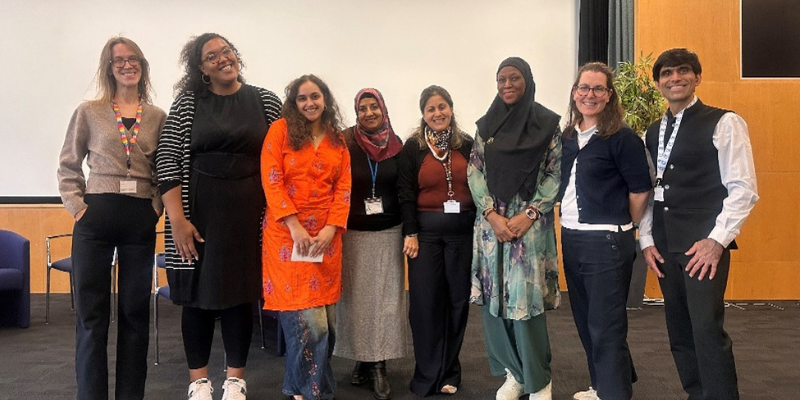
From L-R: Dr Jo Buring (GP, Bristol, NIHR Doctoral Fellow, University of Bristol); Ruby Osunsola (Nilaari); Dr Naabil Khan (Foundation doctor, Kent); Dr Tabinda Rashid-Fadel (Accure Health); Dr Reem Kayyali (UWE Bristol); Dr Faatihah Niyi-Odumosu (UWE Bristol); Francesa Arrigoni (Kingston University, London); Dr Praveen Kumar (Founder and Chair of Ethnic Inequality Research Network)

This is a guest blog by Dr Praveen Kumar, Associate Professor in Stroke Rehabilitation at UWE Bristol.

Health inequalities are rarely the result of a single issue. Gender, ethnicity, culture, mental health, trust in services and wider structural inequalities can all shape people’s experiences of healthcare. These interconnected challenges were at the heart of the Ethnic Health Inequalities Conference 2026, held on 8 October 2026 at EP1 Frenchay Campus, UWE Bristol, bringing academic, healthcare, community and lived-experience perspectives created opportunities to discuss inequalities and consider practical and holistic ways of addressing them and creating more equitable healthcare and research.

With World Menopause Day on 18 October, menopause and women’s health provided a particularly timely focus for the conference. The conference focus was also based on the release of the Renewed Women’s Health strategy for England.

Menopause: addressing inequalities in awareness, access and treatment

Dr Jo Buring (GP) practicing in Bristol explored inequalities in menopause awareness, access to care and treatment. Drawing on Patient and Public Involvement Engagement work with Somali, Afro-Caribbean and White communities in Bristol, alongside qualitative research exploring mental health issues during perimenopause phase, her session highlighted how women’s experiences of menopause can be shaped by wider social, cultural and health inequalities. The discussion emphasised the importance of ensuring that menopause research is genuinely inclusive and representative. Understanding the experiences of women from different communities is essential if we are to identify barriers to care and develop services that respond to the needs of women across the UK.

This focus was complemented by an insightful workshop led by Nathalie Sherring, CEO of Bristol Women’s Voice, exploring medical misogyny experienced by post-menopausal women. By placing lived experience at the centre of the discussion, the workshop moved beyond identifying problems towards practical action, with participants contributing to the development of a checklist designed to help women advocate for themselves within healthcare settings.

Dr Naabil Khan (Foundation doctor in Kent) further broadened the conversation around inequalities in women’s health, including maternity care and menopause, and challenged the limitations of approaches sometimes described as “Bikini Medicine” (refers to the outdated conceptualisation of women’s health as primarily focused on breast and reproductive health rather than whole-person health). The workshop highlighted diverse lived experiences and the importance of culturally responsive care, community engagement and practical action to address inequalities and inform research, service redesign and policy.

Connecting menopause and mental health

An important message from the conference was the need to recognise the connections between physical health, mental health and wider inequalities.

The relationship between perimenopause and mental health featured within the menopause discussions, while Dr Miriam Khan (GP) and Ruby Osunsola from Nilaari explored inequalities in Severe Mental Illness care and access to physical health checks among Global Majority communities in Bristol. Their PPIE work highlighted barriers relating to understanding, communication, trust and access to services. It also reinforced the importance of healthcare services working alongside community organisations and people with lived experience, rather than developing solutions in isolation. Their interactive workshop took this principle further by asking what meaningful community involvement in health research should look like. Drawing on Nilaari’s experience, the session explored trust, intersectionality and community expertise, encouraging a move beyond consultation towards shared ownership, influence and genuinely community-led research.

Anti-racism and institutional commitment

These conversations took place within a wider discussion about racial inequality and organisational responsibility.

As keynote speaker, Professor Sir Steve West, UWE Bristol Vice-Chancellor, shared UWE Bristol’s Anti-Racism Strategy. His contribution provided a meaningful context for the conference, highlighting the importance of creating a more inclusive and equitable university community and reinforcing the need for sustained institutional commitment to addressing racial inequalities, representing diverse voices and embedding anti-racist principles within organisational culture and practice.

This was particularly significant during Black History Month (October), providing an opportunity not only to reflect on inequality but also to consider the role institutions, researchers, healthcare professionals and communities can collectively play in creating meaningful and sustainable change for Global majority Groups.

Moving from consultation to partnership

A consistent message emerged across the conference:

Communities should not simply be consulted about health inequalities. They need to be partners in understanding and addressing them.

Bringing academic, healthcare, community and lived-experience perspectives together created opportunities not only to discuss inequalities but also to consider practical ways of addressing them.

Whether discussing menopause, mental health, women’s health or racial inequality, one message was clear:

Reducing health inequalities requires trust, accessibility, representation and genuine partnerships with communities.

By listening to diverse voices, recognising lived experience as expertise and moving from consultation towards shared ownership, universities, healthcare services and community organisations can work together to create research, services and policies that are more inclusive, equitable and responsive to the communities they serve.

Our sincere thanks to Dr Alice Berry, Dr Faatihah Niyi-Odumosu and Dr Vincent Singh for abstract reviewing; Dr Tabinda Rashid-Fadel and Dr Faatihah Niyi-Odumosu for chairing sessions; and Emma Thomas, Abi Price, Abi Goddard, Emma Dent and Charlie Buckfield for event management. We also thank Professor Marc Griffiths, Pro-Vice-Chancellor, and Professor Fiona Cramp, Director of CHCR, for generously supporting the venue and refreshments. A special thanks to Poppy Shields for her excellent behind-the-scenes administrative support throughout. Your collective contributions were greatly appreciated and helped make the conference a success.

Organising committee

Dr Tabinda Rashid-Fadel (Accure Health); Zehra Haq (CEO, Dhek Bhal), who worked for almost 40 years to support the South Asian community in Bristol), Dr Vincent Singh (Senior Lecturer, UWE) and Dr Praveen Kumar (Associate Professor in Stroke Rehabilitation, founder and Chair of the Ethnic Inequality Research Network, UWE Bristol).

Bringing space science to life in Minecraft during a solar eclipse

Author bethjohnson | Posted on 8 October 202612 October 2026
Bringing space science to life in Minecraft during a solar eclipse

This is a guest blog written by Dr Laura Hobbs, Senior Research Fellow in Science Communication and lead for Science Hunters.

In August, UWE Bristol’s Science Hunters team travelled to Rutherford Appleton Laboratory’s Summer Stargazing event, where families gathered to witness a near-total solar eclipse. Alongside the excitement of the astronomical event, children had the chance to discover the science and engineering behind the UK’s national space laboratory.

Based in the Science Communication Unit (SCU), the Science Hunters team develop practice and research in engaging children and young people with STEM (Science, Technology, Engineering and Maths) subjects through interactive topic exploration and constructive play in Minecraft. Supported by a Spark Award from the Science and Technology Facilities Council (STFC), the Science Hunters: Space Missions in Minecraft project brings together specialists from UWE Bristol and RAL Space to create, deliver and evaluate activities introducing real-world space science, testing facilities and Earth observation.

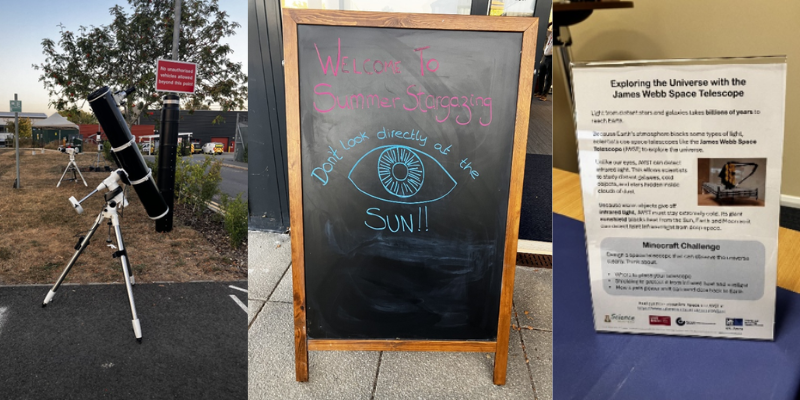
The Summer Stargazing event at Harwell Science and Innovation Campus offered visitors a packed programme of talks, tours, demonstrations and practical activities meeting the needs of the broad age ranges attending. Alongside opportunities such as creating and coding light sensors, recreating the solar system using fluffy planets and trying ice cream made using liquid nitrogen, visitors could join the Space Missions in Minecraft team to explore the most complex telescope ever flown: the James Webb Space Telescope (JWST).

The session introduced children to the telescope and how it helps explore the history of the universe. Using RAL’s JWST Lego model and an infrared camera display, participants learned why the telescope needs to remain extremely cold to detect infrared light from space to allow study of distant galaxies, the first stars, forming planets and more.

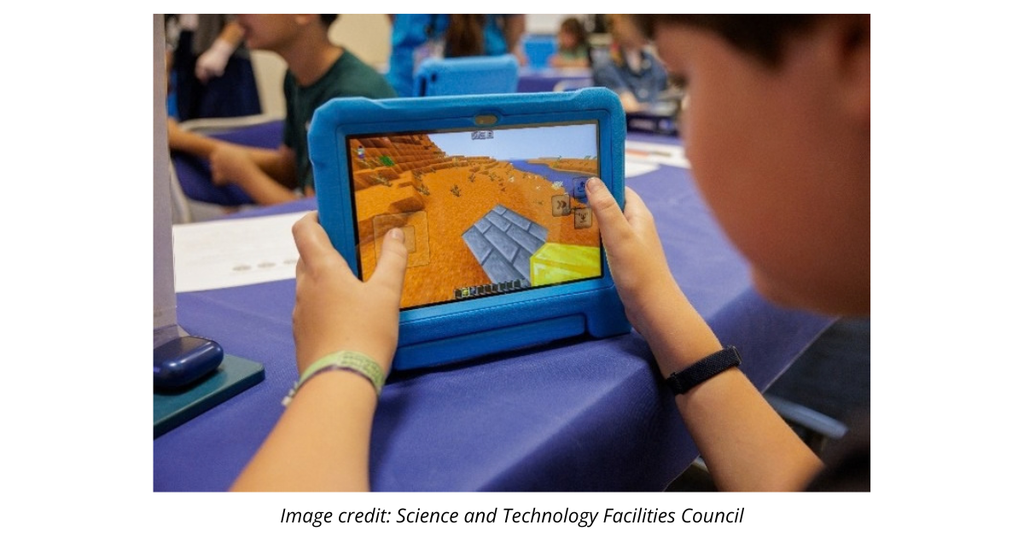
They then put this knowledge into practice by designing their own space telescopes in Minecraft. Like real engineers, they had to think about where their telescope would be located, how it would be shielded from heat, and how it would be powered to communicate with Earth.

As the eclipse began, activities paused and visitors headed outside. Equipped with eclipse glasses and gathered around solar telescopes, families and event staff fell silent as the Moon moved between the Earth and the Sun. Afterwards, visitors returned to the activities full of questions and enthusiasm. The Space Missions in Minecraft team spoke with families about the JWST, space science and how Minecraft can be used to explore complex scientific ideas and admired some excellent telescope designs created by participants.

The Summer Stargazing event was highly rated for inspiration and relevance to their lives by participants, demonstrating the power of combining cutting-edge research with creative public engagement. Through the partnership between UWE Bristol and RAL Space, young people were able to connect with real-world science, develop their problem-solving skills and perhaps even imagine themselves as the scientists and engineers of the future.

“We had the most amazing experience. We thoroughly enjoyed the whole evening from the lecture to all the stands in the visitor centre and were very impressed how well everything was pitched to engage all levels of scientific background.”

Event participant feedback, courtesy of STFC.

The Science Hunters team are continuing their collaboration with RAL Space at recent and future events at the campus, including Space Explorers Day and Jamboree on the Internet, and the ESA-ECSAT Open Day with support from the European Space Agency.

Bringing people together through robotics and performance

Author bethjohnson | Posted on 6 October 2026
Bringing people together through robotics and performance

Guest blog by James Knight, Technical Specialist: Robotic Fabrication at The Bridge Studios, UWE Bristol.

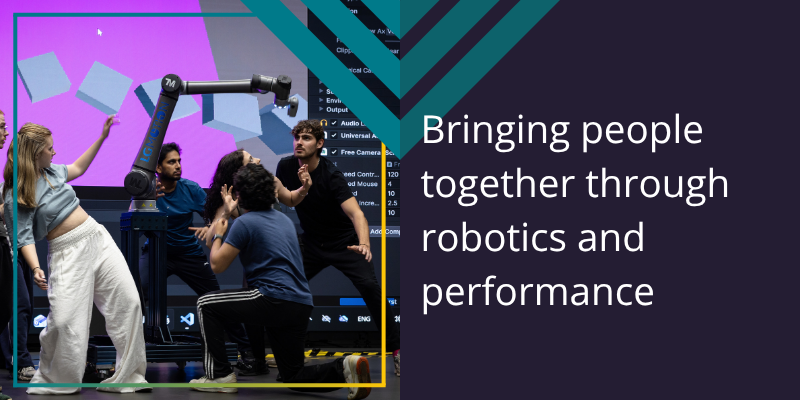
What happens when acting students, engineers, designers and researchers share a stage with a robot?

At The Bridge Studios, our collaboration with the Robots, Art, People and Performance (RAPP) Lab gave us the opportunity to explore exactly that, and to consider how technology can bring people together through creativity, curiosity and play.

We welcomed the RAPP team from the University of Canberra for a three-day workshop exploring physical theatre and human–robot interaction. Working alongside students and practitioners, we used a collaborative robot, or ‘cobot’, powered by embodied artificial intelligence to explore movement, improvisation and storytelling.

The technology gave everyone something to investigate together. Each participant brought a different perspective, and the workshop created opportunities for those perspectives to meet. How do you respond to a robot’s movement? What might that movement communicate? How do you create a performance when one member of the ensemble behaves in unfamiliar ways?

We began with physical theatre exercises, building a shared language of movement before introducing the robot. This gave participants a common starting point, whatever their background. From there, groups experimented with the cobot and developed short performances that brought their different skills into a shared creative process.

Game design and software engineering students also worked with activity from within the robot’s AI system, translating it into live visuals on the studio’s LED wall. Alongside the performers and robot, these visuals added another dimension to the work, opening up questions about how we understand and interpret the technology we interact with.

For me, the value of this collaboration lies in the connections it made possible. Students had the opportunity to work alongside researchers and practitioners, contribute to an experimental project and encounter approaches beyond their own disciplines. Their knowledge and ideas became part of something they could develop and present together.

That experience matters. Working across disciplines asks us to explain our thinking, listen carefully and make room for different ways of approaching a problem. A shared creative task provides a practical setting for that exchange. Here, robotics became a meeting point for people whose paths might otherwise rarely cross.

We are still examining the participant feedback, so there is more to learn about the workshop’s impact. What we can already point to is the work the groups produced together, and the opportunities the collaboration created for hands-on engagement with emerging technology.

This is the kind of activity we want to support at The Bridge. Our facilities bring robotics, immersive technologies and making into one space, supported by people who can help turn an initial question into an experiment. The RAPP collaboration shows how that combination can support both research and learning.

It also offers a positive way to think about technology’s role in our lives. We can use it to invite participation, support creative expression and explore questions together. In this workshop, a robot helped create a space for human collaboration.

We are keen to build on that experience and welcome conversations with researchers and partners who are curious about what we could explore together.


Take a look at a video showcasing the day.

Knowledge Transfer Partnership case study – HVN Labs

Author bethjohnson | Posted on 1 October 2026
Knowledge Transfer Partnership case study – HVN Labs

About HVN Labs:

HVN Labs is a Bristol-based technology company specialising in drone swarm and light-show UAV design, manufacture and choreography. The business develops both the hardware and software technology stack with respect to drone swarm technology. HVN’s markets span commercial drone light shows, bespoke swarm choreography for events, and drone hardware/software design services, serving clients across the UK.

About the Knowledge Base:

The academic team based within the School of Engineering at The University of the West of England (UWE Bristol) brings cross-disciplinary research, combining both academic and industry perspectives. The KTP was supported by UWE Bristol academics Dr Jun Yao and Dr Amina Hamoud. Dr Jun Yao is an Associate Professor in Aerospace Engineering at UWE Bristol whose teaching subjects relate to fundamental aerodynamics, aero propulsion, fluid dynamics and thermodynamics with expertise in Computational Fluid Dynamics (CFD). Dr Amina Hamoud is a Senior Lecturer in Systems Engineering, her research and industry work are within areas of digital twin, systems and control, robotics and autonomous vehicles.

About the KTP Associate:

The KTP Associate, Ritvik Swaminathan holds a 1st class MEng degree from the University of Southampton, bringing his expertise in aircraft design and simulation into this project. He has a deep passion for developing efficient computational solutions in the aircraft design processes ultimately reducing the R&D costs.

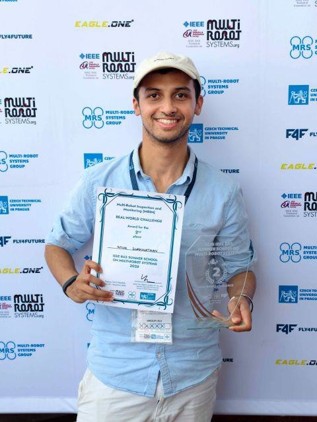
KTP Associate – Ritvik Swaminathan holding his award after achieving 2nd place in the real-world challenge (and 4th in the virtual challenge) at the IEEE RAS Summer School on Multi-Robot Systems, hosted by MRS Group at FEE-CTU Prague.

About Innovate UK:

Innovate UK is part of UK Research and Innovation, the UK’s innovation agency. Their mission is to help companies to grow through their development and commercialisation of new products, processes and services, supported by an outstanding innovation ecosystem that is agile, inclusive and easy to navigate.

The Challenge the KTP Addressed:

The original aim of the Knowledge Transfer Partnership (KTP) was to develop a digital twin system capable of simulating drone flights prior to real-world operations. This capability was intended to support research and development activities, pilot training, and the development of swarm flight behaviours. A further objective was to create a simulation environment that could validate the flight performance of different drone configurations before physical testing, enabling faster design iteration and reducing development risk whist lowering drone development costs.

UWE Bristol provided academic expertise and strategic guidance to support the KTP Associate during the development of the software platform. Additionally, the company worked closely with the university throughout the KTP, to guide the development of the project, which helped ensure the resulting system addressed practical and operational needs to fulfil HVN’s expectations.

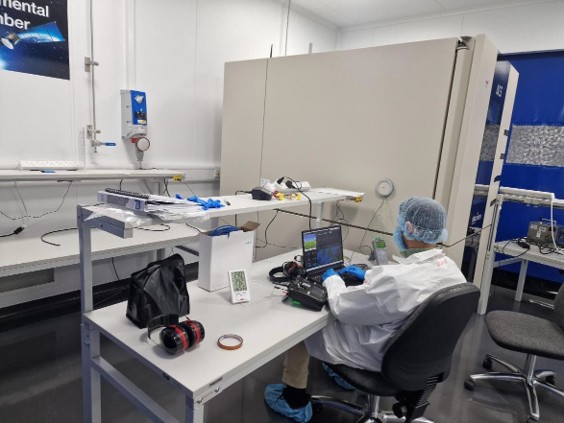
Photo: KTP Associate – Ritvik Swaminathan during lab experiments to collect crucial data to characterise the performance of HVN’s show fleet under extreme temperature and humidity conditions.

The Solution:

The KTP delivered significant value to HVN across commercial, operational and academic dimensions. By establishing a robust digital twin and simulation capability, the project transformed how the company designs, tests and validates its drone systems. The resulting tools and processes have reduced development costs and testing requirements, strengthened safety assurance, and generated new research outputs that contribute to the wider field of Unmanned Aerial Vehicle (UAV) simulation and validation.

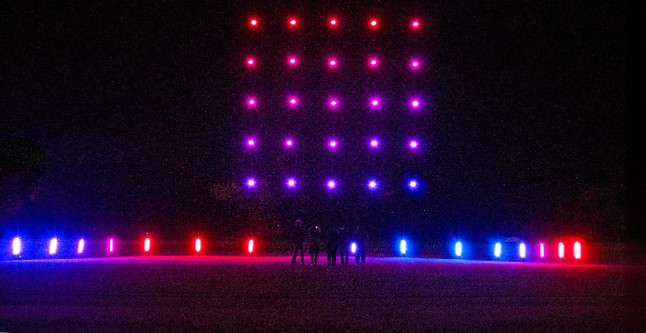
Photo: Internal drone light show #1 demonstration showcased at HVN.

Financial benefits:

Replacing large blocks of physical flight testing with a validated simulation stack cut performance-testing time by 93%, freeing flight-tests resources for revenue-generating shows and new client projects, which led to reducing the cost of qualifying each new drone variant. The new in-house design-configuration tool allows HVN to test and compare novel drone designs within a visual environment using software before committing to physical prototypes, reducing research and development costs on new design exploration.

Non-financial benefits:

The KTP fundamentally changed how HVN designs, tests and validates its technology. What was previously a predominantly ad hoc, test-first design culture has evolved into a company-wide structured simulation-first workflow embedded in the company, enabling engineers to assess performance, safety and system behaviour before flight. The business now holds an in-house flight simulation capability that did not exist before. This gives HVN a genuine internal design and safety-validation capability it previously had to work around rather than own.

Academic input:

The project generated a peer-reviewed research publication and new knowledge in drone simulation and digital twin technology. This provides UWE Bristol with a valuable industry-informed

research output and demonstrates the impact that collaboration between universities and businesses can achieve.

Key milestones:

Full digital twin build and Software-in-the-Loop (SITL) simulation capability; four-tier fidelity validation study; 93% reduction in physical testing time.

Photo: Internal demonstration drone light show #2 developed showcased at HVN.

Key Facts and Impact:

  • 93% reduction in performance-testing time, cutting testing from around 30 days to just 2 days through the introduction of a simulation-first design and validation approach.
  • Reduction in R&D costs associated with exploring and evaluating new drone designs by enabling virtual testing before physical prototypes are built.
  • Developed and embedded HVN’s first in-house drone simulation and digital twin capability, transforming the business from a physical test-first approach to a simulation-first workflow.
  • Developed and validated swarm simulation capability, supporting expansion into larger-scale drone swarm operations.
  • Developed and validated swarm simulation capability, supporting expansion into larger-scale drone swarm operations.
  • Significantly reduced operational risk by validating drone performance.
  • Reduced reliance on external suppliers by creating an in-house propulsion modelling capability for selecting and optimising motors, propellers and batteries.
  • Enabled HVN to develop new drone designs more quickly and efficiently, improving stability, performance, safety and energy efficiency.
  • Workforce approximately tripled during the KTP period, with dedicated hardware, software and flight-testing teams established as the business scaled.
  • Delivered a peer-reviewed research output and a transferable digital twin software package, creating long-term value for both HVN and UWE Bristol.

The Results of the KTP:

The KTP delivered lasting benefits for both HVN Labs and UWE Bristol. The partnership enabled HVN to transform how it designs, tests and validates drone technology, supporting business growth and new commercial opportunities. For UWE Bristol, the project generated valuable research outputs, strengthened expertise in digital twin and autonomous systems technologies, and created new opportunities for knowledge exchange and future collaboration.

Photo: Internal demonstration drone light show #3 developed and showcased at HVN

What the partners have to say…

“We could always fly UAVs. What we didn’t have was a way of modelling them properly, and that’s what the KTP changed. The academic team at UWE were involved throughout, not just at review meetings. They brought the modelling expertise and stayed close enough to the work to understand how we actually operate. We now run flight dynamics through the digital twin before anything leaves the ground, which means far fewer test flights to answer the same questions.

Ritvik is the reason it came together. He sat between the academic side and the operational side and got genuinely good at both, with support from his supervisors at UWE behind him. He’s an engineer we rely on now, and we’re lucky to have him.”

Dr. Laura Alvarez-Hidalgo: Controls Engineer | Lead Drone Engineer

What the Knowledge Base partner has to say…

“The academic team at UWE has enjoyed working with both the KTP associate and HVN supervision team. The KTP project has been an invaluable experience, enabling academic expertise to be translated into real-world innovation while effectively addressing the business partner’s technological challenges. Regular collaboration ensured that the project remained on track, while the KTP Associate gained substantial hands-on experience, developing advanced technical skills, confidence, and emerging leadership. The partnership delivered a market ready solution and further strengthened industry–university links, generating long–term benefits for both parties.”

Dr Jun Yao, Associate Professor in Aerospace Engineering at UWE Bristol

KTP Associate…

“The KTP project has been a great opportunity for me as the Associate to take complete ownership and manage quite a large project from day one. On top of gaining the experience of managing a project with many key stakeholders, I’ve also developed many core technical skills which is a great stepping stone to now pursue the next phase of my career”

Ritvik Swaminathan, Simulation Design Engineer (KTP Associate)

Photo: Ritvik Swaminathan (KTP Associate) and Dr Amina Hamoud (Academic supervisor) inspecting the first version of the digital-twin-system and debugging issues.

Fully funded AI-Ready Robotics Workforce Programme launches for manufacturing and production companies

Author bethjohnson | Posted on 7 September 202629 October 2026
Fully funded AI-Ready Robotics Workforce Programme launches for manufacturing and production companies

Manufacturers are under increasing pressure to improve productivity, address skills shortages and remain competitive. While robotics, automation and AI offer significant opportunities, many organisations lack the capability to adopt these technologies effectively.

To help address this, UWE Bristol is launching the AI-Ready Robotics Workforce Programme, delivered through the world-renowned Bristol Robotics Laboratory (BRL) in partnership with the United Strategic Planning Centre (USPC). Designed specifically for organisations operating within manufacturing and production, this fully funded programme will help participants build practical robotics skills and understand how AI can enhance industrial applications.

What participants will learn

Participants will gain practical, hands-on experience in:

  • Operating and programming industrial and collaborative robots
  • Working with sensors, communication interfaces and machine vision systems
  • Integrating robotics within manufacturing environments
  • Using AI tools to support programming, diagnostics and process monitoring
  • Applying robotics and automation skills to workplace challenges
  • Understanding responsible AI use and human oversight in industrial settings

Register your place

Intensive Cohort Programme Structure

The programme will run over 6 weeks, with participants attending one full day per week at Bristol Robotics Laboratory.

This intensive 6 week programme provides a practical introduction to AI and robotics for modern manufacturing, combining technical learning with hands-on experience using industrial robotics technologies.

Throughout the programme, you’ll develop skills in industrial and collaborative robotics, beginning with robotics fundamentals, safe operation and programming before progressing into areas such as robot communication, sensors, machine vision and multi-robot systems.

You’ll gain practical experience working with UR5e and KUKA iiwa collaborative robots, exploring robot programming and control, movement sequences and pick-and-place applications. You’ll also investigate how robots communicate with external systems, access and interpret live robot data, and explore technologies including ROS2, RTDE and OPC-UA.

The programme will introduce sensors and machine vision, including force-torque sensors, cameras and environmental sensors, and explore how these technologies can be used for inspection, monitoring and other manufacturing applications. You’ll also consider how different robotics platforms can work together and how robots, sensors, machine vision and communications technologies can be integrated within a manufacturing cell.

Alongside robotics, you’ll explore the growing role of AI in robotics engineering and manufacturing. This includes an introduction to agentic AI and the Model Context Protocol (MCP) and how AI tools can support technical documentation, robot programming, diagnostics and process monitoring.

Through practical activities, you’ll explore using natural-language instructions to generate robot code, reviewing and validating AI-generated outputs against technical and safety requirements, and connecting AI tools with robot and sensor data. You’ll also investigate how AI can support the identification of production issues, diagnostics, maintenance and operational decision-making.

Throughout the intensive programme, you’ll have opportunities to bring these technologies together through practical manufacturing scenarios, combining robotics, AI, sensors, machine vision, communications and system integration. You’ll consider how AI-enhanced robotic systems can be programmed, monitored and diagnosed, while exploring responsible deployment and identifying opportunities for applying these technologies within your own organisation.


Cohort dates

Intensive – Day 1Monday 11 January, 09:30-16:30
Intensive – Day 2Monday 18 January, 09:30-16:30
Intensive – Day 3Monday 25 January, 09:30-16:30
Intensive – Day 4Monday 1 February, 09:30-16:30
Intensive – Day 5Monday 8 February, 09:30-16:30
Intensive – Day 6Monday 15 February, 09:30-16:30

Benefits for employers

By investing in workforce development, employers can:

  • Build confidence in robotics and automation projects
  • Develop in-house capability rather than relying solely on external expertise
  • Improve productivity and operational resilience
  • Strengthen understanding of both robotics hardware and software workflows
  • Support future investment decisions around automation and advanced manufacturing technologies

Who can apply?

The programme is open to organisations that have been operating for at least one year and work within manufacturing, engineering, production, automation or related industrial sectors. Participating organisations must be able to attend training at Bristol Robotics Laboratory on UWE Bristol’s Frenchay Campus.

Register your place

If you have any questions about this course, please email workforceskills@uwe.ac.uk or phone +44 117 328 86303.


This workforce programme is funded by Innovate UK.

What UKRI’s new strategy means for UWE Bristol

Author bethjohnson | Posted on 17 August 202617 August 2026
What UKRI’s new strategy means for UWE Bristol

By Boudewijn Devanicus, Research Development Manager (Health and Science) at UWE Bristol.

Earlier this year we looked at how UK Research and Innovation’s (UKRI) Spending Review settlement reorganised research funding into four strategic investment areas across 2026–30: 

  • £14.5bn for curiosity-driven foundational research  
  • £8.3bn for targeted R&D addressing government and societal priorities  
  • £7.4bn to support innovative companies to start, scale and stay in the UK  
  • £8.4bn for skills, talent, infrastructure and national facilities underpinning all three areas  

That blog focused on the broad “buckets” of UKRI funding. UKRI has now published its new five-year strategy (2026–2031) alongside its Delivery Plan for 2026–27. Since the budget itself was already known, there are few new spending commitments, but there’s now much more clarity on what UKRI’s priorities are, how it intends to invest, and who it expects to work with. 

To summarise the changes in a sentence: UKRI intends to be more selective, less duplicative, and more challenge-led in what it prioritises, and be faster, more flexible, and more responsive in how it funds. 

What funding areas does the strategy prioritise?

Curiosity-driven research 

UKRI has explicitly protected a large “investigator-led” budget (£3.3bn) to support discovery research, underpinned by dual support and quality-related (QR) funding. UKRI says it is “committed to supporting and sustaining [this] investment, growing as the economy allows”. In practice this means open responsive calls will continue, though their format may evolve; the Delivery Plan mentions new open applicant-led schemes for BBSRC, and five new ESRC schemes (React, Connect, Grow, Explore, Challenge). 

QR funding is still championed, but its allocation method is under review. Research England’s Strategic Institutional Research Funding (SIRF) review, running to 2030, is examining whether the formula-based funding given to English universities should better reward specialisation and collaboration. This echoes last autumn’s Post-16 Education and Skills White Paper, which wants to see “fewer broad generalist providers and more specialists” over time, with institutions collaborating rather than duplicating effort. 

Strategic government and societal priorities  

A revised emphasis is on targeted R&D to address government-defined challenges. This will mainly be delivered through integrated “Priority Programmes” which broadly align to the eight Industrial Strategy-identified sectors (IS-8), as well as leaving some space “wider priorities” categories that do not fit neatly within the IS8. The overarching message is that “UKRI will be selective about interventions to maximise the return for the UK”, emphasising the general approach of doing fewer things, better. These programmes don’t replace the old Research Councils, but are intended to break down the siloing that occurs across them, with Priority Programmes overseen by UKRI’s own programme board(s). Other UKRI organisational reforms also support this: rather than each Council guarding its own budget, resources will be dynamically managed across UKRI as a single portfolio, allowing funding to be reprofiled mid-year to capture emerging opportunities.  

Industry and commercialisation

UKRI has substantially boosted support for business-led innovation (£7.4bn). Innovate UK is being refocused, via new service offers and IP support, to help spin-outs, scale-ups and R&D-intensive companies grow, including through its account-managed Velocity service for fast-tracking commercialisation. Mechanisms for research translation are also being simplified (see below). 

How will funding change?

Faster and more responsive funding 

UKRI wants faster, more agile decision-making: grant processing times will be cut through new assessment mechanisms and simplified applications. The target is to bring application-to-decision times down to 90 days for applicant-led calls and 60 days for targeted calls by 2031. 

Some of this ‘speeding-up’ is expected to come from more experimental review methods which have been piloted with by the Metascience Unit (established under the former DSIT in 2024, now sitting within the merged business department). Distributed Peer Review, already trialled in 2025, asks applicants to assess each other’s proposals rather than relying solely on external reviewers. UKRI is now building this into a wider AI-assisted evidence platform intended to speed decisions further, alongside faster desk rejection of applications that clearly don’t meet the criteria. 

As well as changes on the UKRI-side, there continues to be a trend towards more University-side ‘demand management’ (limiting how many applications an institution can submit to a given call). REE will continue to work on facilitating this demand management as quickly, efficiently, and fairly as possible. 

Simplification and deduplication 

Where possible, UKRI are trying to reduce duplication of schemes and harmonise them to use the same terminology. For example, in relation to innovation funding schemes there now will be a “new framework [which] reduces the number of schemes [they] run, helping simplify our offer and making sure [they] use consistent terminology across UKRI” (Prosperity Partnerships to enable collaborative R&I; Impact Acceleration to test applicability of new ideas to commercial application; Proof of Concept funding to test these ideas at scale, and Entrepreneurship training support).

Who will UKRI work with and expect universities to partner with?

UKRI is growing increasingly ambitious in encouraging private co-investment: UKRI is targeting 3:1 leverage on its Priority Programmes (compared to historic levels of 2:1 in wider R&I investment), so bids developed alongside industry, charity or other private funding may be viewed more favourably. Innovate UK, the Catapult network and new sector-specific Tech Boards are the main named delivery partners on this side of the strategy. 

Collaboration with local government (be that city regions/councils, combined authorities, or NHS bodies) is another expectation. Through the £500m Local Innovation Partnerships Fund (which funded its first tranche of programmes in April 2026), UKRI wants city regions, combined authorities and universities to co-design programmes around genuine local strengths. In parallel with this and other investments (e.g. OxCam Arc), UKRI will also publish a refreshed “place funding policy” this year. This regional approach was further cemented in the devolution of “later-stage innovation funding” in the recent Rewiring the State – Cabinet Statement. 

Internationally, UKRI is prioritising partnerships with the greatest mutual scientific and strategic benefit, particularly multilateral programmes like Horizon Europe and organisations such as CERN. Of note, Department for Science, Innovation and Technology (DSIT)’s annual report and accounts for 2025-26 were published recently, showing that 2025-26 Horizon Europe associated cost was £2.043bn against an allocated figure of £2.736bn. 

Broader context

UKRI’s reforms sit inside a wider policy landscape rather than standing alone. The Industrial Strategy’s eight priority sectors (IS-8) provide the framework most Priority Programmes will map onto; the Defence Industrial Strategy (Sept 2025) commits to significant defence spending growth with an emphasis on dual-use technology (aligning with UKRI’s push on AI, quantum and engineering biology); and the AI for Science Strategy (Oct 2025) earmarks around £137m for AI-driven science, likely feeding into UKRI’s own AI-focused calls. The Post-16 White Paper, discussed above, shapes how QR funding and specialisation evolve alongside the SIRF review. 

This backdrop now sits under a new government. Andy Burnham became Prime Minister in July 2026, and one of his first acts was to abolish DSIT, folding its science and innovation responsibilities into a new Department for Business, Innovation, Science and Trade (DBIST) under Jonathan Reynolds, with some digital and creative-industries functions moving to the Department for Digital, Culture, Media and Sport under Lisa Nandy, and universities policy moving to Lucy Powell at Education.  

Early signals suggest Burnham intends to preserve the existing R&D settlement and Industrial Strategy rather than reopen them, but his “Manchesterism” emphasis on devolved, bottom-up growth, echoed already in UKRI’s own Local Innovation Partnerships Fund, makes it likely that regional research funding and devolution deals gain even more prominence over this parliament.

What this means for you and for UWE

Think about sector and regional strengths 

  • Show how your work contributes to Industrial Strategy sectors (e.g. IS-8 sectors such as AI, health, clean energy), major agendas (NHS Long Term Plan, AI for Science) or regional strengths (West of England creative tech, green clusters etc.).  

Embrace interdisciplinary calls and programmes.  

  • Collaborate across UWE, external academics partners, or with industry partners to fit with the new Priority Programmes, supported by UWE’s new internal funding routes if pump-priming is needed. 
  • Contact REE’s BID team to get help with positioning bids for outcome-driven calls, as well as keeping on top of new funding opportunities through the Research Funding Bulletin. 

Consider commercialisation and partnerships early.  

  • Engage REE’s Innovation and Impact team as soon as you realise your research could spin out technology or inform policy.  
  • Develop and nurture industry, third-sector and local government contacts to bolster bids, with help from REE’s Business and Alumni Partnerships team.  

Monitor and learn new processes 
  • Get ahead by reading UKRI’s guidance from their pilot on Distributed Peer Review and other new schemes so that timely submissions and quick revisions (if invited) don’t catch your team out. 

Building futures together through Degree Apprenticeships

Author bethjohnson | Posted on 4 August 20264 August 2026
Building futures together through Degree Apprenticeships

This is a guest blog by Jane Exon, Apprenticeship Employer Development Manager at UWE Bristol.

July is always one of the most exciting and proud highlights of the year for all of us involved in apprenticeships at UWE Bristol. It is a moment to celebrate achievement, perseverance and business partnerships. We proudly applauded our 2026 Degree Apprentice graduates recognising not only the incredible learners who crossed the graduation stage, but also the businesses who invested in their potential and supported them throughout their journey.

A degree apprenticeship is never achieved alone.

Behind every apprentice graduating is a business that has committed time, investment, mentoring and encouragement – managers who have created opportunities, colleagues who have shared their own experiences, and businesses that decided to build the skills of their future workforce through apprenticeships. 

Our graduates are a powerful reminder of what can be achieved when providers, employers and apprentices work together with a shared goal – the truest meaning of a triparty!  

Amongst the many inspiring stories from this year’s graduation ceremonies was that of John Adesoye from Bristol NHS Foundation Trust. 

At the age of 64, John graduated with a BSc (Hons) Nurse Degree Apprenticeship, demonstrating that age should never be considered a barrier to learning, development or career progression. Having previously worked as an electronics technician, John changed careers, pursued opportunities through apprenticeships and has now qualified as a registered nurse. His story sends a powerful message to employers and potential apprentices alike: it is never too late to invest in your future. His journey highlights the transformative impact that apprenticeship opportunities can have on individuals, while showcasing Bristol NHS Foundation Trust’s commitment to workforce development and lifelong learning. 

Read John Adesoye’s story.

Supporting the engineers and architects of the future

Across the School of Engineering and School of Architecture, our apprentice graduates are already making a positive impact across the region and beyond, helping to design infrastructure, deliver engineering solutions, shape sustainable buildings and contribute to the UK’s future skills base, proving that apprentices develop the technical capability to be future innovators and leaders in industry.   

Standout examples include Prithvi Ramesh at Rolls-Royce, who was recognised as Engineering & Manufacturing Apprentice of the Year at the Multicultural Apprenticeship Awards. The awards highlighted Prithvi’s technical excellence advocating for apprenticeships and inspiring future engineers, demonstrating that true engineering success lies not only in innovation but in inspiring future generations. 

Hannah Hart from Atkins Realis successfully won the South West Princess Royal Award for Emerging Engineers 2026, impressing judges with her paper and presentation about the public response to flood alerts in Newport, South Wales. Hannah’s research found that many people were receiving and reading flood warnings but often didn’t understand them or know how to respond. “It highlighted that improving resilience is not only about predicting risk but communicating them effectively.’ 

Leonce Pereira with Safran Landing Systems who was a finalist in the Enginuity Skills Awards 2026. Leonce was shortlisted for combining technical excellence and design improvements with leadership and innovation, delivering impact through efficiency and improvement projects, while mentoring peers and promoting engineering careers through STEM outreach. 

Thank you to our employer partners

At UWE Bristol we are proud to work alongside employers who are committed to future talent development through apprenticeships. 

Smith Consult, whose support for apprentices continues to transform careers and strengthen the profession perfectly capturing what degree apprenticeships are all about in their reflections on this years’ graduations:

“For five years, they’ve juggled full-time roles, university study, independent learning and busy personal lives. Everything they have achieved is a testament to their hard work and dedication, and it has been an absolute privilege to watch them grow into the accomplished engineers they are today. The support from UWE is so appreciated. The teaching team there have been fabulous, thank you.” 

As we celebrate our apprentice graduates, we also celebrate the employers who have made these achievements possible. From businesses helping individuals redefine and retrain later in life, to supporting award-winning early career engineering talent, these partnerships continue to demonstrate the transformational power of degree apprenticeships. 

To all our July 2026 graduates: congratulations. 

You have balanced work, study and life commitments with resilience, determination and professionalism. Your achievements deserve to be celebrated. 

And to every employer that has supported a UWE Bristol apprentice along the way: thank you for investing in people, skills and the future workforce. 

Together, we are not simply awarding degrees. We are building futures. 


Explore Higher and Degree Apprenticeships at UWE Bristol.

Posts pagination

Page 1 Page 2 … Page 4 Next page

Search all UWE Bristol blogs

Tags

  • Apprenticeships
  • Bristol
  • Bristol Robotics Laboratory
  • BRL
  • Business
  • CPD
  • Innovation
  • Knowledge Transfer Partnership
  • Knowledge Transfer Partnerships
  • KTP
  • KTPs
  • Launch Space
  • Research
  • Skills
  • University Enterprise Zone
  • UWE
  • UWE Bristol
  • UWE Bristol Research
  • UWE KTP
  • UWE research

Recent Posts

  • Innovation With Impact: Keyowa, The UWE Bristol Start-Up Using Science and Technology to Bring Ideas to Life
  • ESRC Post Doctoral Fellowship Scheme 2027
  • Former Project Zulu Learner Selected for Pumas U21 Trials Squad
  • Bringing hidden histories into view: How historic photographs found new life at Bristol Dockyards
  • Changes to ESRC Funding: What Researchers Need to Know

Subscribe by Email

Subscribe to our blog

Email address
Go to Research and External Engagement

    Contact us

    University of the West of England
    Frenchay Campus
    Coldharbour Lane
    Bristol
    BS16 1QY
    United Kingdom

    Switchboard: +44 (0)117 9656261
    View full contact details

    Visit us

    • City Campus
    • Frenchay Campus
    • Glenside Campus
    • Car parking
    • Visit us

    Quick links

    • Library
    • Jobs
    • Login
    • Term dates
    • Colleges and schools

    Follow us

    Website feedback
    ©2025 UWE Bristol Site map Accessibility Privacy Cookies Modern Slavery statement (PDF)
    ©2025 UWE Bristol