

Guest blog by James Knight, Technical Specialist: Robotic Fabrication at The Bridge Studios, UWE Bristol.
What happens when acting students, engineers, designers and researchers share a stage with a robot?
At The Bridge Studios, our collaboration with the Robots, Art, People and Performance (RAPP) Lab gave us the opportunity to explore exactly that, and to consider how technology can bring people together through creativity, curiosity and play.
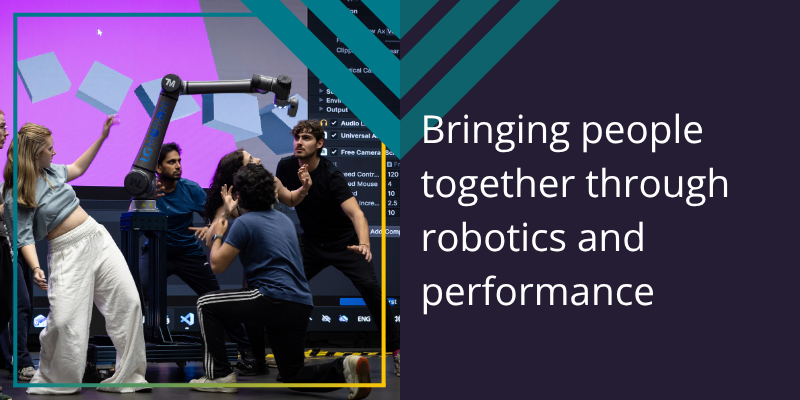
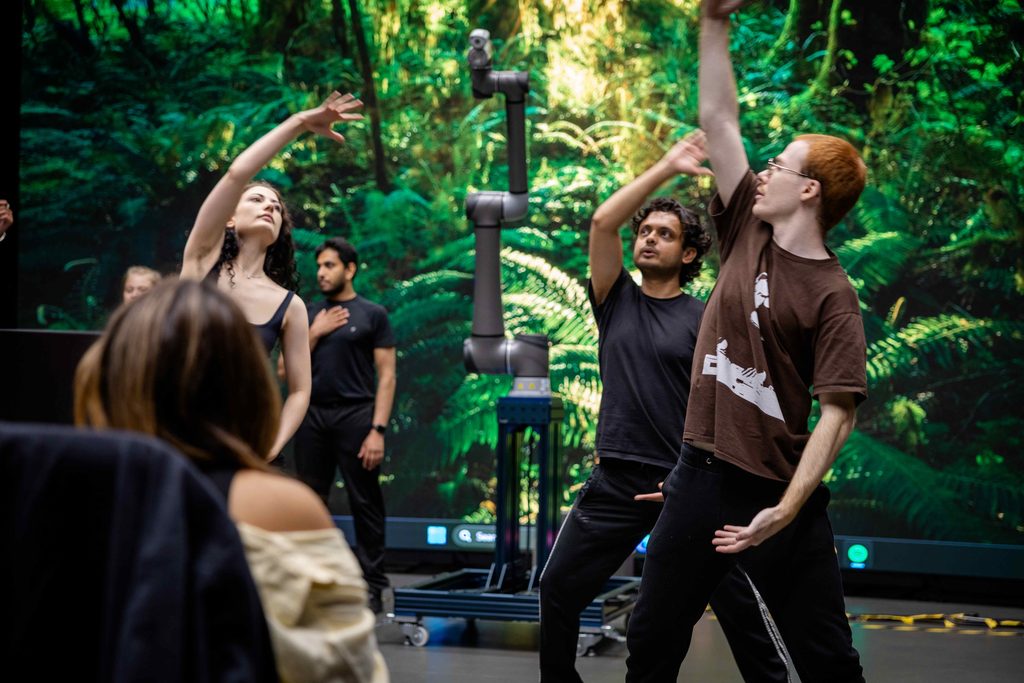
We welcomed the RAPP team from the University of Canberra for a three-day workshop exploring physical theatre and human–robot interaction. Working alongside students and practitioners, we used a collaborative robot, or ‘cobot’, powered by embodied artificial intelligence to explore movement, improvisation and storytelling.

The technology gave everyone something to investigate together. Each participant brought a different perspective, and the workshop created opportunities for those perspectives to meet. How do you respond to a robot’s movement? What might that movement communicate? How do you create a performance when one member of the ensemble behaves in unfamiliar ways?
We began with physical theatre exercises, building a shared language of movement before introducing the robot. This gave participants a common starting point, whatever their background. From there, groups experimented with the cobot and developed short performances that brought their different skills into a shared creative process.
Game design and software engineering students also worked with activity from within the robot’s AI system, translating it into live visuals on the studio’s LED wall. Alongside the performers and robot, these visuals added another dimension to the work, opening up questions about how we understand and interpret the technology we interact with.
For me, the value of this collaboration lies in the connections it made possible. Students had the opportunity to work alongside researchers and practitioners, contribute to an experimental project and encounter approaches beyond their own disciplines. Their knowledge and ideas became part of something they could develop and present together.
That experience matters. Working across disciplines asks us to explain our thinking, listen carefully and make room for different ways of approaching a problem. A shared creative task provides a practical setting for that exchange. Here, robotics became a meeting point for people whose paths might otherwise rarely cross.
We are still examining the participant feedback, so there is more to learn about the workshop’s impact. What we can already point to is the work the groups produced together, and the opportunities the collaboration created for hands-on engagement with emerging technology.
This is the kind of activity we want to support at The Bridge. Our facilities bring robotics, immersive technologies and making into one space, supported by people who can help turn an initial question into an experiment. The RAPP collaboration shows how that combination can support both research and learning.
It also offers a positive way to think about technology’s role in our lives. We can use it to invite participation, support creative expression and explore questions together. In this workshop, a robot helped create a space for human collaboration.
We are keen to build on that experience and welcome conversations with researchers and partners who are curious about what we could explore together.