

Guest blog by:
- Dr Katie McClymont, Professor of Urban Planning
- Dr Neil Philips, Senior Research Fellow
- Dr Owen Cranshaw, Research Fellow in Green Infrastructure
In this blog, we share some of our pilot research into the social and technical viability of installing ground source heat pumps in cemeteries, to generate energy for community buildings. For many, death remains a taboo topic, so this might be a startling proposition, so we will first explain our motivation and interest in the topic.
Unlike other spaces such as parks, which may be upgraded or redeveloped, burial grounds are unlikely to be disturbed over the long term, reducing the risk of damage to buried pipework and supporting the viability of the infrastructure investment. By absorbing solar heat, memorials may warm the surrounding ground, improving heat pump performance compared with grassland. However, cemeteries also currently play many roles in cities, offering spaces for recreation and nature, as well as burial and remembrance.
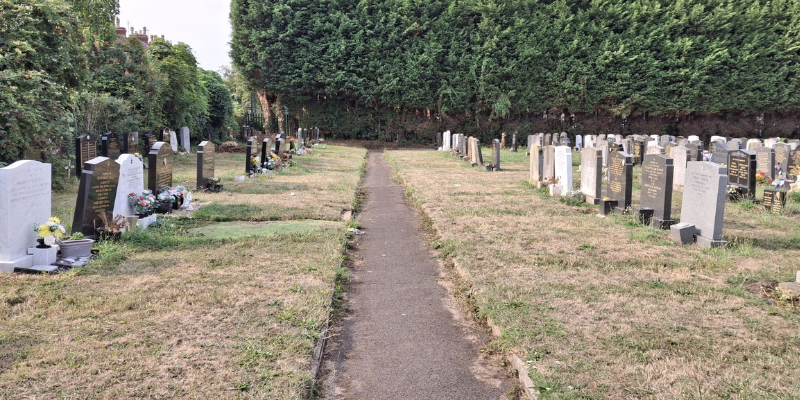
The research has three main parts. First, the capacity of a local cemetery, Shirehampton, Bristol was measured for hypothetical pipework installation. This involved looking at which paths would be suitable for pipework installation, and identifying any areas of greenspace not used for burial. Any proposals coming from this would not involve disturbing buried remains. Our ‘on the ground’ measurements at Shirehampton, using a measurement wheel, totalled 3,034-metres of straight path lines. Tracing the paths by eye in ArcGIS Pro gave an estimated area for the identified routes of 2,683-m², or around 13% of the cemetery’s total area (20,633-m²). Based on published performance a GSHP system installed along these paths could deliver in the region of 150,000–160,00 kWh of heat per year, roughly equivalent to the annual heating energy for 12 to 18 average UK homes, or a substantial contribution to a nearby community building such as a primary school.
Second, scaling this up nationally, we calculated the overall amount of cemetery land in England and Wales.
Our GIS analysis identified 2,255 cemeteries and burial groups across England and Wales, covering a combined area of 8,347 hectares (roughly equivalent to 12,000 football pitches). We then calculated how much of this land falls within practical distance of the kinds of community buildings that might benefit from locally-generated heat: places of worship, community halls and centres, schools, and libraries.
| Community building type | Percentage (%) of cemeteries within 250m | Total number of sites | Site Hectares (multiply by 10,000 for m2) |
| Place of worship | 70% | 1,578 | 6,800 |
| School (primary or secondary) | 42% | 947 | Primary: 3518 Secondary: 1161 |
| Community hall or centre | 28% | 631 | 2,717 |
| Library | 6% | 135 | 422 |
The results are striking, particularly for schools. Forty-two percent of England’s cemeteries lie within 250 metres, the maximum practical reach of a ground-loop pipe network. As you would expect, places of worship are even more consistently co-located with cemeteries (70% within 250-metres), reflecting the deep historical relationship between churches and their adjacent burial grounds. Community halls and libraries are less commonly in close proximity however, overall, this suggests wider opportunities to explore cemetery-based geothermal heating.
Third, we explored the social and cultural acceptance of this idea. Regardless of how technically feasible the proposition may be, its social acceptability would be key to progressing this. A core part of this was a short survey, distributed primarily via the local community group, Shirehampton Action with whom we had discussed the project.
The survey received over 100 responses. On asking about the acceptability of installing heat pumps, views were strongly divided. Around 60% of respondents considered GSHP installation in cemeteries to be acceptable to some degree, while 29% felt strongly that it was wholly inappropriate. Installation was viewed as slightly more acceptable in a new cemetery site than an existing one, or if community facilities would benefit from the heat generated.
Qualitative comments reflected this strong difference in views- some stating that the question should not even be asked, but others saying they would much prefer a cemetery with heat pumps installed. Many asked further questions about the practical implications of such proposals- what would it look like during or after installation?
The findings demonstrate that this is a topic worth further, sensitive, research. From an engineering perspective, this pilot study has opened as many questions as it has answered. Cemetery paths are typically just one to two metres wide, irregular in layout, and flanked by memorials and tree roots — meaning that conventional ground source heat pump design methods do not straightforwardly apply.

Socially, these findings provide valuable insights into different views on the contemporary value of cemeteries, and personal attachments to both deceased loved ones and past populations and communities more generally. They raise questions about relative environmental and social values, and where the lines of acceptability are in the trade-offs for the many uses and meanings of different parts of our cities.