
Skip to content
  • Blog home
  • About us
Home | UWE Bristol blogs | Research and External Engagement
UWE blogs

Research and External Engagement

Author: bethjohnson

Knowledge Transfer Partnership case study – Lynne Fernandes Optometrists

Author bethjohnson | Posted on 25 June 202625 June 2026
Knowledge Transfer Partnership case study – Lynne Fernandes Optometrists

About Lynne Fernandes Optometrists:  

Lynne Fernandes Optometrists is a highly skilled, national award-winning Optometrists founded by Lynne and Gerard Fernandes. It is one of the most respected and trusted UK independent opticians, with highly qualified optometrists and industry-leading technology. Their innovative eye care and exemplary customer service is continuously improved by investment in equipment and products to provide personalised eye care and vision correction of the highest standard.

About the Knowledge Base:  

The Knowledge Base team was made up of Mario Vafeas, Michelle Jackson, and Mary-Ann Sherratt. Professor of Marketing, Mario Vafeas teaches undergraduate and masters; he is involved in Knowledge Exchange Projects with SMEs, and research in the field of buyer-seller relationships and value co-creation. Michelle Jackson is a Senior Lecturer in the Business School, teaching at undergraduate and master’s level and is an experienced marketer and marketing manager. Mary-Ann Sherratt was the Workforce Development Portfolio lead, and Clinical Lead for Optometry and is now Head of Optometry and Consultant Optometrist at Bristol Eye Hospital.

About the KTP Associate:

David Todd worked as a Marketing and Business Change Manager with Lynne Fernandes Optometrists and UWE Bristol. He holds a Master’s degree in Strategy, Change and Leadership, as well as Business Administration. During his time on the KTP programme, David benefitted from extensive training, including a course at Ashorne Hill on Strategy and Innovation, and studied for a Diploma in Digital Marketing.

When asked if he would recommend the KTP Associate role, David shared:

“I would thoroughly recommend the programme to other graduates. You quickly gain knowledge and experience that can make a positive difference to the organisation you work with. You will always have problems, and I have found on several occasions talking to the right people makes a tremendous difference – people want to help. I feel that it is a springboard to a successful and interesting career. The programme gives you the tools and knowledge to progress and enables you to be an asset to your organisation. It is just a pity that more people do not know about it!“

Photo: David Todd, KTP Associate

About Innovate UK:  

Innovate UK is part of UK Research and Innovation, is the UK’s innovation agency. Their mission is to help companies to grow through their development and commercialisation of new products, processes and services, supported by an outstanding innovation ecosystem that is agile, inclusive and easy to navigate.

The Challenge the KTP Addressed: 

The KTP project set out to address the follow aims:

Repositioning and relaunching the EyeSense subscription

  • A key challenge for LFO was to fundamentally reposition and successfully relaunch its EyeSense subscription, clearly articulating its value proposition and differentiating it from traditional eye care offerings in a market dominated by large competitors.

Introducing performance standards and monitoring

  • LFO faced the challenge of introducing consistent performance standards and robust performance monitoring across the business, in order to enhance patient experience while simultaneously improving eyecare outcomes.

Scaling the business and workforce

  • Another significant challenge was increasing the number of LFO practices on the high street and expanding the workforce within a year of project completion, requiring scalable systems, leadership capacity, and sustainable growth processes.

For Lynne Fernandes Optometrists (LFO), continued growth, competitiveness, and resilience in the face of the ‘big three’ presented a clear challenge. Competing on price was neither viable nor desirable; to prosper, LFO had to differentiate itself by delivering demonstrable added value to customers.

This made the expansion of its EyeSense subscription service not just an opportunity, but an imperative. However, scaling this service posed a significant challenge: it demanded management capability, alongside robust clinical and business systems and processes that the company did not yet have in place.

Photo: Newly refurbished practice on Wells Road (Bristol)

The Solution:  

To address Lynne Fernandes Optometrists strategic growth ambitions, they undertook a programme of organisational development, focusing on embedding new management practices, cultural change and leadership capability.

These changes were essential to enable the scalable relaunch and growth of its innovative EyeSense subscription service, which offers predictive and preventative eye care and differentiates the business from more reactive competitors. LFO had previously engaged marketing expertise where the understanding of the importance of care quality had been misunderstood. Similarly, it was difficult to find people with clinical expertise who understood business and marketing.

Facing challenges in aligning clinical expertise with business and marketing capability, LFO partnered with experts from Bristol Business School and Optometry to manage this growth period rigorously. This led to the embedment of these changes within LFO, ensuring long-term impact beyond the project’s lifetime.

Photo: Inside the Nailsea Practice

The Impacts/Benefits of the KTP

The KTP delivered clear benefits for all partners. For Lynne Fernandes Optometrists, it resulted in a defined positioning statement for EyeSense, and a marketing plan for EyeSense, providing a strategic framework for future communications. The project also introduced standardised operating procedures, a new patient record coding system, and an electronic questionnaire, supporting improved efficiency and consistency. In 2025, the LFO group achieved 10% growth – EyeSense revenue had increased due to a fee uplift. Retail performance had been particularly strong, which was an impressive result given the broader UK retail landscape and the challenges which faced optical retail.

For UWE Bristol, the KTP project generated both academic and practitioner-focused outputs, including data collection for two research papers, one of which examines how tensions affect resource integration and outcomes in a private healthcare setting, and, jointly with the Associate, the development of a teaching case study based on brand positioning and branding hierarchy in an SME. These outputs contribute to academic dissemination and strengthen the potential for a future REF impact case study.

The KTP Associate gained a professional marketing qualification and completed the Strategy Innovation course, supported the advancement of their research and strategic skills through interviews, customer research via customer survey and operational development. This fed into the development of a positioning statement for EyeSense, which will guide all future marketing communications, and also led staff training and the implementation of new procedures, contributing to capability building within the business. They also developed standardised operating procedures – supporting staff development, new ways of working and ran staff training sessions.

What the partners have to say… 

“The KTP has been a challenging but supported way of increasing and learning from cross discipline collaboration to the benefit of Lynne Fernandes Optometrists. In turn this will benefit patients in our geographical area and potentially influence national eyecare.“

Gerard Fernandes, Company Chair, Lynne Fernandes Optometrists

Photo: Gerard Fernandes, Optometrist and Director, Lynne Fernandes Optometrists

What the Knowledge Base partners have to say… 

Academic Lead

“From an academic perspective the KTP was an opportunity to apply research-based knowledge to real-world commercial problems. The two-year project generated teaching material and provided the academic team with data for a new research paper. Working on a multi-disciplinary project, which had full commitment from the firm’s leadership team, was a very positive and rewarding experience.“

Mario Vafeas, Professor of Marketing, UWE Bristol.

Photo: Mario Vafeas, Professor of Marketing, Bristol Business School, UWE Bristol

Academic Supervisor

““Being involved with a KTP reminds me of the importance for business tutors, like myself, of the benefit of practical, live, real-time exposure to actual businesses. Gaining knowledge and experience is incredibly valuable for students, as it enriches their understanding and provides a practical context to theoretical learning. When students can relate their studies to real-world experiences, it not only enhances their learning but also prepares them for future professional challenges.”

Michelle Jackson, Senior Lecturer in Marketing, UWE Bristol

Photo: Michelle Jackson, Senior Lecturer in Marketing, Bristol Business School, UWE Bristol

Skills that empower: Celebrating Women in Engineering

Author bethjohnson | Posted on 18 June 202618 June 2026
Skills that empower: Celebrating Women in Engineering

International Women in Engineering Day (INWED) is celebrated annually on 23 June, and is a global celebration of the achievements, influence, and impact of women in the engineering profession. What began as a UK initiative by the Women’s Engineering Society has grown into an international movement with UNESCO patronage, bringing together communities, organisations, and individuals who are committed to shaping a more inclusive future for engineering.

The day shines a light on three core ambitions:

  • Inspiring future engineers – encouraging girls and young women to explore engineering pathways and helping address global skills shortages.
  • Showcasing women’s contributions – celebrating the innovation, leadership, and problem-solving women bring to the sector.
  • Championing equality – supporting women to thrive and promoting diverse, inclusive engineering workplaces.

A conversation about belonging, opportunity and change

At UWE Bristol, we’re marking International Women in Engineering Day with a special podcast featuring women at different stages of their engineering journeys. The discussion explores what representation means, how opportunities are created, and why engineering is a place where more women should feel like they belong.

Huge thanks go to our five brilliant panel members for talking so candidly and thoughtfully, and for sharing their experiences and insights:

  • Amelia Davies, Business Partnerships Manager for Advanced Engineering and Defence at UWE Bristol.
  • Dr Laura Fogg Rogers, Associate Professor for Engineering in Society and lead for the Women Like Me programme at UWE Bristol. Laura was awarded the Nurturing New Talent Award at the WISE Awards in 2025.
  • Emily Boys, Faculty Leader for Science at Cotham School.
  • Madeleine Starling, fourth-year Degree Apprentice at GKN Aerospace.
  • Alexia Williams, Chartered Engineer and Technical Lead at Rolls Royce. Alexia was recently named in the King’s Birthday Honours List 2026. She was awarded an MBE in recognition of her outstanding services to skills and education, her leadership in encouraging more women into STEM, and her commitment to closing the UK skills gap.

The conversation delves into the lived experiences and diverse pathways that brought each guest into engineering, highlighting the moments – both big turning points and quiet realisations – when they thought “yes, this is for me.”

The panel unpacks the persistent misconceptions that discourage girls from choosing subjects such as maths, DT and physics at school, reflects on early widening participation efforts in schools that can shift those patterns, and considers which mentoring approaches genuinely support women to thrive in engineering.

Throughout the conversation, several themes resonated strongly:

  • Representation matters – seeing women in engineering roles helps others to imagine themselves in those spaces and believe they belong.
  • Curiosity counts – problem solving, resilience, and a willingness to explore are often just as important (if not more important) than grades.
  • Engineering shapes the future – from healthcare to sustainability, engineers are tackling the world’s biggest challenges.

The overarching message was clear: engineering has space for everyone.

Building skills that empower women to thrive

At UWE Bristol, we are committed to creating pathways that support women entering and progressing through engineering careers. Our degree apprenticeships combine academic learning with hands-on industry experience, helping apprentices build confidence, capability, and a strong professional identity from day one.

We also work to create environments where women feel supported and connected. Mentoring opportunities link learners with role models across the sector, while award-winning initiatives such as Women Like Me amplify real stories and lived experiences that challenge stereotypes and open doors for the next generation.

By investing in inclusive routes into engineering and supporting talent at every stage, we’re helping to build a more diverse, skilled, and innovative engineering workforce for the future. And as our podcast guests reminded us, representation, curiosity, and community all play a vital role in shaping that future. When women see themselves reflected in engineering – and are given the space to thrive – the whole sector becomes stronger.


Explore Higher and Degree Apprenticeships at UWE Bristol

Explore the Women Like Me mentoring and outreach initiative

Community-led design: Master of Architecture students collaborate with St Michael’s CofE School

Author bethjohnson | Posted on 3 June 20264 June 2026
Community-led design: Master of Architecture students collaborate with St Michael’s CofE School

UWE Bristol’s Master of Architecture (MArch) students and local primary school St Michael’s CofE in Stoke Gifford have recently collaborated on an ‘Exploratory Design Studio’ community project to develop concept designs for a school building’s expansion.

Supported by Ann de Graft-Johnson, students Elliot Burningham, Craig Harding, Shahd Jabr, Huw Lansdowne, Charlotte Ongley and Daniel Pinto Rodrigues produced a series of designs for a new building to replace the school’s ageing ‘H-block’ and further expansion plans to include an onsite nursery and dedicated SEND facility.

What makes this project stand out is the depth of collaboration. Through consultation with staff and parents, and an engaging workshop with the school’s student council, they gathered insights from the people who know the site best. Pupils shared what excites them about learning spaces, while staff highlighted the practical needs of a growing school community. These voices became the backbone of the design process.

The resulting concepts place inclusion, sustainability and community at the forefront. Students explored ways to strengthen the school’s SEND provision, from acoustically considerate learning areas to dedicated spaces for extra provision sessions. Outdoor learning also played a central role, with ideas inspired by the forest school approach and a focus on creating more opportunities for children to learn and play outside. Several proposals also considered how the school could host community events more effectively, ensuring that new spaces feel welcoming and adaptable.

Pete Barnard, Headteacher of St Michael’s CofE School, described the students’ work with real enthusiasm:

“We were blown away by their professionalism and dedication to getting the designs right for all members of our school community. Their attention to detail and engagement of all stakeholders was exceptional, and our children have loved looking through the designs and choosing their favourites!”

Kay Confait, Pre-Award Coordinator at UWE Bristol, said:

“As a parent with children at St Michael’s Primary School, I have spent the last few years facilitating community outreach opportunities between the school and UWE. For this project our goal was to incorporate UWE architecture design expertise to develop concepts for new learning spaces, with a special emphasis on making the environments inclusive and adaptable for pupils with Special Educational Needs and Disabilities (SEND). 

It was an incredible opportunity to bring MArch students on board. Over the last six months, it has been a true privilege to guide the collaboration from the initial briefing sessions and pupil engagement workshops to the final presentation of their outstanding concept designs.”

With the concept designs now complete, the school plans to present them to a local MP as part of its wider expansion ambitions.

The work will also be showcased during UWE Bristol’s annual Degree Show, ‘Showcase’. The Master of Architecture (M-Arch) cohort’s exhibition will be available for the public to view between Friday 7 June to Wednesday 10 June on Frenchay Campus (with the exception of Monday 8 June).

This partnership demonstrates the power of connecting academic learning with real‑world challenges. For the MArch students, it offered hands‑on experience in community‑engaged design. For St Michael’s, it provided a fresh, imaginative vision of what its growing school could become.

A network that doesn’t disappear after 12 weeks

Author bethjohnson | Posted on 19 May 2026
A network that doesn’t disappear after 12 weeks

What does long-term business growth actually look like for SME leaders? For more than 330 participants on a high-impact leadership and management course at UWE Bristol, it has meant building stronger strategies, more resilient teams, and lasting peer networks that continue well beyond the classroom.

The Help to Grow: Management Course is a 12‑week, 90% funded programme that gives SME leaders the skills, confidence, and support to take their business to the next level. Delivered across the UK by Small Business Charter-accredited business schools, to date it has helped over 10,000 leaders strengthen their strategy, sharpen operations, and accelerate growth. With a mix of online and in‑person sessions, dedicated 1:1 mentoring, and practical, ready‑to‑use tools, the course is built to deliver real impact from day one.

At UWE Bristol Business School, the course is delivered by academics and industry experts, with a focus on strategy, innovation, digital adoption, financial management, and leading people.

This year marks a milestone for the course. Now entering its sixth year of delivery at UWE Bristol, the programme has so far supported 330 business leaders to complete the course – each bringing their own challenges, ambitions, and ideas for the future of their organisations.

Since 2020, we’ve welcomed SME leaders from across the region and from a huge variety of sectors. Some arrived from organisations of five people, others from organisations of more than 200. That mix has always been one of the strengths of the programme: leaders learn as much from each other as they do from the curriculum itself.

A network that doesn’t disappear after 12 weeks

One of the clearest signs of the programme’s impact is the strength of the community that has formed around it. With an established national and local Alumni Programme, participants are offered learning and networking opportunities through varied content and events once the 12 week course ends.

Individual cohort communities also continue to support each other – members of Cohort 8, who completed the course in March 2021, still meet every month for peer support sessions. They’ve spoken at alumni events, and two members of the group are now launching a joint venture together.

Members of Cohort 8 speaking at a Help to Grow: Management Alumni Event in March 2025

This particular group shows that what starts as a structured programme can become an invaluable ongoing source of support, accountability, and collaboration.

Real change inside real businesses

Over the years, participants have used the course to tackle some major turning points in their organisations. Some have been preparing for succession, others exploring employee‑ownership models. One business has since transitioned to full employee ownership, using the course as a springboard for that journey.

Many alumni have also stayed connected with UWE Bristol through other opportunities. One has taken part in a Knowledge Transfer Partnership, others have worked with our student consultancy teams, and many have joined additional funded skills programmes such as Skills Bootcamps, Made Smarter, and the Leadership Fundamentals Programme. A number have even returned as guest speakers, panellists, or case study contributors – helping shape the experience for future cohorts.

“From the first session, I felt less overwhelmed with my workload, and gained clarity on how I needed to structure my business, and remove myself from the day-to-day in order to focus on the bigger picture.

The course has more value than you could imagine – the advice, experience, insights, resources and the mentorship hours you get access to is so worth it. The peer group you graduate with is also an incredible resource. The company I started the course with looks quite different to the company I completed the course with.”

Lou Fitzpatrick, Director at PrePitched

Mentoring that makes a difference

Mentoring is a core part of Help to Grow, with each participant having the opportunity to access 10 hours of 1:1 mentoring during their time on the course – and it’s been a real success story. Our mentors bring a wealth of experience, and the relationships they build with participants often continue long after the course ends. One of our Help to Grow alumni was recently named as a finalist at the National Mentoring Matters Awards, and one of our mentors recently won a national award, crediting his success to the work he did with his mentee through the programme:

“For me, the mentoring element of Help to Grow is where the learning becomes real leadership – it’s the bridge between knowing what to do and actually putting it into action. I joined Help to Grow to give back, but mentoring has turned into an unexpected long term partnership that has added value to both of our businesses.”

Olly Reid, Co-Founder of HUM4NS and Mentor on the Help to Grow: Management Course

Looking ahead

Reaching 330 alumni is something we’re very proud of – not just because of the number itself, but because of what it represents. It reflects hundreds of hours of learning, collaboration, and problem‑solving. It reflects businesses that are more resilient, more confident, and better connected. And it reflects a community of leaders who continue to support one another long after the course has finished.

As we enter our sixth year of delivery, the programme continues to grow and evolve. What hasn’t changed is our commitment to supporting SMEs across the region and helping leaders build the skills, networks, and confidence they need to take their organisations forward.

We’re excited to see what the next year of Help to Grow brings, and to continue working with the businesses and people who make Help to Grow what it is.


We’re thrilled to be delivering a new Help to Grow: Management Course cohort, starting in July 2026.

Find out more and register your interest.

Employer Engagement: A Year in Review

Author bethjohnson | Posted on 11 May 202612 May 2026
Employer Engagement: A Year in Review

This blog is written by Ben Tilley, Employer Engagement Officer in the Student and Graduate Talent team at UWE Bristol.

With all careers events now delivered for 2025/26, we thought it would be a good time to reflect on another dynamic year in the Student and Graduate Talent team.

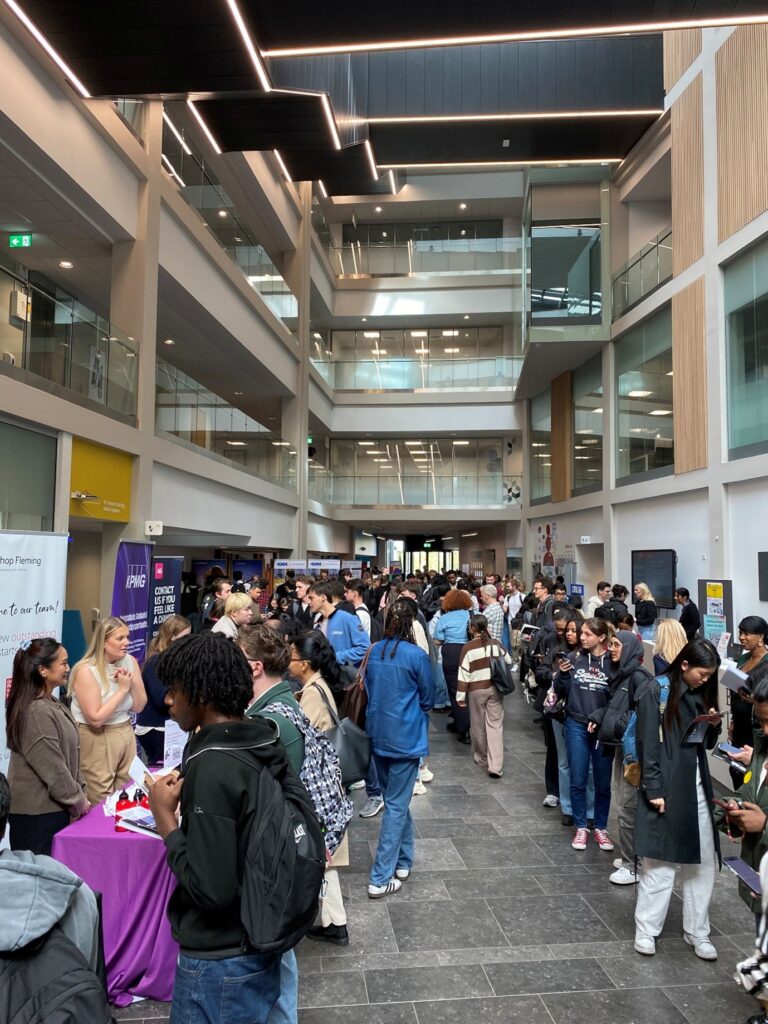
In this academic year we welcomed 315 organisations onto campus. Our events spanned a range of activities, from straight up careers fairs, through to ask the expert sessions, panels and employer career talks. Here is a sample of the great feedback we have received from employers about our events:

Ralph, Aviva (Computer Science Panel): I thought it was a really good event, and I enjoyed getting to talk to your students. I’ve made several new LinkedIn connections and it’s really great to hear that some are already enrolled in the Aviva Graduate Assessment Centres.

Ben, Science Creates Outreach (Science Futures Fair): The students were confident, professional and open to asking questions. It was a pleasure to talk to them. 

Despite being an employer focused team, students are the centre of everything we do, and we welcomed over 4,300 to the 35+ events we delivered over the course of the academic year. We had record breaking student turnout at the Engineering Fair, the Law Fair and Professional Practice Week (PPW). At PPW 2026 the student attendance was double the attendance of the previous year! With an increased focus on the benefit of experiential learning, careers events have taken on even greater significance when it comes to preparing students for what happens when they complete their studies. Here is a sample of some of the great student feedback we’ve received about our events:

Alizeh, LLB Hons Law, 3rd year (Law Fair): Attending the fairs has helped me understand what a career in law looks like beyond university. They gave me insight into the wide range of roles and employers available, which grew my inspiration. Thanks to UWE Careers Fairs, I am more confident in my pursuit of a career in law after graduation. 

Dami, Computer Science with AI, 3rd year (Business School Careers Fair): Attending the fair gave me the chance to connect with employers and learn more about internship opportunities in tech. I was impressed by the variety of companies there, and it helped me feel more confident speaking to recruiters about my skills and career goals. 

Special thanks to our wonderful staff who continue to support our events and offer their expert guidance to students, while pulling together the various elements required to make our events a success. Also, to the Events team for offering their expertise, guidance and support this year. 

With our continued desire to deliver greater experiences for our students and employers alike, we are revamping our careers fairs for academic year 2026/27. All fairs will be consolidated into 3 events over the course of a fortnight in October (7 -21 October 2026), combining several complementary disciplines into each event as follows:  

  • Applied and Social Sciences, Environmental and Public Sector – 7 October 2026
  • Architecture, Construction, Engineering and Property – 14 October 2026
  • Business and Law and Tech – 21 October 2026

Request a place at our 2026/27 careers events: Employer Event Booking Request Form 2026-27 

Business School Careers Fair, October 2025
Property and Construction Bootcamp, October 2025
Professional Practice Week, Creative and Tech Mixer at Strange Brew, January 2026
Ask the Experts (Accounting and Finance), February 2026

Squiggly career paths and reflections from the UWE Bristol x Hitachi Female Talent Initiative event

Author bethjohnson | Posted on 30 April 202630 April 2026
Squiggly career paths and reflections from the UWE Bristol x Hitachi Female Talent Initiative event

The UWE Bristol x Hitachi Female Talent Initiative in Transport, Logistics and Technology event brought together over 30 students and five external speakers to explore careers, challenge assumptions and share honest conversations about the sector. With speakers from industry and academia, the event focused on career pathways, and why diversity of people and perspectives matters more than ever. 


To open the session, Anna Maudet, Head of Bid Management at Hitachi ZeroCarbon, posed the question…

What first comes to mind when you hear “transport and logistics”?

…and as responses were gathered through a live word cloud, many were quick to point out visual and operational associations such as ‘trucks’, ‘trains’, ‘freight’, ‘lorries’, ‘hard hats’ and ‘clipboards’. Other responses focused more on representation, with several participants simply answering ‘men’. Taken together, these responses suggest that the sector is commonly perceived as heavy, operational, and male dominated.

Squiggly Careers

Following some initial icebreakers, Sarah Behenna (UWE Bristol) chaired the next session, which began with industry speakers Maria Perrotti (Hitachi), Isabella Panovic (Innovate UK) and Amber Gunter (Steer), alongside two UWE Bristol academics, Daniela Paddeu and Glenn Lyons, sharing and discussing as a panel their routes into the transport and logistics sector.

What stood out most was the shared theme of “squiggly careers”, with no speaker describing a neat or linear journey into transport or logistics. Instead, the discussion highlighted how a career spent moving between sectors and interests can be a positive rather than a negative.

Dr Daniela Paddeu, Associate Professor of Sustainable Freight Futures at UWE Bristol, discussed how her initial interest in transport and logistics was driven by the innovative technologies which drive cost reduction of system efficiencies, but has since come to be far more interested by the humans behind these systems: the drivers, the planners, the local SMEs who are integral to the supply chain, each with their own experiences and needs.

Conversations around state‑of‑the‑art innovation also featured strongly, with Isabella from Innovate UK outlining the Zero Emission HGV and Infrastructure Demonstrator (ZEHID) programme, and Anna from Hitachi ZeroCarbon describing their role as the principal partner of GRIDSERVE, which aims to deliver one of the most advanced eHGV charging networks in the world.

Alongside excellent technical questions around charging speed and infrastructure, students asked equally important questions about societal challenges: how do drivers feel about this transition, and how does this technology change day‑to‑day working lives?

Representation Shapes Outcomes

Following the panel and Q&A session, the room was split up into roundtable discussions facilitated by the expert speakers, which focused on where perceptions of the transport and logistics sector come from which including responses about media portrayal, lack of visible role models, gendered job descriptions and workplace cultures that don’t always feel welcoming.

Professor Glenn Lyons also noted how colleagues at UWE Bristol’s Centre for Transport & Society refuse to take part in “manels”, i.e. event panels with an all-male line-up, and instead used these instances as opportunities to engage with those making these decisions.

Hitachi also shared practical examples of how exposure can change perceptions, including their student discovery weeks and summer placements that allow participants to spend time across different parts of the organisation and see the full breadth of roles available. By the end of the event, it was great to hear that perceptions had notably shifted. When asked how likely they were to pursue a career in transport and logistics, the overwhelming majority of students selected likely or very likely!


This event was organised in partnership between Anna Maudet (Hitachi ZeroCarbon) and colleagues at UWE Bristol (Daniela Paddeu, Sarah Behenna, Amina Hamoud, and Robert Hicks), with the support of School of Architecture and Environment and School of Engineering Athena Swan self-assessment teams (AS SAT), who sponsored the event.

Further opportunities:

Read more about UWE Bristol’s Women Like Me mentoring scheme.

Read more about Hitachi ZeroCarbon’s ‘Electric Freightway’ project.

Spotlight on Sydney Winter: Winner of Apprentice of the Year Award at the Somerset Business Awards 2026

Author bethjohnson | Posted on 1 April 20261 April 2026
Spotlight on Sydney Winter: Winner of Apprentice of the Year Award at the Somerset Business Awards 2026

We are thrilled to celebrate Sydney Winter, a Level 7 Architectural Apprentice at BoonBrown who recently won the ‘Apprentice of the Year’ Award at the Somerset Business Awards 2026.

We had the opportunity to have a chat with Sydney in the lead up to the final about her apprenticeship journey.


How did you feel when you found out you reached the final three for Apprentice of the Year?

Honestly, I was completely surprised. My director had nominated me without telling me, so I didn’t even know I was being considered until I received the news that I’d been shortlisted. To then find out I’d made it from 70 applicants down to the final seven, and eventually the final three, was such an honour. It made me feel really appreciated, not just for the work I do day‑to‑day, but for how far I’ve come on my apprenticeship journey.

What originally inspired you to start your Level 7 apprenticeship at UWE Bristol?

My first experience at UWE during my bachelor’s degree coincided with some really tough years including COVID‑19, living in halls and being away from home during a difficult time for my family. I knew I wanted to continue my path towards becoming an architect but going back into full‑time university just wasn’t the right path for me.

An apprenticeship or part‑time study felt like the only sustainable options, but BoonBrown had never taken on an apprentice before, so it was a completely new concept for the practice. After some conversations (and a bit of convincing), I was incredibly fortunate to have their support to enrol in the Level 7 Apprenticeship.

It turned out to be the best decision. The apprenticeship allowed me to build a stable life while progressing in my career, something that wouldn’t have been possible if I’d been paying for full‑time tuition or moving back to Bristol. During this time I’ve been able to settle, get married, buy a house, and even get a dog, all while moving closer to my goal of becoming an architect.

Can you describe one or two key projects or moments during your apprenticeship that you’re most proud of?

One of the things I’m most proud of throughout my apprenticeship is how much I’ve grown in confidence. When I first started, I tended to sit quietly in client meetings, but over time I’ve pushed myself to become far more involved and now I’m leading my own meetings. I’ve also supported hosting public consultation events, which can be challenging, especially when the feedback isn’t always positive. Learning to handle those situations professionally, calmly, and with confidence has been a huge milestone for me. My presentation skills, communication, and ability to actively listen and respond to clients have all improved massively.

From a project point of view, a standout achievement has been leading a refurbishment of a curtilage‑listed home for a family. I was responsible for guiding the project through the RIBA stages and acting as the Contract Administrator. This meant chairing design team meetings, conducting monthly site visits, issuing architects instructions and providing technical advice on site. Seeing the project completed and seeing the family living happily in their beautifully restored home, was a genuinely proud moment.

What have been the biggest challenges you’ve overcome and what have they taught you?

A major challenge was balancing the intensity of full‑time work with the academic demands of a master’s‑level apprenticeship. Learning to juggle deadlines, stay organised, and prioritise effectively has pushed me to grow massively, both as a designer and as a professional.

It also meant adjusting my social life, as many weekends were spent studying, something not everyone always understands. Learning to protect time for myself, set boundaries, and maintain relationships while still meeting the demands of the programme was difficult, but it taught me resilience and discipline.

How has the apprenticeship helped you develop in your role or contribute to your team/organisation?

The apprenticeship has helped me strengthen my technical skills and design thinking while applying everything directly to real‑world projects. Being able to bring new ideas, research, and approaches from my studies straight into the office has made me feel like an active contributor rather than someone simply learning on the side. During year two of the apprenticeship, AI tools began to evolve rapidly. In our university studio sessions we were learning more and more about different platforms and their capabilities. I was able to bring that learning into practice and even delivered a CPD session across both of our offices, sharing knowledge about AI tools and how they could support design workflows.

It has also helped me become more confident in taking responsibility, whether that’s running smaller projects, communicating with clients, or supporting colleagues, the hands on experience alongside studying has been invaluable. I feel far more integrated into the team and much more prepared for the responsibilities of an architect.

How has the support from Emily Kelly and the rest of the Apprenticeship Progress Training Coordinator team at UWE Bristol played a part in your journey?

Emily and the APT team have been a huge part of keeping me grounded and on track. Their check‑ins, guidance, and general reassurance created a real sense of support behind the scenes. It never felt like I was going through the programme alone.

Whether it was helping me navigate deadlines, offering advice when things felt overwhelming, or simply being someone to talk to, their support made a big difference especially during more intense parts of the course. No question was ever a silly question and I always knew Emily would be there to help.

Emily also provided me with opportunities beyond my own studies, from mentoring new apprentices to supporting practices who were exploring the apprenticeship route. Being trusted to help others in that way really boosted my confidence and sense of belonging within the wider apprenticeship community.

What are your aspirations after completing the apprenticeship?

My biggest goal is, of course, to qualify as an architect, but beyond that, I want to continue growing within practice, taking on more responsibility and contributing to meaningful, well‑designed projects. Long‑term, I’d love to become someone who supports others on their own training routes, especially apprentices. Having gone through the process myself, I know how transformative the opportunity can be and I’d love to help others experience the same.


Huge congratulations again to Sydney – we’re excited to see where the future will take her beyond her apprenticeship journey!

Explore Degree Apprenticeships at UWE Bristol or search for a course.

Are you an employer? Find out more about Degree Apprenticeships.

CT Lab: Rethinking Critical Thinking in the Age of AI

Author bethjohnson | Posted on 24 March 202624 March 2026
CT Lab: Rethinking Critical Thinking in the Age of AI

This blog is written by Dr Francesco Tava, Associate Professor of Philosophy and Course Leader for CT Lab at UWE Bristol.

AI can perform tasks that resemble critical thinking—such as analysing information, evaluating arguments, and identifying patterns or inconsistencies—but it does not truly think in the human sense. Unlike humans, AI lacks consciousness, self-awareness, understanding, and lived experience; it generates responses based on learned data patterns rather than genuine reasoning or reflection. While it can be highly effective in structured or data-driven contexts, its “thinking” is best understood as a simulation of reasoning rather than real critical thought grounded in awareness and judgment.

The paragraph above was generated by ChatGPT (GPT-5.3, 2026) in response to two simple prompts: “Is AI able to perform critical thinking?” and “Summarise everything into one paragraph”.

If this were a human response, we might call it honest – perhaps even self-critical. Qualities we do not typically associate with large language models (LLMs). And yet, it is precisely this kind of answer that invites deeper questions: what does thinking “in the human sense” actually mean? What are consciousness, self-awareness, understanding, lived experience? And, ultimately, what is Critical Thinking?

CT Lab is a new philosophy-driven professional course at UWE Bristol, designed for professionals and researchers from any background who are willing to engage seriously with these questions and refine their critical thinking in practice. This thought piece is intended as a conceptual appetiser – an invitation to join a wider conversation.

As the opening paragraph suggests, LLMs operate through patterns. Their unmatched analytical capacity allows them to process vast quantities of data in seconds. Yet what they prioritise is not truthfulness – understood as factual, verifiable accuracy – but volume and recurrence. Patterns emerge where data is densest, most repeated, most statistically prominent. Responses are then generated accordingly.

The result is often convincing. Answers appear solid because they reflect a convergence of many sources saying similar things in slightly different ways. But plausibility is not the same as truth.

In this sense, LLMs are mimetic machines. They reproduce the surface structure of human reasoning by drawing on immense bodies of human-generated data. Consider the image of a parrot learning to speak: repetition, imitation, gradual approximation. Now imagine a parrot capable of absorbing billions of conversations within minutes. The result begins to resemble something like ChatGPT. Like that parrot, LLMs optimise for plausibility. They generate responses that align as closely as possible with dominant patterns of thought. Their aim is not to advance knowledge, but to reproduce what is already most widely expressed.

This tendency has been highlighted by researchers across disciplines. Walter Quattrociocchi, professor of computer science in Rome, and author (among many other things) of an interesting piece on “What we risk when we confuse AI and human intelligence”, described in a recent post on Facebook an experiment in which he provided an AI model with epidemiological data from 2010–2014 and asked it to construct a graph. The output included values from 2020–2021—the period of peak data density during the pandemic. The system did not “misread” the data; rather, it defaulted to the most information-rich region of its learned landscape. It followed density, not instruction.

Volume, density, reliability – LLMs are designed to play it safe. They reassure by default. And this is precisely where risk emerges. The problem is not AI itself, but our growing tendency to equate plausibility – which comforts – with truth, which often unsettles.

Critical Thinking does the opposite. It teaches us to recognise that truth is often implausible, uncomfortable, or counterintuitive. It resists the gravitational pull of consensus. Critical thinkers question what appears settled; they interrogate what feels obvious.

This requires specific intellectual dispositions. At least five stand out.

Observation: the disciplined attention to evidence, free from unexamined assumptions.

Scepticism: a readiness to doubt and to demand justification.

Curiosity: the drive to pursue knowledge beyond immediate answers.

Patience: the recognition that understanding is slow, partial, and always evolving.

Courage: the willingness to challenge accepted views, even at personal or professional cost.

These are not abstract virtues. They are practical skills – habits of mind that must be cultivated and refined.

In an age increasingly shaped by AI, Critical Thinking becomes a form of intellectual shelter – one that requires constant maintenance. CT Lab is built around this premise. The course brings together professionals from fields such as philosophy, leadership, law, policy, and strategy into a collaborative learning environment.

Across ten live sessions, participants will engage in structured dialogue with peers, guest speakers, and educators. Rather than traditional lectures, the format emphasises exchange and reflection. A curated set of multimedia materials will support the sessions, offering ongoing access to key thinkers, methods, and tools. Participants will also contribute their own real-world cases, working collectively to sharpen their critical practice.


Applications are now open. The course begins on 21 April 2026.

Join us – not for easy answers, but for the discipline of asking better questions.

Skills that empower: Building careers and community through Alumni Connect

Author bethjohnson | Posted on 24 March 202624 March 2026
Skills that empower: Building careers and community through Alumni Connect

Guest blog by Waqas Qaimkhani, Alumni Engagement Officer at UWE Bristol.

In my role, I have the privilege of talking to alumni and students. These talks often involve alumni sharing their experiences with me – experiences that would be invaluable to students and recent graduates who are at the beginning stages of their careers. The students and recent graduates also tell me about their aspirations and how they want more information and support to make more informed decisions. The answer for both sides (mostly) in these conversations is mentorship!

Mentorship is an important part of creating your own professional development by getting advice and expertise from someone who has already walked down the path that you are considering as well. In the ideal scenario, mentoring becomes a shared experience where both the mentor and mentee grow together. This is exactly why Alumni Connect was created.  

Alumni Connect is a mentorship platform created as a space for students, alumni and staff. This website is free to use and allows UWE Bristol alumni and students to create their own network and get mentorship from established alumni in their industries. People connected with UWE Bristol in other professional capacities can also join the platform as mentors, even if they haven’t studied at the university.

Why become a mentor?

If you are interested in becoming a mentor, there are so many reasons to help others while strengthening your own skills. These three benefits highlight why mentoring remains one of the most important forms of professional engagement. 

  1. Your chance to give back.

Mentorship is an opportunity to make a positive difference in someone’s journey. It’s a meaningful way to share experiences, offer guidance, and support the growth of future leaders. From my own mentoring experience, there’s a genuine sense of satisfaction that comes from seeing a mentee grow, achieve their goals, and gain more confidence. Many mentors find the experience can reenergise their own professional purpose, if they’ve been doing the same role for a long time.

2. Strengthening your leadership skills.

Mentoring naturally develops communication, active listening, coaching, and feedback skills –  all essential qualities to showcase your leadership. Guiding someone else often becomes a valuable exercise for personal growth as well. 

3. Fresh perspectives.

Working with a mentee can bring new ideas, and different ways of thinking. Mentors frequently tell me that they have learnt almost as much as they have taught. Your mentoring relationship can also evolve into a long-term professional connection leading to you being part of broader, diverse networks that enrich your work and outlook. 

Why become a mentee?

However, if you’re not able to provide mentorship to others or want to continue developing yourself before helping others through your experience, getting a mentor is always a great way to continue growing your skills.

  1. Access to experience and insight.

A mentor offers clarity gained from real-world experience. As a mentee, this can mean learning smarter ways to navigate challenges and avoid common pitfalls. Your mentor can also open doors, make introductions, and help you build relationships that support your long-term aspirations.

2. Accelerated development.

Mentors providing regular guidance helps you to build your confidence, stretch your skills, and strategically move toward your career goals. From personal experience, my mentor has provided me with advice but also career opportunities in their networks. Due to the guidance and advice, I am now on a career path that fulfils my ambitions but also challenges my capabilities. If my mentor didn’t know me well enough, they wouldn’t have been able to judge whether my role was right for me or not. So, when you find a mentor, make sure you approach the mentorship with clarity and purpose.

3. Encouraging but honest feedback

Your ideal mentor should provide a supportive space for reflection – helping you recognise your strengths, identify blind spots, and explore new possibilities. Whether through informal coffee chats or more formal documented meetings, having someone who believes in you – and, more importantly, challenges you in the right moments – can be hugely transformative.

Whether you’re interested in providing mentorship or finding a mentor, one thing that is always available to you is growing your network. On Alumni Connect, there is a very useful map feature which allows you to find alumni across the glove. This is brilliant to see where your classmates now are, where your career path could take you or just getting advice on international travel!


So, whichever path you take – mentoring or seeking a mentor – Alumni Connect is here to support your growth.

Explore the platform and discover the power of a community committed to helping each other thrive.

Discover more RISE stories showing how research, innovation, skills and enterprise at UWE Bristol are creating real-world impact.

A standout year for Professional Practice Week in 2026

Author bethjohnson | Posted on 10 March 202610 March 2026
A standout year for Professional Practice Week in 2026

Every January, UWE Bristol hosts a week of interactive workshops, industry talks, seminars, expert panels and bootcamps for creative students, known as Professional Practice Week (PPW).

Organised by the Careers and Enterprise Development Team, the events enable students to enrich their portfolios, develop skills, connect with professionals and explore career pathways.

This year was no exception, with a total 3,866 bookings and 1,022 unique students attending 63 in-person and online events led by 94 externals across City and Frenchay campuses – double the attendance from 2025. The diverse programme engaged students across the School of Arts, Frenchay Creative Technology programmes (Games Technology, Digital Media and Music Technology) and Architecture.

Some of the most popular sessions included the Bristol Filmmakers panel, the Strange Brew mixer event, the Museum of Roadside Magic, talk with puppeteer Josh Elwell, and Screen Industries Day with Jay Clark, storyboarder for Wes Anderson.

The interdisciplinary nature of PPW was a key focus for 2026, aimed at encouraging students to explore the programme beyond their subject areas for the latest innovations, trends and thinking in the creative and tech spaces. The inclusion of Frenchay Creative Technology students for the first time was well received, with 130 students engaging with sessions on Frenchay campus.

Beyond the fantastic industry guests and speakers, staff from across the university offered their support throughout the week – from volunteering on the day and supporting speakers to judging student designs and delivering panel sessions. The team has already received some positive feedback about the week from both students and staff and welcomes further input to help shape PPW27.

Get in touch with the Careers and Enterprise Development Team.

Posts pagination

Previous page Page 1 Page 2 Page 3 Page 4 Next page

Search all UWE Bristol blogs

Tags

  • Apprenticeships
  • Bristol
  • Bristol Robotics Laboratory
  • BRL
  • Business
  • CPD
  • Innovation
  • Knowledge Transfer Partnership
  • Knowledge Transfer Partnerships
  • KTP
  • KTPs
  • Launch Space
  • Research
  • Skills
  • University Enterprise Zone
  • UWE
  • UWE Bristol
  • UWE Bristol Research
  • UWE KTP
  • UWE research

Recent Posts

  • Innovation With Impact: Keyowa, The UWE Bristol Start-Up Using Science and Technology to Bring Ideas to Life
  • ESRC Post Doctoral Fellowship Scheme 2027
  • Former Project Zulu Learner Selected for Pumas U21 Trials Squad
  • Bringing hidden histories into view: How historic photographs found new life at Bristol Dockyards
  • Changes to ESRC Funding: What Researchers Need to Know

Subscribe by Email

Subscribe to our blog

Email address
Go to Research and External Engagement

    Contact us

    University of the West of England
    Frenchay Campus
    Coldharbour Lane
    Bristol
    BS16 1QY
    United Kingdom

    Switchboard: +44 (0)117 9656261
    View full contact details

    Visit us

    • City Campus
    • Frenchay Campus
    • Glenside Campus
    • Car parking
    • Visit us

    Quick links

    • Library
    • Jobs
    • Login
    • Term dates
    • Colleges and schools

    Follow us

    Website feedback
    ©2025 UWE Bristol Site map Accessibility Privacy Cookies Modern Slavery statement (PDF)
    ©2025 UWE Bristol