We are looking for a new pathway lead in Sociotechnical Futures & Digital Methods to support the work of the South West Doctoral Training Partnership (SWDTP) at UWE Bristol.
Experienced in doctoral supervision? Research active in the ESRC space? Interested in supporting doctoral and researcher development at UWE Bristol? Ready to represent the University externally?
Please submit an expression of interest by Friday, 3 July 2026 midday.
SWDTP is an ESRC-funded doctoral training partnership. It brings together 8 universities from the South West to award studentships and post-doctoral fellowships in 18 pathways (for more information on SWDTP click here).
UWE Bristol is involved in 6 pathways — 3 disciplinary and 3 interdisciplinary pathways. Sociotechnical Futures & Digital Methods is an interdisciplinary pathway (for a description of this pathway click here) offering the potential for it to be led by an academic from a wide variety of disciplinary interests associated to the pathway theme.
The lead is essential for the running of the pathway at UWE Bristol as well as working with the broader consortium. For a full description of the role see this document on the SWDTP webpage. The role receives 20 WLBs and will continue until at least the end of the 2027/2028 academic year, with potential to extend beyond that if the SWDTP continues to be funded by the ESRC after the current period.
To make an EoI, please provide a statement (max 500 words) outlining the following:
Your experience of supporting doctoral study. This could include experience beyond being a supervisor or involved in reviewing/progression and include how you have supported the PGR process as well as research culture more widely. It is helpful to highlight if you have any previous experience supporting admissions, at PGR or other levels.
How your research and academic experience demonstrates that you are active in the ESRC space and can represent Sociotechnical Futures & Digital Methods. As SFDM is interdisciplinary, there is a wider range of ESRC disciplines that are relevant here. It’s about having a strong base from which to grasp the complexities and opportunities of the pathways and an openness to different types of research.
Your experience in representing your discipline/research and/or UWE (or a previous institution) internally and/or externally.
Please submit your EoI as a Word document attachment by Friday 3 July 2026 midday to philippa.shelton@uwe.ac.uk We may request additional information after the EOI stage and may have informal conversations on Friday, 17 July in the morning as part of the selection process. The Pathway lead would start in September 2026, in readiness for the next recruitment period, and should be in a position to accommodate the role in their workload.
If you have questions about this opportunity, you can email the current pathway lead, Professor Clare Wilkinson, and/or the SW Institutional Academic Lead for UWE Bristol, Dr Bernhard Gross.
Duku Product Design is a UK-based engineering design consultancy with over a decade of experience in transforming client ideas into market-ready products. The company specialises in end-to-end product development, from concept through to design for manufacture and production delivery. In recent years, Duku has expanded beyond consultancy into the development of its own proprietary technologies, with a strategic focus on innovative and accessible EV charging systems, transitioning from a service-led consultancy model to a product-led scalable business.
About the Knowledge Base:
The academic team based within the Bristol Business School at UWE Bristol brings a strong research foundation, combining both academic and industry perspectives. The KTP was supported by Dr Mel Hudson Smith and Eamonn Condon. As Associate Professor in Operations Management, Mel has over 20yrs of experience working with small businesses to enable them to achieve their strategic objectives by ensuring their operational capabilities and processes are high quality, efficient and strategically aligned. Eamonn is the Programme Lead for the Marketing Degree and a Senior Lecturer in marketing. With international experience, Eamonn has valuable expertise in launching services, leading product teams and embedding processes and launch strategies to new markets.
Photo from the Final LMC – Eamonn Condon (Academic Supervisor), Ria Eyers (KTP Officer), Ellen Parkes (KTP Development and Growth Manager), Taabish Khan (KTP Associate), Andrew Aylesbury (Duku – Company Chair), and Paul Spenley (IUK Adviser). Excluding Alex Lee (Duku – Company Supervisor), Mel Smith (Academic Lead) and Helen Lewis (KTP Project Manager).
About the KTP Associate:
The KTP Associate, Taabish Khan, holds an MBA in Strategy and BSc in Business Management, brings over six years of experience across sales, project management, and corporate communications. His professional background spans both industry and agency roles, delivering commercially focused projects and working across cross-functional teams.
About Innovate UK:
Innovate UK is part of UK Research and Innovation, is the UK’s innovation agency. Their mission is to help companies to grow through their development and commercialisation of new products, processes and services, supported by an outstanding innovation ecosystem that is agile, inclusive and easy to navigate.
The Challenge the KTP Addressed:
The partnership aimed to embed a full commercialisation capability within Duku EV, enabling the transition from a design‑led consultancy to a scalable EV technology business. This capability supports the direct marketing of Duku’s own in-house designed products and enables a full idea‑to‑market service for new and existing design consultancy clients across home, fleet, and public charging markets.
Business Challenge:
At the outset of the KTP, Duku operated primarily as a product design consultancy but had begun developing proprietary EV charging technologies and patents. However, it lacked the commercial capability required to take these products to market. While the business had strong expertise in engineering design and product development, it did not have the internal frameworks needed to support market entry, revenue generation, or scale.
More broadly, the business faced structural challenges such as:
No formal market sizing or prioritisation framework
Lack of defined routes to market or commercial models
Absence of investor-ready financial planning and valuation logic
No established supply chain to support hardware delivery
Reliance on ad hoc project-based revenue rather than scalable growth
In addition, entering the EV charging market required navigating a complex and capital-intensive landscape, including manufacturing readiness, certification requirements, and long procurement cycles.
As a result, the core challenge was not only to commercialise a product, but to determine what should be commercialised, how it should be brought to market, and how the business could do so in a scalable and financially sustainable way.
The Solution:
To address the lack of commercial capability, the KTP focused on embedding structured, evidence-led decision-making within the business, while simultaneously validating real market opportunities for Duku’s EV charging technologies.
The project did not follow a linear path. Early in the partnership, initial commercial assumptions around launching a single public EV charger were tested through detailed market research and industry engagement. This revealed that the chosen segment was highly competitive, low margin, and capital intensive, prompting a fundamental shift in strategy.
In response, the focus moved from commercialising a single product to developing a scalable product portfolio built around Duku’s core cable management technology and family of 11+ patents. This shift enabled the business to target multiple higher-value markets, including fleet, domestic, and commercial charging applications, significantly improving long-term growth potential.
Alongside this strategic pivot, structured commercialisation frameworks were introduced across the organisation. Market sizing methodologies (TAM–SAM–SOM), competitor analysis tools, and value proposition frameworks replaced ad-hoc decision-making, allowing the business to prioritise opportunities based on evidence rather than assumption.
As industry engagement increased, further insights shaped the commercial approach. Engagement with OEMs, charge point operators, and international manufacturers highlighted differing preferences between licensing and hardware supply models. This led to the development of flexible routes to market, including both hardware delivery and IP-led licensing strategies.
(Charlie Meadows. Product Designer at Duku assembling the Duku EV ARC system)
In parallel, significant progress was made in building the foundations required for commercial execution. This included the development of investor ready financial models, structured outreach pipelines, early-stage supply chain relationships, and active participation in industry events to validate demand and position the business within the EV ecosystem.
These activities collectively transformed the business from a consultancy-led organisation with a single product concept into a commercially structured EV charging solutions provider, with a defined product portfolio, validated market opportunities, and a clear pathway to scale.
Key activities delivered through the KTP included:
Development of market sizing and total opportunity assessment frameworks
Expansion from a single product to a multi-sector EV charging portfolio
Creation of repeatable commercialisation tools and processes
Strategic input into Innovate UK grant funding applications
Preparation of investor ready financial and strategic documentation
Industry engagement through exhibitions, panels, and stakeholder outreach
The Results of the KTP:
By the end of the KTP, the business had undergone a fundamental shift – from a consultancy with an early-stage EV concept to a commercially structured EV charging solutions provider with validated demand, secured funding, and a clear pathway to scale.
This transformation was reflected not only in strategy, but in tangible commercial outcomes. During the project, the business secured over £276,000 in pre-production sales across multiple product lines, alongside contributing to £461,967 in Innovate UK funding. Combined, this represents a total financial impact exceeding £730,000, which is more than four times the grant value for the KTP.
Crucially, this activity was not isolated. EV-related grants and commercial traction accounted for approximately 30% of company revenue during the period, demonstrating a meaningful shift away from reliance on consultancy-led income and towards a scalable product-led model. In parallel, the business expanded from a single unfinished product to a portfolio of five production-ready EV charging solutions, significantly reducing market concentration risk and opening multiple routes to market.
The organisational impact extended beyond revenue. Headcount increased by 10% during the KTP, with the commercial groundwork laid through the project expected to support further job creation, including an estimated 7-12 roles within manufacturing through contract partners, and 4–6 roles within the emerging UK marine EV charging sector.
Beyond commercial performance, the project delivered meaningful societal and industry impact. Duku’s focus on accessibility contributed to a measurable improvement in usability, with the proportion of disabled users able to confidently use EV charging increasing from 25% to 61%. This represents a significant step toward inclusive infrastructure, addressing one of the key barriers to wider EV adoption.
(Emily Yates (www.emilyroseyates.co.uk) – Journalist + BBC presenter at a study conducted by Duku EV and RiDC around accessibility on EVC charging)
Depot and charging network safety was another critical area of impact. With 31% of workplace injuries attributed to trips and falls (HSE), the development of automated cable management systems directly addresses a major risk factor within EV charging environments, particularly in fleet and public settings.
The project also contributed to sustainability objectives. Through collaboration with sustainability specialists, the products developed are targeting up to99% recyclability, supporting longer-term environmental goals alongside electrification.
Just as importantly, the KTP elevated Duku EV’s external reputation and industry visibility. During the partnership, the business won the Industry Advocacy Award at the London EV Show 2024 and received Innovation of the Year from the IET for accessible vehicle technology.
(Alex accepting the Industry Advocacy Award at the London EV Show)
Duku EV also strengthened its position as a thought leader in the sector through a talk on accessible EV charging at Cenex Expo 2025, alongside panel participation at Cenex Expo in Millbrook and the EV Charging UK Conference in London in 2026. These milestones signalled growing recognition not only of the technology itself, but of the company’s role in shaping conversations around accessible and user-centred EV infrastructure.
(The Associate delivering a talk at the CENEX Expo ’25)
At an industry level, the KTP enabled Duku to contribute to early-stage policy and infrastructure development. Through involvement in the Clean Maritime Demonstration Competition (CMDC6) under UK SHORE, the business worked alongside organisations such as Cenex and the IET to help shape design guidance and best practices for marine EV charging, an emerging and strategically important sector.
The Knowledge Transfer Partnership (KTP) delivered significant benefits to the knowledge base partner, UWE Bristol, by providing a live commercial environment in which academic frameworks could be applied and tested. For the core project team of Mel Smith and Eamonn Condon, participating in Duku’s strategic transformation created a rich source of real-world material for both teaching and research.
Crucially, the collaboration provided valuable teaching examples of how a new intellectual property (IP) innovation is successfully brought to market (GTM). These practical insights are now being utilised in postgraduate courses, such as the MBA and the MSc in Marketing programmes. These outputs feed into student project work and support the development of future research and impact case studies.
Furthermore, the project’s complex requirements facilitated broader university collaboration, as thought leaders from across UWE outside of the core project team were brought in to assist wherever their specific expertise was needed.
Perhaps most significantly, the KTP has created capability that extends far beyond the lifecycle of the project. The commercialisation frameworks developed, covering market sizing, financial modelling, and go-to-market strategy, are now embedded within the business and are being actively deployed not only within Duku EV, but also as a formal service offering to external clients.
As a result, the KTP has not only delivered immediate financial return, but has established a repeatable and revenue-generating commercial capability that will continue to drive growth long after the project’s completion, while positioning the business for international expansion and external investment.
Key Facts and Impact:
Commercial Impact
Three Innovate UK bids won, valued at £71k, £184k, and £81k
Two confirmed sales orders across different product lines, valued at £88k + VAT and £186k + VAT
Total direct monetary impact of £610k during the project period
3.2x return on the original KTP grant value within the lifetime of the project
Estimated cost savings of £2.73 million over five years through improved strategic decision-making and reduced reliance on external consultancy
Strategic and Organisational Impact
Expansion from 1 to 5 product lines, covering domestic, fleet, and public EV charging markets
Establishment of a scalable supply chain to support hardware and licensing models
Transition from a design consultancy to an EV technology business with defined commercial pathways
Full redesign and launch of the Duku EV website, strengthening market presence and credibility
Reputation and Thought Leadership
Winner of the Industry Advocacy Award at the London EV Show 2024
Winner of Innovation of the Year for Accessible Vehicle Technology, awarded by the Institution of Engineering and Technology (IET)
Delivery of a talk on accessible EV charging at the Cenex Expo ‘25
Participation in panel discussions at:
Cenex Expo, Millbrook (2025)
EV Charging UK Conference, Crowne Plaza London (2026)
(Andrew, Alex, and Taabish with the award at the London EV Show ‘24)
Future and Legacy:
The KTP has established a foundation that extends well beyond the lifecycle of the project, embedding both capability and opportunity that will continue to drive growth across the business.
A key legacy is the formalisation of commercialisation as a structured function within Duku. The frameworks developed during the partnership, including market sizing, financial modelling, and route-to-market strategy, are now embedded at management level and actively used across both EV and non-EV projects. This capability has also been translated into a client-facing service, already generating revenue and strengthening the company’s wider offering.
The project is positioning Duku EV as a clean, investable, and scalable business, separate from the legacy product design consultancy. Commercial and financial readiness has been achieved, with Duku EV now progressing toward a £1.35 million seed raise, supported by early investor interest and ongoing governance development.
New market opportunities have also been unlocked. Active partnerships are now developed with UK and European charge point manufacturers, particularly in the fleet sector, where Duku’s ARC technology is gaining recognition as a differentiated solution. In parallel, the business is exploring marine EV charging, building on its involvement in the Clean Maritime Demonstration Competition (CMDC6), where it contributed to the development of design guidance and best practices alongside organisations such as the IET and Cenex.
While the focus is now on scaling the existing product portfolio, additional opportunities, particularly within marine AC and DC charging, are being explored as part of the longer-term roadmap.
The academic outputs extend beyond UWE. This included an industry project with the MBA cohort of Aston University, which explored IP valuation, organisational transition to hardware supply, and strategic recommendations for scaling, delivering both academic and commercial value.
Looking ahead, the impact of the KTP is expected to extend beyond the business itself. As Duku EV scales, there is clear potential for job creation across manufacturing and emerging sectors such as marine electrification. More broadly, by improving accessibility and usability in EV charging, the business is helping to reduce barriers to adoption and support the wider transition to electric mobility.
With commercial capability embedded, market pathways defined, and early traction established, the KTP has reshaped the trajectory of the business, positioning Duku EV for sustained growth, international expansion, and long-term impact within the EV infrastructure sector.
(Taabish visiting S.Charge’s facility in India – which is Duku’s manufacturer and partner on an international Innovate UK – India Department of Science and Technology (DST) grant)
What the partners have to say…
“This KTP has been genuinely transformative for our business. The project started at a pivotal point for us where we could see an opportunity and had a strong technical concept, but understanding where to focus our resources and building the strategy to exploit it was very difficult. We had a strong technical capability from our background in design and engineering, but this project gave us the structure and support to spend time on the commercial aspects which were not well defined at that point. Working with Taabish and the team at UWE has allowed us to challenge our thinking, refine our approach and ultimately build a plan with real long-term potential. We have ended the KTP with real clarity about our next steps, the next 12 months are going to be very exciting and we’re very grateful for the advice and support we’ve received from UWE and to have Taabish on board to expand and develop this opportunity.” Andrew Aylesbury – Director.
What the Knowledge Base partners have to say…
“From my role as a support academic on this project, I am very satisfied with how the transfer of knowledge from UWE has contributed to the pool of expertise to both Taabish and DUKU in their quest to lift their EV capability to the next stage. The partnership has worked very well and to me is a model of how they should be run” Eamonn Condon – Academic Supervisor.
“It has been a joy to be involved in this innovative and exciting KTP. The partnership between the company, academics and the Associate was exceptional and was key to unlocking the transformation from engineering consultancy to EV charging solution provider. As an academic, the impact of being part of both the planning and execution of a such a significant strategic change project, has created a rich source of material for both teaching and research” Mel Smith – Academic Lead.
KTP Associate…
“This KTP has been an ideal first long-term project following my MBA. While the course prepares you to act as a change agent bridging strategy with operational reality, this experience allowed me to apply that in a live business environment.
Building and translating a strategy into execution is rarely straightforward, particularly in a business balancing technical development with commercial ambition. The project exposed me to real constraints around resources, alignment, and timing – all of which shape outcomes.
It has been a steep and an extremely rewarding learning curve, requiring me to work across product strategy, market analysis, business development, and brand building within a highly competitive EV charging sector. I am grateful to have had this opportunity and the experience gained – and we aren’t finished yet!” Taabish Khan – KTP Associate.
From the Knowledge Transfer Adviser…
“The KTP is a great example of product development and commercialisation led with determination and skill by Taabish. It was a pleasure to work with the whole team and to be a part of the journey towards the implementation of a new sustainable revenue stream which adds to the business model. The KTP makes the company more competitive and with new strategic capabilities most notably the marketing and sales methodology which will serve as an embedded process suitable for any new product or service” Paul Spenkley – IUK Adviser.
Black voices remain underrepresented across many areas of health economics, research leadership and policy decision-making. The newly launched Black Health Economists’ Network (BHEN), founded by Dr Chizoba Esio-Bassey at UWE Bristol, aims to help change that.
BHEN is a new platform that brings together Black researchers, students, practitioners, policy professionals and allies working across health economics and related fields.
BHEN was created from a simple but important need: to build a supportive and visible community where Black health economists and those interested in the field can connect, collaborate, share opportunities and contribute to shaping more equitable health systems and research.
Health economics plays a major role in informing decisions about healthcare funding, access, prevention, medicines, public health interventions and policy. Yet Black voices remain underrepresented across many areas of academia, research leadership and decision-making spaces. BHEN aims to help address this gap by creating opportunities for networking, mentorship, collaboration, knowledge exchange, stakeholder and community engagement.
Inaugural Research and Networking Event
BHEN is excited to host its Inaugural Research and Networking Event on:
Whether you are an established academic, early-career researcher, student, policymaker or simply interested in health economics and equity, you are welcome to join this event.
Registered participants will receive the joining link closer to the event date.
Acknowledgements
The BHEN team would like to express their sincere gratitude and thanks to Professor Marc Griffiths and the ICA for their support and encouragement in helping make this inaugural event possible through funding. Their contribution has helped BHEN take an important first step in building this network and creating space for meaningful engagement and collaboration.
The BHEN team would also like to thank the Centre for Public Health and Wellbeing (CPHWB) for their guidance and backing.
It has now been 3 years since the Arts and Humanities Research Council (AHRC) Impact Accelerator Account (IAA) opened at UWE, supporting knowledge exchange and impact emerging from arts and humanities-based research.
Since then, seven IAA funding calls have awarded 85 grants to projects involving 116 UWE staff members, ranging in size from £1k to £23k. These projects represent a huge range of disciplines within arts and humanities research, including law, media studies, visual arts, music, philosophy, history, political sciences, theatre and architecture. This funding is supporting academics to run projects that respond swiftly to emerging opportunities, strengthen collaboration with non-academic stakeholders, and accelerate the translation of research outputs into real-world impact.
This work has seen an incredible 199 new partners taking part in collaborative proposals, and the delivery of 260 collaborative activities with organisations such as Global Goals Centre, Bristol Woman’s Voice, MISFITS theatre and the Lords Research Service. Across the IAA funded projects, 49,000 people have taken part in knowledge exchange and impact events such as industry roundtables, training courses, school workshops, theatre performances and focus groups.
IAA funding has successfully supported UWE academics to make strong partnerships with industry, improving their processes, sustainability and commercial positioning. Tavs Jorgensen is setting up a commercial venture which looks to transform the brick and tile manufacturing industries; Sofie Boons is working to make the jewellery sector more sustainable in their gemstone production; and Jac Fennell is integrating wearable tech from Milbotix’s SmartSocks® (an SME in UWE Enterprise Zone) into HUG (a soft comforter designed for those living with dementia).
The work of the IAA projects is creating change at a local, national and international level. Documentary film maker Judith Aston and public policy expert Laura De Vito have been working very closely with the Avonmouth community to co-create a theory of change for this contested area of Bristol, while Jack Lowe has developed a digital game that supports cultural heritage organisations to include more diverse perspectives in the stories they tell about place and local heritage. Lisa Mol’s expertise in heritage and climate change conservation in war zones has supported charity Heritage for Peace to continue their work in Yemen, and Peter Clegg collaborated with police forces in The Sovereign Base Area of Cyprus to explore how accredited higher education training could assist them with navigating their nuanced context.
One of UWE’s strengths is in inclusive innovation and we see this in many of the IAA funded projects. Tom Mitchell working closely with the charity Drake Music to co-design and fabricate a new accessible digital musical instrument, and Amy Saleh prioritised equality in her project delivery by only using global majority suppliers (catering, filmmakers, designers etc.) for her project ‘Lit Legacies’, which designed educational materials to tackle the ‘teaching barriers’ in Black British literature.
Many of the IAA projects have been successful in translating their research into changes within policy and professional practice. Suwita Hani Randhawa brought together key political and civic actors to develop new policy insights around ecocide and is now an adviser to the Scottish Parliament to further influence policy changes. Verity McIntosh worked with Watershed in the build-up to the launch of their immersive gallery space Undershed, to ensure the experience design centres access and inclusion for all users.
The range of projects funded through the IAA reflect the diversity of UWE Bristol research and how we are ensuring our engaged arts and humanities research to have commercial, social and cultural impact. Support for impact development is always available for UWE academics and current IAA projects continue to develop their impact work, so there will be even more to celebrate over the coming year!
Visit the RISE page to find out more about how UWE research is driving societal improvement and transforming futures for the better. For more information on UWE Bristol’s arts and humanities research, impact or our Impact Acceleration Account, please do get in touch.
Metrea is a global defence company specialising in intelligence, surveillance, reconnaissance and advanced technology solutions for national security partners worldwide. Through a Knowledge Transfer Partnership (KTP) with UWE Bristol’s Centre for Machine Vision, the company worked to develop AI-powered software capable of detecting, tracking and classifying objects in orbit using airborne imagery.
About the Knowledge Base:
Researchers from UWE Bristol’s Centre for Machine Vision brought expertise in computer vision, machine learning and object modelling. Working alongside Metrea, the team helped develop and test innovative AI approaches capable of analysing complex orbital imagery, transforming early-stage research into a commercially viable solution.
Mark Hansen (UWE), Izaak Stanton (UWE Research Associate), Lyndon Smith (UWE), Chris Dunn (Metrea), Louis Aberdeen (KTP Associate), Ryan Gery (Previous Company Supervisor), and Ria Eyers (UWE) during a tour of the Engineering School.
About the KTP Associate:
KTP Associate Louis Aberdeen joined the project after graduating with a degree in Mathematics from the University of Bath. During the two-year partnership, Louis led much of the technical development, applying expertise in machine learning, optimisation and computer vision to help create a new AI-driven platform for space-domain analysis.
The experience enabled Louis to develop specialist skills in deep learning, image analysis and research translation, ultimately leading to a role as a Machine Learning Engineer.
Louis Aberdeen (KTP Associate) at the Louis Aberdeen (KTP Associate) at Farnborough Bristol Robotics Laboratory
About Innovate UK:
Innovate UK is part of UK Research and Innovation, is the UK’s innovation agency. Their mission is to help companies to grow through their development and commercialisation of new products, processes and services, supported by an outstanding innovation ecosystem that is agile, inclusive and easy to navigate.
The Challenge the KTP addressed
Tracking and identifying objects in orbit is becoming increasingly important as space becomes more congested. Existing methods can be expensive, technically complex and difficult to deploy at scale. Metrea wanted to explore whether AI and machine vision techniques could be used to improve the detection and classification of orbital objects using airborne imagery.
Ryan Gerry (previous Company Supervisor) and Louis Aberdeen (KTP Associate) at the International Space Show – Farnborough
The solution
Researchers from UWE Bristol’s Centre for Machine Vision worked alongside Metrea to develop new machine-learning approaches capable of detecting and classifying objects from airborne imagery.
The project combined expertise in computer vision, artificial intelligence and image analysis to create an analytical pipeline that could process complex imagery and identify objects of interest with greater speed and accuracy.
Throughout the partnership, the team iteratively tested, refined and validated the technology, including operational trials in real-world environments.
An example reconstructed output image of the international space station
The Benefits of the KTP:
The partnership delivered significant benefits for both Metrea and UWE Bristol.
For Metrea, the project accelerated the development of innovative AI capabilities, helping the company move a promising concept towards commercial readiness. The work strengthened Metrea’s ability to analyse and interpret orbital imagery, creating opportunities for future applications in defence, security and space operations.
For UWE Bristol, the partnership provided an opportunity to apply cutting-edge machine vision research to a real-world challenge. The project generated new knowledge, strengthened industry collaboration and created opportunities for future research in artificial intelligence, image analysis and space technologies.
The KTP also delivered a substantial professional development opportunity for KTP Associate Louis Aberdeen. During the project, Louis developed specialist expertise in machine learning, computer vision and software development, gaining experience of translating research into practical solutions for industry.
The success of the partnership demonstrates how Knowledge Transfer Partnerships can bridge the gap between academic research and commercial innovation, helping businesses access specialist expertise while creating lasting impact for researchers, graduates and industry partners alike.
Metrea – Chris Dunn (Company Lead) talk at the Centre for Machine Vision, Bristol Robotics Laboratory.
Impact:
The partnership delivered significant benefits for Metrea, UWE Bristol and KTP Associate Louis Aberdeen.
For Metrea, the project transformed LASSO from a data collection tool into a sophisticated analytics platform capable of generating operationally valuable insights. This work directly supported Ministry of Defence feasibility studies worth more than £1 million and opened opportunities for future software licensing, data sales and commercial applications.
The project also increased Metrea’s visibility across the defence and space sectors, with the technology showcased to organisations including NATO and the UK Ministry of Defence. Beyond its original focus on Space Domain Awareness, the research created opportunities for wider applications in Maritime Domain Awareness and signals intelligence.
For UWE Bristol’s Centre for Machine Vision, the partnership generated new research outputs, including peer-reviewed publications and a new area of applied research at the intersection of computer vision and space technologies. The project strengthened relationships with industry partners and created opportunities for future collaboration and research funding.
KTP Associate Louis Aberdeen played a central role in the project’s success, leading the technical development from image simulation through to advanced analytical techniques. The experience included operational data-collection flights in Florida, academic publishing opportunities and engagement with senior stakeholders across the business. Following the completion of the KTP, Louis secured a role as a Machine Learning Engineer, demonstrating the programme’s impact on graduate development and career progression.
Collectively, the project demonstrated how academic expertise and industry collaboration can accelerate innovation, transforming research into practical solutions with commercial, societal and strategic value.
ERS-2 (ESA) during re-entry period
What the partners have to say… “This was our first time working with a KTP and it has proved to be a very worthwhile venture. UWE Bristol was able to provide Metrea with an exceptional Associate who was able to adapt rapidly to the continued changing business demands throughout his period of work with us. His knowledge and adaptability provided rapid analytical outputs and support products to our customers and was most welcome as we used them across the globe tackling some of the most complex and wicked security problems faced today”. – Chris Dunn: Solution Architect at Metrea.
Returning Aircraft at Tampa test facility
What the Knowledge Base partner has to say… “This was a highly ambitious KTP that has delivered excellently against its plan, in no small part down to the exceptional adaptability of the associate, Louis. It has been a pleasure for the academic team at the CMV to work with Metrea and especially with Louis and see him develop so much over the course of the KTP. The projects that Louis worked on while at Metrea have the potential to have a real impact on international defence as well as giving the CMV its first foray into space. We wish Louis the very best for his future and look forward to working with Metrea again.” Prof Mark Hansen.
KTP Associate… “The KTP has been a fantastic opportunity to develop both my technical and professional skills. Working to foster collaboration between the industry partner and knowledge base results in an outcome greater than the sum of its parts. A personal highlight was getting into the hangar with my KTP supervisor Ryan to troubleshoot the integration of LASSO into Metrea’s aircraft, crawling around on the floor checking we had all the correct port connections” Louis Aberdeen (KTP Space Data Analyst Associate).
Louis Aberdeen (KTP Associate) using a flight simulator at UWE Engineering School.
From the Knowledge Transfer Adviser: “This innovation project has been very successful in enabling new revenue streams now and in the future for the Company as well as achieving significant societal benefits in early detection of fire, people smuggling and defence/space problems enabling early detection and real time actions to be taken
Louis has led the project with drive and determination and has successfully covered the technical and commercial challenges through excellent communication skills and innovative thinking.
The development of the deep learning-based image recovery system by the team is based on wide ranging technology integration into a working and practical system with a strong commercial focus and is a great example of how the KTP methodology works to achieve breakthrough solutions at pace”. Paul Spenley (Knowledge Transfer Adviser – IUK)
The Bristol 3D Medical Centre, Integrated Care, and the Power of Collaboration with UWE Bristol
Written by Professor Marc Griffiths
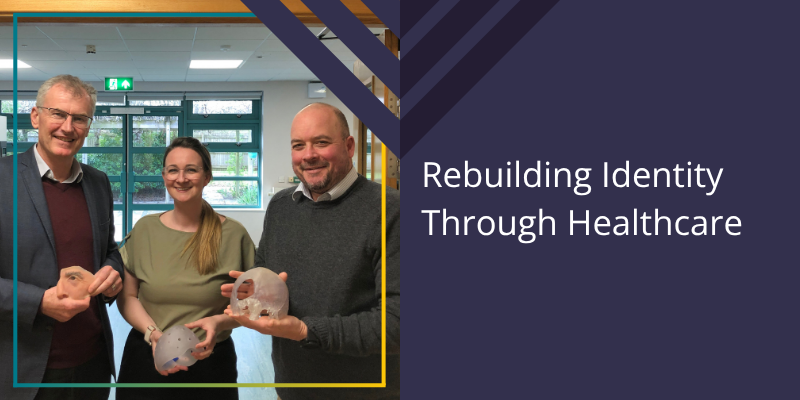
Healthcare can do more than treat illness; it can transform lives. Nowhere is this clearer than at the Bristol 3D Medical Centre, a pioneering NHS facility where innovation, compassion and collaboration come together, redefining reconstructive care through advanced digital technologies, artistry and patient‑centred practice.
As explored in Episode 14 of the Let’s Talk Health and Carepodcast, recorded on site at the Centre, the Bristol 3D Medical Centre is the first NHS facility in the UK to bring 3D scanning, digital modelling and 3D printing together under one roof. But what’s particularly striking is its significance extends well beyond technological firsts. It represents a new model of integrated, innovation‑led care that sits squarely within the ambitions of the Integrated Care Academy at UWE Bristol.
What Makes the Bristol 3D Medical Centre Different?
Located within a residential community rather than a traditional hospital environment, the Bristol 3D Medical Centre operates at the intersection of:
Advanced engineering and digital design
Clinical expertise and patient safety
Artistry, craftsmanship and empathy
Psychological rehabilitation and wellbeing
Under the leadership of Amy Davey, Lead Reconstructive Scientist and Lab Manager, the Centre delivers a fully integrated pathway, from ultra‑high‑resolution facial scanning and digital sculpting, through to 3D printing in biocompatible materials such as resin and PEEK, and finally to the meticulous hand‑finishing of bespoke prostheses.
Critically, the Centre treats patients from infancy through to older age, supporting individuals affected by cancer, trauma, congenital difference and complex surgical intervention. The outputs are not ‘off‑the‑shelf’ devices; they are deeply personalised interventions designed around function, appearance, identity and confidence.
Positive Outcomes
The outcomes associated with the work of the Bristol 3D Medical Centre are striking – and deeply human. Patients do not come simply to “replace” what has been lost. As highlighted in the podcast, the Centre plays a pivotal role in helping people rebuild confidence, regain capability in their day-to-day lives, and improve their overall quality of life.
This includes supporting individuals to re-enter social life and employment, feel more confident interacting with others, and navigate the psychological transition following trauma or cancer. The Centre also helps reduce the need for further invasive surgery and enables smoother, less distressing rehabilitation pathways.
From infants benefitting from non-invasive helmet therapy that avoids surgical risk, to adults rebuilding facial identity following cancer treatment, the Centre demonstrates how innovative technology can directly translate into better outcomes – emotionally, socially and clinically.
This focus on rehabilitation, therapy and long-term wellbeing aligns closely with integrated care principles, where success is defined not only by clinical intervention, but by lived experience and sustained outcomes.
Integrated Care in Action
The Bristol 3D Medical Centre exemplifies the core themes of the Integrated Care Academy at UWE Bristol, blending clinical science, engineering, design and digital skills to translate research and technology into real-world clinical impact. Located within a community-embedded environment, the Centre supports hospital services, community rehabilitation and regional pathways, demonstrating how innovation in practice can strengthen system integration and place-based care.
As discussed in the podcast, the Centre already supports surgical planning, reduces theatre time, and enables clinicians to take an innovation-first approach before patient operations. This system-level value highlights how innovation at the point of care can positively influence efficiency, safety and patient flow across the wider system.
Just a few miles away, UWE Bristol brings together complementary strengths in robotics, advanced and additive manufacturing, health technologies, psychology and workforce development. Existing collaborations with Bristol Robotics Laboratory, where Amy Davey acts as an industrial mentor to doctoral researchers, alongside wider links with engineering and health research communities, reflect a shared ambition to bridge the gap between research and real-world healthcare application.
Looking Ahead
Looking to the future, UWE Bristol is well placed to deepen and extend collaborative workstreams with the Bristol 3D Medical Centre through an innovation-first model. This includes co-developed research focused on applied clinical challenges, translational pathways from robotics, materials science and digital health into patient care, and new approaches to workforce education, training and medical device innovation.
As Amy Davey reflects in the podcast, the Centre itself has the space, ambition and openness to grow into a regional hub and national centre of excellence. UWE Bristol – through the Integrated Care Academy – is a natural partner in shaping that future.
The Bristol 3D Medical Centre is more than a technological success story. It shows what is possible when innovation is driven by patient need, supported by integrated systems and strengthened through collaboration with higher education.
As the Integrated Care Academy continues to champion new ways of working across health, care, technology and education, the Bristol 3D Medical Centre stands as both proof of concept and inspiration – showing how research and innovation, when embedded in care, can genuinely change lives.
Dr Karan Vickers-Hulse, Dr Jane Carter and Dr Sarah Whitehouse have been successful in securing funding from the British Academy to deliver a three-day writing and mentorship workshop for early career researchers in South Africa. These workshops will be planned and delivered alongside academics from four universities in South Africa and will focus on early career researchers with an interest in teacher education, social justice, equity, and decolonising knowledge production. The project aims to build capacity in academic writing, publishing, and grant development while creating sustained international research networks and increasing the visibility of African scholarship.
The project builds on existing partnerships with the University of Zululand in KwaZulu-Natal, which were developed through connections with Project Zulu and sustained during previous British Academy funding. The team has reached out to academics in other institutions in South Africa to ensure that they can build a sustainable early career researcher network across universities in South Africa. The bid aligns closely with Project Zulu by extending a shared commitment to educational equity and aims to strengthen the research and teacher education ecosystem that underpins long-term, systemic change in South Africa.
Women in Refugee Law (WiRL) is re-centring the experiences and rights of women within refugee law, policy and practice.
Founded and led by Dr Christel Querton (Senior Lecturer in Law, UWE Bristol) and Dr Moira Dustin (Assistant Professor of Law, University of Sussex), WiRL is a global transdisciplinary and cross-sector network- with over 360 members in 50 countries- addressing obstacles to the international protection of refugee women.
Addressing gender inequality in international protection
Dr Christel Querton said: “Despite the fact women continue to make up half the world’s refugees and displaced people, research shows that their protection needs continue to be overlooked in many jurisdictions. The work of WiRL is becoming increasingly important, especially as we see refugee rights and women’s rights being eroded more generally too.”
WiRL recently carried out a series of events made possible through funding from UWE Bristol’s AHRC Impact Acceleration Account (IAA). By utilising partnerships with organisations in the asylum sector, it was able to maximise its outputs and impact.
Championing equitable research and policy-focussed outputs
In September 2025, WiRL partnered with Asylos to co-host a roundtable in London to explore the current practice of using safe country concepts and the impact on women seeking asylum in the UK. The event was designed to facilitate coproduction and knowledge-exchange alongside women with lived experience of seeking asylum and being refugees. Over half of the participants were women with lived experience and/ or from organisations that worked directly with them (in addition to scholars, advocates and legal practitioners). Following the event, WiRL published a policy report that highlighted gender-specific concerns about designating a country “safe”. WiRL also made recommendations for change, emphasising the importance of recognising and valuing knowledge produced by women with lived experience.
Strengthening the capacity and expertise of decision influencers
In July 2025 and February 2026, WiRL co-hosted two specialist legal training events for asylum and immigration practitioners with a particular interest in gender-based claims for asylum. Partnering with the Immigration Law Practitioners’ Association (ILPA), the first online training session was UK-focussed. For the second training session, WiRL partnered with the Global Strategic Litigation Council and specifically considered the East Africa region. This training will enable advocates and legal professionals to support the fairer determination of women’s asylum claims. These events attracted over 90 online attendees and were made into video resources that remain freely accessible online.
Supporting advocacy efforts at community and government level
Dr Moira Dustin said: “Our work challenges the assumption that legal and policy changes in the last 30 years have displaced the need for continued research and advocacy efforts. WiRL aims to safeguard advances, and to identify and address contemporary obstacles to the protection of refugee women globally. Our website hosts a database of over 500 resources relating to refugee women which can be accessed by anyone, we also run public information events on pertinent topics. We are increasingly involved in policy work, including informing UN councils, national governments and regional protection frameworks.”
How machine vision is unlocking new ways to understand and improve animal welfare
AWARE-AI, a new two-year research project led by the Centre for Machine Vision (CMV) at UWE Bristol, bringing together partners from academia and industry to explore how artificial intelligence can recognise and track animal emotions through visual behaviour analysis has been backed by over £1 million in funding, including support from UK Research and Innovation (UKRI).
With collaborators including SRUC, Zoetis, and Agsenze, AWARE-AI represents a major step forward in how technology can support animal welfare -both on farms and beyond.
A team effort pushing the boundaries of AI and animal welfare
At its core, AWARE-AI is a collaborative effort led by CMV researchers, combining expertise in machine vision, artificial intelligence and animal behaviour.
Together, the team is working to answer a complex challenge: how can we interpret non-verbal emotional signals in animals in a way that is reliable, scalable, and grounded in science?
The answer lies in rethinking how we understand behaviour as something richer than just isolated actions, something more dynamic, and more meaningful.
From pigs to cows: Can AI understand emotion across species?
One of the most ambitious aspects of the project is its cross-species approach.
Focusing on both pigs and cattle, researchers will explore whether AI models trained in one context can translate across different animals and environments. This has huge implications for scalability – moving from species-specific tools to systems that can work more broadly across agriculture and animal care.
If successful, this could lay the foundation for AI systems capable of recognising emotional states across a wide range of animals.
A new way of reading behaviour: Emotion as a ‘language’
AWARE-AI takes a fundamentally different approach to understanding animal behaviour.
Rather than looking at single indicators, such as ear position or movement in isolation, the project treats behaviour more like a language. Instead of words, animals express themselves through patterns of posture, movement, and interaction over time. Rather than relying on existing datasets, the project will work with animals in controlled settings to observe how emotional states change over time.
This shift allows AI to move beyond surface-level signals and begin to interpret behaviour in a more holistic, nuanced way – closer to how humans intuitively understand emotion.
Building on a strong foundation of innovation
The project builds on CMV’s strong track record of applying AI to real-world agricultural challenges. Previous innovations have included developing systems capable of detecting stress in animals, identifying individual livestock within herds, and enabling continuous welfare monitoring through visual data.
AWARE-AI takes this work a step further, shifting the focus from identifying signs of distress to understanding the full emotional landscape of animal behaviour.
Why it matters: Smarter systems, better welfare
The potential impact of this research is significant.
AI-powered monitoring tools could enable:
earlier detection of changes in animal wellbeing
more responsive and informed care
improved welfare standards across agriculture
Beyond farming, the implications extend to animal welfare science, conservation, and any setting where understanding animal behaviour is critical.
Looking ahead
Launching in April 2026 and running for 24 months, AWARE-AI is set to position UWE Bristol and the Centre for Machine Vision at the forefront of research into AI and animal emotion.
A wearable device developed through three years of research and testing is helping women manage hot flushes – demonstrating how innovation, entrepreneurship and collaboration can translate ideas into real-world impact.
For many women, hot flushes are one of the most disruptive symptoms of menopause – affecting sleep, confidence and day-to-day life. Yet, like many issues when it comes to women’s healthcare, practical solutions remain limited.
At UWE Bristol’s University Enterprise Zone, a start-up called MyCelsius has spent the past three years developing a wearable device designed to provide rapid cooling during hot flushes. The wrist-worn technology delivers targeted cooling within seconds, helping women manage symptoms in a discreet, non-medicinal way. The innovation combines engineering, user-centred design and real-world testing, supported by the innovation ecosystem across Launch Space, Future Space and the Bristol Robotics Laboratory.
For co-founders Max and Aonghus, the goal was clear: create a solution that genuinely improves women’s health and wellbeing.
The Problem
Hot flushes affect millions of women worldwide, yet the everyday impact of the symptom is often underestimated.
The idea behind MyCelsius began when co-founder Max experienced hot flushes linked to stress and anxiety. Early in the company’s journey, the founders joined an incubator programme with healthcare provider Bupa, where they gained deeper insight into the scale of the issue through conversations with women experiencing menopause.
What they heard was striking.
“Hot flushes can disrupt sleep, which leads to fatigue and insomnia,” explains Max. “That then affects concentration, productivity and mental wellbeing.”
For many women, existing solutions were limited.
While hormone replacement therapy (HRT) works well for some, it isn’t suitable or desirable for everyone. Outside of medical treatment, options were often limited to handheld fans or other temporary fixes.
“We realised there was a real gap,” Max says.
“Women deserve solutions that are effective, discreet and designed specifically with their needs in mind.”
The Innovation
Turning that idea into a viable product required extensive research and development.
Over nearly three years, the MyCelsius team conducted more than 1,000 tests and built hundreds of prototypes to refine the technology behind the device.
“We’ve worked with a community of hundreds of women going through menopause,” says co-founder Aonghus. “At every stage we tried to get prototypes onto people’s wrists so they could tell us how it should function, how it should look, and how it should feel.”
This user-centred design approach shaped every stage of development.
Early prototypes were large and bulky; they were functional, but impractical.
“We started with a big, ugly prototype strapped to someone’s wrist,” Aonghus laughs. “Even when it worked, people didn’t want to wear something that large.”
Over time, continuous testing and feedback helped the team refine the design, reducing the size while improving performance.
The result? A compact wearable device capable of delivering rapid cooling to the skin, helping to interrupt or reduce hot flushes. The system uses a miniaturised cooling mechanism designed to deliver significant temperature change within seconds.
Engineering that performance into such a small device was one of the biggest technical challenges.
“It’s easy to increase performance by making something bigger,” Max explains.
“The real challenge was maintaining that cooling power while keeping the device small, stylish and wearable.”
The Impact
Although still early in its journey, MyCelsius is already showing the potential of innovation driven by real user needs.
For the founders, the most rewarding part has been seeing the product make a difference in people’s lives.
“Designing something that genuinely helps people is what we’re most proud of,” says Aonghus.
“After years of development, seeing real users have a fantastic experience with it makes it all worthwhile.”
Voices from the Project
The journey from concept to market has not been straightforward.
“When we started, we genuinely didn’t know if the system was even feasible,” Max says.
Three and a half years later, the device has evolved dramatically.
“We started with something that looked like a prison tag. Now we have a stylish wearable product that’s helping people manage hot flushes.”
For the team, however, this is just the beginning.
“It feels too early to say we’ve achieved everything,” Max reflects. “You climb one mountain and then you see the next one behind it.”
Innovation at UWE Bristol
The MyCelsius journey has been closely connected to UWE Bristol’s innovation ecosystem.
The company has been based within Launch Space, part of the University Enterprise Zone, with additional support from Future Space and the Bristol Robotics Laboratory (BRL).
These environments provide access to workspaces, specialist facilities, technical expertise and business networks that help early-stage companies accelerate their development.
“We’ve been incredibly fortunate to be part of Launch Space, Future Space and BRL,” says Aonghus. “At Launch Space we have access to offices, labs and workshops. At BRL we can learn from experts in electronics and robotics. And Future Space connects us with an incredible network that helps us solve challenges.”
Max agrees the support has been transformative.
“It’s given us the infrastructure and foundation we needed to build the company.”
What’s Next?
Having launched the product recently, the next goal is simple: reach more people.
“We want to get MyCelsius onto as many wrists as possible,” says Max.
As more users adopt the technology, the team plans to continue gathering feedback and refining the product – ensuring the innovation continues to evolve alongside the needs of the people it serves.
For the founders, one milestone stands out.
“The moment I’m looking forward to,” Max says, “is seeing someone wearing MyCelsius out in the street.”