

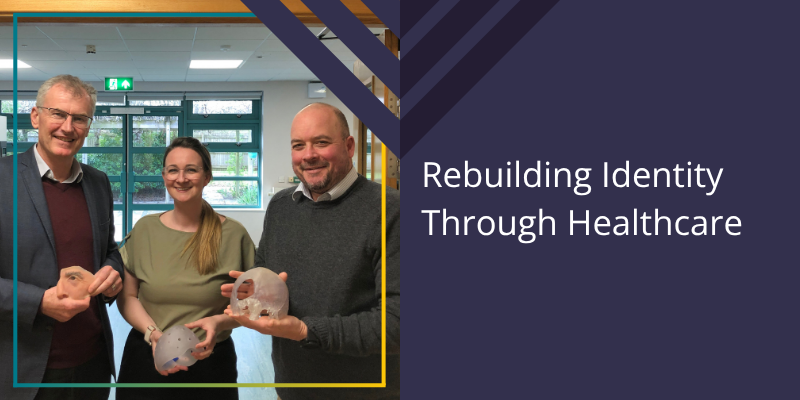
The Bristol 3D Medical Centre, Integrated Care, and the Power of Collaboration with UWE Bristol
Written by Professor Marc Griffiths
Healthcare can do more than treat illness; it can transform lives. Nowhere is this clearer than at the Bristol 3D Medical Centre, a pioneering NHS facility where innovation, compassion and collaboration come together, redefining reconstructive care through advanced digital technologies, artistry and patient‑centred practice.
As explored in Episode 14 of the Let’s Talk Health and Care podcast, recorded on site at the Centre, the Bristol 3D Medical Centre is the first NHS facility in the UK to bring 3D scanning, digital modelling and 3D printing together under one roof. But what’s particularly striking is its significance extends well beyond technological firsts. It represents a new model of integrated, innovation‑led care that sits squarely within the ambitions of the Integrated Care Academy at UWE Bristol.
What Makes the Bristol 3D Medical Centre Different?
Located within a residential community rather than a traditional hospital environment, the Bristol 3D Medical Centre operates at the intersection of:
- Advanced engineering and digital design
- Clinical expertise and patient safety
- Artistry, craftsmanship and empathy
- Psychological rehabilitation and wellbeing
Under the leadership of Amy Davey, Lead Reconstructive Scientist and Lab Manager, the Centre delivers a fully integrated pathway, from ultra‑high‑resolution facial scanning and digital sculpting, through to 3D printing in biocompatible materials such as resin and PEEK, and finally to the meticulous hand‑finishing of bespoke prostheses.
Critically, the Centre treats patients from infancy through to older age, supporting individuals affected by cancer, trauma, congenital difference and complex surgical intervention. The outputs are not ‘off‑the‑shelf’ devices; they are deeply personalised interventions designed around function, appearance, identity and confidence.
Positive Outcomes
The outcomes associated with the work of the Bristol 3D Medical Centre are striking – and deeply human. Patients do not come simply to “replace” what has been lost. As highlighted in the podcast, the Centre plays a pivotal role in helping people rebuild confidence, regain capability in their day-to-day lives, and improve their overall quality of life.
This includes supporting individuals to re-enter social life and employment, feel more confident interacting with others, and navigate the psychological transition following trauma or cancer. The Centre also helps reduce the need for further invasive surgery and enables smoother, less distressing rehabilitation pathways.
From infants benefitting from non-invasive helmet therapy that avoids surgical risk, to adults rebuilding facial identity following cancer treatment, the Centre demonstrates how innovative technology can directly translate into better outcomes – emotionally, socially and clinically.
This focus on rehabilitation, therapy and long-term wellbeing aligns closely with integrated care principles, where success is defined not only by clinical intervention, but by lived experience and sustained outcomes.
Integrated Care in Action
The Bristol 3D Medical Centre exemplifies the core themes of the Integrated Care Academy at UWE Bristol, blending clinical science, engineering, design and digital skills to translate research and technology into real-world clinical impact. Located within a community-embedded environment, the Centre supports hospital services, community rehabilitation and regional pathways, demonstrating how innovation in practice can strengthen system integration and place-based care.
As discussed in the podcast, the Centre already supports surgical planning, reduces theatre time, and enables clinicians to take an innovation-first approach before patient operations. This system-level value highlights how innovation at the point of care can positively influence efficiency, safety and patient flow across the wider system.
Just a few miles away, UWE Bristol brings together complementary strengths in robotics, advanced and additive manufacturing, health technologies, psychology and workforce development. Existing collaborations with Bristol Robotics Laboratory, where Amy Davey acts as an industrial mentor to doctoral researchers, alongside wider links with engineering and health research communities, reflect a shared ambition to bridge the gap between research and real-world healthcare application.
Looking Ahead
Looking to the future, UWE Bristol is well placed to deepen and extend collaborative workstreams with the Bristol 3D Medical Centre through an innovation-first model. This includes co-developed research focused on applied clinical challenges, translational pathways from robotics, materials science and digital health into patient care, and new approaches to workforce education, training and medical device innovation.
As Amy Davey reflects in the podcast, the Centre itself has the space, ambition and openness to grow into a regional hub and national centre of excellence. UWE Bristol – through the Integrated Care Academy – is a natural partner in shaping that future.
The Bristol 3D Medical Centre is more than a technological success story. It shows what is possible when innovation is driven by patient need, supported by integrated systems and strengthened through collaboration with higher education.
As the Integrated Care Academy continues to champion new ways of working across health, care, technology and education, the Bristol 3D Medical Centre stands as both proof of concept and inspiration – showing how research and innovation, when embedded in care, can genuinely change lives.