
Skip to content
  • Blog home
  • About us
Home | UWE Bristol blogs | Research and External Engagement
UWE blogs

Research and External Engagement

Tag: Business

Knowledge Transfer Partnership case study – Metrea

Author Rima Khatun | Posted on 12 May 20269 June 2026
Knowledge Transfer Partnership case study – Metrea

About Metrea:

Metrea is a global defence company specialising in intelligence, surveillance, reconnaissance and advanced technology solutions for national security partners worldwide. Through a Knowledge Transfer Partnership (KTP) with UWE Bristol’s Centre for Machine Vision, the company worked to develop AI-powered software capable of detecting, tracking and classifying objects in orbit using airborne imagery.

About the Knowledge Base:

Researchers from UWE Bristol’s Centre for Machine Vision brought expertise in computer vision, machine learning and object modelling. Working alongside Metrea, the team helped develop and test innovative AI approaches capable of analysing complex orbital imagery, transforming early-stage research into a commercially viable solution.

Mark Hansen (UWE), Izaak Stanton (UWE Research Associate), Lyndon Smith (UWE),
Chris Dunn (Metrea), Louis Aberdeen (KTP Associate), Ryan Gery (Previous Company Supervisor),
and Ria Eyers (UWE) during a tour of the Engineering School.

About the KTP Associate:

KTP Associate Louis Aberdeen joined the project after graduating with a degree in Mathematics from the University of Bath. During the two-year partnership, Louis led much of the technical development, applying expertise in machine learning, optimisation and computer vision to help create a new AI-driven platform for space-domain analysis.

The experience enabled Louis to develop specialist skills in deep learning, image analysis and research translation, ultimately leading to a role as a Machine Learning Engineer.

Louis Aberdeen (KTP Associate) at the              Louis Aberdeen (KTP Associate) at Farnborough
Bristol Robotics Laboratory

About Innovate UK:

Innovate UK is part of UK Research and Innovation, is the UK’s innovation agency. Their mission is to help companies to grow through their development and commercialisation of new products, processes and services, supported by an outstanding innovation ecosystem that is agile, inclusive and easy to navigate.

The Challenge the KTP addressed

Tracking and identifying objects in orbit is becoming increasingly important as space becomes more congested. Existing methods can be expensive, technically complex and difficult to deploy at scale. Metrea wanted to explore whether AI and machine vision techniques could be used to improve the detection and classification of orbital objects using airborne imagery.

Ryan Gerry (previous Company Supervisor) and
Louis Aberdeen (KTP Associate) at the International Space Show – Farnborough

The solution

Researchers from UWE Bristol’s Centre for Machine Vision worked alongside Metrea to develop new machine-learning approaches capable of detecting and classifying objects from airborne imagery.

The project combined expertise in computer vision, artificial intelligence and image analysis to create an analytical pipeline that could process complex imagery and identify objects of interest with greater speed and accuracy.

Throughout the partnership, the team iteratively tested, refined and validated the technology, including operational trials in real-world environments.

An example reconstructed output image of the international space station

The Benefits of the KTP:

The partnership delivered significant benefits for both Metrea and UWE Bristol.

For Metrea, the project accelerated the development of innovative AI capabilities, helping the company move a promising concept towards commercial readiness. The work strengthened Metrea’s ability to analyse and interpret orbital imagery, creating opportunities for future applications in defence, security and space operations.

For UWE Bristol, the partnership provided an opportunity to apply cutting-edge machine vision research to a real-world challenge. The project generated new knowledge, strengthened industry collaboration and created opportunities for future research in artificial intelligence, image analysis and space technologies.

The KTP also delivered a substantial professional development opportunity for KTP Associate Louis Aberdeen. During the project, Louis developed specialist expertise in machine learning, computer vision and software development, gaining experience of translating research into practical solutions for industry.

The success of the partnership demonstrates how Knowledge Transfer Partnerships can bridge the gap between academic research and commercial innovation, helping businesses access specialist expertise while creating lasting impact for researchers, graduates and industry partners alike.

Metrea – Chris Dunn (Company Lead) talk at the Centre for Machine Vision, Bristol Robotics Laboratory.

Impact:

The partnership delivered significant benefits for Metrea, UWE Bristol and KTP Associate Louis Aberdeen.

For Metrea, the project transformed LASSO from a data collection tool into a sophisticated analytics platform capable of generating operationally valuable insights. This work directly supported Ministry of Defence feasibility studies worth more than £1 million and opened opportunities for future software licensing, data sales and commercial applications.

The project also increased Metrea’s visibility across the defence and space sectors, with the technology showcased to organisations including NATO and the UK Ministry of Defence. Beyond its original focus on Space Domain Awareness, the research created opportunities for wider applications in Maritime Domain Awareness and signals intelligence.

For UWE Bristol’s Centre for Machine Vision, the partnership generated new research outputs, including peer-reviewed publications and a new area of applied research at the intersection of computer vision and space technologies. The project strengthened relationships with industry partners and created opportunities for future collaboration and research funding.

KTP Associate Louis Aberdeen played a central role in the project’s success, leading the technical development from image simulation through to advanced analytical techniques. The experience included operational data-collection flights in Florida, academic publishing opportunities and engagement with senior stakeholders across the business. Following the completion of the KTP, Louis secured a role as a Machine Learning Engineer, demonstrating the programme’s impact on graduate development and career progression.

Collectively, the project demonstrated how academic expertise and industry collaboration can accelerate innovation, transforming research into practical solutions with commercial, societal and strategic value.

ERS-2 (ESA) during re-entry period

What the partners have to say… “This was our first time working with a KTP and it has proved to be a very worthwhile venture. UWE Bristol was able to provide Metrea with an exceptional Associate who was able to adapt rapidly to the continued changing business demands throughout his period of work with us. His knowledge and adaptability provided rapid analytical outputs and support products to our customers and was most welcome as we used them across the globe tackling some of the most complex and wicked security problems faced today”. – Chris Dunn: Solution Architect at Metrea.

Returning Aircraft at Tampa test facility

What the Knowledge Base partner has to say… “This was a highly ambitious KTP that has delivered excellently against its plan, in no small part down to the exceptional adaptability of the associate, Louis. It has been a pleasure for the academic team at the CMV to work with Metrea and especially with Louis and see him develop so much over the course of the KTP. The projects that Louis worked on while at Metrea have the potential to have a real impact on international defence as well as giving the CMV its first foray into space. We wish Louis the very best for his future and look forward to working with Metrea again.” Prof Mark Hansen.

KTP Associate… “The KTP has been a fantastic opportunity to develop both my technical and professional skills. Working to foster collaboration between the industry partner and knowledge base results in an outcome greater than the sum of its parts. A personal highlight was getting into the hangar with my KTP supervisor Ryan to troubleshoot the integration of LASSO into Metrea’s aircraft, crawling around on the floor checking we had all the correct port connections” Louis Aberdeen (KTP Space Data Analyst Associate).

Louis Aberdeen (KTP Associate) using a flight simulator at UWE Engineering School.

From the Knowledge Transfer Adviser: “This innovation project has been very successful in enabling new revenue streams now and in the future for the Company as well as achieving significant societal benefits in early detection of fire, people smuggling and defence/space problems enabling early detection and real time actions to be taken

Louis has led the project with drive and determination and has successfully covered the technical and commercial challenges through excellent communication skills and innovative thinking.

The development of the deep learning-based image recovery system by the team is based on wide ranging technology integration into a working and practical system with a strong commercial focus and is a great example of how the KTP methodology works to achieve breakthrough solutions at pace”. Paul Spenley (Knowledge Transfer Adviser – IUK)

Employer Engagement: A Year in Review

Author bethjohnson | Posted on 11 May 202612 May 2026
Employer Engagement: A Year in Review

This blog is written by Ben Tilley, Employer Engagement Officer in the Student and Graduate Talent team at UWE Bristol.

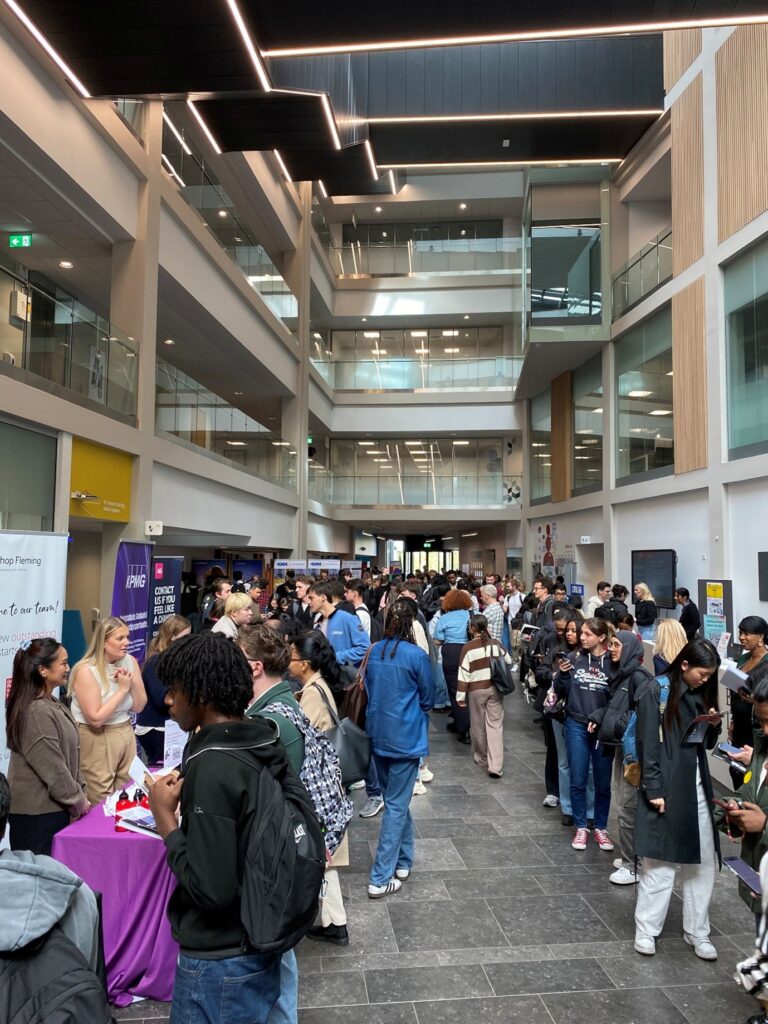
With all careers events now delivered for 2025/26, we thought it would be a good time to reflect on another dynamic year in the Student and Graduate Talent team.

In this academic year we welcomed 315 organisations onto campus. Our events spanned a range of activities, from straight up careers fairs, through to ask the expert sessions, panels and employer career talks. Here is a sample of the great feedback we have received from employers about our events:

Ralph, Aviva (Computer Science Panel): I thought it was a really good event, and I enjoyed getting to talk to your students. I’ve made several new LinkedIn connections and it’s really great to hear that some are already enrolled in the Aviva Graduate Assessment Centres.

Ben, Science Creates Outreach (Science Futures Fair): The students were confident, professional and open to asking questions. It was a pleasure to talk to them. 

Despite being an employer focused team, students are the centre of everything we do, and we welcomed over 4,300 to the 35+ events we delivered over the course of the academic year. We had record breaking student turnout at the Engineering Fair, the Law Fair and Professional Practice Week (PPW). At PPW 2026 the student attendance was double the attendance of the previous year! With an increased focus on the benefit of experiential learning, careers events have taken on even greater significance when it comes to preparing students for what happens when they complete their studies. Here is a sample of some of the great student feedback we’ve received about our events:

Alizeh, LLB Hons Law, 3rd year (Law Fair): Attending the fairs has helped me understand what a career in law looks like beyond university. They gave me insight into the wide range of roles and employers available, which grew my inspiration. Thanks to UWE Careers Fairs, I am more confident in my pursuit of a career in law after graduation. 

Dami, Computer Science with AI, 3rd year (Business School Careers Fair): Attending the fair gave me the chance to connect with employers and learn more about internship opportunities in tech. I was impressed by the variety of companies there, and it helped me feel more confident speaking to recruiters about my skills and career goals. 

Special thanks to our wonderful staff who continue to support our events and offer their expert guidance to students, while pulling together the various elements required to make our events a success. Also, to the Events team for offering their expertise, guidance and support this year. 

With our continued desire to deliver greater experiences for our students and employers alike, we are revamping our careers fairs for academic year 2026/27. All fairs will be consolidated into 3 events over the course of a fortnight in October (7 -21 October 2026), combining several complementary disciplines into each event as follows:  

  • Applied and Social Sciences, Environmental and Public Sector – 7 October 2026
  • Architecture, Construction, Engineering and Property – 14 October 2026
  • Business and Law and Tech – 21 October 2026

Request a place at our 2026/27 careers events: Employer Event Booking Request Form 2026-27 

Business School Careers Fair, October 2025
Property and Construction Bootcamp, October 2025
Professional Practice Week, Creative and Tech Mixer at Strange Brew, January 2026
Ask the Experts (Accounting and Finance), February 2026

Squiggly career paths and reflections from the UWE Bristol x Hitachi Female Talent Initiative event

Author bethjohnson | Posted on 30 April 202630 April 2026
Squiggly career paths and reflections from the UWE Bristol x Hitachi Female Talent Initiative event

The UWE Bristol x Hitachi Female Talent Initiative in Transport, Logistics and Technology event brought together over 30 students and five external speakers to explore careers, challenge assumptions and share honest conversations about the sector. With speakers from industry and academia, the event focused on career pathways, and why diversity of people and perspectives matters more than ever. 


To open the session, Anna Maudet, Head of Bid Management at Hitachi ZeroCarbon, posed the question…

What first comes to mind when you hear “transport and logistics”?

…and as responses were gathered through a live word cloud, many were quick to point out visual and operational associations such as ‘trucks’, ‘trains’, ‘freight’, ‘lorries’, ‘hard hats’ and ‘clipboards’. Other responses focused more on representation, with several participants simply answering ‘men’. Taken together, these responses suggest that the sector is commonly perceived as heavy, operational, and male dominated.

Squiggly Careers

Following some initial icebreakers, Sarah Behenna (UWE Bristol) chaired the next session, which began with industry speakers Maria Perrotti (Hitachi), Isabella Panovic (Innovate UK) and Amber Gunter (Steer), alongside two UWE Bristol academics, Daniela Paddeu and Glenn Lyons, sharing and discussing as a panel their routes into the transport and logistics sector.

What stood out most was the shared theme of “squiggly careers”, with no speaker describing a neat or linear journey into transport or logistics. Instead, the discussion highlighted how a career spent moving between sectors and interests can be a positive rather than a negative.

Dr Daniela Paddeu, Associate Professor of Sustainable Freight Futures at UWE Bristol, discussed how her initial interest in transport and logistics was driven by the innovative technologies which drive cost reduction of system efficiencies, but has since come to be far more interested by the humans behind these systems: the drivers, the planners, the local SMEs who are integral to the supply chain, each with their own experiences and needs.

Conversations around state‑of‑the‑art innovation also featured strongly, with Isabella from Innovate UK outlining the Zero Emission HGV and Infrastructure Demonstrator (ZEHID) programme, and Anna from Hitachi ZeroCarbon describing their role as the principal partner of GRIDSERVE, which aims to deliver one of the most advanced eHGV charging networks in the world.

Alongside excellent technical questions around charging speed and infrastructure, students asked equally important questions about societal challenges: how do drivers feel about this transition, and how does this technology change day‑to‑day working lives?

Representation Shapes Outcomes

Following the panel and Q&A session, the room was split up into roundtable discussions facilitated by the expert speakers, which focused on where perceptions of the transport and logistics sector come from which including responses about media portrayal, lack of visible role models, gendered job descriptions and workplace cultures that don’t always feel welcoming.

Professor Glenn Lyons also noted how colleagues at UWE Bristol’s Centre for Transport & Society refuse to take part in “manels”, i.e. event panels with an all-male line-up, and instead used these instances as opportunities to engage with those making these decisions.

Hitachi also shared practical examples of how exposure can change perceptions, including their student discovery weeks and summer placements that allow participants to spend time across different parts of the organisation and see the full breadth of roles available. By the end of the event, it was great to hear that perceptions had notably shifted. When asked how likely they were to pursue a career in transport and logistics, the overwhelming majority of students selected likely or very likely!


This event was organised in partnership between Anna Maudet (Hitachi ZeroCarbon) and colleagues at UWE Bristol (Daniela Paddeu, Sarah Behenna, Amina Hamoud, and Robert Hicks), with the support of School of Architecture and Environment and School of Engineering Athena Swan self-assessment teams (AS SAT), who sponsored the event.

Further opportunities:

Read more about UWE Bristol’s Women Like Me mentoring scheme.

Read more about Hitachi ZeroCarbon’s ‘Electric Freightway’ project.

Spotlight on Sydney Winter: Winner of Apprentice of the Year Award at the Somerset Business Awards 2026

Author bethjohnson | Posted on 1 April 20261 April 2026
Spotlight on Sydney Winter: Winner of Apprentice of the Year Award at the Somerset Business Awards 2026

We are thrilled to celebrate Sydney Winter, a Level 7 Architectural Apprentice at BoonBrown who recently won the ‘Apprentice of the Year’ Award at the Somerset Business Awards 2026.

We had the opportunity to have a chat with Sydney in the lead up to the final about her apprenticeship journey.


How did you feel when you found out you reached the final three for Apprentice of the Year?

Honestly, I was completely surprised. My director had nominated me without telling me, so I didn’t even know I was being considered until I received the news that I’d been shortlisted. To then find out I’d made it from 70 applicants down to the final seven, and eventually the final three, was such an honour. It made me feel really appreciated, not just for the work I do day‑to‑day, but for how far I’ve come on my apprenticeship journey.

What originally inspired you to start your Level 7 apprenticeship at UWE Bristol?

My first experience at UWE during my bachelor’s degree coincided with some really tough years including COVID‑19, living in halls and being away from home during a difficult time for my family. I knew I wanted to continue my path towards becoming an architect but going back into full‑time university just wasn’t the right path for me.

An apprenticeship or part‑time study felt like the only sustainable options, but BoonBrown had never taken on an apprentice before, so it was a completely new concept for the practice. After some conversations (and a bit of convincing), I was incredibly fortunate to have their support to enrol in the Level 7 Apprenticeship.

It turned out to be the best decision. The apprenticeship allowed me to build a stable life while progressing in my career, something that wouldn’t have been possible if I’d been paying for full‑time tuition or moving back to Bristol. During this time I’ve been able to settle, get married, buy a house, and even get a dog, all while moving closer to my goal of becoming an architect.

Can you describe one or two key projects or moments during your apprenticeship that you’re most proud of?

One of the things I’m most proud of throughout my apprenticeship is how much I’ve grown in confidence. When I first started, I tended to sit quietly in client meetings, but over time I’ve pushed myself to become far more involved and now I’m leading my own meetings. I’ve also supported hosting public consultation events, which can be challenging, especially when the feedback isn’t always positive. Learning to handle those situations professionally, calmly, and with confidence has been a huge milestone for me. My presentation skills, communication, and ability to actively listen and respond to clients have all improved massively.

From a project point of view, a standout achievement has been leading a refurbishment of a curtilage‑listed home for a family. I was responsible for guiding the project through the RIBA stages and acting as the Contract Administrator. This meant chairing design team meetings, conducting monthly site visits, issuing architects instructions and providing technical advice on site. Seeing the project completed and seeing the family living happily in their beautifully restored home, was a genuinely proud moment.

What have been the biggest challenges you’ve overcome and what have they taught you?

A major challenge was balancing the intensity of full‑time work with the academic demands of a master’s‑level apprenticeship. Learning to juggle deadlines, stay organised, and prioritise effectively has pushed me to grow massively, both as a designer and as a professional.

It also meant adjusting my social life, as many weekends were spent studying, something not everyone always understands. Learning to protect time for myself, set boundaries, and maintain relationships while still meeting the demands of the programme was difficult, but it taught me resilience and discipline.

How has the apprenticeship helped you develop in your role or contribute to your team/organisation?

The apprenticeship has helped me strengthen my technical skills and design thinking while applying everything directly to real‑world projects. Being able to bring new ideas, research, and approaches from my studies straight into the office has made me feel like an active contributor rather than someone simply learning on the side. During year two of the apprenticeship, AI tools began to evolve rapidly. In our university studio sessions we were learning more and more about different platforms and their capabilities. I was able to bring that learning into practice and even delivered a CPD session across both of our offices, sharing knowledge about AI tools and how they could support design workflows.

It has also helped me become more confident in taking responsibility, whether that’s running smaller projects, communicating with clients, or supporting colleagues, the hands on experience alongside studying has been invaluable. I feel far more integrated into the team and much more prepared for the responsibilities of an architect.

How has the support from Emily Kelly and the rest of the Apprenticeship Progress Training Coordinator team at UWE Bristol played a part in your journey?

Emily and the APT team have been a huge part of keeping me grounded and on track. Their check‑ins, guidance, and general reassurance created a real sense of support behind the scenes. It never felt like I was going through the programme alone.

Whether it was helping me navigate deadlines, offering advice when things felt overwhelming, or simply being someone to talk to, their support made a big difference especially during more intense parts of the course. No question was ever a silly question and I always knew Emily would be there to help.

Emily also provided me with opportunities beyond my own studies, from mentoring new apprentices to supporting practices who were exploring the apprenticeship route. Being trusted to help others in that way really boosted my confidence and sense of belonging within the wider apprenticeship community.

What are your aspirations after completing the apprenticeship?

My biggest goal is, of course, to qualify as an architect, but beyond that, I want to continue growing within practice, taking on more responsibility and contributing to meaningful, well‑designed projects. Long‑term, I’d love to become someone who supports others on their own training routes, especially apprentices. Having gone through the process myself, I know how transformative the opportunity can be and I’d love to help others experience the same.


Huge congratulations again to Sydney – we’re excited to see where the future will take her beyond her apprenticeship journey!

Explore Degree Apprenticeships at UWE Bristol or search for a course.

Are you an employer? Find out more about Degree Apprenticeships.

Advancing entrepreneurship education innovation in Nigeria

Author Rima Khatun | Posted on 16 March 202616 March 2026
Advancing entrepreneurship education innovation in Nigeria

Written by Paschal Anosike

The Centre for African Social and Economic Transformation (CASET), in partnership with the University of Lagos, Covenant University, the University of Ibadan and the British Council, recently convened a Project Impact Showcase for the Bridging Borders Project themed Transnational Education Pathways between the UK and Nigeria at the Arthur Mbanefo Digital Research Centre, UNILAG, Lagos State, Nigeria.

With a focus on building the entrepreneurship education (EE) innovation infrastructure in Nigerian universities through research, capacity building and international collaboration, the event showcased the project’s impact, plans by participating faculty members to leverage knowledge and skills gained from the project to inform their curricula, and a review of the post-intervention progress to consolidate these project outcomes, enhance graduate employability and entrepreneurial capability through transnational education (TNE) partnership.

Between April and June 2025, 107 academic and professional staff from partner universities participated in 12 online training sessions designed to strengthen their capacity in experiential entrepreneurship education, innovative assessment methods and curriculum design aligned with global best practices. Post-training evaluation revealed a 30% increase in participant confidence in delivering effective EE, alongside improved pedagogical knowledge and assessment design capability. These outcomes reflect a clear shift in teaching practice rather than simply participation in training.

The project contributes to broader sector-level capacity building engagement in Nigeria, following on from a visit to Abuja in August 2025 to train, advise and support Nigerian university Vice Chancellors and the National Universities Commission (NUC) to strengthen national capacity for EE delivery. With 241 universities across Nigeria and entrepreneurship education designated as a compulsory course, the CASET’s Bridging Borders initiative provides practical tools for African higher education institutions seeking to develop effective student start-up ecosystems and address graduate unemployment.

A major milestone of the project was the signing of Memoranda of Understanding (MoUs) between UWE Bristol and the three Nigerian partner universities. These agreements formalised commitments to joint curriculum development, co-delivery of programmes, and student progression pathways, which lay a strong foundation for sustained TNE collaboration. For UWE, the partnerships expand our global engagement and research collaboration, while Nigerian partners benefit from strengthened teaching capacity and international learning opportunities.

The project delivers both individual and institutional impact, as participating faculty apply new knowledge to enhance and redesign EE curricula and explore joint short courses with UWE. More broadly, the initiative supports our RISE Beacons and the United Nations Sustainable Development Goals, particularly #SDG4 (Quality Education), #SDG8 (Decent Work and Economic Growth), #SDG9 (Industry, innovation and infrastructure) and #SDG17 (Partnerships for the Goals).

The fragile lifeline: Reinventing how we make and move blood

Author Rima Khatun | Posted on 11 March 202620 March 2026
The fragile lifeline: Reinventing how we make and move blood

Most of us picture blood donation as simple: book an appointment, donate, have a biscuit, and your blood becomes someone else’s lifeline. But as Episode 13 of the Let’s Talk Health and Care podcast reveals, the reality is far more complex and far more fragile.

In The Fragile Lifeline: Rethinking How We Make and Move Blood, hosts Marc Griffiths and Peter Brindle are joined by Professor Wendy Phillips and Dr Helen Sanderson to explore a question that sits at the heart of healthcare resilience:

What if the future of blood supply isn’t about bigger donations but smarter manufacturing?

Why the blood supply chain is more vulnerable than we realise

Wendy and Helen unpack the hidden complexity behind every blood transfusion. Blood isn’t a single product: it’s separated into components, tested, tracked, and cross-matched with rigorous checkpoints at every stage. And because blood products are highly temperature-sensitive, even a small break in the “cold chain” can mean it becomes unusable.

The episode also highlights how disruption can ripple quickly across the system. From seasonal drops in donor numbers to extreme heat impacting storage conditions, the supply chain is under constant pressure. Wendy points to the seriousness of these risks by referencing an incident where a cyberattack on a third-party supplier had significant knock-on impacts, contributing to shortages and raising concerns about how close the system can come to critical levels.

The message is clear: blood supply is a lifeline but it’s a lifeline with weak points.

Making blood closer to where it’s needed

The conversation then shifts to the future: redistributed manufacturing – producing critical healthcare products closer to the point of need, at the scale required, when they’re required.

Dr Sanderson draws on work with defence partners to explain the logistical reality: blood products often need frequent resupply, have short shelf lives, and rely on refrigerated storage which can lead to waste even as teams must stay prepared for worst-case scenarios.

The innovation isn’t only about the blood itself, either. The episode surfaces a key (often overlooked) point: packaging is part of resilience. If essential medical packaging is sourced from a single nation or relies on fragile materials like glass, that’s another pressure point in an already delicate system.

What innovations are on the horizon?

This episode offers a genuinely fascinating glimpse of what “next” could look like and what might arrive sooner than people expect.

Among the approaches discussed:

  • Spray-dried plasma, currently being tested and scaled, as a more resilient alternative manufacturing route
  • “Walking blood banks” in deployed settings, which could provide rapid access to blood, though regulatory and ethical considerations remain
  • Freeze-dried components, which could reduce reliance on cold storage and simplify transport
  • Lab-grown red blood cells, still some way off at scale, but increasingly promising for targeted use (such as rare blood disorders)
  • Steps toward more universal blood, reducing inequalities caused by shortages in blood types needed by specific communities

Importantly, Wendy and Helen emphasise that innovation isn’t just “high-tech science” – it also requires the right systems around it: reliable power, robust equipment, consistent standards, workable regulation, and a skilled workforce.

UWE Bristol’s role: connecting research, regulation and real-world impact

What stands out is how strongly this work reflects UWE Bristol’s strengths: research that crosses disciplines, responds to real-world challenges, and actively shapes practice.

Wendy discusses how the Redistributed Manufacturing in Healthcare network, originally launched before COVID-19, gained new urgency as the pandemic exposed how quickly global supply chains can fail and how vital it is to secure access to critical health products. The team’s work has contributed to shaping thinking in the regulatory space around point-of-care and decentralised manufacturing – an essential step in turning innovation into safe, usable healthcare solutions.

The episode also highlights the role of workforce development, including the way universities and industry partners can collaborate to build the skills needed for future healthcare manufacturing and supply.

Listen now

If you’re interested in the future of healthcare resilience or you’ve ever wondered what really happens after a donation – this episode is worth your time.

The Fragile Lifeline: Reinventing How We Make and Move Blood is available now as part of the Let’s Talk Health and Care podcast series from the Integrated Care Academy at UWE Bristol.

Skills that empower: Looking ahead to National Apprenticeship Week 2026

Author bethjohnson | Posted on 5 February 2026
Skills that empower: Looking ahead to National Apprenticeship Week 2026

In this blog, Nic Crowley, Head of Centre for Apprenticeships at UWE Bristol, reflects on the stories, successes and evolving purpose of apprenticeships at a time when skills, opportunity and innovation matter more than ever.

As we approach National Apprenticeship Week (NAW) 2026, I find myself reflecting on the extraordinary impact apprenticeships continue to have on people, businesses and the wider economy. Every year, this moment in the calendar reminds everyone why our work matters, not just in theory but in the real lives and futures being shaped through apprenticeship pathways.   

National Apprenticeship Week is, at its heart, a celebration of possibilities. It brings together employers, training providers and apprentices from every corner of the country, all united by a shared belief: that talent is everywhere, and opportunity should be too. Apprenticeships do far more than build technical competence. They build confidence and offer change to individuals, families and communities. 

The theme for NAW 2026, “Skills for Life” challenges us to look closely at the role skills and learning play in driving growth and innovation in a rapidly evolving world. For me, this theme captures something essential about apprenticeships: they break down barriers. They offer accessible, high quality routes into education and through employment, enabling people to earn a salary, learn and progress on their own terms. At the same time, they help employers develop the adaptable, future focused talent they need to thrive. 

At UWE Bristol, this belief in the transformative power of apprenticeships is embedded in our mission. Through collaboration with employers and industry partners, we are cocreating programmes that respond directly to real world challenges and emerging skills needs. Our approach blends academic excellence, applied research and meaningful work-based learning. The result is apprentices who are not only gaining qualifications but making tangible contributions to their organisations from day one. 

This commitment to excellence and inclusion has been recognised nationally. In 2025, we were honoured to be named Training Provider Skills Champion of the Year at the Enginuity Skills Awards, this reflects the dedication and expertise of our teams and partners. Being shortlisted for University of the Year at the Multicultural Apprenticeship Awards was another proud moment, affirming our commitment to widening participation and supporting diverse talent to succeed. 

Behind awards are the stories that matter most to me: apprentices stepping into leadership roles; organisations growing stronger through new capability; communities benefiting from a more skilled, confident and inclusive workforce. These stories are the true impact. They are what drive our work and fuel our ambition for the future. 


National Apprenticeship Week 2026 takes place from 9-15 February.

Find out more about Apprenticeships at UWE Bristol.

Innovation with Impact: What is a Knowledge Transfer Partnership and Why it Drives UK Innovation

Author bethjohnson | Posted on 30 January 202630 January 2026
Innovation with Impact: What is a Knowledge Transfer Partnership and Why it Drives UK Innovation

Knowledge Transfer Partnerships (KTPs) are one of the UK’s best-kept secrets in innovation, quietly transforming businesses for decades.

For over 50 years, they’ve helped companies turn ideas into practical solutions with real-world impact, creating more than 14,000 projects and boosting the economy by £2.3 billion.

KTPs continue to deliver not only because they provide access to funding, but because they embed expertise, build capability, and deliver measurable change. In an environment where companies are under constant pressure to keep evolving, KTP is the initiative that consistently delivers the tools to do exactly that.

Why KTPs work

Unlike traditional funding schemes, KTPs also prioritise delivering a partnership and provide ongoing support. With an 87% success rate, this easily makes them one of the UK’s most effective innovation programmes.

At the centre of every KTP is a unique three-way collaboration between:

  • A business looking to innovate and grow.
  • An academic institution with cutting-edge expertise.
  • A graduate associate who brings fresh skills and energy.

This isn’t just a theory. Associates work full-time in the company, supported by academic experts and an Innovate UK Knowledge Transfer Adviser. It’s a system designed to deliver projects and build lasting capabilities.

Why do UWE Bristol do them so well?

UWE Bristol’s dedicated KTP Team has supported over 100 successful projects in the last 20 years. Our academics bring strengths across disciplines from robotics to marketing delivering projects that advance innovation, sustainability goals, community impact, and regional development.

This expertise is supported by state-of-the-art facilities across our three campuses, with £300 million invested in the last five years to create spaces that inspire collaboration and creativity. 

UWE Bristol’s infrastructure and dedicated KTP Team support the full project journey delivering better outcomes, stronger partnerships, and long-term impact. 

Proof is in the results

A recent example is UWE Bristol’s award-winning African Agriculture KTP with Taro Agric and Obafemi Awolowo University. The project developed Internet of Things (IoT) enabled devices and smart dashboards to support the digital transformation of poultry farms, improving operational efficiency and animal welfare. Early outcomes showed potential for improved business performance and enhanced digital agriculture skills among more than 100 farming participants from various local communities. The KTP highlights how innovation can drive more sustainable agricultural practices.

Or look at Viper Innovations.  Recognising the potential beyond subsea oil and gas for their cable‑monitoring technology, CableGuardian®, the company used a KTP to identify new opportunities in rail. The partnership embedded new innovation practices and aligned CableGuardian® with an emerging rail safety standard, resulting in successful trials, strong stakeholder buy-in and growing international interest.

In just 18 months, Viper reshaped its market strategy, strengthened product development, and laid the foundation for global expansion.  Building on the success of this initial KTP, Viper later undertook a second KTP focused on generating greater insight from live data and enhancing the CableGuardian® service offering, which contributed to strengthening the company’s commercial proposition.

The impact of the initial KTP is already clear through UK installations, new strategic partnerships in the rail sector, and embedded capabilities that enhance product design and strategic planning, delivering real benefits for customers, including fewer delays, reduced penalties, and lower maintenance costs.

The secret to success

Let’s be clear, not every partnership is right for a KTP. KTPs are most successful when all of the partners are truly aligned. If a business brings a clear strategic need, academics offer relevant expertise, and the associate drives delivery, innovation will follow. With open communication and commitment from all partners, the outcome is long-term, transformational impact.

Why businesses should get involved

With Innovate UK covering up to 67% of project costs, the financial risk is significantly reduced, giving the business freedom to reap the other rewards of the programme. Those rewards are substantial. Remember: You’re not only unlocking funding for a project; you’re embedding expertise, creating intellectual property, and opening doors to new markets. In a world where innovation drives competitiveness, KTPs offer a practical route to staying ahead.


KTPs aren’t just another government programme. They’re the UK’s best-kept secret for driving innovation, building resilience, and future-proofing businesses. The evidence and outcomes are clear. If you have a project in mind, contact UWE Bristol’s KTP Team:

Email KTP@uwe.ac.uk or visit the KTP webpage.

UWE Bristol surplus furniture collection event for charities and community groups

Author bethjohnson | Posted on 17 December 202517 December 2025
UWE Bristol surplus furniture collection event for charities and community groups

At UWE Bristol, our commitment to sustainability drives us to reduce waste and support our local community. As part of this, we’re offering an opportunity for charities and community organisations to collect surplus office furniture and equipment from Northavon House, available due to an upcoming refurbishment.

We are hosting a collection event on 9 January 2026, 9:00 AM – 3:00 PM at Northavon House.

Available items include:

· 50+ meeting chairs

· 90+ office chairs

· Approximately 50 cupboards or cabinets

· Approximately 50 desks

· More than 100 pedestals / under desk storage

· 7 meeting tables

Please note, items are not stored centrally and availability can change quickly.

To participate, you must book a 1-hour collection slot in advance via this link: Book your furniture collection slot

Important:

· Items are available on a first-come, first-served basis during the event. We are unable to reserve specific items ahead of time.

· Please arrive at the barrier located at ///fresh.admits.silks (what3words) for your allocated slot. A team member will greet you, grant access, and guide you to your parking space before escorting you to the building.

· Bring a suitable vehicle, enough helpers to carry furniture, and – if possible- a trolley for larger items, as assistance with moving furniture out of the building cannot be provided.

· All recipients must agree to the University’s reuse terms and safety conditions upon collection.

This event is part of our wider Furniture Reuse Marketplace initiative, which helps give surplus university furniture, decor, and non-IT equipment a second life both on and off campus.

The Reuse Marketplace prioritises reuse within the university first to reduce costs and waste. When items are no longer needed internally, they are offered to staff, students, charities, and community groups — all free of charge and subject to availability.

Since launching, the Marketplace has facilitated the reuse of over 2,000 items, weighing approximately 45.5 tonnes, with an estimated value of £67,000 donated to charities and community organisations.

New REE Workshop Series: Build confident, impactful business collaborations across the RISE beacons

Author Rima Khatun | Posted on 9 December 20256 January 2026
New REE Workshop Series: Build confident, impactful business collaborations across the RISE beacons

Research and External Engagement (REE) has launched a new series of interactive, in-person workshops designed to help UWE Bristol academics, researchers, and knowledge exchange professionals build confident, purposeful collaborations with external partners.

Each session is hands-on, practical, and themed around one of UWE’s four RISE beacons. You’ll explore how to position your expertise, craft compelling messages, and identify opportunities for partnerships that create real-world impact.

These sessions are open to colleagues UWE-wide and are ideal for anyone looking to strengthen their external engagement skills, whether you’re just getting started or exploring new directions for your research or business collaboration.

All workshops take place in person on Frenchay Campus and will not be recorded. We recommend booking the session that best aligns with your interest or work theme.

Workshop Series: Creating Effective Business Collaborations

1. Healthcare

Wed 25 February 2026 | 13:00 – 15:30

Drawing on the RISE beacon Shaping integrated healthcare, this workshop focuses on building productive relationships with industry, NHS, and community partners. You’ll learn approaches for developing collaborations that support patient-focused innovation and real-world health impact.

Register now for the Healthcare session

2. Creativity

Wed 04 March 2026 | 13:00 – 15:30

Aligned with the RISE beacon Harnessing creativity and technology, this session unpacks strategies for collaborating with organisations seeking fresh ideas, new perspectives, and digital transformation. You’ll explore how to communicate the value of creative and tech-led research to business audiences.

Register now for the Creativity session

3. Sustainability

Wed 18 March2026 | 13:00 – 15:30

Aligned with the RISE beacon Securing a green, resilient future, this session explores practical strategies for connecting with businesses seeking innovative solutions to environmental and social challenges. You’ll gain the tools to articulate your research in ways that align with sector needs and sustainability priorities.

Register now for the Sustainability session

4. Culture

Wed 22 April 2026 | 13:00 – 15:30

Reflecting the RISE beacon Enriching culture, place and community, this workshop looks at effective ways to engage with businesses, cultural organisations, and community partners who value creativity, heritage, and social impact. You’ll learn how to position your work within wider cultural ecosystems.

Register now for the Culture session

Why attend?

  • Dedicated time to step back and plan
    Reflect on where your research or practice aligns with sector challenges.
  • A safe space to test ideas
    Try out your messaging, practice your pitch, and refine your approach with peers.
  • Practical tools you can use immediately
    Learn frameworks and techniques to shape collaborations that support meaningful, long-term impact.

Spaces are limited

Book early to secure your place, and join us to strengthen your external engagement skills and develop collaborations that make a difference.

Posts pagination

Previous page Page 1 Page 2 Page 3 … Page 14 Next page

Search all UWE Bristol blogs

Tags

  • Apprenticeships
  • Bristol
  • Bristol Robotics Laboratory
  • BRL
  • Business
  • CPD
  • Innovation
  • Knowledge Transfer Partnership
  • Knowledge Transfer Partnerships
  • KTP
  • KTPs
  • Launch Space
  • Research
  • Skills
  • University Enterprise Zone
  • UWE
  • UWE Bristol
  • UWE Bristol Research
  • UWE KTP
  • UWE research

Recent Posts

  • Bringing hidden histories into view: How historic photographs found new life at Bristol Dockyards
  • Changes to ESRC Funding: What Researchers Need to Know
  • British Academy funds interdisciplinary forum on AI governance in democratic societies
  • Meet Professor Faatihah Niyi-Odumosu: Championing Health Equity Through Physical Activity
  • Could UWE Bristol help solve your next business challenge?

Subscribe by Email

Subscribe to our blog

Email address
Go to Research and External Engagement

    Contact us

    University of the West of England
    Frenchay Campus
    Coldharbour Lane
    Bristol
    BS16 1QY
    United Kingdom

    Switchboard: +44 (0)117 9656261
    View full contact details

    Visit us

    • City Campus
    • Frenchay Campus
    • Glenside Campus
    • Car parking
    • Visit us

    Quick links

    • Library
    • Jobs
    • Login
    • Term dates
    • Colleges and schools

    Follow us

    Website feedback
    ©2025 UWE Bristol Site map Accessibility Privacy Cookies Modern Slavery statement (PDF)
    ©2025 UWE Bristol