I remember how I felt before I started my role with UWE Careers communications and marketing department. The usual mixed bag of nerves and excitement. I was excited because of the fantastic opportunity presented to me. The nerves came from the fact I had never worked in comms or marketing before and had no clue how any of it worked. To calm that fretfulness, I asked my lecturer:
“Do you have any advice for working in comms and marketing?”
He had a couple of pointers. One of which I will share with you today.
“Say yes, to everything.”
I know. I had that same reaction too. Really? Everything? I didn’t want to end up being the office errand boy or the department’s tea trolley. Of course this isn’t what happened, nor is it what my lecturer advised. When he said say yes to everything, he was really rallying me to do something quite simple, but often difficult to do.
Get involved.
When we get these moments of fortune, which my role in comms and marketing was, we do ourselves an injustice by not getting stuck in. So, in those first few induction meetings, sat like a little lamb, I had my answer ready for any request thrown at me.
“We’d really appreciate support on our social media posts, is that something you’d like to get involved with?”
I’m a writer, not a social media content creator.
“Yes I’d be more than happy to have a go at that.”
“We were wondering if you’d be able to help out with the monthly bulletin?”
No idea what the monthly bulletin is nor what’s in it but, “yeah I can help with that.”
You get the idea. Within the first month the experiences I gained far exceeded my expectations. I had the opportunity to work across several different channels of communications, some I had not even imagined working in. I learnt how to use tools for editing, I sharpened my copywriting skills, and I gained a wealth of professional attributes that I can take forward with me into my next career roles.
So, I urge you not to sit on these internships or small opportunities. When there’s something going on say yes and grab it with both hands. You never know what amazing things are going to come your way once you get involved.
The benefits of internships and short term experience
I think it’s really key to know that not all experience has to directly relate to future jobs or career paths, it’s all about those soft skills and transferable skills that we can gain from them.
I’m currently a peer coach, but I had never had paid employment before this role. All of my experience and skills came from two short term and one extended period of volunteer work.
When I was 12, I started volunteering at my local library. I was tasked with creating the displays in the children’s section, putting returned books away, shadowing older staff members and choosing and organising the weekly craft in the children’s section. This gave me a wealth of customer facing skills such as attention to detail, organisation and punctuality.
I continued in this role until the outbreak of covid- 19 in 2020. After this I completed three micro volunteer placements with the library, during the summer reading challenges each year. It was here my role changed, now I was on the desk answering questions from children and their parents regarding the challenge, and tracking where they were and what stickers they had won at each part.
Here I learned active listening and support, customer service and communication skills, which really improved my confidence. I also completed a Bristol city council child safeguarding course during this period.
In the summer before I began university in 2024, I volunteered 2 hours a week for a cat and dog shelter for a month. Here I walked the dogs, created enrichment treats for them and occasionally washed kennels- yes, it smelled as bad as you are imagining!
Here many of the dogs were reactive to other dogs, so we could not allow them to cross one another while being walked, this meant we carried walkie talkies and had to carefully co ordinate when each would be let out and how we would ensure no one crossed paths when walking each dog.
This experience further developed my communication skills, time management skills and led me to develop new skills such as resourcefulness, adaptability, thinking on my feet, risk management, and body language reading.
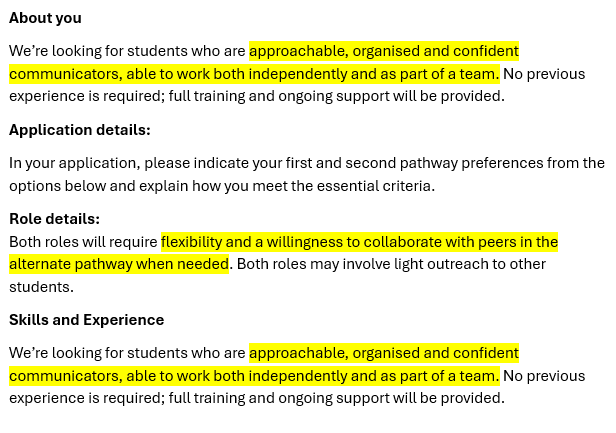
Now lets look at my current job I have landed from these three sets of experience. Here is part of the job advert below where I have highlighted the relevant skills I was able to match the skills I’d learnt throughout my various short term volunteering roles.
Would you have thought that any of the experiences I mentioned above could directly link to the peer coaching role? Neither did I until I broke them down into the skills and compared them with the job spec.
My final thoughts…
With each experience you complete I encourage you to identify the soft skills you gained from various experiences, look at direct courses or training you have completed and assess how can this be applied to your desired new role. And finally, use old contacts to reach out for references even if its been a while.
As you can see, micro placements and volunteer work of any kind, are not only useful but they are vital when searching for a job. Be patient and don’t forget to complete work like this so you have examples of different skills you have gained. Finally, never leave out these experiences form your job applications or CV- you are likely missing out on a wealth of transferable skills you haven’t even identified yet.
Exploring career options can feel like trying to explore a deep, dark and unfathomable cave. Vast and sprawling with gloomy, twisting tunnels and an intimidating maw for an entrance. That’s how I felt before I became a Careers Peer Coach. This was the torch I needed to provide light on job searching, careers planning and graduate schemes. I hope to share some tips to help guide your own journey into the cave of careers.
Spelunking (the sport of walking and climbing in caves) starts with a plan, and the earlier the better. Begin looking inwards, at what you want for your career. What are the current things you want to achieve this year? Maybe you want to secure a place on a graduate scheme, or an internship. Perhaps you’re considering your options of further study. It might be more immediate, as it was with me, you’re looking for a part-time job to gain some money.
Next, it’s time to figure out how to get it. That means exploring that cavernous world of careers. On the hunt for any sparkling gems that are exactly what you want.
Cavers need the proper equipment to explore the subterrain, to be safe and efficient. For those of us conducting careers exploration, we need the proper equipment too. That equipment comes in the form of the UWE Career Toolkit. If you’re looking for a tip or a trick to get you heading in the right direction, then there really isn’t a better place I can point you to than the Career Toolkit.
This is a nifty little web page that acts as guiding rope and as excavating pick for when you’ve found those hidden gems. On there are sections about work experience, placements, CVs and interviews, postgraduate options, international routes, the list is near endless.
If I could share one of those hidden gems it would be the PDF list found under the ‘Jobs & work experience by degree or occupation’ tab within the ‘Job-searching’ tile. These are a fantastic list of career options by study area that are worth a look. They contain advice on searching for jobs as well as links to employers who have provided graduate places or internships before. Take each tool out as needed and you won’t get lost.
Hopefully with the Career Toolkit in your pocket, you’ll be feeling confident and able to step into your own cave of careers and find your own sparkling solutions.
As a second-year postgraduate studying career development, I started mapping out my direction during my very first term. I knew I wanted to support students through coaching and mentoring in higher education. Because I got clear on that early, I kept a regular eye on the vacancies section in the UWE Careers Toolkit. When the Peer Coach role came up in March, I was ready to jump on it.
To build my confidence and practical skills, I also threw myself into hands-on experience: volunteering with Future Quest at UWE on widening participation activities, and working with an NGO to mentor a Year 12 student through their UCAS process. Combining campus outreach with external volunteering gave me a safe space to test theory in the real world, discover my strengths, and clearly pinpoint my blind spots.
Another resource in the Careers Toolkit that made a huge difference is free access to LinkedIn Learning. Whenever I wanted to build specific professional skills, such as coaching frameworks, psychology, or data analysis, I treated those courses as zero-pressure “tasters.” They’re a brilliant way to explore new fields, discover what you actually enjoy doing and earn digital certificates to back up your CV and LinkedIn profile.
If you want to make the most of this academic year without burning out, here are three practical tips that kept me on track:
Invest one hour a week in “future you”: treat career exploration like a scheduled module. Set aside one quiet window a week to browse UWE vacancies, update a CV draft, or watch a quick LinkedIn Learning module.
Prioritize by impact, not just deadlines: academic work will always expand to fill your day if you let it. Use a digital calendar or planner to protect specific slots for volunteering, work experience, and rest so your personal development does not get pushed aside.
Test the waters early: you do not need your whole life mapped out right now. Try a micro-volunteering role, join an NGO initiative, or take an introductory course to see if an area suits you before making big commitments.
Your degree gives you the qualification, but early action gives you the confidence. Log into the Careers Toolkit this week, pick one small goal, and give yourself a head start.
This July, I will be graduating with a bachelor’s degree, which feels surreal and unbelievable how fast three years went by. One thing that is for sure, I am leaving UWE with lots of memories and new experiences from all the opportunities I had as a student, a Student Career Coach and an IT Support Assistant.
My recommendation to students is to make use of all the resources available to you. Never say no to new opportunities, this is your chance to expose yourself to new experiences, make mistakes and find what you love to do and what you are best at! You never know where one “yes” might lead, so take the leap and avoid the regret.
Honestly? I don’t have everything figured out yet. I’m actively job hunting, keeping my options open, and trying not to panic about it, which is easier said than done! But working in the Careers Lounge showed me first-hand that most students graduate with the same exact feelings, and that eventually everyone finds their own path.
Besides my personal projects I have been working on for this summer, I am excited to be taking a break to rest, enjoy the summer and prepare for a new stage in life. I am writing this blog with high hopes that by the time you see this I will have secured a graduate role or possibly be pursuing a master’s degree.
Isa, Economics
It’s hard to believe how quickly the last three years studying Economics have passed. As I close this chapter, I am excited about what comes next and proud to be starting a graduate role in audit at a financial services firm in Bristol this September, where I will also be studying towards the ACA qualification to become a Chartered Accountant.
For now, my plan is simple: enjoy the summer, take a well earned break, and recharge after an academically intense final year.
Looking back, I feel incredibly grateful for the opportunities UWE has given me throughout my degree. Securing my graduate role was made possible through the UWE STRIVE internship programme, which I applied for during my first year. The experience not only helped me develop professional skills and confidence but also introduced me to a career path I had never previously considered, giving me valuable industry insight and a clearer understanding of the opportunities available after graduation.
I would also like to highlight my time working as a Student Careers Coach, a hugely rewarding part of my university journey over the last two years. It helped me strengthen my communication skills, connect with students from a wide range of backgrounds and disciplines, and gain a first-hand insight into all the support, programmes, and events available to students.
But my UWE journey is not quite over yet. This summer, I will be travelling to Kefalonia, Greece, with the Go Global team to take part in a conservation project helping to protect sea turtles, an experience I am incredibly excited about and a fantastic way to round off my time as a UWE student.
If I could offer one piece of advice to current students, it would be to stay open minded and make the most of every opportunity that comes your way. You never know where a single application, conversation, or experience might lead. Some of the most defining moments of my university journey came from saying yes to something new, even when it felt outside my comfort zone.
Amina, English Literature
I went into my third year of university feeling quite unsure about what I was going to do next. Although I knew I wanted to work in publishing, I was also considering continuing my education and pursuing a master’s degree. I quickly realised I did not want to go straight into another degree after graduation. I decided to hold off on applying for graduate jobs until I had finished all my assignments. Now that I have completed my degree, I feel much more confident and clear-headed about my plans for the future.
This summer, I will continue my volunteer position as an Inclusivity Officer with the Society of Young Publishers South West branch, while also working a temporary summer job here in Bristol. I am working on securing an entry-level role in publishing and continuing to build my creative portfolio.
My role as a Student Career Coach has been fundamental in transforming the way I approach applications and think about my career. It has allowed me to develop skills in coaching, adaptability, and relationship-building, while giving me more confidence in my own career decisions. Upon reflection, the role has had a significant impact on how I approach this next chapter after graduation.
Making the most of your summer: my internship experience and tips for planning ahead
When summer approaches, most students start thinking about a well-deserved break. But it can also be one of the best opportunities to gain experience, explore your interests and take a step toward your future career.
Last summer, after finishing my first year as an international student studying Software Engineering, I set myself one clear goal: I wanted to gain real work experience in my field. I knew it wouldn’t be easy. Many people told me internships are difficult to secure, especially after just one year at university. Still, I decided to try. I spent weeks searching and applying for opportunities and, like many students, faced plenty of rejections along the way.
Eventually, while browsing opportunities on InfoHub, I discovered the Strive Internship Scheme. The role aligned perfectly with my interests in IT and felt like the right opportunity to gain hands-on experience after my first year. I applied, and this time it worked.
That internship became one of the most valuable experiences of my summer. It gave me practical exposure to the industry, helped me understand how professional teams work, and allowed me to develop skills beyond what we learn in lectures. Most importantly, it gave me confidence in the direction I want my career to take.
If you’re thinking about what to do this summer, here are a few tips that helped me along the way:
Start planning early: try to think about your summer goals from the beginning of second term. This gives you enough time to explore opportunities and prepare strong applications.
Explore your options: your summer could include internships, volunteering, travelling, or learning a new skill. Think about what experience would benefit you the most.
Use the support available: the Career Toolkit is a great place to explore career paths, understand what employers are looking for, and improve your applications. If you need help with your CV, the Careers Lounge is always there to support you.
Don’t let rejection stop you: rejections are a normal part of the process. Each application is a chance to improve and get closer to the right opportunity.
Have a backup plan: if your original plan doesn’t work out, consider alternatives like volunteering, learning a new skill, or working on personal projects.
Whatever you decide to do this summer, try to make it meaningful. The experiences you gain, even the unexpected ones, can shape your future in ways you might not realise yet. Sometimes all it takes is an opportunity to change your direction. So, start exploring early, keep trying and make this summer count.
Make yourself something to be proud of after summer!
Postgraduate Study: should you go further or go first to work?
As a final-year student studying computer science and artificial intelligence, I’ve been debating whether doing a masters, or getting some industry experience is a better course of action. You’re not alone if you’re asking yourself the same thing. Students in every subject begin thinking about it at various stages of their development.
The opportunity to further specialize is one of the reasons I find postgraduate study appealing. A masters degree can help you advance your knowledge and differentiate yourself in crowded markets, whether you’re in the business, healthcare, AI, or creative sectors. Additionally, it can boost your confidence in research, improve your problem-solving abilities, and introduce you to professionals and scholars who have similar interests.
Nevertheless, it’s critical to consider the big picture. Additional research necessitates a substantial mental and financial commitment. It might involve postponing full-time work or committing to yet another demanding time frame with deadlines and tests. Industry certifications or real-world work experience may be equally, if not more, valuable than a degree for some occupations.
So how am I approaching the decision? Here are a few practical tips that could help you too:
Talk to people who’ve done it eg. students, lecturers, and professionals in your field.
Attend careers fairs and postgraduate events to understand your options.
Reflect honestly on your goals – are you passionate about deeper academic learning, or eager to apply your skills in real-world settings?
Research funding, scholarships, and flexible study routes before committing.
Mentoring and student leadership positions have taught me that there is no one “right path.” Both paths can lead to success; some choose to return after gaining industry experience, while others immediately enrol in postgraduate studies.
The option that best suits your objectives, learning preferences, and desired future is ultimately the best one. Remember that your journey doesn’t have to resemble anyone else’s, so take your time and consider your options.
As a final-year Law student at UWE, and someone who works as a Law PAL and Student Career Coach, I often spend a lot of time thinking about goals — setting them, changing them, and sometimes letting them go. One of the most important lessons I’ve learned is that career planning isn’t about having everything figured out early, but about giving yourself the space to explore and grow.
At the start of my degree, I felt pressure to know exactly where I was heading. Like many students, I thought choosing one clear career path early on meant I was “doing it right.” What I’ve since realised is that exploration is not a lack of direction, it’s part of the process. Trying new roles, attending careers events, and speaking to different people and teachers helped me understand what genuinely interested me and what didn’t.
How has goal setting helped me?
Goal setting works best for me when it’s flexible and broken into small, realistic steps. Instead of focusing on one big outcome, I concentrate on actions I can take now, such as:
These small goals feel achievable and are easy to do, which significantly help build confidence and motivation over time.
Of course, not all goals work out and that can feel disappointing. I’ve had goals that changed once I explored different options or learned more about certain career paths. Rather than seeing this as failure, I now see it as valuable learning. Each experience helped me understand myself better and make more informed decisions to help me in my career journey.
To stay organised, I use simple tools like a digital to-do list and a notes app to reflect on my progress. UWE Careers resources, talks with my teachers and lecturers, and one-to-one guidance have also played a huge role in helping me explore opportunities that I might not have considered otherwise.
It’s important to remember that your goals do not have to match the people around you, and you certainly do not need a perfect plan. It’s easy to compare yourself to others, but success is personal and looks different for everyone.
Be open to exploring. Set goals that suit where you are now, and allow them to change and grow as you do.
Reflection and self-awareness are skills that many people use every day without even realising it. They can be practised in every area of your life whether it be your studies, work experience, personal challenges or new opportunities. Reflection gives you the time and space to look at any situation, positive or negative, sit with it, break it down, and understand what you learnt. It helps you recognise how you handled things in the moment and how you might approach similar situations differently in the future.
As a final-year student at UWE, I’ve found I’ve naturally been reflecting on my time here before moving onto the next stage of my life, wherever that may be.
My time here has pushed me to develop skills both consciously and subconsciously, and it has allowed me to step out of my comfort zone in so many more ways than one. Reflecting is a habit I know I’ll carry forward because it strengthens communication, critical thinking and problem-solving. All qualities that employers value.
If you’re not sure where to begin with self-reflection, don’t panic! A simple structure I have learned during my degree that has helped me throughout university is asking myself three questions:
What? So what? Now what?
You might already be asking yourself these without even knowing it. Here is how each question can be broken down:
What? What happened? What did you do? What was the experience?
So What? What did it mean? What parts were easy or challenging? How did it make you feel emotionally? Did it match your expectations or differ from previous experiences? How did it impact you or those around you such as peers, colleagues and friends?
Now What? Moving forward, what would you do differently? What have you learnt? How will this shape your future decisions, actions or mindset?
Using these three questions can turn any moment you experience, from starting a new job, critical feedback or even a personal setback, into an opportunity for growth. Reflection isn’t about overthinking; it’s about pausing and allowing yourself time to recognise your strengths, understand your challenges and become more aware of how you want to develop in the future.
I have found since doing this that the more I practise, the more natural it becomes, and the more I have realised how valuable it is in every aspect of university, employment and beyond.
When I first moved to the UK as an international student, I arrived with big goals, and an even bigger list of people telling me, “It’ll be impossible to get work experience in your first year.”
After dozens of rejections from part-time jobs, it honestly felt true at times. But I kept my goal in mind: I wanted to secure an internship after first year, no matter how ambitious it sounded.
I applied to every opportunity I could find. Most of the time, the answer was no. But eventually, one “yes” changed everything and I landed an IT internship at the end of my first academic year.
That single experience opened the door to so many others, including becoming a Student Career Coach here at UWE and starting a Learning Experience Analyst internship with the School of Computing & Creative Technologies. None of this would have happened if I had given up early on.
Here are the biggest lessons I learned, which I hope will help anyone starting their career journey:
Build the right mindset The first challenge isn’t the application. It’s your mindset. Don’t underestimate yourself and don’t let other people decide what is or isn’t possible for you. If you want something, go for it.
Experience is more than job titles If you’re new and feel like you have no experience, think again. Projects, hackathons, volunteering, competitions and much more all count as experience so get involved! Volunteering especially is an underrated way to gain experience fast, develop real workplace skills and strengthen your CV.
Tailor every application Treat your CV and cover letter like your personal branding. Tailor them to each role by referring to the job description. One resource that helps me massively is CareerSet, available for free through Career Toolkit, it checks how well your CV matches the role and gives detailed feedback.
Don’t fear rejections. Use it. You might get rejected a lot. That’s normal. What matters is reflecting on what you can improve each time. Every application and interview is practice for the next one.
If you know your strengths, stay consistent, keep improving and opportunities will come. Believe in yourself, keep going and trust the process. You never know which application will be the life-changing one.