Here’s a quick guide to finding and balancing work alongside your studies:
What work can you do?
Anything you like! But if you’re looking for some ideas, here are some popular jobs among students:
Bar work offers flexible evening shifts that fit around lectures. However, be prepared for late nights and some challenging customers.
Hospitality jobs in cafes, restaurants, and hotels can be flexible around uni and may come with perks like free food. Just keep in mind the hours can be long and often involve being on your feet.
Retail jobs in supermarkets or shops include tasks like stocking shelves, serving customers, and working the till. They’re usually flexible and you can often get extra hours during busy periods like Christmas. Just be aware that weekend work is common and hours can vary.
Tutoring involves helping younger students with subjects like maths, English or science. It’s often online, so there are no travel costs, and the pay can be higher than other jobs. Just make sure you’ve got reliable internet and a quiet, private space to work from.
How do I find work?
Sort your CV – if you don’t have one yet, there are plenty of free templates online, and Save the Student has a helpful guide to writing a CV. The Careers Team here at UWE can also support you with CV writing and feedback.
Start your job search – look across a range of platforms to find part time jobs that suit you. Here are some good places to start:
Apply – make sure each application is tailored to the role. Read the job description carefully, highlight your relevant skills, and double-check for any errors before submitting. Keeping track of your applications can also help you stay organised.
Prepare for interviews – if you’re invited to an interview, research the company and be ready to talk about your experience, availability, and what makes you a good fit. The UWE Careers Team can support you with mock interviews and helpful advice.
Balancing work and study
Balancing a part-time job with your studies can be challenging, so here are some tips to help you manage:
– Be clear about the hours you’re available and check if your employer can accommodate them
– Ask if you’ll be able to take time off when needed, especially around exams
– Use a planner (digital or paper) to stay on top of your uni and work commitments
– Prioritise rest and relaxation. It’s important for your wellbeing as well as your studies
Why it’s worth it
A part-time job can bring in extra money, boost your CV and help you develop useful skills if it fits well around your studies. You could gain experience in teamwork, communication, and time management, while also building confidence and independence. The key is making sure it supports your student life, not overwhelms it.
through the UWE Bristol app, which gives you quick access to email alongside things like Blackboard and your timetable
If you use your phone to regularly check your emails, we recommend downloading the Microsoft Outlook app.
An overflowing inbox, with new emails coming in faster than you can delete the old ones, can feel like a lot. We get it. And we know you don’t want to be inundated with irrelevant information or unnecessary updates. Which is why we’re working hard to ensure that we are only sending you the stuff you need to know about.
However, email is still going to be one of your main communication channels as a student and it’s so important that you’re keeping on top of the different info being sent your way. Life as a uni student means taking on new challenges, and one of those might be having to manage a busy inbox for the first time.
Which emails should I prioritise?
Not every email needs an immediate response, but there are some you really shouldn’t leave sitting unread. Pay particular attention to emails about:
your course, modules or teaching
changes to classes or your timetable
assessments and academic information
registration or your student record
student finance
IT security, passwords or your UWE account
wellbeing, safety or important University updates
anything that specifically asks you to complete an action by a deadline
You’ll also receive emails at key stages of the year. These emails will include information about how you’re engaging with your studies, based on the data available to us, including your attendance at teaching sessions, assessment submissions and other study-related activity. We will also provide tailored information about the services we have here at UWE Bristol which are designed to help you succeed, so they’re worth opening rather than saving for “later”.
So, we’re here to help! The tips below will help you embrace good habits and become a pro at managing your emails:
Get organised – Create folders within your inbox so you can keep related emails together and find important information more easily. You could create folders for individual modules, society updates or correspondence with your landlord. When everything has a place, your inbox will feel much more manageable and less overwhelming.
Unsubscribe from emails you don’t need – You have the power to stop many unwanted marketing emails from reaching your inbox. If you no longer find a mailing list useful, take a moment to unsubscribe using the link provided. However, don’t unsubscribe from important university updates. These may include essential information about term dates, academic regulations, IT services, health and wellbeing support, and opportunities available to you. If an email looks suspicious, avoid clicking any links and report it as phishing instead.
Don’t let emails build up – Five unread emails can quickly become 50 if you keep putting them off. When you open an email, try to do one of three things: delete it, take action or file it. Don’t be afraid to delete messages you no longer need, but avoid leaving important emails sitting unread.
Set some boundaries – Having access to your emails on your phone can help you stay informed while you’re on the go. However, being connected around the clock isn’t always helpful. Try checking your inbox at set times during the day and consider turning off notifications when you’re studying, relaxing or getting ready to sleep.
Choose the right way to communicate – Not every conversation needs to happen over email. You could keep your university inbox mainly for academic and official messages, and use platforms such as WhatsApp or Teams for personal or social conversations. If a discussion with your lecturer becomes a lengthy email exchange, it may be quicker and easier to arrange a conversation with them instead.
Make the most of your inbox – Email platforms such as Outlook and Gmail include useful features that can help you stay organised, including folders, categories, filters, flags and automatic rules. Take a little time to explore online guides or tutorials and find the tools that work best for you.
Ask for help – These tips should make your university inbox easier to manage, but support is available if you get stuck. Visit the UWE Email webpage for further information and guidance.
Between finding your way around your new campus, meeting new people, and navigating student life, keeping on top of your budget can easily slip down the list.
Here’s a quick guide to help you manage your money while enjoying being a UWE Bristol student!
Local supermarkets
Bigger supermarkets are usually cheaper than the smaller corner shops, so it’s worth the walk. 💡Top tip: Lidl and Aldi are usually the cheapest, followed by ASDA, then Sainsbury’s (especially if you’ve got a Nectar card).
Below are some good options near your campus.
Frenchay:
ASDA Filton Superstore – located in the Abbeywood Retail Park (15-20 min walk)
Lidl – located on Fox Den Road (10-15 min walk)
Aldi – located on Fox Den Road (roughly a 15 min walk)
Sainsbury’s – located on Fox Den Road (around a 15 min walk)
Glenside:
Lidl – located on Fishponds Road (20-25 min walk)
Morrisons – located on Fishponds Road (20-25 min walk)
Iceland – Channons Hill (15 min walk)
City Campus:
Aldi – located on North Street (20 min walk)
Sainsbury’s – located on Winterstoke Road (25 min walk)
Getting around Bristol
There are lots of ways to get around, but buses are usually the cheapest and easiest.
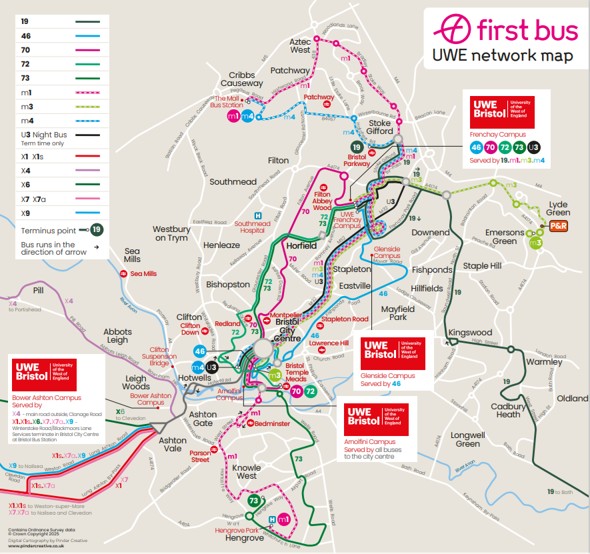
First Bus: First Bus is the main bus company in Bristol, it offers several routes connecting UWE campuses with the city centre and surrounding areas. The First Bus app has live bus times and a journey planner. As a student, you can get discounted ticket prices on the app.
M1/M3/M4 Metrobus: Metrobus services (M1, M3, M4) are rapid routes that connect Frenchay Campus to the city centre and Cribbs Causeway. They run late too, which is perfect for getting home after a night out.
You can also hire e-scooters and e-bikes around the city which are great for quick trips and easy to use. Just download the Dott app, ensure you’re signed up for student discount, find a ride nearby, and go 🛴.
Food and drink on campus
Making your own food is always the cheapest option, but we get it, Freshers’ Week is hectic. Check out how to keep your food and drink spend low on Frenchay campus, Glenside Campus and City Campus.
And of course, if you’ve been organised and got yourself to a supermarket, here are some great student-friendly recipes to get you started: BBC Good Food or Mob’s Easy & Cheap Student Recipes.
Take a look at the video above by our Disability Team on the 10 things you need to know.
1. You belong at UWE Bristol
We welcome disabled students at UWE Bristol. Around 10,000 students have disclosed a disability, long‑term health condition, mental health condition, or are neurodivergent. Being disabled is a normal part of our student community, and support is available to help you take part fully in your course and university life.
Please ensure that you apply before 14:00 on the original deadline date. Requests that are received during the late submission window will not be accepted.
5. If you want to inform your teaching staff, create an impact statement
An impact statement is a short paragraph that explains how your disability affects you in your studies. It helps your teaching staff understand what support you might need, without you having to explain your situation repeatedly.
Take a look at our example impact statements and create one that works for you.
6. You need to keep a check on your disability information on MYUWE
You can view your disability information on MYUWE, including:
your disability disclosure(s)
your impact statement
any reasonable adjustments that are in place
You can check this information as soon as you are registered. It’s worth checking regularly and letting us know if anything needs updating.
7. You can apply for Disabled Students’ Allowance (DSA) if you’re eligible
If you’re a UK student, you may be eligible for Disabled Students’ Allowance (DSA). This is government funding that can pay for:
specialist equipment (for example, software or ergonomic equipment)
study‑related support
training to use the equipment
The process includes a needs assessment to look at what will help you most. Apply for DSA >
8. Library and placement support is available to you
The Library offers a range of inclusive study support, including:
accessible learning resources (including alternative formats)
skills sessions open to all students
one to one help and guidance on all aspects of using the library, study skills and assistive technology
If you are on a Health or Education programme that has a professional placement element and you are a disabled student or the primary carer of a disabled person, support is available:
If you are concerned about your mental health on placement, please find advice and strategies in our wellbeing placement guidance: Wellbeing placement guidance
If you need bespoke reasonable adjustments to access your placement, please speak to your tutor to request an Access to Placement Plan. They will have a detailed conversation with you to discuss any barriers.
9. Careers support for disabled students
UWE Careers and Enterprise offers tailored support for disabled students, including guidance on:
Developing your career ideas and making plans
Access to work, and finding work and placements
Talking about disability in applications or interviews and sharing your needs with employers
UWE Students’ Union clubs and societies aim to be inclusive and accessible. All of our sports clubs and large societies have a Participation and Equality Officer who can help with access arrangements and make sure you can get involved in activities you’re interested in.
Each year, the Students’ Union has a Disabled Students’ Officer who represents disabled students and works to improve access, inclusion, and student experience across UWE.
They can raise issues affecting disabled students, work on campaigns and projects and help make change happen.
Use MyStudentLife to get in touch with us or to submit information or make a request.
Join the Student Advisory Group: We have a group of disabled students that take part in a variety of discussions/surveys to help improve the disabled student experience. Find out more
The summer before joining university feels like a blur; one minute you’re celebrating the end of an era with your friends, and the next minute you’re anticipating the big “unknown” as you embark on the next chapter of life.
We understand that it’s a lot to get your head around, which is why we’ve spoken to 3 students who have been through it before. Who better to describe the first-year whirlwind than Julian, Xenia and Tareem. See what they had wish they’d known and what advice they have for you…
Meet Julian Scerri, second year Optometry MSCI student 👀
“My first year at UWE Bristol has been a great experience. My course has been both challenging and rewarding, and I’ve really enjoyed developing practical skills alongside the academic side of the course. The course is very hands-on and well-structured to prepare you for the real world. I wish I had known that it’s completely normal to feel overwhelmed at first.
Everyone is adjusting, and once you settle into a routine and meet people on your course, university quickly starts to feel like home. I was surprised by how much independent learning there is. There aren’t as many lectures as there were back at school, so you’re expected to put in a lot of work in your own time. It’s important to manage your time well, but the lecturers are always there to support you whenever you need help.
“I expected the workload to be a lot more overwhelming, but realistically I still had plenty of time outside the course to relax and do the things I enjoy.”
Alongside my studies, I continued competing internationally for Malta in squash, travelling to tournaments across Europe while representing both my country and UWE. Balancing sport and university wasn’t always easy, but the support from my course staff made sure I never fell behind and helped make everything as manageable as possible.
I’m really proud of what I’ve achieved in my first year, and I’m excited to see what second year brings.”
MeetTareem Asfour, final year Biomedical Science BSC (Hons) student 🔬
“I wish I had known that one day I’ll have everything figured out and not to stress about it from day one. Everyone starts university feeling the same: lost, confused, and lonely.
But, things do get much easier.”
“Be open to meeting new people, embracing new cultures, and learn to ask for help when you need it-whether it’s with your course or just adjusting to university life.
I was surprised by how friendly everyone is. As an international student, I expected to feel lonely throughout most of my first year. However, everyone is in the same boat as you and is keen to make friends.
Those connections made settling into university much easier than I had expected. I think the key is to keep your priorities in mind and find a routine that works for you. I make sure to attend all my lectures and take notes, which I review when I get back to my accommodation. Outside of exam season, I try to study for at least one to two hours a day while also making time to go to the gym and spend time with my friends. Finding that balance has made university much more manageable.”
MeetXenia Giagli, final year Mental Health Nursing BSC (Hons) student 🏥
“Studying a demanding nursing course, which includes placements and a longer duration than other courses, hasn’t been easy but it has taught me how to manage my time effectively and build a healthy routine. I prioritise recharging on the weekends and taking care of myself in order to have a full battery for a busy week ahead.
I take walks in nature, and try to eat and sleep well whenever I can which improves my mental health and resilience.
“Having things planned beforehand has been a major tool in maintaining a healthy study/social balance on the busiest of weeks.”
I was surprised at the relationships I was able to build with lecturers and how approachable and friendly they are. My lecturers have been with me every step of the way. My personal tutor has been very helpful whenever I had an issue, no matter how small or big.
I wish I had known how much support there is to help you settle into student life, meet new people and join events and societies. I was very scared at first, but I have since figured out there is a great deal of help available for students, including the Student Life team, socials for neurodivergent and disabled students and all sorts of interest-based societies so that everyone can feel included and welcomed to the university.”
If you’re feeling nervous, excited, overwhelmed or all the above, we have plenty of support available:
A new digital platform designed to make it easier to access support and manage everyday university life has launched for students.
MY STUDENT LIFE brings together a range of resources, information and support services in one place, helping you find what you need, when you need it. Through the platform, you can access guidance relating to your course and timetable, disability support, wellbeing, money matters, coaching options and much more.
The new platform also allows you to track enquiries you have submitted and find answers to frequently asked questions, giving you greater visibility and control over your student experience. By bringing key services together in a single location, MY STUDENT LIFE makes it easier to navigate university life and access support quickly.
Over time MY STUDENT LIFE will become a central hub, allowing you to access different types of support and to book appointments with Student Support Advisers and Student Experience Coaches.
MY STUDENT LIFE sits alongside MYUWE which remains the place to enrol, update your personal details and view your timetable.
From 3 August 2026 you can log in and start exploring.
The team behind the platform is already exploring additional features and functionality, with further developments planned in response to student feedback and changing needs throughout the academic year. If you would like to get involved in user experience testing and feedback sessions, email: ux@uwe.ac.uk
The start of the academic year can be a busy time as you get settled into student life at UWE Bristol.
This handy guide features some of the most commonly-asked questions to support new and returning students. And remember, if you still need an answer to your question, submit an enquiry on My Student Life.
After you enrol in MYUWE, you’ll be able to access your timetable. Once enrolled and providing timetables have been published, they will show in MYUWE 3 working days later. Your Starting Block timetable will appear automatically.
New students: If you’ve uploaded a photo to MYUWE, your card will be ready 2 working days later from the campus you study at, unless otherwise advised.
I’m confused by the room numbers – how do I find the right room?
If it says on your timetable you’re going to room 2S706, then you’re looking for 2 – Level 2; S – S Block (all blocks have a block letter outside the entrance); 706 – room number. If you have any problems finding your way around, use this campus map.
If I have a question about something where can I go?
You can find an answer or submit an enquiry on My Student Life. Staff at our InfoPoint will also be happy to help you. You can find it in D Block – 1D11.
Life at City Campus 🎨
Where do I catch a bus to town?
We recommend catching buses from Blackmoors Lane rather than anywhere else as they are much more frequent there.
How do I get between Bower Ashton, Arnolfini and Spike Island?
There’s no UWE parking at Arnolfini or Spike Island, so you might want to consider public transport, cycling or walking. Check out this handy cycling map for guidance. If you need help getting around Bower Ashton you can use this map or our interactive map.
Can I park at Bower Ashton?
There’s very limited parking at Bower. If you’re going to park here, you need a permit. If the car park is full, you can try Ashton Court just up the hill (although that’s not free). There’s no UWE Bristol car parking at Arnolfini or Spike Island – you’ll need to use public car parks.
If I have a question about something where can I go?
You can find an answer or submit an enquiry on My Student Life. Staff at our InfoPoint will also be happy to help you. The Bower Ashton one is B Block, opposite the Art Shop. There’s also one on the fourth floor of the Arnolfini.
How can I print?
You can print ordinary things like A4 black and white via Pharos. You’ll be given £15 on your account at the start of the year.
If you want to print something more specialist, visit the Digital Print Bureau in 0C008.
Where can I use specialist software?
There are loads of opportunities for you to access specialist software, depending on what you need it for. This includes the library, and specialist computer suites in D Block, G Block and B block at Bower Ashton, as well as software at the Arnolfini and Spike Island.
Where can I buy art supplies?
Go wild in the Art Shop! You get an £80 materials allowance each year and you can use it at the Art Shop or the Digital Design Studio.
I’ve lost something – where might it be?
Everything makes its way to the Security office in F Block, check here first! Or email uwecard@uwe.ac.uk to find out if something is there.
Life at Glenside 🏥
I’m so confused by the room numbers – how do I find the right room?
If it says on your timetable you’re going to room 1F06, then you’re looking for 1 – Level 1; F – F Block (all blocks have a block letter outside the entrance); 06 – room number. If you have any problems finding your way around, use this map.
How do I order my placement name badge?
New student: If you’ve completed your online registration, a placement name badge will be ordered for you and it’ll be issued at one of your teaching sessions before you start your simulation skills sessions.
Returning student: If you need a replacement placement name badge, email the team and they’ll order one for you and email you when your badge is ready to collect.
How do I order my placement uniform?
If you’ve completed your online registration in MYUWE, you’ll be emailed details of how to order your placement uniform during induction week. If you’ve registered and haven’t received the email, contact the Information Point.
Are there showers and changing rooms at Glenside?
Yes! These can be found in 1E06 and 1E09. You can ask Glenside Reception staff for a code to access the rooms – you’ll need to show your student ID card.
Are there student lockers at Glenside?
Lockers for short term use are available in the changing rooms in 1E06 and 1E09. To hire a locker for long term use, please email travel.plan@uwe.ac.uk to request one.
I’ve just started my course at Glenside – I applied for the NHS LSF Training Grant, when will I receive my first payment?
You’ll receive it in November, if:
you started your course in September
you’ve completed your student online registration.
We’ll confirm your attendance to the NHSBSA in early November to release the funds to you. It can take up to 10 working days for payment to be processed once we’ve confirmed your attendance.
I have a timetabled teaching session in room 0SC014 at Glenside – where is it?
0SC014 is located at the back of the Glenside Student Centre (old Student Union) building. It is the big brown wooden building located near car park 10.
How do I contact the Accommodation Office at Glenside?
Glenside Accommodation Service office is located near the Hub in 1H29. Reach them here.
How can I contact Occupational Health Service at Glenside?
If I have a question about something, where can I go?
You can find an answer or submit an enquiry on My Student Life. Staff at our InfoPoint will also be happy to help you. You can find it in Glenside Library in D Block.
Your Course 🎓
I already feel like my course isn’t right for me? Can I switch?
Please don’t rush into a decision, it sometimes takes a while to settle in to university life. First, chat to your programme leader or your academic personal tutor and explain to them what you’re struggling with. They can offer support and guidance. If you’d like more in-depth advice about your options, you can get in touch with a Student Support Adviser.
The Students’ Union runs a student rep system, and ideally look for one student rep for every 25 students on your year of study on your course. They are usually chosen at the start of the academic year, so speak to your programme leader about this if you haven’t already received information about it.
I’m struggling with my course? I feel like I’m behind with the work and need some support.
Use the resources of the UWE Bristol Student Money Service. They have plenty of online information as well as an enquiry form to support and advise you. There are additional resources on Money and Finance, including an enquiry form for tuition fee issues.
My rent is really high and I can’t afford it/I’m struggling with money. What can I do?
Firstly we advise students to apply for all the funding they are eligible for from Student Finance and then apply for the Student Support Fund. Many students also choose to take on part-time work alongside their studies, and sign up to Blackbullion for free money education.
I haven’t managed to find anywhere to live. Who can help me?
Don’t panic – there’s lots of help out there to make sure you find somewhere to live. The Students’ Union can support you, so check out their advice pages.
I’m struggling with my housemates and I really want to move.
I need some help for my mental health. Where can I get the support I need?
If you’re struggling with your mental health and wellbeing then please don’t hesitate in reaching out for support. Download the Wisdom app, which offers live chat and video calls with counsellors. Also check out our Wellbeing Service webpage which includes a range of self-help resources and guidance.
I’m concerned about my drug or alcohol use at the moment, and really feel like I could do with some help.
UWE Bristol does not condone or condemn the use of drugs including alcohol; we are focused on providing students with the knowledge to be safe and feel supported. We operate a policy of harm reduction that prioritises the welfare and wellbeing of our students and wider community. We have a free Drugs and Alcohol Service if you would like support from a professional.
I’m looking for support following sexual assault?
We have an Anti-Sexual Violence Service here at UWE Bristol which provides a non-judgemental, inclusive and confidential safe space for you to seek support if you have experienced sexual trauma of any kind, even if you don’t want to report something.
Disability Support 🫱🏼🫲🏾
I have a disability and feel nervous about how this will be managed during my time at university.
Please don’t be nervous, there is a whole range of support available to you. If you haven’t already done so, make sure you have disclosed your disability to the Disability Service. This Disability Support Guide covers everything you need to know.
I am neurodivergent, and would like to know what support is available to me.
I want to start thinking about my future career, as well as looking for part-time work or internships while I study. Who can help with this?
There are so many opportunities available here for you at UWE Bristol:
You can find part-time and term-time roles that work around your studies by visiting the JobShop.
InfoHub is your first stop for careers advice, job listings, and help finding internships.
I want to start thinking about my career in the creative industries – how can I do this?
Learn how to talk about your creative skills and experience in a way employers understand. We offer regular sessions to explore freelancing, running your own business, building your CV, covering letters, and confidence. UWE Careers & Enterprise Padlet
Use our Showcase website to develop your online presence and portfolio.
For many students, summer is something to look forward to; a break from deadlines, lectures and early starts. But for others, it can feel somewhat difficult.
Whether you’re staying in Bristol while friends head home, or returning to a family environment that feels a bit complicated, loneliness can show up in ways you might not expect.
If you’re staying in Bristol this summer
A quieter campus and fewer familiar faces can feel isolating. But Bristol is still very much alive over the summer and there are ways to stay connected, often without spending much money.
Find low-pressure ways to meet people Look for relaxed, drop-in style activities where there’s no expectation to already know anyone.
Create your own routine Without the structure of lectures, days can blur together. Try building small activities into your week. For example:
A regular study or job-search block
A weekly trip to a café (Stokes Croft and Park Street have lots of great options)
A set time for exercise or a walk
Do something that gets you around people (without pressure) Even being around others can help you feel less isolated, even if you don’t know them personally. For example:
Visiting Bristol Museum & Art Gallery
Spending time at St Nicholas Market
Sitting with a book or laptop at a busy café
If you’re going home (and it feels complicated)
Going home isn’t always a simple or comforting experience. Family dynamics, expectations, or feeling like you’ve changed while everything else hasn’t can all contribute to anxiety or loneliness.
Set realistic expectations It’s okay if things don’t feel perfect. Try to avoid putting pressure on yourself to have a ‘perfect summer’ or to fix long-standing dynamics in a short time.
Keep part of your independence Maintaining small elements of your university routine; whether that’s going for a solo coffee, continuing hobbies, or setting aside time for yourself can help you feel grounded.
Stay digitally connected Regular messages, voice notes or video calls with friends in Bristol or elsewhere can remind you that your support network is still there and that these periods of time are just temporary
Small steps that can help, wherever you are Loneliness isn’t always about being physically alone, it’s about feeling disconnected. The good news is that even small actions can help rebuild that sense of connection.
Reach out to existing or old friends in your hometown Sending a simple message like “How are you getting on?” can often lead to more connection than you expect.
Limit comparison Social media can make it seem like everyone else is having an amazing summer. Remember, social media isn’t real: you’re only seeing a highlight reel.
Know when to ask for support If loneliness starts to feel overwhelming or persistent, it’s important to speak to someone.
In March 2026, The Students’ Union at UWE partnered with Bristol Drugs Project (BDP) to launch a new drug testing kit pilot across Frenchay and Bower Campuses. The pilot runs on a drop-in basis so students can come along to a pop-up at a campus site of their choosing.
We launched this pilot following conversations with students at various drug and alcohol events and via online interactions, whereby they expressed an interest in testing kits. This shows a growing awareness among students of the risks associated with substance use, a desire for practical tools to mitigate those risks and the confidence and knowledge that this is a safe environment to do so.
During drop-in sessions, students picking up a kit will get the chance to speak to a practitioner from BDP for around 5 to 20 minutes (dependant on how many questions they have) who’ll ask them about their experiences with taking and testing drugs. They’ll also be shown how to use a reagent kit and be offered advice on how to interpret the result and risks associated.
The first session saw a high level of engagement at Frenchay Campus, with 30 reagent kits distributed and 17 students engaging in conversations about drug safety and harm reduction. Students not only took kits for themselves but took them home for friends.
Our second session was over at Bower Ashton Campus where we had 10 students engage in conversations and over 15 kits were given out.
If you’re interested in picking up your own at home reagent testing kit come along to one of our next pop-ups:
Making the most of your summer: my internship experience and tips for planning ahead
When summer approaches, most students start thinking about a well-deserved break. But it can also be one of the best opportunities to gain experience, explore your interests and take a step toward your future career.
Last summer, after finishing my first year as an international student studying Software Engineering, I set myself one clear goal: I wanted to gain real work experience in my field. I knew it wouldn’t be easy. Many people told me internships are difficult to secure, especially after just one year at university. Still, I decided to try. I spent weeks searching and applying for opportunities and, like many students, faced plenty of rejections along the way.
Eventually, while browsing opportunities on InfoHub, I discovered the Strive Internship Scheme. The role aligned perfectly with my interests in IT and felt like the right opportunity to gain hands-on experience after my first year. I applied, and this time it worked.
That internship became one of the most valuable experiences of my summer. It gave me practical exposure to the industry, helped me understand how professional teams work, and allowed me to develop skills beyond what we learn in lectures. Most importantly, it gave me confidence in the direction I want my career to take.
If you’re thinking about what to do this summer, here are a few tips that helped me along the way:
Start planning early: try to think about your summer goals from the beginning of second term. This gives you enough time to explore opportunities and prepare strong applications.
Explore your options: your summer could include internships, volunteering, travelling, or learning a new skill. Think about what experience would benefit you the most.
Use the support available: the Career Toolkit is a great place to explore career paths, understand what employers are looking for, and improve your applications. If you need help with your CV, the Careers Lounge is always there to support you.
Don’t let rejection stop you: rejections are a normal part of the process. Each application is a chance to improve and get closer to the right opportunity.
Have a backup plan: if your original plan doesn’t work out, consider alternatives like volunteering, learning a new skill, or working on personal projects.
Whatever you decide to do this summer, try to make it meaningful. The experiences you gain, even the unexpected ones, can shape your future in ways you might not realise yet. Sometimes all it takes is an opportunity to change your direction. So, start exploring early, keep trying and make this summer count.
Make yourself something to be proud of after summer!