Making connections more meaningful

Posted on

We’ve all struggled to connect with other people at one time or another, and university is usually the first step out of the bubble of school or college. Ironically, sometimes the more people you’re surrounded by, the easier it can be to feel lonely! 

The small, everyday interactions you have all help build a sense of community and belonging. Connecting with people, in whatever capacity, supports your wellbeing – regardless of the number of people you consider friends. In fact, research shows that social connections are just as important to your overall health as exercise is. 

But how often do you wish you could skip the small talk and go straight to being friends with someone? It’s easier to bond over shared interests or experiences, so if you’re already signed up to events, societies or MOVE activities, you’re already on your way. If you’re not, and your study schedule allows, why not try one? 

Prefer something quieter?

You don’t need to drink, go clubbing or attend a huge event to meet people. Quieter, low-pressure activities can make it easier to talk naturally and find people with similar interests. 

  • Try a daytime society taster, creative workshop, volunteering session or MOVE activity.
  • Invite someone from your course or accommodation for a coffee, lunch, a walk or a study session. 
  • Look for alcohol-free events and smaller activities where there is already something to focus on. 
  • If large groups feel overwhelming, aim for one small interaction at a time – saying hello before a lecture still counts. 

Tips for small talk

The art of small talk is important though, and a skill that will benefit you in your university, personal and professional life, so here’s our top tips to help:

  • Ask open-ended questions. Instead of “did you have a good weekend”, you could ask what someone got up to during it – maybe it’ll turn out you did something similar, or they’ve visited that new spot you’ve been meaning to go to.
  • And then actually listen to the answers! (This one’s important)
  • If you’re asked questions, avoid super short answers; it’s hard to take a conversation anywhere if you don’t give the other person anything to work with. You don’t need to share anything you’re uncomfortable with, but adding a little extra detail can keep the conversation going a little further than just “good thanks, you?” “yeah good, thanks”
  • Respect boundaries. For example, if someone clearly doesn’t want to talk about their family, or dating life– don’t push them to.
  • Don’t take things too personally. You may have caught someone when they just don’t fancy a chat (with anyone), so don’t let this put you off altogether.
  • Be in the moment. Put away your phone – unless it’s relevant to the topic at hand (hello, cute pet pics)
  • If you compliment someone, make sure it’s genuine. Compliments are a great way to start a conversation, or simply brighten someone else’s day – but insincere compliments can have the opposite effect.
  • Make plans with (potential) friends. Especially when everyone is managing a busy workload (or out on placement), it can be easy to shut yourself away a bit. Taking breaks is important though, so factor them into your study schedule and hit two birds with one stone. Had a brief chat with someone after a MOVE class? – ask them if they’re coming to the next one!
  • If you identify as neurodivergent, then come along to one of the Thinking Differently cafes if you haven’t already.
  • Finally – don’t be afraid to get out of your comfort zone, and keep at it! The more you practise, the easier it’ll feel and the more resilient to awkwardness you’ll be. Often the most confident people in the room once felt (or still feel) shy inside!

Connections don’t always develop into friendships, but it’s not all or nothing – a variety of relationships of all different types makes life more fulfilling and interesting.

Good luck!

How to not spend all your money in the first weeks of uni

Posted on

Between finding your way around your new campus, meeting new people, and navigating student life, keeping on top of your budget can easily slip down the list.

Here’s a quick guide to help you manage your money while enjoying being a UWE Bristol student!

Local supermarkets

Bigger supermarkets are usually cheaper than the smaller corner shops, so it’s worth the walk. 💡Top tip: Lidl and Aldi are usually the cheapest, followed by ASDA, then Sainsbury’s (especially if you’ve got a Nectar card). 

Below are some good options near your campus. 

Frenchay:

  • ASDA Filton Superstore – located in the Abbeywood Retail Park (15-20 min walk)
  • Lidl – located on Fox Den Road (10-15 min walk)
  • Aldi – located on Fox Den Road (roughly a 15 min walk)
  • Sainsbury’s – located on Fox Den Road (around a 15 min walk)

Glenside:

  • Lidl – located on Fishponds Road (20-25 min walk) 
  • Morrisons – located on Fishponds Road (20-25 min walk) 
  • Iceland – Channons Hill (15 min walk) 

City Campus:

  • Aldi – located on North Street (20 min walk) 
  • Sainsbury’s – located on Winterstoke Road (25 min walk) 

Getting around Bristol

There are lots of ways to get around, but buses are usually the cheapest and easiest.

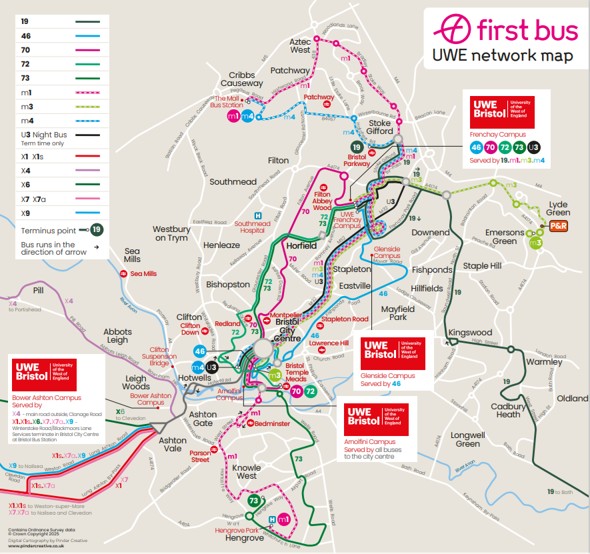
First Bus: First Bus is the main bus company in Bristol, it offers several routes connecting UWE campuses with the city centre and surrounding areas. The First Bus app has live bus times and a journey planner. As a student, you can get discounted ticket prices on the app.

May showing the First Bus UWE network of routes between campuses and key parts of the city.

M1/M3/M4 Metrobus: Metrobus services (M1, M3, M4) are rapid routes that connect Frenchay Campus to the city centre and Cribbs Causeway. They run late too, which is perfect for getting home after a night out.

You can also hire e-scooters and e-bikes around the city which are great for quick trips and easy to use. Just download the Dott app, ensure you’re signed up for student discount, find a ride nearby, and go 🛴.

Food and drink on campus

Making your own food is always the cheapest option, but we get it, Freshers’ Week is hectic. Check out how to keep your food and drink spend low on Frenchay campus, Glenside Campus and City Campus.

And of course, if you’ve been organised and got yourself to a supermarket, here are some great student-friendly recipes to get you started: BBC Good Food or Mob’s Easy & Cheap Student Recipes. 

Essential tips for international students settling into life in the UK 

Posted on

Moving to a new country is exciting… but it can also feel overwhelming. Here are some simple tips to help you settle in and make the most of your experience. 

And if you’re starting with us in September 2026, you can join our International and EU student orientation programme, where you can meet other students and get help with settling into university life in the UK.

Get familiar with your local area 

Take some time to explore your campus and the amazing city you’ve chosen to study in! 

Feeling confident about your surroundings can help you feel at home more quickly. Find out where the nearest supermarkets, pharmacies, banks and transport links are.  

Most large supermarkets in Bristol have an international food aisle plus there are lots of international supermarkets across the city!  

Manage your finances 

Keep track of your spending and remember to plan for essentials such as accommodation, food and travel. Setting up a UK bank account and creating a budget can make daily life much easier. Plus the Blackbullion app is a great way to budget – and enter student competitions! 

Build new connections  

As you settle in, keep connected with friends and family back home – but be sure to make the most of the opportunity to meet new people. 

  • Our Student Life team host a huge range of events both on and off campus.  

Don’t be afraid to start conversations! There will be lots of other students feeling how you feel, so why not make the first move and say hi? 

Look after your wellbeing 

As you settle into new routines, make sure you’re eating well, getting enough sleep and regular exercise. It might sound obvious, but these will help you settle in and feel your best. 

If you’re feeling homesick or stressed, we recommend the Wisdom app. It’s free to download and is available 24 hours a day, 365 days a year. It’s here for when you’re feeling anxious, stressed, or just need some inspiration to manage your wellbeing. You can talk to a counsellor via WhatsApp or a call. 

Embrace your new home 

Trying local food, exploring nearby attractions and learning about UK traditions can make your experience more rewarding.  

At the same time, celebrate and share your own culture with others – diversity is one of the things that makes uni life so special. 

Most importantly, be kind to yourself 

Settling into life in the UK will take some time and that’s ok. Pace yourself and enjoy it!  

Renters’ Rights Act – what you need to know

Posted on

From 1 May 2026, there are important changes coming into action for people that rent in England. With a lot of students at UWE Bristol renting from the private market, these could affect you now and in the future.

This is guidance, not legal advice. If you’re ever in doubt about your tenancy, you can contact the Students’ Union Advice Centre.

Who will these changes affect?

These changes will affect anyone who has an assured tenancy, or an assured shorthold tenancy (AST). ASTs are a type of tenancy that run for a fixed term, such as twelve months. If you are renting your student house privately from a landlord, you likely have an AST. 

If you live in social housing, in university housing, or as a lodger, the new rules will not apply. 

University housing and purpose-built student accommodation (PBSA) that is covered by an approved code of practice, have common law tenancies or licences to occupy, not an AST. You will still need to follow the processes laid out in the terms and conditions of your agreement. 

What key changes are happening?

In short, these are the key changes that are coming into place on 1 May 2026: 

  • Landlords will need a legal reason to evict you. The Act will end Section 21 eviction notices, aka ‘no fault evictions’. For student renters, there will be a new way for landlords to give notice to their tenants called a Ground 4A notice. 
  • Your landlord can only put your rent up once a year, and they must give two months’ notice. You will also be able to dispute it at a tribunal and cannot be evicted for challenging it. 
  • Fixed term contracts will end, and everyone will move to a ‘periodic’ or ‘rolling’ contract. 
  • You will need to give at least two months’ to end your tenancy unless an alternative is pre-arranged.  
  • You can request to keep a pet in your home, and your landlord will only be able to say no if they have a good reason. 
  • Deposits or rent in advance payments will be capped at one month’s rent. 
  • Bidding wars will be banned for rental properties. 

Can my landlord still end my contract?

While Section 21 evictions won’t be allowed anymore, landlords can still ask you to leave the property in certain situations using a Section 8 notice: 

  • You owe rent. 
  • Your landlord is selling or wants to move back into the property. 
  • If you or your housemates have committed anti-social behaviour. 

For students, there are also Ground 4A notices. These are designed to let students living in houses of multiple occupancy (HMOs) leave at the end of the academic year. There are still rules they will need to follow to put this into place: 

  • All tenants will be, or will become, full-time students during the tenancy. 
  • The landlord must be re-renting to a new cohort of students in the new academic year. 
  • The notice must be given four months in advance and specify a date in June to September for when the landlord wants the students to move out. 

If you are not issued with a Ground 4A notice, you’ll need to give two months’ notice before you move out. You might be able to arrange a shorter notice period with your landlord, but two months’ is the new standard. So, if you want to move out in June, you’ll need to give your notice in April. 

How will this affect my current tenancy?

Because the changes are coming in during most students’ tenancies, your landlord will send you information about the Renters’ Rights Act. These will go into effect from 1 May 2026 so will likely impact the end of your tenancy. 

The key thing is to plan in advance and do not assume your old fixed-term end date still applies. You will need to give your two months’ notice yourselves unless an agreement has already been reached. To make sure your notice is valid: 

  • Put it in writing with the date you intend to end the tenancy and vacate the property. 
  • Give at least two months’ advance notice. 
  • End it on the last day of a rent period. This will be the day before monthly rent is due. 

I’ve already signed my contract for next year. What will happen now?

If you already signed an assured tenancy or AST for the next academic year, it will still be valid. Your landlord will need to provide you with a written statement by 31 May 2026 detailing the changes to your rights and how it will affect your tenancy. 

Will I still need a guarantor?

Because of the cap, it is likely that landlords will rely more on guarantors. The rules around guarantors won’t be changing. 

For international students, getting a guarantor can be tricky because of the requirements. There are guarantor agencies that will act on your behalf. These services charge between 4% and 20% of the total rent, so it can vary significantly between agencies. It’s well worth shopping around to get the best deal to suit you and your needs. 

I want to leave my shared house. How should I end my tenancy?

Everyone who signs the agreement will enter a joint tenancy. This means if one person wants to leave it will end the agreement for everyone. 

Now, before you panic, this doesn’t necessarily mean everyone will need to move out. Discuss this with your housemates and landlord to explore options for continuing with a replacement tenant and a fresh tenancy agreement for those staying. 

Can I bring my pet?

Yes, under the new Act you can ask to have a pet once you have moved in. Your landlord will need to give a good excuse, with evidence, why they are refusing your request. 

However, there are still things need to be considered. Can you fit caring for your pet around your studies and lifestyle? How do your other housemates feel about having a pet? Are the house, garden and neighbourhood appropriate for your pet? Having a pet is a big commitment and shouldn’t be taken lightly. 

How will this affect renting in the future?

We’re not sure how this will affect the rental market just yet, but these changes will help strengthen tenants’ rights overall. 

The Renters’ Rights Act also means that HMO landlords will not be able to require students to leave the property if they sign students up more than six months before the moving in date. This means that the searching and signing part of finding your student house will likely move to the spring months so landlords can issue Ground 4A notices. This will hopefully stop landlords and agencies pressurising students to make a commitment too early, before they have had a proper chance to look at the market and get to know potential housemates. 

Tips for Surviving the UK winter: Guide for International students

Posted on

Priya Dashini Selvanathan is currently studying a Master’s in Health Psychology and is a Mature Student Advocate.

My idea of winter came straight from the movies, picturing myself sitting in a nice, cosy café, people watching and enjoying the slow, cosy pace that it brings along. However, as someone who has been living in a tropical country like Kuala Lumpur, Malaysia, my perception of experiencing my first winter in Bristol was far from ideal.

I had to deal with homesickness, staying on top of back-to-back deadlines and on top of that learning the art of layering and dressing for the cold. My energy plunged with the temperature, my mood was consistently low, and the constant stress was a physical weight—I finally understood the reality of seasonal depression.

Looking back, one thing that helped me survive my first winter in the UK was the connection with peers, and engaging with free events available at the University, as well as free events around Bristol.

My top 3 tips are:

  1. Connection
    It is easy to stay in and feel overwhelmed to venture out. I noticed that slowly stepping out of my comfort zone and interacting with my coursemates and other international students helped me feel less lonely. I arranged a few coffee meet-up sessions that turned into friendships that I now cherish. Forming connections and friendships abroad in a foreign country is not an easy task, but I learnt that if I don’t put myself out there and try, I will never know and be limited to my fears.
  2. Movement
    Hibernation mood hits hard during winter months. I was either spending time staring at my screen completing assignments or mostly hibernating in bed. This routine made me feel sluggish and made me miss home even more. I realised that by using the UWE Move App, I could force myself to book some exercise classes like yoga and climbing. These classes not only help me get out of the house, but they also greatly improve my energy levels and mood. I noticed that I tend to feel much better after engaging in some movement.
  3. Perspective
    A shift in perspective occurred when I finished reading the book “ Wintering” by Katherine May. The book highlights a lot about embracing winter and noticing how the cold teaches us to slow down and focus inward more towards ourselves. I learnt that I have no control over the weather, but I do have control over how I respond to it and adapt to it. I started having a cosy night time routine that I looked forward to, where I would read a thriller novel and have a hot cup of camomile tea, and end the night with a simple skin care routine.

It is not going to be easy experiencing your first winter abroad, but do know that there is a wide array of support available. Feel free to reach out to our student advocates on Teams for a friendly chat.

How to join the CHSS Advocate Programme

Interested in being part of this supportive community? Whether you’re looking for peer support, a place to share your experiences, or simply want to connect with others, the CHSS Advocate Programme is here for you.
To join a group or attend one of our meetups, follow the link to our online space and sign up:

For more information, please email the Widening Participation Team: CHSS.WPTeam@uwe.ac.uk

Back to top