The Association for Black and Minority Ethnic Engineers – AFBE live – held their first annual conference in April, sending happy UWE staff and students home with some sparkling trophies.
Halimah’s trophy
The conference was held at IET savoy place, London, and UWE Research Fellow, Halimah Abdullahi, was runner up in the Next Big Idea Competition – Covid and Diversity & Inclusion category – for her presentation on UWE investigations on how to make engineering inclusive for everyone. This work was part of the Digital Engineering Technology Innovation (DETI) Skills project.
Halimah described the conference as “mind blowing” and “the best event I have attended”.
There was also success for UWE students Namlan Oulai Siaba and Moataz Hassan, who came 3rd and 4th place respectively in the Tech Innovation category.
Amina Hamoud with Namlam Oulai SiabaMoataz HassanStudent Innovation prize winners
The conference was also attended by UWE’s Associate Professor in Assistive Robotics, Virginia Ruiz Garate, who represented UWE at the speed networking event. And Lecturer in Systems Engineering, Amina Hamoud sat on the judging panel for the Next Big Idea Competition.
More about the conference
The conference theme was “The Future of Engineering: Sustainability, Innovation and Diversity”, and 537 people turned up to listen from a host of great speakers, and participate in the many networking opportunities and competitions.
The keynote speakers were Chi Onwurah, MP for Newcastle Central, Dame Ottoline Leyser, CEO of UK Research, and Innovation (UKRI) and Chris Knibb, Head of Corporate Communications, IET. With Chi Onwurah urging everyone to consider getting involved with policy as a way of using engineering expertise and thinking to benefit the society.
Co-founders of AFBE-UK, Dr Nike Folayan and Dr Ollie Folayan, delivered speeches on the background and growth of AFBE. Other speakers included Mark Martin MBE, co-founder of UK BlackTech; Janice Mair, director of people, culture and diversity at EnQuest; Dr Shola Mos-Shogbamimu, public speaker and political commentator; former NBA star John Amaechi OBE, CEO of APS Intelligence and best-selling New York Times author; Shereen Daniels, managing director of anti-racism and racial equity advisory firm, HR rewired; and Ortis Deley, host of Channel 5’s The Gadget Show.
Yesterday, a range of Engineers from across the South West scurried out of the rain and into UWE’s outreach classroom to find out what local children had invented in this round of – “If you were an engineer, what would you do?”
A nationwide competition, the engineers soon got dug into the entries (and the biscuits!) sharing the most inventive, interesting, and down-right crazy ones with the group.
“It’s fun!” said Paul Powell of Babcock International
Gill Richardson who works on rail projects at Porterbrook said, “There are some fascinating ideas…really inventive.”
For Darren Kewley, from the MOD, he returns year after year to these grading days to hear the stories.”I think my favourite part is seeing their personal stories come through – the real world problems they face and seeing them apply engineering to fix those problems.”
He gave an example that had particularly struck him. “One child explained how their Gran was in hospital and it broke their heart to see the problems she was facing. They explained in the letter that they hadn’t known what to do, but after hearing about this competition, realised that engineering could help.”
The kids taking part in this competition have got it – Engineering solves problems and can help make the world a better place!
And on that uplifting note, we look forward to find out the winners at the celebration day in June – thanks everyone for volunteering their time to make this competition great.
Alongside other DETI partner companies, UWE Bristol have organised a free virtual skills and training CPD course focused on upskilling local engineers in all things Big Data.
Upskilling and onboarding digital technologies is a core aim of the DETI Innovate program, and Big Data is one such tool that has been identified as critical for the Engineering sector. As such, this introductory course is designed to help industries and workers visualize the possibilities of a future with Big Data by introducing core concepts and applications.
The skills and training course is open to all applicants seeking pathways to a digital career. And to enable as many people to take part as possible, the course is being made available online, allowing participants to study materials at their own pace.
The induction session is 10 – 11am on 25th April 2022 – so sign up soon! Following work can be undertaken at the learners own pace.
What is Big Data?
Big Data refers to the analysis of large datasets to discover trends, correlations, or other insights not easily visible with smaller datasets or conventional processing methods. With the high rate of adoption of sensors and connected devices with the internet of things, there has been a huge increase in the data points created in the manufacturing industry.
In manufacturing, Big Data can discover new information and identify patterns that enable businesses to improve processes, increase supply chain efficiency and identify variables that affect production.
Who’s the course for?
This course is designed for learners with a technology, computer science or engineering background, who are in their early career looking to specialise into digital engineering. Or those currently working in these sectors and looking to develop their existing skills.
That includes, students, graduates, apprentices, technicians, engineers, operators, and anyone interested in upskilling or reskilling their knowledge in the subject area.
We’d particularly like to encourage those who are recently unemployed, self-employed, looking to move into a new job role, or coming out of furlough – to sign up.
Entry requirements
Participants will be required to:
have a good knowledge of basic computer literacy skills
be committed to completing the modules and assessment and be able to take part in the course delivery format and subject matter
be aged from 19 years of age and above.
agree to provide mandatory personal data and supplementary information on their jobs, education and give feedback on the course delivery
Course details
Introduction to Big Data
Defining Big Data and sources of Big Data
The four dimensions of Big Data: Volume, velocity, variety, veracity
Big Data applications/examples in business
Delivering business benefit from Big Data
Establishing the business importance of Big Data
SQL Databases vs. NoSQL Databases
Understand the growing amounts of data
RDBMSs ACID, and Introduction to NoSQL databases
Understanding the difference between a relational DBMS and a NoSQL database
Identifying the need to employ a NoSQL DB
Overview of Hadoop and Related Technologies
Data Quality
Metrics and Measures: Why are the metrics and measures important for data quality estimation and how to select appropriate and relevant metrics for a project?
Tools and Techniques: How to estimate data quality using some of the current tools and technologies? How to use the tools and advantages/disadvantages of various tools.
Knowledge Retrieval
Knowledge Extraction: Types of knowledge
The lifecycle of knowledge extraction from big data
An overview of core principles and techniques used to extract knowledge, for example, classification, clustering, and regression analysis.
Please could you briefly introduce yourself and where your research is based?
I am an Associate Professor in Assistive Robotics at the University of the West of England (UWE), Bristol, where I develop my research within the Bristol Robotics Laboratory (BRL). Within UWE I am also the Co-leader of the Robotics Engineering And Computing for Healthcare (REACH) research group.
As far as I remember, I have always been fascinated by robotics. Although I started with a strong interest in Space robotics, during my Master’s degree, I discovered the field of biomechanics and the potential of robots to improve the quality of life of people in need of assistance.
Since then, I have been working towards developing assistive robots able to adapt to the individual characteristics of each user and make them natural and intuitive to use.
What is your favorite thing about conducting research at BRL, and what made you choose to be based there?
Bristol Robotics Laboratory (BRL) is the most comprehensive academic center for multidisciplinary robotics research in the UK. It is a collaborative partnership between the University of the West of England and the University of Bristol. The available assets emerging from this collaboration are formidable in terms of robots and available space, as well as the vibrant community of reputed researchers within the facilities.
My favorite thing about working in BRL is that it is a huge open space encouraging collaboration. Just by coming to the lab, I have the opportunity to witness and be part of the latest developments in robotics and to have very stimulating discussions or even casual chats over a coffee with extraordinary researchers and leaders in their fields.
Moreover, BRL offers the perfect framework to establish contact and invite end-users to participate in developing technologies from their early stage, which is extremely important and useful to create meaningful robotics technology.
Multidisciplinary research is more than just working with researchers in different fields but taking a global approach to collaboration. What more could be done to improve connections between international communities?
Collaboration between people of different fields is key for advancing robotics, especially Assistive Robotics. This subfield combines diverse technical aspects, which themselves are multidisciplinary, and human factors (end-users), which are a key component to a successful implementation and uptake of the technology.
After all, these robots are meant to be used by people regularly and interact with them, often even physically. This human-side of robotics makes inclusivity and diversity critical factors to be considered.
First, assistive robots are not meant to be used by the average population with who robots are usually tested, but by people in need of assistance, a group usually under-represented in research.
Second, it is important to bear in mind that we live in a world that is more open and global every day, and to maximize the impact of the developed robots, we need to be able to reach as much population as possible.
Therefore, national and international connections between researchers, developers, and end-users are needed to ensure that the technologies consider characteristics from all ethnicities, age, genders, and cultural backgrounds. Without this, advancements in research will have a very limited and local impact.
What could be done for those between women in STEM?
Women represent 49.6% of the population. However, they are under-represented as end-users of the technology and as designers and researchers.
By not including them in the development process, we miss their vision, needs and requirements, ending up with robots that are not appealing or even usable for them.
Initiatives such as the Women in Robotics group, Women in Engineering Society, or even at a smaller scale, the Women Researchers’ Mentoring Scheme in UWE, are beneficial to build connections between women in the field by creating a sense of community for women in STEM.
These communities not only serve as networking tools to establish possible collaborations, but they also provide a feeling of “belonging” in a field in which women are still underrepresented.
This year’s theme for International Women’s Day is #BreakTheBias, focusing on forging an inclusive, diverse, and equal future between genders. What would you say is the most important action that needs to be taken to achieve this?
It is difficult to pick just one action, as so much can be done. Focusing on STEM, I would highlight having reference figures to look upon and feel represented. For example, having women in the higher layers of STEM research and technical jobs can help to break the bias. Women in senior positions can give extra encouragement and confidence to not feel “out of place”, and create that feeling of “belonging”.
During my early career, I have been fortunate to work with two magnificent women and two men as mentors, which gave me a good balance. However, I have often been approached by female students who said it was the first time they could have a female mentor and how they were looking forward to it.
We must start opening our eyes; numerous extraordinary robotic researchers are women, but we rarely hear about them. We must encourage diversity at conferences and symposiums, which often have an established repetitive structure. Only with efforts like these can we build a future where technology is for everyone.
About Dr. Virginia Ruiz Garate
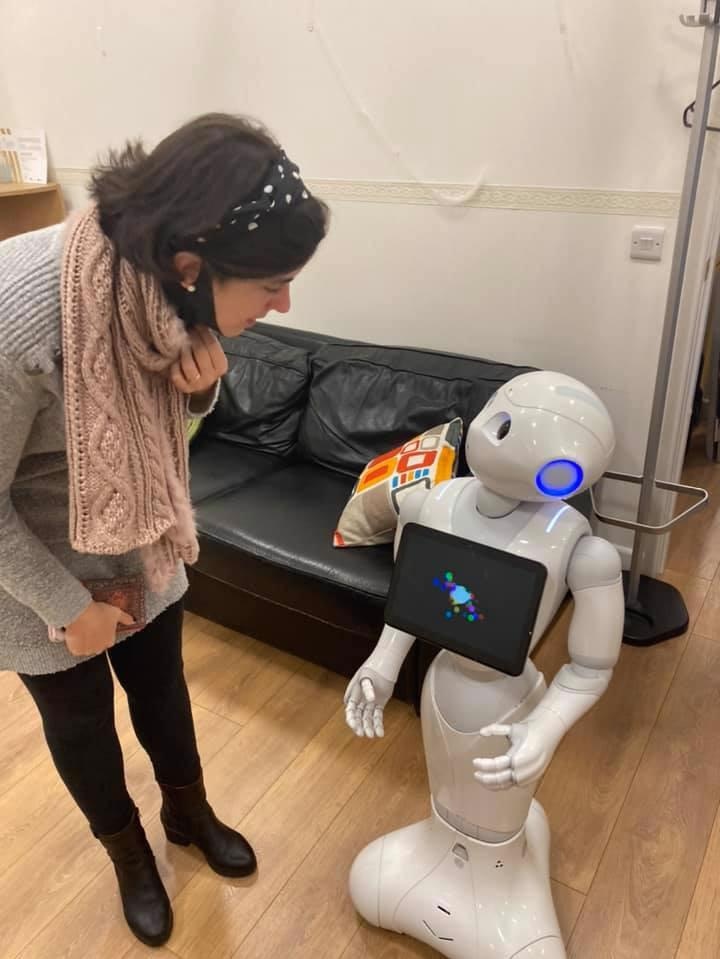
Dr. Virginia Ruiz Garate is an Associate Professor at UWE
She researches adaptive controllers and leading the Assistive Robotics group at BRL. Previously, she was a PostDoc at the Italian Institute of Technology, where she worked under the EU projects SOMA and SOPHIA investigating new bio-inspired grasping stiffness controls for robotic hands and multi-robot collaborations.
She obtained her Ph.D. from the Universite Catholique de Louvain (UCL) in Belgium where she developed bio-inspired controls for lower limb exoskeletons under the EU project CYBERLEGs.
Virginia has been serving as a reviewer for IEEE journals and conferences and co-organized the ICRA 2021 and RSS 2019 workshop on “Emerging Paradigms for Robotic Manipulation: from the Lab to the Productive World”, and the workshop “Human factors in the design and control of robots: what are we missing?” in the 2020 I-RIM 3D conference. Her current research interests include bio-inspired control, assistive robotics, grasping and manipulation, and human-robot collaboration.
Banner images courtesy of Melitas & M.Style/Shutterstock
Disclaimer: The views expressed here are those of the interviewee and do not necessarily represent the views of AZoM.com Limited (T/A) AZoNetwork, the owner and operator of this website. This disclaimer forms part of the Terms and Conditions of use of this website.
Written by Megan Craig Megan graduated from The University of Manchester with a B.Sc. in Genetics, and decided to pursue an M.Sc. in Science and Health Communication due to her passion for combining science with content creation. As part of her studies, Megan partnered with Jodrell Bank Discovery Centre as a Digital Marketing Assistant, producing content and updating sections of their website. In her spare time, she loves to travel, exploring each location’s culture and history – including the local cuisine. Her other interests include embroidery, reading fiction, and practicing her Japanese language skills.
On 24th February, 12 young people, aged 15-24, headed to UWE’s Prototype and Play Lab, in the School of Engineering, for a training day in Climate Communications. Passionate about addressing the climate and ecological emergency, and eager to learn and connect with likeminded people, the delegates came from across the Bristol area, with representation from five different schools/colleges and from the University.
With over half of young people reported to experience some form of climate-related anxiety (Hickman et al. 2021) – this training emerged out of the collective interest of researchers at UWE (from the Science Communication Unit, FET, ABE and DGEM) keen to share their knowledge with, and empower, the younger generation.
How to address climate anxiety
To steer young people away from overwhelm, timely action, forethought and trust in science are needed (Manzanedo & Manning, 2020). And according to a research project by Climate Outreach, to resonate with young people we, as adults, need to validate their negative thoughts while avoiding overly optimistic communications, and provide resources that can alleviate their anxiety.
Drawing on this research, and the interests of young people, the Science Communication Unit shaped the programme of activities for a pilot session with young people.
On the day
“Start with the why”
Associate Professor Laura Fogg-Rogers and Research Fellow Sophie Laggan started the training by explaining that different ways of viewing the world shape how we make decisions and the only way to forge meaningful dialogue and promote pro-environmental change is through meeting people where they’re at. They used the example of solar panels – where one household might buy solar panels for environmental reasons, others do so out of economic/energy security, and others simply because they follow the ‘norm’ – their neighbours did it.
The participants ran with this idea in a role-playing exercise where they tried to convince someone ‘not like them’ – and in a position of power and influence – to install solar panels on the roof of their school. With a bit of context about what makes their partner tick, the participants were able to tap into the other person’s values and use it to their advantage.
Sustainable Housing activity
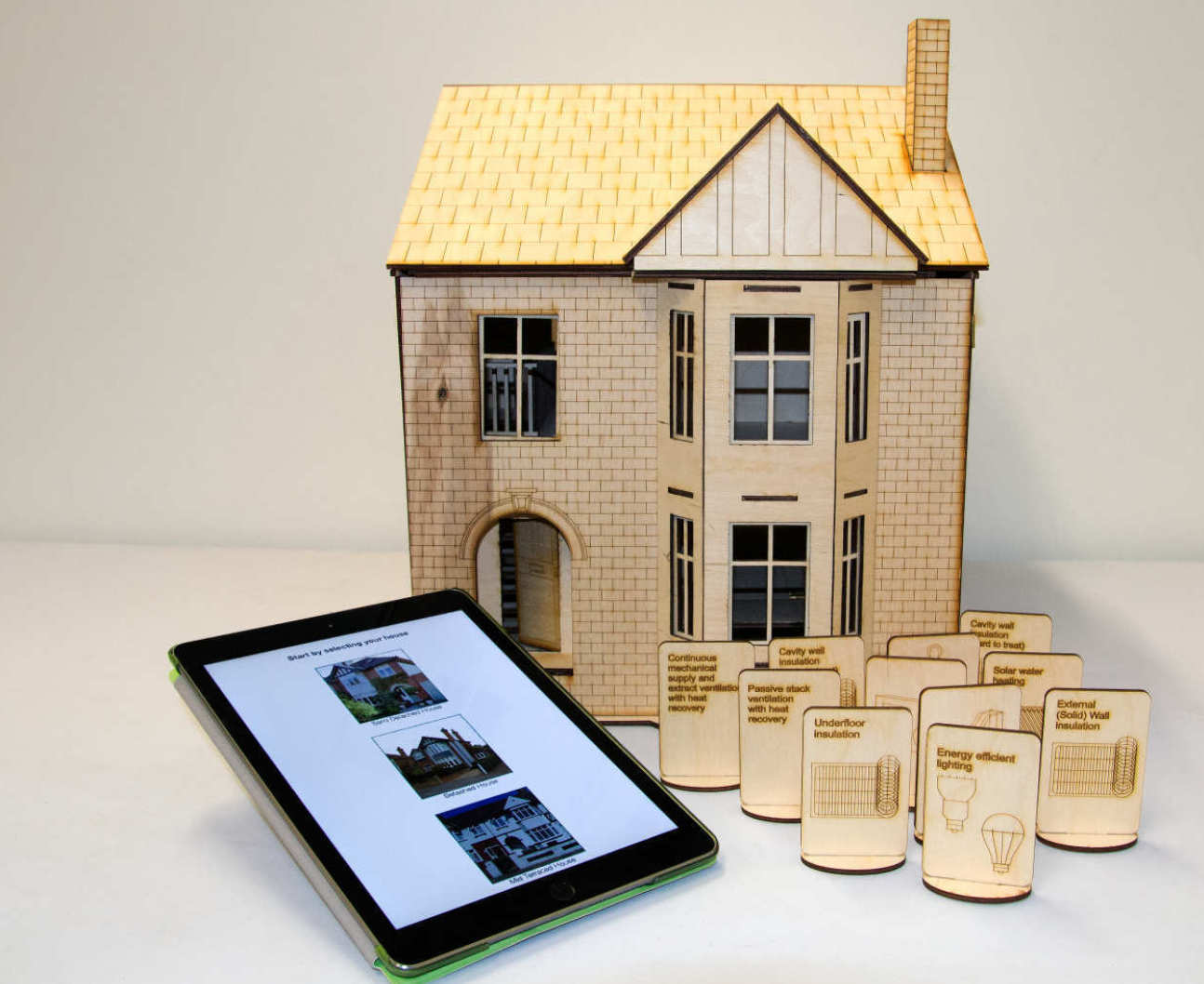
Following lunch and a tour of the Campus’s community garden, the group returned for an engagement activity on passive houses with Dr Deborah Adkins. Each table were given a wooden replica of a typical UK house and asked to stick post-its on the areas they thought could be improved for sustainability, everything from solar panels to insulation and green roofs. The task was accompanied by a short presentation, allowing the participants to learn more about sustainable housing.
Designing their own engagement activity
Deborah’s session was followed by an in-depth explanation of the value of physical engagement activities, by Sophie, with the chance for each participant to prototype their design for an engagement activity based on the issue that mattered to them, be that local food or slow fashion. Their issues of concern were formulated in the opening session of the day – “Start with the why”.
Filming sustainability
The day was concluded with top tips by Josh Warren on filmmaking on a budget, before the young people were set to task on recording their own short film on a sustainability topic. The group enjoyed watching each other’s films and spent the last few minutes of the day reflecting on how valuable the day was for their activism and general understanding of people ‘not like them’.
Climate Anxiety post-training?
Before and after surveys, showed that the young people’s negative thoughts (scared, angry, concerned, powerless, guilty, confused) all reduced following the training (except for mournful) and positive thoughts increased (empowered, hopeful, optimistic and determined).
Confidence in communication skills also increased. For instance, 100% felt confident/very confident in engaging their audience after the training, compared to just 11% (N=1) before.
Next steps
Participants suggested that training on social media, graphics and poster design would be useful, and so the team will shortly launch a social media campaign training event for the cohort.
Shortly after the training day the team found out they were successful in their bid to the HEIF FET-FBL Award! This means the training can be replicated for different youth groups, with a focus on those from more diverse backgrounds. And enables them to create e-learnings and printable toolkits.
This work on climate anxiety in young people sits under the umbrella of the Climate Action Hub at UWE, which acts as a space for researchers to connect with communities interested in tackling the climate and ecological emergency. To facilitate this exchange, the Hub is looking at setting up a Staff Network to allow staff the time to build these connections. If you are interested in connecting to the Hub in any way, or have ideas on how it should operate, then please contact Sophie.laggan@uwe.ac.uk.
Hickman, C., Marks, E., Pihkala, P., Clayton, S., Lewandowski, R.E., Mayall, E.E., Wray, B., Mellor, C. and van Susteren, L., 2021. Climate anxiety in children and young people and their beliefs about government responses to climate change: a global survey. The Lancet Planetary Health, 5(12), pp.e863-e873.
Manzanedo, R.D. and Manning, P., 2020. COVID-19: Lessons for the climate change emergency. Science of the Total Environment, 742, p.140563.
Taylor, S., 2020. Anxiety disorders, climate change, and the challenges ahead: Introduction to the special issue. Journal of Anxiety Disorders, 76, p.102313.
Steve Wright is a senior research fellow in avionics and aircraft systems at UWE, and he’s often approached by the media to provide an informed and balanced perspective on the plethora of flight innovation reports.
We’ve previously featured stories from Steve offering his expertise on green flight, aerospace Covid recovery and Boeing 737 safety concerns. But he’s been kept particularly busy recently, commenting on sports car drones, electric flight, flying cars and taxis.
Want to get a feel for the future of flight?
Have a scroll down a short selection of Steve’s quotes from media coverage on new breakthroughs.
In WIRED on sports car drones
“We’ve been rolling around in hilarity at how impossible that drone is to make work like they claim,” said Steve. “The wretched thing is, I really, really want it to work. I want a sports car to launch a drone that chases me down the road. I am just frustrated that I can’t have one yet.”
Steve outlined the physical and engineering challenges that Polestar’s concept seems to have missed, read more at WIRED.
On the BBC about flying cars
A flying car was issued a certificate of airworthiness in Slovakia, and Steve told the BBC that this made him “cautiously optimistic that I am going to see a few AirCars one day – but I think there is still a way to go”.
Although he’s unsure about the mass appeal flying cars may have. “Are flying cars the future? Yes… and no,” he said. “The personal-transport revolution is definitely coming but not really looking like this.”
“I have worked in aerospace for 30 years and in that time I have not witnessed anything like the revolution I have seen in the industry in the last five years,” he told BusinessLive . “It’s bonkers.”
He says the sector is driving towards decarbonising aviation and electric planes, but the new technologies being developed will take some time before they are commercialised.
Read the full article on Business Live to hear more of Steve’s take on the realities of sustainable flight.
In other news…
You might also have noticed Steve commenting on electric General Aviation flights starting up in the UK, on Sky News. And he also featured in a Channel 5 documentary – 10 Mistakes: 737 Max.
It’s great to have Steve’s to shed some light on these lofty topics!
Gary Atkinson, Associate Professor in Engineering at UWE Bristol and part of Lyndon Smith’s team in the Centre for Machine Vision, is developing the “Polarisation Vision for Composite Part Inspection” – a system to automatically detect defects in raw and processed composite materials and so reduce waste and huge expenses for composite industries.
“I realised this project was a real opportunity to make a difference,” said Gary, highlighting the project’s potential impact on industrial sustainability, where testing and subsequent discarding of materials is a big issue. Digital Engineering Technology Innovation (DETI) funding has enabled him to optimise the technology over the past two years.
The Weakest Link
Composite material strength lies in the uniform pattern of either unidirectional or interwoven carbon fibres lying undisturbed in resin. But any composite component is only as strong as its weakest link, and weaknesses caused by fibre misalignment or gaps is a common problem in composite manufacture.
The dark, shiny nature of composite materials makes defects tricky to spot using visualisation techniques based on traditional camera technology. The current industry standard is to perform time consuming and eye straining manual inspections to ensure the safety of components, particularly those destined for applications in the aerospace industry.
Gary is utilising a different type of visualisation technique to identify the problem areas.
Finding the flaws
Deep in the Machine Vision laboratories at UWE Bristol is a specialised camera (see photo), which detects when light becomes linearly polarised – with its electric field confined to a single plane – on reflection from a surface. Instead of blocking glare from reflected light like polarised sunglasses, the camera detects the reflected polarised light and, with specially developed software, produces a “photo” of composite fibres – with each orientation of fibre shown in a different colour – see images of composite fibre orientation below.
Polarised Vision setup imaging a composite sheet
The images produced by the software highlight tiny, localised defects, but individual fibre orientation can also be computed to give an overall report on a material’s quality. In the example histogram (below), the majority of fibres orientate in two directions, a uniform 90° from one another.
“There’s no way you’d consistently detect localised defects like that using standard manual inspection or traditional methods from machine vision,” said Gary, explaining how his instrumentation could provide rapid and detailed defect detection for composite manufacture.
In recent months, Gary and his team have painstakingly explored what type of defects his “Polarisation Vision” can detect. They’ve taken a huge range of lab-based scenarios, as well as composites in realistic factory conditions, and developed the detection algorithms to automatically find component flaws using the polarised images.
Now they’re ready to start real-world trials, collaborating with Airbus to feed more and more data into the machine learning algorithm, training it further in defect auto-detection.
An alternative view
But the machine vision team haven’t stopped there. Digging even deeper into possibilities for composite fibre visualisation, they’ve invented another system for picking up flaws. The image below shows the moving infrared light scanner or “Photometric Stereo” setup. This type of system has previously been used for shape estimation, but in Gary’s setup here it provides composite fibre detail.
Photometric Stereo setup
The team are curious as to whether this alternative system will highlight a different set of flaws to those visible with Polarisation Vision, and whether the two could be used as complimentary techniques to aid industrial scale composite manufacture.
If you would like to know more about the research happening within the Faculty of Environment and Technology at UWE Bristol please read more on the Engineering our Future website.
Some of the West’s talented young engineers who are part of the Future Brunels programme, were able to redesign the SS Great Britain last week.
‘The West in Minecraft’ is a session from the DETI Inspire team that allows the students to use the hugely popular game Minecraft to re-engineer and re-design the West’s engineering landmarks. Including of course, Brunel’s famous ship.
The young engineers spent the day at the ship with the DETI Inspire team, experiencing Brunel’s design first-hand. Before using the Minecraft programme to prototype and test their creative ideas and modifications. Among the ideas, were adding wings to the ship, a nuclear reactor as a power source, and a device to harness lightning strikes to charge an electric engine.
The aim of The West in Minecraft session is to engage children in digital engineering by using Minecraft and the unique Bristol and Bath worlds as an engaging and accessible hook. It allows space for creativity and problem-solving within the digital space, with the session framed with the Engineering Design Process to harbour an engineering mindset in the students. All whilst being fun and familiar, with most students having lots of prior knowledge of the Minecraft game.
In addition to the Minecraft activity, the DETI Inspire team engaged other Future Brunels with an engineering challenge to design and build modifications to drones, and then pilot their creations to rescue a box of cute kittens from rising lava – aided by a hint of imagination, of course!
To read more about The West in Minecraft session, please head to the DETI Inspire resources site here. Where you can also watch the promotional video, showing the SS Great Britain and some other engineering designs from students across the West.
There, you can also book future free sessions for schools and community groups of the West; to bring the West in Minecraft to more young audiences.
Last week, UWE’s storytelling extraordinaire -Jane Carter – trained up 31 local scientists to make their selected STEM stereotype-busting books come alive for children.
This training is the first step in a new scientist storytelling programme in schools – launched by the DETI Inspire team at UWE Bristol, in collaboration with the West of England STEM Ambassador hub.
The Inspire team want every child in the West of England to see themselves as scientists, and are using books to immerse children in stories featuring women, people from black, Asian and minority ethnicity backgrounds and people with neurodiversity having science-y fun. All delivered by wonderfully inspiring STEM Ambassadors with their own unique story and passions to tell.
The “Curious Stories for Curious Children” model has previously been deployed in science-related locations across the city – but now we want to reach an even wider spread of children in Bristol’s schools.
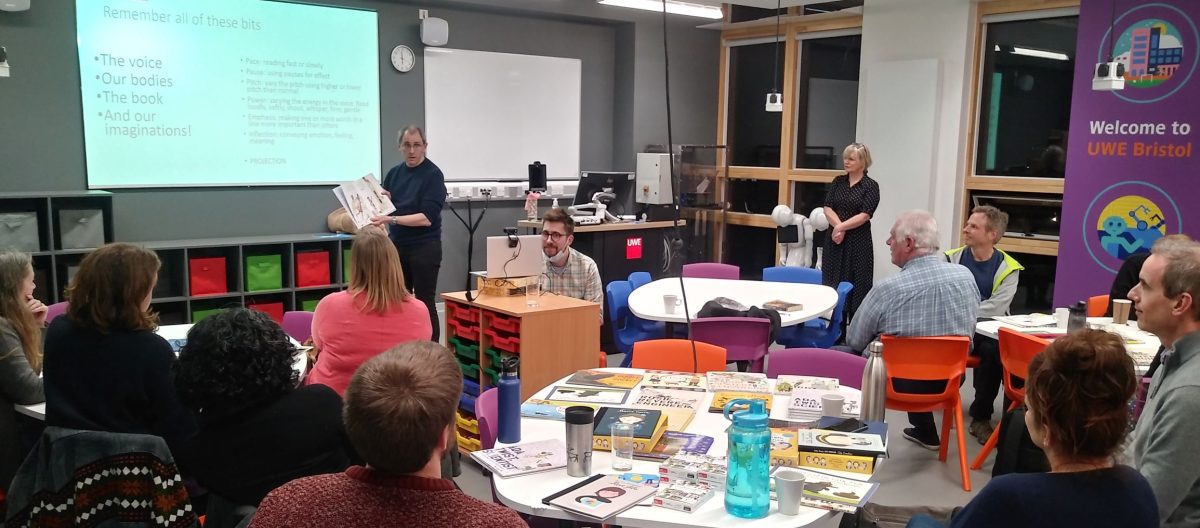
The outreach classroom in UWE’s new Engineering Building was opened up for the training – which wasn’t for the faint hearted, whether online or in-person. The participants dived into the book “Tadpole’s promise” which led them along a tale of two star-crossed lovers (a tadpole & a caterpillar) as they explored ideas about how to introduce a book and build intrigue. All before the rather brutal ending!
Jane – master storytellerAll the fun science books!Liz Lister – master organiser from the West of England STEM Ambassador Hub
It was a hands-on workshop, with every STEM Ambassador leaving with a book from our library tucked under their arm and some sparkling ideas on how best to engage children with the content.
We can’t wait to hear how the kids find the storytelling sessions!
As Head of Engineering, Lisa Brodie has spent the last few years redesigning the curriculum and imagining a space (realised in the new Engineering building) where engineering is accessible for everyone. So it should come as no surprise that she has been shortlisted for the Enginuity Diversity in Engineering Award.
Congratulations Lisa!
The award recognises organisations, individuals or a team that has delivered a specific scheme, project, or initiative, that significantly contributes to shifting the dial of equality, diversity, and inclusion within our sector.
This nomination isn’t the first time Lisa’s tireless efforts for diversity in engineering have been recognised. Watch the BBC Points West Video below to find out more about how the building is designed with neurodiverse students in mind, and read what Lisa has to say about the impact a more diverse workforce can have on engineering –
If we want to solve the challenges we face as a society, we need to attract different types of people into the engineering discipline. We need to embrace different ways of thinking and doing, and celebrate differences. Our mission is to change the perception of the roles that engineers fulfil and raise aspirations in underrepresented groups.
If we carry on seeing the same intake entering the profession, we will continue to come up with the same old solutions. Engineers will need to think differently and be far more creative and innovative over the next decade, particularly with some of the challenges we face in areas such as the climate crisis. We aim to be the difference.
Inspiring the next generation of diverse engineers
But it’s not just about empowering current UWE student engineers, Lisa is also looking to the future of engineering. In late 2019, Lisa fought for, and now leads, the Digital Engineering Technology and Innovation (DETI) Skills programme, which aims to to improve diversity in recruitment into STEM industries (particularly engineering) whilst also enhancing retention of skilled engineers in the industry. The Skills programme has a three pronged approach:
Inspiring children into STEM
Transforming courses and work experience to upskill apprentices
Innovating new short courses to reskill the workforce in digital technologies
The Inspire programme has had particular success, reaching over 7000 children in the South West so far, with 42% of all schools engaged with face-to-face, coming from from areas within the most deprived 20% of the country. Those children have been exposed to innovative engineering workshops that connect them with real-life, diverse engineering role models to widen participation and aspirations for STEM careers.
And lots of those workshops have taken place in the purpose-built classroom at UWE Bristol’s School of Engineering. All made possible by Lisa’s trailblazing ideas.
Engineering for Everyone!
Want to hear more about how Lisa has ensured the new building is designed with diversity in mind? Read on!
The brand-new purpose built engineering facility has been co-designed in conjunction with Lisa’s new engineering curriculum, to create a supportive environment for students from under-represented backgrounds. Keeping this focus in mind throughout both the curriculum and the design of the building’s physical structure make it a truly unique space.
As part of Lisa’s drive to embrace and celebrate neuro-diversity, the building is equipped with individual study spaces designed to support students with sensory issues, such as people with autism who can benefit from features including white noise bubble tubes and adjustable, muted lighting. The building is designed to teach in a very different way.
Lisa has worked with colleagues to embed professional skills, and the professional engineer, at the heart of the curriculum. The very first things taught to student engineers are creativity, innovation, empathy and design, with a focus on the role of the engineer in society.
We are on a mission to change the demographic in engineering!





 Dr. Virginia Ruiz Garate is an Associate Professor at UWE