
Finding part-time work

Posted on

Student living costs are at an all-time high, and in 2024, 58% of students said their maintenance loan doesn’t cover their living costs. With that in mind, you might be thinking about picking up a part-time job to help ease the pressure.

Here’s a quick guide to finding and balancing work alongside your studies:

What work can you do?

Anything you like! But if you’re looking for some ideas, here are some popular jobs among students:

  • Bar work offers flexible evening shifts that fit around lectures. However, be prepared for late nights and some challenging customers.
  • Hospitality jobs in cafes, restaurants, and hotels can be flexible around uni and may come with perks like free food. Just keep in mind the hours can be long and often involve being on your feet.
  • Retail jobs in supermarkets or shops include tasks like stocking shelves, serving customers, and working the till. They’re usually flexible and you can often get extra hours during busy periods like Christmas. Just be aware that weekend work is common and hours can vary.
  • Tutoring involves helping younger students with subjects like maths, English or science. It’s often online, so there are no travel costs, and the pay can be higher than other jobs. Just make sure you’ve got reliable internet and a quiet, private space to work from.

How do I find work?

Sort your CV – if you don’t have one yet, there are plenty of free templates online, and Save the Student has a helpful guide to writing a CV. The Careers Team here at UWE can also support you with CV writing and feedback.

Start your job search – look across a range of platforms to find part time jobs that suit you. Here are some good places to start:

Apply – make sure each application is tailored to the role. Read the job description carefully, highlight your relevant skills, and double-check for any errors before submitting. Keeping track of your applications can also help you stay organised.

Prepare for interviews – if you’re invited to an interview, research the company and be ready to talk about your experience, availability, and what makes you a good fit. The UWE Careers Team can support you with mock interviews and helpful advice.

Balancing work and study

Balancing a part-time job with your studies can be challenging, so here are some tips to help you manage:

– Be clear about the hours you’re available and check if your employer can accommodate them

– Ask if you’ll be able to take time off when needed, especially around exams

– Use a planner (digital or paper) to stay on top of your uni and work commitments

– Prioritise rest and relaxation. It’s important for your wellbeing as well as your studies

Why it’s worth it

A part-time job can bring in extra money, boost your CV and help you develop useful skills if it fits well around your studies. You could gain experience in teamwork, communication, and time management, while also building confidence and independence. The key is making sure it supports your student life, not overwhelms it.

Taking control of your inbox

Posted on

First things first – where is your UWE email?

Your UWE email is one of the main ways the University will contact you, so make sure you know how to access it before term gets busy.

You can access your UWE email:

  • through MYUWE by selecting the envelope icon
  • through Microsoft Outlook using your UWE Bristol account
  • through the UWE Bristol app, which gives you quick access to email alongside things like Blackboard and your timetable

If you use your phone to regularly check your emails, we recommend downloading the Microsoft Outlook app.

An overflowing inbox, with new emails coming in faster than you can delete the old ones, can feel like a lot. We get it. And we know you don’t want to be inundated with irrelevant information or unnecessary updates. Which is why we’re working hard to ensure that we are only sending you the stuff you need to know about.

However, email is still going to be one of your main communication channels as a student and it’s so important that you’re keeping on top of the different info being sent your way. Life as a uni student means taking on new challenges, and one of those might be having to manage a busy inbox for the first time.

Which emails should I prioritise?

Not every email needs an immediate response, but there are some you really shouldn’t leave sitting unread. Pay particular attention to emails about:

  • your course, modules or teaching
  • changes to classes or your timetable
  • assessments and academic information
  • registration or your student record
  • student finance
  • IT security, passwords or your UWE account
  • wellbeing, safety or important University updates
  • anything that specifically asks you to complete an action by a deadline

You’ll also receive emails at key stages of the year. These emails will include information about how you’re engaging with your studies, based on the data available to us, including your attendance at teaching sessions, assessment submissions and other study-related activity. We will also provide tailored information about the services we have here at UWE Bristol which are designed to help you succeed, so they’re worth opening rather than saving for “later”.

So, we’re here to help! The tips below will help you embrace good habits and become a pro at managing your emails:

  • Get organised – Create folders within your inbox so you can keep related emails together and find important information more easily. You could create folders for individual modules, society updates or correspondence with your landlord. When everything has a place, your inbox will feel much more manageable and less overwhelming.
  • Unsubscribe from emails you don’t need – You have the power to stop many unwanted marketing emails from reaching your inbox. If you no longer find a mailing list useful, take a moment to unsubscribe using the link provided. However, don’t unsubscribe from important university updates. These may include essential information about term dates, academic regulations, IT services, health and wellbeing support, and opportunities available to you. If an email looks suspicious, avoid clicking any links and report it as phishing instead.
  • Don’t let emails build up – Five unread emails can quickly become 50 if you keep putting them off. When you open an email, try to do one of three things: delete it, take action or file it. Don’t be afraid to delete messages you no longer need, but avoid leaving important emails sitting unread.
  • Set some boundaries – Having access to your emails on your phone can help you stay informed while you’re on the go. However, being connected around the clock isn’t always helpful. Try checking your inbox at set times during the day and consider turning off notifications when you’re studying, relaxing or getting ready to sleep.
  • Choose the right way to communicate – Not every conversation needs to happen over email. You could keep your university inbox mainly for academic and official messages, and use platforms such as WhatsApp or Teams for personal or social conversations. If a discussion with your lecturer becomes a lengthy email exchange, it may be quicker and easier to arrange a conversation with them instead.
  • Make the most of your inbox – Email platforms such as Outlook and Gmail include useful features that can help you stay organised, including folders, categories, filters, flags and automatic rules. Take a little time to explore online guides or tutorials and find the tools that work best for you.
  • Ask for help – These tips should make your university inbox easier to manage, but support is available if you get stuck. Visit the UWE Email webpage for further information and guidance.

Making connections more meaningful

Posted on

We’ve all struggled to connect with other people at one time or another, and university is usually the first step out of the bubble of school or college. Ironically, sometimes the more people you’re surrounded by, the easier it can be to feel lonely! 

The small, everyday interactions you have all help build a sense of community and belonging. Connecting with people, in whatever capacity, supports your wellbeing – regardless of the number of people you consider friends. In fact, research shows that social connections are just as important to your overall health as exercise is. 

But how often do you wish you could skip the small talk and go straight to being friends with someone? It’s easier to bond over shared interests or experiences, so if you’re already signed up to events, societies or MOVE activities, you’re already on your way. If you’re not, and your study schedule allows, why not try one? 

Prefer something quieter?

You don’t need to drink, go clubbing or attend a huge event to meet people. Quieter, low-pressure activities can make it easier to talk naturally and find people with similar interests. 

  • Try a daytime society taster, creative workshop, volunteering session or MOVE activity.
  • Invite someone from your course or accommodation for a coffee, lunch, a walk or a study session. 
  • Look for alcohol-free events and smaller activities where there is already something to focus on. 
  • If large groups feel overwhelming, aim for one small interaction at a time – saying hello before a lecture still counts. 

Tips for small talk

The art of small talk is important though, and a skill that will benefit you in your university, personal and professional life, so here’s our top tips to help:

  • Ask open-ended questions. Instead of “did you have a good weekend”, you could ask what someone got up to during it – maybe it’ll turn out you did something similar, or they’ve visited that new spot you’ve been meaning to go to.
  • And then actually listen to the answers! (This one’s important)
  • If you’re asked questions, avoid super short answers; it’s hard to take a conversation anywhere if you don’t give the other person anything to work with. You don’t need to share anything you’re uncomfortable with, but adding a little extra detail can keep the conversation going a little further than just “good thanks, you?” “yeah good, thanks”
  • Respect boundaries. For example, if someone clearly doesn’t want to talk about their family, or dating life– don’t push them to.
  • Don’t take things too personally. You may have caught someone when they just don’t fancy a chat (with anyone), so don’t let this put you off altogether.
  • Be in the moment. Put away your phone – unless it’s relevant to the topic at hand (hello, cute pet pics)
  • If you compliment someone, make sure it’s genuine. Compliments are a great way to start a conversation, or simply brighten someone else’s day – but insincere compliments can have the opposite effect.
  • Make plans with (potential) friends. Especially when everyone is managing a busy workload (or out on placement), it can be easy to shut yourself away a bit. Taking breaks is important though, so factor them into your study schedule and hit two birds with one stone. Had a brief chat with someone after a MOVE class? – ask them if they’re coming to the next one!
  • If you identify as neurodivergent, then come along to one of the Thinking Differently cafes if you haven’t already.
  • Finally – don’t be afraid to get out of your comfort zone, and keep at it! The more you practise, the easier it’ll feel and the more resilient to awkwardness you’ll be. Often the most confident people in the room once felt (or still feel) shy inside!

Connections don’t always develop into friendships, but it’s not all or nothing – a variety of relationships of all different types makes life more fulfilling and interesting.

Good luck!

How to not spend all your money in the first weeks of uni

Posted on

Between finding your way around your new campus, meeting new people, and navigating student life, keeping on top of your budget can easily slip down the list.

Here’s a quick guide to help you manage your money while enjoying being a UWE Bristol student!

Local supermarkets

Bigger supermarkets are usually cheaper than the smaller corner shops, so it’s worth the walk. 💡Top tip: Lidl and Aldi are usually the cheapest, followed by ASDA, then Sainsbury’s (especially if you’ve got a Nectar card). 

Below are some good options near your campus. 

Frenchay:

  • ASDA Filton Superstore – located in the Abbeywood Retail Park (15-20 min walk)
  • Lidl – located on Fox Den Road (10-15 min walk)
  • Aldi – located on Fox Den Road (roughly a 15 min walk)
  • Sainsbury’s – located on Fox Den Road (around a 15 min walk)

Glenside:

  • Lidl – located on Fishponds Road (20-25 min walk) 
  • Morrisons – located on Fishponds Road (20-25 min walk) 
  • Iceland – Channons Hill (15 min walk) 

City Campus:

  • Aldi – located on North Street (20 min walk) 
  • Sainsbury’s – located on Winterstoke Road (25 min walk) 

Getting around Bristol

There are lots of ways to get around, but buses are usually the cheapest and easiest.

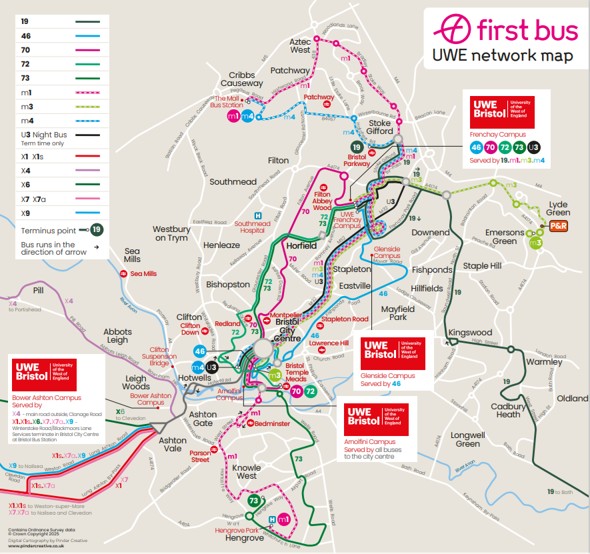
First Bus: First Bus is the main bus company in Bristol, it offers several routes connecting UWE campuses with the city centre and surrounding areas. The First Bus app has live bus times and a journey planner. As a student, you can get discounted ticket prices on the app.

May showing the First Bus UWE network of routes between campuses and key parts of the city.

M1/M3/M4 Metrobus: Metrobus services (M1, M3, M4) are rapid routes that connect Frenchay Campus to the city centre and Cribbs Causeway. They run late too, which is perfect for getting home after a night out.

You can also hire e-scooters and e-bikes around the city which are great for quick trips and easy to use. Just download the Dott app, ensure you’re signed up for student discount, find a ride nearby, and go 🛴.

Food and drink on campus

Making your own food is always the cheapest option, but we get it, Freshers’ Week is hectic. Check out how to keep your food and drink spend low on Frenchay campus, Glenside Campus and City Campus.

And of course, if you’ve been organised and got yourself to a supermarket, here are some great student-friendly recipes to get you started: BBC Good Food or Mob’s Easy & Cheap Student Recipes. 

Your University Health Centre

Posted on

Did you know we have our very own doctors’ surgery right in the heart of Frenchay Campus?

It’s open to all UWE Bristol students, no matter which campus you’re studying at.

Register before you need an appointment: register online with the University Health Centre. 

Registering with the Health Centre 

You can stay registered with us for your whole time at university, which means you won’t have to worry about finding another doctor as you move in your second and third year. 

Plus, as we work in partnership with The Old School Surgery in Fishponds, registering with us means you’ll be automatically registered with them too. Effectively you’re getting two doctors’ surgeries for one! 

Registering now means that we’ll be able to get your records from your previous GP so that we’re ready to treat you if you need us. It also means you won’t have to worry about going through the registration process or finding a walk-in centre when you actually need to see a doctor – you can just book an appointment with us without all the extra hassle. 

And don’t worry – you can still see your previous GP if you go home for the holidays. You’ll just need to see them as a temporary patient. It won’t affect your registration with us in Bristol and you can easily re-register with them if you move back home once you’ve finished your course. 

Booking appointments

So why register with us? 

We make it really easy for you to book appointments that fit around your lectures – you can do it online using our Klinik access system. We offer routine appointments booking up to two weeks in advance, however, if you have an urgent medical need we also offer same-day telephone calls or face-to-face appointments once your Klinik form has been triaged. 

Who you can see

We have a vast clinical team based at the Health Centre, consisting of GPs, nurses, mental health nurses, phlebotomists, first contact physiotherapists, sexual health nurses and clinical pharmacists. The clinician you see or speak to will depend on the symptoms you are experiencing following your Klinik form being triaged. 

Services available

We offer all of your standard GP services, including appointments, blood tests, travel vaccines, sexual health advice and free chlamydia screening kits. 

We can arrange your MenACWY vaccination if you are in your first year and under the age of 25, which protects you against four different causes of meningitis and septicaemia. If you didn’t have it before you arrived we really recommend that you have it. 

Mental health and wellbeing support 

The Health Centre works in partnership with the University’s Wellbeing Service, offering you support for your mental health and wellbeing. We’ll refer you to other services in and around Bristol where required, to make sure you get all the medical help you need.

When you might not need a GP 

Remember that some common minor health concerns like coughs, colds, hayfever or an upset stomach don’t need to be seen by a doctor, unless they last for more than a week. Pop in to talk to your local pharmacist for advice – they’re experts who can recommend certain medications that you can take without a prescription. If the doctors’ surgery or pharmacy is closed, you can call NHS 111 for urgent medical advice.

International students

If you’re an international student our healthcare system may be different to what you’re used to – don’t worry, we’re here to explain everything you need to know and can provide a translator. Most services such as GP consultations and emergency treatment are free for everyone. You may need to pay for prescriptions, dental treatment and sight tests – although most students can get these at a reduced cost or free (just complete an application form).

Dentists and opticians

Doctors’ surgeries don’t provide eye tests or dental check ups – you can find an optician or a dentist through the NHS website.

Remember, we’re here to help you so that you can get on with your studies and fully enjoy your university experience – so register with us now!

Back to top