Black voices remain underrepresented across many areas of health economics, research leadership and policy decision-making. The newly launched Black Health Economists’ Network (BHEN), founded by Dr Chizoba Esio-Bassey at UWE Bristol, aims to help change that.
BHEN is a new platform that brings together Black researchers, students, practitioners, policy professionals and allies working across health economics and related fields.
BHEN was created from a simple but important need: to build a supportive and visible community where Black health economists and those interested in the field can connect, collaborate, share opportunities and contribute to shaping more equitable health systems and research.
Health economics plays a major role in informing decisions about healthcare funding, access, prevention, medicines, public health interventions and policy. Yet Black voices remain underrepresented across many areas of academia, research leadership and decision-making spaces. BHEN aims to help address this gap by creating opportunities for networking, mentorship, collaboration, knowledge exchange, stakeholder and community engagement.
Inaugural Research and Networking Event
BHEN is excited to host its Inaugural Research and Networking Event on:
Whether you are an established academic, early-career researcher, student, policymaker or simply interested in health economics and equity, you are welcome to join this event.
Registered participants will receive the joining link closer to the event date.
Acknowledgements
The BHEN team would like to express their sincere gratitude and thanks to Professor Marc Griffiths and the ICA for their support and encouragement in helping make this inaugural event possible through funding. Their contribution has helped BHEN take an important first step in building this network and creating space for meaningful engagement and collaboration.
The BHEN team would also like to thank the Centre for Public Health and Wellbeing (CPHWB) for their guidance and backing.
It has now been 3 years since the Arts and Humanities Research Council (AHRC) Impact Accelerator Account (IAA) opened at UWE, supporting knowledge exchange and impact emerging from arts and humanities-based research.
Since then, seven IAA funding calls have awarded 85 grants to projects involving 116 UWE staff members, ranging in size from £1k to £23k. These projects represent a huge range of disciplines within arts and humanities research, including law, media studies, visual arts, music, philosophy, history, political sciences, theatre and architecture. This funding is supporting academics to run projects that respond swiftly to emerging opportunities, strengthen collaboration with non-academic stakeholders, and accelerate the translation of research outputs into real-world impact.
This work has seen an incredible 199 new partners taking part in collaborative proposals, and the delivery of 260 collaborative activities with organisations such as Global Goals Centre, Bristol Woman’s Voice, MISFITS theatre and the Lords Research Service. Across the IAA funded projects, 49,000 people have taken part in knowledge exchange and impact events such as industry roundtables, training courses, school workshops, theatre performances and focus groups.
IAA funding has successfully supported UWE academics to make strong partnerships with industry, improving their processes, sustainability and commercial positioning. Tavs Jorgensen is setting up a commercial venture which looks to transform the brick and tile manufacturing industries; Sofie Boons is working to make the jewellery sector more sustainable in their gemstone production; and Jac Fennell is integrating wearable tech from Milbotix’s SmartSocks® (an SME in UWE Enterprise Zone) into HUG (a soft comforter designed for those living with dementia).
The work of the IAA projects is creating change at a local, national and international level. Documentary film maker Judith Aston and public policy expert Laura De Vito have been working very closely with the Avonmouth community to co-create a theory of change for this contested area of Bristol, while Jack Lowe has developed a digital game that supports cultural heritage organisations to include more diverse perspectives in the stories they tell about place and local heritage. Lisa Mol’s expertise in heritage and climate change conservation in war zones has supported charity Heritage for Peace to continue their work in Yemen, and Peter Clegg collaborated with police forces in The Sovereign Base Area of Cyprus to explore how accredited higher education training could assist them with navigating their nuanced context.
One of UWE’s strengths is in inclusive innovation and we see this in many of the IAA funded projects. Tom Mitchell working closely with the charity Drake Music to co-design and fabricate a new accessible digital musical instrument, and Amy Saleh prioritised equality in her project delivery by only using global majority suppliers (catering, filmmakers, designers etc.) for her project ‘Lit Legacies’, which designed educational materials to tackle the ‘teaching barriers’ in Black British literature.
Many of the IAA projects have been successful in translating their research into changes within policy and professional practice. Suwita Hani Randhawa brought together key political and civic actors to develop new policy insights around ecocide and is now an adviser to the Scottish Parliament to further influence policy changes. Verity McIntosh worked with Watershed in the build-up to the launch of their immersive gallery space Undershed, to ensure the experience design centres access and inclusion for all users.
The range of projects funded through the IAA reflect the diversity of UWE Bristol research and how we are ensuring our engaged arts and humanities research to have commercial, social and cultural impact. Support for impact development is always available for UWE academics and current IAA projects continue to develop their impact work, so there will be even more to celebrate over the coming year!
Visit the RISE page to find out more about how UWE research is driving societal improvement and transforming futures for the better. For more information on UWE Bristol’s arts and humanities research, impact or our Impact Acceleration Account, please do get in touch.
A researcher at UWE Bristol has secured new international funding to explore how informal engineering skills can help accelerate the green transition across Africa.
The project, “Unlocking informal green engineering skills in Africa: A comparative pilot for scalable recognition pathways,” is led by Dr Tariq Umar, Senior Lecturer in Civil Engineering at UWE Bristol. The initiative will work with partners in Kenya, Uganda and Ghana to better understand and recognise the skills of informal technicians, artisans and innovators who are already delivering climate and energy solutions within their communities.
Across sub-Saharan Africa, more than 80% of employment takes place in the informal economy, where technicians install solar systems, repair equipment, fabricate energy-efficient technologies and adapt climate solutions to local contexts. However, these practitioners often remain outside formal training and certification systems, limiting opportunities for professional recognition, finance, training and enterprise development.
The project will develop and pilot a scalable recognition model for informal green engineering skills, helping to bridge the gap between grassroots innovation and formal skills systems.
Working closely with training authorities, innovation hubs and community practitioners, the project will:
map informal green engineering practices and competencies
develop practical recognition pathways aligned with national skills systems
pilot a community-based recognition model in Uganda
generate policy guidance to support inclusive green skills development
The initiative forms part of wider efforts to strengthen green workforce development, climate resilience and inclusive innovation across African economies.
Dr Tariq Umar, Project Lead at UWE Bristol, said: “Across Africa, millions of technicians, artisans and grassroots innovators are already driving the green transition by installing solar systems, repairing infrastructure and adapting climate technologies to local needs. Yet their skills often remain invisible within formal training systems. This project aims to recognise and strengthen these capabilities, creating pathways that connect informal innovation with formal skills ecosystems. By doing so, we can support decent work, strengthen local green economies, and accelerate inclusive climate solutions.”
The research consortium includes partners from Kenya’s National Industrial Training Authority (NITA), GIZ Kenya, Leaf Life Solutions, 3N ENGTECH Innovations in Uganda, and the Institute for Sustainable Energy and Environmental Solutions (ISEES) in Ghana. Together, they will examine how recognition approaches can support workforce mobility, innovation and sustainable livelihoods.
Professor Washington Yotto Ochieng, CBE, EBS, CEng, FREng, FCGI, Chair of the Africa Engineers Steering Committee at the Royal Academy of Engineering, emphasised the importance of recognising grassroots innovation in the green transition: “Engineering innovation across Africa often emerges from informal systems where skilled technicians and practitioners are solving real problems in energy, infrastructure and climate adaptation. Recognising and strengthening these capabilities is essential if we are to build inclusive and resilient green economies across the continent.”
The project also aligns with UWE Bristol’s commitment to international collaboration and research addressing global sustainability challenges.
Alice Radley, Senior Manager Sustainable Development at the Royal Academy of Engineering, said: “This project reflects the Royal Academy of Engineering’s commitment to supporting inclusive and sustainable engineering solutions that are grounded in local realities. Across Africa, informal engineers and technicians are already playing a vital role in advancing green innovation and climate resilience. By recognising and strengthening these skills, we can help unlock new pathways for sustainable development, economic opportunity and a more inclusive global engineering ecosystem.”
Over the next twelve months, the research will combine stakeholder engagement, participatory mapping, competency identification and pilot testing of recognition approaches. Findings will inform policy guidance and scalable models that could be adopted across multiple African countries.
Ultimately, the project aims to help governments and partners unlock grassroots engineering capacity, strengthen pathways to decent green jobs, and support locally driven climate solutions.
If you would like to learn more about this project, please contact Dr Tariq Umar, Project Lead, at tariq.umar@uwe.ac.uk.
What does long-term business growth actually look like for SME leaders? For more than 330 participants on a high-impact leadership and management course at UWE Bristol, it has meant building stronger strategies, more resilient teams, and lasting peer networks that continue well beyond the classroom.
The Help to Grow: Management Courseis a 12‑week, 90% funded programme that gives SME leaders the skills, confidence, and support to take their business to the next level. Delivered across the UK by Small Business Charter-accredited business schools, to date it has helped over 10,000 leaders strengthen their strategy, sharpen operations, and accelerate growth. With a mix of online and in‑person sessions, dedicated 1:1 mentoring, and practical, ready‑to‑use tools, the course is built to deliver real impact from day one.
At UWE Bristol Business School, the course is delivered by academics and industry experts, with a focus on strategy, innovation, digital adoption, financial management, and leading people.
This year marks a milestone for the course. Now entering its sixth year of delivery at UWE Bristol, the programme has so far supported 330 business leaders to complete the course – each bringing their own challenges, ambitions, and ideas for the future of their organisations.
Since 2020, we’ve welcomed SME leaders from across the region and from a huge variety of sectors. Some arrived from organisations of five people, others from organisations of more than 200. That mix has always been one of the strengths of the programme: leaders learn as much from each other as they do from the curriculum itself.
A network that doesn’t disappear after 12 weeks
One of the clearest signs of the programme’s impact is the strength of the community that has formed around it. With an established national and local Alumni Programme, participants are offered learning and networking opportunities through varied content and events once the 12 week course ends.
Individual cohort communities also continue to support each other – members of Cohort 8, who completed the course in March 2021, still meet every month for peer support sessions. They’ve spoken at alumni events, and two members of the group are now launching a joint venture together.
Members of Cohort 8 speaking at a Help to Grow: Management Alumni Event in March 2025
This particular group shows that what starts as a structured programme can become an invaluable ongoing source of support, accountability, and collaboration.
Real change inside real businesses
Over the years, participants have used the course to tackle some major turning points in their organisations. Some have been preparing for succession, others exploring employee‑ownership models. One business has since transitioned to full employee ownership, using the course as a springboard for that journey.
Many alumni have also stayed connected with UWE Bristol through other opportunities. One has taken part in a Knowledge Transfer Partnership, others have worked with our student consultancy teams, and many have joined additional funded skills programmes such as Skills Bootcamps, Made Smarter, and the Leadership Fundamentals Programme. A number have even returned as guest speakers, panellists, or case study contributors – helping shape the experience for future cohorts.
“From the first session, I felt less overwhelmed with my workload, and gained clarity on how I needed to structure my business, and remove myself from the day-to-day in order to focus on the bigger picture.
The course has more value than you could imagine – the advice, experience, insights, resources and the mentorship hours you get access to is so worth it. The peer group you graduate with is also an incredible resource. The company I started the course with looks quite different to the company I completed the course with.”
Lou Fitzpatrick, Director at PrePitched
Mentoring that makes a difference
Mentoring is a core part of Help to Grow, with each participant having the opportunity to access 10 hours of 1:1 mentoring during their time on the course – and it’s been a real success story. Our mentors bring a wealth of experience, and the relationships they build with participants often continue long after the course ends. One of our Help to Grow alumni was recently named as a finalist at the National Mentoring Matters Awards, and one of our mentors recently won a national award, crediting his success to the work he did with his mentee through the programme:
“For me, the mentoring element of Help to Grow is where the learning becomes real leadership – it’s the bridge between knowing what to do and actually putting it into action. I joined Help to Grow to give back, but mentoring has turned into an unexpected long term partnership that has added value to both of our businesses.”
Olly Reid, Co-Founder of HUM4NS and Mentor on the Help to Grow: Management Course
Looking ahead
Reaching 330 alumni is something we’re very proud of – not just because of the number itself, but because of what it represents. It reflects hundreds of hours of learning, collaboration, and problem‑solving. It reflects businesses that are more resilient, more confident, and better connected. And it reflects a community of leaders who continue to support one another long after the course has finished.
As we enter our sixth year of delivery, the programme continues to grow and evolve. What hasn’t changed is our commitment to supporting SMEs across the region and helping leaders build the skills, networks, and confidence they need to take their organisations forward.
We’re excited to see what the next year of Help to Grow brings, and to continue working with the businesses and people who make Help to Grow what it is.
We’re thrilled to be delivering a new Help to Grow: Management Course cohort, starting in July 2026.
Metrea is a global defence company specialising in intelligence, surveillance, reconnaissance and advanced technology solutions for national security partners worldwide. Through a Knowledge Transfer Partnership (KTP) with UWE Bristol’s Centre for Machine Vision, the company worked to develop AI-powered software capable of detecting, tracking and classifying objects in orbit using airborne imagery.
About the Knowledge Base:
Researchers from UWE Bristol’s Centre for Machine Vision brought expertise in computer vision, machine learning and object modelling. Working alongside Metrea, the team helped develop and test innovative AI approaches capable of analysing complex orbital imagery, transforming early-stage research into a commercially viable solution.
Mark Hansen (UWE), Izaak Stanton (UWE Research Associate), Lyndon Smith (UWE), Chris Dunn (Metrea), Louis Aberdeen (KTP Associate), Ryan Gery (Previous Company Supervisor), and Ria Eyers (UWE) during a tour of the Engineering School.
About the KTP Associate:
KTP Associate Louis Aberdeen joined the project after graduating with a degree in Mathematics from the University of Bath. During the two-year partnership, Louis led much of the technical development, applying expertise in machine learning, optimisation and computer vision to help create a new AI-driven platform for space-domain analysis.
The experience enabled Louis to develop specialist skills in deep learning, image analysis and research translation, ultimately leading to a role as a Machine Learning Engineer.
Louis Aberdeen (KTP Associate) at the Louis Aberdeen (KTP Associate) at Farnborough Bristol Robotics Laboratory
About Innovate UK:
Innovate UK is part of UK Research and Innovation, is the UK’s innovation agency. Their mission is to help companies to grow through their development and commercialisation of new products, processes and services, supported by an outstanding innovation ecosystem that is agile, inclusive and easy to navigate.
The Challenge the KTP addressed
Tracking and identifying objects in orbit is becoming increasingly important as space becomes more congested. Existing methods can be expensive, technically complex and difficult to deploy at scale. Metrea wanted to explore whether AI and machine vision techniques could be used to improve the detection and classification of orbital objects using airborne imagery.
Ryan Gerry (previous Company Supervisor) and Louis Aberdeen (KTP Associate) at the International Space Show – Farnborough
The solution
Researchers from UWE Bristol’s Centre for Machine Vision worked alongside Metrea to develop new machine-learning approaches capable of detecting and classifying objects from airborne imagery.
The project combined expertise in computer vision, artificial intelligence and image analysis to create an analytical pipeline that could process complex imagery and identify objects of interest with greater speed and accuracy.
Throughout the partnership, the team iteratively tested, refined and validated the technology, including operational trials in real-world environments.
An example reconstructed output image of the international space station
The Benefits of the KTP:
The partnership delivered significant benefits for both Metrea and UWE Bristol.
For Metrea, the project accelerated the development of innovative AI capabilities, helping the company move a promising concept towards commercial readiness. The work strengthened Metrea’s ability to analyse and interpret orbital imagery, creating opportunities for future applications in defence, security and space operations.
For UWE Bristol, the partnership provided an opportunity to apply cutting-edge machine vision research to a real-world challenge. The project generated new knowledge, strengthened industry collaboration and created opportunities for future research in artificial intelligence, image analysis and space technologies.
The KTP also delivered a substantial professional development opportunity for KTP Associate Louis Aberdeen. During the project, Louis developed specialist expertise in machine learning, computer vision and software development, gaining experience of translating research into practical solutions for industry.
The success of the partnership demonstrates how Knowledge Transfer Partnerships can bridge the gap between academic research and commercial innovation, helping businesses access specialist expertise while creating lasting impact for researchers, graduates and industry partners alike.
Metrea – Chris Dunn (Company Lead) talk at the Centre for Machine Vision, Bristol Robotics Laboratory.
Impact:
The partnership delivered significant benefits for Metrea, UWE Bristol and KTP Associate Louis Aberdeen.
For Metrea, the project transformed LASSO from a data collection tool into a sophisticated analytics platform capable of generating operationally valuable insights. This work directly supported Ministry of Defence feasibility studies worth more than £1 million and opened opportunities for future software licensing, data sales and commercial applications.
The project also increased Metrea’s visibility across the defence and space sectors, with the technology showcased to organisations including NATO and the UK Ministry of Defence. Beyond its original focus on Space Domain Awareness, the research created opportunities for wider applications in Maritime Domain Awareness and signals intelligence.
For UWE Bristol’s Centre for Machine Vision, the partnership generated new research outputs, including peer-reviewed publications and a new area of applied research at the intersection of computer vision and space technologies. The project strengthened relationships with industry partners and created opportunities for future collaboration and research funding.
KTP Associate Louis Aberdeen played a central role in the project’s success, leading the technical development from image simulation through to advanced analytical techniques. The experience included operational data-collection flights in Florida, academic publishing opportunities and engagement with senior stakeholders across the business. Following the completion of the KTP, Louis secured a role as a Machine Learning Engineer, demonstrating the programme’s impact on graduate development and career progression.
Collectively, the project demonstrated how academic expertise and industry collaboration can accelerate innovation, transforming research into practical solutions with commercial, societal and strategic value.
ERS-2 (ESA) during re-entry period
What the partners have to say… “This was our first time working with a KTP and it has proved to be a very worthwhile venture. UWE Bristol was able to provide Metrea with an exceptional Associate who was able to adapt rapidly to the continued changing business demands throughout his period of work with us. His knowledge and adaptability provided rapid analytical outputs and support products to our customers and was most welcome as we used them across the globe tackling some of the most complex and wicked security problems faced today”. – Chris Dunn: Solution Architect at Metrea.
Returning Aircraft at Tampa test facility
What the Knowledge Base partner has to say… “This was a highly ambitious KTP that has delivered excellently against its plan, in no small part down to the exceptional adaptability of the associate, Louis. It has been a pleasure for the academic team at the CMV to work with Metrea and especially with Louis and see him develop so much over the course of the KTP. The projects that Louis worked on while at Metrea have the potential to have a real impact on international defence as well as giving the CMV its first foray into space. We wish Louis the very best for his future and look forward to working with Metrea again.” Prof Mark Hansen.
KTP Associate… “The KTP has been a fantastic opportunity to develop both my technical and professional skills. Working to foster collaboration between the industry partner and knowledge base results in an outcome greater than the sum of its parts. A personal highlight was getting into the hangar with my KTP supervisor Ryan to troubleshoot the integration of LASSO into Metrea’s aircraft, crawling around on the floor checking we had all the correct port connections” Louis Aberdeen (KTP Space Data Analyst Associate).
Louis Aberdeen (KTP Associate) using a flight simulator at UWE Engineering School.
From the Knowledge Transfer Adviser: “This innovation project has been very successful in enabling new revenue streams now and in the future for the Company as well as achieving significant societal benefits in early detection of fire, people smuggling and defence/space problems enabling early detection and real time actions to be taken
Louis has led the project with drive and determination and has successfully covered the technical and commercial challenges through excellent communication skills and innovative thinking.
The development of the deep learning-based image recovery system by the team is based on wide ranging technology integration into a working and practical system with a strong commercial focus and is a great example of how the KTP methodology works to achieve breakthrough solutions at pace”. Paul Spenley (Knowledge Transfer Adviser – IUK)
This Article has been written by Ben Mitchell, Impact Development Manager.
UWE Bristol hosted the CHSS (College of Health, Science and Society) Impact Showcase on April 30. This was the fourth occasion an Impact Showcase has been run, and second time for CHSS. It was comfortably the best attended one yet, with well over 100 people in the audience.
These events are an opportunity for academics to highlight some of the impact that has come about from their work. They are a chance to inspire colleagues, whilst demonstrating the breadth and diversity of research being carried out in their respective colleges.
As with previous showcases, presenters had a maximum of five minutes to speak, with impact taking centre stage. In total, there were 15 presentations, split equally across three sessions, with time for questions after each one.
When the idea of an impact showcase was first pitched, I don’t think either myself or my colleagues at the time realised how popular they’d prove to be. As was the case on Thursday, these events work because they give a snapshot of where great research can lead. The five minute limit forces academics to be succinct and punchy. It means honing in on the very best of their work and assuming the audience will know little of their research topic.
There are fewer in person events held since Covid, and certainly not many which bring together such an impressive number of people. The showcase gives colleagues a chance to network, look for future collaborations, as well as time to catch up with people they may only be used to seeing remotely. They’re also great fun to organise!
Another hugely successful impact showcase with the hope of more to come.
The Presentations
The first session of the day explored impact at varying levels, from interventions routed in place and patient communities, to systemic practice-change and international collaborations.
BothAmy Beardmore andEva Fragkiadakifocused on the importance of connection and compassion for health and care services and their users. Nicola Stock spoke about improving surgical decision-making in complex conditions; Craig Johnston looked at ‘Alternative Provision’ in education and Peter Cleggdescribed his work on the UK Overseas Territories with a specific focus on the Chagos Islands.
The second session focused on the importance of planning to create healthier places (Emma Bird); unexpected impacts from wind turbines on bats (Paul Lintott); mindful eating (Zheng Ma); the missing victims of the conflict in Colombia (Lina Malagon Diaz) and stroke rehabilitation for under-represented communities (Praveen Kumar).
The final session saw Diana HarcourtandElla Guest talk about improving the provision of psychosocial support for people affected by visible difference; Kishwar Ali on connecting people and nature with communities in Pakistan; Amber Phillips explored the novel ways for professionals to better measure success in asset recovery from crime;Paul Redford and Ben Knight discussed their work with teachers, parents and pupils in Bristol schools on the extremely topical subject of smartphones and their many impacts and Laura Goodwin closed the showcase with a look at her work on reducing neonatal hypothermia in babies born before arrival in hospital.
Reflections from the day
When reflecting on what they were taking away from the day’s event, attendees highlighted the importance of making connections outside of their usual spheres and the opportunities that this can create:
“[The Impact Showcase] Reinforced the necessity of making connections, knocking on doors and being open to opportunities even if the immediate impact of said opportunity is not clear.”
“[I’m taking away] The importance of openness and multi-disciplinary collaboration.”
“Get in touch with networks/organisations and share what you can do for them before asking what they can do for you.”
Several discussions centred around ‘embracing the unexpected’, and how crucial it is to keep a log of connections, conversations and opportunities as they arise.
“[I’m taking away] Some great tips re: data sharing and impact tracking.”
“Keep pushing for impact in unexpected places.”
Above all, the message from speakers and audience alike was to be bold and keep going! Seeing impact from your research takes time, but by planning it in from the start and working collaboratively you will soon see the fruits of your labour:
“Impact comes in all shapes and sizes.”
“Be brave when reaching out to relevant entities.”
“Impact takes time and has to be planned in from the start.”
If you’re feeling inspired by the showcase and looking for funding to support your impact work, the new Strategic Research and Impact Programme (SRIP) call funds projects that accelerate the translation of research into real-world benefit. There are two upcoming deadlines for applications: Friday 22 May and Friday 2 October. Find out more.
And whether you are taking your very first steps towards creating impact through your research, or you’re well on your way, the Innovation and Impact team would love to help. Why not book a chat with one of the team to find out how we can support you to explore the key question – what change do you want your research to make in the world? Email Ben Mitchell or Maddy Foard.
This blog is written by Ben Tilley, Employer Engagement Officer in the Student and Graduate Talent team at UWE Bristol.
With all careers events now delivered for 2025/26, we thought it would be a good time to reflect on another dynamic year in the Student and Graduate Talent team.
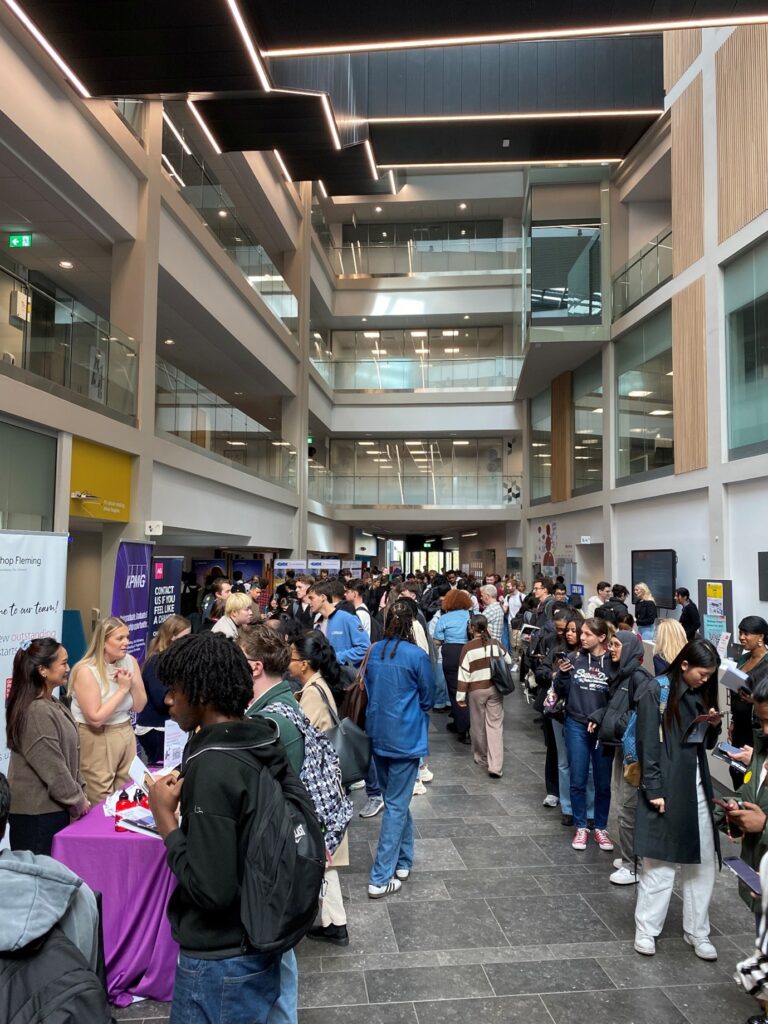
In this academic year we welcomed 315 organisations onto campus. Our events spanned a range of activities, from straight up careers fairs, through to ask the expert sessions, panels and employer career talks. Here is a sample of the great feedback we have received from employers about our events:
Ralph, Aviva (Computer Science Panel): I thought it was a really good event, and I enjoyed getting to talk to your students. I’ve made several new LinkedIn connections and it’s really great to hear that some are already enrolled in the Aviva Graduate Assessment Centres.
Ben, Science Creates Outreach (Science Futures Fair): The students were confident, professional and open to asking questions. It was a pleasure to talk to them.
Despite being an employer focused team, students are the centre of everything we do, and we welcomed over 4,300 to the 35+ events we delivered over the course of the academic year. We had record breaking student turnout at the Engineering Fair, the Law Fair and Professional Practice Week (PPW). At PPW 2026 the student attendance was double the attendance of the previous year! With an increased focus on the benefit of experiential learning, careers events have taken on even greater significance when it comes to preparing students for what happens when they complete their studies. Here is a sample of some of the great student feedback we’ve received about our events:
Alizeh, LLB Hons Law, 3rd year (Law Fair): Attending the fairs has helped me understand what a career in law looks like beyond university. They gave me insight into the wide range of roles and employers available, which grew my inspiration. Thanks to UWE Careers Fairs, I am more confident in my pursuit of a career in law after graduation.
Dami, Computer Science with AI, 3rd year (Business School Careers Fair): Attending the fair gave me the chance to connect with employers and learn more about internship opportunities in tech. I was impressed by the variety of companies there, and it helped me feel more confident speaking to recruiters about my skills and career goals.
Special thanks to our wonderful staff who continue to support our events and offer their expert guidance to students, while pulling together the various elements required to make our events a success. Also, to the Events team for offering their expertise, guidance and support this year.
With our continued desire to deliver greater experiences for our students and employers alike, we are revamping our careers fairs for academic year 2026/27. All fairs will be consolidated into 3 events over the course of a fortnight in October (7 -21 October 2026), combining several complementary disciplines into each event as follows:
Applied and Social Sciences, Environmental and Public Sector – 7 October 2026
Architecture, Construction, Engineering and Property – 14 October 2026
Business School Careers Fair, October 2025Property and Construction Bootcamp, October 2025Professional Practice Week, Creative and Tech Mixer at Strange Brew, January 2026Ask the Experts (Accounting and Finance), February 2026
The Bristol 3D Medical Centre, Integrated Care, and the Power of Collaboration with UWE Bristol
Written by Professor Marc Griffiths
Healthcare can do more than treat illness; it can transform lives. Nowhere is this clearer than at the Bristol 3D Medical Centre, a pioneering NHS facility where innovation, compassion and collaboration come together, redefining reconstructive care through advanced digital technologies, artistry and patient‑centred practice.
As explored in Episode 14 of the Let’s Talk Health and Carepodcast, recorded on site at the Centre, the Bristol 3D Medical Centre is the first NHS facility in the UK to bring 3D scanning, digital modelling and 3D printing together under one roof. But what’s particularly striking is its significance extends well beyond technological firsts. It represents a new model of integrated, innovation‑led care that sits squarely within the ambitions of the Integrated Care Academy at UWE Bristol.
What Makes the Bristol 3D Medical Centre Different?
Located within a residential community rather than a traditional hospital environment, the Bristol 3D Medical Centre operates at the intersection of:
Advanced engineering and digital design
Clinical expertise and patient safety
Artistry, craftsmanship and empathy
Psychological rehabilitation and wellbeing
Under the leadership of Amy Davey, Lead Reconstructive Scientist and Lab Manager, the Centre delivers a fully integrated pathway, from ultra‑high‑resolution facial scanning and digital sculpting, through to 3D printing in biocompatible materials such as resin and PEEK, and finally to the meticulous hand‑finishing of bespoke prostheses.
Critically, the Centre treats patients from infancy through to older age, supporting individuals affected by cancer, trauma, congenital difference and complex surgical intervention. The outputs are not ‘off‑the‑shelf’ devices; they are deeply personalised interventions designed around function, appearance, identity and confidence.
Positive Outcomes
The outcomes associated with the work of the Bristol 3D Medical Centre are striking – and deeply human. Patients do not come simply to “replace” what has been lost. As highlighted in the podcast, the Centre plays a pivotal role in helping people rebuild confidence, regain capability in their day-to-day lives, and improve their overall quality of life.
This includes supporting individuals to re-enter social life and employment, feel more confident interacting with others, and navigate the psychological transition following trauma or cancer. The Centre also helps reduce the need for further invasive surgery and enables smoother, less distressing rehabilitation pathways.
From infants benefitting from non-invasive helmet therapy that avoids surgical risk, to adults rebuilding facial identity following cancer treatment, the Centre demonstrates how innovative technology can directly translate into better outcomes – emotionally, socially and clinically.
This focus on rehabilitation, therapy and long-term wellbeing aligns closely with integrated care principles, where success is defined not only by clinical intervention, but by lived experience and sustained outcomes.
Integrated Care in Action
The Bristol 3D Medical Centre exemplifies the core themes of the Integrated Care Academy at UWE Bristol, blending clinical science, engineering, design and digital skills to translate research and technology into real-world clinical impact. Located within a community-embedded environment, the Centre supports hospital services, community rehabilitation and regional pathways, demonstrating how innovation in practice can strengthen system integration and place-based care.
As discussed in the podcast, the Centre already supports surgical planning, reduces theatre time, and enables clinicians to take an innovation-first approach before patient operations. This system-level value highlights how innovation at the point of care can positively influence efficiency, safety and patient flow across the wider system.
Just a few miles away, UWE Bristol brings together complementary strengths in robotics, advanced and additive manufacturing, health technologies, psychology and workforce development. Existing collaborations with Bristol Robotics Laboratory, where Amy Davey acts as an industrial mentor to doctoral researchers, alongside wider links with engineering and health research communities, reflect a shared ambition to bridge the gap between research and real-world healthcare application.
Looking Ahead
Looking to the future, UWE Bristol is well placed to deepen and extend collaborative workstreams with the Bristol 3D Medical Centre through an innovation-first model. This includes co-developed research focused on applied clinical challenges, translational pathways from robotics, materials science and digital health into patient care, and new approaches to workforce education, training and medical device innovation.
As Amy Davey reflects in the podcast, the Centre itself has the space, ambition and openness to grow into a regional hub and national centre of excellence. UWE Bristol – through the Integrated Care Academy – is a natural partner in shaping that future.
The Bristol 3D Medical Centre is more than a technological success story. It shows what is possible when innovation is driven by patient need, supported by integrated systems and strengthened through collaboration with higher education.
As the Integrated Care Academy continues to champion new ways of working across health, care, technology and education, the Bristol 3D Medical Centre stands as both proof of concept and inspiration – showing how research and innovation, when embedded in care, can genuinely change lives.
The UWE Bristol x Hitachi Female Talent Initiative in Transport, Logistics and Technology event brought together over 30 students and five external speakers to explore careers, challenge assumptions and share honest conversations about the sector. With speakers from industry and academia, the event focused on career pathways, and why diversity of people and perspectives matters more than ever.
To open the session, Anna Maudet, Head of Bid Management at Hitachi ZeroCarbon, posed the question…
What first comes to mind when you hear “transport and logistics”?
…and as responses were gathered through a live word cloud, many were quick to point out visual and operational associations such as ‘trucks’, ‘trains’, ‘freight’, ‘lorries’, ‘hard hats’ and ‘clipboards’. Other responses focused more on representation, with several participants simply answering ‘men’. Taken together, these responses suggest that the sector is commonly perceived as heavy, operational, and male dominated.
Squiggly Careers
Following some initial icebreakers, Sarah Behenna (UWE Bristol) chaired the next session, which began with industry speakers Maria Perrotti (Hitachi), Isabella Panovic (Innovate UK) and Amber Gunter (Steer), alongside two UWE Bristol academics, Daniela Paddeu and Glenn Lyons, sharing and discussing as a panel their routes into the transport and logistics sector.
What stood out most was the shared theme of “squiggly careers”, with no speaker describing a neat or linear journey into transport or logistics. Instead, the discussion highlighted how a career spent moving between sectors and interests can be a positive rather than a negative.
Dr Daniela Paddeu, Associate Professor of Sustainable Freight Futures at UWE Bristol, discussed how her initial interest in transport and logistics was driven by the innovative technologies which drive cost reduction of system efficiencies, but has since come to be far more interested by the humans behind these systems: the drivers, the planners, the local SMEs who are integral to the supply chain, each with their own experiences and needs.
Conversations around state‑of‑the‑art innovation also featured strongly, with Isabella from Innovate UK outlining the Zero Emission HGV and Infrastructure Demonstrator (ZEHID) programme, and Anna from Hitachi ZeroCarbon describing their role as the principal partner of GRIDSERVE, which aims to deliver one of the most advanced eHGV charging networks in the world.
Alongside excellent technical questions around charging speed and infrastructure, students asked equally important questions about societal challenges: how do drivers feel about this transition, and how does this technology change day‑to‑day working lives?
Representation Shapes Outcomes
Following the panel and Q&A session, the room was split up into roundtable discussions facilitated by the expert speakers, which focused on where perceptions of the transport and logistics sector come from which including responses about media portrayal, lack of visible role models, gendered job descriptions and workplace cultures that don’t always feel welcoming.
Professor Glenn Lyons also noted how colleagues at UWE Bristol’s Centre for Transport & Society refuse to take part in “manels”, i.e. event panels with an all-male line-up, and instead used these instances as opportunities to engage with those making these decisions.
Hitachi also shared practical examples of how exposure can change perceptions, including their student discovery weeks and summer placements that allow participants to spend time across different parts of the organisation and see the full breadth of roles available. By the end of the event, it was great to hear that perceptions had notably shifted. When asked how likely they were to pursue a career in transport and logistics, the overwhelming majority of students selected likely or very likely!
This event was organised in partnership between Anna Maudet (Hitachi ZeroCarbon) and colleagues at UWE Bristol (Daniela Paddeu, Sarah Behenna, Amina Hamoud, and Robert Hicks), with the support of School of Architecture and Environment and School of Engineering Athena Swan self-assessment teams (AS SAT), who sponsored the event.
Dr Karan Vickers-Hulse, Dr Jane Carter and Dr Sarah Whitehouse have been successful in securing funding from the British Academy to deliver a three-day writing and mentorship workshop for early career researchers in South Africa. These workshops will be planned and delivered alongside academics from four universities in South Africa and will focus on early career researchers with an interest in teacher education, social justice, equity, and decolonising knowledge production. The project aims to build capacity in academic writing, publishing, and grant development while creating sustained international research networks and increasing the visibility of African scholarship.
The project builds on existing partnerships with the University of Zululand in KwaZulu-Natal, which were developed through connections with Project Zulu and sustained during previous British Academy funding. The team has reached out to academics in other institutions in South Africa to ensure that they can build a sustainable early career researcher network across universities in South Africa. The bid aligns closely with Project Zulu by extending a shared commitment to educational equity and aims to strengthen the research and teacher education ecosystem that underpins long-term, systemic change in South Africa.