UWE Bristol research evaluates the accessibility and inclusivity of voluntary carbon markets in the UK

Posted on

Dr. Rounaq Nayak, Senior Lecturer in Farming Systems, recently completed a project funded the National Innovation Centre Rural Enterprise (NICRE) that aimed to identify the mechanism whereby emerging natural capital investment markets can contribute to a successful rural economy.

 This was achieved in two ways. First, by examining how rural enterprises navigate voluntary carbon and other natural capital investment markets and how they overcome and exploit potential limitations and barriers. Secondly, by identifying priorities related to the enterprise and innovation potential of natural capital investment markets and the resources required to achieve this.

Through an infographic and animation, the project helps to inform local and regional policies and support rural enterprises’ engagement with carbon markets.

The project infographic.

The findings point to the need for clearer ethical guidelines, stronger partnerships with rural communities, and better support for diverse land ownership models.

To help address these issues, an animated guide offering ten practical tips for entering the carbon market and an infographic explaining key principles for navigating these opportunities were produced.

View the tips and view the full research report.  

SW Public Health and Criminal Justice Network: What next for Health and Justice?

Posted on

By Professor Kieran McCartan


On Friday the 24th January, we hosted the 10th Public Health and Criminal Justice network event at UWE Bristol. The event focused on “What next for Health and Justice?” and had over 80 participants from academic, health, public health, prisons, policing, probation and local government from across the southwest of England.

The role of the network is to foster collaboration in the health and justice fields, enabling attendees to see how their research, policy and practice build on each other to help produce a more integrated and synthesised system. The network, and related events, are founded on the idea that health and wellbeing are an outcome as well as a predictor of criminogenic behaviour, and that by looking at crime and offending behaviour through a health and public health lens we can produce better outcomes to reduce re-offending as well as prevent first time offending.

The network has been running for 4 years and has over 250 members. Previous events have looked at Trauma Informed Practice, Public Health approaches to sexual abuse prevention, as well as the impact of COVID-19 on health in prisons to name a few.

This event focused on emerging research, policy and practice in the southwest addressing not only mental health and wellbeing in children and young people, at of people in the prison system as well as on probation, and the development of innovative frontline service provision. The event was opened by Justin Varney-Bennett, Regional Director OHID SW & RDPH NHSE, who highlighted the unique challenges and opportunities that the southwest presented, before linking it to national policy and practice. This framed the event well and opened the conversation to be built on by our other speakers who includes,

Children Young People, Violence Prevention and Mental Health:

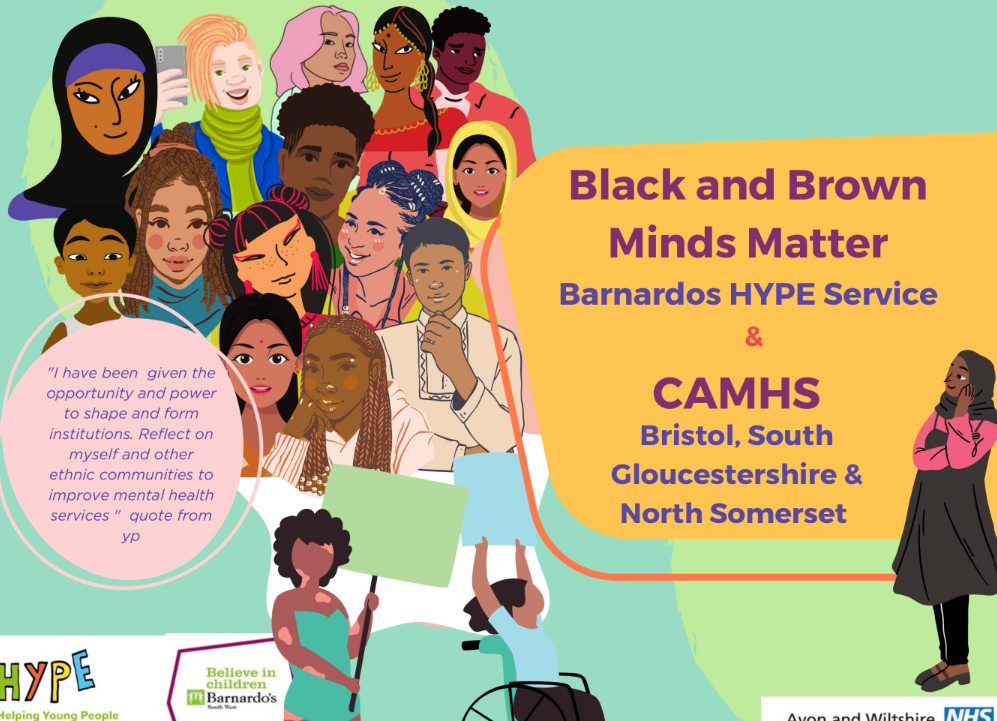
‘Improving Access and Experiences of Mental Health Services for Black and Brown Young People – Barnardo’s Black and Brown Minds Matters Group and CAMHS’ Stephen Barry, CAMHS Project Lead and Be Safe Service Clinical Manager/Lead, Cenzina Barclay, Barnardo’s Co-Production Worker, Latalia Williams, Health Champion.

View the presentation.

‘Shore: a safe place for young people worried about sexual behaviour’- Rachel Haynes, Head of Clinical Services (Children and Young People), Lucy Faithful Foundation.

View the presentation.

‘Developing Key Performance Indicator’s for understanding and responding to Sibling Sexual Behaviour and Abuse’ Kieran McCartan, UWE Bristol, Amy Adams PhD Researcher, University of Birmingham and Research Associate, UWE Bristol.

View the presentation.

The title slide from the Improving Access and Experiences of Mental Health Services for Black and Brown Young People – Barnardo’s Black and Brown Minds Matters Group and CAMHS’ presentation.

Secure Estate/Prisons & Probation – Male and Female focus:

‘Delivering effective healthcare in an inner-city Victorian reception prison- HMP Bristol’s experience’ Natalie Steadman, Deputy Governor, HMP Bristol.

View the presentation.

‘Southwest Probation Health and Justice Team’ – Laura Cairns / Becky Thomas, Health and Justice Partnership Co-ordinators, Community Integration Team, Probation SW.

View the presentation.

‘The National Review of Health and Social Care in Women’s Prisons Our Approach in the South West’ – El Woods, Women’s Pathways Lead, NHS England Health and Justice South West) On behalf of the SWWEEP Board.

View the presentation.

Children with Complex Needs: (Vanguard)

‘Trauma Responsive or Trauma Organised? Understanding how systems can become organised around chronic stress’- Andrew Nicholls Clark, Head of Health & Justice Children Programme, NHS England.

View the presentation.

‘Regional Vanguard evaluation’- Ella Rees, Research Associate, Vanguard, UWE Bristol.

View the presentation.

‘Developing and sustaining the Children Young People Framework of Integrated Care (Community) in the Southwest’- Gail Warnes, Senior Commissioning Manager, Non-Custodial and CYP, Health & Justice. Commissioning Team, NHS England – Southwest, Emma Morgan, Children and Young People Vanguard Project Manager/ Children’s performance manager.

View the presentation.

The event highlighted innovative practice across the southwest regarding health and justice, but particularly in respect to services targeted at traditionally marginalised and excluded groups (i.e., Children and young people, BAME populations, and people with a criminal recorded).  If you would like to join the network to hear more about upcoming events, please sign up.

UWE Bristol research project launches policy briefing outlining findings from a legislative and policy analysis of Welsh educational documentation 

Posted on

A collaborative research team, led by UWE Bristol, has produced a policy briefing based on findings from a legislative and policy analysis of Welsh educational documentation. The project team consists of researchers from Cardiff Metropolitan University; Swansea University, University of South Wales and UWE Bristol.  

The Economic and Social Research Council (ESRC) funded project has challenged the issue of translating policy intention into education practice with a focus on young children’s participation rights and how these are enacted in classroom contexts.  

The policy briefing recommends the following to better support young children’s participative rights in Welsh policy:  

  • Future education policy in Wales should continue to account for children’s participative rights.  
  • Children should be recognised as active rights holders in the ‘now’ in all future legislation and policy in Wales.  
  • Education policy should consider the ‘how’ of children’s participative rights.  

View the full policy briefing

Read the policy briefing in Welsh

Principal Investigator Sarah Chicken commented on the briefing:

“Findings from our policy analysis indicate a strong ongoing commitment in Wales to children’s participative rights but there is currently a gap between the policy ambition and classroom practices. The aim of this briefing is to bridge that gap by providing actionable insights for policymakers and educators” 

The team have also created a series of infographics which are designed to present the project findings in an accessible and visual manner. Currently, we have two infographics available:  


Find out more about the Children’s Participation in Schools project:  

Case Study: Dr. Peter Bradley and Dr. Damian Whittard – Working towards an environmentally sustainable and equitable future

Posted on

“We’re building the evidence base required to bring about economies that embody greater levels of sustainability – at local and global levels.” 

The transition to a green economy presents us with a huge opportunity. But it also poses a fundamental challenge: how do we ensure that this transition is fair and just for everyone? 

Dr. Peter Bradley and Dr. Damian Whittard 

The challenge of a just transition 

The green economy promises transformation, but it’s replicating the same old inequalities. The winners are usually those already in positions of power. 

Take the labour market’s 10% gender pay gap. It carries straight into green jobs. Ethnic groups also face barriers accessing these roles, then earn less once they break through. Our planet’s life-support systems are failing, driving up living costs and degrading quality of life. This threatens human survival itself. But here’s the catch: You can’t save the planet while leaving people behind. You need widespread buy-in, people who recognize the opportunities and believe they have an equal stake in the change. This is where our research comes in.

A systems approach 

Our interdisciplinary team, sociologists, psychologists, environmental scientists, geographers, economists deliberately brings diverse insights because siloed thinking won’t solve this challenge. 

We work from individual behaviour change to macro-policy, collaborating with government departments like Defra and local authorities like the West of England Combined Authority. Implementation happens locally, but you need systems thinking across the whole supply chain. 

The green transition is caught in a classic chicken-and-egg problem: businesses will only shift if there’s consumer demand, but consumers can only demand what’s already available. Breaking this cycle requires understanding both sides of the equation. 

Real-world impact

Our research has lead us to found The Brunel Centre, a long-term collaboration between UWE Bristol, University of Bath, and Futures West. It is all about putting data and research to work by turning insight into action supporting inclusive and sustainable growth in the West of England. Backed by £4.5 million of funding and bringing together universities, businesses, and policymakers to address the region’s biggest challenges.

Our work is rooted in real-world partnerships: from long-term collaboration with Bristol City Council on sustainable business futures, to joint events with fintech firms exploring greener tech infrastructure, to national projects with the Central Bank on digital currencies and tax reform. We’re also supporting community-led businesses through Power to Change funding, ensuring the benefits of change are felt on the ground.

The transition to a green economy is still light on solid data. We don’t even have a shared definition of a ‘green job’ let alone reliable data on pay, benefits, or who’s accessing these roles. The Brunel Centre will change that by building a real-time, publicly accessible data hub. It’s designed to answer urgent questions while remembering this isn’t just about research. It’s about making the transition fair. Because if we’re reinforcing existing inequalities, we’re not really moving forward.

Breaking new ground

Solving the climate crisis will take more than new technologies. It requires fundamental shifts in how we live, work, and consume. That means understanding how to encourage behavioural change in ways that are ethical, inclusive, and rooted in people’s real lives.

We’re also pushing the boundaries of what’s possible with data. By carefully and ethically linking anonymised government records, like payroll and employment histories; we’re building a clearer picture of green jobs across different demographics. It’s a complex and sensitive task, but it’s essential if we want to design a future that truly works for everyone.

The green transition isn’t just about saving the planet. It’s about reshaping our future, and it won’t happen by accident. It takes data, collaboration, and the courage to challenge business as usual. We’re building that foundation. And we welcome those ready to help shape what comes next.


Contribution to the UN 2030 sustainable development goals

UWE Bristol is proud to align our research to the UN sustainable development goals. The above research aligns with the following goals:

Global Migration Network Seminar Series 2025

Posted on

The Global Migration Network, a research group at UWE Bristol chaired by Dr Emily LeRoux-Rutledge, brings together 60+ academics and practitioners from across the university working on migration-related research. The aim is to facilitate and contribute to cross-disciplinary research on migration, inform policy and public debate, and engage with users of migration research.  

The Network has a fantastic seminar series lined up for Spring 2025, and attendance is open to all. The seminars are hybrid, but you are encouraged to come in person for sociability and community (if you are able). For more information please contact emily.leroux-rutlege@uwe.ac.uk.

Seminars:

Migration and Memory, how we prepare for and cope with loss and change

Wednesday 12 February 2025, 1:00pm – 2:00pm (3S803) – Nigel Williams

After offering case examples about how migration is anticipated, and losses are worked with this session will help participants to develop their own sense of the similarities and differences between intergenerational memory running in families, groups and organisations and longer-term transgenerational memory located in culture and bodies in deeper time. Using these cases and some of our own experiences we will explore how to go about addressing first, second, third generation (and beyond) responses to the challenges of migration as a complex multifaceted experience extended in time.

Nigel Williams is a Visiting Fellow in Psychology at the University of the West of England and is author of Mapping Social Memory a Psychotherapeutic and Psycho-Social Approach, in the Palgrave Psychosocial series and has recently published a chapter on generational memory in Studying Generations, Bristol University Press edited by Helen Kinston and Jennie Bristow.


Support for ‘replacement migration’? Region-level demographics and attitudes towards immigration in Europe

Wednesday, 12 March 2025, 1:00pm – 2:00pm (4D005) – Artjoms Ivlevs

Does demographic decline make Europeans more pro-immigration? Our longitudinal, regional-level analysis, drawing on the 2008-2019 European Social Survey (278 regions in 22 countries) and the 1999-2021 German Socio-Economic Panel (16 federal states, 96 planning regions), suggests that people become more favourable to immigration as regional birth rates fall and ageing indicators worsen. While this result would support the logic of replacement migration, we also shed light on the role of the natives/foreigners balance in driving this relationship and tentatively conclude that the link between demographic decline and attitudes towards immigration could also be explained by group conflict theory.

Artjoms Ivlevs is Professor of Economics at the Bristol Business School (UWE Bristol) and a Research Fellow at the Institute for the Study of Labor (IZA). His research interests include migration and subjective well-being, and more recently tourism. Artjoms is an applied microeconomist working with large-scale survey data; much of his work focuses on the post-socialist countries of Central and Eastern Europe.


Supportive local policy, hostile national policy: the integration experiences of refugees and asylum seekers in Wales.

Wednesday, 2 April 2025, 1:00pm – 2:00pm (3S803) – Sam Parker

 In 2001, following the Immigration and Asylum Act 1999, four towns and cities in Wales became asylum dispersal locations and, as such Government has devolved responsibility in many social policy areas that impact upon refugee and asylum seeker integration. This seminar begins by outlining developments in UK immigration and asylum policy and highlights the ways in which successive Westminster governments have introduced legislation creating a ‘hostile environment’ designed to deter asylum seekers from entering the UK and encourage failed asylum seekers to leave the UK. Such policies have restricted the civil and social rights of asylum seekers whilst simultaneously the Westminster government has focused upon policies for the integration of those granted refugee status only. This seminar reports on the findings from interviews conducted with 19 refugees and asylum seekers in Wales, where in contrast to Westminster, the Welsh Government see integration as a process beginning on day one of arrival in Wales. The data are taken from a project focusing on refugee and asylum seeker integration in Wales and demonstrates how policies introduced in recent years have led to restrictions on the day-to-day lives of asylum seekers in Wales and their ability to integrate. It argues that in a system of multi-level governance, the Welsh Government’s vision of integration remains problematic when immigration and asylum remain matters reserved to the Westminster Government. It highlights ways in which Welsh Government policy diverges from that in England and argues that further use of devolved powers could be made to facilitate integration in Wales.

Sam Parker is a Senior Lecturer in Social Psychology at UWE Bristol and has previously worked at Cardiff University and Birmingham City University. Sam is also Chair of Trustees for Space4U Cardiff, a small community organisation that supports newly arrived refugees and asylum seekers in Cardiff.


Am I happier than you are? It depends on when you ask: Reflections on the need for longitudinal studies on the well-being of international students

Wednesday 14 May 2025, 1:00pm – 2:00pm (2A027) – Trang Trần

If an international student speaks English as their first language (EFiL) instead of as an additional language (EAL), would their predicted well-being be higher compared to their EAL peers? English language proficiency has been shown to significantly predict various indicators of mental health among international students. Our longitudinal data shows that during early arrival, EAL students scored significantly higher than their EFiL peers on their psychological well-being measures. While this may seem unexpected, it does align with some previous findings suggesting that UK home students’ well-being indicators are significantly lower than those of their international peers. However, further analysis of longitudinal data (collected at 3 time points over 18 months) showed that the trajectory of psychological well-being for EFil and EAL international students was reversed, with EFiL students’ wellbeing improving over time, while their EAL peers’ well-being score decreased over time. Despite the small sample, these findings invite further reflection on the importance of longitudinal studies, or at the very least, the need to contextualise psychological well-being in the timing of students’ journey, alongside other contextual factors.

Trang Trần is a Senior Lecturer in Psychology at UWE Bristol. Her research interests include international students’ coping strategies and psychological well-being.


From Harm to Hope: Examining Migrant Integration Policies and Practices in the City of Bristol

Wednesday 11 June 2025, 1:00pm – 2:00pm (4D005) – Ryan Lutz

Integration has been a heavily critiqued term with its history of creating exclusionary and racialized policies is well documented (Favell, 2022). Despite this, the term has remained and become stronger. The restrictive approach towards migrants has made way for a worrying trend of decreasing social rights, political inclusion and civil liberties for the citizens that migrants are supposed to be integrating into (de Noronha, 2022). Findings from co-produced mixed methods research, this research attempts to show that the lens of social harm (Hillyard et al., 2004) allows for a bottom-up approach to integration and investigates the efficacy of localized integration policies and how much they can make up for failures at the national level.  

Ryan Lutz is a PhD student in Social Policy at the University of Bristol’s School for Policy Studies in the UK. His research looks at integration, social harm, and the binary between citizens and migrants. Previously Ryan was an Assistant Manager of Research and Strategy at the Kennedy Center for the Performing Arts, received his master’s in public administration from the University of Southern California in Los Angeles.  


Contact the Global Migration Network for more information.  

UWE Bristol research helping to shape new EU Air Quality Directive 

Posted on

The European Union has recently adopted a new Air Quality Directive (Directive (EU) 2024/2881), aimed at improving ambient air quality and tackling environmental inequalities across Europe. The new directive directly cites research co-authored by Professor Jo Barnes, Professor of Clean Air and Dr Laura de Vito, Senior Research Fellow from 2018 in a report titled Unequal Exposure and Unequal Impacts: Social Vulnerability to Air Pollution, Noise and Extreme Temperatures in Europe.  

The report explored how air pollution disproportionately affects people of lower socioeconomic status due to both their greater exposure and higher vulnerability.  

Access the full report.  

What the Directive Says 

In the new directive, the European Commission acknowledges these findings explicitly: 

“According to the European Environment Agency Report No 22/2018 entitled ‘Unequal exposure and unequal impacts: social vulnerability to air pollution, noise and extreme temperatures in Europe’, the health of people of lower socioeconomic status tends to be more affected by air pollution than the health of the general population, as a result of their both greater exposure and higher vulnerability. This Directive takes into account the social aspects of air pollution and the socioeconomic impacts of measures taken.” (Directive, p. 4, Whereas (21)) 

This recognition marks an important shift. For years, the research highlighted that air quality policies often overlooked the social dimensions of pollution. In the 2018 report, they specifically noted a limitation in the previous air quality directive: 

“However, socio-economic factors have not been included in the Directive as a topic for consideration when developing air quality plans.” (EEA Report, p. 57) 

The fact that this new directive directly addresses the socioeconomic aspects of air pollution—a gap pointed out by Jo and Laura—is a significant step forward for both environmental policy and social equity. 

Why This Matters 

Air pollution is not just an environmental issue; it is a social justice issue. Communities with lower incomes often live in areas with higher pollution levels, while also being more vulnerable to its health impacts due to factors like limited access to healthcare or pre-existing conditions. Recognising and addressing these inequalities is essential to creating healthier, fairer societies across Europe. 

The new directive signals progress in this direction, aligning air quality policy with the lived realities of people most affected by pollution. By embedding social considerations into air quality plans, the EU takes an important step toward ensuring environmental policies leave no one behind. 

Professor Enda Hayes, Director of Research and Enterprise, School of Architecture and Environment commented:

“It is fantastic to see UWE Bristol research on environmental inequalities being used to influence such an important piece of legislation.

This new EU Directive will set the agenda over the coming decades on how air quality will be managed for 450 million EU inhabitants. While the immediate impact may be in shaping the Directive, the future impact on the environment, public health and society will be substantial”

UWE Bristol academic awarded a Parliamentary Academic Fellowship

Posted on

Professor Maisuria was shortlisted for two Parliamentary awards for his work as a Fellow preparing Parliament for the General Election.

In 2022, Alpesh Maisuria, UWE Bristol’s Professor of Education Policy, was awarded a Parliamentary Academic Fellowship (PAF) in the UK Parliament. The PAF is administered by Parliament’s Knowledge Exchange Unit with the objective of fostering closer relations between academic researchers and Parliament.

The PAF has enabled Professor Maisuria to work in the House of Commons Library as an education subject specialist. His work has entailed writing impartial policy briefings for politicians. These briefings are also publicly available and widely used by journalists. The experience is being used to develop a toolkit for academics to make their research more usable for those who write such briefings.

The House of Commons Library is more than a 200-year-old space filled with books, journals, artefacts, and subscriptions; it also offers a confidential enquiries service to all MPs, irrespective of Party, to source research and information about any parliamentary business they are engaged with. Enquiries commonly relate to a constituency matter, material for a speech, or preparation for a debate. Working on confidential enquiries has been a fascinating element of the experience and reveals the wide range of issues that MPs are expected to deal with.

Professor Maisuria has also worked as an Advisor and briefing writer for Ministerial sessions of the Education Select Committee. He has worked in this capacity for inquiries into math-to-18, and teacher retention, recruitment, and training. Select Committees serve a crucial function for scrutiny of the government’s performance. The work that goes into each meeting is extensive and diverse. There are meetings with the Committee chair to find their preferred steer of the meeting, meetings with government advisors who will prepare the Minister to ensure they can give a productive reply, preparing the media for their coverage, and working with the MPs who sit on the committee to ensure that the questions on the prepared brief are understood. The hard work is rewarded when the Chair calls “order, order” and the television cameras start rolling.

Perhaps the most unique experience of being in the ‘Westminster bubble’ is during a General Election. This year, an extraordinary 335 new MPs were returned for the first new government in 14 years. After 12 hours of training, Professor Maisuria was a New Members Buddy, working one-on-one with two new MPs. The new MPs are given an intense induction to being an MP, which includes procedural matters, Commons Chamber etiquette (e.g., bobbing and unparliamentary language), security and welfare, the behaviour code, and much more – the induction takes hours. Being an MP is challenging because of the variety and complexity of the work involved.

Former Prime Minister Harold Wilson observed that “a week is a long time in politics.” By July 2025, when the Fellowship will finish, there will have been at least five education secretaries, four PMs, and two monarchs. Being in Westminster during this time has been unique!

Alpesh Maisuria will present at the event, “Lessons from working with policymakers” 31 January 2025, 10-11am via Teams. Contact researchevents@uwe.ac.uk for more information.

He will also talk about the Fellowship at the College for Health, Science and Society Impact Showcase which will be held at EP1, Frenchay Campus, on 13 February 2025, (09:15-13:30). Book your place.

He can be contacted for further information about any aspect of this Fellowship, alpesh.maisuria@uwe.ac.uk

So you want to do a PhD?

Posted on

This article is updated from a first version published as Have you ever thought of doing a PhD?, on 31/11/21 on Design@Open, a blog about design at the Open University.

By Professor Alice Moncaster, Professor of Sustainable Construction

What is a PhD and why might I want one?

A PhD (Doctor of Philosophy) is awarded for postgraduate study in any subject (not only Philosophy) which involves substantial independent research that can be considered to be ‘adding to knowledge’ in your area. It usually takes 3-4 years full-time in the UK, produces a single-authored thesis of up to 100,000 words (depending on discipline), and is examined by two academic examiners through viva voce.

A PhD can be a life-changing event, a career-development opportunity, a career-changing opportunity, a chance to deeply explore  an area of interest, a chance to develop and demonstrate your expertise, a chance to both broaden and deepen skills you didn’t know you had, a chance to impress your nearest and dearest (although also a chance to bore them rigid with the details…), and many other things. It is also, of course, the first step to an academic job.

If you are currently thinking YES, that’s for me! but don’t know how to go about it, read on.

The application process

PhDs are academically challenging, across all universities and disciplines. Applicants therefore need to persuade potential universities and supervisors that they are going to be capable of success.  They are usually expected to have a good first degree and evidence of some previous research (such as a master’s dissertation), although exceptions can be made for significant ‘real world’ experience in a relevant area.

Some institutions and supervisors will consider accepting self-funded students, who are often studying part-time while also working.  Funded PhDs are usually although not always full-time.  In the UK funding covers the tuition fees and a minimum stipend of £19,237 per year (2024-25 figures), usually for three years. This isn’t a loan, unlike for Bachelor’s and Master’s degrees, and you don’t have to pay it back.

However finding funding can be difficult and is very competitive.  Funding might be offered by your company – you can always ask. Some universities have funding for a few studentships each year.  Some funded research projects also include funding for PhD students.  Both of these routes are likely to be for specific, pre-determined research projects.  A good source of open and future positions is findaphd.com, where you will find opportunities which have already been defined to a greater or lesser extent, usually as part of a wider research project.  These are generally advertised throughout the year, although it’s worth noting that many deadlines will be early in the year for a PhD starting in October.

Most UK Government funding is now funnelled through Doctoral Training Partnerships (DTPs), which are held by one or more universities in partnership with one of the UK Research Councils. 

The University of the West of England is part of two DTPs:

For both of these DTPs, the research project is up to you.  This is harder work than the pre-defined positions, but potentially more satisfying as you get to design the research project which really interests you.

Note that the deadlines for UWE applications to the SWDTP are 14th January and applications to the SWWDTP are 20th January, for studentships starting the following October. 

Your research proposal

This is critical part of your application for the Doctoral Training Partnerships, for which you will need to have developed your own research proposal in some detail. This requires some work, including reading and reviewing the existing literature on your chosen area to see what has already been done (Google Scholar is a great source of academic research papers, which are increasingly open access).  Even for open approaches to individual supervisors, you should do some initial work on developing your own research ideas.

Once you have a first draft of your proposal (aim for one page), identify a potential supervisor by looking through individual profiles of academic staff.  The supervisor should be someone with demonstrable research experience and interest in the area you are proposing (check this by looking at their recent publications, which should be linked on their webpage).  They need to be willing to support your application and to work with you on the development of your proposal, and to agree to be your primary supervisor, so your draft research proposal is your first chance to impress them. 

Your supervisor will be your new best friend!

Well maybe not quite, but the relationship with the primary supervisor is really important. As well as discussing your own research ideas, you might want to ask questions about their supervisory style, and about other PhD topics they have supervised in similar areas.  If you are looking to do a PhD to move in to academia, you could ask them about any links with national and international groups and research projects which you might be able to get involved in. If your research idea is very industry-focused you could ask about their links with industry. At UWE, as with most universities, we expect students to have two or sometimes three supervisors; the primary supervisor is often the most involved in helping you develop the direction of your research, but you might want to ask about potential co-supervisors too.

Some final points:

  • A PhD is a long-term decision and commitment; you need to be sure that it’s right for you, and to spend some time investigating it.
  • For speculative applications, or for the DTPs mentioned above, you need to know what you want to research, and find a supervisor with the expertise and desire to support you in doing this.
  • Academics are usually pretty happy to discuss research with interested prospective students – early contact is not a way of gaining favour, and certainly doesn’t count towards a successful application, but it is a normal and expected part of the process.
  • However helping you develop your research ideas is quite a time commitment for an academic. Remember that your first email is your first step of application.  Send a brief overview of your research proposal and a short academic CV to persuade them that you are capable of doctoral research.
  • Remember (again) that academics are generally over-loaded, often receiving over 100 emails a day on multiple different issues. If they don’t get back to your first email, it’s worth trying sending it a second time in case they missed the first. After that accept that this is an indicator that they don’t have the time or interest.
  • Have a chat with your potential supervisor about your research.  This is really important for both of you.
  • If you feel at this point that the supervisor is looking for you to do something different to what you have set your heart on, or that their style of working won’t suit you, think twice about signing up to a three year relationship which won’t work for either of you.

UWE Bristol academic co-produces new guide to Family Court Proceedings for domestic abuse victims

Posted on

Emma Whewell, Senior Lecturer in Law, is part of the Domestic Abuse Advisory Group that has launched a new and freely available guide for any victims of domestic abuse going through a process that can too often feel confusing and frightening.

The “Guide to Family Court Proceedings for those who have experienced domestic abuse” has been created alongside people who have lived experience and their insights into the system; it is particularly targeted at those who have experienced domestic abuse and are navigating court proceedings without legal representation.

The guide will be available and distributed to Courts, the legal profession, councils, statutory and voluntary organisations supporting victims, healthcare services, education settings. It is also available to anyone supporting victims of abuse and their children, and the victim/survivors directly.

This guide is intended to eventually be rolled out nationwide for use within the court system. The advice it offers draws on the experiences of victim/survivors as well as the Judiciary, legal professionals and domestic abuse support services. It is intended as a trauma-informed and easy-to-understand document to help people navigate what can sometimes seem a bewildering and foreboding process.

Access the guide below:

Emma commented:

“The Guide is the first output of Bristol’s Local Family Justice Board Domestic Abuse Advisory Group which in turn was created after a Conference on Domestic Abuse at UWE on 19th May 2023.  Its a hugely important piece of work and I very much hope that all those who have experienced domestic abuse will find the Guide useful.”

Her Honour Judge Cope, Senior Circuit Judge, Designated Family Judge based at Bristol Civil and Family Justice Centre has stated:

“This guide has been prepared by a group of professionals over a long period of time. The result is a clear, local guide aimed at assisting those who come to the court having experienced domestic abuse. It contains a wealth of information in a practical format which I am confident will help all those anxious about attending court. I am delighted to support it.”

About the Guide to Family Court Proceedings for those who have experienced domestic abuse

It is a victim/survivor-centred and victim-informed resource backed by senior members of the judiciary and the Children And Family Courts Advisory Support Service (CAFCASS). It will be made available to all, free of charge.

About the LFJB Domestic Abuse Advisory Group

The Domestic Abuse Advisory group was formed in 2023 to address issues of concern within local Family Justice proceedings and make recommendations to the Local Family Justice Board (LFJB). Members include the Judiciary, Legal Counsel, Domestic Abuse Advocates, Trauma Specialists, Adult and Children’s Social Care, and Academic and Research Specialists.

Knowledge Transfer Partnership Associate Spotlight: Taabish Khan 

Posted on

Taabish is a Commercialisation Manager for Duku as part of our Knowledge Transfer Partnership (KTP) with Duku and UWE Bristol. A KTP is a UK-wide, 3-way partnership between a business, a university and talented graduate, and aims to help businesses improve competitiveness and productivity, whilst also boosting the career prospects of the graduate.  

Duku is an innovative and entrepreneurial engineering design consultancy that take client ideas and develop them into full marketable designs. They have recently added an in-house EV charging technology division, developing new and unique electric vehicle (EV) charging infrastructure, which has considerable potential as the only fully-accessible charging tech available, which conforms to the new BSI standard for accessible EV charging products.

The project aim is to embed a full commercialisation capability within the business and to exploit innovative in-house designed products. This will enable Duku to directly market their own products and offer a full-service idea-to-market capability for new and existing design consultancy clients. 

The KTP team caught up with Taabish to hear about their experiences of the KTP so far:  

What attracted you to the position? 

There are a few reasons why I was drawn to this role. First, it offered the opportunity to develop the commercialisation strategy for a product within the UK’s sophisticated automotive sector, which has been a medium-term career goal of mine. The second is the unique nature of the role. Being a management KTP, the role has allowed me to upskill as an industry consultant while collaborating with an academic institution like UWE Bristol. This partnership provided an added layer of research-driven insight and strategy formulation. Thirdly – working with Duku, a company innovating in the EV charging space and enabling users from all walks of life to access electric vehicles, also gives me a sense of purpose – knowing that my commercialisation efforts have a direct, positive impact on both the community and the planet. 

What are you most looking forward to? 

Six months into the KTP, we are transitioning from the planning into the action phase, which is something I’m particularly excited about. I’m looking forward to collaborating with industry leaders, academic researchers, and automotive OEMs to further advance our accessible charging solution. The goal is to make Duku’s products the gold standard for EV charging infrastructure while cementing our position as a thought leader in the space. The chance to see this project evolve from strategy formulation to commercial success is something I look most forward to. 

How is the partnership between UWE Bristol and the company working? 

The partnership between UWE and Duku has been highly synergistic. The academic team at UWE brings a strong research foundation, combining both academic and industry perspectives, which has accelerated the strategy development process. This collaboration has also created a feedback loop that allows for continuous validation of my deliverables, making the entire process more dynamic, accurate, and responsive. This partnership has also opened new doors for Duku, offering potential collaborations and expanding our contacts in areas such as accessibility and sustainability in EV infrastructure. 

What are the major benefits/support available from UWE Bristol ? 

The major benefits for me personally have been access to UWE’s resources, research capabilities, and academic expertise. Positioned in the middle, I bridge the gap between academia and industry, benefiting from both perspectives. This has allowed me to develop a holistic commercialisation strategy that considers both academic rigor and practical, real-world insights. Beyond the scope of the project, this experience has been transformative. Having recently completed my MBA, I am transitioning from execution roles to more strategic, planning-focused positions. The variety of perspectives I’ve been exposed to through this partnership is helping me upskill rapidly, and I’m confident I’ll emerge a more capable professional by the end of this KTP project. 

What do you enjoy most about your job? 

What I enjoy most about my role is the tangible impact my work has on Duku’s overall strategy. Taking complex data, reports, and insights and distilling them into actionable strategies is something I find highly fulfilling. Being in a management KTP role, I frequently get the opportunity to engage in activities like design thinking, competitive analysis, branding, marketing, and even sales leadership. These are skills that will serve me well throughout my career, and the diversity of the work keeps me constantly challenged and engaged. 

Find out more about KTPs at UWE Bristol.  

Back to top