“I’m excited by putting robots into real life. Already we have seen some amazing results. With children, for example. Social care is also an area where we believe robotics can play an important role.”
I am a bioengineer by background. My PhD is in biomechanics – how the human body moves and performs. Then, seven or so years ago, I became interested in robotics and humanoids, and how they can help real people in their daily lives.
Now my work is centred on developing robots and robotics that can help people with disabilities or any other kind of condition or frailty. We are looking at how we can use robotics for assistance and rehabilitation. To help people get back to doing what they used to be able to do.
Simple beats complex every time
I am passionate about making things simple. Not over-complicated or over-engineered. Because the simpler we can make these robotic applications, the faster we can get them into real world clinical use.
That means we can start helping people sooner rather than later. That’s important to me. It’s not about doing things for us, as researchers or academics. It’s about helping individuals to do things for themselves. Say you are getting older, you’ve had a stroke, or you’ve lost a limb, how can robotics help you to regain and restore your independence and confidence?
Your friendly robot reminder
We’re exploring many kinds of robotics too. For example, how we can use robotics in therapy, for a physical or mental condition. Yes, social robots. Humanoid robots that can give feedback. Say you’re doing rehab exercises, your robot can tell you if you’re doing them well or “Hey, you didn’t exercise today”. Things like that.
That means AI and robotics that can take information from the environment around them and make decisions based on that information.
Helping humans, not replacing them
I’m excited by putting robots into real life. Already we have seen some amazing results. With children, for example. Social care is also an area where we believe robotics can play an important role. We don’t have enough carers right now. And many of them are experiencing fatigue and burnout. Or they are moving to other, better paid sectors.
We will never replace our carers with robots, but they could help them to do their job better and help people who need care to stay in their own homes for longer, and live more independent lives.
This is why I have a user centred approach. We start with what the user needs, not what we want to do. We begin every project we do with something called contextual inquiry. That’s basically go and see. Find out. Discover. Only then can we develop the robotics to aid people. And that’s always our goal.
Contribution to the UN 2030 sustainable development goals
UWE Bristol is proud to align our research to the UN sustainable development goals. The above research aligns with the following goals:
“As leaders in the psychology of appearance and body image research, we’re on a mission to shatter appearance ideals and stereotypes so young people are not held back by low body confidence.”
We’ve both been at the Centre for Appearance Research (CAR) for over a decade. Together, we co-lead a team of researchers, focusing on the co-creation and testing of body image tools for young people.
We work alongside the Dove Self-Esteem Project, which is the community impact and social purpose programme for Unilever’s largest brand, Dove.
Since 2012, we’ve developed and tested tools, policies and strategies that have reached over 100 million young people around the world with partners at UNICEF, Nike, and the World Association of Girl Guides and Girl Scouts.
Low body confidence
The majority of young people do not have body confidence. It affects all genders and cultures, with girls, gender diverse people and LGBTIA+ communities being disproportionality affected. Appearance-based stereotypes in relation to skin colour, body size, aging, physical disabilities are also widely prevalent. This has wide-ranging impacts for people’s health and well-being. For example, 8 in 10 girls opt out of important life activities, like putting their hand up in the classroom, going to the doctor, trying out for a team or club, due to low body confidence.
See the impact, feel the impact
For several decades, researchers have been developing programmes to improve body confidence among young people. However, we’ve really struggled to get effective evidence-based interventions out to lots of people in a sustainable way due to a lack of resource and expertise in marketing.
When we started working with Dove, our goal was to harness the reach and popularity of their brand and work together to deliver evidence-based body confidence education on a global scale.
Creativity you can measure
We’re now 10 years into our partnership. Over those 10 years we’ve developed more than 20 different body confidence tools. Including the Girls Room, a five-part film series crafted by Emmy Award-winning producer and writer Lena Waithe, Dove, the Centre for Appearance Research and Attn:.
We’ve also worked with UNICEF, the World Association of Girl Guides and Girl Scouts, Cartoon Network and a range of creative and tech agencies to co-create animations, e-books, school lessons, digital games, social media marketing campaigns, and chatbots. Our most recent project included a world-first collaboration between Nike and Dove to deliver body confidence education to coaches in sporting settings.
But it’s not just about the creative concepts and wide-reaching platforms we’re using to reach young girls. We rigorously evaluate everything we do through randomised control trials and qualitative research, so that we can be sure of the impact that the these tools are having on young people’s well-being.
Positively improving real lives, over 100 million and counting
We’re very proud of our work with Dove. Dove is now the world’s largest provider of evidence-based self-esteem education and the tools we’ve created together have reached over 100 million young people around the world.
We’re always exploring new ways to reach more young people and look forward to continuing our partnership together.
Contribution to the UN 2030 sustainable development goals
UWE Bristol is proud to align our research to the UN sustainable development goals. The above research aligns with the following goals:
I lead the Generation Genome education team here at UWE Bristol. But my interest in genomics education goes back to 2012, to the launch of the 100,000 Genomes Project.
The 100,000 Genomes Project was an English initiative to sequence and study the role our genes play in health and disease. Even now, even when you see how far the science has come, there is still untapped potential in genomics.
For example, if you know the changes in the DNA sequence in a cancer, say breast cancer, you can identify its subtype. You can then look at how that subtype responds to different drugs. And, providing the drugs exist, you can select the best possible drug for an individual patient.
Mainstreaming genomics
But genomics isn’t just about identifying treatment options; you can predict what’s going to happen in a family too. If one family member has, for example, colorectal cancer, and it turns out to be an inherited form, then we can do surveillance for the family members who have the same DNA variants.
But all this depends on our NHS professionals having the genomics knowledge in the first place. At the moment, we have a knowledge gap; our nurses and midwives don’t have genomics training. If they have training, when they gain genomics knowledge, they can use it to make a real difference to patients.
This is what excites us. Upskilling our health professionals with the genomic know-how they need to positively impact patient health.
Workforce training for our healthcare professionals
So, in collaboration with NHS England, Macmillan Cancer Support, the British Heart Foundation (BHF), Genomics England and the South West Genomic Laboratory Hub, we have created a competency framework for healthcare practitioners.
Based on this competency framework, we have developed a totally new education programme. It’s the only fully validated PgCert in Genomics for nurses, midwifes and allied health professionals in England – and UWE Bristol is currently the only HE provider of genomic CPD aimed specifically for nurses and fully funded by NHS England.
Better access to genomics for more patients
For all of us in the team, it’s about practically improving the knowledge of frontline NHS professionals. Helping them so they help more patients. As a result of training, many more patients are being tested. I’ll give you a specific example. Lynch Syndrome (LS) is a condition that can run in families and can increase the risk of developing some cancers. So, it’s an inherited type. In one region one of our course participants led an LS clinic. In the past in that region 35-40% patients with LS were missed but with this new clinic in place all those eligible for LS genomic testing were referred for testing. So, we know that what we are doing has a huge impact. For patients, for services, for our nurses.
Changing lives in many ways
We know we have changed lives. And, at a time when the NHS is so strapped for cash, if you can provide a better test quicker, then surely that’s only a good thing. For everyone.
So far, we’ve educated over 200 nurses, midwives, allied healthcare professionals, physios, even some GPs. My ambition is to increase that number tenfold. That’s the ambition – and we always have very big ambitions here.
Contribution to the UN 2030 sustainable development goals
UWE Bristol is proud to align our research to the UN sustainable development goals. The above research aligns with the following goals:
I am interested in solving real problems. In doing more meaningful work for the benefit of people.
Take ageing. We know that the UK has an ageing population. Fewer people are now economically active. We also tend to write people off quite early. When you get to a certain age, it can feel like your contribution to society is over. That doesn’t seem right to me. So, we want to explore how we can develop and provide new tools and technologies that will enable people to do more for longer.
Independent living through assistive tech
We are also looking at technologies that can support people to live independently. Technologies that can help caregivers and clinicians in their important work. I have already done some work around dementia. Exploring how social robots can help dementia patients to live more independently.
For example, sometimes dementia sufferers have memory issues. They still retain a lot of information, but they started forgetting things. Where the toilet is, for example. We can create an application or piece of technology that can remind them and give practical advice. Like a co-pilot to help them get around their home. We never want technology to replace humans but to help them. And also, the feeling when you can do something for yourself rather than someone else doing it for you – that is really exciting to me.
Breaking the falls
Here is another example of where technology can help. Older people and people with dementia sometimes fall over. They lose their balance. And if they fall, it can take a long time to recover and they may have to go back into hospital, taking up hospital beds. Can we develop technology to stop these falls? Or detect when someone is about to fall?
If we go back to workers again. People in warehouses who are lifting heavy things a lot of the time. That creates strain on the body and can lead to back problems. So, we are looking at exosuits, for example, where we can transfer the pressure to the suit and enable people to go about their jobs without placing additional strain and stress on their bodies.
Ultimately, my work is to develop useful, affordable and practical robotics that can make a difference to people in the home or at work.
Contribution to the UN 2030 sustainable development goals
UWE Bristol is proud to align our research to the UN sustainable development goals. The above research aligns with the following goals:
Abdulrazaq is a Software Engineer as part of our Knowledge Transfer Partnership (KTP) with WASE and UWE Bristol. A KTP is a UK-wide, 3-way partnership between a business, a university and talented graduate, and aims to help businesses improve competitiveness and productivity, whilst also boosting the career prospects of the graduate.
WASE and the College of Arts, Technology and Environment (CATE) at UWE Bristol began their KTP together in April 2025. The KTP will create a machine learning-based soft sensing platform. This platform will be integrated within WASE’s Electro-Methanogenesis Reactor (EMR) to remotely optimise system performance. The system will help expand EMR technology, allowing customers to treat wastewater on-site while generating energy, reducing carbon emissions, and producing cleaner water and nutrients for use as fertilizers.
The project aim is to develop game-changing improvements to the EMR technology by enhancing the system’s monitoring and adaptability. This will ensure minimal downtime and maximum value from the waste. The improvements will involve optimizing WASE’s industrial-scale system and improving predictive analytics in anaerobic digestion (AD). We will use feedback from microbial electrolysis cell (MEC) modules to enhance sensor accuracy.
The KTP team caught up with Abdulrazaq to hear about their experience of the KTP so far:
What attracted you to the position?
I’m drawn to the role for several reasons. Primarily, it’s the excitement around the project’s potential — what we can achieve and the path to getting there. I enjoy challenges and solving problems, and this feels like the perfect project for someone like me. I’m especially excited about helping position WASE at the forefront of innovation in the anaerobic digestion (AD) sector through the application of AI and operational automation.
Another reason is the role’s position at the intersection of academia and industry. Having previously worked in academia, I’ve been considering a transition into the industry. This opportunity allows me to bridge both worlds. Finally, the sustainability aspect is very important to me. I’ve worked on a project that was somewhat related to sustainability, and being part of an initiative that contributes to a healthier climate is truly rewarding.
What are you most looking forward to?
I’m most looking forward to realising the project’s objectives. I say “realising” because I genuinely believe they’re achievable, even though the journey might be challenging. Reaching those goals will be a testament to the work, support, and growth that come along the way. It will also reflect the level WASE will have reached — and I’m excited to be a key contributor to that progress.
How is the partnership between UWE Bristol and the company working?
It’s only my third week so far, but the partnership has been fantastic. Everyone at both the company and the university has been incredibly supportive and engaged, which is great because it shows that everyone is equally invested in the project. One thing that stands out to me is how they’ve managed to involve the right people — experts who understand exactly what we need to do. That alignment is crucial to the project’s success, and I think they’ve nailed it.
What are the major benefits/support available from UWE Bristol?
The major sources of support from UWE have been the academic team and the KTP team. The KTP team has been actively involved from the start, guiding me through key steps and helping me understand the important elements of the partnership. The academic team has also been very supportive and clearly committed to mentoring and guiding me throughout the project.
What do you enjoy most about your job?
Although it’s only my third week, it already feels like an environment where I’ll get to learn a lot — especially about anaerobic digestion, a field I hadn’t worked in before. The learning curve is steep, but that only makes it more exciting. The people here have also been amazing. They could probably list “Family” as one of their core values, because that’s exactly how they operate — with a strong sense of unity and belonging. That culture really helps drive a shared sense of purpose.
At UWE Bristol, we believe that a truly inclusive learning and working environment benefits everyone. In today’s diverse workforce, recognising and supporting neurodivergent individuals is not just a matter of inclusivity – it’s a strategic advantage.
We are committed to fostering an inclusive environment where neurodivergent individuals can thrive academically and professionally. By understanding and supporting neurodivergent talent, we not only promote inclusivity but also unlock a wealth of potential.
Approximately 1 in 7 people in the UK are neurodivergent, encompassing conditions such as dyslexia, ADHD, autism spectrum disorders, and more. At UWE Bristol, we see the incredible value that neurodivergent students and apprentices bring to our community. These individuals often possess exceptional skills in areas like problem-solving, creativity, and holistic thinking—attributes highly valuable in the workplace.
Apprenticeships provide a practical pathway for neurodivergent individuals to apply their strengths in real-world settings. The hands-on experience, structured learning environment, and mentorship opportunities align well with the learning styles of many neurodivergent apprentices.
For businesses, embracing neurodiversity within apprenticeship programmes can lead to:
Enhanced Innovation: Diverse thinking styles contribute to creative problem-solving and innovation.
Improved Employee Retention: Inclusive practices foster a supportive environment, leading to higher job satisfaction and retention rates.
Greater Productivity: Unlocking the potential of the entire workforce is critical for effective and efficient ways of working and boosting outputs.
To reinforce the importance of understanding and supporting neurodivergent individuals within the apprenticeship landscape, Simon Flenley, Assistant Director of Research & External Engagement (Skills), Vanda Papafilippou, Senior Lecturer in Human Resource Management and Dr. Laura Fogg-Rogers, Associate Professor for Engineering in Society from UWE Bristol met with Inclusive Change. The discussion covers the challenges neurodivergent apprentices face, the importance of disclosure, recruitment and retention strategies, and creating an inclusive learning and working environment. The video also highlights our initiatives and upcoming events aimed at fostering these discussions and practices.
Please don’t hesitate to get in touch with us. Our partnership managers can explore how we can support your business with our apprenticeship programmes.
UWE Bristol is proud to highlight the achievements of Dr. Jack Lowe, based in the Digital Cultures Research Centre, who recently completed the prestigious ARC Accelerate programme. Jack spent six months transforming his innovative ideas into a scalable venture, with the support of this AHRC/ESRC-funded initiative.
About ARC Accelerate
ARC Accelerate is a 6-month accelerator programme designed to help researchers in social sciences, arts, and humanities transform their ideas into market-ready products and services. The programme offers up to £62,500 in funding, along with comprehensive support including training, mentorship, and networking opportunities.
Dr. Jack Lowe: Pin the Tale
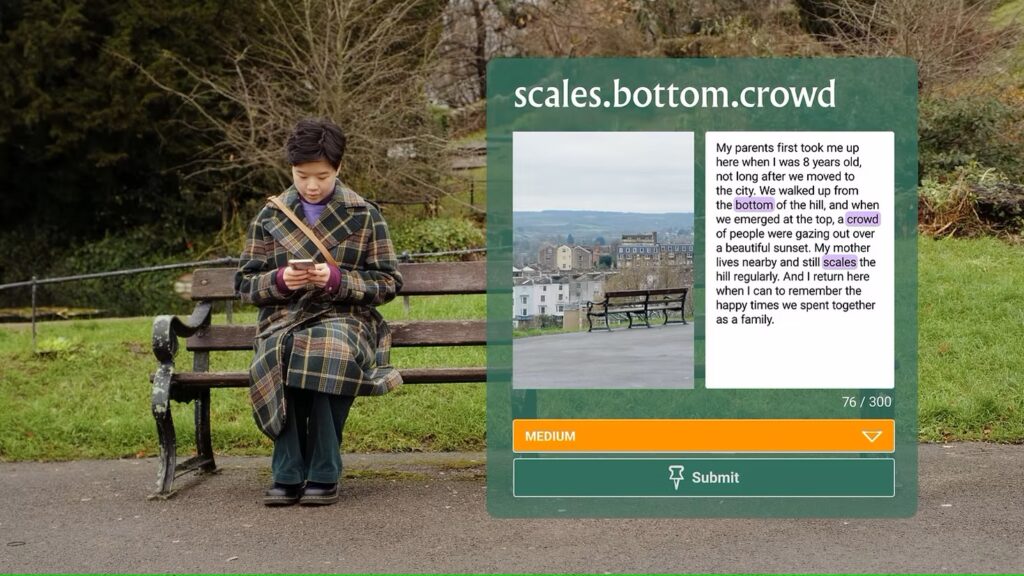
Jack has developed Pin the Tale, a digital game that strengthens community ties to place using the what3words app. In the game, players use what3words addresses to write stories about specific locations, creating connections between narrative and place. This innovative approach encourages players to explore and share their experiences of different locations through storytelling.
For Jack, the ARC programme offered a transformative perspective on research commercialisation. He reflects:
“Commercialisation doesn’t have to mean profiteering. Instead, it is most useful as a lens for thinking about how to sustain the impact of your work, whatever form that might take.”
The programme’s structured support and resources proved invaluable:
“Having a dedicated period of paid time focused solely on my venture, and being able to fully pay my collaborators for their work, resulted in an outcome that simply would not have been possible otherwise.”
Through engaging with multiple stakeholders during the programme, Jack gained crucial insights into how his platform could meet real-world needs. Each public workshop has provided new learning opportunities about the challenges and possibilities his game presents.
Project Progress and Future Plans
Since completing the ARC Accelerate programme, Jack has successfully launched Pin the Tale in early-access to the public. The game is now freely available online, inviting users to discover and create stories connected to specific locations across the UK.
“At its heart, Pin the Tale is about re-connecting individuals and communities to the places they live in, visit or care about. It’s about going beyond the ‘official’ stories of places; the ones we might be familiar with from history lessons or books. Pin the Tale aims to be much more intimate, inspiring and creative, where ‘culture’ and ‘heritage’ is something to be uncovered in people’s own stories and the stories of others in their communities.”
The game offers two key experiences:
Discovering stories about places you’re interested in: Navigate on the map to an area of the UK that you’re interested in. Click the Find Stories button to read stories other people have written about places in that area.
Share your own stories: Zoom into a UK location on the map that you want to write a story about. Click the square closest to the spot your story is about, then click ‘Write a story about this location’. Stories on Pin the Tale can take any creative form: fictional, poetic, historical, personal, informative, imaginative.
Jack emphasises the experiential nature of the game:
“When learning about the world around you feels like a process of discovery – when it engages your imagination – that’s when it becomes exciting. We want to evoke that feeling in our players.”
The project continues to gain recognition within the academic community, with Pin the Tale being selected as a featured project at this year’s Royal Geographical Society Annual International Conference, where it aligns perfectly with the conference theme of ‘Geography and Creativity.’
Support for UWE Researchers
UWE is committed to supporting our researchers in transforming their innovative ideas into real-world impact. Jack’s success in the ARC Accelerate programme demonstrates the potential of our research community to drive positive change through commercialisation.
The Knowledge Transfer Partnership (KTP) between University of the West of England (UWE), Obafemi Awolowo University (OAU), the Taro Agric Farm (TAF) was established to harness data-enabled innovations (DEI) for the commercial poultry industry in Nigeria. The project aimed to enhance chicken production efficiency and optimise overall business operations through the strategic application of data-driven technologies and academic expertise. Kamran Munir (Professor of Data Science) led the collaborative relationship with the Nigerian partners and the project from UWE. Saidu Oseni (Professor of Animal Sciences) led the project from OAU.
The Company
Taro Agric Farm (TAF), is a broiler chicken production company based in Southwest Nigeria. With over a decade of experience, TAF specialises in commercial broiler farming, operating concurrent batches of 2,000 birds per cycle. The company has multiple production centres, including its main base in Ile-Ife, Osun State, and outgrower units in Ilesa (Osun State) and Ibadan (Oyo State). Beyond production, TAF is actively engaged in consulting services, capacity building, and training for poultry farmers, offering expertise across the entire broiler chicken value chain—including input supply, production, processing, distribution, and marketing. A defining characteristic of TAF is its forward-thinking approach to poultry farming. Through the African Agriculture Knowledge Transfer Partnership (AAKTP), TAF successfully integrated smart technologies such as IoT-enabled sensors, a data storage for real-time data management, and predictive analytics to enhance decision-making in poultry production. This has positioned TAF as one of the leaders in leveraging data-driven solutions for sustainable poultry farming in Nigeria.
The Challenge
The Knowledge Transfer Partnership (KTP) between Taro Agric Farm (TAF), Obafemi Awolowo University (OAU), and the University of the West of England (UWE) was initiated to apply data-enabled innovations (DEI) to commercial chicken production in Nigeria and to improve and optimise business operations. A key focus was developing a strategy for embedding DEI to create sustainable broiler chicken operations over the long term. The poultry industry in Nigeria faces multiple constraints, including high mortality rates, inefficient farm management practices, limited use of data in decision-making, and poor environmental conditions affecting broiler chicken welfare and productivity. In the past, TAF like many others in the industry, relied on conventional methods of managing poultry production, which lacked the real-time monitoring and predictive capabilities needed to optimise productivity and farm environment. Farmers and farm managers had to rely on manual data collection and experience-based intuition, making it difficult to identify early warning signs of health risks or performance inefficiencies. Without data-driven insights, farm operations were reactive rather than proactive, often leading to delayed interventions and losses. In addition, one of the biggest challenges TAF faced in the past was high mortality and morbidity rates in broiler production. Various environmental factors, such as poor ventilation, excessive heat, high humidity, and exposure to noxious gases, particularly ammonia, significantly affected bird health. Without a robust system to monitor and control these environmental conditions, broiler chickens were at risk of disease outbreaks, respiratory problems, and stress, which ultimately led to economic losses.
Tackling these constraints required innovation in both poultry management and business practices to enhance the viability and profitability of operations. The KTP project activities included setting up an IoT platform, configuring sensor nodes, and establishing a database to record and store data on various parameters such as chicken welfare, input supplies, production, processing, distribution, and marketing. The project also involved the development of dashboards for monitoring key performance indicators (KPIs), the use of predictive analytics, and conducting performance comparisons across production batches. Additional activities included stakeholder engagement through workshops to build and embed capacity. The key accomplishments of KTP project include the successful setup, testing, and deployment of a IoT platform in a broiler chicken unit in southwest Nigeria, where key variables related to chicken welfare and performance were captured and monitored. Company data was archived in a database, and a dashboard was developed to track temperature, relative humidity, air quality and noxious gas parameters. An end of project Stakeholders’ Engagement Workshop aiming towards widening participation and sustainability with approximately ~100 participants, including poultry farmers and industry professionals, was also successfully conducted.
“This project equipped TAF staff with advanced digital farming skills, enhanced OAU’s research capacity and curriculum, and strengthened international collaboration—demonstrating how innovation and partnership can drive sustainable agricultural development.”
Prof. Kamran Munir (Professor of Data Science, University of the West of England, UWE Bristol)
Benefits and Changes
The Knowledge Transfer Partnership (KTP) between Taro Agric Farm (TAF), Obafemi Awolowo University (OAU), and the University of the West of England (UWE) has led to significant improvements in broiler chicken production, farm efficiency, and data-driven decision-making at TAF. As a result of the KTP, Taro Agric Farm and its staff have acquired several new knowledge areas and capabilities. These include (but not limited to):
The staff gained expertise in deploying sensor nodes to monitor key health and welfare indicators of broiler chickens. This application of digital technology is directly contributing to improved productivity and profit margins by enabling real-time data collection and analysis of poultry welfare to guide operations at the unit.
TAF implemented a smart farm infrastructure, incorporating WiFi, inverters, and clusters of sensor nodes, along with smart cameras to monitor the comfort, welfare, and performance of chickens. This integration allows for continuous, remote monitoring, improving operational control and decision-making.
The business acquired the capability to track, manage, and analyse its data assets—spanning performance, ambient conditions, costs, and returns—via a MySQL database. This centralised data storage allows for enhanced data organisation, retrieval, and long-term analysis.
A key capability gained was the deployment of a real-time dashboard that tracks health and welfare indicators of broiler chickens. This dashboard offers a user-friendly interface for staff to monitor key variables and make informed decisions regarding poultry welfare and management.
The staff were trained to track and monitor key performance indicators (KPIs) across production batches and historical data. This has allowed TAF to benchmark performance, identify trends, and adjust improve the consistency and quality of production, while also enabling more accurate forecasting and strategic planning
TAF’s adoption of data-enabled innovations (DEI) and IoT technologies positioned it as a leader in digital poultry farming in Nigeria. Sales turnover is expected to increase by 30%-40% within three years, due to improved efficiency and scalability. Profit before tax is projected to grow by 20%, within the next three years. Increased demand for TAF’s consulting services, as other poultry farms seek to implement similar digital solutions.
Obafemi Awolowo University (OAU) updated its Animal Sciences curriculum to incorporate digital technologies. The project also strengthened ties between OAU and UWE, fostering international collaboration in poultry technology research. The project research outcomes are being published as open access where possible which cover the use of digital technologies and data-enabled innovations for the enhancement of the welfare and performance of broiler chickens – as a case study in Nigeria.
“The KTP was an excellent opportunity to blend academic research with industry application. At OAU, we have always been committed to advancing precision livestock farming, and this project allowed us to practically demonstrate the power of digital transformation in poultry production.”
Prof. Saidu Oseni (Professor of Animal Sciences, Obafemi Awolowo University, OAU, Nigeria)
Key Facts
To best of our knowledge, TAF is the first poultry farm in Nigeria to integrate IoT and digital technologies into broiler production to this scale.
IoT-enabled sensors deployed to monitor temperature, humidity, air quality, and toxic gases in real-time.
A database established for real-time data collection and performance tracking
Decision Support Dashboard developed, allowing farmers to make data-driven decisions
Sales turnover expected to grow by 30 – 40%within three years
Profit before tax projected to increase by 20%
100+ poultry farmers and industry professionals trained on smart poultry farming
19 undergraduate & 2 MSc projects initiated on digital poultry farming at OAU
Presented findings at the Nigerian Poultry Show (NPS) 2024, reinforcing industry leadership
OAU integrated digital technologies into its Animal Sciences curriculum, influencing future research.
Find out more about the Knowledge Transfer Partnership in the Case Study below.
This partnership received financial support from the Knowledge Transfer Partnerships programme (KTP). KTP aims to help businesses to improve their competitiveness and productivity through the better use of knowledge, technology and skills that reside within the UK knowledge base. This successful Knowledge Transfer Partnership project, funded by UK Research and Innovation through Innovate UK, is part of the government’s Industrial Strategy.
UWE Bristol has been selected as part of a pioneering initiative to support the growth of self-funded spinouts in the creative and social sciences sectors. The university was successful in securing funding from Research England Development (RED) fund’s Connecting Capability Fund (CCF) as part of a new consortium led by the University of the Arts London (UAL).
The funding will support the ‘Shared Technology Transfer Office to Accelerate the Growth of Self-Funded Spinouts (STAGE)’ pilot, a groundbreaking project designed to accelerate the development of spinouts, particularly within universities that currently lack infrastructure for early-stage spinout development. By focusing on commercialising ventures in SHAPE disciplines (Social Sciences, Humanities, and the Arts for People and the Economy) and social enterprises across all research fields, STAGE provides a much-needed framework to help bring innovative research to market.
This initiative offers a new pathway for researchers to explore commercial opportunities in fields that have traditionally struggled to access conventional spinout support, ensuring that groundbreaking ideas are given the resources needed to thrive. As part of this programme, UWE Bristol academics are receiving dedicated support from an external Technology Transfer Officer to help advance their projects. The academics and their projects include:
Tavs Jorgensen – Advanced Clay Tooling Tavs Jorgensen’s research explores innovative manufacturing techniques for sustainable construction. His project, Advanced Clay Tooling, introduces novel low-carbon brick manufacturing methods, utilising robotic and digital fabrication processes to create highly efficient and sustainable construction materials. These techniques have the potential to revolutionise traditional building practices by significantly reducing carbon footprints. Read more
Tom Abba – Ambient Literature Tom Abba’s Ambient Literature project reimagines storytelling by blending digital technology with physical spaces. His research examines how literature can be experienced through location-based narratives, creating immersive reading experiences that bridge the gap between fiction and reality. This project is a unique exploration of how storytelling can evolve in the digital age. Learn more
IIIhem Berrou – Mintroot IIIhem Berrou leads Mintroot, a platform that fosters sustainable social enterprises by connecting innovators with resources and networks to drive social change. The project focuses on impact-driven solutions, supporting businesses that prioritise ethical, environmental, and social responsibility. Mintroot aims to empower entrepreneurs to create lasting change in their communities. Explore more
Rob Wilkes – Deaf Legal Theory Rob Wilks’ research addresses the critical intersection of law with deaf individuals globally utilising Deaf Legal Theory. His project seeks to bridge gaps in legal understanding and advocacy for the deaf community, developing frameworks that promote greater inclusion and accessibility in legal systems. This work has the potential to influence policies and practices worldwide. Find out more
Sofie Boons – Laboratory-Grown Ruby in Platinum Rings Sofie Boons’ project explores the intersection of science, sustainability, and jewellery design. Her research focuses on growing laboratory-created rubies directly within platinum settings, an innovative process that challenges conventional gemstone manufacturing while offering a sustainable alternative to traditional mining practices. Read more
Through the STAGE pilot, UWE Bristol continues to drive forward pioneering research with real-world impact, supporting academics in transforming their ideas into viable commercial ventures. By fostering innovation in creative and social sciences, this initiative is set to redefine the landscape of spinout development and create new opportunities for researchers in traditionally underrepresented fields.
Contribution to the UN 2030 sustainable development goals
UWE Bristol is proud to align our research to the UN sustainable development goals. The above research aligns with the following goals:
Traditionally held in September, SFW is expanding with a February edition to align with global fashion weeks, amplifying its reach and impact. This new week of action emphasises the power of local action for global change, uniting communities across the UK to tackle fashion waste and champion sustainability.
The Future Citizens Project focuses on empowering young people aged 11–23 through schools and community initiatives, inspiring them to address fashion waste and climate change. By encouraging sustainable habits and practices, the project equips the next generation with the skills to create lasting change.
Designed for Fairfield students, these workshops will teach essential sewing skills, such as using a sewing machine and transforming old fabrics into creative new designs. The sessions aim to inspire sustainable fashion habits while empowering young people with practical, waste-reducing skills.
Led by UWE Fashion Textile Technician Ruth Squires, Fairfield High School teacher Ayat Said, and Beth Cooper from the Old Library Repair Café, the workshops will host up to 10 students per session, fostering creativity, collaboration, and sustainability.
For the community sewing workshops, children can pick from a variety of items they would like to create from scrap fabrics, such as pillow cases and tote bags.
Film Screening: Fashion Reimagined
Join UWE Bristol’s Reel Nature Environmental Film Club on 24th February, from 5–7 pm, in Student Union Meeting Room 1 for a free screening of Fashion Reimagined, a thought-provoking documentary on the environmental and social impacts of fast fashion.
This event invites attendees to reflect on the consequences of unsustainable fashion practices and inspires action toward more responsible choices. Don’t miss this opportunity to learn, connect, and join the movement for a more sustainable future.
Bristol Fashion Futures Panel Discussion
On Tuesday, 25th February, from 4–6 pm, at the Publishing Lab, Bower Ashton Campus, UWE will host a panel discussion exploring the future of fashion in Bristol.
Led by UWE BA Fashion Textiles lecturers, students, and innovative local practitioners, this event will spotlight opportunities for sustainable and creative fashion practices. Attendees can also view an in-progress exhibition showcasing the visionary work of BA Fashion Textiles students.
This is your chance to connect with changemakers and gain insights into the exciting potential of Bristol’s sustainable fashion community.
During Sustainable Fashion Week, the Sustainability Hub Swap Shop in 1D015 will offer extended opening hours:
Tuesday, 25th February: 12:00–17:00
Wednesday, 26th February: 12:00–17:00
Thursday, 27th February: 11:00–17:00
At the Swap Shop, you can exchange old clothes for tokens or browse for pre-loved treasures. To celebrate SFW, the shop will feature a “Stitch It, Don’t Ditch It” rail of free clothes that need a little TLC, along with free sewing kits (subject to availability) to encourage mending and care.
Mending Drop-In Session
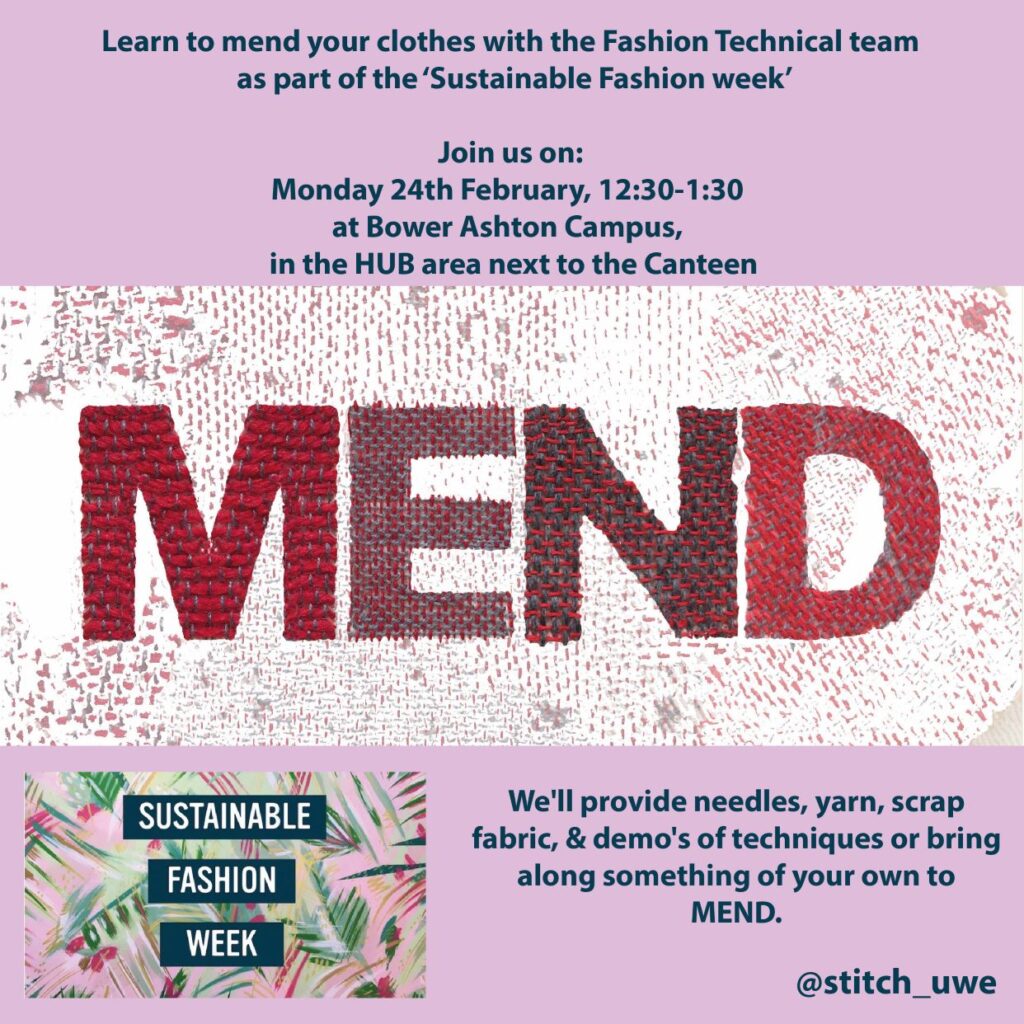
Join UWE Fashion Technicians for a drop-in mending session on February 24th, from 12:30 to 1:30 PM, at the Bower Ashton campus (HUB area near the canteen). This hands-on workshop offers a great opportunity to learn essential sewing and repair techniques while promoting sustainability. Plus, engage in a creative and mindful activity that supports mental well-being.
Neutral and Fairtrade Stalls Outside OneZone
On Thursday 27th February, 12:00pm – 14:00pm outside OneZone, people can explore what Neutral and The Fairtrade Foundation are doing to improve the future for both people and the planet.
An opportunity to:
Learn about Neutral’s sustainable supply chain, the launch of their UWE branded clothing in the SU shop and their tiger cotton conservation work.
Learn the important work carried out by The Fairtrade Foundation and where Fairtrade Products can be purchased both on and off campus.
For more information about any of these activities, please contact kat.corbett@uwe.ac.uk.