Explore a career in Health and Social Care – an insight event for mature learners at UWE Bristol

Posted on

Are you aged 21 or over and considering a career in Health and Social Care? UWE Bristol is hosting a dedicated Insight Event for mature learners to help you take the next step in your education or career.

Taking place on Tuesday 22 July 2025, from 10am to 1pm at our Glenside Campus, this event is designed to support adults who are thinking about returning to study, changing career paths, or gaining new qualifications in the health and social care sector.

What to expect:

  • Find out about our wide range of Health and Social Care courses and apprenticeships
  • Meet current students and get an insider’s view of life at UWE Bristol
  • Tour our specialist facilities, including practical teaching spaces
  • Learn how we support mature learners 

Whether you’re interested in nursing, midwifery, social work, or another area of health and social care such as occupational therapy, physiotherapy or diagnostic radiography this event is an excellent opportunity to learn more in an informal and welcoming environment.

Event details

Date: Tuesday 22 July 2025

Time: 10am – 1pm

Location: Glenside Campus, Blackberry Hill, Bristol, BS16 1DD

To attend, sign-up here.

If you have any questions or would like further information, please contact: widening.access@uwe.ac.uk

Inside Bristol’s Last Farm – A Film Screening and Discussion

Posted on

The final session of this year’s Reel Nature: Environmental Film Club will take place on Wednesday 7 May, from 17:00 to 19:00, in Room 2D007, D Block, UWE Frenchay Campus.

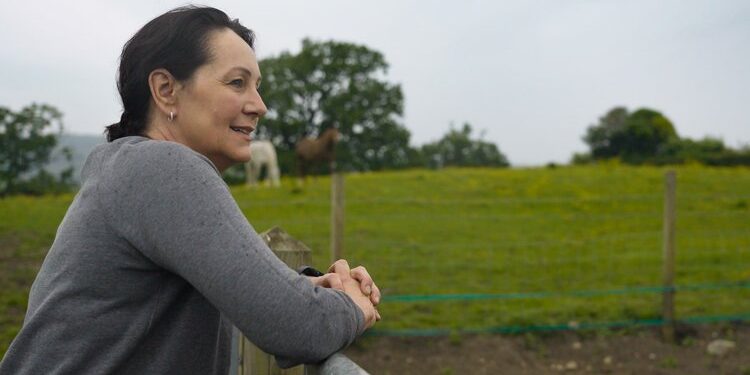
The event will feature a screening of One Last Farm, a short documentary by UWE alumna Nikki Dodd, followed by a Q&A with the director.

One Last Farm focuses on Yew Tree Farm, the last working farm within Bristol’s city boundary, and the challenges it faces from urban development and a proposed cemetery expansion. The film highlights the ecological importance of the farm’s habitats and the efforts of farmer Catherine Withers to maintain sustainable, nature-friendly practices.

The screening is hosted by Jelena Krivosic, a PhD student in the School of Arts and the Digital Cultures Research Centre at UWE Bristol. Their research examines how Natural History documentaries engage audiences in climate and ecological justice, with a focus on co-creation and participation in environmental storytelling.

The event is open to all – UWE students, staff, and the public. Attendees are welcome to bring refreshments.

Further information here: Reel Nature? Environmental Film Club – Screening and Director Q&A – “One Last Farm”

Green and Healthy Futures Fair: Building Skills, Careers, and Community in Bristol

Posted on

Residents of St Pauls and the wider Bristol community are warmly invited to the Green and Healthy Futures Fair on Monday 19 May 2025, taking place from 1:00pm to 8:00pm at St Pauls Learning Centre, 94 Grosvenor Road, BS2 8XJ.

Organised by UWE Bristol’s Inspire Sustainability Team in collaboration with Bridging Histories, this free event celebrates community partnership and shared action towards fairer, greener futures. It brings together local employers, educators, and support services to offer practical advice, training opportunities, and pathways into sustainable careers — all within an open, welcoming environment.

A Fair for All

The Green and Healthy Futures Fair is designed for everyone — whether you’re looking for your next career step, re-entering the workforce, exploring training opportunities, or simply curious about what’s happening locally.

Open to all ages and backgrounds, the event offers a chance to:

  • Browse stalls featuring job opportunities, apprenticeships, and free educational courses
  • Receive advice on training pathways, employment support services, and skills development
  • Enjoy warm food from Glen’s Kitchen (served from 3.30pm)
  • Access free tech support with FixMyTek (bring your devices for a check-up)

It’s an opportunity to build confidence, ask questions, and connect with people and organisations working to make Bristol a greener, healthier, and more inclusive city.

Free Workshops and One-to-One Support

Throughout the afternoon and evening, attendees can join a range of free, bookable sessions designed to support career development:

  • Mock Interviews (1:1, pre-booked, 3:00pm–4:35pm)
  • Professional LinkedIn Headshots (5:00pm–7:00pm)
  • Interview Skills Workshop (5:15pm–5:45pm)
  • CV Writing Session with Babbasa (6:00pm–6:40pm)

Spaces are limited, and workshops can be booked in advance when registering via Eventbrite.

Meet the Organisations Shaping Bristol’s Future

Attendees will have the chance to meet and network with organisations committed to building inclusive, sustainable opportunities across the city, including:

  • Babbasa – supporting young people from diverse backgrounds into education and employment
  • Youth Environmental Service (YES) – offering paid placements in environmental organisations for 18–25-year-olds
  • City of Bristol College – providing a wide range of academic and vocational courses
  • Employment, Skills and Learning (Bristol City Council) – delivering targeted employment support for underrepresented groups
  • Centre for Sustainable Energy (CSE) – supporting green skills development and fighting fuel poverty
  • FareChance Southwest – helping young adults gain warehouse and logistics experience
  • Ageing Lifestyles in Blacks and Asians (ALIBSA) – promotes health literacy to address health inequalities and empower Black and South Asian communities
  • UWE Bristol’s School of Health and Social Wellbeing and Degree Apprenticeships team – offering accessible routes into healthcare and community-focused careers
  • Bristol Waste and the Digital Inclusion Scheme – promoting access to refurbished technology and digital literacy support
  • Wheels to Work – providing transport support, including bikes and bus passes, to overcome barriers to employment

All these partners share a vision of a Bristol where every resident has the opportunity to thrive in a greener, fairer economy.

How to Get Involved

The Green and Healthy Futures Fair is free and open to all. To take part in any of the workshops or book a professional photo slot, please register in advance:

Book your free place on Eventbrite

If you have any questions about the event, please contact kat.corbett@uwe.ac.uk.


Event Details:

  • Monday 19 May 2025
  • 1:00pm–8:00pm
  • St Pauls Learning Centre, 94 Grosvenor Road, BS2 8XJ

Please note: There is no parking available at the venue.

The use of TV drama ‘Adolescence’ in schools: why simple solutions to complex problems don’t work

Posted on

A guest blog post by Kieran McCartan, Professor of Criminology, University of the West of England, Bristol and Dr Sophie King-Hill, Associate Professor in the Health Services Management Centre, University of Birmingham

Recently there has been a lot of debate about the Netflix show Adolescence. It tells a fictional story of a 13-year-old boy who is rejected by a female classmate and because of the influence of incel counterculture goes on to stab and kill her. The narrative of the four-episode story is that children and young people are being influenced by harmful online social media, which is radicalising them in to accepting extreme misogynistic beliefs which they then unwittingly internalise and act on. The drama touches upon how exposure to unfiltered, problematic social media may change children and young people’s perceptions of, and engagement, with each other.

The drama skirts many issues about misogyny that involve hate crime, violence against women and girls, gender-based violence and Incel culture, mental health, wellbeing, radicalisation, risk management, education, radicalisation, knife crime, counterculture, the collapse of parental engagement, issues with family systems, and growing societal disengagement.

This is where the drama falls short as an educational resource. Four hours over the episodes is not enough time to unpack these issues in any meaningful way. The programme signals the need for an informed debate and conversations about all these issues yet does not cover these in any great depth. Adolescence is not the answer to the issues posed and it is dangerous to think of it as such, for it offers no solutions. The show has sparked a national debate in the UK, with the Prime Minister stepping in to say that adolescence should be screened in schools to educate, and awareness raise with children and young people about the realities of harmful online social media and misogynistic hate crime. This sensationalist, knee jerk reaction to a range of complex and endemic problems and issues that are faced by children and young people in society is problematic. Although, across the political spectrum in the UK there is not a considered, evidence-based response to this with Kemi Badenoch, leader of the opposition, although not having seen Adolescence believes that removing phones from children and young people in schools is one of the most effective responses. It is important to remember that under the last Conversative government the issue of Relationships and Sex Education in schools was a challenging issue and unresolved debate.

The show, given its short run time and structure which includes an episode about a different aspect of the story – the arrest, the school based follow up, the risk assessment, and the consequence, delves into parts of this story but does not offer a rounded in-depth perspective. No understanding of how and why the young boy was “radicalised” into accepting Incel culture as is implied. The complex social interactions between the boy, his friends, his family, his community or the victim are not explored. This is problematic, especially if the show is to be used as a teaching and critical reflection tool in schools.

No points of intervention and what those interventions look like are offered, as this was not designed as an educational resource. What is implied is that there is a problematic online community that are out there influencing children and young people, but no explanation is given as to how or why. Additionally, the show indicates that online misogyny, Incel culture and violence against women and girls is omnipresent in the lives of children and young people and that children and young people are accepting of this. This approach takes away the autonomy and agency of children and young people. This is problematic and works against the prevention of sexual abuse and violent behaviour. A multi-level approach is needed to tackle social issues being targeted at individuals and the community and society in which they sit. In preventing radicalisation, how the individual is affected needs exploring, which cannot be done with ‘Adolescence’.

Wanting to introduce this into schools is naïve. Adolescence is a fictional story, designed for TV/streaming and therefore its content, although based in real world issues, is fictionalised. Its aim, although to raise awareness of social issues, is to increase viewership and ratings. It is important to state that teen murders are rare and that most online hate crimes and misogyny do not result in fatalities. TV shows are not always realistic and can often adapt knowledge and practice to fit the needs to the story. Which means that the evidence based, research informed and even practice consultation which may be part of the development and writing of the screenplay can get lost of the needs of the story as they can get in the get in the way of the drama.

The best example of this flaw in Adolescence is the admission in episode four that the main character is going to change their plea from not guilty to guilty. Which goes against the narrative of episode one and three, and there is no real discussion of change of heart in episode four. It seems out of place, but it wraps the story up nicely in the last episode. Which means that the psychological or behavioural change in the character is not seen and therefore learning cannot take place from their experience. The arc of the story and the story telling approach do not allow a nuanced debate about the reality of the offence committed, the thinking and motivation behind it or the best way to understand it.

‘Adolescence’ does not help understanding of Incel culture or online hate crime better. It does not help understanding knife crime and harmful behaviour between children and young people better. It sets out that children and young people are at risk but does not offer any solutions to the problem.

The UK government want to screen it in schools as a prevention and desistence tool to educate children and young people about the issues of radicalisation, online hate and synonym. Which is problematic, as this is not what it was designed to do and does not offer those insights. What does is say then? The main discussion piece from the show detracts from the main narrative, that understanding and engagement with young people is needed to better understand these issues. In episode four where the parents recognise that they could have done, and maybe should have done more, is where the real message is. The showing of adolescence in schools to GCSE and A-Level students (as its rated 15) will not help pre-teens and younger teenagers understanding and engage with these issues better and it will not help their parents understand the issues or how to engage with them better on it. In the UK it would be better to have a conversation about the reality of growing up online, the intersection between the online and offline worlds and how they impact the mental health and wellbeing og children and young people and how we as adults, and parents, can better support them in this transition. There are pockets of work being carried out that do this with young men and boys that are evidence based and well evaluated. Why is the upscaling of these not the focus.

The period of adolescence is a point of transition and liminality in the lives of children and young people how can we support them in becoming well rounded, thoughtful and critically engaged adults. By engaging with children and young people, talking and communicating directly and thoughtfully we can learn how to best fit their individual needs. This cannot be done by simply showing them a fictionalised TV show.


Addressing the Awarding Gap: A Research Event with Dr Paul Campbell

Posted on

The Education and Childhood Research Group (ECRG) is proud to present a thought-provoking and vital discussion on race, assessment, and higher education. Join us on Friday, 11 April 2025, from 14:30 to 16:30 (UTC) for an insightful session featuring Dr Paul Campbell, Associate Professor in the sociology of race and inclusion at the University of Leicester.

Why This Event Matters

Despite ongoing efforts to decolonise the curriculum, the ethnicity awarding gap remains a persistent challenge in UK higher education. Students from global majority backgrounds continue to face systemic barriers in assessments, leading to disparities in academic outcomes. Dr Campbell’s work directly addresses these challenges, offering research-driven insights and practical solutions to foster a more inclusive and equitable assessment landscape.

About Dr Paul Campbell

Dr Campbell is a leading scholar in race, education, and social justice. He is the author of Race, Assessment and HE, the “the first direct, evidence-based response on the challenges faced by students of colour in higher education assessments in the UK“. His work not only advances academic discussions but also provides actionable strategies for meaningful change. His expertise spans sociology, history, education, and sport, with a particular focus on how racial exclusions continue to manifest in both academia and athletics.

What to Expect

This session will be particularly valuable for colleagues involved in learning and teaching across UWE Bristol. Attendees will gain:

  • A deeper understanding of the ethnicity awarding gap and its structural causes.
  • Evidence-based approaches to making curricula and assessments more inclusive.
  • Practical strategies to implement change at an institutional and classroom level.

Book Your Place

Spaces for this event are limited, so early registration is encouraged. Secure your spot today and be part of the conversation that drives real change in higher education.

📍 Where: Room 2X242, X Block
📅 When: Friday, 11 April 2025
⏰ Time: 14:30 – 16:30 (UTC) Dublin, Edinburgh, Lisbon, London

Don’t miss this opportunity to engage with critical research and contribute to a more equitable academic environment.

UWE Bristol Part of an Innovative Spinout Pilot Supporting Creative and Social Ventures – STAGE

Posted on

UWE Bristol has been selected as part of a pioneering initiative to support the growth of self-funded spinouts in the creative and social sciences sectors. The university was successful in securing funding from Research England Development (RED) fund’s Connecting Capability Fund (CCF) as part of a new consortium led by the University of the Arts London (UAL).

The funding will support the ‘Shared Technology Transfer Office to Accelerate the Growth of Self-Funded Spinouts (STAGE)’ pilot, a groundbreaking project designed to accelerate the development of spinouts, particularly within universities that currently lack infrastructure for early-stage spinout development. By focusing on commercialising ventures in SHAPE disciplines (Social Sciences, Humanities, and the Arts for People and the Economy) and social enterprises across all research fields, STAGE provides a much-needed framework to help bring innovative research to market.

This initiative offers a new pathway for researchers to explore commercial opportunities in fields that have traditionally struggled to access conventional spinout support, ensuring that groundbreaking ideas are given the resources needed to thrive. As part of this programme, UWE Bristol academics are receiving dedicated support from an external Technology Transfer Officer to help advance their projects. The academics and their projects include:

  • Tavs Jorgensen – Advanced Clay Tooling
    Tavs Jorgensen’s research explores innovative manufacturing techniques for sustainable construction. His project, Advanced Clay Tooling, introduces novel low-carbon brick manufacturing methods, utilising robotic and digital fabrication processes to create highly efficient and sustainable construction materials. These techniques have the potential to revolutionise traditional building practices by significantly reducing carbon footprints. Read more
  • Tom Abba – Ambient Literature
    Tom Abba’s Ambient Literature project reimagines storytelling by blending digital technology with physical spaces. His research examines how literature can be experienced through location-based narratives, creating immersive reading experiences that bridge the gap between fiction and reality. This project is a unique exploration of how storytelling can evolve in the digital age. Learn more
  • IIIhem Berrou – Mintroot
    IIIhem Berrou leads Mintroot, a platform that fosters sustainable social enterprises by connecting innovators with resources and networks to drive social change. The project focuses on impact-driven solutions, supporting businesses that prioritise ethical, environmental, and social responsibility. Mintroot aims to empower entrepreneurs to create lasting change in their communities. Explore more
  • Rob Wilkes – Deaf Legal Theory
    Rob Wilks’ research addresses the critical intersection of law with deaf individuals globally utilising Deaf Legal Theory. His project seeks to bridge gaps in legal understanding and advocacy for the deaf community, developing frameworks that promote greater inclusion and accessibility in legal systems. This work has the potential to influence policies and practices worldwide. Find out more
  • Sofie Boons – Laboratory-Grown Ruby in Platinum Rings
    Sofie Boons’ project explores the intersection of science, sustainability, and jewellery design. Her research focuses on growing laboratory-created rubies directly within platinum settings, an innovative process that challenges conventional gemstone manufacturing while offering a sustainable alternative to traditional mining practices. Read more

Through the STAGE pilot, UWE Bristol continues to drive forward pioneering research with real-world impact, supporting academics in transforming their ideas into viable commercial ventures. By fostering innovation in creative and social sciences, this initiative is set to redefine the landscape of spinout development and create new opportunities for researchers in traditionally underrepresented fields.


Contribution to the UN 2030 sustainable development goals

UWE Bristol is proud to align our research to the UN sustainable development goals. The above research aligns with the following goals:

Professor of Robot Ethics, Alan Winfield, attends Paris conference on Safe and Ethical AI

Posted on

Alan Winfield, Professor of Robot Ethics, recently attended the Paris Conference on Safe and Ethical AI. In the below guest blog post he writes about his experience:


Earlier this month I was privileged to part of the inaugural conference of the International Association for Safe and Ethical AI. The two day conference was held in Paris, on February 6th and 7th, and hosted by the OECD.  The timing and location of the conference was arranged to directly precede the governmental AI-summit on February 10th and 11th. I was one of around 650 invited representatives from academia, civil society, industry, media, and government. It was a remarkable meeting, with terrific keynote talks, including three from Nobel prize winners, Geoffrey Hinton, Maria Ressa and Joseph Stiglitz.  

As someone who has been worrying about robot and AI ethics for longer than most who attended I was *very* pleased that there was a strong consensus around the need for regulation, supported by standards, alongside urgent concerns over the huge energy and water costs of AI that are completely at odds with sustainable development goals.

The conference concluded by publishing a Call to Action for lawmakers, academics, and the public ahead of the AI Summit, with ten critical action items. Overall, the action items are very good. I’m especially pleased to see ‘mandatory reporting of incidents’ in action 5. This is something I lobbied for. My one disappointment however is that the call for action statement has no explicit mention of the need to mitigate the energy costs of AI.

Here below are a few photos from the conference.

A slide from Joseph Stiglitz’ wonderful keynote: AI and Economic Risk: Assessment and Mitigation.

A slide from Kate Crawford’s excellent keynote: Hyperscaled: The Global Challenge of Sustainability in AI.

Cover photo at the top: Professor Alan Winfield with Oxford colleague Pericle Salvini presenting their work on accident investigation.

UWE Bristol joins forces with Sustainable Fashion Week // Future Citizens Project to drive climate action through community events

Posted on

UWE Bristol is thrilled to announce its participation in Sustainable Fashion Week (SFW) // Future Citizens Project, an inspiring initiative taking place from 24th February to 2nd March.

Traditionally held in September, SFW is expanding with a February edition to align with global fashion weeks, amplifying its reach and impact. This new week of action emphasises the power of local action for global change, uniting communities across the UK to tackle fashion waste and champion sustainability.

The Future Citizens Project focuses on empowering young people aged 11–23 through schools and community initiatives, inspiring them to address fashion waste and climate change. By encouraging sustainable habits and practices, the project equips the next generation with the skills to create lasting change.

Hands-On Learning: Community Sewing Workshops

As part of this initiative, UWE Bristol’s MAKERS project is collaborating with Fairfield High School and the Old Library Community Hub in Eastville to host a six-week series of interactive sewing workshops, beginning 28th February.

Designed for Fairfield students, these workshops will teach essential sewing skills, such as using a sewing machine and transforming old fabrics into creative new designs. The sessions aim to inspire sustainable fashion habits while empowering young people with practical, waste-reducing skills.

Led by UWE Fashion Textile Technician Ruth Squires, Fairfield High School teacher Ayat Said, and Beth Cooper from the Old Library Repair Café, the workshops will host up to 10 students per session, fostering creativity, collaboration, and sustainability.

For the community sewing workshops, children can pick from a variety of items they would like to create from scrap fabrics, such as pillow cases and tote bags.

Film Screening: Fashion Reimagined

Join UWE Bristol’s Reel Nature Environmental Film Club on 24th February, from 5–7 pm, in Student Union Meeting Room 1 for a free screening of Fashion Reimagined, a thought-provoking documentary on the environmental and social impacts of fast fashion.

This event invites attendees to reflect on the consequences of unsustainable fashion practices and inspires action toward more responsible choices. Don’t miss this opportunity to learn, connect, and join the movement for a more sustainable future.

Bristol Fashion Futures Panel Discussion

On Tuesday, 25th February, from 4–6 pm, at the Publishing Lab, Bower Ashton Campus, UWE will host a panel discussion exploring the future of fashion in Bristol.

Led by UWE BA Fashion Textiles lecturers, students, and innovative local practitioners, this event will spotlight opportunities for sustainable and creative fashion practices. Attendees can also view an in-progress exhibition showcasing the visionary work of BA Fashion Textiles students.

This is your chance to connect with changemakers and gain insights into the exciting potential of Bristol’s sustainable fashion community.

Free spaces can be booked via Eventbrite.

Extended Opening Times: Sustainability Hub Swap Shop

During Sustainable Fashion Week, the Sustainability Hub Swap Shop in 1D015 will offer extended opening hours:

  • Tuesday, 25th February: 12:00–17:00
  • Wednesday, 26th February: 12:00–17:00
  • Thursday, 27th February: 11:00–17:00

At the Swap Shop, you can exchange old clothes for tokens or browse for pre-loved treasures. To celebrate SFW, the shop will feature a “Stitch It, Don’t Ditch It” rail of free clothes that need a little TLC, along with free sewing kits (subject to availability) to encourage mending and care.

Mending Drop-In Session

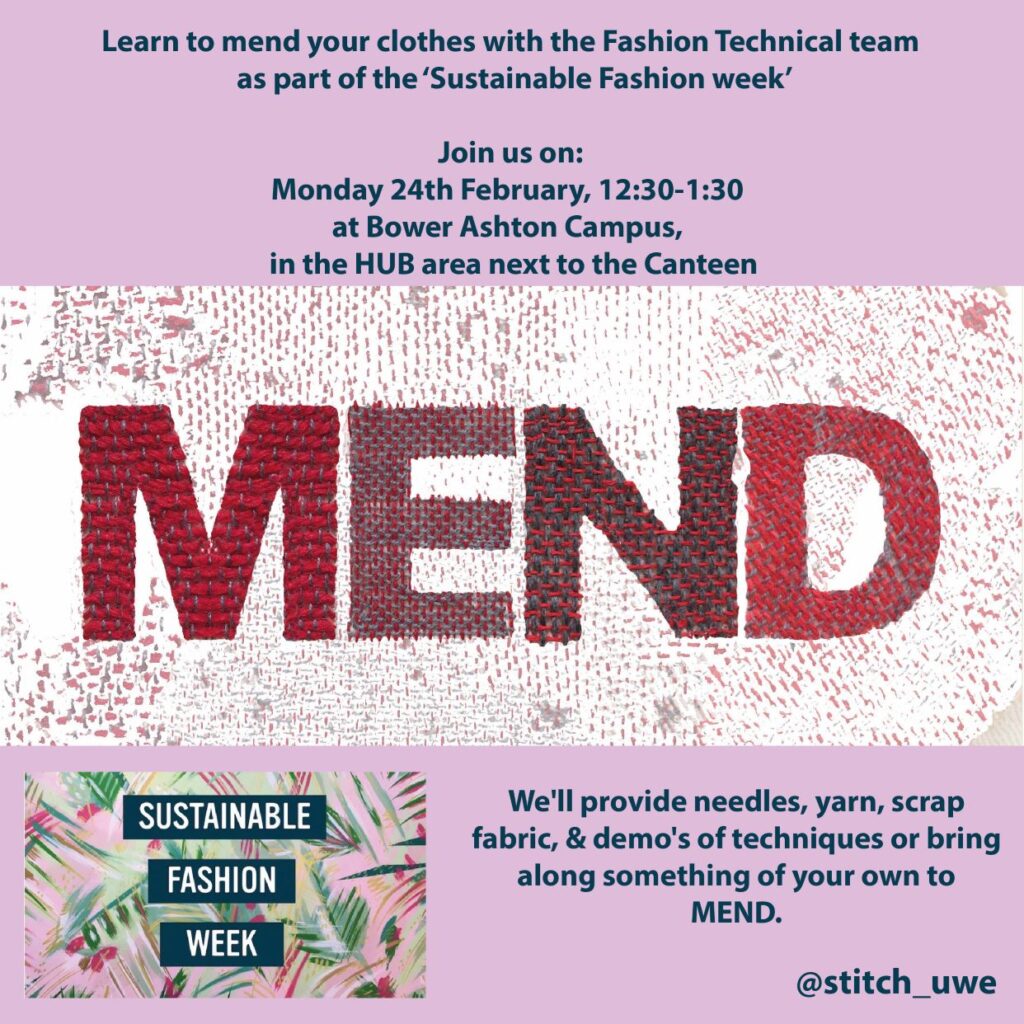
Join UWE Fashion Technicians for a drop-in mending session on February 24th, from 12:30 to 1:30 PM, at the Bower Ashton campus (HUB area near the canteen). This hands-on workshop offers a great opportunity to learn essential sewing and repair techniques while promoting sustainability. Plus, engage in a creative and mindful activity that supports mental well-being.

Neutral and Fairtrade Stalls Outside OneZone

On Thursday 27th February, 12:00pm – 14:00pm outside OneZone, people can explore what Neutral and The Fairtrade Foundation are doing to improve the future for both people and the planet.

An opportunity to:

  • Learn about Neutral’s sustainable supply chain, the launch of their UWE branded clothing in the SU shop and their tiger cotton conservation work. 
  • Learn the important work carried out by The Fairtrade Foundation and where Fairtrade Products can be purchased both on and off  campus.

For more information about any of these activities, please contact kat.corbett@uwe.ac.uk.

UWE Bristol-led study explores natural alternative to antibiotics in fight against Salmonella in pig farming

Posted on

Salmonella causes more than 93 million cases of salmonellosis, resulting in 155,000 deaths annually worldwide. Many severe cases are associated with the production and consumption of pork: salmonella is found in the pig gut and is often multidrug-resistant. The bacteria can be transmitted through the pigs’ oral−fecal route at the farm, the slaughterhouse, and the food processing plant, where it can survive and cross-contaminate equipment or the final food products, leading to human infections.

Salmonella is conventionally dealt with by using antibiotics. However, antimicrobial resistance is on the rise, and it is widely associated with the intensive use of antibiotics in pig farming. This has led to an increased interest in alternatives to antibiotics in the fight against bacterial pathogens.

Dr Alexandros Stratakos, Senior Lecturer in Sustainable Agri-Food Production at UWE Bristol, has led a study on alternatives to antibiotics in pig farming. Alexandros in collaboration with UWE Bristol colleagues Professor Olena Doran and Dr Sotirios Oikonomou, and Dr Dimitrios Lamprou from Queen’s University, Belfast, developed novel nanostructures for the targeted delivery of geraniol, a natural antivirulence compound, in the pig gut.

Geraniol is the primary component of citronella oil but can also be found in many other plant essential oils.

The study has shown that geraniol at specific concentrations inhibits Salmonella colonisation in the pig gut, which can potentially reduce the requirement for antibiotics in pig farming.

For this study, geraniol was also encapsulated in liposomal (spherical fat-like) formulations, which acted as carriers to protect the agent from degradation and increase its effectiveness against the pathogen.

This approach could lead to reduced Salmonella transmission to food, ultimately leading to an increase in the safety of the food supply chain.

The full publication can be accessed on the website of the Journal of Agricultural and Food Chemistry.


Community STEM Club connects local community, engineering students, and industry professionals

Posted on

The Old Library Community STEM Club has become a well-established weekly event in Eastville since it was first launched in September 2021: every Thursday after school, children and their parents or carers make their way to the Old Library Community Hub to take part in STEM (Science, Technology, Engineering and Maths) based activities, and to play and socialise.

The Old Library is a community led and run project, based in the former Eastville Library, which was closed down in March 2016 after council budget cuts. It now serves as a hire space for workshops and activities, including a community café, workshops, crafts, quiz nights, music, book clubs, a repair café, and the weekly STEM Club.

The Club was co-developed with the team behind UWE Bristol’s DETI Inspire, a programme designed to connect children from all backgrounds with real-life, diverse engineering role models to widen participation and aspirations for STEM careers.

It gets further support from Industry professionals via the STEM Ambassador Hub, and UWE Bristol Engineering students, who regularly support and run activities.

A club for the whole community

The sessions vary every week: children have built balloon- and sail powered cars, electric circuits, bike pump powered paper rockets, water filtration systems, and they even designed their own city, using recycled materials. They also had the opportunity to build and programme their own robots using Lego Mindstorms, and they digitally re-designed Bristol in Minecraft sessions led by the  DETI Inspire Team at UWE Bristol.

The Club is aimed to be as accessible as possible, which is why it is run on a free, drop-in basis. There are also healthy snacks on offer alongside the activities, and the grown-ups can relax with a cup of tea or coffee, or choose to get involved in the activities themselves.

What’s next?

For the upcoming sessions the children will be building model boats which will be raced at the Bristol Harbour Festival on Saturday 16 July. Boat building is taking place on 16 of June and 7 July and supported by the My Future My Choice programme and Industry volunteers.

Lego Mindstorms will be making a comeback on 23 and 30 of June: instructed by UWE Engineering students, the children will learn how to build and programme Lego robots.

There are also plans for wind turbine building, though the exact dates are still to be confirmed.

The last STEM Club session of this term is planned for Thursday 14 July, and then the Club will pause for the summer holidays, with a return planned in September, for the start of the new school year.

For updates check the Old Library Facebook page or email hello@theoldlibrary.org.uk should you have any questions.

Back to top