

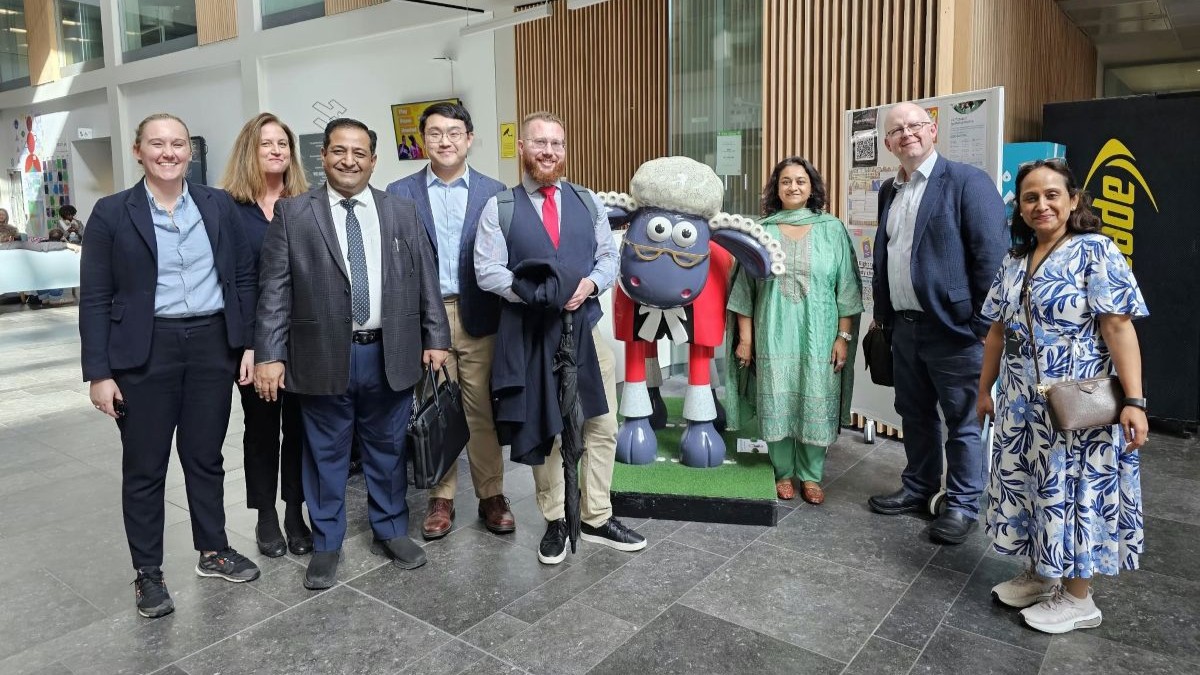
On 24 September 2026, the Global Financial Systems and Illicit Economies theme (led by Dr Neeti Shikha) within the Global Crime, Justice and Security Research Group at UWE Bristol Law School, in collaboration with the University of Bristol, hosted a research event titled Rethinking Insolvency and Commercial Law: Fairness, Reform and Emerging Challenges.
The event brought together academics, researchers and industry professionals to explore contemporary developments in insolvency and commercial law. It was well attended by colleagues from industry and academic institutions, including Nottingham Trent University, the University of Belfast, the University of Reading and the University of Bristol.
The event opened with a welcome address by Professor Noëlle Quénivet, followed by Dr Mary Young, who introduced the keynote speaker Prof Jason Harris from Sydney Law School, University of Sydney.
Fairness in restructuring deals: Rethinking the fundamentals
Professor Harris delivered a thought-provoking keynote titled Fairness in Restructuring Deals, raising a fundamental question: what does fairness actually mean in corporate restructuring?
Is fairness about respecting creditors’ existing priorities, achieving the best economic outcome, preserving businesses and jobs, or ensuring an equitable distribution of the benefits generated by restructuring?
Drawing on developments in Australian restructuring law, Professor Harris examined different dimensions of fairness, including procedural fairness, the treatment of creditors with competing interests, and the role of judicial discretion. He discussed recent Australian decisions questioning restructuring arrangements that disadvantage particular creditors without sufficient commercial justification.
The keynote also offered a comparative perspective, examining developments in UK restructuring plans and approaches adopted in the United States, Canada and India. A particularly interesting theme was whether ensuring that creditors receive at least what they would obtain in liquidation is sufficient to establish fairness, or whether restructuring law must also consider how the additional value created through restructuring is distributed.
The discussion highlighted that fairness is not necessarily a uniform concept. Its meaning and application may differ depending on the nature of the business, the restructuring framework and the interests at stake.
Showcasing research and emerging scholarship
The second part of the event featured research presentations moderated by Dr Sejal Chandak from UWE Bristol.
Dr Charles Mak, University of Bristol, presented his research on Sovereign Debt Restructuring and Legal Pluralism: The Public and Private Continuum in International Financial Law, exploring an important area at the intersection of sovereign debt and international financial law.
Michał Chodorowski, University of Bristol, presented on Legal Science and Paradigms of Law, bringing a broader jurisprudential perspective to the session.
The event also provided a platform for Ademidun Alalade, a PhD researcher at UWE Bristol, to share ongoing doctoral research.
Together, the presentations reflected the breadth of contemporary legal scholarship and the importance of creating opportunities for researchers at different career stages to share their work and engage in academic discussion.
Strengthening research collaboration
The event provided a valuable opportunity for scholarly exchange, bringing together academics, doctoral researchers and industry professionals from across institutions. The collaboration with the University of Bristol, alongside participation from colleagues at other universities, reflected the GCJS research group’s commitment to fostering academic dialogue, supporting emerging researchers and strengthening research networks beyond institutional boundaries.
The event concluded with a vote of thanks by Dr Neeti Shikha, who organised the session.