Wednesday 16th Sept saw the launch of new book The Deaf Legal Dilemma: Challenging Equality Law by Associate Professor in Law, Rob Wilks. The publication was celebrated with a hybrid launch event at UWE Bristol Business School attended by 70 people both in person and online.
The book’s author Rob Wilks explained how his work on The Deaf Legal Dilemma began, inspired in part by his experience during his early law career supporting other deaf people facing barriers:
“I started in the voluntary sector where I advised over 2,000 deaf people on how to overcome the challenges they were facing, whether that was not being able to access health services or education. Where information was never available in British Sign Language (BSL).”
“I found myself asking why do we have these barriers when we have equality laws in place?”
Navigating a world designed for hearing people
Rob described life as a deaf person and the challenges of navigating a society created by and for hearing people:
“From the cradle to the grave, deaf people face significant difficulties. When a child is diagnosed as deaf they are sent to audiology to be ‘cured’ so that they can fit into society. Our society works through a patriarchal model where deaf people are to be looked after, given benefits, hearing aids/cochlear implants and can be seen as ‘less than’.”
Rob also challenged the way deafness is often framed, arguing that the focus tends to be placed on deaf people’s lack of hearing rather than on the barriers created when hearing people and institutions cannot communicate with them.
“The focus is on our lack of hearing, rather than hearing people being unable to communicate with us. Deaf people are so much more, we have our own culture away from the hearing world.”
The book explores the barriers deaf people can encounter when accessing public services, including healthcare and the justice system. Research from the Deaf Health Wales project, on which Rob is Co-Investigator, highlights some of these challenges, including difficulties even contacting GP surgeries as well as accessing appointments.
For those navigating the criminal justice system, the consequences of inaccessible communication can be particularly significant, with access to legal advice in BSL among the barriers highlighted by Rob.
“Despite decades of equality and antidiscrimination law, why do deaf people still experience inequality?“
The framing of equality
To answer this question the book examines the way ‘equality’ has been framed and acknowledges that scholars have not been able to agree on what the important questions are.
Categories such as ‘formal’, ‘substantive’ and ‘transformative’ equality are used to look at how we could remove barriers and how equal treatment and opportunities, dignity and equality of outcomes could build towards social inclusion, challenge ‘audism’ (a term used to describe discrimination or prejudice against deaf people and the privileging of hearing people) and lead to full participation in society.
The Deaf Legal Illusion
Rob uses the term ‘Deaf Legal Illusion’ to describe the gap between the rights deaf people appear to have in law and their ability to exercise those rights in practice. He examines how frameworks including the European Convention on Human Rights, the Equality Act 2010 and the UN Convention on the Rights of Persons with Disabilities can fall short of delivering meaningful equality for deaf people.
“On paper we think deaf people are afforded all of these rights but it’s an illusion; it’s not working for us. We have fought for these rights for so many years, but it has not been fruitful.”
The Deaf Legal Dilemma
“Equality law deals with deaf people through a disability lens, but as deaf people we are so much more. We are a language minority. Some language laws recognise our sign languages, but equality laws are so much more powerful in comparison.”
For Rob, this creates a dilemma: deaf people may need to identify as disabled to access legal protections and support, while this framing can overlook their identity as a language minority and culturo-linguistic community.
“If I need help or need to challenge the law I have to call myself ‘disabled’ to access the same rights as hearing people.”
What needs to change
The UK’s four sign language acts offer a chance for change but Rob argues that reforms to the law, education, BSL concordant services and deaf people being included as co-producers are what is needed. Through his Deaf Rights Model he illustrates the holistic understanding needed to achieve meaningful equality for deaf people on their terms.
“The law is biased towards hearing people and written through a hearing lens. This book is an expose, it’s unbelievable that we are still grappling with these issues. We need to tell the world!”
On 3 September 2026, colleagues from across UWE Bristol gathered for the AI in Education conference, a day dedicated to exploring how artificial intelligence is reshaping teaching, learning, assessment and academic practice. The event brought together academic and professional services colleagues from different Schools such as engineering, social sciences, business and law to share experiences, discuss challenges and consider how higher education can respond constructively to a rapidly evolving technological landscape.
From experimentation to integration
From the outset, the conference emphasised that AI is no longer a future possibility but a present reality. In his opening remarks, Dr James Lee, Pro-Vice Chancellor and Head of the College Health, Science and Society, reflected on UWE Bristol’s AI journey, noting that the institution has moved beyond experimentation towards embedding AI within curricula and supporting staff in developing their capabilities. James Lee made a particularly striking observation that AI should not be regarded as a passing trend, but as the next stage in the evolution of teaching and learning. The point invites an almost Darwinian reflection on adaptation; those institutions, educators and students best able to adapt to this changing environment may be the ones most likely to survive and thrive within it.
The conference itself was framed around key themes including equitable access to AI, curriculum development and staff support. These themes were identified by conference participants before the event provided a useful backdrop to the day’s discussions. Mark Shand, Senior Learning Technologist, explained that colleagues expressed interest in using AI to work more efficiently, improve teaching and learning, and rethink assessment in ways that maintain academic integrity while acknowledging the realities of an AI-enabled world. At the same time, concerns around ethics, risk, changing professional roles and the need for practical skills training featured prominently throughout the programme. Colleagues were then invited to attend a variety of panels run concurrently. In this blog post, we are sharing our thoughts on panels we attended though this might not truly capture the wide range of themes addressed at the conference.
AI writing feedback: research findings and opportunities for practice
This session, held by Dr Sarah Gillie and Jackie Chelin, discussed research findings on the integration of AI-supported writing feedback tools such as Studiosity and ways in which students engage with automated feedback. They noted that these tools are most effective when positioned not as substitutes for human support, but as part of a wider academic support ecosystem, complementing institutional resources and opportunities for in-person guidance. In contrast, students who did not make use of Studiosity relied more on AI and other digital tools. Discussions underscored the importance of helping students understand and interpret feedback, recognising that comments can sometimes seem mysterious or overly summative without opportunities for dialogue and reflection.
Assessment and academic integrity
This session, led by Dr Antony Hill, Dean of Learning and Teaching at the College of Health, Science and Society, addressed what we would consider the most pressing concerns facing higher education. Colleagues considered how generative AI challenges traditional assumptions about authorship, originality, expertise and assessment validity. The discussion gradually moved beyond concerns about cheating to question a more fundamental premise regarding the purpose of assessment itself. As several participants noted, if assessment remains focused solely on outputs, institutions may struggle to distinguish between genuine learning and AI-generated work. Colleagues agreed that there is need for deeper conversation around assessment design, transparency and judgement, with a strong emphasis on evaluating students’ learning processes rather than merely the final product.
AI, employability and the future of work
This session, chaired by Dr Frano Barbic, extended these discussions beyond the classroom. Panellists (Dr Kamran Soomro, Dr Christopher Lipp, Michal Bobula, Nhi Ho and a PGR student from the College of Arts, Technology and Environment) stressed that while AI will undoubtedly transform workplaces, human capabilities remain central. Critical thinking, deep understanding, sound judgement and interpersonal skills were repeatedly identified as qualities that cannot be outsourced to technology. Indeed, participants suggested that competitive advantage increasingly lies in human relationships, creativity and the ability to make informed decisions in complex situations.
Universities therefore now face a dual responsibility: preparing students to use AI effectively while simultaneously ensuring they retain the intellectual foundations necessary to evaluate and challenge AI-generated outputs.
AI, equity and the student experience: Understanding EDI opportunities and challenges and supporting diverse learners
The roundtable led by Steffie Denton explored the opportunities and challenges that AI presents for equity, diversity and inclusion in the student experience. Discussion considered inequalities in access to AI, differences in students’ experiences of using these tools, and how disclosure of AI use may sometimes introduce bias into assessment and evaluation. Audience questions prompted reflection on how institutions might make AI use more inclusive and support diverse learners more effectively.
The discussion also recognised that AI systems themselves may reproduce or amplify biases embedded in their training data. Together, these issues highlighted the layered relationship between student experience, institutional practices and technological bias. While the roundtable generated valuable discussion, several questions remained open, particularly around how institutions can translate principles of equity into practical approaches to AI use and assessment.
Reflections
A recurring theme throughout the day was the increasing importance of AI literacy. The challenge is not only to determine whether students are using AI, but also to help them (as well as colleagues!) understand when, why and how these tools should be used.
The conference made us rethink about our response to AI in education which should not be framed only around risk, detection or efficiency. Instead, it requires us to think carefully about what kinds of learning experiences we want students to have, and which intellectual skills we want them to retain and strengthen in an AI-enabled environment.
Participants observed a tendency to treat AI as synonymous with ChatGPT, when in reality the landscape includes a wide range of tools designed for different purposes.
Developing the capacity to select appropriate tools, verify outputs and critically evaluate information emerged as a crucial graduate attribute for the future.
For legal educators, these discussions are particularly relevant. The legal profession is already integrating AI into research, drafting and administrative processes. Yet legal reasoning, ethical judgement and critical analysis remain indispensable (read the blog post by Dr Neeti Shikha). The conference served as a timely reminder that our task is not to resist technological change but to ensure that students learn to engage with it thoughtfully, responsibly and critically.
The AI in Education conference demonstrated that institutions are moving beyond questions of whether AI should be used and towards more constructive discussions about how it can be used well. The most valuable takeaway was perhaps the simplest: technology may change rapidly, but the core purposes of higher education, developing understanding, cultivating critical thinking and preparing students for meaningful professional lives, remain remarkably constant. AI changes the context, but not the underlying mission.
PS: Copilot was used to structure handwritten notes taken during this event and the final version was edited using Grammarly
African Rosewood under CITES: conservation, trade and compliance
The international trade in endangered species presents a significant challenge for environmental law. The Convention on International Trade in Endangered Species of Wild Fauna and Flora (CITES)1 aims to ensure that international trade in wild animals and plants is legal, sustainable and traceable, and does not threaten the continued survival of species in the wild.2
Pterocarpus erinaceus, commonly known as West African Rosewood, provides an important case study for examining the effectiveness of this international framework. CITES came into force in March 1973 and the species has been regulated by CITES since 2017. It appears in Appendix II, which regulates logs, sawn wood, veneer sheets, plywood and transformed wood.6 African Rosewood has multiple uses, but demand for traditional Chinese furniture has been the primary driver of trade in recent years.7
Prior to its regulation, African Rosewood was the world’s most traded tropical hardwood by volume, making it a significant test case for CITES.8 Generally, effectiveness has been mixed due to the emergence of sophisticated smuggling networks, which significantly threaten the survival of the species.9 This raises questions about the limitations of CITES and its ability to regulate trade where national enforcement capacity is limited.
This article explores these issues through an evaluation of Articles IV, VIII and XIII of CITES.
Effectiveness of CITES: Articles IV, VIII and XIII
First, Article IV governs the trade of species in Appendix II.10 Under Article IV(2), state scientific authorities must first produce a Non-Detriment Finding (NDF).11 This theoretically enhances the effectiveness of CITES in relation to African Rosewood because states, by producing an NDF, must prove that trade will not negatively affect the species. However, NDFs are rarely scrutinised and may be based on weak data.12 Consequently, harmful trade may continue, which undermines CITES protection for African Rosewood.
The second requirement of Article IV(2) is that State Management Authorities must provide a ‘Legal Acquisition Finding’ (LAF) to ensure that specimens have been obtained in accordance with national laws.13 This could increase CITES’ effectiveness because it aims to address the issue of illegal felling. However, in practice, LAFs are easily bypassed. For example, in 2022 Gambia had a total export ban on African Rosewood, yet trade continued because smugglers merely misdeclared shipments.14
On balance, the Secretariat identified Ghana, Mali and Sierra Leone as having made significant progress at a workshop for West African States, highlighting the feasibility of increased CITES compliance.15 Article IV(4) requires that exit permits must be checked by the receiving state.16 However, data from 2020 indicates a vast discrepancy between reported quantities exported by West African nations and received by China for Hongmu furniture.17
This suggests that Article IV’s traceability mechanism fails in practice because the West African region has limited means to verify exit permits or detect misdeclared shipments, which significantly limits the effectiveness of CITES protection of African Rosewood.
Next, Article VIII covers enforcement, confiscation and reporting by parties.18 This is effective because the threat of confiscation may deter illegal loggers. However, some fines are reportedly less than the value of the wood, highlighting the difficulty in overcoming compliance gaps as a result of regional instability.19 Therefore, Article VIII is weakened because challenges such as inadequate funding and limited technical resources impede states’ ability to closely follow reporting obligations, which reduces African Rosewood protection.
Lastly, Article XIII sets out international enforcement measures for addressing non-compliance.20 Article XIII(1) holds that where the Secretariat deems that the Convention is not being implemented, it will notify the affected parties of implementation shortfalls.21 This enhances the effectiveness of CITES because the approach gives states a chance to independently enhance their compliance. For example, Senegal amended domestic legislation in response to Secretariat concerns under Article XIII(1).22
However, other West African states, such as Gambia, have failed to implement permanent legal protection, suggesting that Article XIII(1) only functions where political will already exists.23 Under Article XIII(3), states that have received notification can present findings at the Conference of the Parties, which may suggest further recommendations.24 This increases the effectiveness of CITES because scrutiny may cause economic and reputational damage, which incentivises compliance.
Article XIII is then complemented by ‘Review of Significant Trade’ (RST), which limits non-complying states.25 In 2024, eight West African states were under RST.26 This appears effective for the protection of the species because other parties to the Convention may not trade with identified RST states. However, Rosewood-exporting states have seen continued large volumes of unlawful trade to China.27
While this demonstrates that CITES can identify problematic trade and exert a degree of pressure, such pressure is limited because it depends entirely on voluntary compliance, which renders Article XIII largely symbolic.28 Therefore, Article XIII exposes the limits of voluntary compliance mechanisms in politically unstable regions.
Overall, Articles IV, VIII and XIII reveal significant structural limitations within CITES because each provision assumes a baseline of administrative capacity and political will, which is absent in many West African states.29 While the Convention provides theoretically robust safeguards, its effectiveness in regulating African Rosewood is fundamentally limited without meaningful enforcement mechanisms.30 Consequently, the CITES framework becomes ineffective where governance issues enable continued exploitation.
Strengthening the CITES framework
First, Article IV should be reinforced through independent verification of NDFs and LAFs in high-risk regions. Many West African states lack reliable forest inventories and face widespread document fraud, meaning national authorities alone cannot guarantee credible assessments.31 External auditing would increase accountability and reduce opportunities for manipulation.
Secondly, Article VIII enforcement should be strengthened by encouraging states to adopt targeted anti-corruption measures to facilitate confiscation and penalise illicit traders. In several states, fines for illegal shipments are lower than the value of the wood, creating incentives for continued exploitation.32 Introducing randomised inspections and transparent reporting requirements would help reduce bribery and improve traceability.
Finally, Article XIII could be made more effective by enabling the Secretariat to conduct a species-wide compliance review because there has been extensive non-compliance despite RSTs.33 For states that repeatedly fail to meet obligations under Articles IV and VIII, parties should consider whether uplisting African Rosewood to Appendix I is necessary to curb ongoing illicit trade, as Appendix I protection of Brazilian Rosewood has been very effective. While not a complete solution, this would raise the evidentiary threshold for legal exports and signal a stronger international commitment to protecting the species.34
Ultimately, without addressing governance failures and enforcement gaps, CITES will remain structurally limited in its ability to protect African Rosewood.
References
1. Convention on International Trade in Endangered Species of Wild Fauna and Flora (CITES) (adopted 3 March 1973, entered into force 1 July 1975) 993 UNTS 24. 2. Ibid; What is CITES, https://cites.org/eng/disc/what.php accessed 25 June 2026. 3. CITES (n 1) Appendix I. 4. Ibid, Appendix II. 5. What is CITES (n 2). 6. CITES (n 1), ‘Leguminosae’, Appendix II. 7. UNODC, World Wildlife Crime Report 2020: Trafficking in Protected Species (UNODC, 2020), 38. 8. CITES (n 1). 9. Bandoh WKN, Adjonou K and others, ‘Towards Sustainable Management of African Rosewood in West and Central Africa: A Scoping Review of Current Research’ (2022) 24 International Forestry Review 129, 130. 10. CITES (n 1), Art IV. 11. Ibid Art IV(2)(a). 12. CITES Secretariat, Report on the Conservation and Trade of CITES-Listed Rosewood Tree Species [Leguminosae (Fabaceae)] (PC27 Doc 27, 2024), https://cites.org/sites/default/files/eng/prog/Rosewood_2024/CITES_Rosewood_report_2024_EN.pdf accessed 20 March 2026, 1, s2.3.1. 13. CITES (n 1), Art IV(2)(b). | State Management Authorities are national government bodies, who issue permits, ensure the species was obtained lawfully and record trade. 14. J Skrdlik, ’Gambia Bans All Timber Export’ (Organised Crime and Corruption Reporting Project, 2022) https://www.occrp.org/en/news/gambia-bans-all-timber-export accessed 1st April 2026. 15. CITES, Regional Workshop for Range States of African Rosewood (Pterocarpus Erinaceus), Cameroon, March 2024, <www.cites.org/sites/default/files/eng/prog/Rosewood_2024/2_African_rosewood_Background_document_EN.pdf> accessed 4th March 2026, 6. 16. CITES (n 1), Art IV(3). 17. Environmental Investigation Agency, Red Alert: Regional Rosewood Crisis Hits Malian Forests and People, (EIA, March 2022) <www.eia.org/wp-content/uploads/2022/03/EIA_US_Mali_Rosewood_Briefing_Report_0322_FINAL.pdf> accessed 15 March 2026, Fig 3. 18. CITES (n 1), Art VIII. 19. UNODC (n 7) 43. 20. CITES (n 1), Art XIII. 21. CITES (n 1), Art XIII(1). 22. Loi n°2018-25 du 12 Novembre 2018 Portant Code Forestier [Senegal Forestry Code] (12 November 2018) https://www.archives.sn/docs/lois/loi-n-2018-25-portant-code-forestier-6138 accessed 20 April 2026. 23. Baidoo A, Méral P and Ongolo S, ‘Global China Effects and Domestic Politics of Rosewood in Africa: A Realist Review’ in S Ongolo and M Krott (eds), Power Dynamics in African Forests (1st edn, Routledge 2024) Chapter 4, 98. 24. CITES (n 1), Article XIII(3). 25. CITES Notification to the Parties No. 2024/006. 26. CITES (n 1) SC79 Doc 6.2, November 2025. 27. C Costello, ‘China’s Appetite for Rosewood Is Causing Chaos in Africa’ Foreign Policy Magazine 2025, https://foreignpolicy.com/2025/09/09/rosewood-timber-africa-china-illegal/ accessed 20 April 2026. 28. Abdullahi A and Musa IG, ‘The Legitimacy of International Law: Challenges and the Emerging Issues’ (2023) 4 Journal of Global Social Sciences 14, 15. 29. Van den Bersselaar D and Decker S, ‘“No Longer at Ease”: Corruption as an Institution in West Africa’ (2011) 34 International Journal of Public Administration 74, 10-11. 30. C E Pavel, ‘The Ethics of State Consent to International Law’ (2025) 10 Global Constitutionalism 1, 5. 31. CITES Rosewood Report (n 12). 32. Environmental Investigation Agency, ‘The Rosewood Racket China’s Billion Dollar Illegal Timber Trade and the Devastation of Nigeria’s Forests’ (EIA, October 2017) https://static.us.eia.org/pdfs/Rosewood+Racket+Report+(High+Res).pdf accessed 20 March 2026. 33. Costello (n 27). 34. Biaou S, Gouwakinnou GN and others, ‘Insights from Analyzing Local Ecological Knowledge and Stand Structure for Guiding Conservation Actions for the Endangered Tropical Tree Pterocarpus Erinaceus. Poir’ (2023) 14 Trees, Forests and People.
Since the 20th July 2026, Bristol Law School has welcomed eight international students to its Summer School programme, which covers a range of topics from financial crime to human rights law. The programme includes substantive lectures as well as sessions focused on career development and research skills. This year’s cohort consists of seven students from India and one student from Brazil, creating a genuinely international learning environment that enriched classroom discussions throughout the day.
Introduction to international law
One day was dedicated to international law. On the 27th July, Professor Noëlle Quénivet and Dr Mike Pollard introduced students to key concepts of public international law, treaty negotiation, and international humanitarian law through a combination of lectures, simulations, and problem-based learning exercises.
The morning began with an introduction to public international law, focusing on the sources of international law, the relationship between international and domestic legal systems, and the distinction between actors and subjects of international law. Particular attention was devoted to treaty law and the Vienna Convention on the Law of Treaties, providing students with essential knowledge before they moved into the practical simulation.
Treaty negotiation exercise
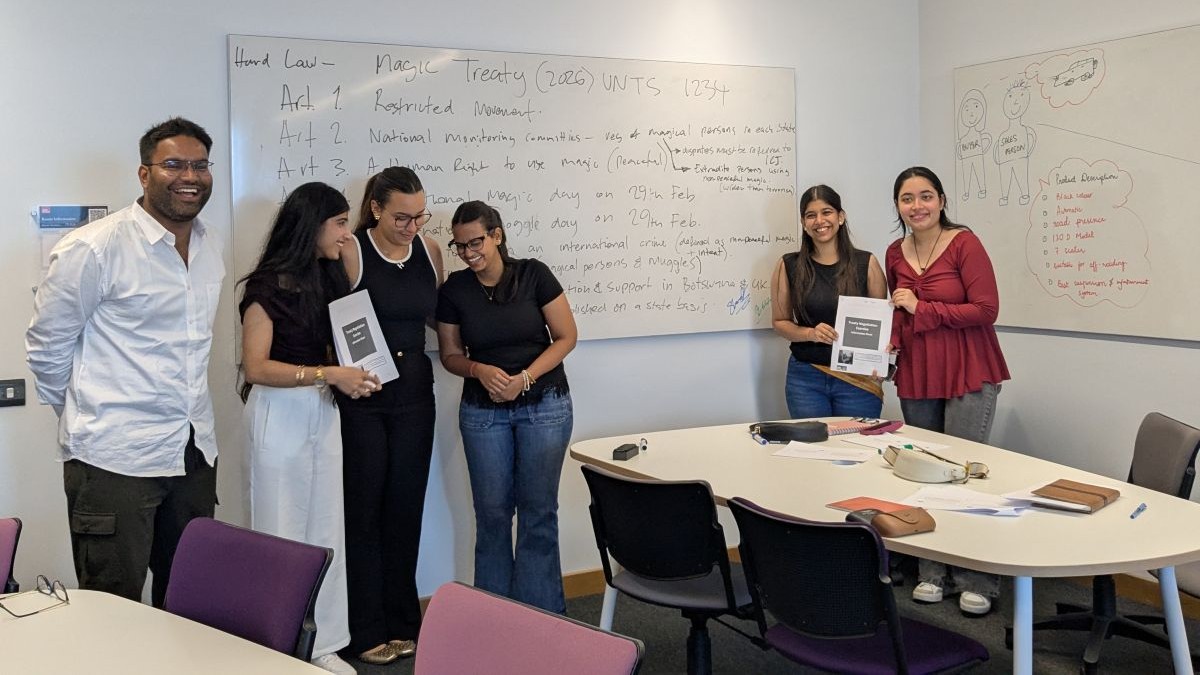
The highlight of the morning was undoubtedly the treaty negotiation exercise (penned by Prof James Green), which transformed the classroom into the “Conference on Magic”. Drawing inspiration from the world of Harry Potter, the exercise invited students to represent three State delegations in negotiations over a proposed international Treaty on Magic. The scenario imagined a world in which magical powers had suddenly been discovered among sections of the world’s population, prompting States to consider how international law should regulate both the risks and opportunities associated with magic.
Students were tasked with negotiating solutions to a series of challenging legal and political questions. These included whether magical persons should enjoy freedom of movement across borders, whether an international monitoring body should be established, whether there should be a human right to use magic, and whether magical discrimination should be prohibited. One particularly lively area of debate concerned the funding of the international monitoring body.
The students embraced the exercise with remarkable enthusiasm and creativity. Despite having only recently been introduced to treaty law and international negotiations, they quickly grasped the complexities of balancing national interests with the need for international cooperation. The negotiations required compromise, coalition-building, and strategic thinking. The exercise also provided an engaging way to understand the practical operation of international law. By negotiating, adopting, and debating reservations to the proposed treaty, students experienced first-hand the processes by which international agreements are created and the legal considerations that shape treaty-making. What might initially have appeared to be a light-hearted fantasy scenario became a sophisticated exploration of many real issues that arise in international law, including human rights protection, international cooperation (including extradition provisions), security concerns, and enforcement of treaty provisions.
Principles of International Humanitarian Law
After lunch, students were introduced to International Humanitarian Law (IHL), the legal framework governing both international and non-international armed conflicts and examined the conditions under which IHL becomes applicable.
The afternoon focused in particular on the fundamental principles of international humanitarian law, including humanity, distinction, proportionality, military necessity, and the prohibition of superfluous injury and unnecessary suffering. These principles form the backbone of IHL.
Rather than approaching these principles solely through lectures, students were given the opportunity to apply them to a series of practical scenarios. Working through realistic case studies, they analysed situations involving wounded combatants, attacks having an effect on civilians, military targeting decisions, and the potential humanitarian consequences of new weapons technologies. Students were encouraged to identify the relevant legal principles, assess whether violations had occurred, and develop legal arguments to justify their conclusions.
These exercises generated excellent discussions and demonstrated the students’ ability to engage critically with complex legal questions. By moving beyond abstract legal rules and applying them to concrete situations, participants gained a deeper appreciation of both the protective purpose of IHL and the difficult choices that arise during armed conflicts. The interactive format also highlighted the importance of legal reasoning, interpretation, and evidence-based analysis in international law practice.
Conclusion
The Summer School provided a stimulating and rewarding experience for everyone involved. Throughout the day, the students demonstrated exceptional curiosity, creativity, and willingness to engage with unfamiliar legal concepts. Whether negotiating a treaty on magic or applying humanitarian law principles to battlefield scenarios, they approached every activity with enthusiasm and intellectual rigour. The success of the programme illustrates the value of combining academic learning with practical simulations. By integrating imaginative role-playing exercises with rigorous legal analysis, Bristol Law School continues to provide innovative opportunities for students to experience international law in action. The active contribution of all participants made the day a memorable one and showcased the appeal of studying International Law at Bristol Law School
On the 23rd July 2026, Bristol Law School’s research-active staff and PGR students gathered for the annual Research Away Day at the Engineers’ House in Bristol. This was a genuine “Away Day” in every sense of the term, taking colleagues away from the UWE Bristol Frenchay campus and into a space designed for reflection and discussion.
The venue was perfect for our needs and created a nice vibe for both serious discussions and laid-back networking. Almost 30 colleagues attended the event. The day offered an opportunity not only to share ongoing research but also to reflect on strategic priorities, discuss common challenges and strengthen connections across the School’s research groups.
Research and the REF
The day began with coffee and tea before Prof James Green provided an update on the Research Excellence Framework (REF). Recognising that REF can sometimes appear complex and remote from everyday research activities, Prof Green started by outlining its purpose and significance before discussing recent developments concerning outputs, impact case studies, and the evidence required for the Strategy, People and Research Environment element.
A key message emerged from the session: every member of Bristol Law School’s research community contributes to the School’s REF profile. Whether through publications, engagement activities, collaborations or impact-oriented projects, all research activity plays an important role in shaping the School’s research reputation.
Showcasing research across Bristol Law School
One of the highlights of the day was the opportunity for colleagues to present their research in a series of brief five-minute presentations. Spread across the morning and afternoon, these sessions offered a fascinating glimpse into the diversity, quality and impact of research taking place across the School.
Together, these presentations demonstrated the many forms that legal research can take. Colleagues spoke about newly published books, developing research projects, stakeholder engagement initiatives, interdisciplinary collaborations, policy-oriented research and practical outputs such as toolkits. The sessions illustrated both the intellectual richness of Bristol Law School’s research culture and its commitment to addressing contemporary legal and societal challenges.
Enhancing the visibility of research
The presentations were followed by a discussion on the visibility of research and researchers. Colleagues reflected on how visible they felt their research currently was, how visibility might be improved and what support could help maximise the reach and recognition of their work. These proposals will be explored during the next academic year as the School continues to strengthen its research profile.
Law and the industrial strategy
Colleagues then took part in an interactive workshop led by Ms Nicola Temple from Research and External Engagement. The session focused on the eight priorities of the Industrial Strategy. Working in groups across four tables, colleagues explored the role of law in addressing major economic and technological challenges. The discussions highlighted both existing strengths within the School and opportunities for future research development. The outputs from the session will help inform Bristol Law School’s evolving research agenda and strategic priorities in the coming years.
Sharing research challenges
The afternoon began with a Research Challenges session using a “Triad Listening” approach. Participants worked in groups of three, with each person taking turns to present a research challenge in three minutes. One colleague listened to the factual elements of the challenge, while another focused on the feelings and concerns expressed by the presenter. Following feedback from both listeners, presenters were encouraged to reflect on their challenge from different perspectives.
Looking ahead
The day concluded with some final reflections and words of thanks. Looking back, what stood out most was the relaxed and supportive atmosphere that characterised the event throughout. The schedule allowed enough time for meaningful conversations, reflection and networking, ensuring that colleagues never felt rushed between sessions. Equally importantly, the day provided a chance to step back from everyday commitments and reflect on the broader direction of research within the School.
PS: Copilot was used to structure handwritten notes taken during this event and the final version was edited using Grammarly.
On 24 March 2026, the Global Crime, Justice and Security Research Group at Bristol Law School, in collaboration with the Centre for African Social and Economic Transformation (CASET), hosted a timely and insightful event entitled “Locating the Impact of Competition Regulations on African Trade and Entrepreneurial Development.” Held on campus and online, the event brought together academics and practitioners to explore how competition regulation can unlock trade, support entrepreneurship and address structural inequalities across the African continent.
Opening remarks: Framing the debate
The event began with welcome remarks by Dr Mary Young, the Lead of the Research Group Global Crime, Justice and Security, who set the foundation by emphasising the central role of trade in Africa’s development. She highlighted that sustainable economic growth across the continent depends not only on expanding markets but also on establishing robust and effective competition rules. Such frameworks, she noted, are essential to ensuring fairness, preventing abuse and fostering long-term development.
Dr Austin Nwafor then introduced the keynote speaker, Hon. Justice Dr Nnamdi Dimgba, a Judge of the Court of Appeal of Nigeria. Dr Dimgba is an alumnus of Bristol Law School, where he earned a PhD in Law, focusing on the relationship between European competition law and the European Convention on Human Rights.
Keynote Address: “Competition Regulations: A Panacea for Trade and Enterprise in Africa”
The keynote address was delivered by Hon. Justice Dr Nnamdi Dimgba who provided a wide-ranging and deeply analytical assessment of competition regulation across Africa.
His central argument was that competition law cannot be understood in isolation; it must be situated within the broader economic, demographic, and structural realities of the continent. Africa’s market potential is considerable, supported by a large and growing population and opportunities for industrial development. However, this potential remains constrained by structural challenges, including fragmented markets, limited domestic economies and poor infrastructure.
A key concern raised was the persistence of economic stagnation in many regions, with a significant proportion of the population living in poverty. Small domestic markets hinder meaningful participation in global trade, while investors tend to favour larger, more integrated economies with skilled workforces. In this context, regional integration initiatives have emerged as a critical strategy. The development of trade agreements and regional blocs has contributed to trade liberalisation, while the African Continental Free Trade Area (AfCFTA) represents a landmark step forward, particularly with its competition policy protocol, which aims to foster cooperation, enhance enforcement and create a level playing field.
Yet, the keynote also underscored persistent gaps. Notably, many African states still lack competition laws, and jurisdictional fragmentation remains a major obstacle. Competition policy must therefore be aligned with broader efforts to address trade deficits and promote intra-African trade. Hon. Justice Dr Dimgba also highlighted sector-specific concerns, including high levels of concentration in banking and energy markets, which limit competition and can lead to excessive pricing.
Importantly, the keynote recognised that competition law must strike a balance: while preventing anti-competitive behaviour, it must also preserve incentives for innovation. Regulatory frameworks should thus be carefully calibrated to avoid stifling growth.
Panel discussion: Bridging law, practice and reality
The panel discussion, introduced by Dr Austin Nwafor, brought together a diverse group of experts from law, economics, and business. Panellists included Mr Christian Dadomo (Former Senior Lecturer at UWE and PhD supervisor of Dr Dimgba)) , Professor Paschal Anosike, Dr Chisa Onyejekwe, Dr Olerato Ogotseng, Dr Alex Pietrus, and Dr Prince Olokotor, each offering distinct yet complementary perspectives.
The discussion highlighted significant institutional weaknesses across the continent. Competition authorities are often underfunded and subject to political interference, while judicial systems may lack the independence or capacity required for effective enforcement. Fragmented jurisdiction, inconsistent regulation, and limited coordination between regional bodies further undermine effectiveness.
The panel explored the challenges of adopting and enforcing competition law, with particular reference to Nigeria. It was noted that legislative delays can be attributed to resistance from powerful industry actors with vested interests and political connections. The influence of external models, particularly from the European Union and the United States, was also debated, with participants emphasising the need for context-specific approaches.
A recurring theme throughout the panel was the importance of small and medium-sized enterprises (SMEs). They account for a substantial proportion of employment across Africa and are often the backbone of local economies. However, many operate informally, without legal recognition, access to finance, or adequate infrastructure.
Informality presents a fundamental challenge for competition regulation. Traditional legal frameworks assume formal, visible markets, yet much of Africa’s economic activity takes place in informal sectors. These “invisible” economies, such as township markets, provide crucial employment and services but remain marginalised in policy design.
Panellists also emphasised systemic barriers faced by SMEs, including limited access to finance, inadequate transport infrastructure and complex regulatory environments. While competition law aims to promote fairness, it must be implemented in a manner that supports, rather than hinders, SME growth.
Further insights were provided into sectoral concentration and market access. South Africa was used as an example of a relatively open economy with established competition institutions, yet one in which SMEs continue to face significant financing challenges. Financial institutions often perceive SMEs as high-risk investments, limiting access to credit and constraining growth. This issue is particularly acute for entrepreneurs from historically disadvantaged communities, many of whom enter business out of necessity rather than opportunity. While support schemes exist, a lack of awareness and limited capacity-building opportunities often prevent effective uptake.
Many panellists emphasised the need to recognise the realities of informal economies. Much economic activity is not captured in official data, creating challenges for regulation and policy design. They stressed the importance of developing frameworks that legitimise and support these sectors without undermining their flexibility.
Structural and historical factors were also identified as key drivers of inequality. High barriers to entry in certain industries mean that local communities often fail to benefit from economic activities. This raises broader questions about sustainability, equity and the distribution of wealth.
Another critical issue discussed was legal pluralism across African jurisdictions. Differences in legal frameworks between countries such as Kenya, Nigeria, and South Africa create challenges for harmonisation and enforcement. The absence of binding regional laws further complicates integration efforts and raises questions about sovereignty and supranational authority.
Conclusion
The event wrapped up with Dr Sejal Chandak’s remarks who, reflecting on India and Africa, noted the lasting effects of colonial legacies alongside the resilience and entrepreneurial spirit present in both regions. The discussions emphasised that while competition law is crucial, it should be part of a broader framework that includes structural reform, institutional strengthening and inclusive development.
The BLS–CASET event examined competition regulation in Africa, showing its potential and challenges. Despite progress, particularly with initiatives like the AfCFTA, significant issues persist. Policymakers need to address institutional weaknesses, improve coordination, and develop tailored legal frameworks, while also supporting the informal economies that many rely on. Effective competition law can transform markets and promote innovation, but it is not a cure-all; it must be integrated into a broader strategy to unlock Africa’s economic potential and ensure equitable development.
PS: Copilot was used to structure handwritten notes taken during this event and the final version was edited using Grammarly.
The recent US-Israeli attack against the sovereign nation of Iran – which included the deadly bombing of a primary school, killing more than 150 children and wounding over 100, as well as the killing of the Supreme Leader, Ayatollah Ali Khamenei, along with several family members – presents a textbook example for the war crimes and the crime of aggression. This blog post focuses primarily on the jurisdictional hurdles involved in prosecuting the crime of aggression. It demonstrates how the proposed amendments to the jurisdictional provisions for the crime of aggression in the Rome Statute, and a Ukraine-style special tribunal, could provide some potential pathways for navigating these hurdles. It first briefly outlines how the attack constitutes both a war crime and a crime of aggression, followed by an analysis of the jurisdictional obstacles for the crime of aggression and their navigation, before placing the crime of aggression in a historical context to make a case for hope.
The attack constituting crime of aggression and war crime
The attack constitutes a manifest violation of Article 2(4) of the UN Charter, which prohibits the use of force. Furthermore, there appears to be no reasonable claim to the exercise of self-defence under Article 51 of the Charter (Quénivet 2026). Consequently, the invasion of the sovereign state of Iran and the bombardment of its territory qualify as acts of aggression under Article 8 bis (1) and (2) of the Rome Statute of the International Criminal Court (ICC), rendering those in authority responsible for the crime of aggression. Specifically, the Head of State and Head of Government of the US and Israel – President Donald Trump and Benjamin Netanyahu – as individuals in positions to effectively exercise control over or direct military action, bear apparent responsibility under Article 8 bis (1).
Moreover, during this international armed conflict under Common Article 2 of the Geneva Conventions, the bombing of a primary school – a property being a civilian object protected under the Article 52 of Additional Protocol I of the Geneva Conventions – may constitute grave breaches of the Geneva Conventions of 12 August 1949, as per Article 8(2)(a) of the Rome Statute. Directing attacks at undefended schools and the killing of the civilian population and senior leadership may also constitute violations of the laws and customs applicable in an international armed conflict under Article 8(2)(b). These acts may amount to war crimes, particularly as they were undertaken as part of a coordinated US-Israeli plan or policy to topple the Iranian regime.
Pathways to accountability: navigating jurisdictional challenges for crime of aggression
The primary challenge is not whether these acts constitute specific crimes – as the law would suggest they do – but rather the difficulty of ensuring accountability within the framework of international criminal law. Under Article 15 bis and 15 ter of the Rome Statute, the ICC can only exercise jurisdiction over the crime of aggression committed by the national of a state if the state is a party to the Rome Statute, if the crime of aggression occurs on the territory of a state party or if the security council refers the crime of aggression to the prosecutor of the ICC.
Further, under Articles 15, 15 bis, and 16 of the Rome Statute, no investigation into the crime of aggression can proceed unless the UN Security Council makes a determination that an act of aggression has been committed by the state concerned. Alternatively, an investigation may proceed if the Pre-Trial Chamber of the ICC authorises it, provided the Security Council has not deferred the matter. Since the U.S., Israel, and Iran are non-parties, and the U.S. holds a permanent seat (and veto) on the Security Council (Article 27(3) UN Charter), a reference to the prosecution or non-deferral of investigation is unlikely, leaving the crime of aggression legally out of reach at the ICC.
However, the ongoing amendment review initiated by the Assembly of States Parties (ASP) of the ICC in July 2025 provides a potential solution to this jurisdictional hurdle, as the ASP is considering an amendment – proposed by Germany, Costa Rica, Slovenia, and several other states – to modify the conditions under which the Court may exercise jurisdiction over crimes of aggression. If implemented, the amendment would mean that if the state on whose territory the crime occurred, or the state whose national is accused of committing the crime, ratifies or accepts the amendment (provided it is already a State Party), then the ICC can exercise jurisdiction. Furthermore, if a state chooses to remain a non-State Party or not to ratify the amendment, the Court could still exercise jurisdiction if that state lodges an Article 12(3) declaration with the ICC Registrar accepting the Court’s jurisdiction over the crime of aggression.
This amendment would be highly relevant in holding Heads of State and other officials responsible for the US–Israeli attack on Iran. It would mean that Iran, even if it chooses to remain a non-State Party to the Rome Statute, could lodge an Article 12(3) declaration giving the ICC jurisdiction over crimes committed on its territory. Article 12(3) declarations can apply retrospectively, as seen in the case of Ukraine, which filed a declaration in April 2014 accepting jurisdiction for crimes committed between 21 November 2013 and 22 February 2014.
However, whether the principle of non-retroactivity under Article 24 would preclude the retrospective effect of the amended provision – thereby preventing Iran from reaching back to the recent attacks by the US and Israel – is debatable. One could argue that while the procedural provisions would be amended, the substantive provisions (Articles 8 bis, 15 bis, and 15 ter of the Rome Statute) criminalising acts of aggression have been effective since July 2018, making the nullum crimen sine lege (no punishment without law) argument less persuasive. Nevertheless, one must wait and see, as the next ASP session will be convened in 2029 to consider the proposed amendments.
Meanwhile, a Council of Europe–style Special Tribunal for the crime of aggression, similar to the one established for Ukraine, could be considered. The necessity of such a tribunal stems from the fact that, within the current ICC legal framework, jurisdiction over the crime of aggression is limited to States Parties to the Rome Statute – a hurdle that currently prevents the ICC from exercising jurisdiction over the US-Israeli attack on Iran. In the absence of an exact parallel to the Council of Europe in Asia, the organisations that most closely resemble it – specifically regarding the formation of a tribunal by negotiating a statute with Iran and using the Ukraine model as a blueprint – could be the Organization of Islamic Cooperation (OIC), which currently represents 57 states including Iran, or the Shanghai Cooperation Organisation (SCO). The SCO is the world’s largest regional organisation in terms of geographic area and population; it focuses on Eurasia and includes Russia, China, India, Iran and Pakistan, among others, as member states. Unlike the ICC, the Ukraine model would support trials in absentia. However, a downside of such a tribunal is that it may not be able to conduct the trial of a sitting Head of State, Head of Government, or other person in an official capacity unless they leave their position or their immunity is waived (Cosneanu 2025).
Accountability for international crimes: a challenging but hopeful case
Ultimately, bringing perpetrators of international crimes to justice will be a long and challenging battle, though at the ICC these crimes are not subject to limitation period per Article 29 of the Rome Statute, given that international criminal justice is not without political influence. One can understand the challenges the ICC may face in this regard, when they consider the fact that the US imposed sanctions on the ICC judges and prosecutors once the ICC issued arrest warrants for Benjamin Netanyahu and Yoav Gallant for the alleged war crimes and crimes against humanity in the situation in Palestine.
However, setbacks in prosecuting Heads of State and other senior government officials are not novel. The victors’ attempt to prosecute the Grand Vizier of the Ottoman Empire for the Armenian massacre never saw the daylight, as the Treaty of Sèvres negotiated in Paris was never ratified by any Turkish regime. The attempt to prosecute the German Emperor, Kaiser Wilhelm II, also could not materialise, as the ‘special tribunal’ sanctioned by the Treaty of Versailles was never actually established and as the Netherlands refused to extradite him (Schabas 2012). An even-handed prosecution for the atrocities committed in the Second World War – by way of bringing to justice those responsible from the Allied forces, such as the Russian leadership for the Katyn Massacre of Polish citizens or the US leadership for the Hiroshima and Nagasaki bombings or the UK-US leadership for the Dresden bombings – never materialised (Labuda 2024).. Even after all these setbacks, since we have precedents of successful prosecutions of Heads of State and senior officials, such as Japanese Prime Minister Hideki Tojo at the International Military Tribunal for the Far East (IMTFE), or Yugoslav President Slobodan Milošević and Rwandan Prime Minister (Interim) Jean Kambanda at the International Criminal Tribunals for the former Yugoslavia and Rwanda (ICTY and ICTR) or Liberian President Charles Taylor at the Special Court for Sierra Leone (SCSL) – there is always hope for justice to prevail in the long run.
Conclusion
Finally, to echo Sir Thomas More, the celebrated English lawyer and Lord Chancellor, a question must be asked of us all: if the Devil were to turn around on us – if we remain silent now and passively accept this flagrant breach of international norms and a culture of impunity – where would we hide when our turn comes?
Recent US and Israeli military operations against Iran have prompted intense debates about the legality of such force under contemporary international law. US Secretary of State Marco Rubio claimed the United States acted to support Israel as the US President “knew that there was going to be an Israeli action. We knew that that would precipitate an attack against American forces”. Yet this combination of justifications does not support the actions taken.
The US justification rests on speculative assessments about what Iran might have done, rather than demonstrable evidence of an impending attack. This conclusion is echoed forcefully in a plethora of expert commentaries on various international law blogs (see e.g. Milanovic 2026,Adil Ahmad Haque 2026). Whilst Lieblich 2026 has provided an excellent examination of the double pre-emption and imminence discussion, one element that has, however, not been elaborated upon is that the attack by the US could be considered an ad hoc form of collective self-defence. This post argues that, absent a lawful intervention by Israel, the US would not be able to claim it is acting in collective self-defence.
This post starts by explaining the prohibition of the use of force and its exceptions, notably Article 51 of the United Nations Charter and the customary rule of anticipatory self-defence. It then warns against an expansive interpretation that includes pre-emptive self-defence before providing an analysis of a flawed potential collective self-defence claim.
Article 51 and the threshold requirement of an armed attack
The prohibition of the use of force is a cornerstone of the United Nations Charter (ICJ DRC v Uganda 2005, para 148), anchored in its Article 2(4). Force can only be used in two specific circumstances: when the Security Council authorises the use of force (Chapter VII), and in the exercise of the inherent right of individual or collective self-defence if an armed attack occurs (Article 51).
Some quarters would argue that, given that Israel had already been attacked by Iran (some time ago), the right of self-defence did not extinguish simply because time had passed (see Lovitky 2025 on Israel’s attack against Iran in June 2025 following Iran’s attacks in October 2024). The law is clear: a State must prove that resort to force is necessary to repel the attack. First, it is difficult to see how the current attack fends off an attack that is over a year old. Second, necessity is also measured with due regard to whether nonforcible means could be used successfully (see Adil Ahmad Haque 2026;Schmitt, Bridgeman and Goodman 2026). Israel did not even attempt negotiating with Iran; rather, it was the US that was in discussion with Iran and, according to Oman’s Foreign Minister, “peace [was] within […] reach”. Yet, the US ended such negotiations. A claim of necessity cannot thus be made.
Anticipatory self-defence: A narrow and disputed doctrine
Under customary international law, anticipatory self-defence is recognised as a lawful use of force. This narrow exception, stemming from the 1837 Caroline incident, allows force when the State can show “a necessity of self-defence, instant, overwhelming, and leaving no choice of means and no moment for deliberation”. The rule of thumb is that the State is simply using force “before it is too late to do so”, i.e., to enable it to mount an effective defence (see O’Meara 2022). As Schmitt 2025 puts it, this is a test of “last window of opportunity”. However, nothing suggests that Iran was on the brink of launching an attack against Israel or the US.
Modern interpretations of this rule have focused on the imminence of the attack, each State (e.g. the US, the UK, and Australia) adopting its own standard. The lack of a common understanding both among States and scholars reflects the controversial nature of the use of force in anticipatory self-defence. Among the indicators used to determine the lawfulness of such action (see O’Meara 2022) are the probability or likelihood of the attack, the nature of the threat, the immediacy of the threat, whether the use of force is the only reasonable choice in the given circumstances, whether the response is proportionate, etc. That said, an anticipatory self-defence claim rests on actual imminent threats, not hypothetical scenarios. In practice, much of this links back to the availability of accurate intelligence information (see Bachmann and Keinan 2025). Nothing in the few days before the Israel/US attacks suggests that Iran was more likely to attack Israel than at any other point. In fact, Iran was at the time in negotiations with the US (see interview with Oman’s Foreign Minister).
Rubio’s justification did not rely on evidence of Iranian mobilisation but on US predictions that Iran might retaliate for Israel’s own pre-planned actions. What is more, Rubio’s statement could be interpreted as inadvertently undermining the US claim by stating that the US knew that “there was going to be an Israeli action” (a claim later withdrawn). He did stress the Iranian military preparations as the catalyst for US fears. This is the opposite of imminence! This reinforces the claim that Israel lacked a basis to claim imminence.
Pre-emptive self-defence: An even narrower and more controversial doctrine
Since the Bush era, the concept of pre-emptive (sometimes also confusedly referred to as preventive) strikes has gained prominence, though it is highly controversial. Whilst the US seemingly acted under such a doctrine when it invaded Iraq in 2003, it argued that it did not accept such a theory (see discussion in Taft and Buchwald 2003); rather, in its view, the intervention was based on Iraq having violated a UN Security Council resolution (see Finucane 2025). The doctrine of preemptive self-defence was mainly developed in the context of the “war on terror” to enable the US to strike State and non-State actors in a “non-consenting state” (see Lederman 2016), i.e. a State unable or unwilling to put an end to that threat on its territory (see Schmitt 2025).
There is, nonetheless, a wider reach of this doctrine, notably with the purpose of such strikes being to destroy a State’s threatening capabilities. This is more often called preventive self-defence (see Israel’s position as explained in Friedman 2026). In 1981, the US joined other States in the UN Security Council (Resolution 487 (1981)) in condemning Israel’s attack on Osirak, an Iraqi nuclear facility and rejecting similar justifications (see Finucane 2025). It pointed out the “absence of any evidence that Iraq had launched or was planning to launch an attack that could justify Israel’s use of force. … [T]he presence in a State of the military capacity to injure or even to destroy another State cannot itself be considered a sufficient basis for the defensive use of force.” (Sofaer, US Legal Adviser, as cited in Lederman 2016). Replace Iraq with Iran in the above statement, and the irony of such a statement in light of the current events is not lost on the reader. This historical consistency severely undercuts Washington’s current position. Rubio indeed stated that the US intervened “to eliminate the threat of Iran’s shortrange ballistic missiles and the threat caused by their Navy particularly to naval assets”.
It is evident that such a (flawed) understanding of anticipatory self-defence differs significantly from the original interpretation of the Caroline incident formulation. For certain, the law evolves, but even the most contemporary interpretations of anticipatory self-defence do not authorise preventive strikes based merely on an adversary’s developing capabilities. As Schmitt 2025 emphasises, “States enjoy no right under international law […] to use force solely because another State is about to acquire a threatening capability”.
Collective self-defence
Under international law (both Article 51 UN Charter and customary international law (see ICJ Nicaragua 1986, para 194)), a State is allowed to seek support through collective self-defence, which denotes the situation whereby a State acts to defend an ally that has suffered an armed attack or is facing an imminent threat. Interestingly, the US support for Israel has not been couched in terms of collective self-defence. That being said, let’s entertain this claim here. For collective self-defence to be lawful, the self-defence must comply with the jus ad bellum rules (see Green 2024;Schmitt, Bridgeman and Goodman 2026). This means that if Israel lacked a valid claim of self-defence, then the United States cannot invoke collective self-defence.
First, it must be noted that the US did not refer to collective self-defence in this recent attack. This contrasts to the situation in June 2025, when the US had invoked it in its letter to the UN Security Council to justify its attack on Iran by first referring to Israel responding to Iranian attacks “in the exercise of its inherent right of self-defence” and adding that “[i]n close coordination with the Government of Israel, the United States has taken necessary and proportionate action […] to defend Israel and also to protect our own security, citizens, and interests, consistent with Article 51 of the Charter of the United Nations.” Even at the time, Finucane 2025 demonstrated that such a claim violated international law. As explained, Israel can certainly not claim to be acting in self-defence. This forecloses the possibility of a lawful “derivative” US collective self‑defence.
Second, from a procedural perspective, the victim State must declare that it has suffered from an armed attack, and it must request military aid in response (ICJ Nicaragua 1986, paras 165, 195 and 199). Israel therefore needs to issue a declaration that it has been attacked and then an ad hoc request for the US to join them in self-defence. Green 2017, however, points out that, in practice, the declaration requirement finds no relevance. In contrast, the request for assistance is (see Green 2024). No request was made by Israel; rather, it seems that the US intervened out of fear that it would be attacked (Rubio).
Third, and relatedly, the US rationale for its intervention appears to be also grounded in its own projection that Iran might retaliate against US assets following Israeli escalation (see Rubio). In other words, the putative attack was on the US and not Israel, which, following this logic, would make it impossible for the US to claim that it acted in collective self-defence to support Israel.
Conclusion
This interpretive drift regarding anticipatory self-defence has become particularly dangerous (see also Schmitt 2025). While governmental legal teams could be perceived to be bending doctrines to suit policy goals rather than grounding policy in legal constraints, it gives the impression that an increasing number of political leaders now see international law not only as a constraint but also as an utter nuisance. The US logic depends on a chain of hypothetical contingencies, reminiscent of the “Minority Report” scenario. International law categorically rejects such conjectural reasoning. In the end, the intervention reflects precisely what international law seeks to prevent: unilateral, pre-emptive uses of force dressed in the language of (collective) self-defence.
In February 2026 I had the opportunity to attend the 83rd session of UNCITRALWorking Group II (Dispute Settlement) at the United Nations Headquarters in New York. I participated as an observer at the invitation of the American Society of International Law and in my capacity as a UWE academic.
Walking into the UN conference rooms where international legal texts are negotiated was a striking experience. Around the table were State delegates from across the world, representatives of international organisations, arbitral institutions and accredited observers, all contributing to discussions that may ultimately shape the future of international dispute resolution.
Working Group II is responsible for UNCITRAL’s work on arbitration, mediation and related dispute resolution mechanisms. This session was chaired by Andrés Jana (Republic of Chile), who also serves as Vice-President of the International Court of Arbitration at the International Chamber of Commerce, and supported by the UNCITRAL Secretariat. The week’s discussions focused on how international dispute settlement frameworks should adapt to rapid technological change.
Artificial intelligence and the future of dispute resolution
One of the most fascinating themes throughout the session was the growing role of digital technologies in arbitration. Delegations discussed the increasing use of electronic communications, remote and hybrid hearings and the potential use of artificial intelligence tools within arbitral proceedings.
The conversation around AI was particularly lively. Delegates considered how AI might assist with tasks such as document review, legal research, case management and procedural administration. At the same time there was clear recognition that any use of AI must be carefully designed to protect core principles of dispute resolution: due process, transparency, party autonomy and equality of arms.
What made these discussions especially interesting was their global character. Delegations from jurisdictions including the United States, Israel, Finland, Russia, Cameroon, Bahrain, France and the Philippines offered different perspectives shaped by their own legal systems and policy priorities. Watching these viewpoints converge through negotiation and compromise offered a powerful illustration of UNCITRAL’s consensus based drafting process.
Alongside the formal plenary meetings, a series of colloquium panels brought together academics, practitioners and members of the judiciary. Leading arbitral institutions from major global centres were represented, including the London Court of International Arbitration, highlighting London’s continued importance as a hub for international arbitration.
One particularly thought-provoking moment came during a discussion of an AI assisted arbitrator model currently being trialled by the American Arbitration Association (AAA). The concept involves an AI system assisting an arbitrator with aspects of decision making, subject to the express consent of the parties. The idea sparked extensive debate about accountability, oversight and the limits of algorithmic decision making in legal processes.
A memorable intervention came from H.E. Judge Sapna Jhangiani KC of the Dubai International Financial Centre Courts of Appeal. She emphasised that while AI systems may be capable of mimicking legal reasoning, they do not truly reason. For that reason she argued they must remain subject to meaningful human control. Her remarks captured a broader concern echoed throughout the session: technological innovation must support rather than replace judicial responsibility.
From working group to the General Assembly: how international law is made
The Working Group also advanced work under the Dispute Resolution in the Digital Economy (DRDE) project. During the session delegates approved draft texts including recommendations on the interpretation of the New York Convention in relation to arbitral awards in electronic form, proposed amendments to the UNCITRAL Model Law on International Commercial Arbitration and additions to the Notes on Organizing Arbitral Proceedings.
At the end of the week the Working Group adopted its draft report, which will now be submitted to the UNCITRAL Commission at its 59th annual session in 2026. If approved the outcomes may ultimately inform resolutions and legislative texts considered by the United Nations General Assembly. Observing this process offered a clear reminder that international law develops through patient negotiation, drafting and consensus building among States.
Reflections for research and teaching
For me personally the experience provided valuable insight into how debates about AI governance are unfolding in international legal institutions. As someone whose research focuses on the regulation and governance of artificial intelligence, hearing how States and arbitral institutions are thinking about the responsible integration of AI into legal processes was particularly valuable. These discussions will inform my ongoing research on regulatory oversight, human control mechanisms and accountability in AI assisted adjudication. They will also enrich my teaching by offering students a clearer picture of how international legal norms are debated and developed in practice.
Leaving New York I brought back a small commemorative model of the United Nations Headquarters building, a reminder not only of the visit but also of the Law School’s growing engagement with international legal forums.
The Law School’s support in facilitating this participation is gratefully acknowledged.
On 16 February 2026, the Research in Public International Law Group of the Bristol Law School organised an event on “Perspectives on Post-Conflict and Post-Atrocity Accountability”. It welcomed Dr Fabricio Guariglia for a compelling and timely keynote on “Ongoing Accountability Efforts in Ukraine”. The event drew 30 staff and students, filling the room to capacity, with students attending from across our LLB and LLM in International Law and Conflict programmes. Their engagement throughout the session underscored both the relevance of these issues to their studies and the growing interest in international accountability among the next generation of legal practitioners. Dr Guariglia, who has served as defence counsel and victim representative in Argentina, held senior roles at the International Criminal Tribunal for the Former Yugoslavia and the International Criminal Court, and now directs the International Development Law Organisation Hague office, drew on decades of experience to explore the legal institutional and human challenges posed by the ongoing conflict.
A system under pressure: Ukraine’s overnight transformation
A central theme of Dr Guariglia’s keynote was the extraordinary strain on Ukraine’s criminal justice system. When Russia launched its full-scale invasion in February 2022, Ukraine already maintained a specialised war crimes unit. Yet this was nowhere near enough to cope with the explosion of violations across the country. Almost instantly, the entire judiciary pivoted into war crimes mode. Prosecutors and judges accustomed to working within structures shaped by the Soviet legacy found this model unworkable amid territorial occupation and mass displacement.
Investigators adapted quickly. Laptop-based field interviews replaced office-based procedures. Moreover, emergency laws and curfews led to a temporary collapse in ordinary crime. For a time, nearly the entire prosecutorial apparatus focused on atrocity crimes. But as refugees returned and daily life resumed, ordinary criminal caseloads surged once again, leaving legal professionals simultaneously managing conventional offences and a war crimes docket that now exceeds 200000 cases. Only a small proportion of these have progressed to trial, revealing longstanding structural gaps in prioritisation and case tracking.
International engagement and Ukraine as a “laboratory”
Recognising the scale of the challenge, Ukraine sought help from the international community. States contributed seconded personnel expert advisers and platforms for coordination. Dr Guariglia highlighted one major success. Four years on Ukrainian judges and prosecutors possess significantly greater expertise in international humanitarian and international criminal law. In many ways Ukraine has become a “laboratory” for international law, especially regarding the crime of aggression, committed on a scale and with a clarity of annexationist intent not seen in recent history.
Yet gaps remain. The International Criminal Court is unable to prosecute the crime of aggression in Ukraine due to the Court’s jurisdictional requirements, creating a stark mismatch between the gravity of the wrongdoing and the existing accountability tools.
A conflict with many harms: gendered violence, environmental damage, and the targeting of children
Dr Guariglia noted that the war’s impact extends far beyond the battlefield. Gender-based violence is prevalent during war and women often seek refuge in neighbouring countries, where some become victims of exploitation and trafficking. The environmental damage caused by the conflict will stay for generations. And among the most troubling developments are the violations against children who were separated from their families, transferred to Russia, and subjected to systemic Russification efforts.
The challenge of linking crimes to perpetrators
Dr Guariglia highlighted two challenges. First, Ukraine’s legal system does not operate on a priority basis, in the sense that there is no effective case-mapping or prioritisation process. Prioritisation is happening in an organic rather than a systemic manner. Second, there are issues in establishing linkage evidence that is the connections between crimes and those responsible. Access to military intelligence and internal documents remains severely restricted, resulting in many cases stalling before trial. The use of the universal jurisdiction principle in other countries and the creation of a joint investigative team (with ICC participation) coordinated through Eurojust offer some hope, but meaningful justice will require decades of sustained work.
Panel Reflections: Limits and Opportunities in International Criminal Justice
The post-keynote panel broadened the discussion to consider global accountability efforts.
Slow but meaningful progress
Tanvir Hashem Munim (Lecturer at UWE and ICC Counsel) emphasised the slow pace of investigations and arrest warrants in relation to the situation in Myanmar. He highlighted that progress was made in various forums. The Government of Gambia initiated a case before the International Court of Justice and a case has started in Argentina using universal jurisdiction. In contrast other initiatives, such as those in Indonesia, have been rejected. Tanvir stressed that arrest warrants themselves can be victories, offering hope and signalling that impunity will not endure.
Aggression: the core crime still evading legal capture
Lawrence Hill-Cawthorne (Professor of International Law at the University of Bristol) highlighted the structural gap around the crime of aggression. Although Ukraine has cases before the European Court of Human Rights, the International Court of Justice and the International Tribunal for the Law of the Sea none directly referred to aggression, leaving a critical aspect of the conflict unaddressed in formal legal terms. Also as Ukraine has largely lost these cases (except for those brought before the European Court of Human Rights) Russia has framed these outcomes as vindications, even when they do not reflect the broader context of the conflict.
The Ljubljana – the Hague Convention: a new tool with old challenges
Alison Bisset (Associate Professor at the University of Reading) presented the Ljubljana-The Hague Convention, the first global interstate treaty focused on cooperation in investigating and prosecuting international crimes. Driven by practitioner needs the Convention addresses jurisdiction extradition evidence sharing and victims’ rights. While it has the potential to reshape cooperation difficulties remain. It mirrors the UNTOC model which many states fail to use. It does not address immunities. It fails to refer to evidence gathering that is specific to international crimes (for example excavations). It provides much leeway to states to refuse cooperation on the basis of national security and it is overwhelmingly supported by European states raising questions about global uptake.
Conclusion: a generational struggle for justice
Dr Guariglia’s keynote and the subsequent panel offered a rich though realistic and sobering assessment of what justice looks like amid ongoing conflict. The work ahead is immense and will span generations. Yet legal institutions however imperfect remain essential. They document truth empower victims and gradually build pathways to accountability. For our students in the LLB and LLM programmes the event was both academically invaluable and deeply motivating illustrating the importance of their future roles in shaping global justice.