

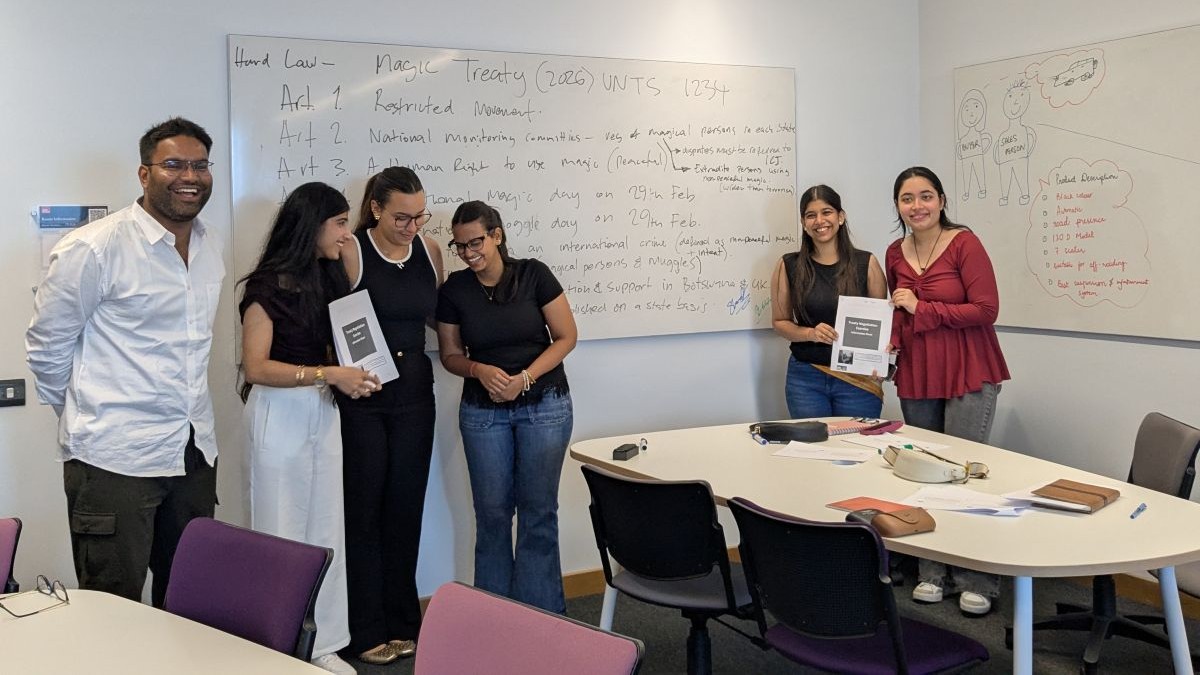
Since the 20th July 2026, Bristol Law School has welcomed eight international students to its Summer School programme, which covers a range of topics from financial crime to human rights law. The programme includes substantive lectures as well as sessions focused on career development and research skills. This year’s cohort consists of seven students from India and one student from Brazil, creating a genuinely international learning environment that enriched classroom discussions throughout the day.
Introduction to international law
One day was dedicated to international law. On the 27th July, Professor Noëlle Quénivet and Dr Mike Pollard introduced students to key concepts of public international law, treaty negotiation, and international humanitarian law through a combination of lectures, simulations, and problem-based learning exercises.
The morning began with an introduction to public international law, focusing on the sources of international law, the relationship between international and domestic legal systems, and the distinction between actors and subjects of international law. Particular attention was devoted to treaty law and the Vienna Convention on the Law of Treaties, providing students with essential knowledge before they moved into the practical simulation.
Treaty negotiation exercise
The highlight of the morning was undoubtedly the treaty negotiation exercise (penned by Prof James Green), which transformed the classroom into the “Conference on Magic”. Drawing inspiration from the world of Harry Potter, the exercise invited students to represent three State delegations in negotiations over a proposed international Treaty on Magic. The scenario imagined a world in which magical powers had suddenly been discovered among sections of the world’s population, prompting States to consider how international law should regulate both the risks and opportunities associated with magic.
Students were tasked with negotiating solutions to a series of challenging legal and political questions. These included whether magical persons should enjoy freedom of movement across borders, whether an international monitoring body should be established, whether there should be a human right to use magic, and whether magical discrimination should be prohibited. One particularly lively area of debate concerned the funding of the international monitoring body.
The students embraced the exercise with remarkable enthusiasm and creativity. Despite having only recently been introduced to treaty law and international negotiations, they quickly grasped the complexities of balancing national interests with the need for international cooperation. The negotiations required compromise, coalition-building, and strategic thinking. The exercise also provided an engaging way to understand the practical operation of international law. By negotiating, adopting, and debating reservations to the proposed treaty, students experienced first-hand the processes by which international agreements are created and the legal considerations that shape treaty-making. What might initially have appeared to be a light-hearted fantasy scenario became a sophisticated exploration of many real issues that arise in international law, including human rights protection, international cooperation (including extradition provisions), security concerns, and enforcement of treaty provisions.
Principles of International Humanitarian Law
After lunch, students were introduced to International Humanitarian Law (IHL), the legal framework governing both international and non-international armed conflicts and examined the conditions under which IHL becomes applicable.
The afternoon focused in particular on the fundamental principles of international humanitarian law, including humanity, distinction, proportionality, military necessity, and the prohibition of superfluous injury and unnecessary suffering. These principles form the backbone of IHL.
Rather than approaching these principles solely through lectures, students were given the opportunity to apply them to a series of practical scenarios. Working through realistic case studies, they analysed situations involving wounded combatants, attacks having an effect on civilians, military targeting decisions, and the potential humanitarian consequences of new weapons technologies. Students were encouraged to identify the relevant legal principles, assess whether violations had occurred, and develop legal arguments to justify their conclusions.
These exercises generated excellent discussions and demonstrated the students’ ability to engage critically with complex legal questions. By moving beyond abstract legal rules and applying them to concrete situations, participants gained a deeper appreciation of both the protective purpose of IHL and the difficult choices that arise during armed conflicts. The interactive format also highlighted the importance of legal reasoning, interpretation, and evidence-based analysis in international law practice.
Conclusion
The Summer School provided a stimulating and rewarding experience for everyone involved. Throughout the day, the students demonstrated exceptional curiosity, creativity, and willingness to engage with unfamiliar legal concepts. Whether negotiating a treaty on magic or applying humanitarian law principles to battlefield scenarios, they approached every activity with enthusiasm and intellectual rigour. The success of the programme illustrates the value of combining academic learning with practical simulations. By integrating imaginative role-playing exercises with rigorous legal analysis, Bristol Law School continues to provide innovative opportunities for students to experience international law in action. The active contribution of all participants made the day a memorable one and showcased the appeal of studying International Law at Bristol Law School