“Research is a passion. Look at the work we’ve done in developing magnetic detection technology – for home use, doctors’ surgeries and point of care. I love working with ambitious companies to accelerate their innovation to bring real change to people.”
I’m Professor Richard Luxton. Back in 2008, with my colleague Professor Janice Kiely, we set up the Institute of Biosensing Technology, IBST for short.
The IBST is the first of its kind in the UK. Here, industry and academia are working together to develop novel biosensing technologies – for the healthcare, agriculture and food technology sectors. We’re also applying biological principles to develop novel sensors for environmental, security and engineering applications.
From prototype to point-of-care
In our labs, we design complex biological tests and incorporate those tests into prototype devices using microfluidics and bespoke electronics. We’re a high-tech one-stop-shop if you like; supporting start-up and scale-up companies to develop innovation and tech by working collaboratively, simultaneously with them on all aspects of a product.
Personally speaking, I’ve moved from clinical research in the NHS to developing technology here in the university. I have two passions. One’s research. For example, the work we’ve done in developing magnetic detection technology – for home use, doctors’ surgeries and point of care. I also love the interdisciplinary nature of what we do. Working with ambitious companies to accelerate their innovation.
A community charged
We’ve a really dynamic environment here. A fantastically dynamic community. We have electronic engineers, software engineers, microbiologists and biochemists here. We’re able to pair the right people with the right companies to develop a particular technology that will positively change lives for the better.
That’s what it’s all about. Creating real world applications that will positively impact real lives. Getting to the right solution. Getting the product to market. We’re developing technology to support medics or patients in their homes.
This one project we’re working on is to develop a propofol sensor to look at non-gaseous anaesthesia, and how well people are sedated in intensive care. We have another project where we’re working with a company whose vision is to 3D print a heart. So that we can better understand and measure the triggering of heart transplant rejection systems.
Far-reaching impact
For me, the most exciting thing is the fact that our work, the work we do with companies, has a direct impact in the real world. It can help people to stay out of hospital and in their own homes. That has a huge impact – not just on individuals but on our NHS, our economy. And as well as helping our students to learn and grow, we’re helping companies to accelerate, evolve and expand too. We have the best of all worlds here at IBST.
Contribution to the UN 2030 sustainable development goals
UWE Bristol is proud to align our research to the UN sustainable development goals. The above research aligns with the following goals:
“I want a freight future that delivers for everyone, and is economically, environmentally and socially sustainable.”
Dr Daniela Paddeu, Associate Professor of Sustainable Freight Futures
Working closely with academic, government and industry partners and stakeholders, my research explores how we can co-design a more innovative, sustainable freight future. A freight future that’s responsive to the needs and expectations of all partners and stakeholders.
As the freight specialist for the Centre for Transport and Society (CTS) at UWE Bristol, I provide a strong link between research and practice. For example, I work on projects with strong policy impact, especially related to strategic thinking on decarbonisation and innovation plans for the future of transport. I’m looking at the environmental impacts of freight, as well as its social and economic impacts. I see things from both an industry and stakeholder perspective, as well as a public one. That’s important to me. It’s important to all our futures too.
Balancing efficiency and sustainability
I work to better understand how we move freight, especially in busy urban areas. Because the way we buy things has changed a lot. We buy things and want them to be delivered to our doorstep the same day or the next day. That’s very convenient for us but what does it mean in terms of environmental and social impact? What is the bigger cost of this? Through my work, I want to better understand how to design appropriate policies and plans that address freight issues from both an efficiency and sustainability perspective.
Another big question for me is how we build freight systems that are resilient to uncertainty. In the last few years, we have had very disruptive events. I want to try to help the industry and its many stakeholders to make better decisions today but also take into consideration the uncertainties we might be facing in the next 10 or 15 years.
The freight future we want – and need
What does the future of freight look like? It’s a good question but, in many ways, the wrong question. For me, it’s more about what is the future we want? Where do we want to get to? We all want a future that is more sustainable, more inclusive, more economically prosperous for everyone. That’s where I’m heading. That’s where I want my research work to take this very important industry.
Contribution to the UN 2030 sustainable development goals
UWE Bristol is proud to align our research to the UN sustainable development goals. The above research aligns with the following goals:
“I’m excited by putting robots into real life. Already we have seen some amazing results. With children, for example. Social care is also an area where we believe robotics can play an important role.”
I am a bioengineer by background. My PhD is in biomechanics – how the human body moves and performs. Then, seven or so years ago, I became interested in robotics and humanoids, and how they can help real people in their daily lives.
Now my work is centred on developing robots and robotics that can help people with disabilities or any other kind of condition or frailty. We are looking at how we can use robotics for assistance and rehabilitation. To help people get back to doing what they used to be able to do.
Simple beats complex every time
I am passionate about making things simple. Not over-complicated or over-engineered. Because the simpler we can make these robotic applications, the faster we can get them into real world clinical use.
That means we can start helping people sooner rather than later. That’s important to me. It’s not about doing things for us, as researchers or academics. It’s about helping individuals to do things for themselves. Say you are getting older, you’ve had a stroke, or you’ve lost a limb, how can robotics help you to regain and restore your independence and confidence?
Your friendly robot reminder
We’re exploring many kinds of robotics too. For example, how we can use robotics in therapy, for a physical or mental condition. Yes, social robots. Humanoid robots that can give feedback. Say you’re doing rehab exercises, your robot can tell you if you’re doing them well or “Hey, you didn’t exercise today”. Things like that.
That means AI and robotics that can take information from the environment around them and make decisions based on that information.
Helping humans, not replacing them
I’m excited by putting robots into real life. Already we have seen some amazing results. With children, for example. Social care is also an area where we believe robotics can play an important role. We don’t have enough carers right now. And many of them are experiencing fatigue and burnout. Or they are moving to other, better paid sectors.
We will never replace our carers with robots, but they could help them to do their job better and help people who need care to stay in their own homes for longer, and live more independent lives.
This is why I have a user centred approach. We start with what the user needs, not what we want to do. We begin every project we do with something called contextual inquiry. That’s basically go and see. Find out. Discover. Only then can we develop the robotics to aid people. And that’s always our goal.
Contribution to the UN 2030 sustainable development goals
UWE Bristol is proud to align our research to the UN sustainable development goals. The above research aligns with the following goals:
“As leaders in the psychology of appearance and body image research, we’re on a mission to shatter appearance ideals and stereotypes so young people are not held back by low body confidence.”
We’ve both been at the Centre for Appearance Research (CAR) for over a decade. Together, we co-lead a team of researchers, focusing on the co-creation and testing of body image tools for young people.
We work alongside the Dove Self-Esteem Project, which is the community impact and social purpose programme for Unilever’s largest brand, Dove.
Since 2012, we’ve developed and tested tools, policies and strategies that have reached over 100 million young people around the world with partners at UNICEF, Nike, and the World Association of Girl Guides and Girl Scouts.
Low body confidence
The majority of young people do not have body confidence. It affects all genders and cultures, with girls, gender diverse people and LGBTIA+ communities being disproportionality affected. Appearance-based stereotypes in relation to skin colour, body size, aging, physical disabilities are also widely prevalent. This has wide-ranging impacts for people’s health and well-being. For example, 8 in 10 girls opt out of important life activities, like putting their hand up in the classroom, going to the doctor, trying out for a team or club, due to low body confidence.
See the impact, feel the impact
For several decades, researchers have been developing programmes to improve body confidence among young people. However, we’ve really struggled to get effective evidence-based interventions out to lots of people in a sustainable way due to a lack of resource and expertise in marketing.
When we started working with Dove, our goal was to harness the reach and popularity of their brand and work together to deliver evidence-based body confidence education on a global scale.
Creativity you can measure
We’re now 10 years into our partnership. Over those 10 years we’ve developed more than 20 different body confidence tools. Including the Girls Room, a five-part film series crafted by Emmy Award-winning producer and writer Lena Waithe, Dove, the Centre for Appearance Research and Attn:.
We’ve also worked with UNICEF, the World Association of Girl Guides and Girl Scouts, Cartoon Network and a range of creative and tech agencies to co-create animations, e-books, school lessons, digital games, social media marketing campaigns, and chatbots. Our most recent project included a world-first collaboration between Nike and Dove to deliver body confidence education to coaches in sporting settings.
But it’s not just about the creative concepts and wide-reaching platforms we’re using to reach young girls. We rigorously evaluate everything we do through randomised control trials and qualitative research, so that we can be sure of the impact that the these tools are having on young people’s well-being.
Positively improving real lives, over 100 million and counting
We’re very proud of our work with Dove. Dove is now the world’s largest provider of evidence-based self-esteem education and the tools we’ve created together have reached over 100 million young people around the world.
We’re always exploring new ways to reach more young people and look forward to continuing our partnership together.
Contribution to the UN 2030 sustainable development goals
UWE Bristol is proud to align our research to the UN sustainable development goals. The above research aligns with the following goals:
I lead the Generation Genome education team here at UWE Bristol. But my interest in genomics education goes back to 2012, to the launch of the 100,000 Genomes Project.
The 100,000 Genomes Project was an English initiative to sequence and study the role our genes play in health and disease. Even now, even when you see how far the science has come, there is still untapped potential in genomics.
For example, if you know the changes in the DNA sequence in a cancer, say breast cancer, you can identify its subtype. You can then look at how that subtype responds to different drugs. And, providing the drugs exist, you can select the best possible drug for an individual patient.
Mainstreaming genomics
But genomics isn’t just about identifying treatment options; you can predict what’s going to happen in a family too. If one family member has, for example, colorectal cancer, and it turns out to be an inherited form, then we can do surveillance for the family members who have the same DNA variants.
But all this depends on our NHS professionals having the genomics knowledge in the first place. At the moment, we have a knowledge gap; our nurses and midwives don’t have genomics training. If they have training, when they gain genomics knowledge, they can use it to make a real difference to patients.
This is what excites us. Upskilling our health professionals with the genomic know-how they need to positively impact patient health.
Workforce training for our healthcare professionals
So, in collaboration with NHS England, Macmillan Cancer Support, the British Heart Foundation (BHF), Genomics England and the South West Genomic Laboratory Hub, we have created a competency framework for healthcare practitioners.
Based on this competency framework, we have developed a totally new education programme. It’s the only fully validated PgCert in Genomics for nurses, midwifes and allied health professionals in England – and UWE Bristol is currently the only HE provider of genomic CPD aimed specifically for nurses and fully funded by NHS England.
Better access to genomics for more patients
For all of us in the team, it’s about practically improving the knowledge of frontline NHS professionals. Helping them so they help more patients. As a result of training, many more patients are being tested. I’ll give you a specific example. Lynch Syndrome (LS) is a condition that can run in families and can increase the risk of developing some cancers. So, it’s an inherited type. In one region one of our course participants led an LS clinic. In the past in that region 35-40% patients with LS were missed but with this new clinic in place all those eligible for LS genomic testing were referred for testing. So, we know that what we are doing has a huge impact. For patients, for services, for our nurses.
Changing lives in many ways
We know we have changed lives. And, at a time when the NHS is so strapped for cash, if you can provide a better test quicker, then surely that’s only a good thing. For everyone.
So far, we’ve educated over 200 nurses, midwives, allied healthcare professionals, physios, even some GPs. My ambition is to increase that number tenfold. That’s the ambition – and we always have very big ambitions here.
Contribution to the UN 2030 sustainable development goals
UWE Bristol is proud to align our research to the UN sustainable development goals. The above research aligns with the following goals:
SPIKA challenges inequality and urban food futures through microbial innovation.
UWE has been a key part of a development that has taken centre stage at one of the world’s biggest design exhibitions – the Triennale di Milano – with a striking new installation exploring nature, inequality and the future of food.
Launched on 13 May, SPIKA is part of the 24th International Exhibition at the Triennale di Milano. The installation features a hydroponic tower powered by microbial fuel cells – a sustainable system developed at UWE Bristol with Dr Mukesh Sharma and Prof Neil Willey. It invites audiences to consider our relationship with nature and how we might produce nutritious food in future urban settings.
Watch the SPIKA build come to life and hear from the researchers involved: Video: Building SPIKA
SPIKA is an output of the Microbial Hydroponics (Mi-Hy) project – a €6.5 million EU/UKRI-funded effort to create sustainable urban hydroponic systems. The team at UWE is working in partnership with KU Leuven, University of Southampton, CSIC Madrid, University of Novi Sad, Biofaction Vienna and SONY Computer Science Labs Paris.
Innovation at UWE: The MI-Hy System
The Mi-Hy system – short for Microbial Hydroponics – is being developed in the Envirotron at UWE Bristol, a specialist facility for environmental and agricultural innovation. It reintroduces beneficial microbes into hydroponic systems and uses smart technology to manage these microbial communities.
Why? Because microbes are key to turning common urban waste streams into a nutrient source for food production. This makes Mi-Hy a bold response to urban sustainability, food security, and climate change – using waste to grow nutritious crops, closer to where people live.
Mi-Hy is part of the European Innovation Commission’s CO₂ and Nitrogen Valorisation Portfolio – a €30 million programme aimed at reducing emissions and creating circular solutions across Europe. The system will be demonstrated at key events and forums across the continent over the next two years.
See SPIKA in action
SPIKA is on display at the Triennale di Milano until November 2025
SPIKA and Mi-Hy are just one part of a bigger picture – showing how UWE researchers are using science, design and collaboration to shape sustainable futures.
I am interested in solving real problems. In doing more meaningful work for the benefit of people.
Take ageing. We know that the UK has an ageing population. Fewer people are now economically active. We also tend to write people off quite early. When you get to a certain age, it can feel like your contribution to society is over. That doesn’t seem right to me. So, we want to explore how we can develop and provide new tools and technologies that will enable people to do more for longer.
Independent living through assistive tech
We are also looking at technologies that can support people to live independently. Technologies that can help caregivers and clinicians in their important work. I have already done some work around dementia. Exploring how social robots can help dementia patients to live more independently.
For example, sometimes dementia sufferers have memory issues. They still retain a lot of information, but they started forgetting things. Where the toilet is, for example. We can create an application or piece of technology that can remind them and give practical advice. Like a co-pilot to help them get around their home. We never want technology to replace humans but to help them. And also, the feeling when you can do something for yourself rather than someone else doing it for you – that is really exciting to me.
Breaking the falls
Here is another example of where technology can help. Older people and people with dementia sometimes fall over. They lose their balance. And if they fall, it can take a long time to recover and they may have to go back into hospital, taking up hospital beds. Can we develop technology to stop these falls? Or detect when someone is about to fall?
If we go back to workers again. People in warehouses who are lifting heavy things a lot of the time. That creates strain on the body and can lead to back problems. So, we are looking at exosuits, for example, where we can transfer the pressure to the suit and enable people to go about their jobs without placing additional strain and stress on their bodies.
Ultimately, my work is to develop useful, affordable and practical robotics that can make a difference to people in the home or at work.
Contribution to the UN 2030 sustainable development goals
UWE Bristol is proud to align our research to the UN sustainable development goals. The above research aligns with the following goals:
Sibling sexual behaviour and abuse (SSB-A) is an emerging research area in the field of preventing and responding to harmful sexual behaviour (HSB) in children and young people (CYP). Over the last five years the authors have been involved in several research projects (including the first government commissioned national sibling sexual abuse project for the Home Office with SARSAS, Purple Leaf and Dr Sophie King-Hill from the University of Birmingham)have worked with a number of national and international organisations (#SiblingsToo and Thriving Survivors) and have published with others on SSB-A (including but not limited to Dr Sophie King-Hill, David Russell, Dr Peter Yates and Stuart Allardyce – for a list of relevant publications please see the resource and the UWE repository). Over this period, it has occurred to the authors that while the research and evidence base on SSB-A is emerging and has long been central to the work of many professional organisations and frontline services, these services rarely carry out research or collate an evidence base on their practices and outcomes relating to SSB-A. This is mainly because frontline services lack time, resources, funding and research experience to carry out this work alongside their practice. To support services/organisations/professionals who want to become more outcomes focussed and evaluate their work regarding SSB-A, the authors using internal impact related funding from UWE, have developed a research and evaluation framework for SSB-A.
The research and evaluation framework has been developed and is underpinned by the authors’ research experience and knowledge of the area of SSB-A, as well as the extensive research and evaluation carried out by them in the field of sexual abuse. The framework provides the current research context of SSB-A and states why we need a better practice-based evidence base, before highlighting the most effective methodologies for doing this and how they can be best understood, interpreted and evidenced by practitioners. The framework is underpinned by a wellbeing and trauma-informed approach and a public health and development perspective. Moreover, as SSB-A is a family systems issue it needs a family systems response, especially if uncovered or disclosed in childhood, as such the framework addresses and centralises a ‘whole family’ perspective.
Given the complicated nature of reporting and recording data on SSB-A, whether the behaviour and abuse was disclosed and reported in childhood (therefore framed as harmful sexual behaviour (HSB) and an ongoing child protection issue) or in adulthood (as a victim services issue as well as potentially a criminal justice issue), evaluating the topic can be challenging. The framework offers insights to collecting and evidencing outcomes for five distinct but interrelated populations:
Children and young people (CYP) who has been harmed
CYP responsible for the harm
Parent and carers of CYP impacted by SSB-A
Adults who as children were responsible for harm
Adult victim-survivors of SSB-A
The framework also provides examples of the research questions, data that needs to be collected for each of these groups, providing worked examples and data collection tools and analysis guidelines. It is hoped that this framework will be of use to practitioners in developing their own evidence base in SSB-A and that this in turn will feed into academic research as well as improving commission, evidence-based practice and improve outcomes for everyone impacted by SSB-A.
The framework is a free resource and can be found on the UWE website.
Amy and Kieran would like to thank New Wave , especially Jessica Jolliffe and Kaela Earl-Tester, for all their work on the production of the final document.
UWE Bristol is proud to highlight the achievements of Dr. Jack Lowe, based in the Digital Cultures Research Centre, who recently completed the prestigious ARC Accelerate programme. Jack spent six months transforming his innovative ideas into a scalable venture, with the support of this AHRC/ESRC-funded initiative.
About ARC Accelerate
ARC Accelerate is a 6-month accelerator programme designed to help researchers in social sciences, arts, and humanities transform their ideas into market-ready products and services. The programme offers up to £62,500 in funding, along with comprehensive support including training, mentorship, and networking opportunities.
Dr. Jack Lowe: Pin the Tale
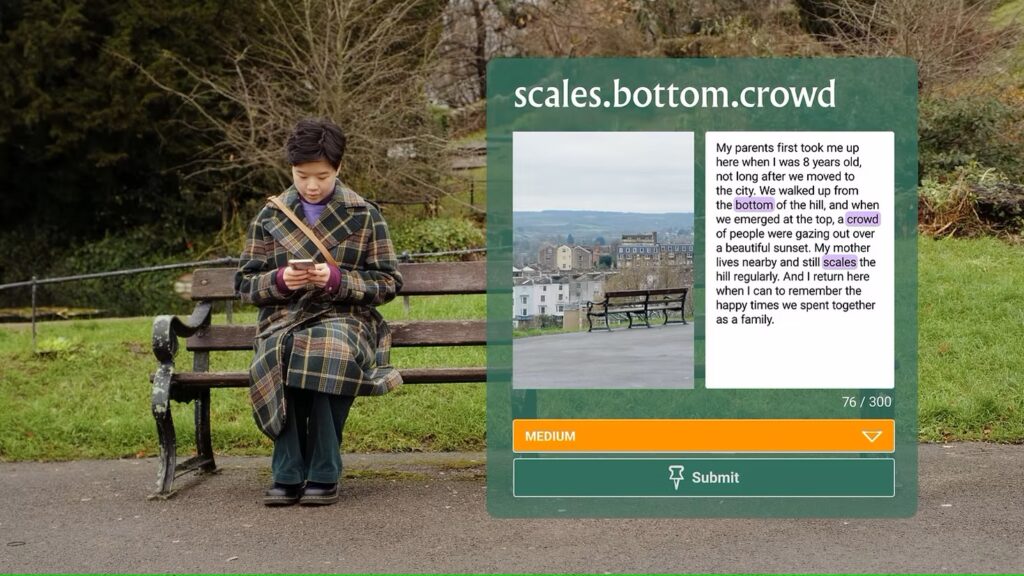
Jack has developed Pin the Tale, a digital game that strengthens community ties to place using the what3words app. In the game, players use what3words addresses to write stories about specific locations, creating connections between narrative and place. This innovative approach encourages players to explore and share their experiences of different locations through storytelling.
For Jack, the ARC programme offered a transformative perspective on research commercialisation. He reflects:
“Commercialisation doesn’t have to mean profiteering. Instead, it is most useful as a lens for thinking about how to sustain the impact of your work, whatever form that might take.”
The programme’s structured support and resources proved invaluable:
“Having a dedicated period of paid time focused solely on my venture, and being able to fully pay my collaborators for their work, resulted in an outcome that simply would not have been possible otherwise.”
Through engaging with multiple stakeholders during the programme, Jack gained crucial insights into how his platform could meet real-world needs. Each public workshop has provided new learning opportunities about the challenges and possibilities his game presents.
Project Progress and Future Plans
Since completing the ARC Accelerate programme, Jack has successfully launched Pin the Tale in early-access to the public. The game is now freely available online, inviting users to discover and create stories connected to specific locations across the UK.
“At its heart, Pin the Tale is about re-connecting individuals and communities to the places they live in, visit or care about. It’s about going beyond the ‘official’ stories of places; the ones we might be familiar with from history lessons or books. Pin the Tale aims to be much more intimate, inspiring and creative, where ‘culture’ and ‘heritage’ is something to be uncovered in people’s own stories and the stories of others in their communities.”
The game offers two key experiences:
Discovering stories about places you’re interested in: Navigate on the map to an area of the UK that you’re interested in. Click the Find Stories button to read stories other people have written about places in that area.
Share your own stories: Zoom into a UK location on the map that you want to write a story about. Click the square closest to the spot your story is about, then click ‘Write a story about this location’. Stories on Pin the Tale can take any creative form: fictional, poetic, historical, personal, informative, imaginative.
Jack emphasises the experiential nature of the game:
“When learning about the world around you feels like a process of discovery – when it engages your imagination – that’s when it becomes exciting. We want to evoke that feeling in our players.”
The project continues to gain recognition within the academic community, with Pin the Tale being selected as a featured project at this year’s Royal Geographical Society Annual International Conference, where it aligns perfectly with the conference theme of ‘Geography and Creativity.’
Support for UWE Researchers
UWE is committed to supporting our researchers in transforming their innovative ideas into real-world impact. Jack’s success in the ARC Accelerate programme demonstrates the potential of our research community to drive positive change through commercialisation.
The Knowledge Transfer Partnership (KTP) between University of the West of England (UWE), Obafemi Awolowo University (OAU), the Taro Agric Farm (TAF) was established to harness data-enabled innovations (DEI) for the commercial poultry industry in Nigeria. The project aimed to enhance chicken production efficiency and optimise overall business operations through the strategic application of data-driven technologies and academic expertise. Kamran Munir (Professor of Data Science) led the collaborative relationship with the Nigerian partners and the project from UWE. Saidu Oseni (Professor of Animal Sciences) led the project from OAU.
The Company
Taro Agric Farm (TAF), is a broiler chicken production company based in Southwest Nigeria. With over a decade of experience, TAF specialises in commercial broiler farming, operating concurrent batches of 2,000 birds per cycle. The company has multiple production centres, including its main base in Ile-Ife, Osun State, and outgrower units in Ilesa (Osun State) and Ibadan (Oyo State). Beyond production, TAF is actively engaged in consulting services, capacity building, and training for poultry farmers, offering expertise across the entire broiler chicken value chain—including input supply, production, processing, distribution, and marketing. A defining characteristic of TAF is its forward-thinking approach to poultry farming. Through the African Agriculture Knowledge Transfer Partnership (AAKTP), TAF successfully integrated smart technologies such as IoT-enabled sensors, a data storage for real-time data management, and predictive analytics to enhance decision-making in poultry production. This has positioned TAF as one of the leaders in leveraging data-driven solutions for sustainable poultry farming in Nigeria.
The Challenge
The Knowledge Transfer Partnership (KTP) between Taro Agric Farm (TAF), Obafemi Awolowo University (OAU), and the University of the West of England (UWE) was initiated to apply data-enabled innovations (DEI) to commercial chicken production in Nigeria and to improve and optimise business operations. A key focus was developing a strategy for embedding DEI to create sustainable broiler chicken operations over the long term. The poultry industry in Nigeria faces multiple constraints, including high mortality rates, inefficient farm management practices, limited use of data in decision-making, and poor environmental conditions affecting broiler chicken welfare and productivity. In the past, TAF like many others in the industry, relied on conventional methods of managing poultry production, which lacked the real-time monitoring and predictive capabilities needed to optimise productivity and farm environment. Farmers and farm managers had to rely on manual data collection and experience-based intuition, making it difficult to identify early warning signs of health risks or performance inefficiencies. Without data-driven insights, farm operations were reactive rather than proactive, often leading to delayed interventions and losses. In addition, one of the biggest challenges TAF faced in the past was high mortality and morbidity rates in broiler production. Various environmental factors, such as poor ventilation, excessive heat, high humidity, and exposure to noxious gases, particularly ammonia, significantly affected bird health. Without a robust system to monitor and control these environmental conditions, broiler chickens were at risk of disease outbreaks, respiratory problems, and stress, which ultimately led to economic losses.
Tackling these constraints required innovation in both poultry management and business practices to enhance the viability and profitability of operations. The KTP project activities included setting up an IoT platform, configuring sensor nodes, and establishing a database to record and store data on various parameters such as chicken welfare, input supplies, production, processing, distribution, and marketing. The project also involved the development of dashboards for monitoring key performance indicators (KPIs), the use of predictive analytics, and conducting performance comparisons across production batches. Additional activities included stakeholder engagement through workshops to build and embed capacity. The key accomplishments of KTP project include the successful setup, testing, and deployment of a IoT platform in a broiler chicken unit in southwest Nigeria, where key variables related to chicken welfare and performance were captured and monitored. Company data was archived in a database, and a dashboard was developed to track temperature, relative humidity, air quality and noxious gas parameters. An end of project Stakeholders’ Engagement Workshop aiming towards widening participation and sustainability with approximately ~100 participants, including poultry farmers and industry professionals, was also successfully conducted.
“This project equipped TAF staff with advanced digital farming skills, enhanced OAU’s research capacity and curriculum, and strengthened international collaboration—demonstrating how innovation and partnership can drive sustainable agricultural development.”
Prof. Kamran Munir (Professor of Data Science, University of the West of England, UWE Bristol)
Benefits and Changes
The Knowledge Transfer Partnership (KTP) between Taro Agric Farm (TAF), Obafemi Awolowo University (OAU), and the University of the West of England (UWE) has led to significant improvements in broiler chicken production, farm efficiency, and data-driven decision-making at TAF. As a result of the KTP, Taro Agric Farm and its staff have acquired several new knowledge areas and capabilities. These include (but not limited to):
The staff gained expertise in deploying sensor nodes to monitor key health and welfare indicators of broiler chickens. This application of digital technology is directly contributing to improved productivity and profit margins by enabling real-time data collection and analysis of poultry welfare to guide operations at the unit.
TAF implemented a smart farm infrastructure, incorporating WiFi, inverters, and clusters of sensor nodes, along with smart cameras to monitor the comfort, welfare, and performance of chickens. This integration allows for continuous, remote monitoring, improving operational control and decision-making.
The business acquired the capability to track, manage, and analyse its data assets—spanning performance, ambient conditions, costs, and returns—via a MySQL database. This centralised data storage allows for enhanced data organisation, retrieval, and long-term analysis.
A key capability gained was the deployment of a real-time dashboard that tracks health and welfare indicators of broiler chickens. This dashboard offers a user-friendly interface for staff to monitor key variables and make informed decisions regarding poultry welfare and management.
The staff were trained to track and monitor key performance indicators (KPIs) across production batches and historical data. This has allowed TAF to benchmark performance, identify trends, and adjust improve the consistency and quality of production, while also enabling more accurate forecasting and strategic planning
TAF’s adoption of data-enabled innovations (DEI) and IoT technologies positioned it as a leader in digital poultry farming in Nigeria. Sales turnover is expected to increase by 30%-40% within three years, due to improved efficiency and scalability. Profit before tax is projected to grow by 20%, within the next three years. Increased demand for TAF’s consulting services, as other poultry farms seek to implement similar digital solutions.
Obafemi Awolowo University (OAU) updated its Animal Sciences curriculum to incorporate digital technologies. The project also strengthened ties between OAU and UWE, fostering international collaboration in poultry technology research. The project research outcomes are being published as open access where possible which cover the use of digital technologies and data-enabled innovations for the enhancement of the welfare and performance of broiler chickens – as a case study in Nigeria.
“The KTP was an excellent opportunity to blend academic research with industry application. At OAU, we have always been committed to advancing precision livestock farming, and this project allowed us to practically demonstrate the power of digital transformation in poultry production.”
Prof. Saidu Oseni (Professor of Animal Sciences, Obafemi Awolowo University, OAU, Nigeria)
Key Facts
To best of our knowledge, TAF is the first poultry farm in Nigeria to integrate IoT and digital technologies into broiler production to this scale.
IoT-enabled sensors deployed to monitor temperature, humidity, air quality, and toxic gases in real-time.
A database established for real-time data collection and performance tracking
Decision Support Dashboard developed, allowing farmers to make data-driven decisions
Sales turnover expected to grow by 30 – 40%within three years
Profit before tax projected to increase by 20%
100+ poultry farmers and industry professionals trained on smart poultry farming
19 undergraduate & 2 MSc projects initiated on digital poultry farming at OAU
Presented findings at the Nigerian Poultry Show (NPS) 2024, reinforcing industry leadership
OAU integrated digital technologies into its Animal Sciences curriculum, influencing future research.
Find out more about the Knowledge Transfer Partnership in the Case Study below.
This partnership received financial support from the Knowledge Transfer Partnerships programme (KTP). KTP aims to help businesses to improve their competitiveness and productivity through the better use of knowledge, technology and skills that reside within the UK knowledge base. This successful Knowledge Transfer Partnership project, funded by UK Research and Innovation through Innovate UK, is part of the government’s Industrial Strategy.