


20 June 2024 is Clean Air Day. To celebrate we are sharing this blog post from MSc Environmental Management student Kirsten Commesso:
Air pollution stands as one of the most significant challenges of our time. Implications include impacts on the environment and human health. Particulate Matter (PM), for example, poses serious risk to human health as they infiltrate the respiratory system and can cause respiratory and cardiovascular diseases and increased risk of cancer. Many pollutants can be monitored, and current and future projections can be modeled to see if mitigation measures are working to limit exposure to these harmful particles. While monitoring systems and models offer an excellent insight into the air quality of an area, some systems work best in specific sampling locations over others (Manisalidis et al., 2020). Initial screening is completed to see which pollutants need to be monitored and which methods are best suited.

Passive Sampling
Passive sampling refers to a method of collecting air samples without the need for active pumps or power sources. Rather, passive samplers rely on the natural diffusion of gases and particles from the surrounding air into a sampling device. An example of passive sampling are diffusion tubes (Figure 1). Additional advantages include low costs, small/light weight, and easy to implement in numerous sampling sites. Moreover, they can easily be implemented by non-specialists which allows the data to be spatial and long-term (Pienaar et al., 2015). Passive sampling does have limitations which include the accuracy and limited ability to look at data for a specific day or week. In the end, the tubes are collected from the sites every month and data is processed in a laboratory (Cheshire East Council, 2021).
Low-Cost Sensor Systems
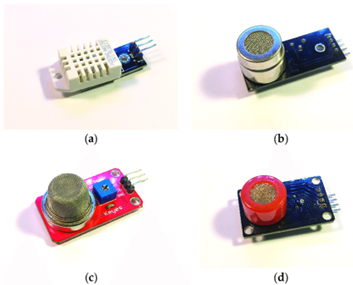
Low-cost sensor systems (Figure 2) are low power devices that can range from a few hundred pounds for devices that measure a single pollutant to multi-pollutant systems that can cost several thousand pounds. Compared to passive sampling, low-cost sensor systems can provide highly time resolved data (Welsh Government, 2024). This allows for authorities to identify sources of pollution and provide a more accurate assessment of exposure. One of the downsides of low-cost sensor systems is that they will require re-calibration for the long-term operation of these devices. But, overall, they are an effective option for indicative measurements (Penza et al., 2017).
Active (Semi-Automatic) Sampling
In this type of method, pollutant samples are collected by physical or chemical means and then sent to the laboratory for analysis. The sampling device (Figure 3) draws air through a filter or other collection medium and captures the particles suspended in the air (Welsh Government, 2024). Semi-automatic suggests that some aspects of the process are automated, but there are still steps that require manual intervention, for example setting up the equipment and handling collected samples. The positives with this sampling method include easy operation and that there are historical datasets available on U.K. government networks (Welsh Government, 2024). A drawback to this method is that it can be a more laborious process which includes special handling of the sample while in transit from the site to the laboratory and then an analysis is performed (National Research Council (US), 1981).

Automatic Point Monitoring
These air quality monitoring systems are usually the most advanced and costly of the methods. They use automatic analyzers to draw in ambient air and then measure the concentration of the pollutant in the sampled air at specific locations (Welsh Government, 2024). These measurements are often transmitted in real-time to a central database and provide measurements with very fine accuracy and fast data collection. In order to ensure that the data produced is reliable, a high quality of operation is required. This includes operator training, regular maintenance and calibration, and detailed QA/QC procedures per the set standards. Due to all these factors, the operation of automatic point monitoring is particularly expensive and the system itself can be quite large (Northern Ireland Air, 2024).
Remote Optical/Long-Path Monitoring
This method of air quality sampling uses a method called long-path spectroscopic technique in order to make real time measurements of the concentration of numerous pollutants seen between the light source and the detector (Welsh Government, 2024). These types of instruments use Differential Optical Absorption Spectroscopy (DOAS) (Figure 4). A light source is a crucial component of an DOAS instrument because it determines the instrument’s range and it has a significant impact on the instrument’s performance (Duan et al., 2022). This type of technology is especially useful because it can be used near sources and can measure multiple pollutants at a time. The issues that come with this type of technology include the high cost of the devices and that a trained operator is required for operation.

Overview of Dispersion Modeling
Dispersion modeling utilizes mathematical formulas to characterize the atmospheric processes that disperse emissions of pollutants. This type of modelling can be used to predict concentrations at selected locations. Models are completed within national standards (US EPA, 2023). Dispersion models can take on many forms including simple graphs and tables, but can also be more complex with many inputs, as seen in computer software. Some examples of these are ADMS, SCREEN and AERMOD. A program used to assess road traffic is ADMS-Roads. This model can be used to investigate air pollution problems due to networks of roads but may also be in combination with industrial sites (CERC, 2024). Models cover many types of sources including point sources, line sources, road traffic sources (Figure 5), airport sources (ADMS-Airport), liquid spills (LSMS) and long-range transport (US EPA CALPUFF). In each program, pollutant concentrations are measured using contaminant emission rates, characteristics of the emission source, topography, meteorology of the area and background concentrations (US EPA, 2023).

References
Cambridge Environmental Research Consultants (CERC). (2024). ADMS-Roads. [online]. Available on: CERC > Environmental software > ADMS-Roads model. [Accessed on 9 May 2024].
Cheshire East Council (2021). Passive Diffusion Tubes. [online]. Available on: Diffusion Tube Monitoring (cheshireeast.gov.uk). [Accessed 9 May 2024].
City of London (2023). Air Quality Monitoring. [online]. Available on: Air Quality Monitoring – City of London. [Accessed 10 May 2024].
Duan, J., Qin, M., Fang, W., Liao, Z., Gui, H., Shi, Z., Yang, H., Meng, F., Shao, D., Hu, J., Han, B., Xie, P. and Liu, W. (2022) Detection of Aircraft Emissions Using Long-path Differential Optical Absorption Spectroscopy at Hefei Xinqiao International Airport. Remote Sensing [online]. 14 (16), p. 3927. [Accessed 11 May 2024].
Hernandez De La Iglesia, D., De Paz, J.F., Villarrubia, G., Barriuso, A.L. and Bajo, J. (2018) A Context-aware Indoor Air Quality System For Sudden Infant Death Syndrome Prevention. Sensors [online]. 18 (3), p. 757. [Accessed 11 May 2024].
Manisalidis, I., Stavropoulou, E., Stavropoulos, A. and Bezirtzoglou, E. (2020) Environmental and Health Impacts of Air Pollution: A Review. Public Health [online]. 8 [Accessed 11 May 2024]
National Research Council (Us) Committee on Indoor Pollutants, (1981) Monitoring and Modeling of Indoor Air Pollution. National Library For Medicine [online]. [Accessed 10 May 2024].
Northern Ireland Air. (2024). Monitoring Air Pollition [online]. Available on: Monitoring air pollution – Northern Ireland Air (airqualityni.co.uk). [Accessed 10 May 2024].
Penza, M., Suriano, D., Pfister, V., Prato, M. and Cassano, G. (2017) Urban Air Quality Monitoring with Networked Low-cost Sensor-systems. Proceedings of Eurosensors [online]. 1 (4) [Accessed 11 May 2024].
Pienaar, J.J., Beukes, J.P., Van Zyl, P.G., Lehmann, C.M.B. and Aherne, J. (2015) Chapter 2 – Passive Diffusion Sampling Devices For Monitoring Ambient Air Concentrations. Comprehensive Analytical Chemistry [online]. 70, pp. 13-52. [Accessed 10 May 2024].
US EPA. (2023). Air Quality Dispersion Modelling. [online]. Available on: Air Quality Dispersion Modeling | US EPA. [Accessed on 10 May 2024].
Welsh Government. (2024). Air Quality in Wales – Monitoring Methodologies. [online]. Available on: Monitoring Methodologies | Air Quality In Wales (gov.wales). [Accessed 10 May 2024].