
Research Centre Spotlight: Centre for Sustainable Planning and Environments

Posted on

The Centre for Sustainable Planning and Environments (SPE) aims to develop understanding of how to achieve sustainable, healthy places that are resilient and responsive to future challenges. We are a multidisciplinary centre of academics researching different aspects of planning theory and practice, urban governance, green infrastructure, urban design and climate change adaptation. This blog gives a flavour of some of the ways we are doing this.

The world has changed since the emergence of COVID-19. The pandemic has given many of us the opportunity to think about what we want from our neighbourhoods, be it access to local amenities, or reducing our reliance on cars and inequalities. Planning for this deeply uncertain future recognises that the pandemic has propelled cities through a decade of digital transition overnight, promoting new ways of living and working more locally, with potential for major environmental benefits, reduced greenhouse gas emissions and improved air quality. SPE’s CURE and SUNEX projects, led by David Ludlow, are providing targeted policy solutions that recognise the opportunities to rethink urban connectivity and re-energise the economy, whilst delivering carbon neutral cities.

Moving towards sustainable urban futures also requires a consideration of our national infrastructure. Infrastructure for transport, energy, resource extraction, and water and waste management is critical to our wellbeing, but much of our current infrastructure is old and unsustainable. For example, one proposal to address our resource insecurity is to extract the metals needed for smart technology from old metal mines. Our research, led by Danni Sinnett, found that many of these mines are protected for their heritage, geological and biodiversity value, but that those living in former mining communities may be open to remining the wastes if this was combined with sensitive restoration and improvements in water quality. New research is exploring the stakeholder response to new sustainable waste management facilities which will allow resources to be recovered in the future.

Our new colleague, Rebecca Windemer, brings her expertise on the planning of energy infrastructure. Her research has examined the future of our oldest wind and solar farms as they reach the end of their 25-year planning consents. This includes how decisions are made regarding repowering, life-extension and decommissioning and how communities have experienced living with the infrastructure. This is important as if sites are not repowered then overall renewable energy generation could decrease, but decision-making is not simple, particularly where communities were promised removal after 25 years. The findings revealed the range of opportunities and challenges facing our oldest sites and have provided recommendations for policymakers, developers, and communities. This research won the EnergySHIFTS ECR award for innovative research findings and has been shortlisted Economic and Social Research Council’s Celebrating Impact Prize 2021.

Effective planning is absolutely crucial to the delivery of infrastructure and our research, led by Hannah Hickman, for the Royal Town Planning Institute (RTPI) identified five principles of good infrastructure planning: A shared vision of place, with clear objectives; Specific infrastructure priorities identified to achieve that vision, aligned to funding sources; Effective and early engagement to align planning and delivery; Capacity, knowledge and resources and Continuous learning and dissemination. Despite finding pockets of innovation where these principles were being applied, the team found that often this was not common practice, leading the RTPI to warn “that a failure to adopt a more joined-up approach to planning the UK’s towns and cities will make it impossible to meet the challenges of climate change, population growth and environmental risks over the coming decades”.

Green infrastructure, which includes parks and other greenspaces, street trees, river corridors and green roofs, is essential for sustainable, healthy cities. For example, research supported by the West of England Combined Authority and led by Danni Sinnett, on greenspace use under lockdown highlighted the importance of providing green spaces within walking distances of people’s homes. There is increased focus on the role of street trees in improving the quality of the public realm, reducing urban temperatures and pollution, and providing habitats for wildlife. As a result, new planning guidance prioritises the creation of tree-lined streets in new development and many places around the world have set targets for tree planting. We recently worked with one of our MSc students, Max Walters, to publish the findings from his dissertation examining the feasibility of Bristol’s target to double tree canopy cover by 2045. This found that the current planting of 10,000 trees per year would need to be increased to at least 18,000 ‘heavy standard’ trees every year. However, using mortality rates more typical of urban areas increased this to 44,000 trees per year. This highlights the importance of good tree establishment and stewardship practices. However, it is often challenging to establish trees in urban environments, and traditional planting techniques are often unsuitable in adverse growing conditions, resulting in high mortality rates among street tree populations. This reduces the benefits that trees provide and hampers achievement of these planting targets. To address this, Dean Bell is assessing alternative tree pit solutions for their impact on tree establishment, growth and survival in hard landscapes in partnership with GreenBlue Urban and Forest Research.

As the climate changes, we need to balance the different priorities for the design of our green infrastructure. Focusing on the cultural acceptability of climate-adapted green infrastructure research by Helen Hoyle has demonstrated broad support for non-native, climate-adapted plantings, with appreciation of unusual aesthetics and an awareness of climate-adaptation, such as reduced need for labour-intensive watering. Recent research focusing on public perceptions, values and socio-cultural drivers in designed garden settings revealed that climate-adapted settings were viewed as more attractive, but traditional settings more restorative. The restorative benefits of green infrastructure for physical and mental health are well known. We have recently contributed to a review for the Wellcome Trust led by Issy Bray from the Centre for Public Health and Wellbeing which examined these benefits for young people with anxiety and depression. This found strong evidence that walking or being in a green space like a forest or park improves mood and reduces feelings of anxiety for young people aged 14 to 24 years, and that even short 15-minute walks in a green space are beneficial.

Our research emphasises the importance of providing high-quality, well-designed places for people to live. However, research funded by the West of England Combined Authority, revealed there can be a significant drop in the quality of new development between planning permission being granted and delivery on the ground. This drop can particularly affect the aspects of the developments relevant to climate change mitigation and adaptation, such as green infrastructure. This research won the 2021 RTPI Sir Peter Hall Award for Research Excellence, and provides recommendations to improve local authority practice including reducing the potential for a decline in quality in the post-consent process; resourcing planning authorities and empowering planning officers; and building trust between local planning authorities and developers. Our research has been influential in improving the quality of green infrastructure, through our collaborative with Gloucestershire Wildlife Trust in the development of Building with Nature. This benchmark focusing on providing green infrastructure that delivers climate-adapted, healthy places that are good for nature.

Finally, SPE is inspiring the next generation of planners through our planning and built environment programmes. This is informed by our research, supported by the RTPI, into the motivations and expectations of planning students. Now in its third year, the study has involved participation from over 20 planning schools across the UK and Ireland, and over 400 students. Particularly revealing has been the student’s overwhelming desire to affect positive environmental change in their future practice as planners, with ‘climate change and energy’ rated as the subject students are most interested in learning about. These findings are a significant contribution to furthering our understanding of young planners and are of relevance not just to educators (both in schools and universities) but to the RTPI, employers and politicians alike. SPE’s research is contributing to our understanding of how we can plan and deliver sustainable places and achieve our ambitious targets for climate change and sustainable development.

Knowledge Transfer Partnership Case Study: Craven Dunnill Jackfield

Posted on

The Knowledge Transfer Partnerships (KTP) scheme is a UK-wide programme helping businesses to improve competitiveness and productivity. A recent graduate is placed within an organisation to help solve a business problem, with access to our academic expertise.

The below case study is from our KTP with Craven Dunnill Jackfield:

About Craven Dunnill Jackfield

Craven Dunnill & Co Ltd is a historic business, founded in 1872. It has been producing ceramic wall and floor tiles for 150 years and is the oldest surviving purpose-built tile factory in the world. It is part of the Ironbridge Gorge World Heritage site at the heart of Britain’s Industrial Revolution

The challenge the KTP was set up to address

Each individual project requires the application of ceramic modelling skills to create new working models and moulds for the restoration of architectural features and to interpret the complex three-dimensional shape of the item beneath the glaze layers of an original sample.

This is a highly skilled art, and ceramic modellers with this ability are few in number and expensive to employ. Across the industry modellers with the necessary hand skills are reaching retirement age and are difficult to replace which will significantly impact the future sustainability of the sector. The situation is a major bottleneck in the production process and limits the ability of the company to expand this part of the business.

The application of 3D technologies, specifically 3D scanning to derive the surface shape of the original ceramic pieces and 3D CAD to recreate the aesthetic of the original work, combined the CNC milling can be used to produce master models and moulds for the reproductions.

Why was a KTP the right mechanism to achieve this?

The KTP allowed us to test machinery and processes at the University in a way that would have been time consuming and expensive to achieve without the partnership. The CFPR’s knowledge of both ceramics and digital manufacturing technology were a perfect fit for Craven Dunnill’s needs. There are limited organisations with the knowledge of both subjects. Years of research from university staff fed into the project and allowed us to address the problems which arose when combining the traditional hand craft process with digital technology.

How did the KTP meet the need (the activities / solution)?

By utilising the expertise offered from the University, new technology was brought in to improve lead times and open new areas of business, specifically in 3D scanning. The development budget provided opportunities for learning new skills which were applied to the project.

Outcome – Impacts & Benefits

What changed as a result of the KTP?

Craven Dunnill invested in a CNC milling machine and a 3D scanner, both of which were required to embed digital design into their traditional mould making process. Moulds, tiles and artworks can be 3D scanned and manipu- lated to produce new block moulds, the block can be directly plaster cast from, saving time and cost.

As well as being utilised for mould making, CAD now plays a role in the initial contact with customers. Vector drawings and 3D models are used to visualise end products, before we commit to producing physical models.

Layouts for wall and floor tile are designed within Rhinoceros3D. This allows for tiles to be automatically counted and layout issues to be resolved before committing resources to a project.

Broad benefits and impacts for all partners, (including economic, environ- mental and/or social perspective)

For CDJ:

Having the 3D capabilities in house has opened up the possibilities of additional revenue streams. Many projects can now be completed in house.

For UWE Bristol:

The Centre for Fine Print Research has a strategic objective and a long history of collab- orating with industry that constitutes around a third of its research.

The success of the KTP with Craven Dunnill Jackfield will add to the Centre’s reputation for combining traditional methods with modern digital technologies both in academia and commercially.

The project validates this research and highlights the value of this method.

The initial concept used was based on an Arts and Humanities Research Board (AHRB) project conducted in the early 2000’s and the development of these ideas into a successful industrial outcome is likely to generate further research questions for investigation.

It demonstrates how embedding digital technologies into traditional processes can generate benefits for both of the partners.

For the KTP associate

As the KTP associate, I am very pleased with how the project concluded. KTP has opened doors for me and given me the opportunity to develop as a project manager. I have attended multiple courses and conferences over the project, developing both my key skillset (CAD/3D Design) and other elements which will improve my efficiency at work such as Finance/ management/business.

Quantifiable benefits (the numbers bit!)

  • Improved product development time by 72% (From 2 weeks of model making, down to 4 days)
  • Reduced development costs on specific projects by up to 79% (Based on price of model board compared to traditional block and casing)

What the partners are saying?

“Through a challenging time for businesses, the KTP programme has been a true shining light, surpassing our expectations as a Company. It is critical for a 150yr old Company like ours to stay dynamic and explore ways in which new technologies can support and compliment traditional craftmanship. The KTP has brilliantly highlighted the way in which business and academia can come together to develop new capabilities and embed them into our operations. ”

Simon Howells, Managing Director, Craven Dunnill Group

“The Craven Dunnill Jackfield, CFPR/UWE KTP project shows that a committed Company and Academic team combined with an excellent, dedicated Associate can overcome the difficulties and adversities of operating during a pandemic to drive through to success. The project has been very successful and has exceeded the expectations of both partners.“

David Huson Senior Research Fellow, UWE Bristol

“The KTP program has been the most exciting part of my working life to date. It has given me the opportunity to develop my skills and interests within 3D design and technology, whilst allowing me the opportunity to put into practice the knowledge developed during my degree. “

Jed Leonard-Hammerman, 3D Technologies Specialist Craven Dunnill Jackfield

“This project could not have been done without the unusually wide skill set of the Associate who was equally at home in the application of complex digital technology and the practical traditional skills required to manufacture three dimensional tiles together with the support of his academic and company supervisors”

Russ Bromley Knowledge Transfer Adviser

Social Sciences – The lynchpin for conducting real-world research?

Posted on

Guest blog post by Professor Kieran McCartan, Professor of Criminology, UWE Bristol

All research, even theoretical research, has a real-world basis. Research helps us understand the world and our role in it better. Therefore, at the core of all research conducted at UWE Bristol should be people and social life. The social sciences, therefore, are central in developing and adapting a range of different research ideas, methodologies, and products so that they have real world validity and can be used more effectively in practice. The social sciences are the study of social beings, social lives, and social interaction; they are the disciplines that connect our psychological, social, and cultural worlds. The social sciences provide context, and understanding, to our behaviours and actions. This means that all research has a social component to it – whether it be Engineering or Art, Food Technology or Fine Print, AI or Architecture – because humans, and the human experience, are at the heart of all these.

This increased recognition of the importance of the social science perspective is reflected in the external funding landscape. More and more funding calls with ‘hard science’ remits require that academic teams include those from the humanities and social sciences to bring this much-needed perspective to addressing the challenge at hand.

At UWE Bristol, we research a range of social sciences and in doing so add nuance to policy and practice, which means that we can add to ongoing and novel research across a number of disciplines. Our research strengthens external research bids, adds new dimensions to research and publications, and expands the parameters of UWE Bristol’s role as a civic, community based, practice-based university. Social scientists are spread and integrated throughout the UWE Bristol academic diaspora – you find them in every faculty and department.

However, the largest congregation is gathered in the Department of Social Sciences, in the Faculty of Health and Applied Sciences, where the Social Science Research Group (SSRG) is based. The SSRG has over 91 members drawn from disciplines as wide as Philosophy, Sociology, Criminology, Social Psychology, Counselling Psychology, Psycho-social studies, Politics, International Relations, Policing, and Social Work. The SSRG is split into five themes with cross cutting, qualitative research methods expertise:

  • The World, Meaning and Human Action research theme investigates and employs the interaction between philosophical thought and cultural, political and critical practices, with a particular emphasis on the collective project of human flourishing.
  • The Global Security and Human Rights research theme draws on work on global security, human security, human development and human rights. Key cross-cutting dimensions are around gender, health, governance, security, human rights, exclusion, vulnerability and resilience, and migration.
  • The Crime Risk and Society research theme gives voice to the experiences of victims, offenders and professionals within the Criminal Justice System (CJS) and critically engage, challenge and inform criminal justice policy and practice.
  • The Psycho-social Studies and Therapeutic Practices research theme studies the way in which psychic experiences and social life are fundamentally entangled with each other.
  • The Identities, Subjectivities, and Inequalities research theme is a collective of researchers who focus on exploring the ways in which identities, subjectivities, and inequalities are produced by exploring how individuals make sense of their selves and the worlds they inhabit as well as on wider social practices and discourses.

How can the SSRG, and social sciences more broadly, add to your research moving forward?

  • Maybe you need to conduct social research (qualitative, quantitative or mixed methods) to preface, support or evaluate the impact of your research or product?
  • Maybe you need access to and representation from diverse populations to test your product or innovation?
  • Maybe you need advice about how to approach and work with frontline professions so that your research can be implemented in the community?
  • Maybe you need support in working with policy makers so that your research and innovations get used in practice?
  • Maybe you need a social, cultural, or psychological lens to add nuance to a new or ongoing project?
  • Maybe you need to understand why different communities, cultures, or populations react differently to the product or innovation that you are developing?

We live in a social world where people are the core users of much of the research and innovation developed at UWE Bristol, therefore the social sciences provide a lynch pin for bringing in expertise to make sure that all the research done at UWE is applied and fit for purpose.

If you are a social scientist interested in joining the SSRG or a colleague at UWE Bristol interested in collaborating with SSRG members please reach out.

Prof Kieran McCartan, UWE Bristol

UWE researchers use socially intelligent robot in a school to support autistic young people

Posted on

Original story appeared on UWE Bristol website.

UWE Bristol researchers have placed a socially intelligent robot at a special needs school in Somerset to support autistic pupils aged 12 to 19 with their wellbeing and emotions over a three-week period.

The robot, known as Pepper, is can take part in a range of social and physical activities with children, such as story-telling, dancing, and relaxation techniques which are designed to help autistic pupils manage their emotions and wellbeing. Many autistic children can have difficulty regulating their emotions and require calming and stimulation to help them engage with school-based activities.

UWE researchers Dr Louis Rice, Associate Professor in  Architecture and the Built Environment; Dr Nigel Newbutt, Senior Lecturer in Digital Education; and Dr Séverin Lemaignan, Associate Professor in Social Robotics and AI, were funded in part by the universities Vice-Chancellor’s Challenge Fund.

UWE Bristol’s Vice-Chancellor’s Challenge Fund enables researchers to reach beyond their research centres, departments and faculties; look outside of their disciplines; and develop exciting new research with colleagues working in different fields. The University’s aim is to support collaborations that are ready to respond to external funding calls which require innovative interdisciplinary responses to meet future opportunities.

Dr Severin Lemaignan, said: “The use of robots to support autistic children is not entirely new. However, while previous research has focused on teaching skills to children, our autistic participants told us this is not what they actually need. Our approach focuses instead on wellbeing and child-led interactions. Our robot lives in the school’s corridors; Pepper engages with the children on their terms.’’

Find out more about the trial in the full story here.

Centre for Fine Print Research project selected as Best Practice at EU Industry Days 21, a flagship event of the EU Commission

Posted on

A Centre for Fine Print Research project, led by Associate Professor Fabio D’Agnano, has been selected as Best Practice at EU Industry Days 21, a flagship event of the EU Commission. The project featured in the main exhibition of the fourth edition of the European Industry Days 2021 which took place virtually 23-26 February 2021.

The UNESCO4ALL TOUR project was undertaken with the aim of producing replicas to be displayed at four UNESCO World Heritage sites (Basicica Aquileia, Alhambra Palace, Sibenik Cathedral, Rila Monastery) to aid visually impaired audiences.

The scope of the research was to develop accessible, innovative, transnational cultural tourism artefacts and experiences by integrating tactile exploration with audio data.

Researchers tested a high-tech “ring” detection of Near Field Connectivity (NFC) tags integrated into 3D printed artefact replicas. NFC sensors located on tactile surfaces are triggered to communicate wirelessly with a smart device (through an app for tablets or mobile phones).

The team found innovative solutions for the production of three-dimensional models for tactile exploration. This required translating real objects into digital models through photogrammetry, digital 3D modelling and digital sculpting.  Digital models were then built using a variety of materials and techniques including Computer Numerically Controlled (CNC) routing, laser cutting and engraving, and resin 3D printing. One of the main challenges was to create a precise replica of an artefact, of considerable size and at reasonable expense. In addition, the material used needed to be easy to maintain and pleasant to touch.

Watch the video below to learn more about the project:

Replicas will be sited at four UNESCO World Heritage sites and findings will be disseminated via conferences and public talks in 2021.

Find out more here.

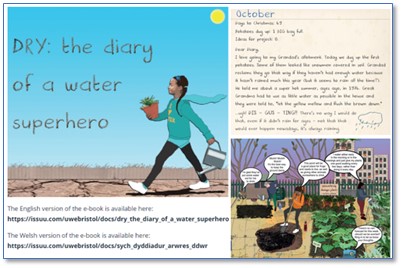
Award winning book created by UWE academics: DRY:The Story of a Water Superhero launches a children’s competition

Posted on

An exciting competition for school children has been launched by UWE Bristol academics in collaboration with Waterwise. Based on the award winning book DRY: The Story of a Water Superhero, the competition provides an ideal opportunity to engage young people to think about water use and enable positive behaviour change.

Having won the Geography Association’s Silver Award, the book written as a young girl’s diary, has been published by the Drought Risk & You (DRY) Project (UWE Bristol), which is funded by the Natural Environment Research Council (NERC). The story runs over the course of a year and tells how an ordinary schoolgirl in the UK transforms into a water superhero when a dry summer and winter with little rainfall lead to drought. Seeing life through ‘water goggles’, the girl shares her new-found love of water with her school and community, as the drought progresses.

The story and accompanying teacher notes were created by Professor Lindsey McEwen, who heads the DRY project and is Professor of Environmental Management and Director of the Centre for Water, Communities and Resilience at the UWE Bristol, Dr Verity Jones, Senior Lecturer in Education at UWE; Sarah Whitehouse, Senior Lecturer in Education & Humanities at UWE and Dr Sara Williams, an environmental psychologist and researcher. The illustrations by artist Luci Gorell Barnes play a key role in projecting the relevance of the story and the science behind it.

The curriculum-led competition is a creative challenge for children to read and enjoy the engaging STEM book and use their imagination to illustrate what their community would look like if we all used water more wisely. It also offers an ideal opportunity to embed geography, science and PSHE into real-world learning, informed by evidence-based scientific research. Which can be carried out in lessons / activities or set as a homework assignment. It is also ideal for out-of-school activity groups.

The aim of the competition is to:

  • Raise awareness of the importance of treating water as a precious resource in the face of climate change, based on the research of the Drought Risk and You (DRY) Project
  • Teach the causes of and impacts of drought in the UK
  • Prompt changes in behaviour to use water more wisely – inspiring children to be agents of change, to protect our communities and our planet, carrying the message back to their homes and families
  • To give them the confidence and background knowledge to engage with some of the themes and messages of COP26, the world’s biggest climate change summit being hosted by the UK in Glasgow in November
  • Communicate the accessible science behind the DRY Project, part of the NERC-funded About Drought programme

The competition is open to 5-9 and 10-13 year olds entries must be submitted between May 1st-28th 2021

For more information about the competition see the website: www.waterwise.org.uk/drycompetition

You can access the online DRY: The Story of a Water Superhero book and teacher notes here

UWE Bristol Scientist publishes book exploring practical applications of graph theory

Posted on

UWE Bristol’s Dr Vadim Zverovich, Senior Lecturer in Operational Research, has recently had his new book published – Modern Applications of Graph Theory. The book discusses many cutting-edge applications of graph theory, such as traffic networks, navigable networks and optimal routing for emergency response, placement of electric vehicle charging stations, and graph-theoretic methods in molecular epidemiology. Due to the rapid growth of research in this field, the focus of the book is on the up-to-date development of these applications and the mathematical methods used to tackle them.

One of the topics discussed in the book is devoted to the well-known Braess’ paradox in traffic networks. Braess’ Paradox illustrates situations when the addition of another road link or route, with the intention of improving traffic flow, actually has the opposite effect of causing more congestion. This is because drivers generally choose their own driving routes when making their travel plans, without thinking about the traffic flow for all drivers, so that the road system as a whole does not operate optimally.

Deeper insight into this paradox from the viewpoint of the structure and characteristics of road networks may help transport planners to avoid the occurrence of Braess-like situations in real-life networks. If the analysis of all performance measures in a road network is done before the construction of a new road, then a huge amount of money and time can be saved. One relevant example is a demolition of a motorway section in Seoul in 2003, which improved travel time in the local network and resulted in a restoration of a river under the motorway (see Figure 2). The demolition and restoration costs were £201 million, not including very high construction expenses and upkeep of the river. Although it is generally believed that this is a real-life example of Braess’ paradox, it was not proved mathematically that the paradox actually occurred in this road network.

“The Cheonggyecheon river in Seoul: before (left picture) and after (right picture)

A generally accepted belief is that Braess’ paradox is wide spread. This was confirmed by some researchers who claimed that the likelihood of the paradox is 50%, or even higher under some assumptions. However, Dr Zverovich proved mathematically that typical probabilities for Braess’ paradox to occur in classical road network configurations do not exceed 10%.  In addition, the probability of Braess’ paradox to occur is 6% in the classical network configuration consisting of motorway sections and class A roads. Notice that for traffic networks consisting of motorway sections, class A roads or a mixture of both, statistical tests showed that the distribution of parameters of travel time functions follow the Erlang-k distribution for small values of k.


Examples of the Erlang-k distribution for the parameters of travel time functions of motorway sections and class A roads.

Congratulations to Dr Vadim Zverovich on his recent book success.

Book Launch: Roads, Runways and Resistance – from the Newbury Bypass to Extinction Rebellion

Posted on

Senior Lecturer in Transport and Planning, Steve Melia, has written a new book called Roads, Runways and Resistance – from the Newbury Bypass to Extinction Rebellion. It spans a 30-year story of the most controversial issues in transport, and the protest movements they spawned.  His research included 50 interviews with government ministers, advisors and protestors – many of whom, including ‘Swampy’, were speaking for the first time about the events they describe. It is a story of transport ministers undermined by their own Prime Ministers, protestors attacked or quietly supported by the police, and smartly-dressed protestors who found a way onto the roof of the Houses of Parliament.

The research project which led to the book was partly funded by UWE, although most of the interviews and writing were done in Steve’s own time.  It also produced two academic journal articles, which inform the book’s conclusions in a ‘light touch’ way.

The book will be launched virtually in a webinar on the 26 January 2021. The webinar will be introduced and chaired by Prof. Graham Parkhurst.  Steve will tell the story of the main events described in the book, and also reflect on the tensions between academic research, direct action and writing for the general public, before opening for questions and discussion.

Register a place here. 

More about the book can be found here or watch this short video:

Steve Melia is a Senior Lecturer in Transport and Planning in the Centre for Transport and Society. His research interests focussed on behaviour change (particularly in the context of climate change), changing transport policy and the interaction between transport and spatial planning.  He invented the term ‘filtered permeability’ and the concept of the ‘paradox of intensification’.  His PhD concerned the potential for carfree development in the UK.  He has advised UK Government departments, local authorities, political parties and the UK Climate Assembly in 2020. 

Knowledge Transfer Partnership company Flexys signs multi-year deal with Bamboo

Posted on

One of our Knowledge Transfer Partnership (KTP) companies, Flexys signs multi-year deal with personal loans provider, Bamboo.

Flexys provides modular, highly scalable and extensible debt management, collection and recovery solutions for the digital age. Their cloud-native solutions maximise operational efficiency, reduce the cost to collect and ensure that they deliver the best possible customer service while protecting your business from reputational and regulatory risk.

Flexys Solutions is based at the Future Space Innovation Hub, part of our University Enterprise Zone and employs over 20 people, most of whom are working from home for the duration of the COVID-19 pandemic. Flexys has experienced a period of significant growth this year as lockdown fuels a surge in digital engagement and a move to cloud-native technology.

Bamboo are a direct lender who have built their business around helping people find an affordable loan that fits your credit situation.

Flexys CEO, Jon Hickman said “We are very proud to have secured this multi-year partnership with Bamboo. The economic consequences of the pandemic have put debt management in the spotlight and we have seen a surge in demand for our smart, cloud-native systems. Every new client helps us to expand our business and to promote Bristol as the ideal location for innovative technology businesses.”

Our KTP with Flexys aims to integrate Artificial Intelligence and Machine Learning technology within debt resolution software, to enable more effective management of debt resolution and improvement of customer relationships and retention.

A KTP scheme is a UK-wide programme helping businesses to improve competitiveness and productivity. With the help of graduate talent and access to UWE Bristol academic expertise, a KTP can help your business to transform and solve problems to achieve goals.

To find out more about KTPs please visit our website.

Navigating reduced hours careers: experiences of male and female executives and senior managers

Posted on

Navigating reduced hours careers: experiences of male and female executives and senior managers is a research project led by Professor Susan Durbin (UWE), with Professor Jennifer Tomlinson (Leeds University Business School) and Stella Warren (UWE) for the Human Resources, Work and Employment Research Group in the Faculty of Business and Law at UWE, Bristol.

The challenges of greater gender balance at senior management levels and on corporate boards are faced by businesses worldwide. Working hours are critical to career advancement and women rather than men tend to seek a reduction in hours at career defining life course stages. Despite previous research that shows women experience a lack of progression in their career when they reduce their working hours, until now there has been very little research focusing specifically on executive/senior management careers of women and men in relation to reduced hours working.

The most widely utilised form of flexible working in the UK is part-time, however this tends to be mostly in low paid, low skilled occupations and although part-time work has grown in professional occupations, this cannot be said for managerial roles where in fact less than 4% of jobs are on a part-time basis.

This has significant consequences for the utilization of women’s skills, pay and career opportunities across the life course.

As researchers who specialise in women’s careers and in tackling gender inequalities in the workplace and labour market, Sue Durbin and team believe that making reduced hours working available at senior levels would enable more women to step forward into senior roles. We also believe that this opportunity should be open to men. Women’s work, especially when performed on a reduced hours basis, is under-valued and not enough women are making it into senior roles. For most women, and some men, having the opportunity to work the hours that would enable them to have a work/family balance could be key to their future prospects and benefit the wider businesses in which they work.

The support of employers is key to making this happen. This research project enables us to get in touch with senior men and women working on reduced hours basis and to explore why and how they reduced hours and what that means for their senior careers.

The project began in November, 2019 and is funded by the British Academy/Leverhulme Trust. Recognising the rise in the use of flexible working arrangements at the organisational level, and a drive for more inclusive workplace cultures, what are the prospects for navigating executive and senior management careers while working reduced/part-time hours? When individuals at senior levels do work reduced hours, what are their experiences of work in terms of job quality and growth potential, and how do the experiences of reduced hours working compare and contrast between male and female executives and senior managers? Furthermore by focusing exclusively upon executives and senior managers, this research explores the experiences of organisational leaders who have reduced hours and the strategies they employ to manage a demanding position requiring leadership and visibility while working less than full time, and the extent to which they feel they can act as role models for others seeking to advance careers on a flexible basis. The project addresses this important research gap to better understand how male and female senior managers navigate flexible careers and how gendered assumptions might impact their careers.

We are working with seven external partners who have offered their support to the project. All have a keen interest and take active roles in the promotion of gender equality in organisations. They know the importance of gender diversity at all levels of organisations and the business benefits this can yield. Crucially, they are able to help us to access and interview the rare and hard to reach executives and senior managers who work on a reduced hours basis, in the UK.

  • Flexology – flexible working specialists in the recruitment of professional part-time and flexible working roles and the design and implementation of flexible working practices
  • Workwell – a HR and people change consultancy, providing support in the areas of HR/people support, flexible working, project management, strategy, stakeholder management and research
  • Teach First – a charity that was set up to address educational disadvantage in the UK and is currently extending the uptake of job share working at senior levels
  • Bristol Women in Business Charter Community Interest Company – supports the operation of a city-wide Charter recognising and supporting progress on gender equality in city businesses.
  • Timewise – an organisation that was founded to tackle the lack of quality part-time jobs and to encourage more organisations to open up to both men and women jobs on a flexible basis, at all levels of organisations
  • Fair Play South West – the women’s equality network for the South West of England, researching and consulting women on their aspirations and barriers to achieving them and campaigning for change
  • Moon Executive Search – undertakes executive recruitment for senior management and board level roles and other highly skilled candidates.

The project is being conducted through virtual interviews with male and female executives and senior managers working reduced hours in organisations across the UK private sector.  Interviews began just before ‘lockdown’ (March, 2020). Importantly, the interviews also explore the impact of the pandemic on interviewees’ careers, including working from home, their views on this new way of working and its potential future ‘normalisation’, organisation readiness for lockdown/working from home and the general impact of covid on the individual and their ability to work from home.

The project will culminate in an end of project event (September/October, 2021), involving all research participants and partner organisations, key business leaders, policy makers and groups set up to support gender balance in business. At this event, we will present the key research findings and discuss recommendations for best practice, alongside a panel of business experts and policy makers who are keen to promote the social and business benefits of reduced hours and wider policies on flexible working.

If you would like to know more about the project and/or would like to take part in an interview, please contact sue.durbin@uwe.ac.uk