UWE Bristol academic awarded a Parliamentary Academic Fellowship

Posted on

Professor Maisuria was shortlisted for two Parliamentary awards for his work as a Fellow preparing Parliament for the General Election.

In 2022, Alpesh Maisuria, UWE Bristol’s Professor of Education Policy, was awarded a Parliamentary Academic Fellowship (PAF) in the UK Parliament. The PAF is administered by Parliament’s Knowledge Exchange Unit with the objective of fostering closer relations between academic researchers and Parliament.

The PAF has enabled Professor Maisuria to work in the House of Commons Library as an education subject specialist. His work has entailed writing impartial policy briefings for politicians. These briefings are also publicly available and widely used by journalists. The experience is being used to develop a toolkit for academics to make their research more usable for those who write such briefings.

The House of Commons Library is more than a 200-year-old space filled with books, journals, artefacts, and subscriptions; it also offers a confidential enquiries service to all MPs, irrespective of Party, to source research and information about any parliamentary business they are engaged with. Enquiries commonly relate to a constituency matter, material for a speech, or preparation for a debate. Working on confidential enquiries has been a fascinating element of the experience and reveals the wide range of issues that MPs are expected to deal with.

Professor Maisuria has also worked as an Advisor and briefing writer for Ministerial sessions of the Education Select Committee. He has worked in this capacity for inquiries into math-to-18, and teacher retention, recruitment, and training. Select Committees serve a crucial function for scrutiny of the government’s performance. The work that goes into each meeting is extensive and diverse. There are meetings with the Committee chair to find their preferred steer of the meeting, meetings with government advisors who will prepare the Minister to ensure they can give a productive reply, preparing the media for their coverage, and working with the MPs who sit on the committee to ensure that the questions on the prepared brief are understood. The hard work is rewarded when the Chair calls “order, order” and the television cameras start rolling.

Perhaps the most unique experience of being in the ‘Westminster bubble’ is during a General Election. This year, an extraordinary 335 new MPs were returned for the first new government in 14 years. After 12 hours of training, Professor Maisuria was a New Members Buddy, working one-on-one with two new MPs. The new MPs are given an intense induction to being an MP, which includes procedural matters, Commons Chamber etiquette (e.g., bobbing and unparliamentary language), security and welfare, the behaviour code, and much more – the induction takes hours. Being an MP is challenging because of the variety and complexity of the work involved.

Former Prime Minister Harold Wilson observed that “a week is a long time in politics.” By July 2025, when the Fellowship will finish, there will have been at least five education secretaries, four PMs, and two monarchs. Being in Westminster during this time has been unique!

Alpesh Maisuria will present at the event, “Lessons from working with policymakers” 31 January 2025, 10-11am via Teams. Contact researchevents@uwe.ac.uk for more information.

He will also talk about the Fellowship at the College for Health, Science and Society Impact Showcase which will be held at EP1, Frenchay Campus, on 13 February 2025, (09:15-13:30). Book your place.

He can be contacted for further information about any aspect of this Fellowship, alpesh.maisuria@uwe.ac.uk


So you want to do a PhD?

Posted on

This article is updated from a first version published as Have you ever thought of doing a PhD?, on 31/11/21 on Design@Open, a blog about design at the Open University.

By Professor Alice Moncaster, Professor of Sustainable Construction

What is a PhD and why might I want one?

A PhD (Doctor of Philosophy) is awarded for postgraduate study in any subject (not only Philosophy) which involves substantial independent research that can be considered to be ‘adding to knowledge’ in your area. It usually takes 3-4 years full-time in the UK, produces a single-authored thesis of up to 100,000 words (depending on discipline), and is examined by two academic examiners through viva voce.

A PhD can be a life-changing event, a career-development opportunity, a career-changing opportunity, a chance to deeply explore  an area of interest, a chance to develop and demonstrate your expertise, a chance to both broaden and deepen skills you didn’t know you had, a chance to impress your nearest and dearest (although also a chance to bore them rigid with the details…), and many other things. It is also, of course, the first step to an academic job.

If you are currently thinking YES, that’s for me! but don’t know how to go about it, read on.

The application process

PhDs are academically challenging, across all universities and disciplines. Applicants therefore need to persuade potential universities and supervisors that they are going to be capable of success.  They are usually expected to have a good first degree and evidence of some previous research (such as a master’s dissertation), although exceptions can be made for significant ‘real world’ experience in a relevant area.

Some institutions and supervisors will consider accepting self-funded students, who are often studying part-time while also working.  Funded PhDs are usually although not always full-time.  In the UK funding covers the tuition fees and a minimum stipend of £19,237 per year (2024-25 figures), usually for three years. This isn’t a loan, unlike for Bachelor’s and Master’s degrees, and you don’t have to pay it back.

However finding funding can be difficult and is very competitive.  Funding might be offered by your company – you can always ask. Some universities have funding for a few studentships each year.  Some funded research projects also include funding for PhD students.  Both of these routes are likely to be for specific, pre-determined research projects.  A good source of open and future positions is findaphd.com, where you will find opportunities which have already been defined to a greater or lesser extent, usually as part of a wider research project.  These are generally advertised throughout the year, although it’s worth noting that many deadlines will be early in the year for a PhD starting in October.

Most UK Government funding is now funnelled through Doctoral Training Partnerships (DTPs), which are held by one or more universities in partnership with one of the UK Research Councils. 

The University of the West of England is part of two DTPs:

For both of these DTPs, the research project is up to you.  This is harder work than the pre-defined positions, but potentially more satisfying as you get to design the research project which really interests you.

Note that the deadlines for UWE applications to the SWDTP are 14th January and applications to the SWWDTP are 20th January, for studentships starting the following October. 

Your research proposal

This is critical part of your application for the Doctoral Training Partnerships, for which you will need to have developed your own research proposal in some detail. This requires some work, including reading and reviewing the existing literature on your chosen area to see what has already been done (Google Scholar is a great source of academic research papers, which are increasingly open access).  Even for open approaches to individual supervisors, you should do some initial work on developing your own research ideas.

Once you have a first draft of your proposal (aim for one page), identify a potential supervisor by looking through individual profiles of academic staff.  The supervisor should be someone with demonstrable research experience and interest in the area you are proposing (check this by looking at their recent publications, which should be linked on their webpage).  They need to be willing to support your application and to work with you on the development of your proposal, and to agree to be your primary supervisor, so your draft research proposal is your first chance to impress them. 

Your supervisor will be your new best friend!

Well maybe not quite, but the relationship with the primary supervisor is really important. As well as discussing your own research ideas, you might want to ask questions about their supervisory style, and about other PhD topics they have supervised in similar areas.  If you are looking to do a PhD to move in to academia, you could ask them about any links with national and international groups and research projects which you might be able to get involved in. If your research idea is very industry-focused you could ask about their links with industry. At UWE, as with most universities, we expect students to have two or sometimes three supervisors; the primary supervisor is often the most involved in helping you develop the direction of your research, but you might want to ask about potential co-supervisors too.

Some final points:

  • A PhD is a long-term decision and commitment; you need to be sure that it’s right for you, and to spend some time investigating it.
  • For speculative applications, or for the DTPs mentioned above, you need to know what you want to research, and find a supervisor with the expertise and desire to support you in doing this.
  • Academics are usually pretty happy to discuss research with interested prospective students – early contact is not a way of gaining favour, and certainly doesn’t count towards a successful application, but it is a normal and expected part of the process.
  • However helping you develop your research ideas is quite a time commitment for an academic. Remember that your first email is your first step of application.  Send a brief overview of your research proposal and a short academic CV to persuade them that you are capable of doctoral research.
  • Remember (again) that academics are generally over-loaded, often receiving over 100 emails a day on multiple different issues. If they don’t get back to your first email, it’s worth trying sending it a second time in case they missed the first. After that accept that this is an indicator that they don’t have the time or interest.
  • Have a chat with your potential supervisor about your research.  This is really important for both of you.
  • If you feel at this point that the supervisor is looking for you to do something different to what you have set your heart on, or that their style of working won’t suit you, think twice about signing up to a three year relationship which won’t work for either of you.

UWE Bristol academic co-produces new guide to Family Court Proceedings for domestic abuse victims

Posted on

Emma Whewell, Senior Lecturer in Law, is part of the Domestic Abuse Advisory Group that has launched a new and freely available guide for any victims of domestic abuse going through a process that can too often feel confusing and frightening.

The “Guide to Family Court Proceedings for those who have experienced domestic abuse” has been created alongside people who have lived experience and their insights into the system; it is particularly targeted at those who have experienced domestic abuse and are navigating court proceedings without legal representation.

The guide will be available and distributed to Courts, the legal profession, councils, statutory and voluntary organisations supporting victims, healthcare services, education settings. It is also available to anyone supporting victims of abuse and their children, and the victim/survivors directly.

This guide is intended to eventually be rolled out nationwide for use within the court system. The advice it offers draws on the experiences of victim/survivors as well as the Judiciary, legal professionals and domestic abuse support services. It is intended as a trauma-informed and easy-to-understand document to help people navigate what can sometimes seem a bewildering and foreboding process.

Access the guide below:

Emma commented:

“The Guide is the first output of Bristol’s Local Family Justice Board Domestic Abuse Advisory Group which in turn was created after a Conference on Domestic Abuse at UWE on 19th May 2023.  Its a hugely important piece of work and I very much hope that all those who have experienced domestic abuse will find the Guide useful.”

Her Honour Judge Cope, Senior Circuit Judge, Designated Family Judge based at Bristol Civil and Family Justice Centre has stated:

“This guide has been prepared by a group of professionals over a long period of time. The result is a clear, local guide aimed at assisting those who come to the court having experienced domestic abuse. It contains a wealth of information in a practical format which I am confident will help all those anxious about attending court. I am delighted to support it.”

About the Guide to Family Court Proceedings for those who have experienced domestic abuse

It is a victim/survivor-centred and victim-informed resource backed by senior members of the judiciary and the Children And Family Courts Advisory Support Service (CAFCASS). It will be made available to all, free of charge.

About the LFJB Domestic Abuse Advisory Group

The Domestic Abuse Advisory group was formed in 2023 to address issues of concern within local Family Justice proceedings and make recommendations to the Local Family Justice Board (LFJB). Members include the Judiciary, Legal Counsel, Domestic Abuse Advocates, Trauma Specialists, Adult and Children’s Social Care, and Academic and Research Specialists.

Knowledge Transfer Partnership Associate Spotlight: Taabish Khan 

Posted on

Taabish is a Commercialisation Manager for Duku as part of our Knowledge Transfer Partnership (KTP) with Duku and UWE Bristol. A KTP is a UK-wide, 3-way partnership between a business, a university and talented graduate, and aims to help businesses improve competitiveness and productivity, whilst also boosting the career prospects of the graduate.  

Duku is an innovative and entrepreneurial engineering design consultancy that take client ideas and develop them into full marketable designs. They have recently added an in-house EV charging technology division, developing new and unique electric vehicle (EV) charging infrastructure, which has considerable potential as the only fully-accessible charging tech available, which conforms to the new BSI standard for accessible EV charging products.

The project aim is to embed a full commercialisation capability within the business and to exploit innovative in-house designed products. This will enable Duku to directly market their own products and offer a full-service idea-to-market capability for new and existing design consultancy clients. 

The KTP team caught up with Taabish to hear about their experiences of the KTP so far:  

What attracted you to the position? 

There are a few reasons why I was drawn to this role. First, it offered the opportunity to develop the commercialisation strategy for a product within the UK’s sophisticated automotive sector, which has been a medium-term career goal of mine. The second is the unique nature of the role. Being a management KTP, the role has allowed me to upskill as an industry consultant while collaborating with an academic institution like UWE Bristol. This partnership provided an added layer of research-driven insight and strategy formulation. Thirdly – working with Duku, a company innovating in the EV charging space and enabling users from all walks of life to access electric vehicles, also gives me a sense of purpose – knowing that my commercialisation efforts have a direct, positive impact on both the community and the planet. 

What are you most looking forward to? 

Six months into the KTP, we are transitioning from the planning into the action phase, which is something I’m particularly excited about. I’m looking forward to collaborating with industry leaders, academic researchers, and automotive OEMs to further advance our accessible charging solution. The goal is to make Duku’s products the gold standard for EV charging infrastructure while cementing our position as a thought leader in the space. The chance to see this project evolve from strategy formulation to commercial success is something I look most forward to. 

How is the partnership between UWE Bristol and the company working? 

The partnership between UWE and Duku has been highly synergistic. The academic team at UWE brings a strong research foundation, combining both academic and industry perspectives, which has accelerated the strategy development process. This collaboration has also created a feedback loop that allows for continuous validation of my deliverables, making the entire process more dynamic, accurate, and responsive. This partnership has also opened new doors for Duku, offering potential collaborations and expanding our contacts in areas such as accessibility and sustainability in EV infrastructure. 

What are the major benefits/support available from UWE Bristol ? 

The major benefits for me personally have been access to UWE’s resources, research capabilities, and academic expertise. Positioned in the middle, I bridge the gap between academia and industry, benefiting from both perspectives. This has allowed me to develop a holistic commercialisation strategy that considers both academic rigor and practical, real-world insights. Beyond the scope of the project, this experience has been transformative. Having recently completed my MBA, I am transitioning from execution roles to more strategic, planning-focused positions. The variety of perspectives I’ve been exposed to through this partnership is helping me upskill rapidly, and I’m confident I’ll emerge a more capable professional by the end of this KTP project. 

What do you enjoy most about your job? 

What I enjoy most about my role is the tangible impact my work has on Duku’s overall strategy. Taking complex data, reports, and insights and distilling them into actionable strategies is something I find highly fulfilling. Being in a management KTP role, I frequently get the opportunity to engage in activities like design thinking, competitive analysis, branding, marketing, and even sales leadership. These are skills that will serve me well throughout my career, and the diversity of the work keeps me constantly challenged and engaged. 

Find out more about KTPs at UWE Bristol.  

Research into student fears of public speaking in higher education is most read paper of all time in the Journal of Further and Higher Education

Posted on

In July 2021, the lead researcher Dr Rob Grieve and academic colleagues Dr Stephen Hunt, Alison McKay and Dr Julie Woodley published a qualitative survey on student fears of oral presentations and public speaking in higher education in the Journal of Further and Higher Education (JFHE).  The research study is now the most read paper of all time in JFHE with just over 163K downloads and rising.

Oral presentations and public speaking are an important aspect of the student experience in UK higher education and oral presentations are a commonly used a form of assessment.  Previous research evidence has indicated that many students experience a fear in public speaking. The aims of this qualitative survey were two-fold. First, it sought to gather further insight into the fears experienced and strategies used by students who fear public speaking, including oral presentations. The second objective was to determine whether their fear affected their overall experience of higher education.

The main findings from this qualitative survey have clearly indicated that for those students with a fear of public speaking and oral presentations, public speaking tasks have an overall negative effect on learning and the student experience. Specifically, the findings have indicated that many students’ main fears are associated with being judged, uncertainty about the topic and physical symptoms. This survey also clearly indicated that most of the students in this study, although fearful of public speaking, were aware of the importance of practice and preparation. The findings clearly identified the lack of and need for further comprehensive support for students with a fear of public speaking.

Many of the findings from the study have informed the “Student Voices” in Rob Grieve’s book “Stand Up and Be Heard: Taking the Fear Out of Public Speaking at University” (Sage Publishing).

Empowering Communities: The ALIBSA Network

Posted on

The Ageing Lifestyle in Blacks and Asians (ALIBSA) network is a groundbreaking initiative dedicated to improving health literacy and reducing health inequalities within Black and Asian communities. Founded by Associate Professor Faatihah Niyi-Odumosu of UWE Bristol, the network focuses on empowering these communities to take control of their health by addressing the unique barriers they face in accessing healthcare.

ALIBSA emerged from a collective passion for reducing health disparities among its six core team members. These include Dr Niyi-Odumosu, who leads the initiative, alongside Dr Zheng Ma, a senior lecturer in public health who engages with Chinese ethnic minorities to promote health awareness. Other members include Alosh Jose, CEO of Cricketqube; two medical doctors, Dr Gisele Abissegue and Dr Abolanle Adesope; and doctoral researcher Oluwatobi Fatola. Together, this multidisciplinary team combines expertise to design culturally tailored interventions that enhance access to healthcare while fostering self-confidence and autonomy in managing health conditions.

The network operates through a variety of community-focused activities. One of its key initiatives is the organisation of monthly webinars that bring together experts to discuss health-related topics relevant to Black and Asian populations. These sessions serve as a platform for knowledge exchange, where participants can engage with speakers and share experiences. Beyond these events, ALIBSA maintains a vibrant WhatsApp group with over 120 members, which acts as a resource hub for sharing links to ongoing research, health services, and other useful information.

ALIBSA’s influence extends well beyond the UK. Participants and volunteers from countries including Nigeria, Ghana, the Netherlands, Canada, Malaysia, Australia, and the United States contribute to the network’s mission. Volunteers also serve as champions in their regions, advocating for health literacy and supporting local community initiatives. The network offers mentoring opportunities to early-career researchers and health professionals passionate about addressing lifestyle-related health conditions.

At its core, ALiBSA strives to be a global movement. Its vision is to establish health literacy initiatives led by communities, with a champion in every country. By empowering individuals through education and accessible resources, ALiBSA aims to reduce health disparities and ensure equitable access to healthcare services for Black and Asian populations worldwide.

Joining ALIBSA means becoming part of a collective effort to create a healthier, fairer future. Whether as a volunteer, researcher, or advocate, there are opportunities to contribute to this important work. Together, we can make a lasting impact.

To learn more about ALiBSA and how to get involved, visit their website or join one of their upcoming events.

UWE Bristol win funding to evaluate digital self-management app

Posted on

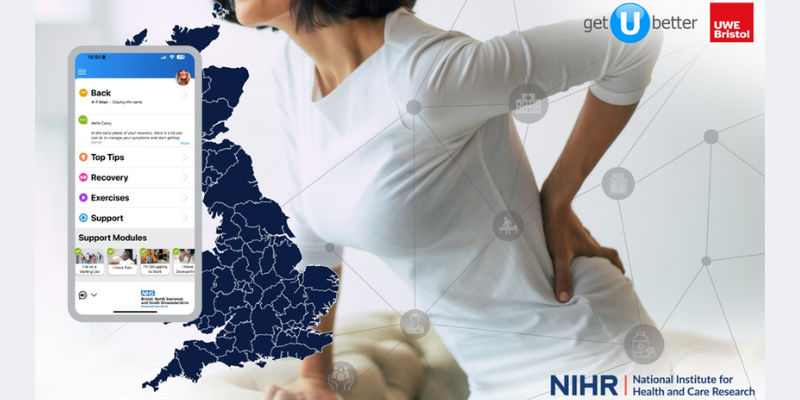
UWE Bristol, in collaboration with the Bristol, North Somerset, South Gloucestershire Integrated Care Board and getUBetter, and partners University of Bristol and St George’s University Hospital NHS Foundation Trust has won funding to evaluate the implementation of the musculoskeletal self-management app, getUBetter.

Low back pain affects many people in the UK, restricting their daily activities and accounting for 5% of GP appointments. Many digital tools exist to support people with low back pain to self-manage their symptoms. However, we don’t know how they work for patients and healthcare professionals, and whether they provide good care.

The getUBetter app is already used by the NHS to support people with low back pain. Typically, patients are directed to the app by their doctor, GP practice staff, or physiotherapist. A simple registration process connects them to guidance and support throughout the recovery journey, providing them with advice about symptoms, information about what to expect, relevant exercises, goal-setting tools, and referral to local treatments and services. 

The funding comes from the National Institute for Health and Care Research (NIHR) Invention for Innovation (i4i) Programme, in collaboration with the Office for Life Sciences and the National Institute for Health and Care Excellence. NIHR have funded seven new projects aimed at bringing new technologies into the NHS to benefit patients.

The funded teams will be gathering real-world evidence for their products. This will help to accelerate adoption of these technologies, which have been recommended for early use in the NHS through NICE Early Value Assessment.

The funding aims to help make the UK a leading testbed for late-stage health innovations. It will allow researchers and companies to generate the evidence needed to achieve full NICE guidance, and to accelerate uptake in the NHS so that patients can benefit sooner.

This project aims to assess if using getUBetter improves pain, and the ability to engage with daily activities, reduces the need for further care, and whether it offers the NHS good value for money. This research will help to understand how the app is being used by patients and GP practices and develop guidance on how getUBetter and other digital self-management tools can be used to support patients with low back pain.

Dr Alice Berry, Associate Professor in Rehabilitation at UWE Bristol and lead for the project commented: We are very excited to be leading this work and to receive NIHR funding and support from the Office of Life Sciences to broaden understanding of how digital technologies can be utilised by the NHS.

More information on the funding: NIHR and OLS invest £7.8m in new technology to benefit patients | NIHR

The Unconventional Computing Lab construct new vigilance robot

Posted on

Professor Genaro J. Martínez, Professor Andrew Adamatzky and colleagues from the Unconventional Computing Lab (UCL), based at UWE Bristol, recently finished a multidisciplinary project where they constructed a new vigilance robot named “McIntosh I”. Involving the Artificial Life and Robotics Lab in Mexico and Unconventional Algorithms & Computation Lab in Czech Republic.

The main characteristic and difference with other similar robots around the world is that the navigation system is implemented with a new bio-algorithm based on a Physarum polycephalum complex cellular automata model.

Physarum polycephalum represents an enigmatic group of organisms known as the slime molds. Despite their name these organisms are not related with fungi,  and form a genuine branch in the tree of life, beside plants, animals, and fungi. When Physarum takes up nutrient by its surface, the plasmodium will grow but still maintains coherence of the network structure. As a result, the network architecture is highly dynamic with flexible rearrangement of its junctions, following a decentralized and intelligent protocol of organisation.

The result will be presented in “The 15th International Workshop on Networking, Computing, Systems, and Software (to be held in conjunction with CANDAR’24) in Okinawa, Japan, from November 26 to 29 2024.

The results will be published in March 2025 in the Advances in Cellular Automata: Volume 1: Theory, and Advances in Cellular Automata: Volume 2: Computation and Applications

Major funding to support next generation of biology researchers

Posted on

The University of the West of England has been part of a successful bid for new Doctoral Landscape Award funding from UK Research and Innovation, for the South West Biosciences Doctoral Landscape Partnership (SWBio DTP) from the Biotechnology and Biological Sciences Research Council (BBSRC) worth £22.4 million.

The SWBio DTP is led by the University of Bristol, together with the Universities of Bath, Cardiff and Exeter, alongside Rothamsted Research.  This partnership also includes the following associate partners; Marine Biological Association (MBA), University of Plymouth, SETsquared Bristol, Swansea University, UCB Pharma and University of the West of England (UWE). SWBio4 will offer PhD studentships over five cohorts starting in October 2025, with a vision to train the next generation of highly skilled leaders in research, innovation, science policy, and communication. Students will receive structured training in data and project management, science communication, innovation, research impact, and artificial intelligence.

Professor Jeremy Tavaré, Pro Vice-Chancellor, Faculty of Health and Life Sciencesat the University of Bristol, said: “This award is a testament to the excellent academic and support teams across the existing SWBio Doctoral Training Partnership, which have built a buoyant, multi-disciplinary research training environment, with academic and non-academic partners guiding and championing 350 PhD students to date.”  

Professor Jon Lane, Director of the SWBio DTP and Professor of Cell Biology at the University of Bristol, said: “This is fantastic news. We are delighted to have received this vote of confidence in our vision to train and inspire future leaders in bioscience research and innovation. This award is a huge endorsement of our sector-leading biosciences departments within our institutions, recognising the world class biosciences research taking place in the South West and Wales.”

Professor Aniko Varadi, Lead of the SWBio DTP at UWE Bristol added: “Our bioscience research and innovation training formed integral part and contributed to the success of the SWBio DTP in the past five years. This award is the recognition of our excellent research, PhD supervision and training, which will enable us to build on our success and grow talented PhD students working in biology addressing significant global challenges.”

UWE Bristol Researchers Developing a Prosthetic Microbiome for ‘Vertical Farms’  

Posted on

Vertical farms for crops eliminate the soil microbes that, in the field, help plants grow – UWE Bristol academics are putting the microbes back. 

Professor Neil Willey, Dr Mukesh Sharma, and PhD student Segun Ogunmefun are part of a €6 million European Innovation Commission (EIC) project, ‘Microbial Hydroponics (Mi-Hy)’, that is making vertical farms more sustainable by incorporating microbial processes.  

In the next few decades Controlled Environment Agriculture (CEA) will produce an even higher proportion of the world’s food than it does now. It will include not just greenhouses but vertical farms and urban agriculture. In CEA crops are frequently grown without soil in a controlled environment with artificial light.  In contrast to growing in soil, crops are just fed a nutrient solution (‘hydroponics’) and there’s no microbiome involved in nutrient uptake – a bit like intravenously feeding a human.  In the field, the soil around plant roots (the rhizosphere) teems with microbes that help not just nutrient uptake but also stress avoidance and pathogen resistance. When plants in hydroponics have no rhizosphere microbiome, they are completely dependent on inorganic unsustainable sources of nutrients and their taste and nutritional quality can be different.  This makes sustainable growth of nutritious crops in hydroponics difficult.   

Basil growing in hydroponics in the Envirotro

The Mi-Hy project is using wastewater streams to drive Microbial Fuel Cells (MFCs) and Microbial Electrolysis Cells (MECs) and is developing a system to manage them as a prosthetic rhizosphere. This prosthesis captures nutrients from waste, provides energy for lights and pumps, and produces organic compounds like those of the rhizosphere.  The project is also developing designs for incorporating this hydroponic system into urban spaces.  The plant growth  experiments for the project will be done in the UWE Envirotron and the whole system will be demonstrated at, for example, the Sony Computer Science Labs in Paris and the Milan Triannale 2025.  Numerous UWE student projects and modules are linked to the research. 

The Mi-Hy project

Professor Neil Willey commented on the research so far: 

We’ve already been able to capture from waste streams more than 50% of the nitrogen that hydroponic plants need so we’re confident that when we’ve made the whole system and can fine-tune it, we will be able to grow plants completely on nitrogen captured from waste streams. We‘re hoping that we might help develop buildings that can feed their inhabitants!   

The other partners on the Mi-Hy project are The Dept of Regenerative Architecture at Katholieke Universitaet Leuven , the microbiology labs of the Consejo Superior de Investigaciones Cientificas in Madrid, the Engineering Dept of the University of Southampton, the Sony Computer Science Research Laboratories in Paris and Biofaction in Vienna. Mi-Hy is working closely with 8 other projects to meet the EIC’s €29mi Pathfinder Challenge: Carbon Dioxide and Nitrogen Management and Valorisation.   

Professor Neil Willey, Dr Mukesh Sharma, and PhD student Segun Ogunmefun are part of a €6 million European Innovation Commission (EIC) project, ‘Microbial Hydroponics (Mi-Hy)’, that is making vertical farms more sustainable by incorporating microbial processes.  They are funded by UKRI under the Horizon Europe Guarantee.

Back to top