


We spoke with Dr Faatihah Niyi-Odumosu (MBChB, MSc, PhD, PGCTHE, FHEA), Associate Professor of Physical Activity and Health Promotion, School of Applied Sciences, College of Health Science and Society, UWE Bristol, about a new collaboration designed to strengthen independence and wellbeing among older adults and people requiring reablement support.
About the project
Happy Care Ltd first approached UWE Bristol looking for innovative ways to help their service users regain independence and improve their quality of life. Through their hospital discharge work, they identified a gap in how reablement could be supported more holistically.
From there, the partnership developed naturally, bringing together:
- UWE Bristol (Associate Prof Faatihah Niyi-Odumosu) – leading on the research and evaluation framework.
- Happy Care Ltd (Ahmed Ibrahim, Fadumo Farah, Ayan Buleh, and Natnael Guliano) – embedding the work within their care provision and providing access to service users.
- Wesport (West of England Sport Trust) (Kirsty Brown) – contributing expertise in inclusive physical activity and programme design.
Together, the partners are developing and evaluating approaches to reablement through everyday physical activity.
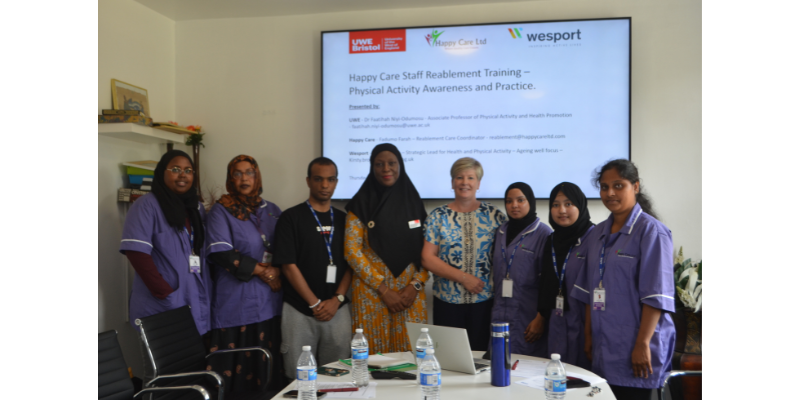
What “developing and evaluating reablement” looks like
In practice, this means supporting individual clients in their own homes. Carers from Happy Care help build independence and mobility into daily routines i.e. reducing sitting time, encouraging regular movement, and supporting everyday tasks that promote confidence and autonomy.
A key focus is educating carers to understand how small, consistent actions can make a big difference to physical and psychological wellbeing. Alongside this, the team is gathering evidence and feedback to evaluate the impact on clients, families, and carers.
Aims and outcomes
The Happy Care Project aims to:
- Improve independence, confidence, and quality of life for service users.
- Equip carers and families with practical tools to support reablement.
- Demonstrate the value of regular physical activity within reablement settings.
- Develop a model that can be shared across Bristol and the Southwest, influencing both practice and policy.
Building evidence and influencing practice
By systematically evaluating the programme, the project is generating an evidence base that shows how physical activity can be effectively embedded into reablement services. This work could help inform local commissioning decisions and shape future models of care, demonstrating how reablement through movement (and regular physical activity) can reduce longer-term health and care needs.
If successful, the model could be replicated across social-care providers in Bristol and beyond.
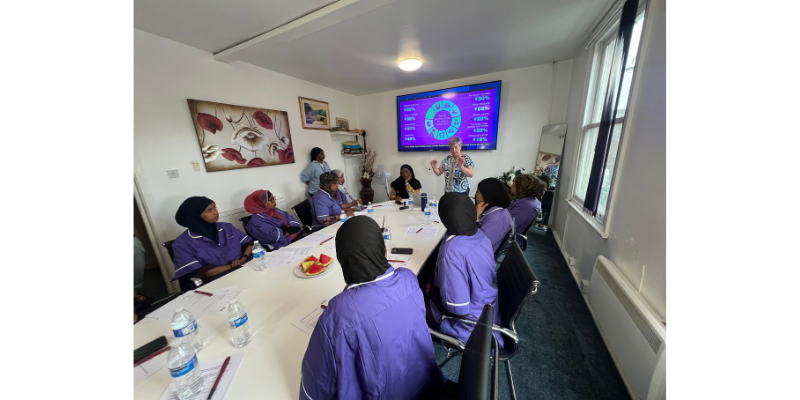
Early progress and next steps
The team has delivered its first training workshop to carers, focusing on the knowledge and confidence needed to integrate physical activity into care routines. Feedback and evaluation from this session will be shared in a follow-up blog.
Although still in its first year, the project is already helping to strengthen connections between health research, social care, and community wellbeing.
Looking ahead, the team plans to explore internal UWE funding opportunities and engage MSc Health Psychology placement students and final-year undergraduates to support evaluation and data collection.