


20 June 2024 is Clean Air Day. To celebrate we are sharing this blog post from MSc Environmental Consultancy student Jozie Beattie:
The quality of our air is a critical concern affecting both public health and the environment. To address these issues both the UK and EU have published legislation aimed at improving air quality. This blog post aims to explore how these measures are shaping efforts to reduce air pollution and ultimately promote cleaner, healthier air for all.
EU Air Quality Standards Directive 2008/50/EC
This directive merges different ambient air quality legislation in the EU into one. It was established in 2008 and includes target values and thresholds for several pollutants such as sulphur dioxide and particulate matter. This directive is also used in the UK.
Since 2008, a lot has changed in the environment, especially types and levels of air pollutants. Thus, the directive could seem outdated. The EU has stated its intent to update the directive to be in line with the WHO guidelines (Kuula et al, 2022) would result in some drastic changes, such as limit values for PM2.5 reducing by more than half.
This directive is legally binding for all EU countries, as well as the UK. The UK breached this directive on several occasions. The European Commission argues the UK has consistently exceeded annual NO2 limits in 16 areas and has not minimised the period of NO2 limit exceedance, since 2010 (Herbert and Woodliffe, 2021) As a result, the UK was ordered to update air quality management plans immediately, to meet these targets.
The human effect of these breaches resulted in an inquest into Ella Adoo Kissi-Debra’s death. Ella was just 9 years old in 2013 when she died of acute respiratory failure via asthma attack. She was the first person in the UK to have air pollution listed as a cause of death (BBC, 2020).
WHO Air Quality Guidelines
Table 1: WHO Air Quality Guidelines (WHO, 2021a)
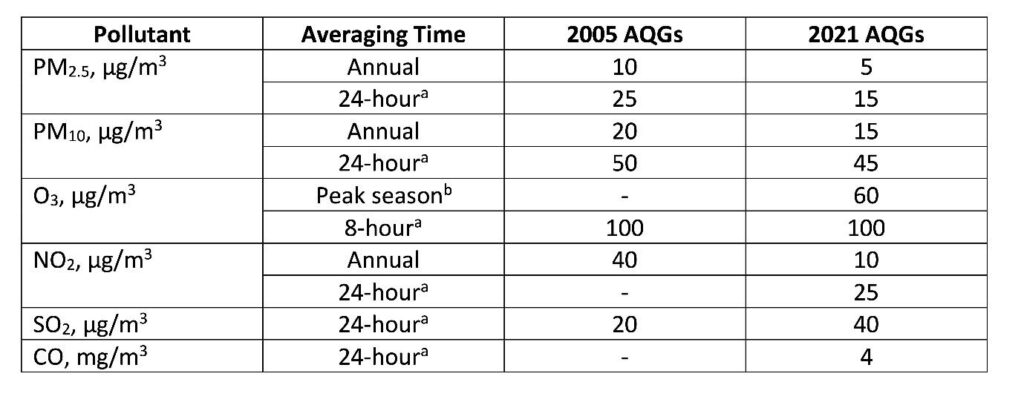
The World Health Organisation (WHO) has set targets for governments all over the world that aim to reduce air pollution and improve human health. These recommend levels of several common pollutants such as PM 2.5, PM 10 and NO2, to name a few.
The first guidelines were released in 1987, again in 2005, and most recently in 2021 – see the image above. Since 2005, targets have changed drastically in response to air quality levels. These guidelines have been created by a team of experts who have intensely monitored and evaluated air quality, while consulting with others globally. This makes the targets popular with government bodies and allows the public accurate information to rely on (WHO, 2021b).
However, these targets are simply guidelines. They are not standards and are not legally binding, so do not have to be met by law. This leads to variability in air quality management practices globally (Hausfeld, 2021). As well as this, they do not provide specific guidance on implementation measures, leaving room for interpretation depending on the country’s context. While this does ensure guidelines are not generalised standards, it can leave governments lost as to how to achieve these ambitious targets (Burki, 2021).
2021 Environment Act
Figure 2 – (Mendes, 2021)
The 2021 Environment Act was published in the UK after the UK left the EU, to consolidate rules on environmental protection that were at risk of being lost. The act covers the protection of air quality, as well as nature, water, and biodiversity etc.
For air pollution, the act proposes to change air quality targets, for example reducing PM2.5 by over a third compared to 2018 levels (DEFRA, 2022). As well as changes in regulation relating to local air quality management frameworks, smoke control area enforcement and environmental recall of vehicles.
This act is legally binding, meaning regulations must be followed by governments, local authorities, businesses, and the public. This signifies a robust framework for addressing a range of environmental issues and holds everyone accountable. The act introduced the ‘Office for Environmental Protection’ who can ensure law is complied with.
Although the act is law, it can be argued that it does not meet the ambition that the government promote, particularly around clean air. The act set a duty for the government to bring forward 2 air quality targets by October 2022 – however the government failed to meet this deadline (Client Earth, 2022). As well as this, insufficient public consultation took place for long term targets, it lacked critical information and was of insufficient length which meant the public were not adequately engaged (Lee, 2023).
UK Clean Air Strategy 2019
Figure 3 – (Gowling WLG 2019)

This 2019 strategy details the UKs approach to tackling all sources of air pollution, with the goals of improving air quality, safeguarding nature, and enhancing the economy. It works alongside the Industrial Strategy, Clean Growth Strategy and 25-year Environment Plan. It sets out actions and methods to reduce emissions for all relevant bodies to follow (DEFRA, 2019).
This robust strategy involved extensive consultation and took on board initial feedback to improve the strategy and extend ambition further. As well as this, it integrates monitoring and actions to provide accurate data and ensure progress is consistent.
However, the Clean Air Strategy has been criticised for its lack of funding. A group of local government leaders – UK100 stated that the Clean Air Fund of £220 million was not enough, the strategy does emphasise that additional funds are available but falls short of the £1.75 billion that was initially suggested. Without sufficient funding, the strategy cannot be implemented fully and ultimately the pressing public health issue will not be addressed (The Lancet, 2019).
References
BBC (2018) What is the EU? – CBBC Newsround www.bbc.co.uk [online]. Available from: https://www.bbc.co.uk/newsround/21164710. [Accessed 11 May 2024].
BBC (16th December 2020) Ella Adoo-Kissi-Debrah: Air pollution a factor in girl’s death, inquest finds BBC News [online]. Available from: https://www.bbc.co.uk/news/uk-england-london-55330945. [Accessed 11 May 2024].
Burki, T. (2021) WHO introduces ambitious new air quality guidelines. The Lancet [online]. 398 (10306), p. 1117. [Accessed 8 May 2024].
Client Earth (2022) The UK Environment Act – what’s Happening now? www.clientearth.org. 1 April 2022 [online]. Available from: https://www.clientearth.org/latest/news/why-the-uk-environment-bill-matters/.[Accessed 5 May 2024].
Defra (2022) Environment Act 2021: Environmental Targets – Defra in the Media deframedia.blog.gov.uk. 17 March 2022 [online]. Available from: https://deframedia.blog.gov.uk/2022/03/17/environment-act-2021-environmental-targets/.[Accessed 11 May 2024].
Department for Environment, Food & Rural Affairs (2019) Clean Air Strategy 2019 GOV.UK. 14 January 2019 [online]. Available from: https://www.gov.uk/government/publications/clean-air-strategy-2019. [Accessed 5 May 2024].
Gowling WLG (2019) UK Clean Air Strategy 2019 – Issues for Business Gowling WLG. 2019 [online]. Available from: https://gowlingwlg.com/en/insights-resources/articles/2019/uk-clean-air-strategy-2019-issues-for-business/.. [Accessed 8 May 2024].
Hausfeld (2021) WHO launches more stringent Air Quality Guidelines Hausfeld. 2021 [online]. Available from: https://www.hausfeld.com/en-gb/what-we-think/perspectives-blogs/who-launches-more-stringent-air-quality-guidelines/ [Accessed 11 May 2024].
Herbert and Woodliffe (2021) The CJEU Finds that the UK Breached its Obligations under the Air Quality Directive Ropewalk Chambers. 2021 [online]. Available from: https://ropewalk.co.uk/blog/the-cjeu-finds-that-the-uk-breached-its-obligations-under-the-air-quality-directive/.[Accessed 11 May 2024].
Kuula, J. et al. (2022) Opinion: Insights into updating Ambient Air Quality Directive 2008/50/EC. Atmospheric Chemistry and Physics [online]. 22 (7), pp. 4801–4808. [Accessed 5 May 2024].
Lee, M. (2023) The Aarhus Convention 1998 and the Environment Act 2021: Eroding Public Participation. The Modern Law Review [online]. [Accessed 5 May 2024].
Mendes, S. (2021) Environment Act 2021: UK’s New Protection Plan Iceclog. 23 November 2021 [online]. Available from: https://iceclog.com/environment-act-2021-uks-new-protection-plan/ [Accessed 11 May 2024].
The Lancet (2019) New strategy for clean air in the UK—is it enough? The Lancet Respiratory Medicine [online]. 7 (3), p. 187. . [Accessed 12 May 2024].
WHO (2021a) What are the WHO Air quality guidelines? World Health Organization. 22 September 2021 [online]. Available from: https://www.who.int/news-room/feature-stories/detail/what-are-the-who-air-quality-guidelines. . [Accessed 8 May 2024].
WHO (2021b) WHO global air quality guidelines. Geneva Who. . [Accessed 8 May 2024].