

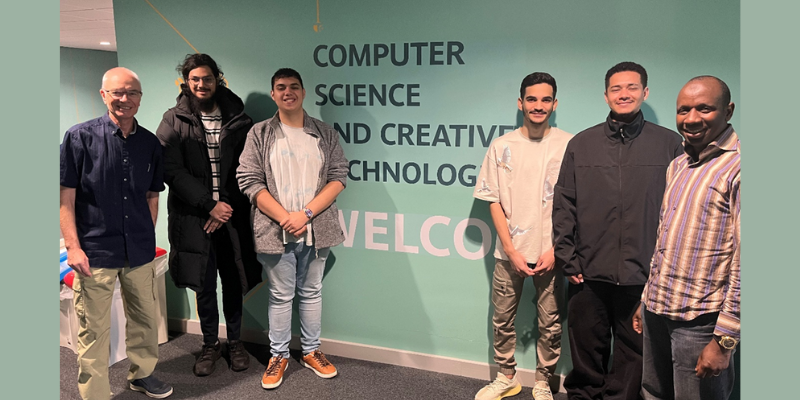
Image: From right to left, Abdullahi Arabo from UWE, Mehe, Maxens and Lukas from University Institute of Technology (UIT) of Reunion Island, Mohammad from ESIRIO University of Reunion Island and David from University Institute of Technology (UIT)
This year marks the 6th anniversary of UWE Bristol’s research and internship collaboration with the University of Reunion Island (started in 2018), supported by Erasmus+ and other funding sources. To date, this collaboration has raised more than £165,000 to cover interns’ expenses during their stay in the UK, plus other findings that allowed UWE Bristol’s Abdullahi Arabo to visit the Island for collaborations research and development as well as teaching. This is part of Abdullahi Arabo’s initiative of CyberSkool, creating an environment that mentors, nurture and inspire future cyber talents globally.
This is only the start – the team are aiming to expand this further year by year to include Abdullahi visiting both institutions in the Island for sharing excellence in research and development, as well as teaching and learning pedagogy within cyber science and cyber engineering. This summer, Abdullahi is hosting four interns working on various cutting-edge research and development projects aimed at fostering the rapid development of cyber security ecosystem. The aim is to provide an environment via CyberSkool that allows interns, other interested students, mentees and individuals to explore, nurture, and inspire young talents within cyber science and cyber engineering to reduce the skills shortage within the cyber ecosystem.
This collaboration has led to several publications, external and internal research funding, and interest from researchers’ other institutions globally. More importantly, it has mentored and inspired over 20 young cyber professionals who have become CyberSkool inspirers who are helping other globally and recruiting interns for CyberSkool.
A summary of some of the excellent research work conducted by this year’s interns can be found below. The research includes advancements and development of automated penetration testing tools powered by machine learning:
Mahé’s research project aims to fully automate the evaluation of machine and server security in the field of cybersecurity. To achieve this, the team have developed a tool in Python. This tool automatically manages the launch of an Nmap scan to detect open ports and services, utilises techniques to discover hidden directories on the web, analyses potential vulnerabilities in WordPress, and extracts metadata from images on web pages. Finally, it automatically generates a detailed report. The entire process is fully automated.
Maxens Barbier research focuses on cyber security, specifically on the application of large language models (LLMs) for phishing detection in emails. This involves fine-tuning these models to improve their accuracy in identifying malicious content, thereby contributing to the development of more robust cyber security measures. This project not only broadens my expertise in artificial intelligence and network security but also provides valuable practical experience in a critical area of technology.
Lukas’s project integrates Large Language Models with Selenium-based web scraping to enhance profile building. By allowing the LLM to view and navigate web pages like a human, it can extract relevant information naturally. Data collected is stored in a structured database to generate detailed profiles. Despite limitations like text extraction hallucinations, our goal is to build an ethical, predictive data framework. This proof-of-concept highlights how online digital footprints can be used to create profiles, emphasizing the potential for misuse by malicious actors.
Mohammad’s research project focuses on detecting phishing attacks using artificial intelligence. Initially, conducting thorough research on phishing, artificial intelligence, and the combination of these two fields. Subsequently, this will develop a tool that uses artificial intelligence to detect phishing.
Also one of our MSc students mentored within the scheme Tunde Oduguwa has successfully showcased their final year MSc Cyber Security Project at the ‘Cluster on Tour: Commercialising Innovation – Research Project to Business Venture’ event, organised by Cynam and hosted by Cardiff University Cyber Innovation Hub on April 25, 2024. Additionally, the output of the same research on “Passwordless Authentication” has been disseminated and published in Journal of Cybersecurity and Privacy. 2024; 4(2).