INNOVATE™ BRISTOL & BATH, the latest edition from Global Village Publishing, is a 380-page premium coffee-table book complete with augmented reality videos showcasing all the people, companies, products, and services that are leading the race within Bristol & Bath’s innovation and entrepreneurial ecosystem.
Our hugely successful Project Week receives a well deserved mention, highlighting our unique approach to teaching through project-based learning and live industry briefs, along with our department’s focus on introducing sustainability to all areas of our curriculum.
The book also highlights our work as strategic lead for the DETI Skills programme, drawing particular attention to our Inspire programme events and activities undertaken in recent months, engaging local pupils with engineering careers and opportunities in the West of England.
This book is a celebration of the region’s most exciting innovations and its entrepreneurial ecosystem. Every single one of the stories within the publication has been carefully chosen to guide you on a journey across the region and offer you a glimpse into the future.
Natalia Rodríguez Novás, Publishing Partner for Global Village Publishing
You can read more, including opinion pieces from some of the leading innovators in our region, including our very own Steven West, Vice-Chancellor, President and Chief Executive Officer for UWE Bristol, in the online e-book by visiting https://innovationsoftheworld.com/ecosystems/bristol-bath/
Formula student is the world’s largest Engineering design competition, organised by the Institution of Mechanical Engineers, with the challenge of designing, manufacturing and racing a single seat race car.
Through multiple events, cars are judged on their acceleration, handling and efficiency, while engineers are assessed for their design, costing and business presentation skills.
Current UWE student engineers and alumni from 2020 took part in the UK event which was held at the Silverstone race circuit in Northampton between the 21st and 25th of July.
The IET Prize is awarded annually to outstanding students who are completing a course of study which has been accredited by the IET. Prize winners are nominated by their university based on having shown distinction in their course leading to the award of a first degree.
As part of his win Oliver will receive a certificate and two years free student membership of the IET.
I am honoured to receive the IET Prize from the University of the West of England for my outstanding performance during my MEng degree. I am extremely grateful for the recognition I have received for my work. I would like to thank my lecturers, project supervisor, and the laboratory technicians at the university who have provided me with the necessary support, knowledge, and guidance throughout my degree.
Oliver Németh, Electronic Engineering Graduate, UWE Bristol
Our IET Prizes are a fantastic way for talented engineering students to be recognised for their outstanding ability in the early stages of their engineering journey. IET Membership provides early career professionals with the opportunity to connect with a global community, grow their networks and develop their technical knowledge.
The IET is passionate about promoting engineering excellence and our awards and prizes showcase some of the very best engineering talent. All of the winners should be incredibly proud of their achievements. I wish them all the best for a very fulfilling and successful career – they are all difference makers of the future.
Professor Danielle George MBE, President of the IET
To find out more information about the range of prizes and awards available to young and aspiring engineers through the IET, please visit: www.theiet.org/awards
Last month the DETI Inspire team at UWE Bristol held an online webinar with local engineers from organisations throughout the West of England, to share learnings from the past year with regards to delivering online engineering work experience events.
As can be seen in the above word cloud, there are many benefits to virtual engagement activities. The benefit of increased accessibility due to the lack of travel requirements was highlighted by several participants, along with an increase in the number of young people reached due to increased capacity when delivering activities online.
The graphs below show the variety of different activities delivered by our participants and their organisations over the past year, with more informal Q&A sessions with employees being a popular choice that seems to have had the most success so far, much like our recent Big Beam In event.
Participants discussed what has been working well and what could be improved, barriers to online experiences and how to overcome these, and what work experience will look like for their organisation in the future – a hybrid combining the best bits of online and in-person experiences.
Thanks to all our speakers and participants for attending, it was great to hear what you’ve been up to over the past year and share ideas for improving our engineering work experience events to make sure we are all delivering careers engagement activities with real impact.
Engineering Open House Day is all about highlighting the important roles that engineers play in everyday life, with participating venues and organisations demonstrating the creativity and excitement behind engineering careers.
This year the event will be taking place virtually and UWE Bristol’s Engineering Design and Mathematics (EDM) department will be joining in the fun with a virtual viewing of their new science show developed with Explorer Dome Bristol, We Make Our Future.
We Make Our Future is an interactive, educational & entertaining science show for the next generation of Digital Engineers.
Explorer Dome, in collaboration with the DETI Inspire team at UWE, have created a new experience to celebrate the ingenuity of human engineering, address current issues around Climate Change and introduce Digital Engineering as a relevant and attainable aspiration for all young people.
We Make Our Future is a presenter-led experience which can be delivered inside Explorer Dome in schools or remotely via Zoom.
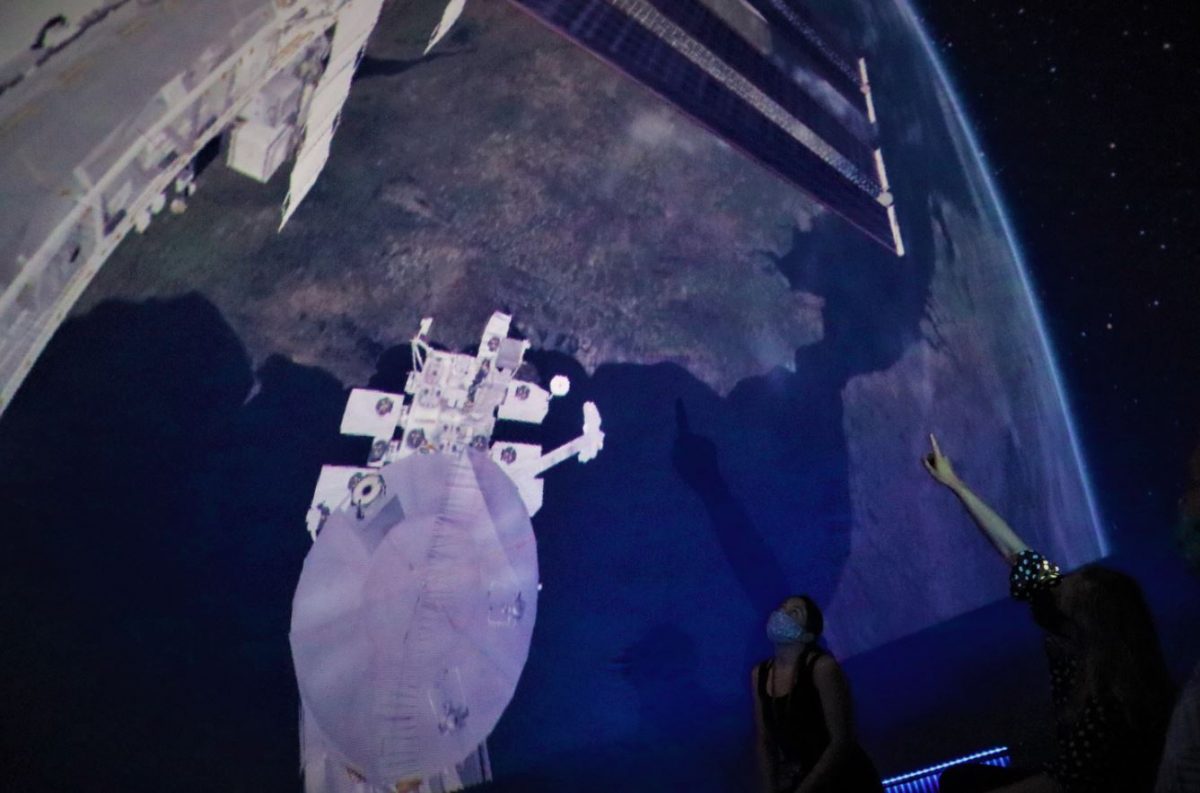
The DETI Inspire team enjoying their first look at the show from inside the dome
Full-dome digital projections allow us to visit engineering marvels from history and explore the pros and cons of modern life. Industry, technology and invention have progressed civilisation, but at what cost? Get to know how the Engineering Design Process and application of digital technology can make the world a better place for us all.
Flying over some of Bristol’s famous engineering landmarks – the virtual show via Zoom
The show is aimed at children aged 8 – 14 and their families, but all ages are welcome! If you would like to join us for this free viewing of the show this July 23rd, please register your place here.
Our Product Design and Development Engineering Degree Apprentices from Renishaw Engineering, representing Gloucestershire College and UWE Bristol, made it through to the top six teams before being named Runners Up in this year’s competition.
Run in partnership with Engineers Without Borders, the Engineering for People Design Challenge encourages university students to broaden their awareness of the social, environmental and economic implications of their engineering solutions, through a project-based learning pedagogy. This challenge also forms part of UWE Bristol’s Engineering Practise module Project Week.
This year 1339 teams (around 8000 students) from UK and Ireland universities participated in the competition with 102 teams submitting their designs to be judged by 234 professional reviewers from 32 countries. The top 35 teams were invited to a finals event on July 1st, where they pitched their idea to a panel of 22 expert judges. Our brilliant team of apprentices then made it through to the Grand Finals along with five other teams before being awarded the Runners Up Prize.
A huge congratulations to Marcus, Charlie, Eleanor, Oliver and Ezra! We’re all immensely proud of your fantastic achievement.
The team’s design, an Implementation of Biodigesters and Oxidation Ponds, provides a cost-effective and low maintenance solution which seeks to improve the sanitary conditions and economic prospects of Lobitos and Piedritias, in Peru. This new system would remove and treat wastewater, whilst also providing clean drinking water, solid and liquid fertiliser, and building materials. You can learn more about their design idea here.
The Product Design and Development team presenting their Biodigester project
For more information about The Engineers for People Design Competition or UWE’s Project Week, please contact engineeringourfuture@uwe.ac.uk
If you could completely re-design your city, your street, your home, what would you do differently?
DETI Inspire at UWE have been exploring digitally engineering the West with local children, using the incredibly popular block-building video game Minecraft.
Why Minecraft?
Minecraft is the second-best selling video game of all time and extremely popular with children. Players place and break blocks with a wide range of appearances and properties, to build a huge variety of constructions. It’s easy to make changes to your builds and quickly visualise new ideas, much like computer-aided design (CAD) software used for digital engineering.
The game has proven to be a successful science communication tool, and evaluations undertaken by the Science Hunters project, based at UWE’s Science Communication Unit and Lancaster University, indicate that use of Minecraft both attracts children who might not otherwise have engaged with science learning, and successfully improves scientific knowledge and understanding after participating in sessions.
The West in Minecraft
The DETI Inspire team have taken things one step further, partnering with local design & engineering consultancy Atkins, and Science Hunters including Minecraft experts Dr Laura Hobbs and Jonathan Kim, to create a scale recreation of Bristol and Bath within the game, allowing local children to explore, build, re-design and re-engineer their very own cities!
The Roman Baths, an engineering highlight of the West in Minecraft world
Lewis Mould and Sam Collier, senior GIS consultants from Atkins, created a programme to convert Ordnance Survey data into a to-scale Minecraft world, allowing a highly detailed Bristol and Bath to be created – the West in Minecraft.
This new world was then populated with famous engineering landmarks such as the Clifton Suspension Bridge, Temple Meads station and the SS Great Britain, all expertly crafted by Jonathan Kim.
I enjoyed adapting and creating many of the real-life Bristol landmarks in Minecraft. I hope that exploring these landmarks will encourage students to develop their own ways of tackling engineering problems
Jonathan Kim, Science Hunters
STEM in the Community
DETI Inspire have been using this new Minecraft world at after school STEM clubs recently established in Lawrence Weston and Easton as part of a STEM in the Community project funded by UWE and the STEM Ambassador hub West England, in collaboration with local community groups in both areas.
The Bristol and Bath worlds are so detailed and thoughtfully created. The children have been discovering the area they live in and other iconic places such as Temple Meads and the Roman Baths. Most children already have a lot of experience with Minecraft so they adapted well to it. During our Pride themed week, the children built giant flags, rainbow farms and buildings.’
Cilpha James, STEM Ambassador
Enjoying sunset views of Bristol Harbour and the SS Great Britain
By re-creating these areas of Bristol within the game, children from both Lawrence Weston and Easton are able to explore the parts of their community that are familiar to them, piquing their interest and giving them power to reshape where they live.
Exploring new areas of the city through Minecraft also opens up opportunities for children to visit and talk about some of the city’s famous landmarks, many of which they may never have seen before, strengthening their knowledge and cultural connection with these areas and our city as a whole.
So far the new Minecraft world has been a huge success amongst the young people attending these STEM clubs. There has been much excitement at finding their own homes within the model city, re-building structures and adding to existing ones. Farms have been built on rooftops as the children have been encouraged to think about how they would re-design their city for a net zero future.
Giving young people access to these places and giving them power to reshape them, even if it is just in Minecraft, offers them the opportunity to imagine their world as being different to what it is now. We hope that planting the idea that we can have some control over our own environment will lead some young people to think about the relevance of design and engineering to their lives, and then perhaps on to thinking of themselves as designers and engineers of the future.
Liz Lister, STEM Ambassador Hub West England
A set of school resources to explore digital engineering this new Minecraft world are currently being developed by the DETI Inspire team for release next academic year. These 1-2 hour Minecraft lessons are currently being trialled with local primary schools, linking activities to the curriculum and drawing on several different subject areas to allow for a cross-curricular and rather unique learning experience.
For more information on The West in Minecraft please contact deti@uwe.ac.uk
Bristol Robofest is an annual city wide initiative taking place in June to celebrate the UK Festival of Robotics and raise the profile of STEM (Science, Technology, Engineering & Maths) in our local communities.
This year, robots popped up in various locations throughout the city, including the University of Bristol’s Micro-Campus at Wellspring Settlement which played host to several robotics inspired workshops where 24 enthusiastic 10 – 14 year olds from the local area took the opportunity to explore and play with MicroBit BitBots, and Thymio Robots. They learnt about cutting edge research in the field of Swarm Robotics, while honing their skills in programming and problem solving.
Children exploring how a Thymio robot follows a drawn track
Over at the Old Library in Easton, Pepper the robot gave a warm welcome to all of the visiting families. Over 100 visitors took part in family-friendly robot workshops which were on offer throughout the day, led by researchers from the Bristol Robotics Lab, with support from FARSCOPE PhD students and MSc students from UWE Bristol.
Children were able to get hands on with lots of different robots including Naos, Thymios, Vectors and of course Pepper! There was plenty of programming robots and exploring how they move and interact with each other and with people too.
Pepper the robot sporting a very nice BRL hoody!
Families enjoying Robots Day at the Old Library. Easton
At at UWE Bristol School of Engineering, the DETI Inspire team had a fun day building robots for the Prototype and Play lab, getting the space in tip top shape for hosting school groups next academic year.
The team also partnered with Explorer Dome to host a virtual viewing of their new interactive show, We Make Our Future, in celebration of this year’s regional Lego League teams, who have been busy building and programming their Lego robots to complete this year’s challenges.
Prototype & Play Lab (outreach classroom) at UWE Bristol
Thymio robots at STEM @ Baggator, a community STEM Club in Easton
Bristol RoboFest was a great success and we’re already looking forward to doing it again next year, hopefully it can be even bigger and better in 2022.
If you would like more information about how to get involved with Bristol RoboFest or STEM outreach at UWE Bristol, please contact the DETI Inspire team deti@uwe.ac.uk
STEM @ Baggator is a community STEM club for young people in Easton that takes place after school on Mondays (3-8.30pm) and welcomes all young people in the area to drop by and join in!
The club was co-developed with members of the local community, with support from the STEM Ambassador hub for the West of England and the DETI Inspire team at UWE Bristol, as part of a STEM in the community project funded by UWE, which aims to help STEM Ambassadors and UWE students collaborate to run STEM (Science, Technology, Engineering & Maths) initiatives that are relevant to their local communities.
Lego Mindstorms being assembled at STEM @ Baggator
STEM @ Baggator had a hugely successful launch event last week, with over 30 local young people joining in for some robot building and racing! There was a wonderfully positive atmosphere throughout the evening with everyone keen to get involved and even help tidy up all the stray pieces of Lego that had found their way onto the floor, as Lego tends to do!
At the next session, the team will be trialling a brand new activity which will have young people re-designing their local areas digitally, using the popular game Minecraft and a specially designed scale model of Bristol city.
A swarm of robots at STEM @ Baggator!
STEM in the community is an ongoing project based at UWE Bristol and we’ll be sharing more news of the initiatives that are being co-developed with other communities in the West of England region. If you would like to know more about STEM @ Baggator or would like to collaborate on a new community STEM project, please contact the team at deti@uwe.ac.uk
This news piece was written by Pilar Garcia from the UWE Bristol Estates and Facilities team.
UWE Bristol’s new School of Engineering building on Frenchay campus has achieved an “Excellent” rating for its green credentials from the international scheme BREEAM (Building Research Establishment Environmental Assessment Method).
BREEAM is the leading and most widely used environmental assessment method for buildings in the UK. Our rating demonstrates that the building is in the top 10% of UK new non-domestic buildings for sustainability best practice.
Our assessor Hydrock Consultants Ltd carried out a comprehensive assessment of:
Management
Health and Wellbeing
Energy
Transport
Water
Materials
Waste
Land Use and Ecology
Pollution
Innovation
Examples of the sustainability best practice employed in the building include having lots of natural ventilation, installing PV (solar) panels, connection to UWE Bristol’s district heating network, use of underfloor heating and use of materials with high thermal mass (the ability of a material to absorb and store heat energy).
Tod Burton, Executive Dean of the Faculty of Environment and Technology, said: “Engineering is about problem-solving and the climate emergency is arguably our greatest challenge of all. It is important that the building used by our student engineers as they develop their problem-solving skills has now been recognised by BREEAM as “Excellent” for its sustainability performance – a great achievement and credit to everyone associated with the project”.
The project was also rated 100% for “Management”. This is a real testament to what can be achieved by #TeamUWE and the Engineering Building Project Team should be particularly proud.
The Project Team:
Tod Burton – Deputy Dean, FET
Lisa Brodie – Head of Department: Engineering Design & Mathematics
Marianne Reed – Senior Programme Manager
Chris English – Head of Technical Services, FET
Elena Marco – Head of Department: Architecture and the Built Environment
Stephen Denning – Estates Project Manager, Estates and Facilities
Doug MacLeod – ITS Strategic Business Partner
Richard Dewey and Paul McCluskey – BAM Contractors
Andrew Lintern and Darren Edson – Capita
Jim Crouch – MACE
Adam Spall and Hira Teirney – AHR Architects
Stuart Hitchcock, Eunan Scanlon & Simon Nation – Hydrock Consultants
Alistair Brooke, Assistant Director of Estates said: “A fantastic achievement for UWE Bristol and the Project Team. Strong collaboration enabled sustainability to be embedded from the early stages of the project and ultimately led to the success of the scheme. The project is a further endorsement of UWE Bristol’s commitment to sustainability and innovation across its estate.”
Find out more and view more images of the building on the UWE Bristol website.