
UWE Bristol Academic Spotlight: Mehmet Aydin, Senior Lecturer, Computer Science

Posted on

Knowledge Transfer Partnership

Working with Flexys to integrate Artificial Intelligence and Machine Learning technology within debt resolution software, to enable more effective management of debt resolution and improvement of customer relationships and retention.

Research Interests

Dr Mehmet Aydin is Senior Lecturer in Computer Science with long-standing experience in solving real-world problems using AI, machine learning and soft computing methods. He has led and taken part in numerous research and industrial projects involving data analysis and modelling and problem-solving aspects in supervisory, consultant and researcher capacities. His research resulted in a long-list of publications in internationally peer-reviewed and well-recognised journals and conferences, and the impact of his research can be evidenced with citation metrics.

He has conducted guest editorial of a number of special issues for internationally peer-reviewed journals including International Journal of Production Research, European Journal of Industrial Engineering and International Journal of Fuzzy Systems. In addition to the membership of the advisory committee of many international conferences, he is associate editor and member of the editorial board of peer-reviewed international journals. He is currently a fellow of the Higher Education Academy, member of EPSRC Review College, member of The OR Society UK, ACM and IEEE.

Business/Sector Interests and a brief description of how your academic expertise could be practically applied for a business partner

Mehmet has experience of being the academic supervisor on two KTP projects.

One, still in progress, concerns data analysis and machine learning to understand customer behaviours in the area of debt management. The other, recently successfully completed, was with Lyons Davidson. This concerned the use of artificial intelligence for natural language processing and task-oriented dialogue management, creating automated systems for answering customer queries.

These, combined with his extensive experience of modern software development practices (for example, he is module leader for UWE’s final year module ‘Enterprise Systems Development’) provide him invaluable experience with project management and tools throughout the workplan. In particular his research experience and wide experience of formulating problems as learning tasks, then designing, implementing and evaluating machine learning-based solutions, give him the expertise needed to support collaborations.

For more information about Mehmet’s work please click here

For more information about Knowledge Transfer Partnerships click here

Continence care app developed by UWE Bristol academics wins national Nursing award

Posted on

An app developed by a national team including UWE Bristol academics has recently won the Nursing Times Award for Continence Promotion and Care.

The free CONfidence app was developed by the Bladder and Bowel CONfidence Health Integration Team (BABCON HIT) as part of Bristol Health Partner’s Academic Health Science Centre.  Development included a national team of clinical experts and patient and public partners, supported by a local self-care app developer, Expert Self Care, to develop a unique app to enable people with bladder and bowel leakage (incontinence) to access self-help advice and information.

The BABCON HIT and app project is led by Dr. Nikki Cotterill, Professor in Continence Care at UWE. The CONfidence app was launched in June during World Continence Week and has just achieved over 1000 downloads. It has been termed a ‘gamechanger’ as it bridges the gap between the millions of people with symptoms who feel they are alone and nothing can be done, and the evidence-based guidance that can really make a difference.

The CONfidence App

The award winning app has already proven to be hugely successful and has been covered regionally, nationally and widespread on social media.

Nikki commented “We are thrilled with the reception of the app so far. Nationally, we’ve seen services adopting it into their service pathways as it aligns with the NHS Long Term plan to promote self-care. It’s also been included in the Orcha app library and is currently undergoing an NHS DTAC review. At its core though, the app can help people to take control of their life where bladder and bowel symptoms are taking the lead, avoiding the physical and mental health declines that can ensue.”

To learn more visit Bristol Health Partners.

UWE Bristol Academic Spotlight: Dr Patrick Crogan

Posted on

Patrick Crogan is Associate Professor of Digital Cultures at UWE Bristol where he teaches and researches in media, technology and culture. Originally from Australia, he completed a doctorate at the University of Sydney and taught at a number of institutions in Australia before coming to the UK.

He has worked at UWE Bristol since 2008, where he supports the Media Communications degree programme. He is also a founding member of UWE Bristol’s Digital Cultures Research Centre, a collaborative network focussing on practical approaches to responsible technological futures.

Patrick’s work specifically highlights the link between digital media making and theory. He works in both conventional ‘academic’ and practice-based modes, working with creative makers, an approach that he says keeps him “’fresh’ and ‘honest’”.

Area of expertise

Automation and AI:

Patrick was one of the UWE Bristol-led, AHRC-funded South West Creative Technology Network’s Automation Fellows in 2019-2020. He worked with other Fellows on the future of creative uses of AI and automation. Before that, Patrick was co-investigator on the AHRC Automation Anxiety Research Network (2017-18) which explored innovative methods by which the humanities might address contemporary cultural anxiety about new forms of automation.  He also works on military drone developments and the future of AI and automation in military and civilian circles. In addition to this, he is a collaborator and research lead on the I am Echoborg​ project. Led by colleague and interactive experience designer, Rik Lander, this interactive show challenges the audience to discover the best possible outcome for the relationship between humans and intelligent machines.

Video games and digital culture: 

Patrick’s 2011 book Gameplay Mode critically examines what videogames can tell us about the relations between war and computer-based technoculture. 

He also ran the Creative Territories AHRC Video games research network (2014-15). Its major report The Good Hubbing Guide outlines its major findings and recommendations about independent game maker colocation. 

Bernard Stiegler: 

Patrick’s work is strongly influenced by Bernard Stiegler, a French technology and media philosopher who argued that individuals and society as a whole are increasingly shaped by algorithms and automated systems, driven by economic rather than human interests.  

Patrick has written several pieces on Stiegler’s work’s relevance to film, media and digital cultural theory and translated some of his writings into English. He also guest edited a special issue of the journal Cultural Politics on Stiegler. He is currently working on a book about the philosopher’s relevance to digital media and cultural studies.

Bristol Planning Law and Policy Conference and Dinner

Posted on

The Bristol Planning Law and Policy Conference and Dinner will be taking place on 31 March 2022 at Ashton Gate.

This year’s conference will explore the theme of Development and Climate Change- How can planning save the planet?

The aim of the Annual Bristol Planning Law and Policy Conference (BPLP) is to provide a forum to highlight current practice within the field of urban planning and property development, including reflections on current key discourses with industry, professions, and society.

Please email bplpconference@uwe.ac.uk with any enquiries.

Please see our terms and conditions for further information:

Introducing our research strength focus: Digital Futures

Posted on

At UWE Bristol we are proud of our active and collaborative research community of bold and innovative thinkers that are breaking research boundaries. 

Our four key research strengths are:   

  • Creative industries and technologies 
  • Digital Futures 
  • Health & Wellbeing 
  • Sustainability and Climate Change Resilience

Over the past three months we have been sharing content around our research strength, Sustainability and Climate Change Resilience. We are now moving onto our next focus: Digital Futures.

 Our research strengths in this area include: 

  • robotics, artificial intelligence and advanced engineering 
  • industrial digitalisation, high-value design and next generation services 
  • future mobile communications, ubiquitous computing, data science and cybersecurity. 

To introduce this research strength, we are going to share with you two of our Digital Futures research case studies: 

Cyber crime: Helping authorities worldwide to tackle financial crime 

Being as vast and intangible as it is, the internet has proved one big loophole for cyber criminals – until now. Turning the tables on fraudsters is the raison d’etre of experts in cyber security and financial crime, who are helping police forces across the world to close in. 

“We know that the rapid exchange of information between cyber criminals, and the lack of information sharing across police forces and countries is a major barrier to success in tackling the issue,” says Professor Phil Legg, Associate Professor of Cyber Security. “Our goal is to work with police forces to understand what tools they currently lack and how we can help by using our research intel to come up with a solution.” 

Phil is working alongside Professor Nic Ryder, Professor of Financial Crime, on a multidisciplinary project to address the evolving nature of crime online, and to develop technological solutions for facilitating law enforcement in this globally connected space. 

Much of Nic’s work has already helped shape improvements in how law enforcement agencies across the world tackle terrorism financing and money laundering. As well as training police authorities in Rome, the Netherlands and the UK, he has worked with NATO, the UK Home Office and the Centre of Research Evidence and Security Threats (CREST). 

A seminal piece of work is the development of a fraud typology that enables agencies to identify where financial crime is being used to fund terrorist activity. The typology is a robust toolkit based on evidence from convicted terrorism cases, which revealed how terrorism is often connected to fraudulent activity in areas including immigration, identity theft, credit cards, tax, student loans and insurance. 

View the full case study  

Digital ethics: Balancing creativity with ethics on and off screen 

What happens when you give people the power to raise the dead? Aside from the creative potential for screen directors to shock audiences into paying attention, the deep fake phenomenon which does precisely that, raises a host of ethical and legal challenges. Who better to test the balance of such powers than Maggie Thatcher…? 

Digital face replacements are commonplace in the high budget film industry, with the widespread use of CGI and digital effects by Disney and the Star Wars franchise, among others. Since 2017 the open source, lower resolution alternative of deep fakes has become widespread, providing an affordable means of translating existing images into a simulated context. 

For television and film directors like UWE Bristol’s Dr Dominic Lees, Associate Head of Department, Filmmaking, this is interesting territory that poses both creative and ethical questions when it comes to examining a director’s intentions and the potential for shifting perceptions. 

“We have a moment in technological development that is really exciting,” says Dominic. “It’s the democratisation of what has been an extremely elite part of the studio and film process for some years. Philosophically, it raises questions around why we would want to do this, how we do it, and whether we even ought to.” 

These are the questions that Dominic is exploring in collaboration with colleagues from Law, and Engineering and Technology, via the Virtual Maggie project, digitally resurrecting the former British Prime Minister Margaret Thatcher for a contemporary short film set in the 1980s. 

Having filmed several scenes with a real actor, they are now testing out open source (artificial intelligence) AI technology to recreate the actor’s scenes with a simulated version of Thatcher’s face. 

Dominic says: “It’s both interesting and rattling to consider whether I want people to completely believe that this is Margaret Thatcher, which I could never do because the audience knows she wasn’t alive when I was shooting this film? Or whether I want it to be slightly unbelievable so that viewers are aware of the artifice of what I’m doing, and appreciate the fakeness?” 

View the full case study. 

Sustainability and Climate Change Resilience Round Up

Posted on

For the past three months, we have been focusing on sharing content with you around Sustainability and Climate Change Resilience, one of our four research strengths.

The challenges of global warming, finite resources and shrinking biodiversity could not be clearer – the future of the planet and our world is at stake and we won’t get a second chance. Net-zero carbon buildings, sustainable mobility, green agriculture, emissions and air quality are just some of the critical issues we are tackling.

Our research strengths include:

  • transforming construction, infrastructure and design
  • food security, water management and air quality
  • future mobility, connectivity and place.

We have shared with you a guide to COP26, discussed the importance of sustainable fashion, shared sustainable businesses in our University Enterprise Zone and highlighted our Research Centres and Groups within this area, to name a few.

The below blog shares some of our favourite blogs from the past few months.

Our next focus is our research strength Digital Futures. We look forward to sharing more of our amazing research with you.

For UWE Staff: Women Researchers’ Mentoring Scheme

Posted on

The Women Researchers’ Mentoring Scheme (WRMS) aims to promote and facilitate professional development for women researchers working at UWE Bristol, helping them reach senior research roles.  This scheme provides support to female staff to develop and strengthen their research portfolio, making them more able to compete for senior research roles alongside their male counterparts.

This scheme offers a specified number of mentoring opportunities, which aim to provide mentees with encouragement, support and advice from experienced colleagues in order to help the mentee realise their potential and fulfil their research career aspirations. 

The new application cycle for the Women Researchers Mentoring Scheme (WRMS) is now open. The scheme is open to all women in academic and research roles, employed by UWE, who wish to develop their careers.

The benefits of being involved in the scheme by becoming a mentor or mentee could assist your development and progression. The scheme will entail a nominated woman researcher being matched to a mentor, who can be a woman or man. Training will be provided to all new participants. The application deadline is Wednesday 12 January 2022.

Further details of the scheme including how to apply is available on the Women Researchers’ Mentoring Scheme staff intranet pages.

UWE Bristol Research Team awarded Research Project Grant for collaborative project

Posted on

A research team from UWE Bristol’s Centre for Print Research were recently awarded the ‘UWE Bristol Health and Applied Science (HAS) Faculty – Arts and Creative Education (ACE) Faculty Connecting Research Project Grant Scheme’ to work on collaborative project : Slow Violence and River Abuse: The Hidden Effect of Land Use on Water Quality.

Research Project

The existentialistic threats wrought by human induced environmental change take place gradually and often invisibly.   

Figures recently released by the Environment Agency (2020) show for the first time that no river in England has achieved good chemical status and indeed that only 14% of rivers meet good ecological status in accordance with the European Water Framework Directive.

Pollution from sewage discharge and land misuse (agricultural chemical runoff) is having a huge impact and such slow violence is diminishing water quality through increased nutrient loading of rivers, leading to algal blooms. These “eutrophication” events limit light penetration, reduce oxygen availability and greatly impact microbial and aquatic life. This collaboration plans to initiate ideas and develop new cross-disciplinary methodologies which will be developed as part of a larger project on understanding river health.

Aims and Objectives

  • To address this “slow violence” and our inattention to the chronic lethality of environmental degradation.
  • To bring innovative possibilities of the print artist and environmental scientist and create a new collaborative environmentalism that responds to declining water quality in local landscapes.
  • Analysis of local rivers to determine contaminants associated with algal blooms.
  • To produce printed works that integrates laboratory and studio-based methodologies to create printed narratives.
  • To critically engage audiences in the issue of declining water quality of our rivers and slow violence

Project plan

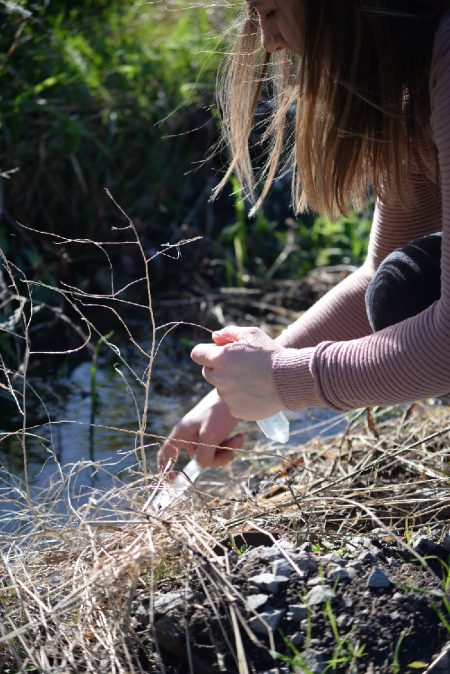
The work generated will be informed by the collaborative process of fieldwork and knowledge exchange. ACE and HAS participants will engage in regular fieldwork, which will take place on site at Honeygar farm, Westhay in collaboration with Somerset Wildlife Trust.

The HAS team will undertake water quality analysis of local water bodies to understand their physicochemical state (e.g. nitrates, phosphates and dissolved oxygen concentrations), as well as identify algal species present. Algal species and any observed blooms shall undergo microscopy imaging (e.g. Light microscopy and scanning electron microscopy) of algal blooms performed by GC. The laboratory work and imagining technology will inform and inspire a portfolio of prints to be created by ACE.

The ACE team will use traditional printmaking and experimental photographic processes to create printed outcomes that investigate and respond to the relationship between land use and aquatic health. The work will use several print processes which respond to the specificity of water bodies investigated and the initial findings gathered through fieldwork and lab analysis. This process will investigate how collaborative practice may create accessible narratives that respond to complex environmental issues.

Through fieldwork and experimental exchange of methodologies within HAS laboratories and ACE printing facilities this project will deliver the following:

  • HAS/ACE Knowledge exchange through collaborative fieldwork will be undertaken. Sample extraction using scientific methodologies and documenting the affected water body through experimental print and photographic means
  • Water samples and documentation will be examined and analysed in laboratories and will inform the printed response that within ACE print studios
  • As a key outcome of the project, the work generated will produce a cross disciplinary exhibition and dissemination event which aims to engage new audiences and demonstrate findings from the ongoing exchange between ACE and HAS.

Research Team

Professor Darren Reynolds HAS
Dr. Gillian Clayton HAS
Niamh Fahy ACE
Sarah Bodman ACE

Centre for Print Research

The centres research into the history and practice of 19th century and 20th Century photomechanical printing also moves beyond the flat surface to 2.5 and 3 dimensions, creating new means and processes for scanning, reproduction, conservation and care of a range of artworks and artefacts including paintings, sculpture, ancient objects, ceramics and buildings.

CFPR has a long history of successful collaborations with artists, researchers, materials manufacturers, galleries and museums, educators and creatives. 

For further information about CFPR click here

UWE Bristol academic wins ESRC Celebrating Impact Prize 2021

Posted on

Dr Rebecca Windemer, Lecturer in Environmental Planning and Design, last week won the Outstanding Early Career Impact award as part of the Economic and Social Research Council (ESRC) Celebrating Impact Prize 2021 for her research on “Influencing policy and debate on end-of-life considerations for onshore renewables”.

The ESRC Celebrating Impact Prize, now in its ninth year, is an annual opportunity to recognise and celebrate the success of ESRC-funded researchers in achieving and enabling outstanding economic or societal impact from excellent research.

Rebecca’s research into the 25-year planning consents that regulate the UK’s onshore wind and solar farms has led to policy change in Wales, greater guidance for local authorities and the wind industry on end-of-life considerations for onshore renewable energy infrastructure, and increased community awareness of the potential to influence the future of local wind and solar sites.

In the context of a global transition to decarbonise the energy system and meet NetZero targets, expanding energy output from renewables is increasingly important. However, space for renewable energy infrastructure is limited and existing wind farms are beginning to reach the end of their operational or consent life. Given tightening planning and land restrictions, keeping consented infrastructure in place is likely to form a key part of ensuring that renewable energy targets are met. There is also potential to significantly increase the energy generated from existing sites through repowering (replacing existing infrastructure with new). However, the context of existing sites and the opinions of local communities may have changed over time. There is thus a need to consider how we make decisions about the future of our existing onshore renewable energy sites, including how local communities are involved in such decisions.

Rebecca commented: “I am delighted to have won this award for my work on planning for the future of onshore renewable energy sites. As our existing wind farms are reaching the end of their planning consent there is an urgent need to consider how we make decisions about their future. These decisions are not straightforward as both the sites and the opinions of communities living close to wind farms may have changed over time.

Directly responding to this challenge, I have used my research findings to help develop planning policy in this area. I have also shared my research findings with the renewable energy industry, emphasising the importance of considering communities over the life of energy developments, rather than only during planning applications. The funding that I have received from this award will be used to further generate such policy and behavioural change, both locally and internationally.”

Find out more about Rebecca’s research. Find out more about the other winners from the ESRC Celebrating Impact Prize.

UWE Bristol researchers seeking dairy farmer input in developing a new way to fight bovine mastitis

Posted on

UWE Bristol academic Alexandros Stratakos is currently seeking dairy farms to work with to develop a new way to fight bovine mastitis.

This project is part of an ongoing collaboration between the UWE Bristol (Dr Alexandros Stratakos) and University of Bristol (Dr Daniel Enriquez-Hidalgo, Professor John Tarlton):

Bovine mastitis is the leading infectious disease of dairy cattle and remains a major challenge to the UK dairy industry. It is the most costly disease for the industry, and affects the welfare of your animals.

Normally treated with expensive antibiotics that can leave residues in milk and lead to antimicrobial resistance, researchers are developing a new preventative method based on cold plasma.

Cold plasma is produced at a very low cost by applying electricity to a gas. This technology is non-invasive, quick, antibiotic, residue and pain free, environmentally friendly and can be applied directly to the cow’s teat.

We believe that this technology can offer significant benefits and we are interested in finding dairy farmers who can help us identify what they need to make this technology work for them. The project will explore: i) the efficacy against microorganisms causing mastitis and ii) the safety of the method on bovine mammary skin and iii) wound healing acceleration.

If you are a dairy farmer interested in helping develop this technology further, please contact one of the team members to arrange a short visit to your farm.

Contact details: