
World Teachers’ Day 2024 – a teacher’s voice.

Posted on

Author: Claire Bowers.

Every year on 5th October, World Teachers’ Day is celebrated across the world to commemorate the importance of the role that teachers play in our lives. This tradition came about in 1962 when Dr Sarvepalli Radhakrishnan, the President of India, suggested that his birthday date be used to honour teachers across the nation. To mark the occasion, we break from our ‘day in the life’ series with a special focus on this year’s theme of ‘teachers’ voice.’ In this blog, Claire Bowers, a Senior Lecturer in Policing at UWE, reflects on her time in teaching. She considers the value and meaning that teachers bring to our lives, and contemplates the changes in police education and their implications for prospective student officers.   

Black and white image of Claire Bowers

Claire originally trained as a teacher in 2007 and has taught in many different educational settings, varying from Post 16 and secondary education in schools, training and development in the Police and Children’s Services, to Higher Education. She specialises in psychology, safeguarding, vulnerability and youth justice.  


Teaching is a privilege

Maya Angelou is quoted as saying “I’ve learned that people will forget what you said, people will forget what you did, but people will never forget how you made them feel.” Whilst the details of our Key Stage 2 history lessons or GCSE maths curriculum may have faded, most of us will always remember that teacher who believed in us, or inspired us to keep going, despite our fears.  

Teaching is one of the oldest professions and one of the most profound. As a teacher you have the power to inspire and motivate. Teaching can ignite a passion that can shape a student’s lifelong interests and career paths, and it goes so much further than that. They help students build confidence, resilience and empathy, teaching life lessons that go far beyond the classroom. They act as role models and their character and behaviour can profoundly influence students’ values and aspirations. Being a teacher is such a privilege and there is no knowing the difference you have made. I have over 15 years of varied teaching experience and it brings me such pleasure to bump into an ex-student who is so excited to tell me about their progress in life and recalls a lesson or moment in our time together than had such an impact of them.  

Radical changes in Police Education

Image of F Block at Frenchay Campus with a quote about professionalising policing and making it more representative.

In 2016, the College of Policing announced that new police officers in England and Wales would need to have a degree from 2020 onwards. This was in line with the ‘Policing Vision 2025’, which recognised policing as a graduate-level occupation and followed a consultation with more than 3,000 responses, of which a large majority of police officers supported accreditation for their professional skillset (BBC News, 2016). This radical change meant that aspiring officers were required to go back into the classroom. For many, this presented an exciting opportunity to earn whilst they learn and receive the recognition and certification that they deserve as professionals in an increasingly complex landscape. However, for some others, the idea of going back into education can be daunting.  

The challenge of education

Research carried out by NHS England in 2023 found that 70.9% of children enjoy learning at school. This leaves a large number of individuals who do not have fond memories of education in childhood. The reasons for this are numerous and highly individual, but could include negative experiences, bullying and feelings of isolation or rejection, anxiety and academic struggles with learning and a sense of failure, as well as sensory overload. Research from the UCL Institute of Health Equity (Rickard, 2018) found that two out of five people with learning disabilities are not diagnosed in childhood.  It is therefore no surprise that the requirement to return to study is not embraced by all.  

Teachers encourage use to keep moving forward

Academia pushes everyone outside of their comfort zone at one time or another. Formal writing, meeting deadlines and submitting work for review can expose our vulnerabilities. Learning to receive feedback and reflect with humility can be difficult at times. A good teacher helps to allay concerns, helping to install self-belief and a growth mindset for those students who lack in confidence. They can help a student to see that there is growth in the discomfort. As Einstein says: “in the middle of difficulty lies opportunity.” All it takes is for the individual to keep aspiring and moving forwards. In the words of Theodore Roosevelt: “believe you can and you’re halfway there.” Thankfully, most of us have felt the benefit of an educator’s belief in us and been spurred on as a result.   

Teaching at UWE Bristol

Image of Level 3 F Block at Frenchay Campus, housing the criminology, sociology and policing departments.

UWE was recently judged as part of the Teaching Excellence Framework Review (TEF) to have “highly effective and embedded teaching, learning and assessment practices that support students’ learning, progression and attainment” (UWE Bristol, 2023). The Policing teaching team draws on a wide variety of policing and criminal justice backgrounds and utilises a range of different assessment approaches to enable learning. However, it is not just the teacher that makes the difference, the learning environment and its approach to supporting learning is crucial. The Policing Department at UWE has excellent facilities and offers an extensive package of support, from study skills to neurodiversity and disability screening to help all learners make the most of their academic potential. This is demonstrated by our recent TEF Gold ‘outstanding’ status awarded for ‘student experience.’  

As teachers in higher education, we are so proud of our student officers’ achievements and are currently welcoming our 25th Cohort to the PCDA. So, if you are thinking about taking the leap and returning to study, go for it! UWE offers a wide range of different policing qualifications. What’s the worst that can happen? You might surprise yourself… 

“Your fate has not been written until you pick up the pen.” – Dean Bokhari


References

BBC News (2016) All new police officers in England and Wales to have degrees. Available from: https://www.bbc.co.uk/news/uk-38319283 [Accessed 01/10/24] 

NHS England (2023) Mental Health of Children and Young People in England survey – wave 4 follow up to the 2017 survey. Available from: https://digital.nhs.uk/data-and-information/publications/statistical/mental-health-of-children-and-young-people-in-england/2023-wave-4-follow-up/part-3-education-services-and-support#feelings-about-school [Accessed 01/10/24]  

Rickard, W.R (2018) A Fair, Supportive Society: Summary Report [online] London: UCL Institute of Health Equity. Available from: https://www.instituteofhealthequity.org/resources-reports/a-fair-supportive-society-summary-report [Accessed 01/10/24] 

UWE Bristol (2023) Teaching Excellence Framework: UWE Bristol provides an outstanding student experience. Available from: https://www.uwe.ac.uk/news/uwe-bristol-provides-outstanding-student-experience. [Accessed 01/10/24] 


Editorial Team

Paul Williamson (Editor-in-Chief); Claudia McCready (Lecturer); Eve Smietanko (Joint Programme Leader & Senior Lecturer); Ian Lowe (Senior Lecturer); Micah Hassell (Senior Lecturer) & Claire Bowers (Senior Lecturer).

If you would like to contribute as a guest blogger, please contact the team at Police.Blog@uwe.ac.uk

You can subscribe to this blog now! Details provided on the right.


Youthful Insights: Exploring Policing at the University of the West of England

Posted on

Introduction by Dr Georgie Benford: Director of Learning and Teaching for Health and Social Sciences

Welcome to our blog today. I am thrilled to share a unique and insightful piece from an exceptional young guest contributor. Katie recently had the exciting opportunity to gain secondary school work experience with the Policing Programme at UWE. This experience provided Katie with a glimpse into the world of higher education and our role in delivering a degree education to the profession of policing.

During Katie’s time with us, she was immersed in various activities, learning directly from professionals and academics who are passionate about Policing. Katie kindly agreed to write a reflection on her experience, which we are delighted to share in this blog. We hope you enjoy reading this as much as we enjoyed having Katie spend a week with the UWE Policing Team.

The truth, the whole truth  

During my work experience I took part in range of different activities. My favourite experience was a trip to the deception lab, which is all about detecting dishonest responses in interview scenarios. I was able to take a few surveys to see if I was able to initially recognise when people were lying. After testing my skills, I got taught how to detect lying and to support truthtellers in these scenarios. It was really enjoyable and interesting because you would think that identifying lying would be easy but during the session I realised that it is so much more complex than you would imagine! This experience really stood out to me because it was also really relevant to my future career as I’d like to become a Police Detective.

Another thing I did during my work experience was helping with a student engagement day. This included supporting the staff and students attending by going on a tour, observing some simulated crime scenes, for example a burglary scenario and attending some training about how to use handcuffs. There was also a talk about the Policing courses on offer at UWE.

Meeting the experts

I talked with a lot of ex police officers during the week; this inspired me a lot. They helped me understand what it was like to be an officer, shared their experiences and helped me learn about Police ethics, which was something new to me. They all helped me develop my knowledge on becoming a police officer, for example they talked about the rank structure and different jobs within the police. I also attended a workshop about drug and alcohol usage and how the students’ union support students to drink safely while still having fun at university.

Coming to UWE for work experience really helped me understand how to get into the Police and it made me look forward to going onto the Police Constable Degree Apprenticeship (PCDA) course. I gained new knowledge about the university and the different courses and I got taught about the student timetable. Throughout the week I have realised more and more that there are a range of different jobs within policing, and its more varied than I thought. There’s something for everyone in the police, there’s forensics involved, psychology and critical thinking; loads of different aspects and choices within one whole career.

Help is at hand 

If you have any questions about a career in Policing, but don’t know how to get there or what specific route to take, or even what role you want to be in I would recommend that you speak to UWE too. I would reach out, ask the staff any questions, and learn about their courses. If you do this, I would 100% say that you’ll have a better idea of the courses and whether Policing is for you.

To sum up my work experience it was really exciting and very interesting. I had a lot of fun hearing about the courses and in particular looking round the simulations and doing the deception lab.

The experience has improved my confidence in talking to new people, and my IT skills but the most important lesson I’ve learned would have to be that putting yourself out there is essential, and it gets so much easier the more you do it.

My advice to someone who’s thinking about doing work experience at UWE is to do it. The hardest part of my week was definitely the first day on Monday. This is because I didn’t really know what to expect and that was overwhelming. Further into the week the less nervous I got. Once you get used to it, it is definitely a really good place for work experience.   Also, I would recommend other student’s to be confident in your abilities and ask questions because, you aren’t going to get judged and people are trying to help you.  They’re doing it for you, so you might as well ask for help.

What I’ve learned   

This week has given me so much more information than I have ever been exposed to, not only about joining the police, but what it is like being in the Police too. I am now more confident in what routes I could to take to get into the Police, which I was uncertain about before. I have identified the training I need to do and I have been able to meet the relevant course leader. This course is my next step to achieving my goal and I am looking forward to progressing.

Here at UWE, we all wish Katie the very best in achieving her ambition of joining the Police. More information on joining can be found here

Editorial Team

Paul Williamson (Editor-in-Chief); Claudia McCready (Lecturer); Eve Smietanko (Joint Programme Leader & Senior Lecturer); Ian Lowe (Senior Lecturer); Micah Hassell (Senior Lecturer) & Claire Bowers (Senior Lecturer).

If you would like to be a guest blogger, please contact Police.Blog@uwe.ac.uk

UWE Policing Apprentice Spotlight

Posted on

Authors: Eve Smietanko and PC Jodie Norris

This week’s UWE Policing blog turns the spotlight on Police Constable Jodie Norris. Jodie is a police officer with Avon and Somerset and is a Police Constable Degree Apprenticeship (PCDA) student here at the University of the West of England (UWE). In the short time since he joined, he has made a big impression. Jodie has taken an active role within the PCDA as a student representative, acting as the voice of the PCDA student body.  He is also a valued member of his response team. Back in March Jodie was nominated for the ‘Officer of the Year’ award. Eve caught up with him to find out how that went, why he loves the job he does and whether he has any tips for new students…

Please tell me a little bit about your career so far.

I originally joined Avon and Somerset Police as a PCSO in 2019, working initially in Somerset West before transferring to Taunton. It was never my intention to become a Police Officer as I really enjoyed the community level work which comes as being a part of the neighbourhood team. However, as my career progressed, I found I wanted to do more. Whilst in Taunton I was very lucky to work with a great team, particularly a PCSO Supervisor named Sharon Baker who was so supportive of my progression. I was a Hate Crime Tactical Advisor and a tutor. A position came up as an acting PCSO supervisor which I applied for and was successful. I enjoyed the training and the role, however felt that it was not the right time for me to be more office based. I started working a lot of overtime, working side by side with response officers and got to see more about the PC role. Initially I was put off by the PCDA programme and having to go back into education, however the more I learned about the programme, the more it started to interest me. Eventually, I applied for the role of a PC and was successful and was lucky to be posted to Taunton working with response Team 3.

As a PC I have undergone a lot of additional training already, I have tried to upskill as much as possible and I have found a bit of an affinity for traffic related incidents. After my time on response, I hope to return to Neighbourhood policing, however the ultimate goal would be to join the Roads Policing Unit before looking at studying to become a Sergeant. I enjoyed my role as a Tutor when I was a PCSO and later in my career hope there is scope to return to training, either within the PDU or something with UWE.

Congratulations on being nominated for ‘Officer of the Year’, the ceremony was held on 12th March, how did you get on?

Unfortunately, I did not win, however I was not disappointed, sitting and listening to all the amazing stories of so many brilliant officers and staff, just to be in the room was a reward it in self. We do not do this role for the thanks; however it is always nice to be recognised.

Could you explain what the award is and what the ceremony was like?

I was nominated for ‘Police Officer of the Year’. The ceremony was glamourous and fun, officers and police staff of all ranks and roles coming together, enjoying an evening of each other’s company, talking about their experiences, having a lovely meal and a drink or two. Everyone was dressed formally and I got to wear the Police No1 uniform, being a tunic. I was allowed to bring along a guest, which was my wife Victoria, who has been so supportive of my journey into policing and I couldn’t have done this without her.

How did it feel to be nominated?

I was shocked to find out I had been nominated but even more to be shortlisted. The final came down to 3 officers. I am honoured to be considered along with the other amazing people; I feel very humbled by the whole experience, especially with so many of my peers approaching me to say congratulations and to wish me good luck.

You have clearly been recognised for your achievements as an officer but what is it that encourages you to keep up the good work?

The main reason I keep doing the work I do, is for my family. I have 4 children and an amazing wife. I want my children to see the work I do and understand that they can make a difference. I want them to be as proud of me as I am of all of them and I’m sure they will go on to do amazing things. I want to help keep the world they live in a little safer.

I also see so many people and families who are not as fortunate to have what I have and if I can help change things, whether that be through removing someone from their lives that harms them, putting in a social care referral or even just being there to hold their hand and say everything is going to be ok, that gives me the motivation to keep going.

Finally, I am extremely lucky to be surrounded by some of the most inspiring people I have ever worked with. I might be biased, but Team 3 Base 5, from front line officers to the custody team are the best. All are extremely hard working and supportive, I don’t think I would have been able to push myself as hard as I have without them.

There is a lot of talk at the moment of morale within policing being low, how do you stay positive and what is your advice to other officers?

Being on response is one of the most stressful jobs I have ever had. policing is certainly not what you see on the TV, with a lot of incidents we attend being more social related than policing. Sometimes you do wonder why we are going to things. We are under constant scrutiny and sometimes it feels like everyone has it in for the police. However, I have often felt it’s the smallest percentage who have the loudest voice. Good news doesn’t sell newspapers, so of course a good news story very rarely gets shared, but so often over my career I have had members of the public walk up to me and thank me for my service and this just reminds me that we do still have the support of the public. One of my favourite parts of this job is when you see a child smile and wave and they seem to be excited to see a police officer.

If I had any advice for other officers, it would be to just remember, we only really deal with people at their absolute lowest point and most of them are not happy to see us. We are either arresting them, detaining them under 136, stop searching etc or ruining their evening by telling them to go home after having a few too many drinks. In very few other jobs, do the people you deal with have an instant distain for you. However, this is only the smallest percentage of the population. If you think about all those victims we’ve helped, those people we’ve pulled off bridges, that social care referral that gives a child that better life etc, it really makes it all worth it.

You joined the police through the PCDA programme at UWE. How do you think this experience helped you become a good police officer?

Before my first day at UWE, it had been 23 years since I was last time I was in education and I was very nervous, however I have found the UWE side of role surprisingly enjoyable, not just learning about the laws and legislation, but about why these things exist.  The history of policing and how / why things progress as society changes. I often feel a lot better equipped to deal with my role thanks to this background knowledge I have gained from my studies. I have particularly enjoyed learning about the reasons why individuals commit offences and early intervention / preventative measure we can do.  I am now 18 months into my role as a student officer. I am both a cohort rep and the whole PCDA / DHEP programme rep. I am looking forward to completing my degree over the next 18 months.

We would like to thank Jodie for sharing his journey on the PCDA at UWE Bristol. His dedication and commitment to both studies and operational delivery are truly inspiring and his story not only highlights the challenges and rewards of this path but also serves as a motivating example for future apprentices. We greatly appreciate Jodie’s openness and the insights provided and wish him and all UWE PCDA apprentices the best of luck as they continue to grow and make a positive impact in their policing careers.

Editorial Team

Paul Williamson (Editor-in-Chief); Claudia McCready (Lecturer); Eve Smietanko (Joint Programme Leader & Senior Lecturer); Ian Lowe (Senior Lecturer) & Micah Hassell (Senior Lecturer).

mail sign

If you would like to contribute as a guest blogger, please contact Police.Blog@uwe.ac.uk

The idea of extreme ownership and how it is relevant to Policing.

Posted on

Author: Ian Lowe UWE Bristol

smart icon of a pencil

This week’s blog, from Senior Lecturer Ian Lowe, focuses on the idea of extreme ownership and how the concept may apply to policing. Along with his varied background within public services, and interest in coaching and leadership, Ian’s exploration originally stemmed from reading. His blog explores how, in a sector where ‘blame culture’ resonates, this theory might evoke reflection from those within on their decision-making and responsibilities.


The theory of extreme ownership

Have you ever asked/told someone to do something, and they have not done what you asked. Did you ask yourself why? Or did you just assume they didn’t get it. The idea of extreme ownership is the idea that if someone did not understand you. It is down to you and your inability to describe what is needed in a way they understand. Simply put, you did not explain yourself clearly or in a way that the individual could understand.

Stick person with a megaphone

I have long believed that, where I set a task in a group setting and only one group doesn’t carry out the task, then they were probably not listening. If two groups are not following instructions, I have to start questioning what I said. If three groups are struggling, it is clearly my fault. My communication was not good enough or clear enough and I need to rethink and adjust my style and my explanation. Maybe even restart the task.

It’s not my fault.

We hear this so often, people refusing to take responsibility for their actions and the actions of others that they have leadership responsibility for.

Extreme ownership.

Volatile increase on chart

This is an idea I have taken from Americas Navy Seals, a special forces unit and part of the US Navy. I have run with it a bit. But these ideas where originally tested in violent conflict situations in Iraq and have stood up to high levels of scrutiny and extreme pressure. This is where the term extreme comes from. You could easily argue that it could be utmost; maximum; high; ownership. It embodies the idea that this is not always the norm, and we are holding ourselves to an extremely high standard.

Extreme ownership is a leadership concept, which tells us to take responsibility for our own actions, and the action of others who we have had direct contact or influence over this includes being accountable for the actions that we have taken or the words we have spoken or written to others. We often read that we live in a blame culture. In my mind what this means is people are not accountable or refuse to take ownership for their words and actions. If a team, we have briefed to carry out an action (say execute an arrest warrant for instance) and something goes wrong. Is it the teams fault, or is it your fault for not ensuring the team fully understood the brief and you had included all the necessary contingencies and overall intents of the mission. I accept there can be dichotomies in a situation like this. It is important that the team understands clearly the tasks intents and has a level of autonomy to carry out what is required. But also fully understands the limit of what they are able to do.

Mistakes were made. But not by me.

One of the most obvious examples in modern culture is politicians who never seem to take true ownership always finding an ‘angle’ a way of blaming something or someone else. As a colleague of mine from PSD used to say, ‘they give the Priti Patel apology, I’m sorry you feel that way.’ This does work and can placate the situation. But does it show that you have taken ownership, taken responsibility, that you are genuinely sorry for the mistake and the resulting problems. Or when looked at closer are you just saying that you accept the individual is not happy, but that is not your problem?

As responsible professionals should we not be prepared to take ownership for our actions. I would potentially argue more so in the current media climate. Demonstrating clear honesty and integrity. I am pretty sure the Code of Ethics from the College of Policing explicitly states this.

If you are late. Is it the traffic or did you just not allow enough time.

Is the student officer you are working with really struggling or have I just not made the effort to understand and engage in a way that supports and enables them.

Was the drive to work today full of idiots. Or is the common factor me and my driving was not as good as it could have been.

We need to take extreme ownership and understand just how much of what we are involved in is OUR responsibility. How we do things, the clarity of our communications. I am not asking you to take the blame for everything. But to understand that by changing our perspective on events we can start to realize how much influence we have on the people and interactions around us. We can stop the continual self-justification of events that we can find ourselves in. The search to find a scapegoat or an excuse to validate or support our decision, so that we can accept them or so we can make others accept them (remember what sounds like a reason to you is often seen as an excuse by others).

three stick persons with lightbulb above their heads

Once you take this idea and absorb it fully it is freeing. Your perspective changes and you accept if the CPS turns down your case file, it is because you did not include enough clear and detailed information to reach the charging threshold. Extreme ownership also helps you to think ahead to prevent such problems before they happen. We start to realize and understand our own cognitive dissonance. That we know what we did was not quite right, but we are going to try and believe we did right anyway. Holding these two opposing ideas is exhausting, and the self-justification required is hard work. The smoker who knows smoking is bad for them but justifies vaping as a type of quitting. ‘Cuz it’s not as bad?’  

None of these ideas are new, as said above they are part of the Code of Ethics and should be at the centre of all the decisions made.

  • Accountability: You are answerable for your decisions, actions and omissions.
  • Integrity: You always do the right thing.
  • Objectivity: You make choices on evidence and your best professional judgement.
  • Openness: You are open and transparent in your actions and decisions.

Extreme ownership is also included in many forces’ visions and values. West Mercia Police actually has ownership as one of its values. Surely part of Avon and Somerset Police’s mission of Outstanding policing for everyone. Owning our actions and their results is included within that even if not stated.

Finally. If we know we have done all we can to help; support; explain to others what is required and tried every avenue. When the point comes that no more can be done, then we can be satisfied we have done the right thing.

As leaders, true leaders, we can share in the success of our teams but understand We take responsibility for the failures.


Student Surveys

You can access the National Student Survey here.


Year One and Two students can provide anonymous feedback on their course here, or by scanning the above QR code.


Editorial Team

Paul Williamson (Editor-in-Chief); Claudia McCready (Lecturer); Eve Smietanko (Joint Programme Leader & Senior Lecturer); Ian Lowe (Senior Lecturer) & Micah Hassell (Senior Lecturer).

mail sign

If you would like to contribute as a guest blogger, please contact Police.Blog@uwe.ac.uk

Read our previous blogs below

Collapsible

Why Trauma-Informed Leadership Is Important in Policing
How can today’s police leaders support a workforce routinely exposed to trauma while maintaining professional standards and accountability? In this …
Passionately curious: Bridging Theory and Practice in Police Education
How can police education successfully connect academic theory with the realities of operational practice? In this latest UWE Bristol Policing …
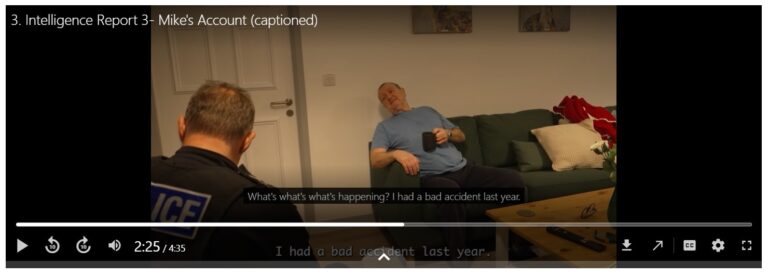
Photo shows body worn camera footage of Martin Fox (Police Officer) and Charlie Downes (Mike).
In this week’s blog, Claire Bowers, Senior Lecturer at UWE, reflects on an innovative collaboration with UWE’s New Wave Agency …
In this powerful and reflective blog, Imogen Hirst, Senior Lecturer on the Policing Programme at UWE Bristol, reflects on the …
May 2026 Taking trauma-informed practice to St Helena The British Overseas Territories police, do not benefit from the degree-level education …
This week’s blog is written by Sarah Williams, Associate Director in Policing at UWE Bristol. In this article, Sarah reflects …

Finally, some good news!

Posted on

This week sees UWE Bristol wind down for the Christmas period, with the campus set to close between Friday 22nd December 2023 – Tuesday 2nd January 2024.

It has been a busy year for most, with some of the highs covered by Eve below. January 2024 brings the marking of March 2021’s dissertations and their End Point Assessments, we wish them all the best of luck and look forward to seeing their hard work pay off. We warmly receive some existing apprentices back on the 2nd January, with a new cohort of first year apprentices joining us the week after. This pace continues throughout the year and your academic team are excited for the times ahead.

Image of Eve Smietanko

We know that most of you will be busy over the festive period – turning up at work when it feels like the rest of the country remain at home with loved ones – all in aid of keeping your communities safe. Look after one another and stay safe. A heartfelt thank you to all of those that are working over this period and for the continuous hard work you all undertake 365 days a year, 24 hours a day.

This week’s blog is written by Eve Smietanko, a senior lecturer on the PCDA programme and programme lead for Law and Criminology. Eve has been collating positive news stories around the Criminal Justice System in the hope that it will show you that the hard work you do is recognised and making a difference.

Over to Eve…


The good news stories

It can be easy as a police officer to feel that the world is a dark place, and that what you do, day in, day out, makes little difference. There is pressure from all sides to do things differently, decisions made in split seconds are scrutinised and analysed and every person has an opinion on what was done wrong. It can be easy to feel the weight of the world on your shoulders and to believe that world is awful; where the bad guys win and good guys get criticised. Does this all sound familiar?

Well you will find none of that here. This post is for good news. Take five and let me remind you of a few of the many positive, inspiring and hopeful stories that may have passed you by.


Support for firearms officers

In September many firearms officers laid down their weapons due to concern of how they would be treated if they did need to pull the trigger, and the impact this would have on their families. It was positive to see both leadership within policing, politics and the public standing by officers, who had chosen not to carry. Sir Mark Rowley wrote in an open letter to the (then) Home Secretary that ‘[armed officers] are extremely well trained’ and that ‘we have one of the safest models of armed policing in the world’ (Rowley, 2023).

Icon of two hands shaking in collaboration

Avon and Somerset armed officers have in recent weeks had praise from the public on a number of jobs they have dealt with courageously and professionally. There are many out there who see and acknowledge the huge responsibility that is placed on our officers to make life-changing decisions in a matter of seconds. You are appreciated.


Robber turned runner

Ever feel like you’re just churning people through the criminal justice system with no hope of any change? Thankfully this is not always the case. John McAvoy, who is now known for being a triathlete, previously served a lengthy prison sentence for armed robbery. Whilst in prison he began training hard in the gym and, with the encouragement of a prison officer, Darren Davis, started beating records. Since his time inside he has become a professional athlete, and more recently a mentor to young people.

McAvoy has teamed up with a charity, Youth Beyond Borders, to train, coach and support young people from disadvantaged backgrounds to compete in trail running. There has long been an acknowledgement that nature, exercise and wellbeing are interlinked. Many of us take our ability to utilise the outdoors for granted but not all have this opportunity. As we know within policing and McAvoy surely knows himself, the connections you make in your childhood can have a huge impact, both positive and negative for the rest of your life. Despite McAvoy not having a great role model growing up, he is now trying to be one for young people across the country. It is worth remembering that he did not get to this point alone, he met encouragement and support along the way, like Darren Davis the prison officer. Without this he wouldn’t be where he is today helping other young people who could be in danger of making the same choices he once did. You too can be the difference.

Icon of stick male running

 The armed robber turned runner helping young people go straight – Positive News

John McAvoy interview: Former criminal turned Ironman (redbull.com)


Right Care, Right Person

When you ask most officers why they joined up they will say something along the lines of ‘to help people’. We know that being a police officer isn’t all about fighting crime but we also know that for many years now that the policing time and resource being put into mental health calls has been increasing. Dealing with people struggling with their mental health is becoming an increasingly common tasking. Whilst this is frustrating for officers it is potentially damaging for those who need mental health care and support. We do however appear to have reached the tide of change.

‘Right Care, Right Person’ (RCRP) was first introduced by Humberside Police in 2021 and since then has been rolled by a number of other forces throughout the country. The College of Policing has now issued national guidance on the scheme and the projections are that this could save up to a million police hours per year. This should mean that vulnerable people are getting the help they need and officers have more time available to them to investigate crime, build relationships with the community or any of the other invaluable actions you take.

Image of brain with neurons

Right Care Right Person – police adopt new national model re specialist care for health incidents – Policing News

Right Care Right Person (RCRP) national guidance launched | College of Policing


Court convictions

Over the last few months Avon and Somerset have got some great convictions at court. There have been several large-scale drugs convictions including eight men sentenced for a total of 36 years in relation to a county lines network. More recently three men have had their prison sentences for robbery increased.

Bristol robbers’ sentences increased | Avon and Somerset Police

Eight men sentenced for total of more than 36 years for drug offences | Avon and Somerset Police

Icon of scales of justice

It is easy for us to see the end result and forget about all the hard work that has gone on along the way. The big stories that hit the headlines often feel detached from the officers on the street but that couldn’t be further from the truth. It is those officers who gather intelligence, build rapport and begin the investigation when everybody else has gone to bed. In order to get a conviction at court, the silver thread of a quality actions has to be there throughout the investigation from beginning to end. It is with meticulous record-keeping, excellent decision-making and brilliant communication that people like those I have mentioned above have been put behind bars. It is also worth remembering that really, this isn’t the end goal. While the aim is to get a conviction, the purpose is to protect the public. To get drugs off the street, to allow people to run their business in peace, or whatever else it might be. Without our officers on the ground none of this would be possible.  


Good News from UWE

Icon of shining star

The PCDA has been subject of an Ofsted Inspection and an End Point Assessment Quality Inspection, both achieving ‘Good’ status. Our key partner Avon and Somerset Police (ASP) were ranked 75th in the Department for Education’s Top 100 Apprenticeship Providers and UWE was listed in the Top 20 ‘Rate my Apprenticeship’ providers. With the PCDA representing over 25% of all UWE apprentices, these accolades reflect our growing reputation. In addition, a PCDA apprentice won first prize for their research project at the 2023 Social Sciences Student Conference, evidencing academic excellence. In April 2023, Avon & Somerset Police celebrated growing from 2,835 operational officers to 3,393 since July 2019, exceeding the Uplift target and reflecting the popularity of the programme. Overall, the National Student Survey 2023 scores showed improvements in all areas of the PCDA programme in 2023 compared to 2022. The majority of areas saw double-digit increases compared to 2022. The programme is determined to build further on this positive direction of travel.

Our very own Dr Anne Eason – along with UWE colleagues Professor Kieran McCartan and Dr Sarah Senker – presented the early findings of their research at the NOTA conference this year.  Their research looked at how male perpetrators of sexual offences can be supported to address their own trauma. There will be more on this to follow in the year ahead. As well as this there are many other research and writing projects currently under-way in the Policing team which hopefully will be published and presented in 2024. Remember, your research journey doesn’t have to end with your dissertation! If there is more you would like to discover then keep in touch!

Information about Anne Eason, Keiran McCartan & Sarah Senker's early research findings presented to NOTA this year.

A final round-up

So there is my round-up. There are many stories I haven’t included, some because I haven’t got the word count and some because they have been told to me in confidence but take it from me, you are doing a fantastic job. Policing is difficult and it is easy to feel under-valued so on behalf of the many, many people who are grateful for what you do, I want to say thank you. You make the difference, and we know it.

Useful links

Avon and Somerset Police (2023) Bristol robbers’ sentences increased. Available from: https://www.avonandsomerset.police.uk/news/2023/11/bristol-robbers-sentences-increased/ [Accessed 18 Dec 2023].

Avon and Somerset Police (2023) Eight men sentenced for total of more than 36 years for drug offences. Available from: https://www.avonandsomerset.police.uk/news/2023/10/eight-men-jailed-for-total-of-more-than-36-years-for-drug-offences/ [Accessed 18 Dec 2023].

College of Policing (2023) Right Care Right Person (RCRP) national guidance launched. Available from: https://www.college.police.uk/article/rcrp-national-guidance-launched [Accessed 18 Dec 2023].

Eason, A & Senker, S. ‘Dual identity’ and the forgotten trauma in the histories of people who have sexually offended [research presentation to NOTA Conference] . Cardiff. 3 May. Available from:https://www.nota.co.uk/wp-content/uploads/2023/07/NOTA-presentation.pdf [Accessed 18 Dec 2023].

Metropolitan Police Services (2023) Commissioner letter to Home Secretary 14 September 2023 [online]. Available from: https://news.met.police.uk/documents/commissioner-letter-to-home-secretary-14-september-2023-dot-pdf-434982 [Accessed 18 Dec 2023].

Policing News (2023) Right Care Right Person – police adopt new national model re specialist care for health incidents. Available from: Right Care Right Person – police adopt new national model re specialist care for health incidents – Policing News [Accessed 18 Dec 2023].

Positive News (2023) The robber turned runner helping young people stay on the straight and narrow. Available from: https://www.positive.news/lifestyle/sport/the-robber-turned-runner-helping-young-people-go-straight/ [Accessed 18 Dec 2023].

Red Bull (2023) The incredible story of John McAvoy, armed robber turned top triathlete. Available from: https://www.redbull.com/gb-en/john-mcavoy-from-iron-bars-to-ironman [Accessed 18 Dec 2023].

Editorial Team

Icon of paper plane for email

Paul Williamson (Joint Programme Leader & Senior Lecturer); Claudia McCready (Lecturer); Eve Middleton (Tripartite Assessor – Policing); Eve Smietanko (Joint Programme Leader & Senior Lecturer); Ian Lowe (Senior Lecturer) & Micah Hassell (Senior Lecturer).

If you would like to contribute as a guest blogger, please contact Police.Blog@uwe.ac.uk

Becoming An Evidence-based Police Practitioner

Posted on

This week’s blog is written by UWE Bristol Policing programme Senior Lecturer Gary Stephens. Gary served in Avon & Somerset Police as a Detective Chief Inspector prior to joining UWE Bristol where he is the module leader for ‘Becoming an Evidence-based Police Practitioner’ on the Police Constable Degree Apprenticeship (PCDA).

There is general consensus that Evidence-based Policing (EBP) is the development of knowledge, which is shared to inform operational practice. Working together with Avon & Somerset Police we seek to blend the best of policing craft with the science of ‘what works’. This is important because traditional models of policing no longer appear to provide the answers to a lot of current and future policing problems. Having recently attended the Society of Evidence Based Policing (SEBP) annual conference, Gary reflects on the key learning from this event.

Society of Evidence Based Policing (SEBP) annual conference

Over the 9 – 10 November, the SEBP held their annual conference at the College of Policing in Ryton. The SEBP are insiders, they are predominantly police officers with day jobs who are committed to nurturing change from within their organisation by developing knowledge, practice and performance utilising Evidence Based Policing.

Attending the conference were UWE policing staff Associate Director Dr Anne Eason along with Senior Lecturer Gary Stephens. Amongst the over 130 other candidates were representatives from forces and organisations from around the country, and internationally, including Inspector Alecto Shyne and PS Sue Coates from the Avon and Somerset Inspection and Evidence Based Policing Team.

The title of the conference was:

The importance of focus: How can evidence based policing drive precision policing?

The conference was opened by the SEBP Chair T/Chief Constable Alex Murray of West Mercia Police who introduced the variety of speakers delivering presentations over the two days. A consistent theme was the importance of modern policing being data led and optimising the principle of ‘what works’.

The College of Policing are at the forefront in using evidence led policing and Director of Knowledge and Innovation Rachel Tuffin outlined recent developments, most notably the practice bank, which complements the longer standing Crime Reduction Toolkit. The practice bank shares crime prevention and community safety best practice initiatives developed across the country to assist officers in their own local problem solving.

Speakers spoke of subjects ranging from crime satisfaction, focused deterrence to using vetting data to understand the more prevalent characteristics of those who go onto be subject of gross misconduct proceedings. Whilst there was a wide range of speakers there was one consistent theme, the importance of using data to produce a deeper understanding of what works and to utilise this as evidence to inform practice.

So what did we take specifically from the two days?

The material from all speakers was valuable but what we found most interesting is how EBP is constantly developing and how we can all contribute to it. For example, we now know that, under certain conditions, hot spots policing works. One of these conditions is optimising the time officers (or PCSOs) are present in a given hot spot (The Koper curve theory). However, a study in Leicester based on hot spot patrolling areas of potential disorder has developed this principle further. In partnership with the Youth Endowment Fund youth outreach workers were employed to be in hot spot areas and engage with youths to prevent disorder. During this time they sought to engage those youths in diversionary interventions, something EBP tells us works. But to follow Koper’s 12-16 minute rule would not enable them to engage, so the patrols were extended, often in excess of 50 minutes, which allowed them to nurture conversations and engage with potential offenders.

The conference was closed by Professor Lawrence Sherman, the leading architect and proponent of EBP who outlined the need to move from the 3R’s (random patrol, rapid response, reactive investigation) toward the 3Ts (targeting, testing and tracking). As well as reflecting on where EBP was and where it is now he outlined his vision of the next steps for it. As Chief Scientific Officer for the Metropolitan Police he took an active role in an initiative that was recently launched to target the serious amount of violent harm against women and girls in London. With limited resources the police must focus their resources on those who present the most harm. A top 100 list, ‘the power few concentration’ was produced. Having identified the top 100, a key tactic used was application for Sexual Risk Orders. If the application is successful, this order places stringent conditions on subjects. In the short time since this initiative has been running an impressive 85% reduction in offending has been identified.

Professor Sherman suggested that future steps for EBP could be in adopting these principles of ranking and stacking relative risk, and further utilising the principle of the 3T’s, in categories such as repeat burglary, ASB 999 calls, police misconduct and others. If adopted this could lead to what he described as not doing more with less, somewhere policing has found itself in recent years, but doing less with more.

What can you do?  

  • Join the SEBP, it’s easy, just go online and join. You will receive regular e mails of evidence-led studies and initiatives and you will have access to all resources.
  • Look out for the posters around campus with QR codes you can click on to provide direct access to the practice bank amongst other resources.
  • Be that evidence led practitioner – it works! As a practitioner guided by evidence, integrate its effectiveness seamlessly into your daily operations for your specific purposes. Embrace the principles, customise them to your context, and employ them to focus on your objectives. Shift from perceiving it as an abstract concept; it’s increasingly becoming standard practice, and we need to fully harness the principles of EBP in contemporary law enforcement.

Editorial Team

Paul Williamson (Joint Programme Leader & Senior Lecturer); Claudia McCready (Lecturer); Eve Middleton (Tripartite Assessor – Policing); Eve Smietanko (Joint Programme Leader & Senior Lecturer); Ian Lowe (Senior Lecturer) & Micah Hassell (Senior Lecturer).

If you would like to contribute as a guest blogger, please contact Police.Blog@uwe.ac.uk

Taking Youth Work Week 2023 as a moment to pause & reflect on our work with children.

Posted on

Welcome to the latest UWE Policing blog, where we’re excited to celebrate Youth Justice Week. At UWE Bristol, we take immense pride in our commitment to cultivating a diverse and expert Policing Programme. As we delve into the important discussions surrounding youth justice, it’s crucial to acknowledge the ever-growing diversity within our teaching team.

This week’s additional blog is written by Claire Bowers in light of Youth Work Week 2023. Claire recently joined us as a Senior Lecturer and brings a wealth of experience and expertise of working in various fields reflecting the real-world complexity of policing in today’s society. With experiences ranging from community policing, probation and risk management to tackling international organised crime, our programme teaching team is uniquely positioned to equip our students with a comprehensive understanding of the challenges and opportunities in modern law enforcement.

As we celebrate Youth Justice Week, we invite you to explore the perspectives, insights, and initiatives shared by Claire.


Shining the spotlight on our staff…

Senior Lecturer, Claire Bowers joined UWE in 2023 having spent an impressive and varied career within the Criminal Justice System. Claire brings extensive experience in crime reduction initiatives, prisoner rehabilitation, and youth justice diversion and preventative work – including specialisms in safeguarding, harmful sexual behaviour and trauma informed working, as a Manager of North Somerset Youth Offending and Prevention Service. Claire is also a passionate advocate for young victims of crime and domestic abuse having managed Avon and Somerset’s Young Victims Service for four years. Claire holds two masters with distinction in Psychology and Criminology & Criminal Justice, and has a varied and expansive teaching career.


This week is Youth Work Week.

This week is Youth Work Week, and so it seems the perfect opportunity to shine a light on the important work carried out with children by the youth work sector, as well as taking a moment to contemplate the current challenges facing children and their families and our approach to working with them.

Blue icon of laptop and internet.

We are living in uncertain times, with the cost-of-living crisis, living through a pandemic and the rise of technology and social media to mention just a few. In their 2022 report, Barnados highlighted the top issues facing young people from a practitioners’ perspective. This included increasing mental health issues and insufficient support, poverty and financial instability, potential exposure to sexual exploitation and online abuse and lack of safety and cohesion in the home.

Blue icon of male. female and girl.

This is a very real threat for children as one in seven will have lived with domestic abuse at some point in their life (Radford, 2011) and domestic abuse related crimes increased 7.7% in 2022 (ONS, 2022). Every generation has its struggles, however, the children of today are facing a unique set of challenges. However, despite these concerns youth services such as youth clubs and youth workers have been cut by 69% since 2010 (Local Government Association, 2023) and children’s services have never been under more pressure. 


Representations

Blue icon of downwards statistics.

Negative representations of young people is commonplace (Guardian, 2004). However, the statistics show that youth crime rates have consistently been in decline for many years (ONS, 2022; ONS, 2023) . Most children are not involved in crime, and those who are, still spend much of their time leading law-abiding lives. Working with children can be challenging at the best of times, however it is a child’s job to push boundaries! Ask any parent coming towards the end of the summer holidays, let alone the police officer who is having to deal with repeated incidents of anti-social behaviour and disrespect. That being said, I am sure we can all reflect back and think of examples of behaviour from our younger selves that we would rather forget.

Working with children requires a specific attitude and skill set. Youth workers often adopt a PACE approach (Hughes, 2006). Standing for playfulness, acceptance, curiosity, and empathy, the focus is on building rapport and high-quality relationships. Maturation of the brain is not accomplished until 25 years old (Arain et. al, 2013).

The law is clear. The term ‘child’ is preferred practice for any young person below the age of 18 (CPS, 2023). A young person may well look and act as if they are an adult, but they are not and we must not treat them as such. Children that do come to the attention of the youth justice system should be seen as children ‘first’ and ‘offenders’ second” (CPS, 2023). This recognises that children may make mistakes, but this should be viewed through a rehabilitative lens, rather than a punitive one. Research outlined in the The Punishing Abuse report (Chard, 2021) argue that 9 in 10 children in the youth justice system are known or suspected to have been abused, with 7 in 10 having lived with domestic abuse (MOJ, 2013). Over 60% of people in youth justice estate have difficulties with speech, language or communication (Gateshead Council, date unknown).

Icon of 5 hands touching

Youth work emphasises education, mentorship and support to help guide children away from criminal behaviour and contribute to their positive development. The primary focus is on prevention, diversion and early intervention to avoid criminalisation of children.


What can we do to support young people?

So what can we do to support young people? In their book “the power of showing up” Dr Daniel Siegel and Dr Tina Bryson outline 4 fundamental needs for children. First children need to feel ‘safe’.  When children feel unsafe, they are not able to access their upper ‘thinking’ brain. They go into survival mode. Children who have experienced trauma may already be hypervigilant and struggling to self-regulate, having learned to always be on the lookout for danger. Once they know that they are safe, the young person has access to more resources to enable them to cope and manage their behaviour. Tone of voice and body language is key. Anxiety will be reduced by slow movements and a gentle voice.

The second factor is being ‘seen’. In children, behaviour is communication and language matters. Being curious about what is happening for a young person and viewing them through a trauma-informed lens helps us to help them. Are they ‘not engaging’ or do they simply not feel safe enough to engage?

‘Soothed’ is the third need and this is based on the adult- child interaction. Children need to learn how to self-soothe through modelling by adults. Letting children know that we are there for them and we want to connect with them is fundamental. This can be achieved through being calm, actively listening to them, showing empathy and offering strategies for ‘brain breaks.’ The final ‘S’ is ‘secure’. This means showing up for the child and being a ‘safe base’. It can take time for a young person to trust, especially if they have learnt that people let them down. Youth workers show reliability by agreeing a time and place to meet and ensuring that they are there every week, even if the young person is not. Over time, trust can be established and meaningful interactions can take place.

Blue icon of footprints.

It sounds like a cliché (or the lyrics from a famous song) but children literally are our future. Whilst youth work week specifically recognises and celebrates the achievements of youth workers in particular, these are not the only people that have an impact on a young person’s life. Police, teachers, social workers, and doctors to name but a few, all leave footprints on a young person’s journey. We all therefore have a responsibility to consider what type of imprint we want to make.


I will leave you with the words of trauma specialist, Dr Karen Treisman (2020):

“Every moment and interaction can be an intervention…can be change agents…Every moment has the potential to open a door or to close a door.”

Dr Karen Treisman, 2020.

Helpful Resources

Arain, M., Haque, M., Johal, L., Mathur, P., Nel, W., Rais, A., Sandhu, R., & Sharma, S. (2013). Maturation of the adolescent brain. Neuropsychiatric disease and treatment, 9, 449–461. https://doi.org/10.2147/NDT.S39776

Hughes, D. (2006). Building the bonds of attachment: Awakening love in deeply troubled children. Oxford: Jason Aaronson

National Youth Agency – Youth Work Week 2023


Editorial Team

Paul Williamson (Joint Programme Leader & Senior Lecturer); Claudia McCready (Lecturer); Eve Middleton (Tripartite Assessor – Policing); Eve Smietanko (Joint Programme Leader & Senior Lecturer); Ian Lowe (Senior Lecturer) & Micah Hassell (Senior Lecturer).

If you would like to contribute as a guest blogger, please contact Police.Blog@uwe.ac.uk


Guest blog by Tom Andrews: Reflections on the Degree Entry Route into Policing

Posted on

Introduction

In the ever-evolving landscape of police education, it is crucial for policing professionals, academics, and aspiring officers to gain a deeper understanding of the current and emergent trends.

This year, I had the privilege of meeting Tom at the Policing Education Conference at Liverpool John Moores University and he graciously agreed to contribute a blog post for UWE Bristol. Tom is a lecturer in Policing at Derby University and in this blog shares a personal perspective on his own educational and professional journey which offers a valuable reflection on the past, present, and future of police education.

As we navigate the shifting landscape of the Police Constable Entry Routes and new ‘optimisation curriculum’ it is imperative to consider the significance of continuous learning and how education can empower police officers to make a meaningful difference in their communities.

Tom’s blog provides a thought-provoking insight and valuable lessons for both those entering the profession and experienced officers seeking to enhance their skills and knowledge through the ‘Top Up’ degree at UWE Bristol (featured in a recent blog). It is a testament to the importance of building bridges between academia and the real world of policing, creating a network of professionals dedicated to advancing the field through education and innovation.

Over to Tom…

Tom’s reflections

I’m honoured to have been asked to complete this guest contribution to the UWE Policing Blog, after chatting with several of the excellent lecturers there. I’ve written quite a bit on both PoliceProfessional and PolicingInsight around my thoughts of the Police Entry Qualifications Framework (PEQF) aka the degree entry routes into policing. I wanted on here to do something different, and to share my own journey with those entering or undertaking the current entry routes, with my reflections. Like any good reflection, I will be framing this around a recognised model, and my personal favourite is Rolfe et al.’s (2001) model, both for its simplicity and requirement to look forward.

Tom Andrews – Lecturer in Policing at the University of Derby.

What?

I joined the police in 2008 (with a pre-existing degree in History) under an IPLDP+ scheme, during which I undertook the majority of my training at my force headquarters, but attended a local further education (FE) college once or twice a week in uniform but with no PPE or radio etc. There we would learn the more theoretical side of policing such a criminology, while we learned the legislation and policy aspects at force training school. Looking back, the learning delivered by the professional educators was by-and-large far more engaging than that delivered by training school; where the legislation was simply learnt by wrote. I even vividly remember (in the very early days of social media!) making comment about the boring training school aspect on Facebook, and receiving suitable words of advice from the training school sergeant…

After the initial six months classroom-based (force and college) learning, we would regularly return every three months or so for a week’s additional input from the college. During these weeks we were set essay and presentation assignments to write in our own time (no protected study leave at all). We also had a SOLAP to complete (FOC’s in today’s terms), where we had to write all the reports ourselves. No doubt this method of learning sounds very familiar to those of you reading this! That is a key reason why I am particularly vocal about maintaining the current routes, as they don’t represent a radical departure from some of the old ones!

I ‘graduated’ training with a Foundation Degree in Policing (at level 5, equivalent to finishing two years of university); with an option to pay for a further year’s study at our own expense, to complete a full degree in Criminology and Policing. (I didn’t take this up as I had a degree already and didn’t have the money to pay.)

So What?

At the time of my initial learning (I specifically don’t use the term training, as the FE college input took it beyond that into education / learning) and for long after, I simply couldn’t see the value or purpose of the FE input at all. I spent five years on response, where indeed the need for that wider knowledge around criminology and crime prevention was very limited. This was even more true at that time at the height of target-driven policing based around arrests and detections – at most it may have helped me classify some D&D’s as Section 5’s to gain a bonus detection.

It was when I applied for a job on neighbourhoods that some of my previous learning came from the dark recesses at the back of my head. Vague rumblings about a triangle for problem analysis, stemming from a problem-solving model with a girls name – yes, you guessed it, SARA and PAT! I dug out my old lecture notes (yes, I’d kept them in my loft, I know…) and brushed up on various aspects of criminology and crime prevention that might be useful for neighbourhood policing. I beat a field of several candidates at interview to land the job, and it was here, using my regained knowledge of criminology and specifically problem-solving, that I can honestly reflect on and state confidently, was where I had the most impact on society during my career. I didn’t just rush to jobs and put sticking plasters on situations as I had on response. I actually not only identified, but solved problems that were causing real issues to my local community.

My two most notable examples are using brand new powers (for 2014) under the Antisocial Behaviour, Crime and Policing Act 2014 to issue Community Protection Notices to a local Urban Street Gang who were continually loitering on one street creating misery for the residents, and thereafter never seeing them again. Secondly, using the same pioneering powers, combined with obscure sections of the Misuse of Drugs Act 1971 and crucially partnership working powers with Trading Standards, to execute warrants and seize and ultimately destroy tens of thousands of pounds worth of so-called ‘legal highs’ or new psychoactive substances; several years before they were made illegal. This latter operation saw me gain attention from police forces nationwide, and had the College of Policing’s ‘What Works’ centre or Going Equipped journal existed at this time, would have been written up on there. Neither of these I believe would have been possible without use of SARA and PAT, and the associated learning around multi-agency working I had undertaken at college.

Now What?

For various reasons I left the police in October 2020 as a sergeant on response. I loved the role, having responsibility for supervising other officers and making decisions. The part I loved the most however was developing those on my team – arranging training, attachments, and supporting applications for other departments for where they could make best use of their talents. I would also regularly take the various team members out with me on patrol, hosting informal one-to-one’s and also sharing some of my policing knowledge and experience. I even supervised three of the country’s first PCDA officers so learnt well the demands that operational and educational expectations place on them.

I ultimately realised that I preferred this part of the job to the actual policing part, whilst simultaneously recognising – through personal, local and national reasons – that policing was not in a healthy place. I wanted to be a part of that change. I therefore took a job up as a lecturer delivering the PEQF to new recruits. It was only a few weeks into the role that I realised that had I been taught half as much as new PEQF recruits were getting, I could have been an infinitely more effective officer. Ideas such as ‘vulnerability’ were only just being introduced into operational policing and I’d certainly never had any training on it. I had never heard of Adverse Childhood Experiences; I wasn’t aware of things such as cognitive biases and heuristics; I knew how to do a stop and search but not the impact the tactic has on various communities; and so on and so forth. What other departments did was largely a mystery to me and I certainly didn’t have opportunity to go on attachments to them.

I was initially sceptical of the PEQF, especially as an operational supervisor, but the more I have come to know about it and be involved in it, the more I passionately believe in it and advocate it from the mountain-tops. Are the current routes absolutely right? Of course not. Is going back to a pre-degree requirement a good move? Absolutely not. I’ve recently done two research studies with PCDA students and the general public that demonstrate that. And, as outlined, what does that even mean anyway – I’d rather have had a recognisable degree than a Foundation Degree, that even I don’t really understand what it means.

Editorial Team

Paul Williamson (Joint Programme Leader & Senior Lecturer); Claudia McCready (Lecturer); Eve Middleton (Tripartite Assessor – Policing); Eve Smietanko (Joint Programme Leader & Senior Lecturer); Ian Lowe (Senior Lecturer) & Micah Hassell (Senior Lecturer).

If you would like to contribute as a guest blogger, please contact paul.williamson@uwe.ac.uk

Guest blog: Reflections on a 30 year career of problem-solving

Posted on

Introduction

For decades Policing was founded upon local connections and awareness of problems by the local ‘beat bobby’. The evolution of Computer Aided Dispatch resulted in an era of policing that became reactionary and demand driven. As the old saying goes, ‘you can only expect what you inspect’ and policing became driven by response times and how quickly officers could move on to the next job to ‘clear the screen’.

Recognising this problem there was a drive to adopt problem-solving policing in the 1980’s which has been a feature of British policing ever since. It is a proactive approach that involves identifying problems before they result in criminal activity, rather than reacting after the event.

This month, the College of Policing published new guidelines that aim to further encourage a consistent problem-solving culture across policing. We are fortunate in this guest blog to hear from Superintendent Dickon Turner who is Chair of the Avon & Somerset Police ‘Problem Solving Workshop’ which drives the forces problem-solving philosophy, response and evaluation. Notably, it has also collaborated with the UWE Bristol Policing Programme, resulting in enhancements to the training received by Police Constable Degree Apprentices in their ‘Becoming an Evidence-Based Police Practitioner’ Module.

Image of Superintendent Dickon Turner

As Dickon prepares to retire from policing later this month, we extend our gratitude for his 30 years of public service and wish him well in his future endeavours. Here are his reflections on solving problems during a varied and rewarding 30-year police career. Over to Dickon…

Initial impressions

Image of a traditional Police helmet

In 1993 I joined Thames Valley Police looking like a 12-year-old. I struggled to find my place in a competitive macho culture where winding-up drunk people in order to arrest them was the norm and stopping 3 cars (hoping for an arrest) on the way to a burglary victim you had been deployed to was common. Luckily, I was selected to be a tutor constable then a beat manager in West Reading. Both these roles taught me the importance of investing energy into longer term work which I have found so rewarding through my career.

The early years on the job

In the 90s crimes were mostly pretty simple – virtually no-one had a mobile phone, loads of cars were stolen and fraud was mostly cheque-kiting. I found my niche though, after a 2-week attachment to the Child Protection Team in Bristol. This turned into a year, then a detective qualification, acting Detective Sergeant and some very difficult but gratifying investigations. Like the couple who tortured their toddler (30+ injuries including cigarette lighter burns) and were sent to prison, or the grandfather sentenced to 8 years for raping his 8-year-old grandson. Though the story was hard to hear, the hardest was dealing with the boy’s mother (and offender’s daughter) who asked me so many questions through her tears – like “what do I say to him when he is older? How do I deal with my mum (who was standing by the offender)?”

After a short spell as uniform sergeant at I went back to Child Abuse Investigation. This was my favourite role. I had a great team, fantastic relationships with partner agencies and dealt with a lot of harrowing cases. I investigated 13 child deaths in that time – mostly natural causes, a few suicides, but a couple of manslaughters too. It is such a privilege to be finding answers for a family at the very worst point in their whole life. Many of these will stick with me for ever.

Evidence-based Policing in practice

Dial with neddle pointng to the highest level. Evidence based practice concept

As Detective Inspector ‘Prevent’ in Counter Terrorism I learned a lot about intelligence and covert policing which I had no exposure to before, then promoted to Detective Chief Inspector in charge of Offender Management. Another busy job – 105 staff managing about 3000 offenders across Avon & Somerset. Taking a leading role with prisons, Probation and other agencies allowed me to successfully advocate for more resources to manage the riskiest people in our communities – sexual, repeat, juvenile and domestic offenders. I also developed the first domestic abuse perpetrator programme (called Drive) in Force using money from the Home Office, PCC and National Lottery. For the first time I was using an evidence base, research and good practice from elsewhere in the country to reduce risk, prevent offending and make best use of limited resources.

The importance of Neighbourhood policing, SARA and problem-solving

Image of a puzzle

I end my career in charge of Neighbourhood Policing for Somerset and Force Problem Solving lead. Neighbourhood policing is the foundation of everything in UK policing. This is where we gain, maintain or rebuild trust in policing by engaging with individuals, groups, schools and other organisations to understand crime patterns, anti-social behaviour and solve problems. We use the SARA model (Scanning, Analysis, Response and Evaluation) to understand causes before responding in order to tackle underlying issues and prevent escalation or repeat issues. Using the best data, intelligence, information from partners and analysis, this can reduce crime and long-term demand. For example, in Cheddar Gorge, a hotspot for repeated car cruises, working with land owners and the local council the installation of gabions made the area less attractive and has significantly reduced the problem for local residents Problem solving is particularly important now, because over the last 30 years crime has become more complex. Far fewer vehicle crimes and burglaries but far greater risk and vulnerability – for example, a 14-year-old child from Liverpool may be exploited to sell drugs on the streets of Weston Super Mare who may in turn threaten local kids to deal drugs or carry weapons. Anti-social behaviour, petty theft, assaults, and/or murder can all result. We need all our intelligence, analysis, flexibility and partnership working to sort all that out!

Positive impact of the PCDA

Image of the PCDA learning space at UWE Bristol

In 2022 and 23 I have been lucky enough to receive a number of Police Constable Degree Apprentices into my neighbourhood teams. Invariably these apprentices bring energy and fresh ideas. Some are reluctant to come to an area of policing perceived to be less exciting than Response Policing but quickly learn about the benefit of long-term relationships and apply problem solving approaches. They tend to consider serving our communities instead servicing of a list of calls from the public.

Concluding thoughts

Image of countdown clock from work to retirement

How many other jobs have everything above plus appearing on TV and radio, giving evidence in Crown Court, attending post-mortems, being threatened by Bob Marley’s drummer, or being urinated on by a drunk woman (a career low point), pursuing stolen cars, interviewing paedophiles……? Anyone in policing now has my utmost respect and best wishes – stay safe out there.

Further resources

Readers interested in finding out more can refer to these helpful resources:

Evidence-based guidelines to support the effective implementation of problem-oriented policing. 

SARA Model

College of Policing Crime Reduction Toolkit Problem Oriented Policing

Editorial Team

Paul Williamson (Joint Programme Leader & Senior Lecturer); Claudia McCready (Lecturer); Eve Middleton (Tripartite Assessor – Policing); Eve Smietanko (Senior Lecturer); Ian Lowe (Senior Lecturer) & Micah Hassell (Senior Lecturer).

If you would like to contribute as a guest blogger, please contact paul.williamson@uwe.ac.uk