A Lifetime in Communication – From Policing to the Page

Posted on

In this week’s UWE Bristol Policing Blog, we are delighted to feature a special Q&A with Les King, retired police officer, probation officer, university lecturer, and now two-time author. Les’s latest book, How to Strangle a Jelly, brings together a lifetime of experience and insight into the professional and human skill of communication.

Having had the privilege of working with Les earlier in my policing career, I saw first-hand how his natural style of communication could put people at ease, even in the most challenging situations.

In this blog, Les shares the story behind the book’s unusual title, reflects on the role of communication in modern policing and education, and offers practical wisdom for those both new to the job and decades in.

Les, congratulations on the release of How to Strangle a Jelly! For those unfamiliar with the title, could you tell us where the inspiration for the book, and where its unique name came from?

During a police promotion board for sergeant, one of the tests was to see if you could stand and talk for 3 minutes completely off the cuff on a subject they chose. My subject was ‘How to Strangle a Jelly,’ hence inspiration for the title of the book. I passed the test but not the promotion board!

You’ve had a remarkable 50-year career across policing, probation and University lecturing. Looking back, what first drew you to a career in public service, and how did communication play a role in that journey?

I was brought up in the country and spent a lot of time in the local pub. I learnt from a young age how to talk to people and the art of repartee. I developed a natural confidence in dealing with adults and knew I could use these talents in the police as well as earn a steady wage.

In How to Strangle a Jelly, you reflect on everything from courtroom drama to delivering wedding speeches. Were there any stories or moments you found particularly difficult, or especially rewarding to write about?

I enjoyed recounting everything in the book. However, one difficult bit was the example of talking to a group of parents who had all suffered the bereavement of losing a baby, who spoke about their poor experience of how the police dealt with it insensitively. It brought back my own experience of dealing with a cot death on a New Year’s Day. A tragic experience I shall never forget.

One of the standout themes of the book is the emotional range of communication—how it can console, persuade, entertain, and protect. Have your views on the importance of communication changed over the years, or have they simply deepened?

My opinion over the years has deepened as to the importance of communications, both written but especially verbal. In my opinion, the best cops and best detectives are first and foremost the best communicators in talking to people, putting them at their ease, obtaining information and then translating it into evidence.

I particularly enjoyed your reflections on briefing and leadership, especially the lesson from your sergeants’ course. How do you think briefing and command communication have changed in modern policing?

I say in the book, ‘You don’t have to be a leader to be a good communicator, but to be a good leader, you must be a good communicator.’

That has always been true. However, the world of 24/7 online and dynamic digital recording and communications has now made communicating even more challenging for everyone than relying purely upon the old methods of personal face to face briefings.

You also share tools and models in the book, especially in the chapters on investigative interviewing and professional standards. What prompted you to include those more structured techniques alongside your personal stories?

I am a pragmatist by nature and thrive on a bit ad-libbing and ad hoc wit and repartee. However, more complex problems require more sophisticated methods to resolve, and I believe implicitly in tried and tested theoretical models, especially when it comes to formal interviewing, counselling or de-briefing, because they work, so use them like a crutch!

You end the book with a moment of reflection on what makes a great communicator. If you had to distil that into one piece of advice for someone starting out on one of our policing programmes today, what would it be?

Use empathy and treat everyone with respect, even those who do not show respect to you.

You have now written two books. What motivated you to start writing, and how has your approach evolved between the first and this latest publication?

I started writing my first book Cornflakes with Whisky (my autobiography of policing) after taking a degree and just wanted freedom to write without referencing! I write as I speak, from the heart and both books are written in this style so no differences really.

Having taught at university level, you clearly care deeply about how we engage learners. What’s your take on the current state of communication in teaching—especially in professional policing education?

Policing is a practical, hands-on job but requires great skills, knowledge and technical ability. As such it will always require a teaching approach that reflects both strong academic research and learning combined with the ability to translate this into policing practice from those who have “walked the talk” and done the job. I believe this model exists in most policing programmes. Long may it last!

Finally, if you could revisit one moment in your career, not to change it, but to experience it again, what would it be and why?

The camaraderie, the craic and the humour in policing – I miss it dreadfully; hence, I need to write about it!

Cornflakes with Whisky and How to Strangle a Jelly by Les King. Available from Amazon  

Editorial Comment

Les’s point about the challenges of digital communication was picked up on by one of the editorial team. They had read about the recent launch of the Skills 4 Living initiative in Greater Manchester, designed to help Gen Z students develop soft skills like empathy and effective communication. Backed by UNESCO partner Higher Health, Mayor Andy Burnham, and local universities, the programme supports young people to enhance workplace interactions and tackle mental health challenges such as anxiety and social isolation. While Gen Z are confident online, experts note many still find face-to-face communication difficult. You can read more here

Editorial Team

Paul Williamson (Editor-in-Chief); Claudia McCready (Lecturer); Claire Bowers (Senior Lecturer); Eve Smietanko (Joint Programme Leader & Senior Lecturer) and Ian Lowe (Senior Lecturer).

If you would like to be a guest blogger, please contact Police.Blog@uwe.ac.uk

The idea of extreme ownership and how it is relevant to Policing.

Posted on

Author: Ian Lowe UWE Bristol

smart icon of a pencil

This week’s blog, from Senior Lecturer Ian Lowe, focuses on the idea of extreme ownership and how the concept may apply to policing. Along with his varied background within public services, and interest in coaching and leadership, Ian’s exploration originally stemmed from reading. His blog explores how, in a sector where ‘blame culture’ resonates, this theory might evoke reflection from those within on their decision-making and responsibilities.


The theory of extreme ownership

Have you ever asked/told someone to do something, and they have not done what you asked. Did you ask yourself why? Or did you just assume they didn’t get it. The idea of extreme ownership is the idea that if someone did not understand you. It is down to you and your inability to describe what is needed in a way they understand. Simply put, you did not explain yourself clearly or in a way that the individual could understand.

Stick person with a megaphone

I have long believed that, where I set a task in a group setting and only one group doesn’t carry out the task, then they were probably not listening. If two groups are not following instructions, I have to start questioning what I said. If three groups are struggling, it is clearly my fault. My communication was not good enough or clear enough and I need to rethink and adjust my style and my explanation. Maybe even restart the task.

It’s not my fault.

We hear this so often, people refusing to take responsibility for their actions and the actions of others that they have leadership responsibility for.

Extreme ownership.

Volatile increase on chart

This is an idea I have taken from Americas Navy Seals, a special forces unit and part of the US Navy. I have run with it a bit. But these ideas where originally tested in violent conflict situations in Iraq and have stood up to high levels of scrutiny and extreme pressure. This is where the term extreme comes from. You could easily argue that it could be utmost; maximum; high; ownership. It embodies the idea that this is not always the norm, and we are holding ourselves to an extremely high standard.

Extreme ownership is a leadership concept, which tells us to take responsibility for our own actions, and the action of others who we have had direct contact or influence over this includes being accountable for the actions that we have taken or the words we have spoken or written to others. We often read that we live in a blame culture. In my mind what this means is people are not accountable or refuse to take ownership for their words and actions. If a team, we have briefed to carry out an action (say execute an arrest warrant for instance) and something goes wrong. Is it the teams fault, or is it your fault for not ensuring the team fully understood the brief and you had included all the necessary contingencies and overall intents of the mission. I accept there can be dichotomies in a situation like this. It is important that the team understands clearly the tasks intents and has a level of autonomy to carry out what is required. But also fully understands the limit of what they are able to do.

Mistakes were made. But not by me.

One of the most obvious examples in modern culture is politicians who never seem to take true ownership always finding an ‘angle’ a way of blaming something or someone else. As a colleague of mine from PSD used to say, ‘they give the Priti Patel apology, I’m sorry you feel that way.’ This does work and can placate the situation. But does it show that you have taken ownership, taken responsibility, that you are genuinely sorry for the mistake and the resulting problems. Or when looked at closer are you just saying that you accept the individual is not happy, but that is not your problem?

As responsible professionals should we not be prepared to take ownership for our actions. I would potentially argue more so in the current media climate. Demonstrating clear honesty and integrity. I am pretty sure the Code of Ethics from the College of Policing explicitly states this.

If you are late. Is it the traffic or did you just not allow enough time.

Is the student officer you are working with really struggling or have I just not made the effort to understand and engage in a way that supports and enables them.

Was the drive to work today full of idiots. Or is the common factor me and my driving was not as good as it could have been.

We need to take extreme ownership and understand just how much of what we are involved in is OUR responsibility. How we do things, the clarity of our communications. I am not asking you to take the blame for everything. But to understand that by changing our perspective on events we can start to realize how much influence we have on the people and interactions around us. We can stop the continual self-justification of events that we can find ourselves in. The search to find a scapegoat or an excuse to validate or support our decision, so that we can accept them or so we can make others accept them (remember what sounds like a reason to you is often seen as an excuse by others).

three stick persons with lightbulb above their heads

Once you take this idea and absorb it fully it is freeing. Your perspective changes and you accept if the CPS turns down your case file, it is because you did not include enough clear and detailed information to reach the charging threshold. Extreme ownership also helps you to think ahead to prevent such problems before they happen. We start to realize and understand our own cognitive dissonance. That we know what we did was not quite right, but we are going to try and believe we did right anyway. Holding these two opposing ideas is exhausting, and the self-justification required is hard work. The smoker who knows smoking is bad for them but justifies vaping as a type of quitting. ‘Cuz it’s not as bad?’  

None of these ideas are new, as said above they are part of the Code of Ethics and should be at the centre of all the decisions made.

  • Accountability: You are answerable for your decisions, actions and omissions.
  • Integrity: You always do the right thing.
  • Objectivity: You make choices on evidence and your best professional judgement.
  • Openness: You are open and transparent in your actions and decisions.

Extreme ownership is also included in many forces’ visions and values. West Mercia Police actually has ownership as one of its values. Surely part of Avon and Somerset Police’s mission of Outstanding policing for everyone. Owning our actions and their results is included within that even if not stated.

Finally. If we know we have done all we can to help; support; explain to others what is required and tried every avenue. When the point comes that no more can be done, then we can be satisfied we have done the right thing.

As leaders, true leaders, we can share in the success of our teams but understand We take responsibility for the failures.


Student Surveys

You can access the National Student Survey here.


Year One and Two students can provide anonymous feedback on their course here, or by scanning the above QR code.


Editorial Team

Paul Williamson (Editor-in-Chief); Claudia McCready (Lecturer); Eve Smietanko (Joint Programme Leader & Senior Lecturer); Ian Lowe (Senior Lecturer) & Micah Hassell (Senior Lecturer).

mail sign

If you would like to contribute as a guest blogger, please contact Police.Blog@uwe.ac.uk

Read our previous blogs below

Collapsible

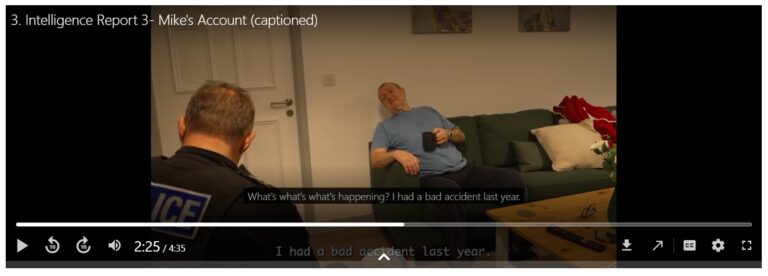
Photo shows body worn camera footage of Martin Fox (Police Officer) and Charlie Downes (Mike).
In this week’s blog, Claire Bowers, Senior Lecturer at UWE, reflects on an innovative collaboration with UWE’s New Wave Agency …
In this powerful and reflective blog, Imogen Hirst, Senior Lecturer on the Policing Programme at UWE Bristol, reflects on the …
May 2026 Taking trauma-informed practice to St Helena The British Overseas Territories police, do not benefit from the degree-level education …
This week’s blog is written by Sarah Williams, Associate Director in Policing at UWE Bristol. In this article, Sarah reflects …
We are grateful to Molly Diamond, a third-year Professional Policing Degree (PPD) student at UWE Bristol, for reflecting on her …
Author: Micah Hassall This week, we are proud to share this insightful blog post about Stand Against Racism & Inequality …

Back to top