The idea of extreme ownership and how it is relevant to Policing.

Posted on

Author: Ian Lowe UWE Bristol

smart icon of a pencil

This week’s blog, from Senior Lecturer Ian Lowe, focuses on the idea of extreme ownership and how the concept may apply to policing. Along with his varied background within public services, and interest in coaching and leadership, Ian’s exploration originally stemmed from reading. His blog explores how, in a sector where ‘blame culture’ resonates, this theory might evoke reflection from those within on their decision-making and responsibilities.


The theory of extreme ownership

Have you ever asked/told someone to do something, and they have not done what you asked. Did you ask yourself why? Or did you just assume they didn’t get it. The idea of extreme ownership is the idea that if someone did not understand you. It is down to you and your inability to describe what is needed in a way they understand. Simply put, you did not explain yourself clearly or in a way that the individual could understand.

Stick person with a megaphone

I have long believed that, where I set a task in a group setting and only one group doesn’t carry out the task, then they were probably not listening. If two groups are not following instructions, I have to start questioning what I said. If three groups are struggling, it is clearly my fault. My communication was not good enough or clear enough and I need to rethink and adjust my style and my explanation. Maybe even restart the task.

It’s not my fault.

We hear this so often, people refusing to take responsibility for their actions and the actions of others that they have leadership responsibility for.

Extreme ownership.

Volatile increase on chart

This is an idea I have taken from Americas Navy Seals, a special forces unit and part of the US Navy. I have run with it a bit. But these ideas where originally tested in violent conflict situations in Iraq and have stood up to high levels of scrutiny and extreme pressure. This is where the term extreme comes from. You could easily argue that it could be utmost; maximum; high; ownership. It embodies the idea that this is not always the norm, and we are holding ourselves to an extremely high standard.

Extreme ownership is a leadership concept, which tells us to take responsibility for our own actions, and the action of others who we have had direct contact or influence over this includes being accountable for the actions that we have taken or the words we have spoken or written to others. We often read that we live in a blame culture. In my mind what this means is people are not accountable or refuse to take ownership for their words and actions. If a team, we have briefed to carry out an action (say execute an arrest warrant for instance) and something goes wrong. Is it the teams fault, or is it your fault for not ensuring the team fully understood the brief and you had included all the necessary contingencies and overall intents of the mission. I accept there can be dichotomies in a situation like this. It is important that the team understands clearly the tasks intents and has a level of autonomy to carry out what is required. But also fully understands the limit of what they are able to do.

Mistakes were made. But not by me.

One of the most obvious examples in modern culture is politicians who never seem to take true ownership always finding an ‘angle’ a way of blaming something or someone else. As a colleague of mine from PSD used to say, ‘they give the Priti Patel apology, I’m sorry you feel that way.’ This does work and can placate the situation. But does it show that you have taken ownership, taken responsibility, that you are genuinely sorry for the mistake and the resulting problems. Or when looked at closer are you just saying that you accept the individual is not happy, but that is not your problem?

As responsible professionals should we not be prepared to take ownership for our actions. I would potentially argue more so in the current media climate. Demonstrating clear honesty and integrity. I am pretty sure the Code of Ethics from the College of Policing explicitly states this.

If you are late. Is it the traffic or did you just not allow enough time.

Is the student officer you are working with really struggling or have I just not made the effort to understand and engage in a way that supports and enables them.

Was the drive to work today full of idiots. Or is the common factor me and my driving was not as good as it could have been.

We need to take extreme ownership and understand just how much of what we are involved in is OUR responsibility. How we do things, the clarity of our communications. I am not asking you to take the blame for everything. But to understand that by changing our perspective on events we can start to realize how much influence we have on the people and interactions around us. We can stop the continual self-justification of events that we can find ourselves in. The search to find a scapegoat or an excuse to validate or support our decision, so that we can accept them or so we can make others accept them (remember what sounds like a reason to you is often seen as an excuse by others).

three stick persons with lightbulb above their heads

Once you take this idea and absorb it fully it is freeing. Your perspective changes and you accept if the CPS turns down your case file, it is because you did not include enough clear and detailed information to reach the charging threshold. Extreme ownership also helps you to think ahead to prevent such problems before they happen. We start to realize and understand our own cognitive dissonance. That we know what we did was not quite right, but we are going to try and believe we did right anyway. Holding these two opposing ideas is exhausting, and the self-justification required is hard work. The smoker who knows smoking is bad for them but justifies vaping as a type of quitting. ‘Cuz it’s not as bad?’  

None of these ideas are new, as said above they are part of the Code of Ethics and should be at the centre of all the decisions made.

  • Accountability: You are answerable for your decisions, actions and omissions.
  • Integrity: You always do the right thing.
  • Objectivity: You make choices on evidence and your best professional judgement.
  • Openness: You are open and transparent in your actions and decisions.

Extreme ownership is also included in many forces’ visions and values. West Mercia Police actually has ownership as one of its values. Surely part of Avon and Somerset Police’s mission of Outstanding policing for everyone. Owning our actions and their results is included within that even if not stated.

Finally. If we know we have done all we can to help; support; explain to others what is required and tried every avenue. When the point comes that no more can be done, then we can be satisfied we have done the right thing.

As leaders, true leaders, we can share in the success of our teams but understand We take responsibility for the failures.


Student Surveys

You can access the National Student Survey here.


Year One and Two students can provide anonymous feedback on their course here, or by scanning the above QR code.


Editorial Team

Paul Williamson (Editor-in-Chief); Claudia McCready (Lecturer); Eve Smietanko (Joint Programme Leader & Senior Lecturer); Ian Lowe (Senior Lecturer) & Micah Hassell (Senior Lecturer).

mail sign

If you would like to contribute as a guest blogger, please contact Police.Blog@uwe.ac.uk

Read our previous blogs below

Collapsible

Passionately curious: Bridging Theory and Practice in Police Education
How can police education successfully connect academic theory with the realities of operational practice? In this latest UWE Bristol Policing …
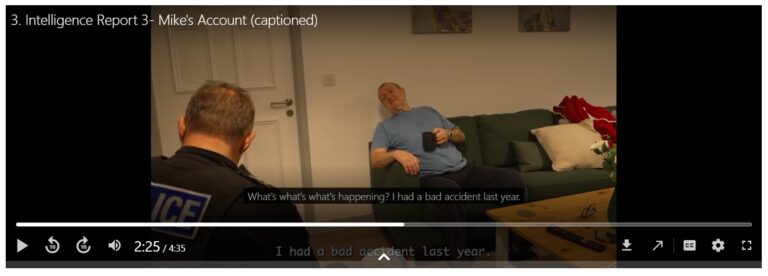
Photo shows body worn camera footage of Martin Fox (Police Officer) and Charlie Downes (Mike).
In this week’s blog, Claire Bowers, Senior Lecturer at UWE, reflects on an innovative collaboration with UWE’s New Wave Agency …
In this powerful and reflective blog, Imogen Hirst, Senior Lecturer on the Policing Programme at UWE Bristol, reflects on the …
May 2026 Taking trauma-informed practice to St Helena The British Overseas Territories police, do not benefit from the degree-level education …
This week’s blog is written by Sarah Williams, Associate Director in Policing at UWE Bristol. In this article, Sarah reflects …
We are grateful to Molly Diamond, a third-year Professional Policing Degree (PPD) student at UWE Bristol, for reflecting on her …

‘X: free speech vs. extreme narratives – sexism and misogyny’​ 

Posted on

Author: Claire Bowers UWE Bristol

In February 2024, six members of the UWE Bristol Team (Claire Bowers, Jack James, Katie Etherton, Dr Jennifer Holmes, Claudia McCready and Eve Smietanko) presented at the third annual colloquium of the European Society of Criminology Working Group on radicalisation, extremism, and terrorism at the University of Portsmouth. This week’s blog, authored by Claire and with input from all of the research team, takes a look at the important issues that this research seeks to explore.

Introduction

Issues of sexism and misogyny continue to be hugely topical within Policing. From acknowledged concerns of institutional misogyny in the Met, chronicled within the Casey report (2021), to the ongoing Angiolini Inquiry investigating how serving officers David Carrick and Wayne Couzens were able to commit such horrific crimes. This is reinforced by the recent College of Policing 2023 Action plan entitled ‘Tackling sexism and misogyny in policing’ whose review of published and unpublished evidence identified more than 200 ways in which sexism and misogyny are present in a policing context. Misogyny is a form of violence against women (Arsawati and Bunga, 2021) and gender-based violence is on the increase, partly due to the virtual space which did not previously exist (Singh and Singh, 2021; Yar and Steinmetz, 2024). As a group of six academics who teach on the policing programme, we are interested in the role that social media, particularly the platform ‘X’ formally known as Twitter, may play in fuelling this crisis.  

Our research proposal, presented at the 2024 Annual Terrorism and Extremism Colloquium, was triggered by recent events in the media, and particularly the influence of Elon Musk’s acquisition of Twitter/X in October 2022. At a cost of $44 billion on 28th October 2022, Musk announced to all “the bird is freed.” A self-declared ‘free speech absolutist’, Elon permitted the return of prominent public figures, such Donald Trump, Tommy Robinson, and Andrew Tate back to the site (Griffin, 2022).  

Background to our research

The online sphere (Papacharissi, 2022) can be a place of community and acceptance, but it has also become a place where extreme views can thrive and flourish. Since the dawn of social media there has been concern around its policing of hate speech. In 2018, 23% of women polled across eight countries stated that they had experienced harassment or abuse online (Amnesty International, 2018)​. Of those women, 47% stated the abuse or harassment was sexist or misogynistic. We expect that this statistic is likely to have increased, something we hope to explore in our research. 

Since social media has become mainstream, there has been increasing concern around online safety and what role companies such as Twitter should play. In the latter half of the 2010s, more safety advice and tools were added such as the ‘harmful reply’ nudge. Since the transition from Twitter to X there has been concern that the safety features are no longer as effective, with much of the team responsible for this facility being laid off when Musk took over (Brewster, 2024). 

Studies have been carried out into the effect that Musk has had on X since his takeover. For example, the Institute for Strategic Dialogue completed research for BBC Panorama in 2023. This found that in the days after Musk’s takeover there was an increase in new accounts created, that followed known misogynistic and abusive channels. Interestingly misogynistic views were not dominant but often included in more clear ideologies around anti-liberalism and pro-free speech. The research showed that there is a potential link between Musk’s own ‘free speech absolutist’ stance and a more permissive environment where hate speech can flourish. Other forms of hate speech have increased on the platform, for example antisemitism has doubled since Musk took over X (Miller et al, 2023). Research also suggests that people hold positive views of figures such as Andrew Tate, a self-proclaimed misogynist (Radford, 2023), especially from younger populations.  Polling data released by Skiner and Gottfried on behalf of IPSOS (2024) shows that young UK males are far more supportive of Tate than females and older males and surveys from 2022 illustrate that 56% of young male fathers also hold positive views of him (Internet Matters, 2023). 

About our research

64% of women see sexism as a major problem in the UK (Young Women’s Trust, 2019) and research from Stop Hate (2023) show extensive increases (as high as 322%) in incident reports relating to gender. This persistent trend of research and high-profile cases have led to a momentum for change (Chattier, 2020) telling us that women have had enough. 

There has been little research into misogynistic hate speech on the app since Musk’s takeover, and all of these appear to focus on the quantitative rise rather than the experience of its users. In our research we want to adopt a mixed methods approach, using both qualitative and quantitative methods to better understand the experiences of those using the platform.  

What do we want to find out? 

  • We want to explore whether there is a link between Musk’s ‘free speech absolutist’ stance and the perceived rise in hate speech.  
  • We want to explore firsthand experiences of users potentially exposed to this harmful narrative and the impact it has on them and society. 
  • We want to establish the current rates of misogynistic hate crime and incidences and how they are being recorded.  

 We look to achieve this through:  

  • Examining content from X after Musk’s acquisition in October 2022. 
  • Surveying X users on their experiences.  
  • Information requests from all Police forces in England and Wales about their recording of such crimes and incidences. 

Why is this research important? 

Violence against women and girls.  

Online misogynistic narratives drive gender-based Hate Crimes which disproportionately affect women and girls, used as a form of intimidation and suppression reflected in worldwide trends of prevalence of violence against women. Obtaining a true picture of experiences of users on platforms such as X helps us to better understand the problem to inform policy moving forward.  

Impact on mental health 

The research shows women’s mental health is being negatively impacted, with experiences of sexism correlating with reduced wellbeing and life satisfaction. Research from the Young Women’s Trust shows that young women are 5 times more likely to have clinical depression. Our research will consider whether these impacts are the same for users on X. 

Anti-feminist communities and radicalisation 

The online ‘manosphere’ (Van Valkenburgh, 2021) environment is associated with ‘cyber hate’ and online harassment.  It is a space where radicalisation can take place and misogynistic views can be validated and confirmed. It is a breeding ground for confirmation bias. Our research will consider whether there is evidence of this on X.  

Polemical gender discourse  

Unnecessarily, this topic can generate an ‘us and them’ paradigm which is divisive and compounds the problem. This perpetuates and justifies the need for some, further misogynistic challenge, particularly online. Taking the stance that challenging misogyny is ‘women taking on men’ is disproportionate and a narrative exploited by misogynists. Our research will examine X to see if there is evidence of this type of discourse. 

Limiting women’s voices and visibility online with additional ‘emotional labour’  

Incidences of misogyny experienced through online engagements consciously serve to limit women’s online voices and visibility (Aliche, 2023)​. To deal with this, women adopt a two-tier strategy: “moral persuasion” or “going hard” to deal with online abuse. With the emphasis being on women to change and regulate their behaviour, this approach constitutes serious ‘emotional labour’ and despite its utility, remains unsustainable in fighting online misogyny.  We will consider whether this is the experience of users on X. 

We do not fully understand the true extent of the issue.  

Pre-existing research shows that online sexually aggressive behaviours tend to be downplayed and are often not reported. Cyber-sexual violence is deemed as less serious (Vizcaíno-Cuenca, Romero-Sánchez, and Carretero-Dios, 2024). ​We hope that this research will shine a light on and help us to better understand the extent of incidences that go unreported as well as the impact of these experiences. 

Concluding Thoughts 

Elon Musk is known for saying “the point of freedom of speech is allowing those whose views you disagree with to express those views,” This is true, safeguarding freedom of speech is essential, but this must be balanced against enabling hatred against others or putting them in danger. It is simply not acceptable to claim freedom of speech protection when it is perpetrating, justifying, and breeding harm. The question is, where do we draw the line?  

Investigating sexist and misogynistic narratives on high profile platforms such as X and the impact on its users is an important area to investigate, so that we can improve our understanding of these issues and begin to think about how we, as a united society can take steps towards achieving a more egalitarian and safer society for both men and women. We look forward to sharing our findings at the conclusion of this research.  

References

Alichie, B. O.  (2023) “You don’t talk like a woman”: the influence of gender identity in the constructions of online misogyny, Feminist Media Studies, 23:4, 1409-1428 https://www.tandfonline.com/doi/full/10.1080/14680777.2022.2032253?scroll=top&needAccess=true [Accessed 31 January 2024] 

Amnesty International, 2018 Toxic Twitter – women’s experiences of violence and abuse on Twitter, Toxic Twitter – Women’s Experiences of Violence and Abuse on Twitter – Amnesty International [Accessed 30 January 2024].​ 

Arsawati, N. and Bundga, D (2021) Misogyny as Violence in Gender Perspective. International Journal of Business, Economics and Social Development. [online].Vol. 3, No. 1, pp. 19-27, 2021. [Accessed 27 February 2024]. 

Bewster, T. (2024) Musk’s X Fired 80% Of Engineers Working On Trust And Safety, Australian Government Says. Forbes. [online] 10 January. Available from: https://www.forbes.com/sites/thomasbrewster/2024/01/10/elon-musk-fired-80-per-cent-of-twitter-x-engineers-working-on-trust-and-safety/?sh=6c469b1c79b3 

Chattier, P. (2020) The Women’s movement: so much momentum, but still miles to go. ABT Associates [blog] 7 April. Available from:  https://abtgovernance.com/2020/04/07/the-womens-movement-so-much-momentum-but-still-miles-to-go/ [Accessed 01 February 2024]​ 

Griffin, A. (2022) Who has Elon Musk unbanned from Twitter? From Trump to Andrew Tate. The Independent. [online] 21 November. Available from: https://www.independent.co.uk/tech/elon-musk-twitter-ban-trump-tate-west-b2229716.html 

Institute for Strategic Dialogue (2023) BBC Panorama research: Misogyny and abuse on Twitter before and after Elon Musk’s takeover, BBC Panorama research: Misogyny and abuse on Twitter before and after Elon Musk’s takeover – ISD (isdglobal.org) [Accessed 30 January 2024].​ 

Internet Matters (2023) New research sees favourable views towards Andrew Tate from both teen boys and young dads. Internet Matters. [online] 28 September. Available from: https://www.internetmatters.org/hub/press-release/new-research-sees-favourable-views-towards-andrew-tate-from-both-teen-boys-and-young-dads/#:~:text=Over%20half%20of%20young%20dads,also%20positive%20about%20the%20influencer. 

Skinner, G and Gottfried, G. (2024) Masculinity and women’s equality: study finds emerging gender divide in young people’s attitudes. IPSOS. [online] 1 February. Available from: https://www.ipsos.com/en-uk/masculinity-and-womens-equality-study-finds-emerging-gender-divide-young-peoples-attitudes#:~:text=One%20in%20five%20(21%25),aged%2060%2B%20(2%25). 

Miller, C.,  Weir, D.,  Ring, S., Marsh, O., Inskip, C. and Prieto Chavana, N., 2023 Antisemitism on Twitter Before and After Elon Musk’s Acquisition. [online] Beam Available from: Antisemitism on Twitter – 15 March (beamdisinfo.org) [Accessed 30 January 2024].​ 

Papacharissi, Z. (2002). The virtual sphere: The internet as a public sphere. New Media & Society. [online] 4(1), 9-27. [Accessed 27 February 2024]. 

Radford, A. (2023) Who is Andrew Tate? The self-proclaimed misogynist influencer. The BBC [online] 4 August. Available from: https://www.bbc.co.uk/news/uk-64125045 

Singh, D. & Singh, V. (2021) An Increase in Gender-based Violence during COVID-19. Journal of midwifery and reproductive health. [Online] 9 (2), 2762–2766.​ 

Stop Hate UK (2023) [online] Annual Statistical Review 2022-2023 https://www.stophateuk.org/wp-content/uploads/2023/11/Annual-report-22-23.pdf [Accessed 31 January 2024]​ 

Van Valkenburgh, S. P. (2021). Digesting the Red Pill: Masculinity and Neoliberalism in the Manosphere. Men and Masculinities. 24(1), 84-103. https://journals.sagepub.com/doi/10.1177/1097184X18816118 [Accessed 31 January 2024] 

Vizcaíno-Cuenca, R., Romero-Sánchez, M., & Carretero-Dios, H. (2024). Making Visible the Myths About Cyber-Sexual Violence Against Women: An Analysis of Social Reactions Toward Victims on Twitter. Journal of interpersonal violence. [online] Advance online publication. https://pubmed.ncbi.nlm.nih.gov/38243759/ [Accessed 31 January 2024] 

Yar, M. and Steinmetz, K. F. (2024) Cybercrime and Society. 4th ed. London: Sage.​ 

Young Women’s Trust (2019) [online] Impact of sexism on young women’s mental  health https://www.youngwomenstrust.org/wp-content/uploads/2020/11/Impact-of-sexism-on-young-womens-mental-health.pdf . [Accessed 31 January 2024]​ 

You can access the survey here

Editorial team

Paul Williamson (Editor-in-Chief); Claudia McCready (Lecturer); Eve Smietanko (Joint Programme Leader & Senior Lecturer); Ian Lowe (Senior Lecturer) & Micah Hassell (Senior Lecturer).

If you would like to contribute as a guest blogger, please contact the team at Police.Blog@uwe.ac.uk

Back to top