Skills for a green transition

Posted on

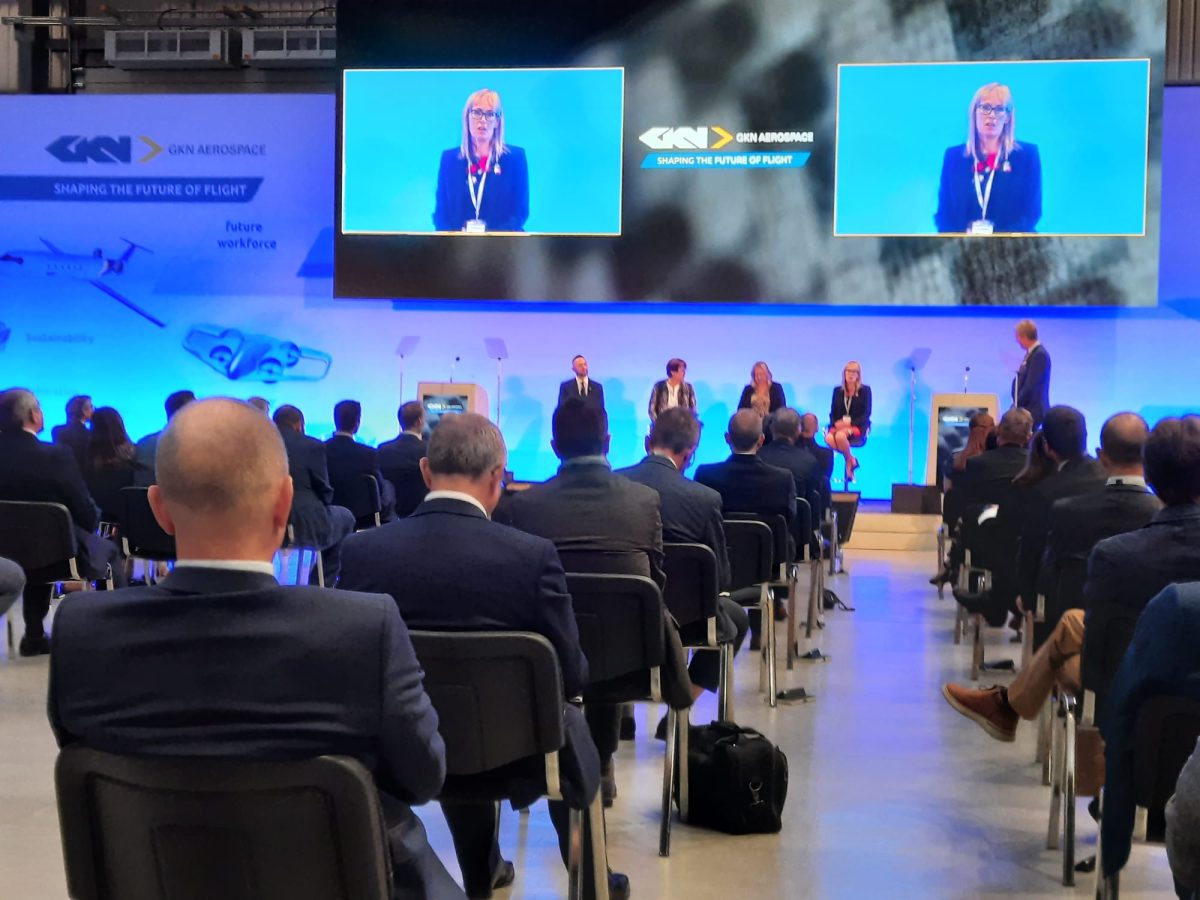
DETI partner GKN Aerospace launched their new ‘Global Technology Centre’ on 18th October with a conference titled – Shaping a Sustainable Future of Flight. UWE Bristol’s Head of Engineering, Design and Mathematics -Lisa Brodie – spoke on a panel discussing the skills shortage in engineering that needs to be addressed to enable the workforce to take on the technological challenges of aviation’s Net Zero 2050 targets.

Leading the Skills Development programme for Digital Engineering Technology Innovation (DETI) in the West of England, Lisa is passionate about investing in the skills needed to enable a green transition. And a key part of boosting engineering skills is enabling diverse people from different backgrounds to become engineers. Lisa highlighted the huge benefit a variety of perspectives can have when engineering solutions to global problems, like the Climate Emergency.

As such, Lisa is driving forward key research to ensure courses are ‘fit for purpose’ to build the workforce of the future. We’ll be updating you soon on the DETI Skills team’s research into enabling under-represented groups to enter and progress in engineering, and also on local research into the specific types of skills needed to reengineer our homes, energy systems etc – so watch this space!

GKN Aerospace supports the school outreach the DETI Inspire team (a branch of DETI Skills) is rolling out across the West of England to inspire children into engineering. For more details on the Global Technology Centre’s launch, please read: https://www.ainonline.com/aviation-news/air-transport/2021-10-18/gkns-global-technology-center-aims-net-zero-carbon-goal

Youth discuss traffic reduction for Net Zero 2030

Posted on

During the three day Youth Engineering for Environmental Sustainability Summit (YEESS), 11-13 October 2021, young people across the West of England discussed carbon-emission cutting solutions with experts, before quizzing local politicians on their Climate Action strategies.

There was lots of great discussion worth noting, so we’re reporting each day’s targets, questions and potential solutions in a three-part series.

Day 1 – How might we take 40% of traffic off our roads by 2030?

Traffic reduction is a core target mapped into the Bristol and West of England Climate Action Plans, and after exploring the topic, KS4 & KS5 pupils posed questions for Bristol Mayor Marvin Rees on his strategy for achieving traffic reduction.

Why do we need to slim down road traffic?

Dr Steve Melia, Senior Lecturer in Transport and Planning, UWE Bristol introduced the issue, explaining the patterns of increased traffic in the UK and introducing a few traffic reduction methods used across the world.

“Transport accounts for 27% of the UK’s carbon emissions, but is our fastest growing sector,” said Melia. He concluded that electrification wouldn’t be enough to reach carbon cutting targets and therefore traffic volume cutting methods will be required. See his video introduction below.

How to reduce traffic by 40%?

YEESS delegates watched video postcards from engineers leading the way in traffic reduction, and then discussed the various ideas presented, including:

On the online chat, YEESS delegate Izaac O asked “Why will electrification on it’s own not be enough?”

He was answered by Fidel Olaye, Electronic Engineer at Babcock, “There’ll still be loads of traffic on the road and the generation of electric power used by electric cars isn’t great because pollutants are still produced.”

Discussion was dominated by questions over commuting times, electric cars and resistance to change; with young people steering towards trams in the city centre, but unconvinced by the idea of 15 minute cities.

Our city’s Climate Action strategy

Live stream of Roy Kareem interviewing Marvin Rees on Monday 11th Oct

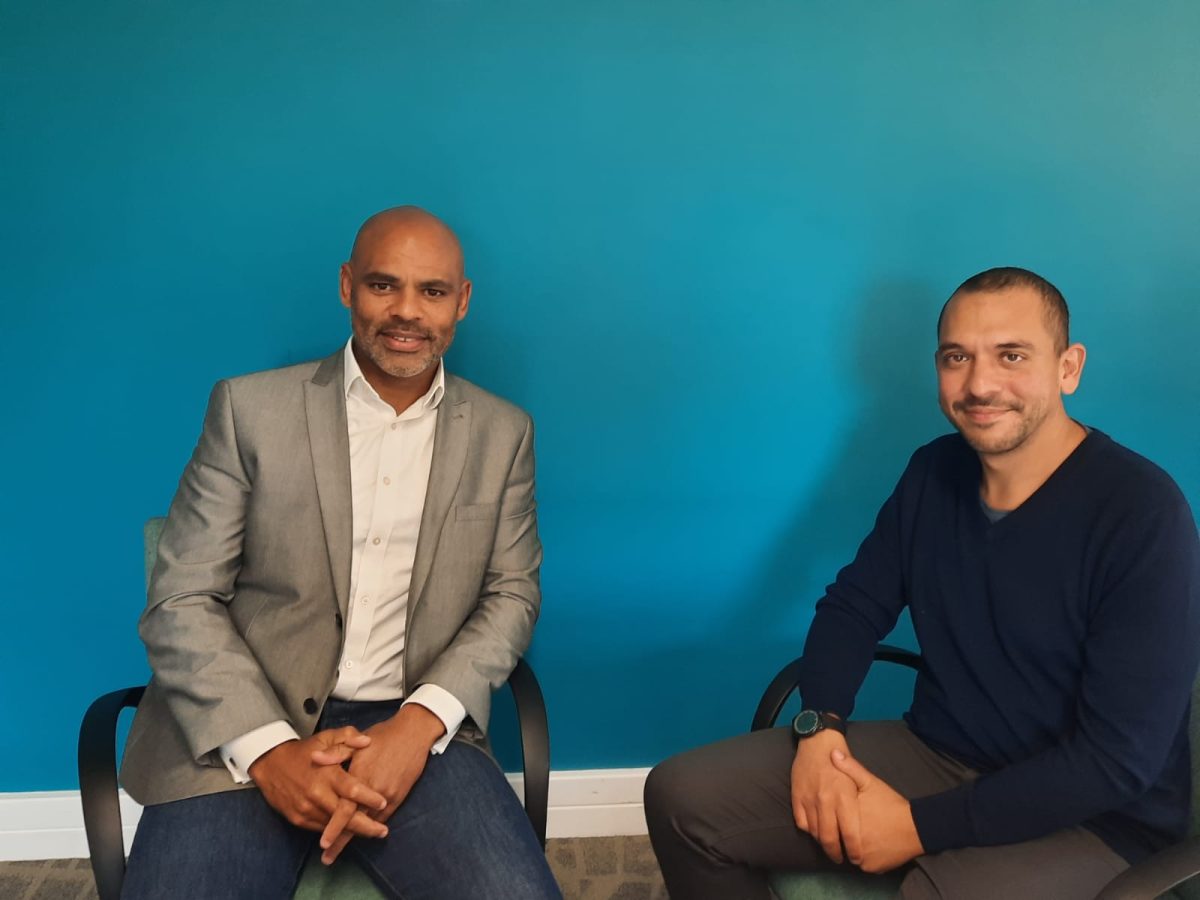
Roy Kareem, Director of Bright Green Future, interviewed Bristol City Mayor Marvin Rees, who quickly picked up on the importance of engineers in managing the Climate Action response. “Fundamentally what we need to do is change the very systems that underpin city life – transport systems, energy systems, water systems, energy systems, housing systems; so we have the ability, and actually have no choice, other than to lead a low impact life,” said Rees.

In terms of transport, Rees outlined his vision – “The end goal is to have an underground over-ground for the city. An underground in the middle and an over-ground for the outside, that’s predictable, that’s fast, that’s decarbonised and that’s used by hundreds of thousands of people every day.”

Rees pointed out the need for long term financial support needed to support the infrastructure changes needed. He hopes that COP26 will help in releasing those funds from central government.

For YEESS resources, check out Digital Trailblazers site, and to view more of the discussion on the day, take a look at the YEESS website.

DETI Inspire team with Roy Kareem and Marvin Rees

Is green flight possible?

Posted on

Steve Wright, Senior Research Fellow in Aerospace Engineering at UWE Bristol, shared his thoughts on the electrification of flight, at the EV Summit Online Series “How do we deliver a decarbonised international aerospace sector?” held on 14th October.

On the live stream, Steve flew one of his drones to demonstrate one of the core advantages in electric aviation – “It gives flexibility – you can sprinkle propulsion systems all over the aircraft, arranging them in ways you just couldn’t imagine in conventional aerospace.”

Steve explained that this flexibility was enabling a relatively quick roll out of electric and alternative propulsion systems in smaller aircraft and the creation of new classes of “flying taxis”.

But Steve expressed doubts about how quick it would be to scale up the electric propulsion systems, alongside their unique supporting technologies.

“I’m not expecting a transatlantic passenger plane until 2050. I hope I’m wrong,” said Steve. “We’re not going to beat this problem in one sitting. Electric and alternative propulsion systems are very different [to conventional] and have a whole set of specific problems and also opportunities.”

Hear more of Steve’s short talk and his Q&A session in the video below.

And if you’d like to hear the other speakers’ take on the problem, watch the entire online event: How do we deliver a decarbonised international aerospace sector? – YouTube

Young engineers think educating the public is key for Climate Action

Posted on

This week young people across the West of England discussed carbon-emission cutting solutions with experts, before quizzing local politicians on their Climate Action strategies. During the three day Youth Engineering for Environmental Sustainability Summit (YEESS), 11-13 October 2021, discussion ranged from trams in city centres, to jobs of the future. But a key theme, of how to educate the public and get everyone onboard, emerged as a major concern.

“How can we solve a problem if we  don’t know what the problem is?” said TJ, a Year 10 student from Orchard School, Bristol, frustrated about the lack of public dissemination about the Climate Action Plans for achieving Net Zero 2030. “It’s the same thing as my teacher giving me homework and a deadline, and not telling me what the homework is. The nation doesn’t know what to do.”

Politicians get quizzed

Bristol Mayor Marvin Rees addressed the young people on his Climate Action Plan on 11 October, followed by Councillor Toby Savage from South Gloucestershire Council and Councillor Sarah Warren from Bath & North East Somerset Council on 12 October.

Finally, West of England Mayor, Dan Norris had his turn to face young people from Orchard School, Bristol, face-to-face at We The Curious on 13 October.

“How do you plan on causing the public to actually change their habits – do you think it will succeed?” asked Eloise, addressing the major talking point expressed during the summit.

Mr Norris agreed that to make changes in emissions, everyone has to work together and spread the word about the impact our habits are having on the planet, and that his job was to make the “best” low carbon options easier for the public to take hold of. Like cheaper, faster buses.

Year 10 students from Orchard School, Bristol in a live streamed Q&A from We The Curious with West of England Mayor, Dan Norris

Dan Norris said: “When it comes to the climate emergency, young people are well ahead of politicians. They understand the need for urgent action. They are clear-thinking and straight-talking. And they have creative ideas about how we can move quickly to meet our ambitious net zero targets.

“Our region is home to so much innovative technology, with brilliant scientists, researchers and engineers working to meet the urgent challenges we all face.

“As they move into further study and into employment these young people will become valued additions to our huge West of England pool of talent, helping shape solutions.”

Dan Norris, West of England Mayor, being interviewed at We The Curious, 13 October

Outcomes

Discussions from the summit will be communicated to policymakers in the West of England, and the Digital Engineering Technology and Innovation (DETI) Inspire educational team at UWE Bristol, supported by the West of England Combined Authority (WECA), will showcase outcomes to international audiences at COP26 in November.

We’ll be reporting more on the outcomes from YEESS in the coming weeks and legacy materials will also be available on the DETI Inspire resource hub, but for now, you can find all Q&As with politicians and expert videos on the DETI Inspire YouTube channel. If you only want to watch one, here’s our favourite video used to inspire young people in Climate Action:

Local Climate Action Plans

Bristol City Council’s Climate Action plan.

West of England Combined Authority’s Climate Action plan is currently being reviewed.

Gaming bot joins the outreach hub at UWE Engineering

Posted on

UWE Bristol Alumni, Silas Adekunle, recently dropped into the School of Engineering’s education outreach hub, to donate a smartphone-controlled robot he invented whilst studying at the Bristol Robotics Laboratory.

The fluid moving, life-like robot known as MekaMon, was the world’s first intelligent gaming robot, but it’s also an amazing tool for teaching coding, and so equipping the next generation with the skills required for a digital robotic future.

With no prior coding knowledge required, children follow guided learning missions on MekaMon’s counterpart app, ReachEDU, learning to code MekaMon from simple block-based coding onto written code.

A great addition to UWE Bristol’s engineering outreach hub!

UWE Alumni Inventor, Silas Adekunle, kindly donated a MekaMon to Laura Fogg-Rogers, Senior Lecturer and DETI Inspire lead, UWE Bristol

The Digital Engineering Technology and Innovation (DETI) Inspire team based at UWE’s new School of Engineering, were thrilled to accept the locally invented tech, and even keener to start putting it to use in engaging the school children |SPOILER ALERT| soon due to begin visiting the digital engineering outreach hub!

Expect to hear more about school visits to UWE Bristol very soon…

As for our Alumni extraordinaire, Silas first founded Reach Education in 2013 and has since moved into the development of cloud infrastructure for biotechnology automation in the UK. But he hasn’t forgotten his passion for science, technology, engineering and mathematics (STEM) education, sending MekaMon robots to Nigeria through another company he founded – Awarri – which aims to enable the development and adaptation of advanced AI & Robotics technology in Africa.

Good luck Silas and welcome to the outreach hub MekaMon!

Young people discuss how to reduce carbon emissions with West of England policymakers

Posted on

How can we take 40% of traffic off our roads, heat our homes without fossil fuels and reduce our waste by 2030?  These are some of the questions young people will be tackling at the Youth Engineering for Environmental Sustainability Summit (YEESS), 11 – 13 October 2021. 

Designed by the Digital Engineering Technology and Innovation (DETI) Inspire educational team at UWE Bristol (supported by the West of England Combined Authority) in collaboration with the “I’m an Engineer” outreach team, YEESS gives young people a voice to mitigate the impact climate change has on their futures.

Sixth form students across the West of England will be challenged to critically evaluate the feasibility of carbon emission reduction strategies to achieve Net Zero 2030. Each day of the summit, the students will address a different aspect of sustainability and engage with local engineers and politicians through live online discussions.

The online discussions will include Bristol Mayor Marvin Rees on 11 October, and Councillor Toby Savage from South Gloucestershire Council and Councillor Sarah Warren from Bath & North East Somerset Council on 12 October.

On 13 October, West of England Mayor Dan Norris, will join in activities with schools in person at We The Curious and will be answering questions in a live online event.

Young people will directly ask the politicians questions, and the resulting discussions will be communicated to policymakers in the West of England, and showcased to international audiences at COP26.

Programme

YEESS delegates will be assessing three core targets (and the suggested solutions) mapped into the Bristol and West of England action plans:

  • How might we take 40% of traffic off our roads by 2030?
  • How might we heat our homes without fossil fuels by 2030?
  • How might we reduce our waste by 65% by 2030?

For each target, students will investigate the issue, imagine solutions framed by experts and then refine those ideas through online discussions before the daily Q&As with politicians.

The full programme of events can be found at https://yeess.imanengineer.org.uk/.

Legacy Materials from YEESS will also be available on the DETI Inspire resource hub for KS3, 4 and 5.

About DETI Inspire

DETI Inspire champions science for children in the West of England with a particular focus on breaking stereotypes and challenging perceptions about STEM careers in order to appeal to under-represented groups in engineering. Our vision is for every young person in the West of England to have access to inclusive, engaging and inspiring engineering experiences with real-life relatable role models. We make it our mission to support and inspire the next generation of digital engineers.

For more information, please visit https://www.digitaltrailblazers.net/about or contact engineeringourfuture@uwe.ac.uk

About I’m an Engineer

I’m an Engineer is a student-led, online STEM engagement and enrichment project. Since 2012 it has connected 25,000 students with 370 engineers. Evaluation shows the online format is highly effective at reaching and engaging young people, especially those under-served by other STEM interventions.

Local Action Plans

This summit is based on Bristol City Council’s Climate Action plan. West of England Combined Authority’s Climate Action plan is currently being reviewed.

About COP26

The COP26 event is a global United Nations summit about climate change and how countries are planning to tackle it. COP stands for Conference of the Parties, and will be attended by countries that signed the United Nations Framework Convention on Climate Change (UNFCCC) – a treaty agreed in 1994.

The meeting taking place in Glasgow in November 2021 will be the 26th meeting, which is why it’s called COP26. You can read more about the aims of COP26 here: https://eciu.net/analysis/briefings/inter national-perspectives/what-is-cop26-who-will-attend-it-and-why-does-it-matter?s=08

Sustainability solutions show from UWE Bristol chosen to take part in COP26

Posted on

A new planetarium show designed with the Engineering department at UWE Bristol has been chosen to showcase sustainability solutions as part of the Green Zone at the 26th UN Climate Change Conference of the Parties (COP26) in Glasgow on 31 October – 12 November 2021.

The team will be exhibiting “We Make Our Future”, an interactive, educational & entertaining science show for the next generation of engineers. The show has been designed with planetarium experts Explorer Dome, and is part of the Inspire educational work from the Digital Engineering Technology and Innovation (DETI) team at UWE Bristol. 

Full-dome projections allow attendees to visit engineering marvels from history and explore the pros and cons of modern life. The team aims to celebrate the ingenuity of human engineering, address current issues around Climate Change, and introduce engineering as a relevant and attainable aspiration for all young people.

Guests will learn how the Engineering Design Process can spark our imagination for sustainability solutions to the greatest challenges of our time.

Cllr Toby Savage enjoyed a sneak peak of the show at UWE’s recent Zero Carbon Tour event

Inspiring climate action

To achieve net zero and a low carbon global economy, everything we make and use will need to be completely re-imagined and re-engineered. The digital revolution is boosting the potential for engineers’ design thinking to optimise not only the development process but also the potential for collaborative citizen engagement. That’s where DETI comes in, bringing together industry, academia, and education from across the West of England region. The research collaboration aims to identify and develop the tools, technologies, processes, and skills needed to rapidly accelerate and embed digital engineering to deliver energy transition and clean transport.

We are so pleased to be selected to attend COP26 – at such a critical time in history, all industries need to come together to make a difference for our future. Our new show celebrates the ingenuity of human engineering and shows how we can harness our creativity to implement sustainability solutions. Thinking like an engineer offers hope to solve global problems and bring about real change. We see this as a call to action for the diverse and socially conscious engineers of today – and tomorrow.

Project Lead Dr Laura Fogg Rogers, Senior Lecturer in STEM Education and Communication, UWE Bristol

The COP26 summit will bring parties together to accelerate action towards the goals of the Paris Agreement and the UN Framework Convention on Climate Change. The theme is #TogetherForOurPlanet, and UWE Bristol will also be highlighting our climate action through the new linked Climate Action Hub on the Frenchay Campus.

The ‘We Make Our Future’ show is available to tour schools after COP26 in Explorer Dome’s mobile planetarium. To book the show please look at the resources here: https://digitaltrailblazers.co.uk/resources

Blog written by Anna Jones, Research Business and Innovation Unit, UWE Bristol

New Community STEM Club in Eastville launched

Posted on

A new Community STEM (Science, Technology, Engineering & Maths) Club run by UWE Bristol academics and local volunteers has launched at the Old Library Community Hub in Eastville.

The first session was incredibly well attended, with around 60 children and their parents and carers getting involved in the various activities on offer.

The Bristol version of Minecraft was especially popular at the club. Developed by the DETI Inspire team, local design and engineering consultancy Atkins, and Science Hunters, it gives children the opportunity to digitally explore, build, re-design and re-engineer their city and the surrounding area.

The Thymio robots were also very well received during the session. The small androids are designed to introduce children to programming and coding through interactive play. There were also a range of “analogue” STEM themed activities available, including construction sets, games, craft and books.

The sessions take place every Thursday 3.30-6pm and are free of charge. They are run on a drop-in basis with no prior booking required. The activities vary from week to week, depending on volunteer and equipment availability.

The club is co-developed by Old Library volunteers and the DETI Inspire Team at UWE. It receives further support from the STEM Ambassador Hub for the West of England. For more information on how to get involved or how to support the club, please get in touch with hello@theoldlibrary.org.uk or deti@uwe.ac.uk.

Say YEESS to climate action!

Posted on

DETI Inspire at UWE Bristol have partnered with I’m an Engineer to host an online sustainability and engineering youth summit this October, ahead of the UN climate change summit COP26 taking place in Glasgow this November.

The Youth Engineering for Environmental Sustainability Summit (YEESS) will enable young people from the West of England region to connect with local engineers and policymakers, to explore how engineering can help tackle the Climate Emergency and discuss the interconnected solutions needed for future sustainability.

On the 11, 12 and 13 October, sixth form students from across the region will come together to discuss potential solutions, using the engineering design process to explore ideas.

The summit will focus on three key themes from the Bristol Climate Action Plan to reach net zero by 2030: Transport, Energy and Waste.

Through a series of videos and live chats, students can visualise what climate solutions look like, from engineering innovation to societal change, discover what green jobs and career paths are available, and have the opportunity to ask questions of our four West of England political leaders, Bristol Mayor Marvin Rees, Councillor Toby Savage of South Gloucestershire Council, Councillor Sarah Warren of Bath and North East Somerset Council, and West of England Mayor Dan Norris.

See the full programme here.

Register your interest

If you are a teacher, parent, carer, or young person, and would like to know more or register your place at the summit, please sign up here.

If you are a West of England engineer and would like to take part in a live chat during the summit, please register your interest here.

Each evening will also see a green jobs panel to discuss routes into these industries. This will also form part of Bristol Technology Festival on Tuesday 12th October at 19:30 – find out more about the live talk here.  


YEESS is a joint project by I’m an Engineer, Get me out of here and UWE Bristol, with funding from the initiative for Digital Engineering Technology & Innovation (DETI) as part of the DETI Inspire programme.


Empowering WECA pupils with data for sustainable school streets

Posted on

Speeding cars, traffic jams, air pollution… these are but a few of the grievances the average city dweller contends with on a daily basis. Below the driving age, children in the West of England do not contribute to these problems, yet they are among the most vulnerable to their consequences.

To allow children to safely make their way to school, without the need to breathe in polluted air and to arrive in a timely manner, EU citizen science project WeCount, together with DETI Inspire, has launched a series of educational resources for KS2 and KS4 pupils.

Covering a wide range of subjects, all curriculum linked, children are able to learn about the grand challenges’ cities face in relation to urban travel, and the steps they can take collectively to make their school streets, and cities, safer, healthier and happier.

By taking part, schools can gain points towards Modeshift STARS Travel Plan accreditation.

This collaborative project is coordinated by UWE researchers from the Science Communication Unit. Project manager Laura Fogg-Rogers explains why these resources are so important:

Road transport is a leading cause of air pollution and climate change within the West of England. For our cities to reach net zero carbon emissions by 2030, the date which scientist warn is our deadline to keep global warming below 1.5°C and prevent runaway climate change, drastic changes need to be made to every aspect of life, not least driving. WeCount sensors and associated school resources are one piece of the puzzle in helping citizens to create the changes they wish to see.

Dr Laura Fogg-Rogers, Senior Lecturer for the Science Communication Unit and Engineering Design & Mathematics Department, UWE Bristol

What is WeCount?

WeCount, led by UWE Bristol, is a project that equips households, community centres and schools with low-cost traffic sensors to count cars, bikes, pedestrians and heavy vehicles, as well as the speed of cars. Over time, the citizen scientists can observe trends and use the evidence to lobby for changes on their roads. Among the successes with WeCount data so far, citizens across Europe have convinced their councils to install speed cameras and reduce road speeds, and consider bike lanes and pedestrianisation, spread awareness among residents and contributed to consultations on new housing developments.

How do we get involved?

WeCount is giving away 20 sensors to schools across the West of England. Contact engineeringourfuture@uwe.ac.uk to apply.

KS2 resources are freely available here. KS4 due for release early Autumn term. Email the above email address if you would like to be sent a KS4 pack directly to your school when available. All resources can be delivered without a sensor, using the data available at https://www.telraam.net/en

You are also able to buy all of the components required for the sensor at PiHut. More details on the equipment you need are included in the component list below.

What’s inside the KS2 pack?

A whole school assembly

Fifteen curriculum-linked worksheets, with instructions and PowerPoint for teachers, covering Geography, IT, Maths, Science, Art and English, Design and Technology. These include tasks to: collect and analyse data; understand different urban travel views; design a bike for the future; vision a healthier, happier school street; and persuade the mayor to consider your proposals.

Lessons can be delivered independently or combined for after-school clubs or themed curriculum, and can be teacher-led or with the support of UWE or STEM Ambassadors.


What’s inside the KS4 pack?

A whole school assembly

Ten curriculum-linked worksheets, with instructions and PowerPoint for teachers, covering nearly all GCSE subjects – Geography, Computer Science, Maths, Science, Citizenship and English, Design and Technology, History and Engineering. These activities include tasks to: learn about the influence of powerful actors on the proliferation of the car; collect and analyse data; explore the science behind the sensors; debate the role of AI in solving the climate crisis; research local travel issues and viewpoints; design interventions and deliver action projects; creatively write about their experiences.

Lessons can be delivered independently or combined for after-school clubs or themed curriculum, and can be teacher-led or with the support of UWE or STEM Ambassadors.
Back to top